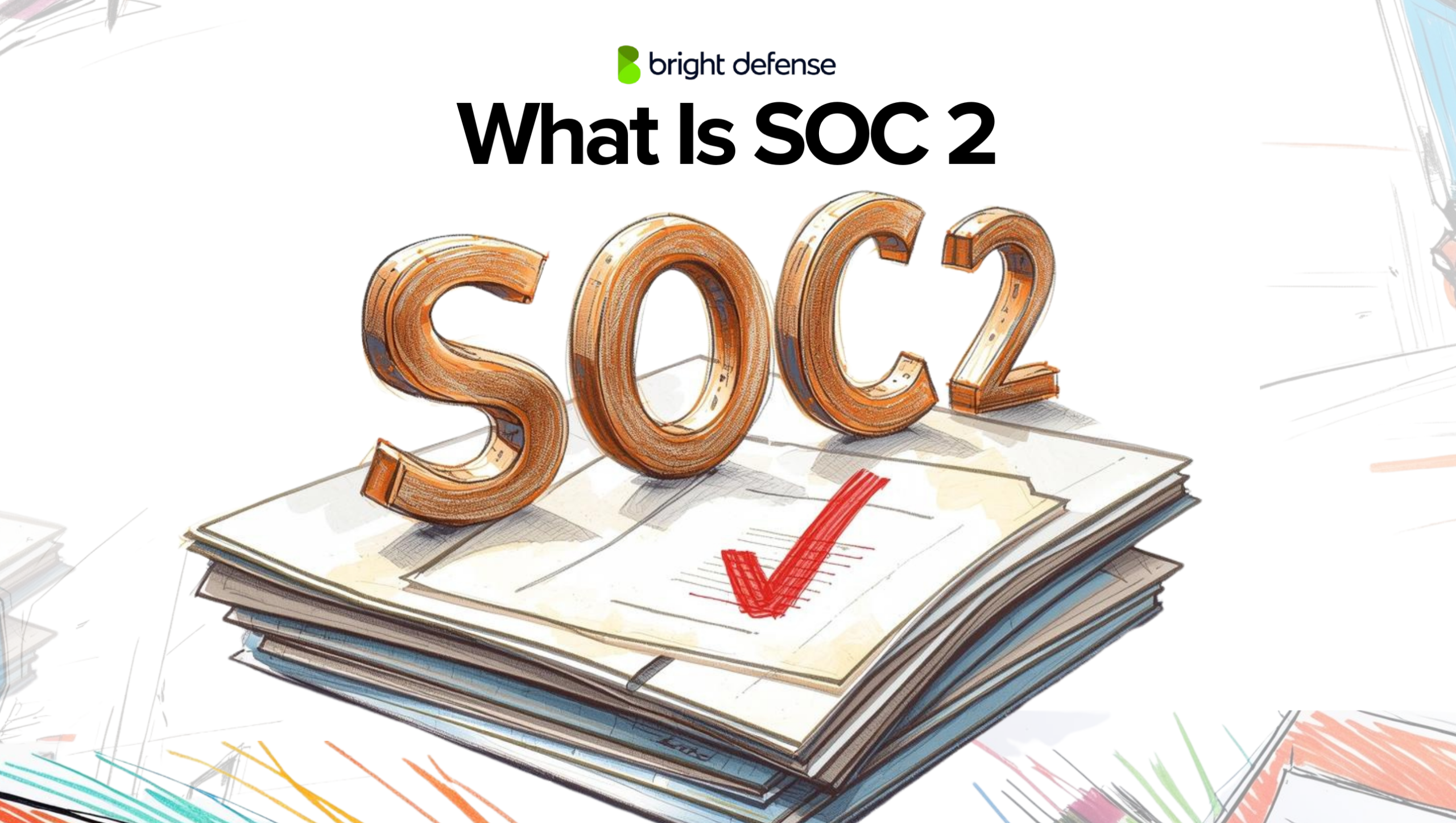
What Is SOC 2? A Definitive Guide
Updated:
August 25, 2026
SOC 2 is a report that shows a company has clear rules and checks in place to protect customer data and maintain a strong security posture. It focuses on keeping systems secure, keeping services available, processing data correctly, protecting confidential information, and handling personal data responsibly.
Customers often ask for SOC 2 to confirm a vendor takes security seriously and can be trusted with sensitive information, including how the vendor approaches vendor management and service level agreements.
Its importance is clear in recent breach figures, since the Identity Theft Resource Center recordedv 3,158 publicly reported US data compromises in 2024 that led to more than 1.3 billion victim notices.
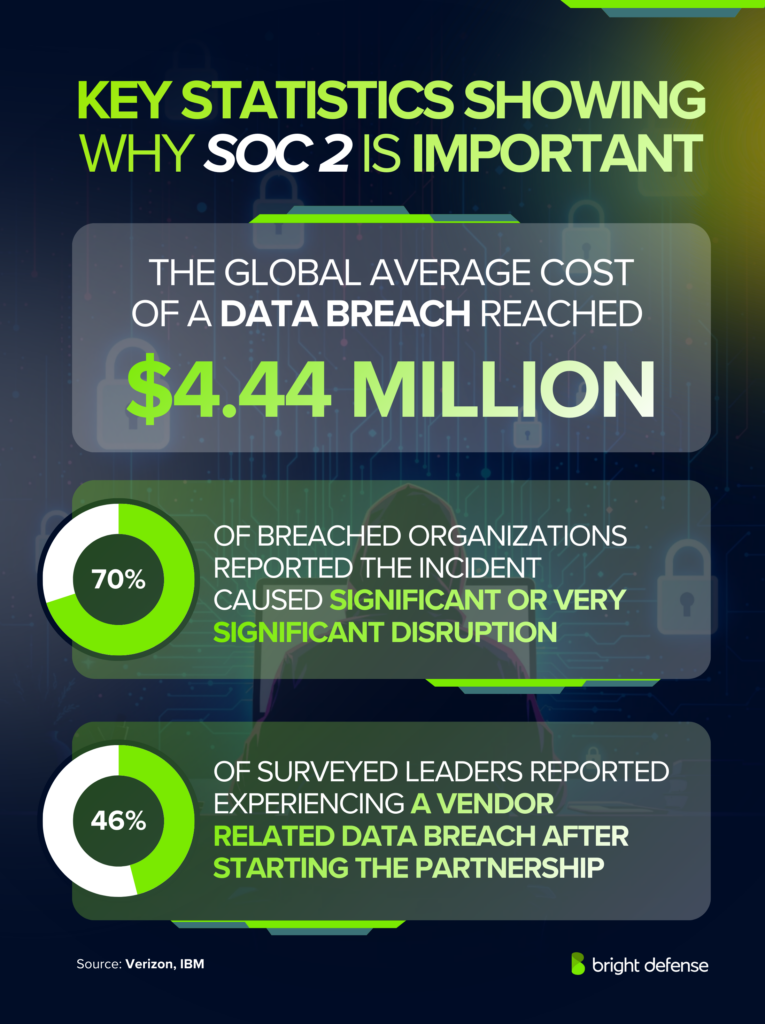
The financial impact is also significant, since IBM reported the global average cost of a data breach reached USD 4.44 million in 2025.
What Does SOC 2 Stand For?
SOC 2 stands for Service Organization Control 2, a reporting framework created by the American Institute of Certified Public Accountants that evaluates how service providers manage and protect customer data. Here’s what each letter within SOC 2 refers to in detail:
1. S – Service
Service refers to the systems and services a company provides to customers. In a SOC 2 context, this means the infrastructure, software, data handling processes, and operational activities that support the delivery of a service, especially when customer data is involved.
2. O – Organization
Organization refers to the company or entity that operates the service. This includes the people, policies, procedures, governance structure, and internal controls that shape how the business manages risk and protects information.
3. C – Control
Control refers to the policies, procedures, and technical safeguards put in place to reduce risk. These controls address areas such as access management, system monitoring, data protection, incident response, and change management to demonstrate that the organization manages its systems responsibly.
The number 2 distinguishes this framework from other SOC reporting types and indicates that the report evaluates controls related to the Trust Services Criteria: security, availability, processing integrity, confidentiality, and privacy.
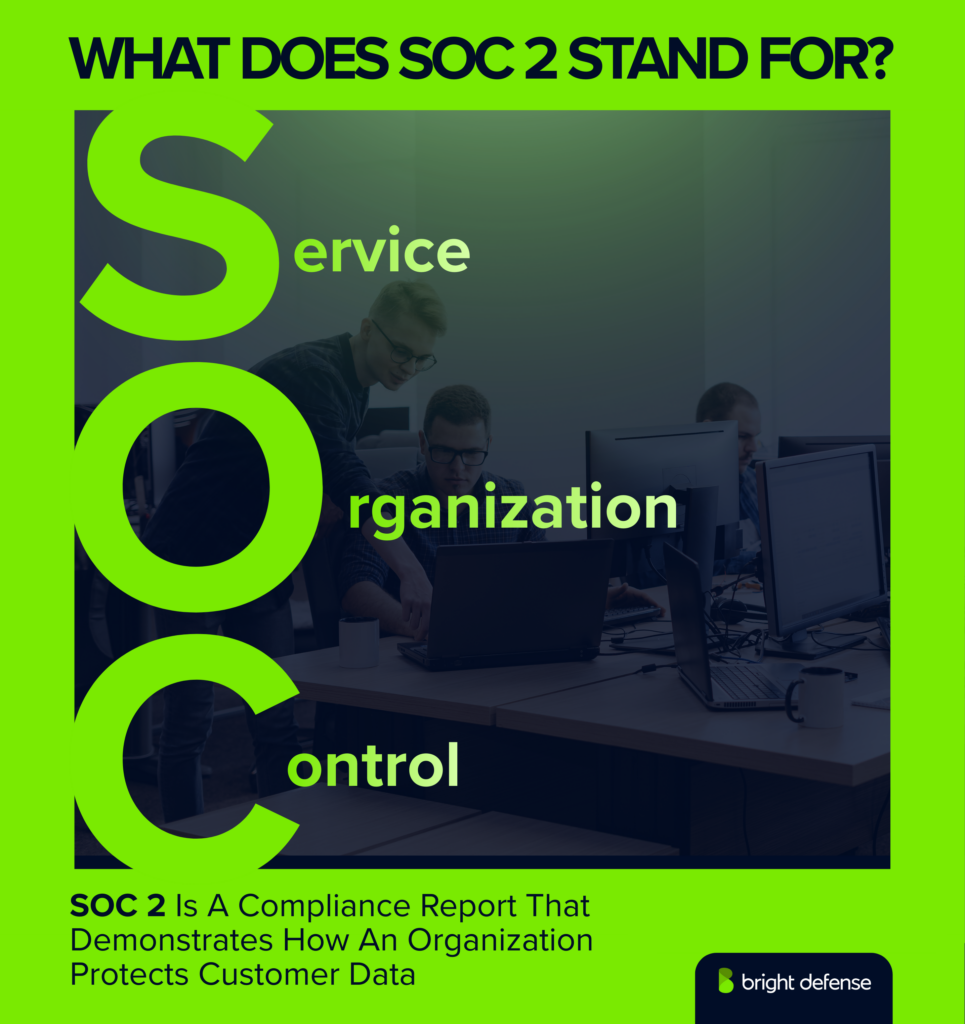
SOC 2 focuses on controls related to security, availability, processing integrity, confidentiality, and privacy, with reports used to demonstrate how an organization’s systems and practices address these trust service criteria.
What Is SOC 2 Compliance?
SOC 2 compliance refers to meeting the requirements of the SOC 2 reporting framework, which evaluates how well a company designs and operates controls to protect customer data. The framework is based on five Trust Services Criteria that define what auditors review during an assessment.
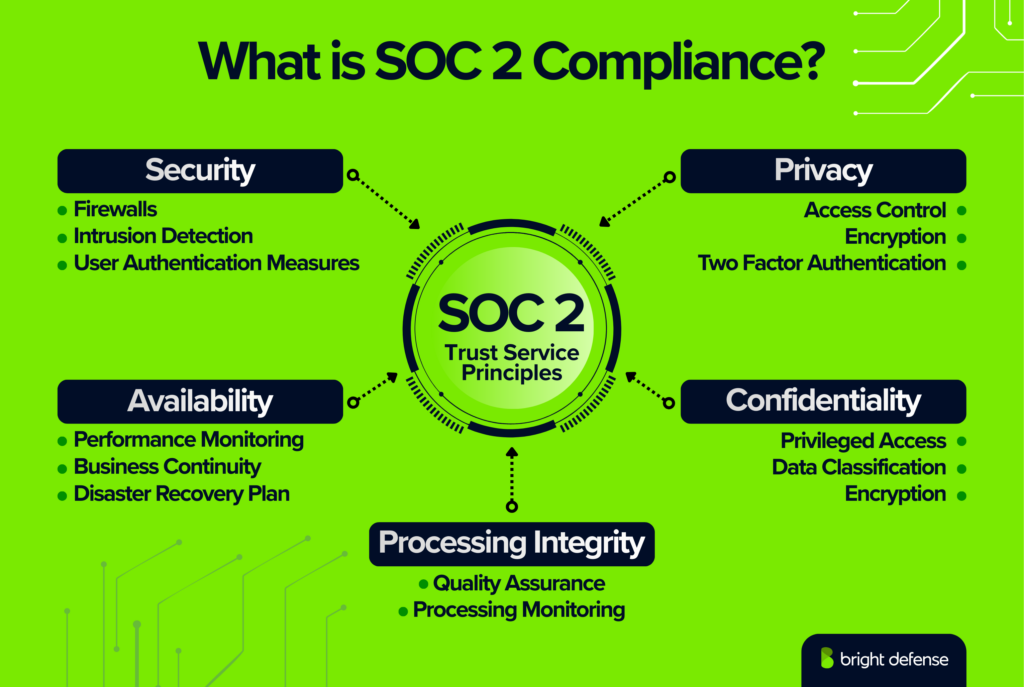
The five Trust Services Criteria are:
- Security, which covers controls that protect systems and data from unauthorized access, misuse, and security threats.
- Availability, which focuses on whether systems remain accessible and perform as promised in service agreements.
- Processing Integrity, which addresses whether systems process data accurately, completely, and on time.
- Confidentiality, which applies to information that must be restricted, such as proprietary or contractually sensitive data.
- Privacy, which governs how personal information is collected, used, stored, and shared.
To achieve SOC 2 compliance, an organization typically follows a defined process:
- Scope systems and services that handle customer data.
- Design policies and technical controls mapped to the Trust Services Criteria.
- Document how those controls operate in daily business activities.
- Complete an independent audit that tests control design and operating effectiveness over a defined period.
SOC 2 compliance helps customers understand how a company manages security and data protection risks in real operating conditions rather than relying on policy statements alone.
What Are SOC 2 Controls?
SOC 2 controls are the rules, processes, and security measures a company uses to protect its systems and customer data.
These controls include actions like restricting access to sensitive data, using multi-factor authentication, encrypting information, and monitoring systems for threats. They help prevent unauthorized access, reduce security risks, and keep data safe. SOC 2 controls are organized around five key areas, such as:
- Security
- Availability
- Processing Integrity
- Confidentiality
- Privacy
These principles guide how companies manage and protect information.
For a full breakdown of each control and how they apply in practice, read our complete guide on SOC 2 controls.
Types Of SOC 2 Reports
There are two types of SOC 2 reports: SOC 2 Type I and SOC 2 Type II, and they differ based on the time period and depth of evaluation. SOC 2 Type I evaluates whether a company’s controls are properly designed at a specific point in time, while SOC 2 Type II evaluates both the design and operating effectiveness of those controls over an extended period, usually three to twelve months.
| SOC 2 Report Type | Time Coverage | What It Evaluates | Typical Use Case |
| SOC 2 Type I | Point in time | Design of controls | Early-stage compliance or readiness validation |
| SOC 2 Type II | Period of time | Design and operating effectiveness of controls | Customer assurance, vendor risk reviews, and enterprise sales |
SOC 2 Type I is commonly used to demonstrate initial control readiness, while a SOC 2 Type II report is generally required by customers and partners because it provides evidence that controls consistently operate over time.
What’s the Difference Between SOC 2 Type I Vs Type II?
SOC 2 Type I is a point in time report on whether controls are designed and implemented, while SOC 2 Type II also tests whether those controls worked over a defined period.
| Category | SOC 2 Type I | SOC 2 Type II |
| What it covers | Control description and whether controls are implemented as of a specific date | Everything in Type I plus whether controls were effective across the full test period |
| Time coverage | Snapshot as of one date | Period report, commonly measured in months and often set to a year for mature programs, with shorter first periods sometimes used |
| Testing depth | Confirms controls exist and are set up | Samples evidence across time to confirm controls ran as described |
| Typical customer takeaway | Good for showing a control program is in place | Stronger for proving controls worked consistently, which is why customer auditors often ask for Type II |
| Best fit | Early stage, first audit, or when controls are newly implemented | Established controls with enough operating history to produce repeated evidence |
- Choose Type II when customers or their auditors ask for proof that controls worked across a period, not only on a single date.
- Choose Type I when you need an earlier snapshot to confirm the control set exists and is implemented, then plan a move to Type II after controls have run long enough to generate period evidence.
- Pick a Type II period length that matches expectations, since periods commonly range from a few months for a first report to a full year in many programs.
For a deeper side-by-side breakdown, see our full guide on SOC 2 Type 1 vs Type 2 compliance.
Who Needs A SOC 2 Report?
A SOC 2 report is typically needed by any service provider that stores, processes, or transmits customer data and must give customers detailed assurance about the controls that protect that data.
Organizations that most often need a SOC 2 report include:
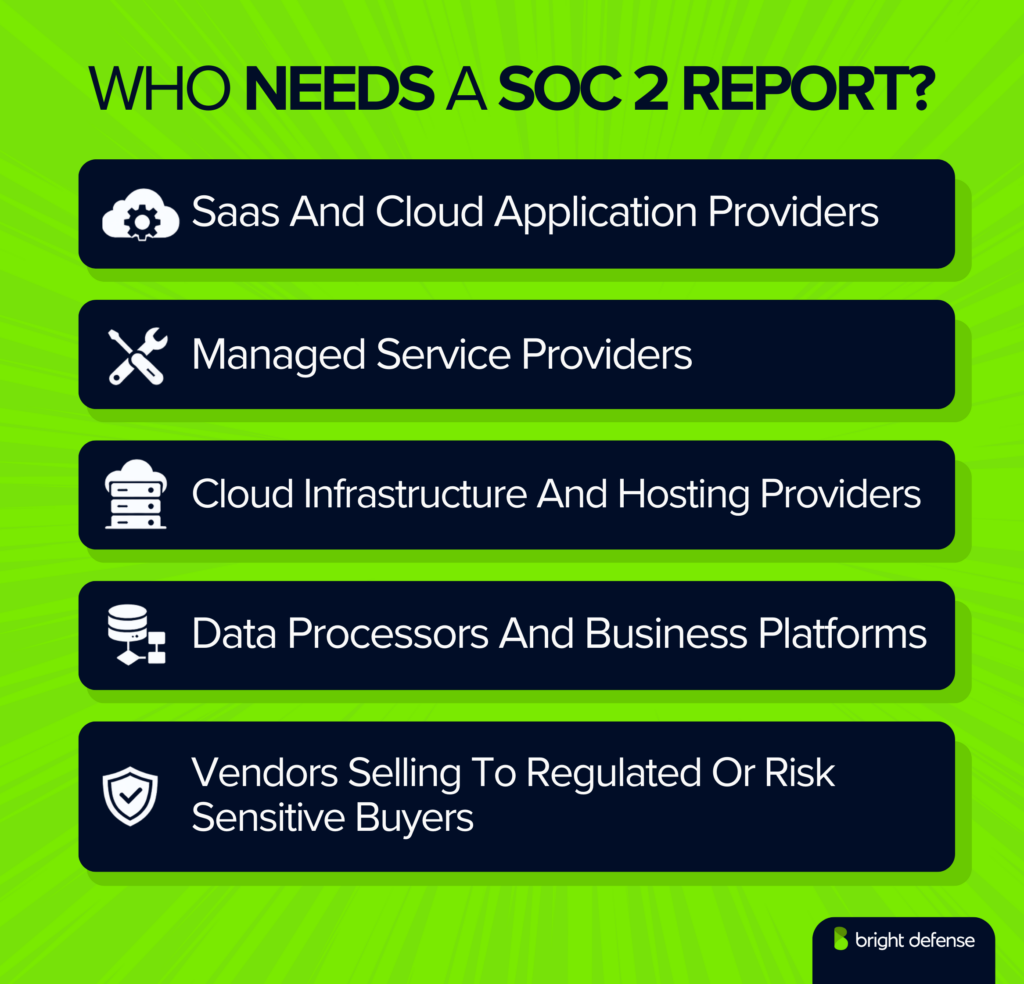
- SaaS and cloud application providers that host customer data or run critical customer workloads.
- Managed service providers such as IT outsourcing, monitoring, and security operations vendors that access customer environments or data.
- Cloud infrastructure and hosting providers such as data centers, platform providers, and services that support customer systems and availability commitments.
- Data processors and business platforms such as analytics, identity, HR, payroll, and customer support systems that handle confidential or personal information.
- Vendors selling to regulated or risk sensitive buyers where customers and business partners use SOC 2 reports as part of their risk review of service providers.
Vendors selling to regulated or risk sensitive buyers, where SOC 2 for enterprise clients becomes part of every vendor risk review.
You may need a SOC 2 report depending on your business model and customer requirements, and our blog on who needs SOC 2 compliance explains whether your organization falls into that category.
your organization falls into that category.
What Is A SOC 2 Audit?
A SOC 2 audit is an independent review that examines whether a company has designed and follows controls that protect customer data and critical systems. The audit is performed by a licensed CPA or SOC 2 audit firm and measures controls against the Trust Services Criteria.
A SOC 2 audit typically includes:
- Scope definition, which identifies the systems, services, and data included in the audit.
- Control review, which evaluates whether security, availability, processing integrity, confidentiality, and privacy controls are properly designed.
- Evidence testing, which involves reviewing logs, records, and other proof that controls operate as described.
- Audit reporting, which results in a formal SOC 2 report that customers and partners can review.
SOC 2 audits are issued as either Type I reports, which assess control design at a specific point in time, or Type II reports, which evaluate how well controls operate over a defined period, usually several months.
How Much Does a SOC 2 Audit Cost?
A SOC 2 audit typically costs between $15,000 and $100,000+, with most small to mid-sized businesses spending $20,000 to $50,000 depending on scope and complexity.
Costs vary based on audit type and organization size. Type 1 audits usually range from $15,000 to $30,000 for SMBs, while Type 2 audits cost more at $30,000 to $70,000+ due to extended testing periods. Larger enterprises often exceed $100,000 due to broader systems and multiple trust criteria.
Total SOC 2 costs increase when adding readiness assessments, remediation, compliance tools, and security testing, which can push first-year spending significantly higher than the audit fee alone. Teams working with tight budgets can also review our playbook on budget-friendly SOC 2 compliance before scoping the project.
Learn what drives SOC 2 audit pricing and what to expect at each stage in our detailed guide on SOC 2 audit costs.
Who Can Perform A SOC Audit?
A SOC audit must be performed and the SOC report must be issued by an independent licensed CPA, typically through a CPA firm acting as the service auditor.
A SOC examination is an AICPA attestation engagement under the SSAEs and is tied to AICPA professional and ethical requirements, including independence standards reflected in the required independent practitioner reporting language.
A readiness assessment or prep work can be supported by consultants, but a consultant cannot sign or issue the SOC report.
A practical qualifier is that the firm should be a public accounting firm that participates in the AICPA peer review program, since peer review is how the profession evaluates quality for audit and attestation work.
SOC 2 Audit Checklist
A SOC 2 audit checklist is a structured inventory of scope details, required report elements, and evidence items aligned to the AICPA Trust Services Criteria and the SOC 2 Description Criteria. Many teams pair this checklist with a SOC 2 gap assessment to identify missing controls before formal audit fieldwork begins.
Engagement Scope And Report Basics
- Report type: SOC 2 Type I or SOC 2 Type II
- Examination period dates or point in time date
- In-scope Trust Services Categories: Security, plus any of Availability, Processing Integrity, Confidentiality, Privacy
- System boundary statement, including in-scope environments and locations
- Subservice organizations list
- Subservice method: carve-out method or inclusive method
- Complementary user entity controls
- Management assertion
- SOC 2 report sections: system description, service auditor’s report, tests of controls, results
System Description Inventory (SOC 2 Description Criteria)
- Services provided
- System components: infrastructure, software, people, procedures, data
- Data flows and key dependencies
- Commitments and system requirements relevant to in-scope categories
- Subservice organization responsibilities and assumed control types when carve-out applies
Trust Services Criteria Evidence Inventory (Common Criteria CC1 Through CC9)
- CC1 Control environment: org chart, role definitions, governance records
- CC2 Communication and information: policy set, training records, internal communications
- CC3 Risk assessment: risk methodology, risk register, risk acceptance records
- CC4 Monitoring: monitoring routines, review records, issue tracking
- CC5 Control activities: SOPs, approvals, segregation of duties evidence=
- CC6 Logical and physical access: IAM configuration, access requests, access reviews, privileged access records, physical access logs
- CC7 System operations: logging scope, alerting, vulnerability records, incident records
- CC8 Change management: SDLC documentation, code review records, deployment records
- CC9 Risk mitigation: incident response materials, backup records, disaster recovery materials, vendor oversight records
How AI Can Affect SOC 2 Compliance
AI impacts SOC 2 compliance through changes in data handling, control environments, and risk exposure. AI systems process large volumes of sensitive data, which increases requirements for access controls, monitoring, and data governance under SOC 2 Trust Services Criteria.
A Gartner survey of 360 organizations found that those deploying AI governance platforms are 3.4 times more likely to achieve high effectiveness in AI governance than those that do not.
Automated decision-making introduces risks around accuracy, bias, and explainability, which directly affect processing integrity. AI adoption also expands vendor risk due to reliance on third-party models and APIs.
The March 2026 Delve scandal illustrates this directly. A whistleblower accused the $300 million Y Combinator-backed AI compliance startup of fabricating evidence of board meetings, tests, and processes that never took place, potentially exposing hundreds of clients to regulatory penalties.
The incident reinforces that AI-powered compliance platforms demand the same vendor scrutiny as any critical third party.
Key areas where AI influences SOC 2 include:
- Data governance requirements increase due to high-volume and sensitive data processing
- Access controls must cover models, training datasets, and generated outputs
- Vendor risk expands when external AI tools and APIs are introduced
- Audit logging must capture AI decisions and system behavior for traceability
- Monitoring must detect model drift, anomalies, and performance degradation
For a deeper breakdown of SOC 2 requirements for AI startups, read this guide SOC 2 For AI Startups.
Why SOC 2 Compliance Is Important
SOC 2 compliance is important because it provides third parties with independent proof that security and operational controls exist and operate consistently within an organization’s Security Framework.
The reasons why SOC 2 compliance is important are discussed in detail below.
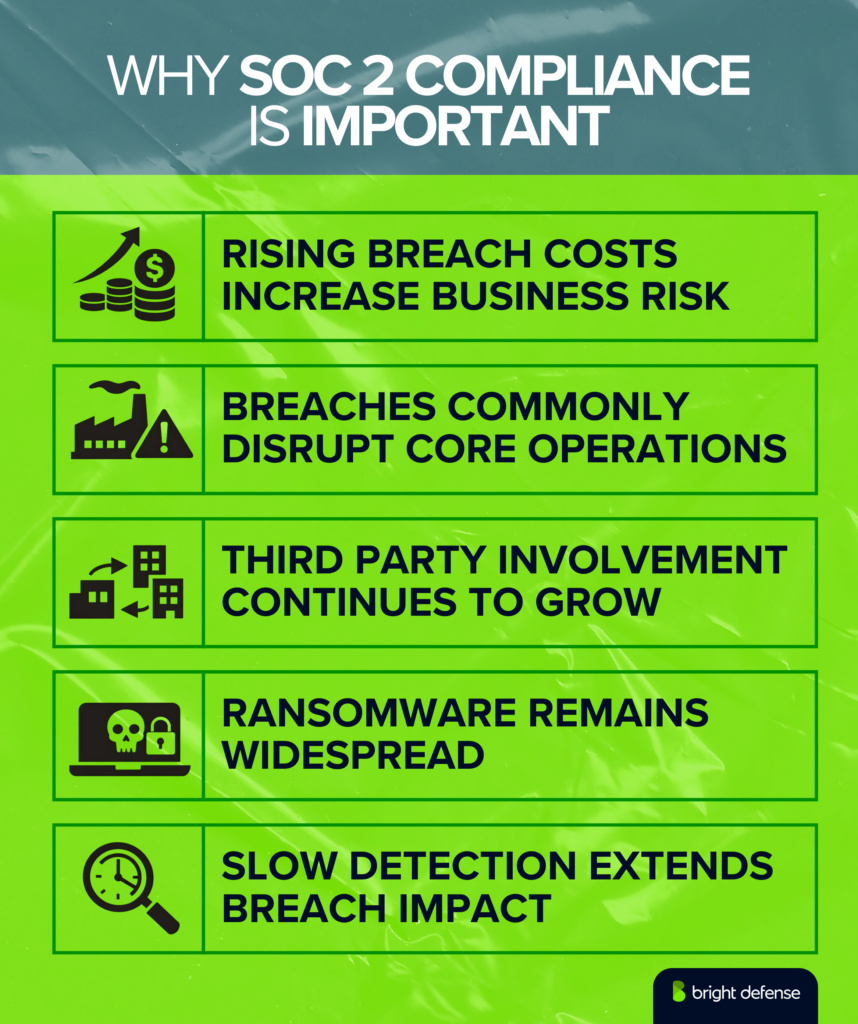
1. Rising Breach Costs Increase Business Risk
The average cost of a data breach reached $4.88 million in 2024, so a security failure can turn into a direct financial problem rather than a limited technical issue. We treat SOC 2 as a practical baseline for Risk Management because it requires documented controls, clear ownership, routine oversight, and repeatable evidence tied to Financial Reporting impacts. That structure reduces confusion during incidents and supports accountability when protecting sensitive business operations.
2. Operational Disruption Shows Why Availability Controls Matter
70% of breached organizations reported significant or very significant operational disruption, showing how incidents quickly affect uptime and internal workflows. SOC 2 addresses this risk through expectations tied to Operational Effectiveness, including system reliability controls, disciplined change management, and monitoring practices that reduce downtime and support structured recovery.
3. Third Party Involvement Continues To Grow
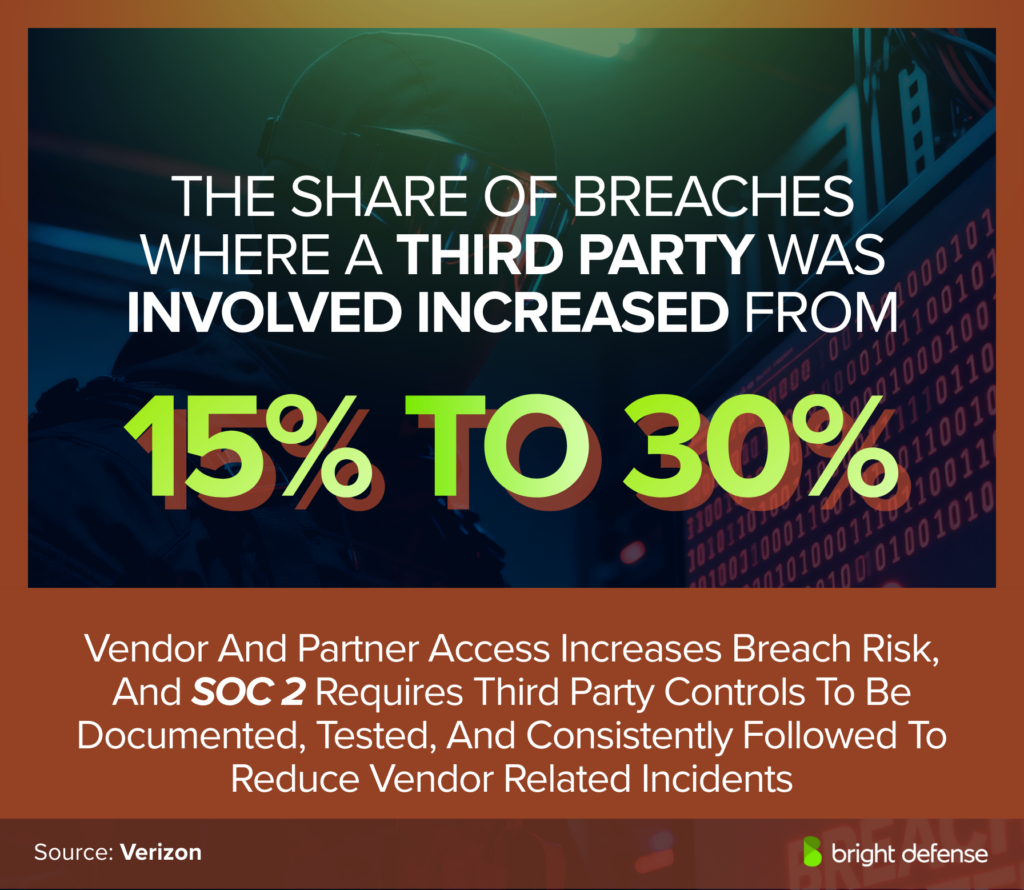
The share of breaches involving a third party increased from 15% to 30%, highlighting the expanded attack surface created through vendors. SOC 2 remains relevant because it requires defined controls over Third Party Vendors, including access boundaries, oversight activities, and accountability mechanisms that integrate vendor risk into the organization’s overall security program.
4. Ransomware Remains Widespread
Ransomware appeared in 44% of reviewed breaches, showing how attackers often succeed after gaining access and moving laterally. SOC 2 expectations emphasize preventive and detective controls such as tighter access management, monitoring, and Intrusion Detection Systems that help identify misuse earlier and limit damage during active incidents.
5. Slow Detection Extends Breach Impact
Breaches involving compromised credentials took 292 days to identify and contain, reflecting gaps in visibility and review. SOC 2 addresses this issue through expectations for logging, review routines, and documented response actions that support faster detection and consistent investigation of Security Incidents.
SOC 2 Requirements
SOC 2 requirements consist of specific documented elements and control conditions evaluated against the AICPA Trust Services Criteria to demonstrate how organizations Protect Data and manage risk across systems.
Key SOC 2 requirements include the following.
- A clearly defined system description covering services, infrastructure, software, people, processes, and data, including how organizations Store Customer Data.
- Documented control objectives mapped to applicable Trust Services Criteria.
- Security controls addressing logical access, authentication, authorization, and Network Security.
- Availability controls supporting uptime, capacity planning, and recovery.
- Change management controls governing system and code changes.
- Monitoring and logging controls that support detection, investigation, and review.
- Incident response controls covering detection, escalation, containment, and resolution.
- Vendor and third party risk controls governing access, oversight, and accountability.
- Evidence demonstrating control operation over the examination period through consistent documentation.
- An independent CPA attestation supported by External Auditors resulting in a SOC 2 Type I or Type II report.
Learn about the SOC 2 requirements in full detail in a dedicated blog!
What Are Access Control Models?
Access control models define how permissions are assigned and enforced to support secure operations and limit unauthorized access.
| Model | Description |
|---|---|
| Discretionary Access Control (DAC) | Data owners manage access to their own resources, offering flexibility with limited centralized oversight. |
| Mandatory Access Control (MAC) | A central authority enforces strict access rules suited for high-security environments. |
| Role-Based Access Control (RBAC) | Permissions are assigned based on job roles, supporting consistent access management. |
| Attribute-Based Access Control (ABAC) | Access decisions rely on user, resource, and contextual attributes for fine-grained control. |
| Relationship-Based Access Control (ReBAC) | Permissions depend on relationships between users and resources, often used in collaborative systems. |
Bright Defense Helps You Get SOC 2 Compliant
Bright Defense works with you to run SOC 2 as a continuous compliance program rather than a single audit milestone. We stay involved from early readiness through the full Type II period so your controls operate consistently and remain audit-ready.
How we help you manage SOC 2
- We assess your current environment and document SOC 2 gaps against Trust Services Criteria
- We help define risks, support control implementation, and prepare required policies and procedures
- We organise and validate evidence across the full 6–12 month Type II audit timeframe
- We monitor control performance and track remediation to prevent audit surprises
- We provide vCISO guidance, staff training, and phishing simulations to support day-to-day security operations
This model helps you avoid rushed audits, reduce evidence shortfalls, and maintain a reliable SOC 2 position that supports customer reviews and sales cycles throughout the year.
FAQs
SOC 2 is an AICPA framework and examination for service organizations that reports on controls related to the Trust Services Criteria: security, availability, processing integrity, confidentiality, and privacy.
SOC 2 has two report types: Type 1 and Type 2. Type 1 looks at control design at a point in time, while Type 2 looks at control design and operating effectiveness over a period of time.
There is no single universal list of only four audit types, but in business FAQs a common set is internal audit, external audit, financial audit, and compliance audit. Different sources and standards use different groupings.
A SOC 2 assessment usually means a readiness assessment (gap check) before the formal audit, where you review policies, controls, risks, and evidence to see if you are prepared; some people also use the term loosely for the formal SOC 2 examination itself.
Service organizations that handle customer data for other businesses, such as SaaS, cloud, and outsourced service providers, commonly need SOC 2 because customers and partners use it during vendor risk reviews.
No. SOC 2 is an attestation report with an auditor’s opinion, not a certification badge, and the final deliverable is a report describing the system and the control evaluation.
SOC 2 evaluates controls against the Trust Services Criteria, which cover security, availability, processing integrity, confidentiality, and privacy, based on the scope selected for the examination.
Type I reviews whether controls are suitably designed at a specific point in time, while Type II reviews design and operating effectiveness over a period of time with testing across that review window.
No. SOC 2 is generally pursued when a company provides services to other organizations and customers want formal third-party assurance, rather than as a universal requirement for every business.
It depends. Many startups start when enterprise buyers begin asking for security reviews, but starting earlier can help if your sales process regularly involves vendor questionnaires and data security checks.
No, usually not. Type II requires a review period to test how controls operated over time, and major providers describe Type II audits as period-based examinations rather than point-in-time reviews.
It depends. Many startups start when enterprise buyers begin asking for security reviews, but starting earlier can help if your sales process regularly involves vendor questionnaires and data security checks. For a dedicated playbook, see our guide on SOC 2 for startups.
No, usually not. Type II requires a review period to test how controls operated over time, and major providers describe Type II audits as period-based examinations rather than point-in-time reviews. For realistic timing expectations, see our guide on how long it takes to get SOC 2 compliance.