370+ Compliance Statistics – July 2026
Updated:
August 25, 2026
Compliance requirements are becoming more complex, audit workloads are increasing, and businesses face greater pressure to prove that their controls work. 85% of executives said compliance requirements had become more complex, 97% of organizations conducted at least two audits annually, and 38% had lost revenue or competitive bids because they could not provide sufficient compliance evidence.
The Bright Defense team compiled the latest compliance statistics for 2025 and 2026 to show how regulation, cybersecurity risk, AI, staffing shortages, and third-party exposure are changing compliance programs.
This article covers:
- Major compliance trends and regulatory pressures
- Audits, frameworks, budgets, staffing, and technology
- Cybersecurity, AI governance, privacy, and third-party risk
Let’s look at the most important compliance statistics for 2026.
| Methodology note: The percentages come from separate surveys with different industries, company sizes, geographies, and sample designs. Treat each figure as an individual research finding rather than a directly comparable global market share. Vendor cost and timeline figures are planning estimates, not prices set by standards bodies or regulators. |
Key Compliance Statistics
The headline figures show the main direction of compliance in 2026: greater complexity, more audits, stronger commercial pressure for proof, larger budgets, persistent manual work, rapid AI adoption, and serious cyber and third-party exposure.
- 88% of C-suite respondents viewed compliance programs as a strategic advantage, although 47% still described them as a necessary constraint on business. (NAVEX State of Risk and Compliance Report, 2026)
- 85% of executives said their compliance requirements had become more complex during the previous three years. (PwC Global Compliance Survey, 2025)
- 97% of organizations conducted at least two compliance audits per year. (A-LIGN Compliance Benchmark Report, 2026)
- 52% of surveyed organizations had achieved or were pursuing more than one compliance framework. (Secureframe Cybersecurity and Compliance Benchmark Report, 2026)
- 61% said compliance certification was necessary to win new contracts or renew existing agreements. (Secureframe Cybersecurity and Compliance Benchmark Report, 2026)
- 38% had lost revenue or competitive bids because they could not provide sufficient evidence of compliance. (Secureframe Cybersecurity and Compliance Benchmark Report, 2026)
- 58% expected their organizations to increase GRC spending during 2026. (Hyperproof IT Risk and Compliance Benchmark Report, 2026)
- 53% of legal entity practitioners managed more than 60% of their governance workload manually through spreadsheets, email, and document templates. (Diligent Global State of Legal Entity Compliance, 2026)
- 50% of organizations using ad hoc or incident-driven risk management experienced a breach, compared with 27% using an integrated and automated approach. (Hyperproof IT Risk and Compliance Benchmark Report, 2026)
- 78% of compliance teams were involved in organizational AI decisions, up from 65% the previous year. (NAVEX State of Risk and Compliance Report, 2026)
- 64% assessed the security of AI tools before deployment, while 29% had no AI security assessment process. (World Economic Forum Global Cybersecurity Outlook, 2026)
- 88% of cybersecurity professionals reported at least one significant organizational consequence caused by skills deficiencies. (ISC2 Cybersecurity Workforce Study, 2025)
- 84% of employees said compliance training was relevant to their roles, while 77% considered it engaging. (LRN Ethics and Compliance Program Effectiveness Report, 2026)
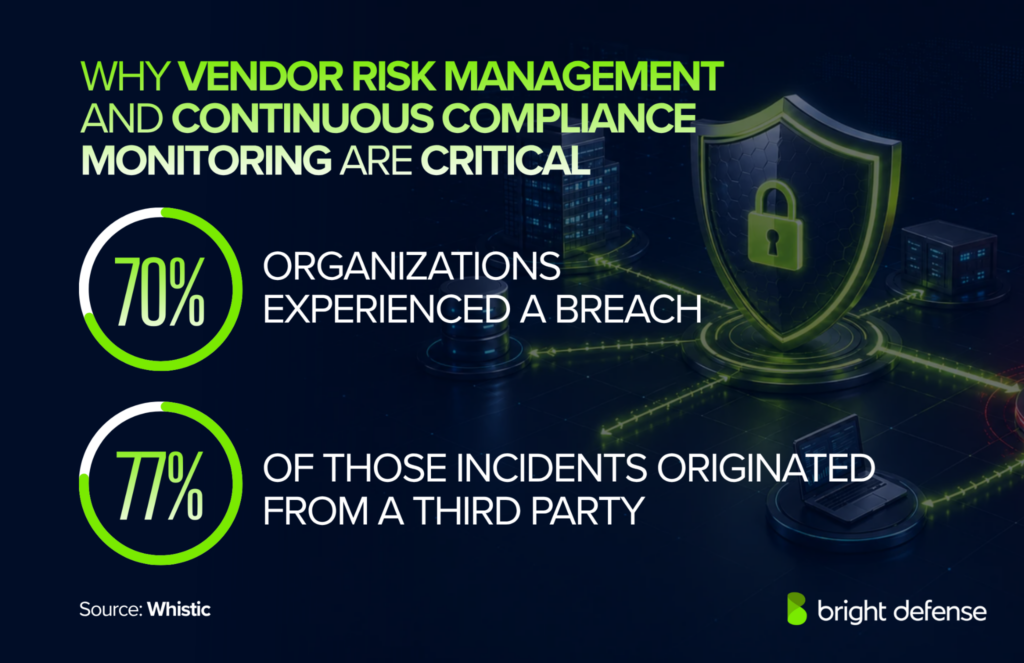
- 70% of organizations experienced a breach during the previous three years, and 77% of those breaches originated from a vendor or another third party. (Whistic Third-Party Risk Management Impact Report, 2025)
- Only 4% of organizations reached the Mature level of overall cybersecurity readiness. (Cisco Cybersecurity Readiness Index, 2025)
The Current State of Compliance
Compliance responsibilities are expanding beyond policy administration. Teams are expected to support transformation, product decisions, cyber risk, AI governance, and geopolitical resilience, even when staffing and technology do not keep pace.
- Nearly 90% reported that the breadth of their compliance responsibilities had increased over the previous three years. (PwC Global Compliance Survey, 2025)
- Nearly 90% of executives said the scope of their compliance responsibilities had increased during the previous three years. (PwC Global Compliance Survey, 2025)
- 51% ranked cybersecurity among their five leading compliance-risk priorities, and the same percentage selected data protection and privacy. (PwC Global Compliance Survey, 2025)
- 40% identified corporate governance as a leading compliance priority, while 38% selected anti-bribery, anti-corruption, anti-money laundering, or fraud risks. (PwC Global Compliance Survey, 2025)
- 77% said compliance complexity had negatively affected their organization across areas that influence growth, transformation, resources, systems, and business relationships. (PwC Global Compliance Survey, 2025)
- 59% said better coordination of compliance activities gave them greater confidence in compliance-related decision-making. (PwC Global Compliance Survey, 2025)
- 86% of organizations had a centralized team responsible for governance, risk, and compliance, while 14% continued managing GRC through separate teams or business units. (Hyperproof IT Risk and Compliance Benchmark Report, 2026)
- 93% said the compliance function was involved to some degree in organizational risk assessment and management, including 70% that described compliance as highly engaged. (NAVEX State of Risk and Compliance Report, 2025)
- 49% used technology across at least 11 compliance activities, showing that digital compliance systems now extend well beyond basic evidence storage or policy management. (PwC Global Compliance Survey, 2025)
- 82% planned to increase investment in at least one technology used to automate or improve compliance activities. (PwC Global Compliance Survey, 2025)
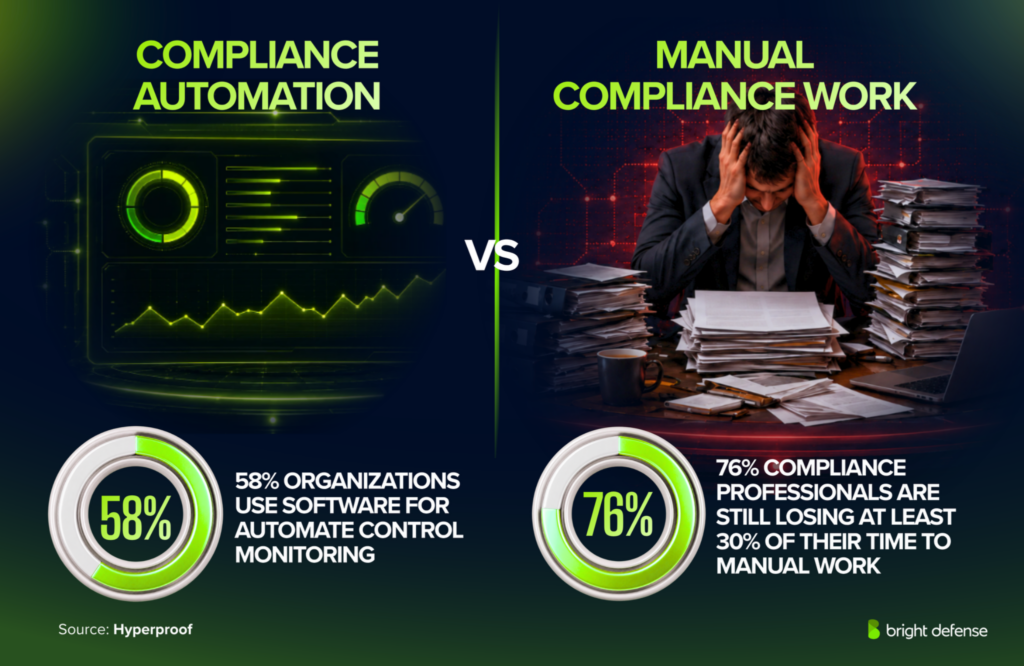
- 58% used software to monitor controls continuously, but 76% still spent at least 30% of their working time on repetitive manual and administrative tasks. (Hyperproof IT Risk and Compliance Benchmark Report, 2026)
- 3.89 out of 5 was the average global compliance-program effectiveness score in 2026, only slightly higher than 3.87 in 2025. (LRN Ethics and Compliance Program Effectiveness Report, 2026)
- 74% of legal entity compliance and governance practitioners said their scope had expanded during the previous two years. (Diligent Global State of Legal Entity Compliance, 2026)
- 63% said their workload had grown faster than their team or that their team had been reduced, while 52% operated with only one or two dedicated entity-management resources. (Diligent Global State of Legal Entity Compliance, 2026)
- 52% spent at least six hours each week tracking filings, deadlines, and record updates rather than performing legal, governance, or strategic work. (Diligent Global State of Legal Entity Compliance, 2026)
- 51% experienced at least one near-miss during the previous year in which a legal entity obligation almost went unmet. (Diligent Global State of Legal Entity Compliance, 2026)
- 56% of legal entity practitioners considered themselves strategic advisers to the board, but only 17% believed leadership fully agreed with that assessment. Another 52% said leadership underestimated the complexity of entity and subsidiary governance. (Diligent Global State of Legal Entity Compliance, 2026)
- 53% of executives identified specialist compliance, regulatory, legal, risk, or audit knowledge as an important capability, while 43% selected data-management expertise. More than half of those prioritizing these capabilities expected related skills shortages within the following year. (PwC Global Compliance Survey, 2025)
- 68% of C-suite leaders said time-consuming compliance and reporting work constrained the effectiveness of enabling functions, yet only 17% viewed simplifying that work as the most important opportunity for improvement. (Thomson Reuters C-Suite Survey, 2025)
- 84% of organizations aimed to be either leading or mature in compliance within three years, despite only 7% currently describing themselves as compliance leaders and 31% as mature. (PwC Global Compliance Survey, 2025)
The Business Value of Compliance
Compliance has a direct commercial effect. Strong programs support trust, enterprise sales, market access, and lower incident exposure. Weak programs delay deals, raise remediation costs, and increase the chance of regulatory, financial, and reputational damage.
- 88% of C-suite respondents viewed compliance programs as a strategic advantage, although 47% still described them as a necessary evil that can inhibit business. (NAVEX State of Risk and Compliance Report, 2026)
- 61% of organizations said achieving compliance was required to win new contracts or renew existing agreements. (Secureframe Cybersecurity and Compliance Benchmark Report, 2026)
- 40% pursued compliance certifications specifically to reach enterprise customers. (Secureframe Cybersecurity and Compliance Benchmark Report, 2026)
- 82% believed stronger security and compliance directly increased customer trust. (Vanta State of Trust Report, 2025)
- 77% said customers and other stakeholders demanded verified proof of security and compliance. (Vanta State of Trust Report, 2025)
- 99% of organizations reported receiving at least one tangible benefit from privacy initiatives, including greater agility, innovation, and customer loyalty. (Cisco Data and Privacy Benchmark Study, 2026)
- 64% said compliance technology provided better visibility into risks, 53% reported faster identification and response to issues, 48% received better reporting, and 43% achieved productivity gains or cost savings. (PwC Global Compliance Survey, 2025)
- $2.2 million in average customer revenue was associated with ISO 27001 certification, producing an estimated net upside of $2.18 million after certification costs in A-LIGN’s survey. (A-LIGN Business Case for Compliance, 2026)
- $1.5 million in average customer revenue was associated with SOC 2 certification, with an estimated net upside of $1.48 million. (A-LIGN Business Case for Compliance, 2026)
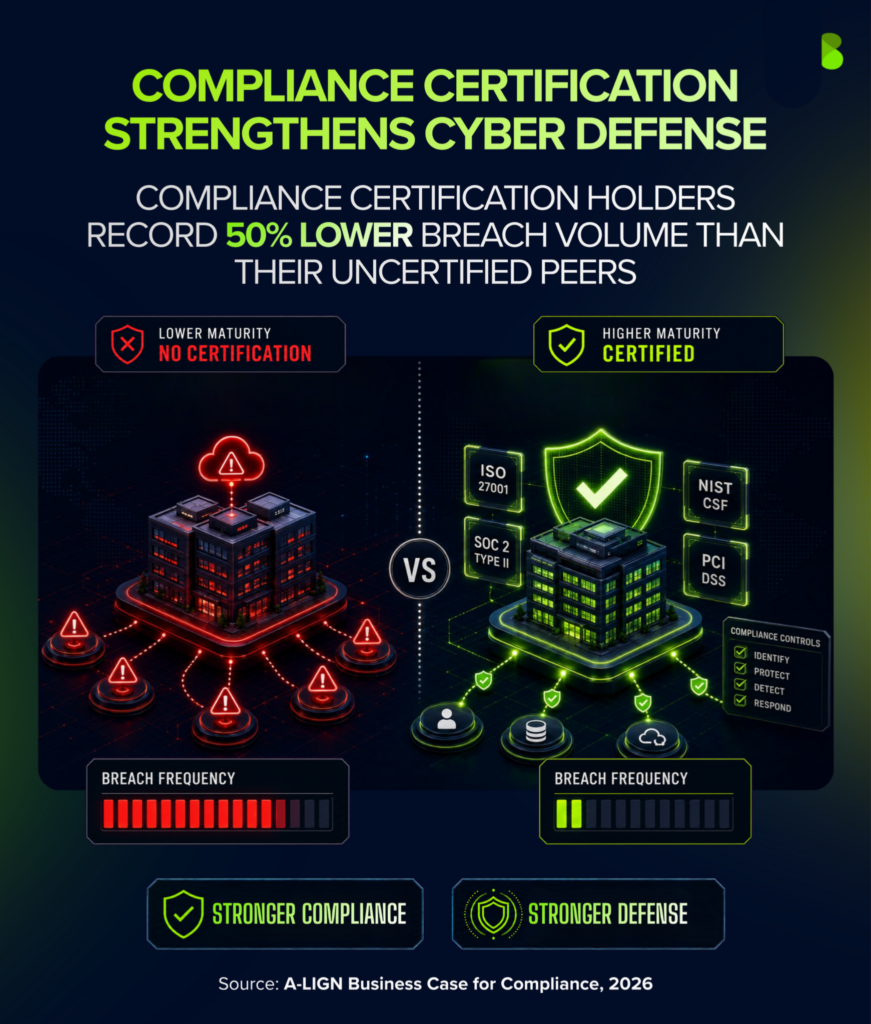
- About 50% fewer breaches were reported by organizations holding major compliance certifications than by organizations without them. This was an association reported across frameworks including SOC 2, ISO 27001, HITRUST, FedRAMP, and PCI. (A-LIGN Business Case for Compliance, 2026)
Financial and Regulatory Consequences of Noncompliance
- 46% of organizations said lacking a compliance certification had delayed their sales cycles. (Secureframe Cybersecurity and Compliance Benchmark Report, 2026)
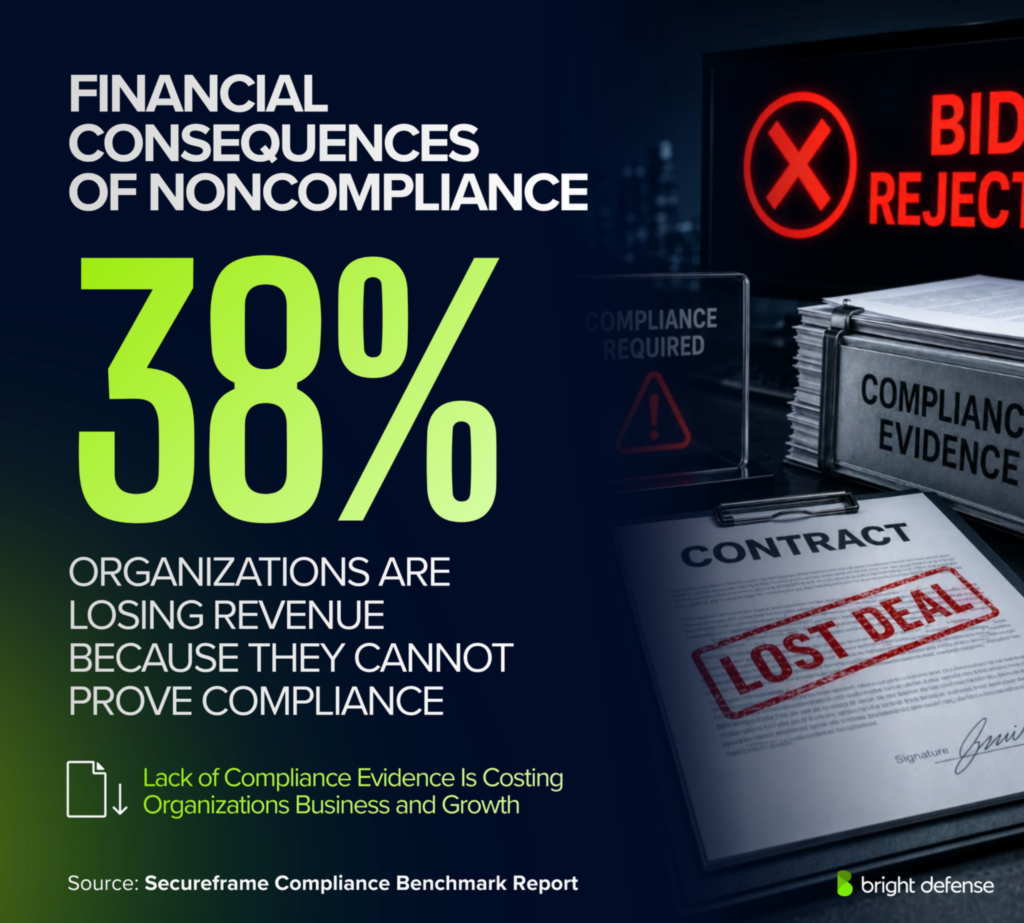
- 38% had lost revenue or competitive bids because they could not provide sufficient proof of compliance. (Secureframe Cybersecurity and Compliance Benchmark Report, 2026)
- 24% experienced strained customer relationships because of insufficient compliance evidence. (Secureframe Cybersecurity and Compliance Benchmark Report, 2026)
- 12% of organizations surveyed by A-LIGN had experienced a rejected compliance report. Each rejection cost roughly $70,000 and caused around 3 months of remediation, with the full cost approaching $100,000 after labor was included. (A-LIGN Business Case for Compliance, 2026)
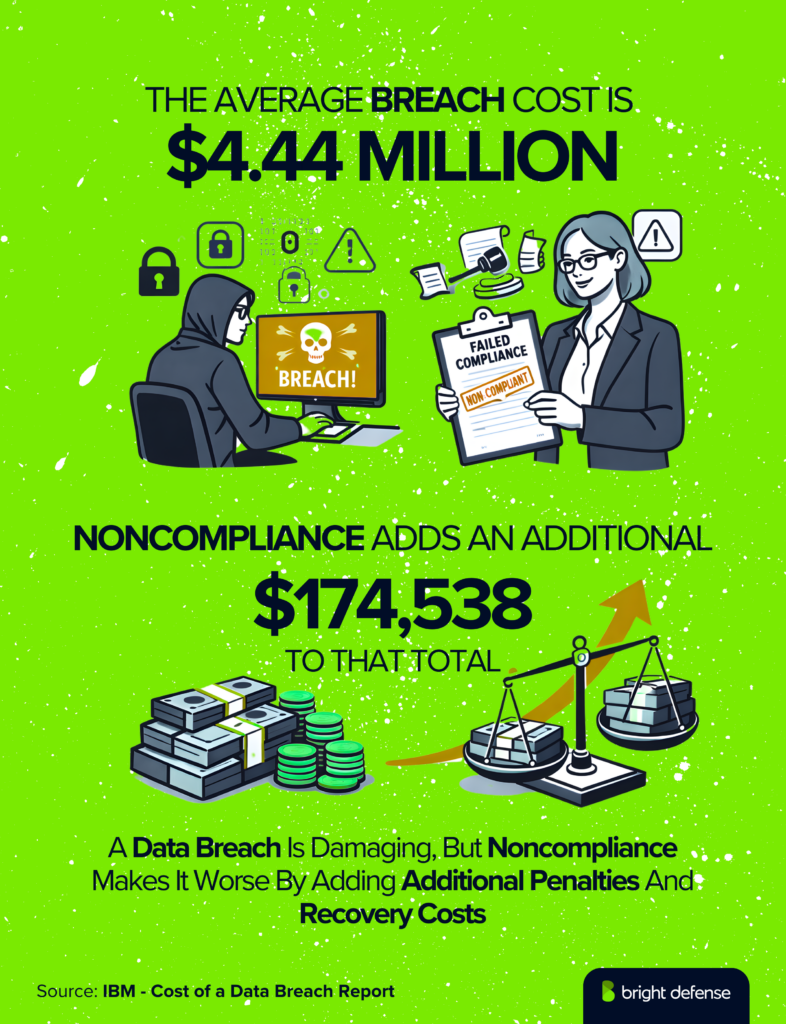
- $4.44 million was the global average cost of a data breach in 2025. (IBM Cost of a Data Breach Report, 2025)
- $10.22 million was the average cost of a U.S. data breach in 2025, the highest national average measured by IBM. (IBM Cost of a Data Breach Report, 2025)
- $670,000 in additional breach costs was associated with high levels of shadow AI compared with low or no shadow AI use. (IBM Cost of a Data Breach Report, 2025)
- $1.9 million in average breach-cost savings was associated with extensive use of AI and automation in security compared with organizations that did not use those technologies. (IBM Cost of a Data Breach Report, 2025)
- $900,000 in average savings was recorded when organizations detected breaches internally rather than having the breach disclosed by an attacker. (IBM Cost of a Data Breach Report, 2025)
- €1.2 billion in GDPR fines was issued by European supervisory authorities during 2025. (DLA Piper GDPR Fines and Data Breach Survey, 2026)
- 41% of organizations where leaders tolerated greater compliance risk experienced a privacy or cybersecurity breach, compared with 25% where leaders did not tolerate greater risk. (NAVEX State of Risk and Compliance Report, 2026)
- 23% of organizations where leaders tolerated greater compliance risk faced legal or regulatory action, compared with 14% where leaders did not tolerate greater risk. (NAVEX State of Risk and Compliance Report, 2026)
Regulatory Complexity and Change
The hardest part of regulatory change is not receiving an alert. It is translating new obligations into policies, controls, evidence, system changes, and accountable ownership before another requirement arrives.
- 85% of executives said their organizations’ compliance requirements had become more complex during the previous three years. (PwC Global Compliance Survey, 2025)
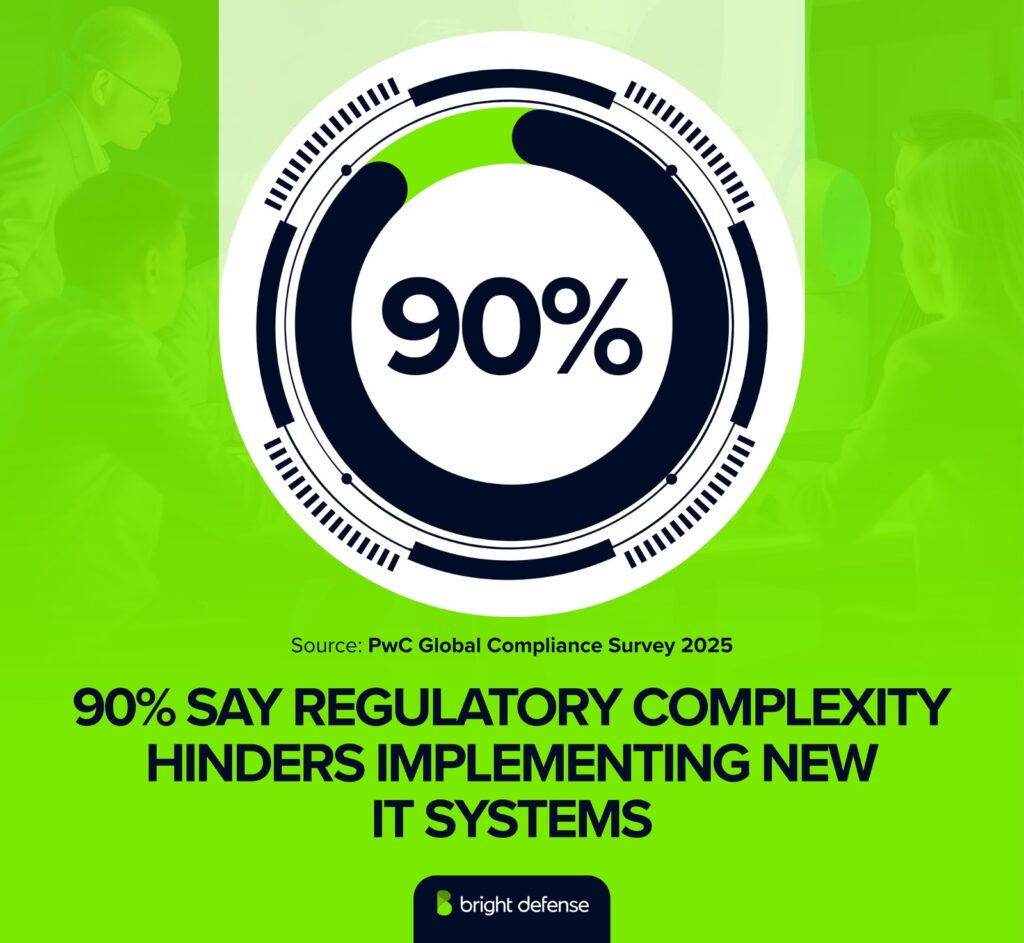
- Nearly 90% said increasing compliance complexity negatively affected their ability to implement and maintain IT systems and data. (PwC Global Compliance Survey, 2025)
- 82% said compliance complexity diverted senior management’s attention and focus. (PwC Global Compliance Survey, 2025)
- 81% reported a negative effect on business transformation and change initiatives. (PwC Global Compliance Survey, 2025)
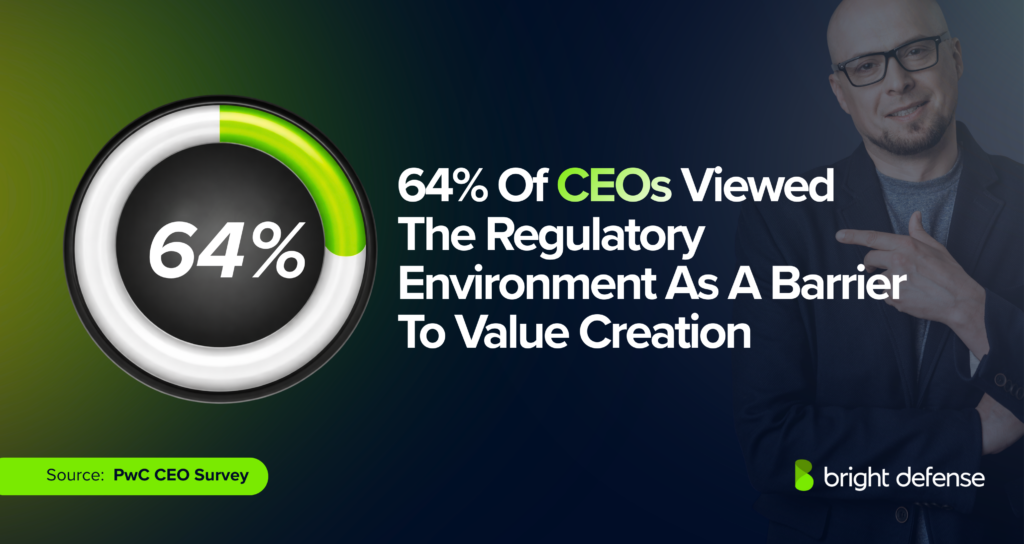
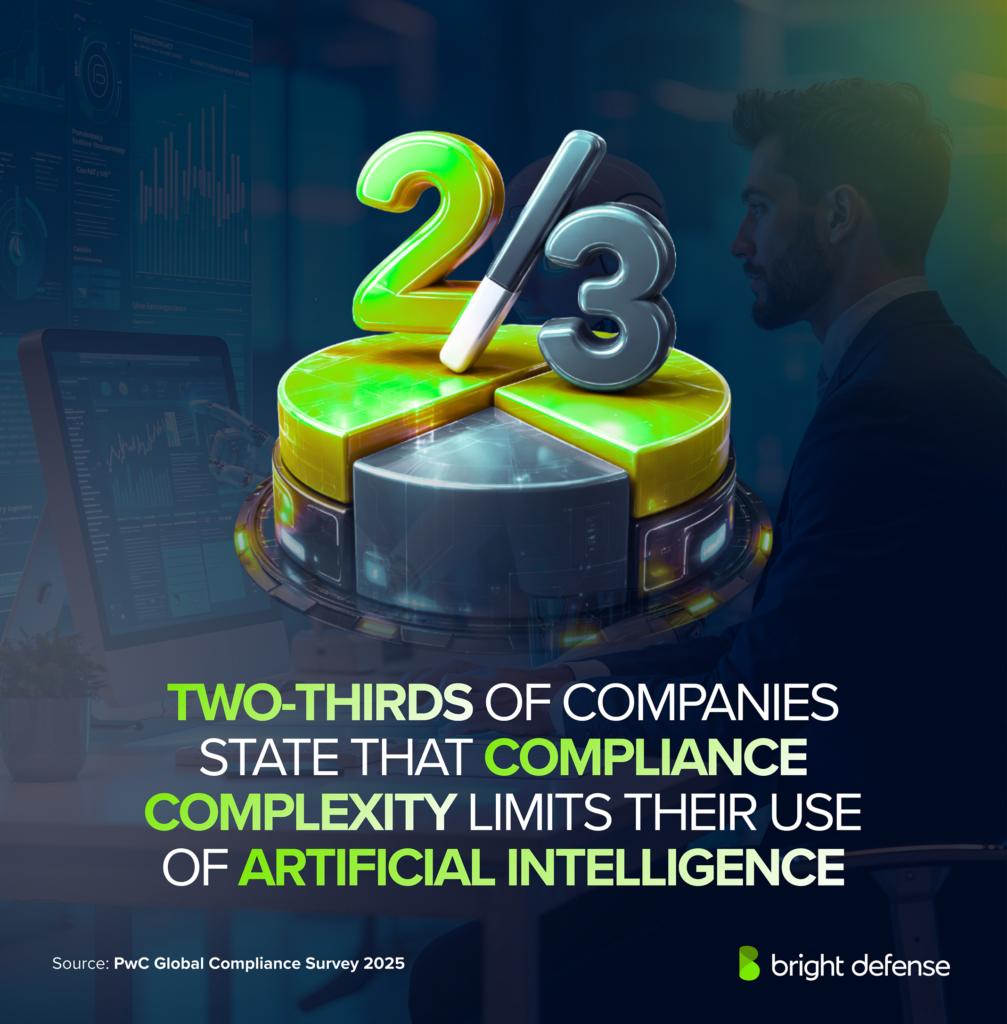
- 67% said compliance requirements restricted their organizations’ adoption of artificial intelligence. (PwC Global Compliance Survey, 2025)
- 76% said regulatory complexity negatively affected the establishment and maintenance of third-party relationships and alliances. (PwC Global Compliance Survey, 2025)
- Regulatory complexity was a leading obstacle to effective compliance for 47% of respondents, followed by organizational complexity at 34%, organizational culture at 29%, and resource capacity at 28%. (PwC Global Compliance Survey, 2025)
- 42% of organizations using compliance technology reported faster identification of and response to regulatory changes. (PwC Global Compliance Survey, 2025)
- Disaggregated and complex organizational data made compliance more difficult for 63% of executives. (PwC Global Compliance Survey, 2025)
- 56% cited data reliability and quality as a compliance challenge, while 47% cited limited data availability and 47% reported insufficient data skills or experience. (PwC Global Compliance Survey, 2025)
- Increasing regulatory complexity ranked among the top three legal entity compliance challenges for 46.3% of practitioners in 2026. (Diligent Global State of Legal Entity Compliance, 2026)
- 37.2% struggled to keep pace with regulatory change, while 23.6% identified cross-border compliance obligations as a leading challenge. (Diligent Global State of Legal Entity Compliance, 2026)
- Resource and headcount constraints affected 43% of legal entity compliance functions, showing that regulatory change is often managed without corresponding team growth. (Diligent Global State of Legal Entity Compliance, 2026)
- Only 19% had near-real-time visibility into their compliance obligations, while 46% had real-time visibility over less than 40% of their obligations. (Diligent Global State of Legal Entity Compliance, 2026)
- Regulatory change management was considered a critical capability for the next three years by 47.9% of legal entity compliance practitioners. (Diligent Global State of Legal Entity Compliance, 2026)
- 21% of financial services compliance and risk leaders rated their regulatory change management approach as somewhat or highly ineffective. (CUBE Cost of Compliance Report, 2025)
- 98% automated at least part of their regulatory change management process, but 74% still took more than one year to implement new regulations fully. (CUBE Cost of Compliance Report, 2025)
- Only 16% reported potential regulatory changes directly to executive teams or boards. (CUBE Cost of Compliance Report, 2025)
Compliance Audit Frequency, Costs, and Trends
Audit demand is rising faster than audit capacity. Organizations are conducting more assessments, working with multiple firms, and relying on technology, but repeated evidence requests and inconsistent report quality still create significant friction.
- 97% of organizations conducted at least two compliance audits per year in 2026. (A-LIGN Compliance Benchmark Report, 2026)
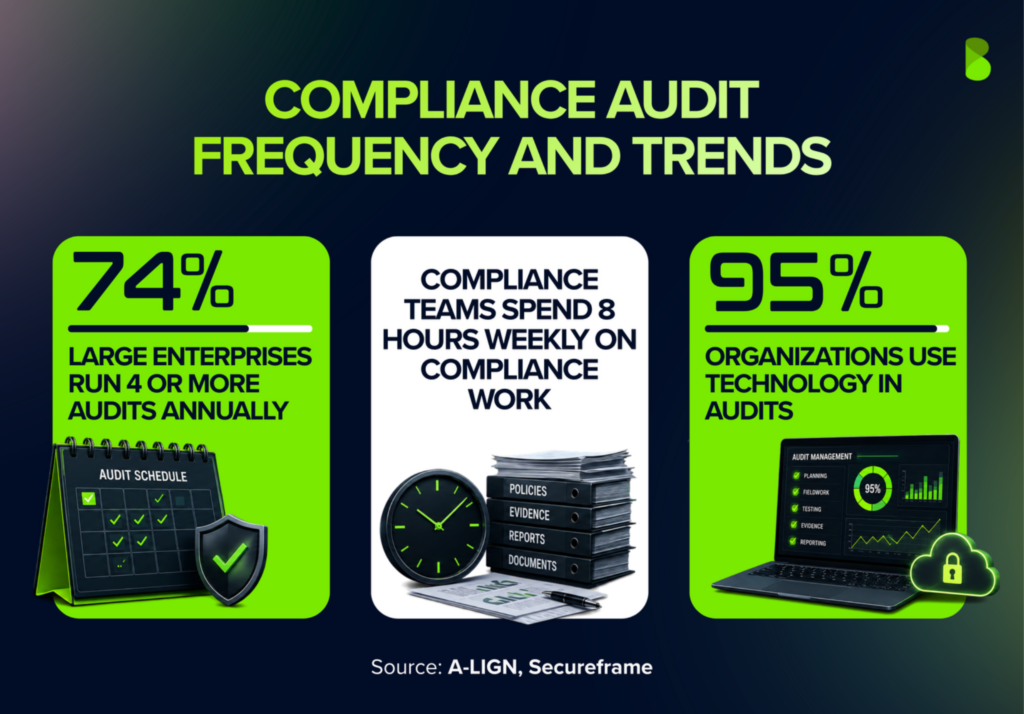
- 74% of enterprises with more than 1,001 employees conducted four or more compliance audits annually. (A-LIGN Compliance Benchmark Report, 2026)
- 90% worked with multiple audit partners, increasing duplicated communication and evidence collection across audit cycles. (A-LIGN Compliance Benchmark Report, 2026)
- 25% identified managing multiple concurrent audits as their greatest compliance challenge. (A-LIGN Compliance Benchmark Report, 2026)
- 20% said limited compliance staffing was the greatest challenge affecting their audit process. (A-LIGN Compliance Benchmark Report, 2026)
- 99% believed consolidating or harmonizing compliance audits could save time, money, or both. (A-LIGN Compliance Benchmark Report, 2026)
- 27% had not consolidated their audits because they did not know how to begin, while 24% said they lacked the time. (A-LIGN Compliance Benchmark Report, 2026)
- 80% rated the quality of a compliance report as extremely important. (A-LIGN Compliance Benchmark Report, 2026)
- 83% had noticed quality differences between auditors, indicating that organizations do not view audit reports as interchangeable products. (A-LIGN Compliance Benchmark Report, 2026)
- 60% would switch auditors to improve the quality of their final compliance report. (A-LIGN Compliance Benchmark Report, 2026)
- More than 50% had experienced a vendor or prospect rejecting a compliance report. Common reasons included missing documentation, insufficient control testing, templated findings, and limited trust in the auditor. (A-LIGN Compliance Benchmark Report, 2026)
- 95% used technology during compliance audits or assessments, making technology-supported audit workflows the standard rather than an optional capability. (A-LIGN Compliance Benchmark Report, 2026)
- 23% identified manual internal and external audit preparation as their leading cybersecurity and compliance challenge heading into 2026. (Secureframe Cybersecurity and Compliance Benchmark Report, 2026)
- Compliance and security teams spent an average of 8 hours per week on compliance work, frequently repeating tasks across frameworks. (Secureframe Cybersecurity and Compliance Benchmark Report, 2026)
- 36% spent fewer than five hours per week on compliance and security tasks, while 37% spent between five and ten hours. (Secureframe Cybersecurity and Compliance Benchmark Report, 2026)
- 18% spent between 10 and 20 hours per week, 6% spent between 20 and 40 hours, and 3% spent more than 40 hours. (Secureframe Cybersecurity and Compliance Benchmark Report, 2026)
- 73% proved their security posture by sharing a third-party audit report with customers or business partners. (Secureframe Cybersecurity and Compliance Benchmark Report, 2026)
- 70% relied on security questionnaires and requests for proposals to provide assurance during sales and vendor reviews. (Secureframe Cybersecurity and Compliance Benchmark Report, 2026)
- 36% shared internal audit reports or self-attestations, while 31% used a security dashboard or trust page. (Secureframe Cybersecurity and Compliance Benchmark Report, 2026)
- 20% identified demonstrating compliance to customers or partners as a leading challenge, while 15% struggled to monitor systems and controls continuously. (Secureframe Cybersecurity and Compliance Benchmark Report, 2026)
Compliance Management Statistics
Maturity is not simply a larger budget or a longer policy library. Stronger programs integrate risk and compliance, test controls continuously, reduce administrative work, and measure whether compliance activity changes actual outcomes.
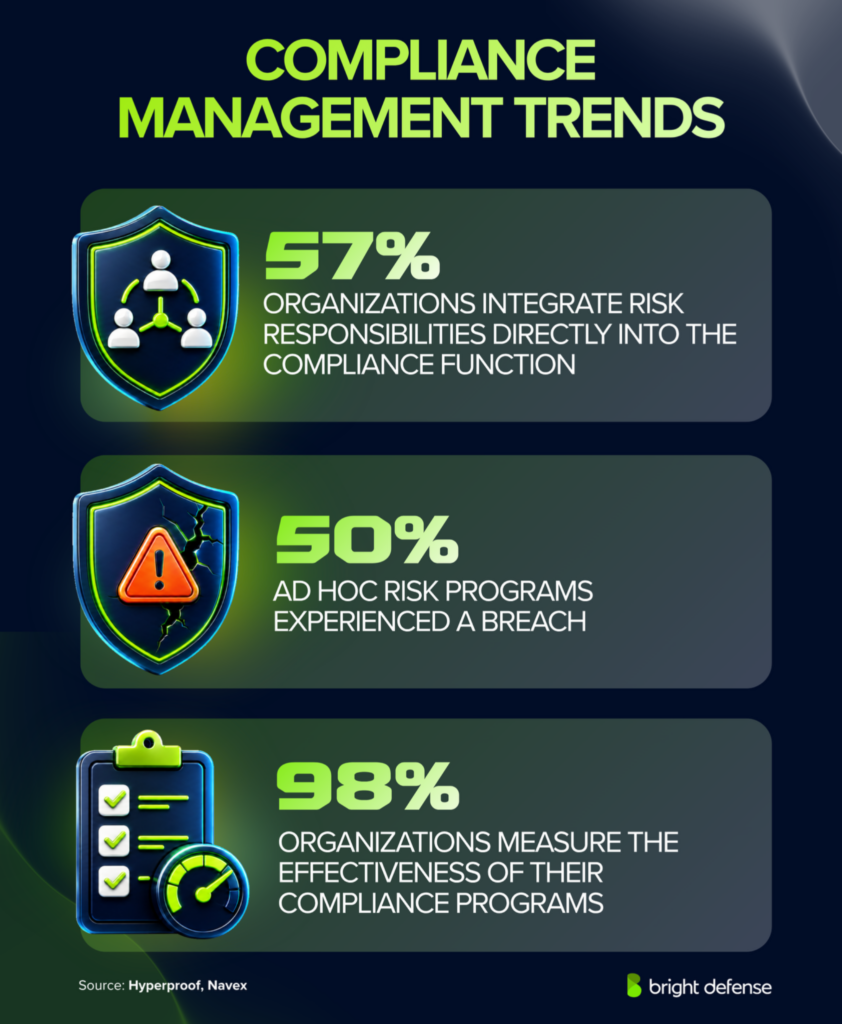
- 57% integrated risk responsibilities into the compliance function, while 36% maintained separate risk and compliance teams and 7% used different structures across functions or locations. (Hyperproof IT Risk and Compliance Benchmark Report, 2026)
- Only 21% of organizations with centralized GRC teams viewed risk and compliance activities as fully integrated and aligned. (Hyperproof IT Risk and Compliance Benchmark Report, 2026)
- 43% of centralized GRC teams conducted risk and compliance activities in response to separate events, while 36% viewed compliance primarily as a function that enforces regulations and industry standards. (Hyperproof IT Risk and Compliance Benchmark Report, 2026)
- 50% of organizations managing risk through an ad hoc or incident-driven approach experienced a breach in 2025, compared with 27% using an integrated and automated approach. (Hyperproof IT Risk and Compliance Benchmark Report, 2026)
- Integrated and automated programs spent about 33% of team time on repetitive or administrative work, compared with 39% among ad hoc and siloed programs. (Hyperproof IT Risk and Compliance Benchmark Report, 2026)
- Organizations with integrated risk-management approaches conducted security risk assessments more frequently than those using ad hoc processes, showing that standardized workflows support more consistent reassessment. (Hyperproof IT Risk and Compliance Benchmark Report, 2026)
- NAVEX evaluates compliance maturity across 5 levels: Underdeveloped, Defining, Adapting, Managing, and Optimizing. (NAVEX State of Risk and Compliance Report, 2026)
- 41% of organizations with Optimizing programs reported no compliance issues during the previous two years, compared with 34% of organizations with Underdeveloped programs. (NAVEX State of Risk and Compliance Report, 2026)
- Data privacy or cybersecurity breaches affected 30% of organizations with Optimizing programs and 33% of those with Underdeveloped programs, showing that structural maturity alone did not eliminate incidents. (NAVEX State of Risk and Compliance Report, 2026)
- Difficulty meeting regulatory obligations affected 15% of Optimizing programs, compared with 21% of Underdeveloped programs and 25% of Defining programs. (NAVEX State of Risk and Compliance Report, 2026)
- Third-party ethics or compliance failures affected 14% of Optimizing programs, compared with 23% of Underdeveloped programs and 22% of Defining programs. (NAVEX State of Risk and Compliance Report, 2026)
- 98% of surveyed organizations actively measured the effectiveness of their risk and compliance programs. (NAVEX State of Risk and Compliance Report, 2026)
- 41% identified expanded responsibilities without additional resources as their largest internal risk and compliance challenge. (NAVEX State of Risk and Compliance Report, 2026)
- Only 34% of ethics and compliance programs actively used data analytics to evaluate program effectiveness. (LRN Ethics and Compliance Program Effectiveness Report, 2026)
- High-impact programs used benchmarking tools at a rate of 58%, compared with 34% among medium-impact programs. (LRN Ethics and Compliance Program Effectiveness Report, 2026)
- High-impact programs were nearly 2 times as likely to use benchmarking data, advanced analytics, and automation to manage compliance. (LRN Ethics and Compliance Program Effectiveness Report, 2026)
- 53% of high-impact programs used data analytics for compliance risk identification and effectiveness measurement, up from 47% in the previous year. (LRN Ethics and Compliance Program Effectiveness Report, 2026)
- The average global compliance-program effectiveness score reached 3.89 out of 5 in 2026, compared with 3.87 in 2025. (LRN Ethics and Compliance Program Effectiveness Report, 2026)
Compliance Budgets, Staffing, and Skills
Spending and headcount are increasing, but workload and technical demands are growing just as quickly. The main constraint is shifting from access to tools toward access to people who understand risk, cloud systems, AI governance, security engineering, and cross-functional operations.
Compliance Budgets and Investment
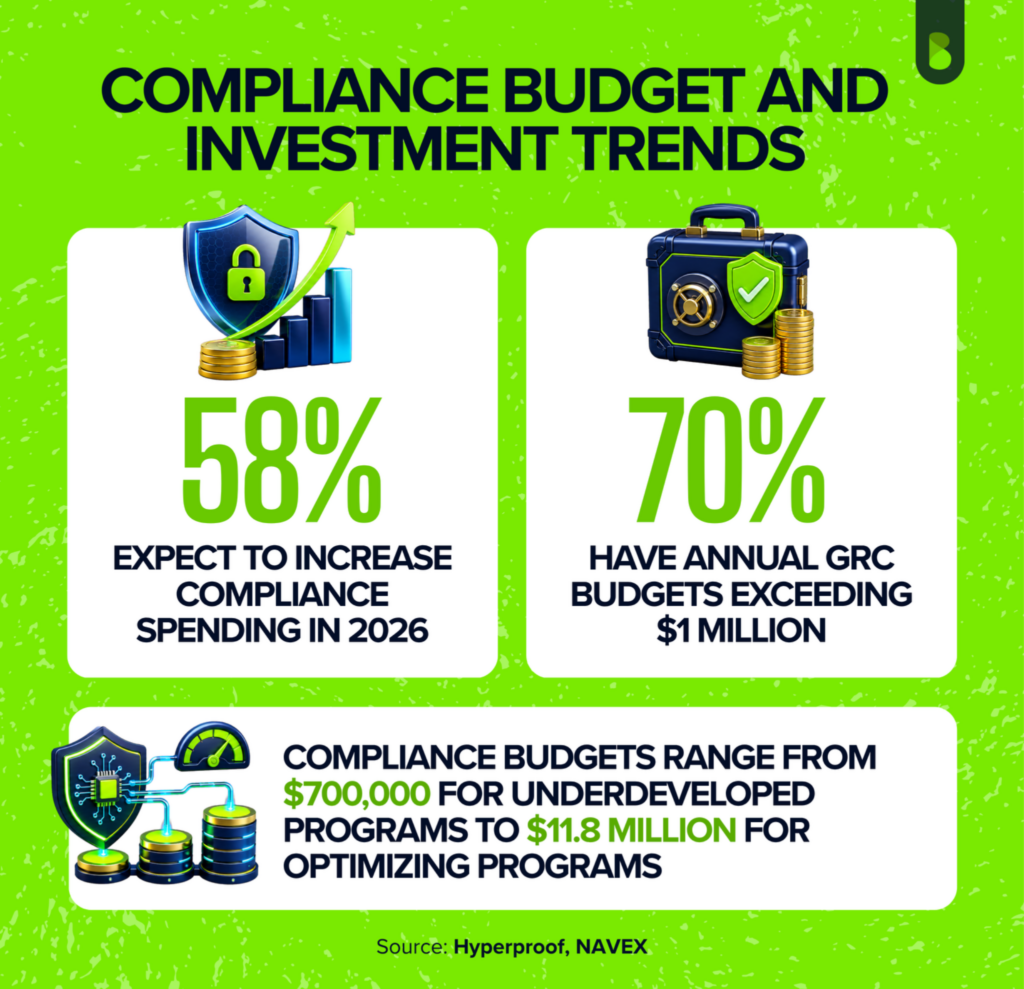
- 58% of organizations expected to increase spending on IT risk management and compliance during 2026. (Hyperproof IT Risk and Compliance Benchmark Report, 2026)
- 50% expected a slight GRC spending increase, while 8% expected a significant increase. Another 34% expected spending to remain unchanged, and 8% anticipated a reduction. (Hyperproof IT Risk and Compliance Benchmark Report, 2026)
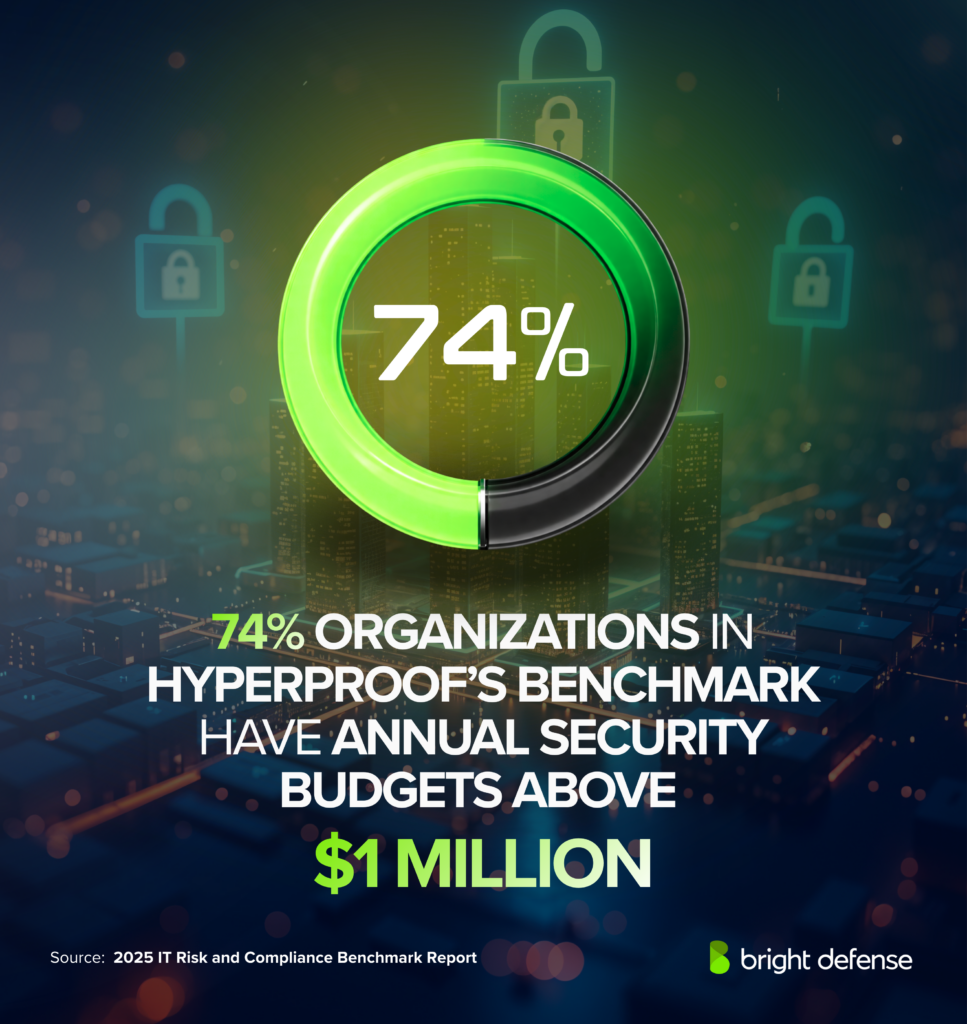
- 70% of surveyed organizations had annual GRC budgets exceeding $1 million. (Hyperproof IT Risk and Compliance Benchmark Report, 2026)
- Among organizations that increased GRC budgets, 45% raised spending by 11% to 25%, while 33% increased it by 1% to 10%. (Hyperproof IT Risk and Compliance Benchmark Report, 2026)
- Risk and compliance budgets averaged $700,000 for Underdeveloped programs, $1.7 million for Defining programs, $3.5 million for Adapting programs, $6 million for Managing programs, and $11.8 million for Optimizing programs. (NAVEX State of Risk and Compliance Report, 2026)
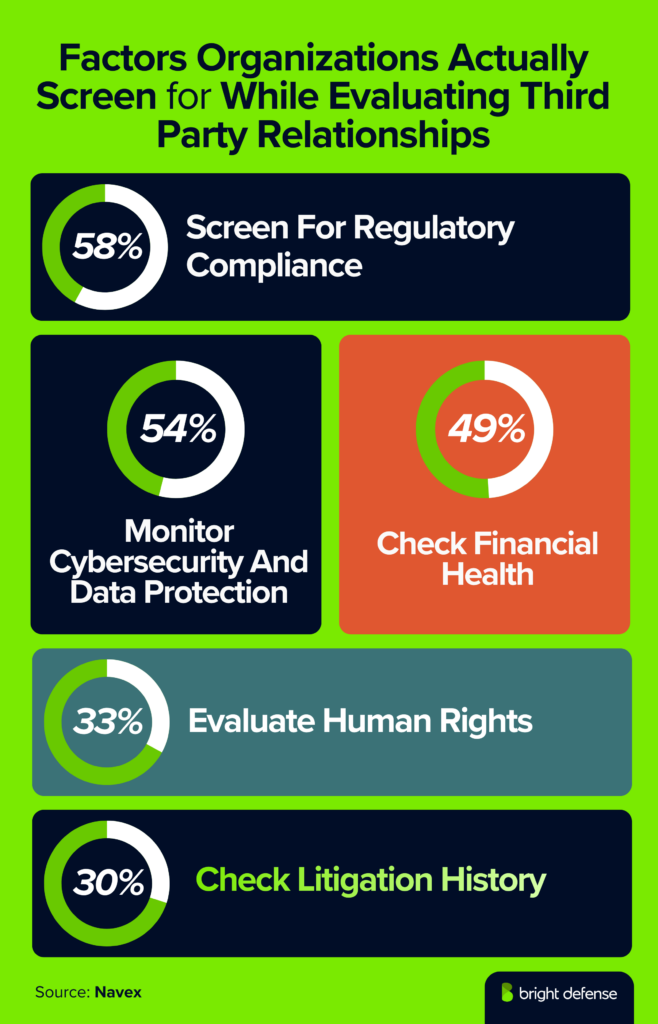
- Internal audits were the most effective argument for greater compliance investment at 49% of organizations, followed by regulatory changes at 45%. (NAVEX State of Risk and Compliance Report, 2026)
- Training and awareness received increased investment at 53% of organizations, followed by technology upgrades at 49% and risk assessments at 45%. (NAVEX State of Risk and Compliance Report, 2026)
- Highly regulated organizations had an average risk and compliance budget of $6.6 million, compared with $5.6 million among organizations in less regulated industries. (NAVEX State of Risk and Compliance Report, 2026)
Compliance Staffing and Workload
- 68% of organizations expected their compliance teams to grow during the following two years. (Hyperproof IT Risk and Compliance Benchmark Report, 2026)
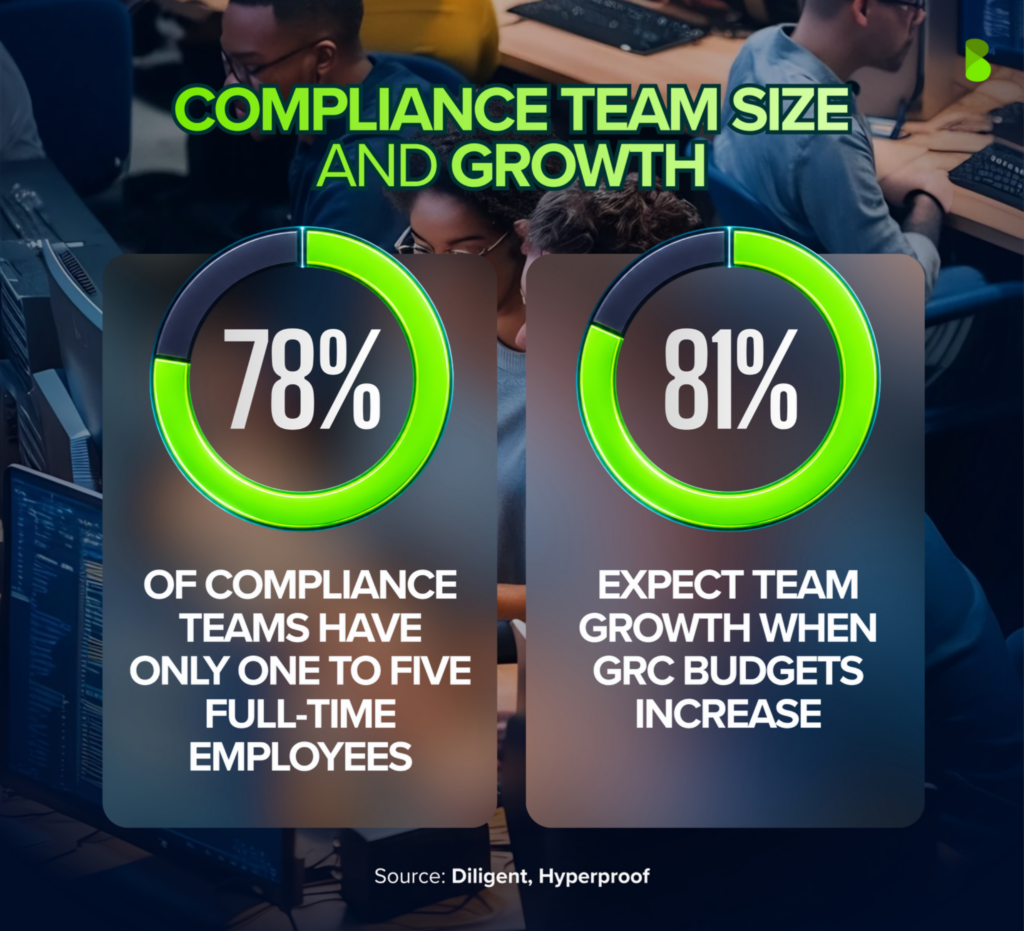
- Organizations whose GRC budgets increased were much more likely to expect compliance-team growth, at 81%, compared with 38% among organizations whose budgets remained unchanged. (Hyperproof IT Risk and Compliance Benchmark Report, 2026)
- Compliance staffing growth was expected by 74% of technology companies and 72% of banks, compared with 57% of manufacturers and 45% of healthcare organizations. (Hyperproof IT Risk and Compliance Benchmark Report, 2026)
- 38% of risk and compliance leaders identified expanded responsibilities without additional resources as an increasing internal challenge. (NAVEX State of Risk and Compliance Report, 2026)
- Difficulty coordinating across functions affected 34% of compliance teams, while 32% cited manual processes or technology limitations and 31% struggled to keep up with new regulatory demands. (NAVEX State of Risk and Compliance Report, 2026)
- Highly regulated organizations employed an average of 37 risk and compliance professionals, compared with 29 among less regulated organizations. (NAVEX State of Risk and Compliance Report, 2026)
- 78% of legal entity compliance functions operated with only one to five dedicated full-time employees. (Diligent Global State of Legal Entity Compliance, 2026)
- Talent retention and recruitment were a leading challenge for 27.5% of legal entity compliance practitioners. (Diligent Global State of Legal Entity Compliance, 2026)
Cybersecurity and Compliance Skills
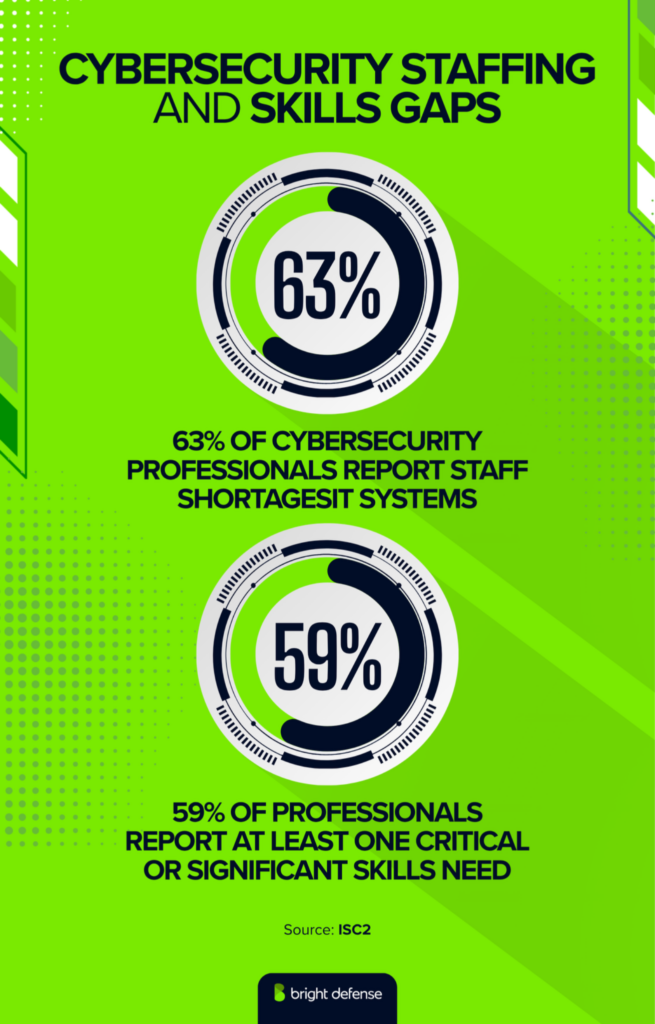
- 63% of cybersecurity professionals reported staff shortages within their teams. Only 34% believed they had the right staffing level, while 4% reported excess staff. (ISC2 Cybersecurity Workforce Study, 2025)
- 59% reported at least one critical or significant cybersecurity skills need, while 95% reported at least one skills gap of any severity. (ISC2 Cybersecurity Workforce Study, 2025)
- Artificial intelligence was the most commonly reported cybersecurity skills need at 41%, followed by cloud security at 36%, risk assessment at 29%, application security at 28%, and GRC and security engineering at 27% each. (ISC2 Cybersecurity Workforce Study, 2025)
- 33% of organizations lacked the budget needed to staff their cybersecurity teams adequately, while 29% could not afford professionals with the skills they required. (ISC2 Cybersecurity Workforce Study, 2025)
- Only 55% believed their organizations had sufficient resources to respond to security incidents over the next two to three years. (ISC2 Cybersecurity Workforce Study, 2025)
- 55% of ISACA respondents considered their cybersecurity teams understaffed, and the median security team contained 8 employees. (ISACA State of Cybersecurity, 2025)
- 47% of organizations had open non-entry-level cybersecurity roles, while only 18% had open entry-level positions. (ISACA State of Cybersecurity, 2025)
- 39% required three to six months to fill non-entry-level cybersecurity positions, while 25% needed more than six months. (ISACA State of Cybersecurity, 2025)
- Soft skills were the largest cybersecurity skills gap at 59%, followed by cloud computing at 37%, data security and large-language-model security operations at 33% each, and scripting or automation at 30%. (ISACA State of Cybersecurity, 2025)
- Professional development training was provided by 60% of employers, while 54% paid employee certification fees. (ISACA State of Cybersecurity, 2025)
- 64% of legal entity compliance practitioners ranked AI governance and oversight as the most important capability for the next three years. (Diligent Global State of Legal Entity Compliance, 2026)
Compliance Leadership, Culture, and Employee Training
Culture is determined by what leaders tolerate, reward, and enforce under pressure. Formal training and reporting channels matter, but employees judge the program by managerial behavior, retaliation risk, and whether the same standards apply to high performers and executives.
Compliance Leadership and Board Oversight
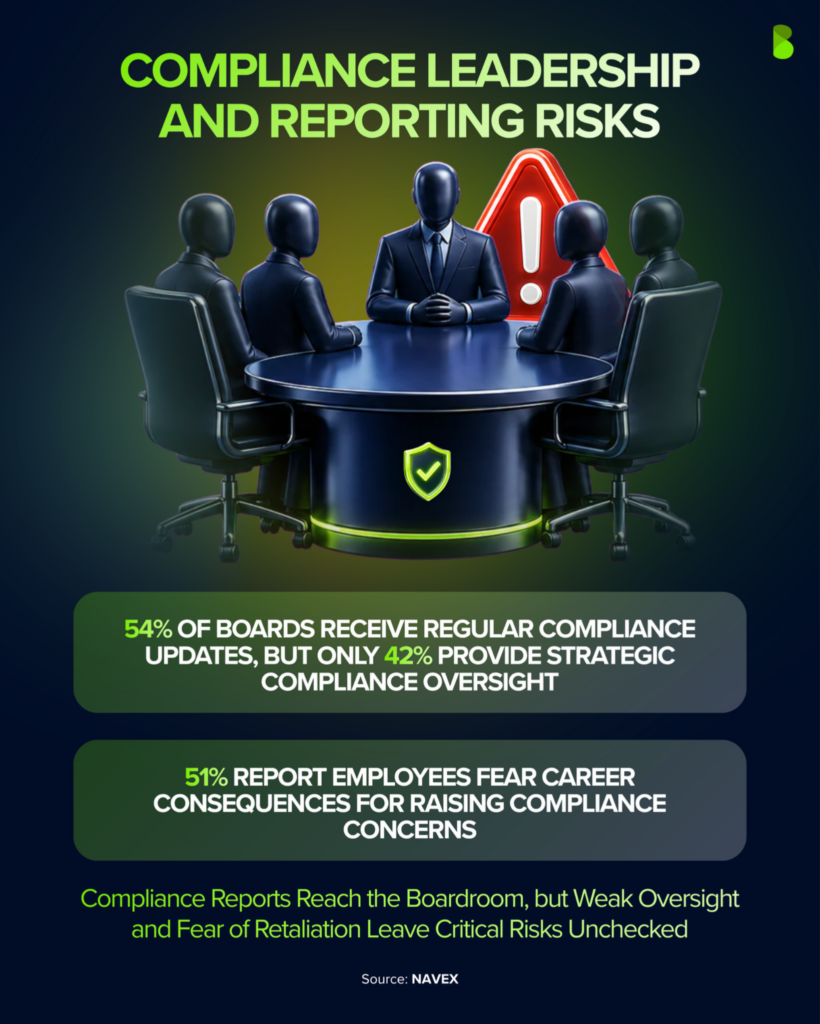
- 54% of boards received regular compliance updates, but only 42% provided strategic oversight of the compliance program. (NAVEX State of Risk and Compliance Report, 2026)
- Only 36% of boards participated in periodic compliance training, and 34% had a designated committee responsible for compliance oversight. (NAVEX State of Risk and Compliance Report, 2026)
- 70% said senior leaders encouraged compliance and ethics, compared with 62% for middle management and 59% for frontline managers. (NAVEX State of Risk and Compliance Report, 2026)
- 55% said senior leaders modeled proper behavior, falling to 53% for middle managers and 50% for frontline managers. (NAVEX State of Risk and Compliance Report, 2026)
- 50% believed senior leaders remained committed to ethics when business objectives competed with compliance, compared with 45% for middle management and 44% for frontline managers. (NAVEX State of Risk and Compliance Report, 2026)
- Greater compliance risk was tolerated in pursuit of revenue or business objectives by 29% of senior leaders, 30% of middle managers, and 27% of frontline managers. (NAVEX State of Risk and Compliance Report, 2026)
- 65% said the compliance officer met with or presented to the board quarterly. (SAI360 Healthcare Compliance Benchmark Report, 2026)
- Only 23% said the compliance officer routinely met privately with the board without management present. (SAI360 Healthcare Compliance Benchmark Report, 2026)
Compliance Culture and Speak-Up Confidence
- 61% of employees believed high performers were held to the same standards as everyone else. (LRN Ethics and Compliance Program Effectiveness Report, 2026)
- 58% believed managers held themselves to the same ethical standards as other employees. In low-impact programs, that figure fell to 15%. (LRN Ethics and Compliance Program Effectiveness Report, 2026)
- 71% said employees continued following organizational values and the code of conduct even under pressure to meet business goals. (LRN Ethics and Compliance Program Effectiveness Report, 2026)
- Only 54% said employees questioned decisions that did not appear consistent with organizational values or ethical standards. (LRN Ethics and Compliance Program Effectiveness Report, 2026)
- 88% knew how to ask questions or report compliance concerns, while 86% felt comfortable doing so. (LRN Ethics and Compliance Program Effectiveness Report, 2026)
- 85% believed their organizations encouraged reporting and protected people who raised concerns from retaliation. (LRN Ethics and Compliance Program Effectiveness Report, 2026)
- 78% said supervisors or managers regularly discussed compliance and ethical issues. (LRN Ethics and Compliance Program Effectiveness Report, 2026)
- 51% of organizations said leaders encouraged employees to speak up, but the same percentage reported that employees feared negative career consequences for doing so. (NAVEX State of Risk and Compliance Report, 2026)
- 53% of non-leadership respondents believed employees feared negative consequences from speaking up, compared with 43% of C-suite respondents. (NAVEX State of Risk and Compliance Report, 2026)
- 47% of organizations did not include an anonymous option among their reporting channels. (NAVEX State of Risk and Compliance Report, 2026)
- Fear of speaking up was identified as a reporting deterrent by 51%, while fear of retaliation was cited by 18%. (NAVEX State of Risk and Compliance Report, 2026)
Compliance Training and Employee Awareness
- 84% of employees said compliance training was relevant to their role and suited to their needs. (LRN Ethics and Compliance Program Effectiveness Report, 2026)
- 77% considered their compliance training engaging. (LRN Ethics and Compliance Program Effectiveness Report, 2026)
- 85% knew where to locate compliance guidance, while 87% considered the available policies and guidance relevant and helpful. (LRN Ethics and Compliance Program Effectiveness Report, 2026)
- 92% of surveyed Nordic organizations provided Code of Conduct training to all employees. (Nordic Ethics and Compliance Survey, 2025)
- 64% provided risk-based ethics and compliance training tailored to specific employee roles. (Nordic Ethics and Compliance Survey, 2025)
- 75% of surveyed healthcare organizations provided compliance training when employees were hired and annually thereafter. (SAI360 Healthcare Compliance Benchmark Report, 2026)
- Nearly 50% evaluated whether compliance training was effective beyond merely tracking attendance, while approximately 25% did so inconsistently. (SAI360 Healthcare Compliance Benchmark Report, 2026)
- 50% provided specialized training tailored to employees’ individual responsibilities, while roughly another quarter provided it only sometimes. (SAI360 Healthcare Compliance Benchmark Report, 2026)
- 53% of organizations expected training and awareness to receive increased investment or activity during 2026, making it the leading investment priority measured by NAVEX. (NAVEX State of Risk and Compliance Report, 2026)
Compliance Tools and Automation Statistics
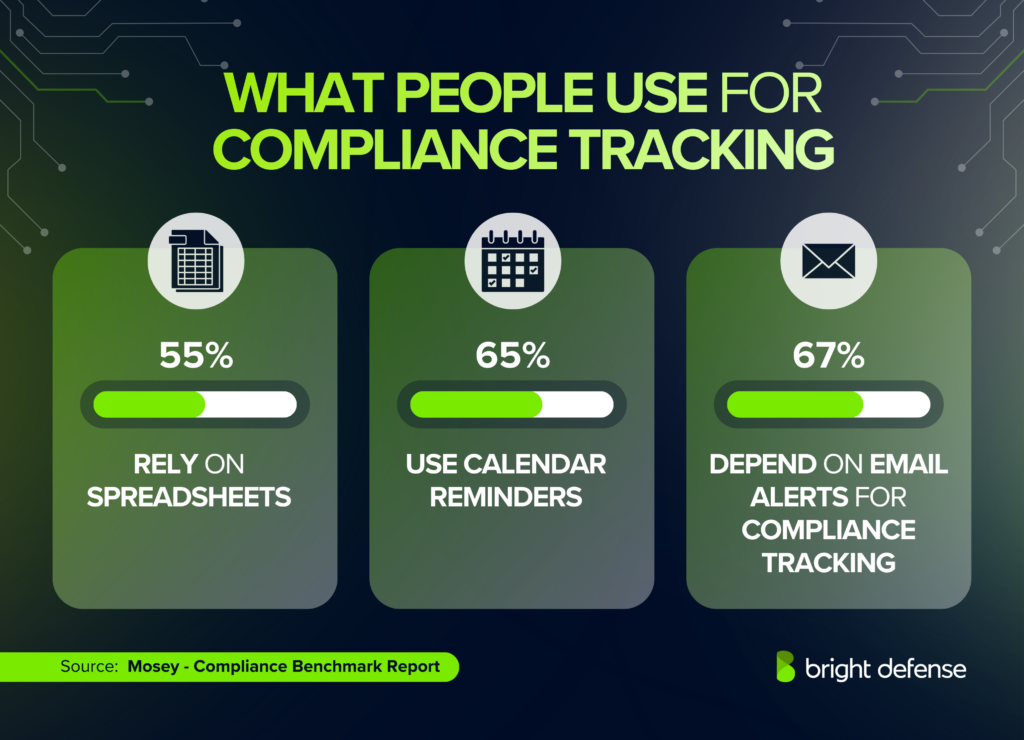
Compliance automation is becoming standard across evidence collection, control mapping, audit preparation, monitoring, and reporting. The remaining gap is not access to technology but whether teams integrate it into reliable workflows, maintain trustworthy data, and measure reductions in manual work and risk.
- 97% of GRC professionals used AI to streamline at least part of their workflows in 2026. (Hyperproof IT Risk and Compliance Benchmark Report, 2026)
- 34% still used spreadsheets to identify and manage third-party risks, showing that manual GRC processes remain common despite broader automation adoption. (Hyperproof IT Risk and Compliance Benchmark Report, 2026)
- Compliance technology provided better visibility into risks for 64% of organizations. (PwC Global Compliance Survey, 2025)
- 53% said compliance technology supported faster identification of and response to compliance issues. (PwC Global Compliance Survey, 2025)
- 48% reported that compliance technology improved the quality and usefulness of reporting. (PwC Global Compliance Survey, 2025)
- 43% achieved productivity improvements or cost savings through compliance technology. (PwC Global Compliance Survey, 2025)
- Only 34% of ethics and compliance programs actively used data analytics to evaluate program performance. (LRN Ethics and Compliance Program Effectiveness Report, 2026)
- High-impact compliance programs were nearly 2 times as likely to use benchmarking, advanced analytics, and automation as other programs. (LRN Ethics and Compliance Program Effectiveness Report, 2026)
- Embedded productivity AI tools such as Microsoft Copilot, Google Workspace AI, and Glean were used by 69% of surveyed legal entity compliance functions. (Diligent Global State of Legal Entity Compliance, 2026)
AI in Compliance Statistics
AI has moved from an emerging technology issue to a direct compliance responsibility. Organizations are using AI across training, monitoring, investigations, reporting, security, and decision support, but policies, risk assessments, autonomy limits, data controls, and outcome measurement remain uneven.
AI Adoption in Compliance Programs
- Only 4% of NAVEX respondents said their compliance programs did not use AI in any area. (NAVEX State of Risk and Compliance Report, 2026)
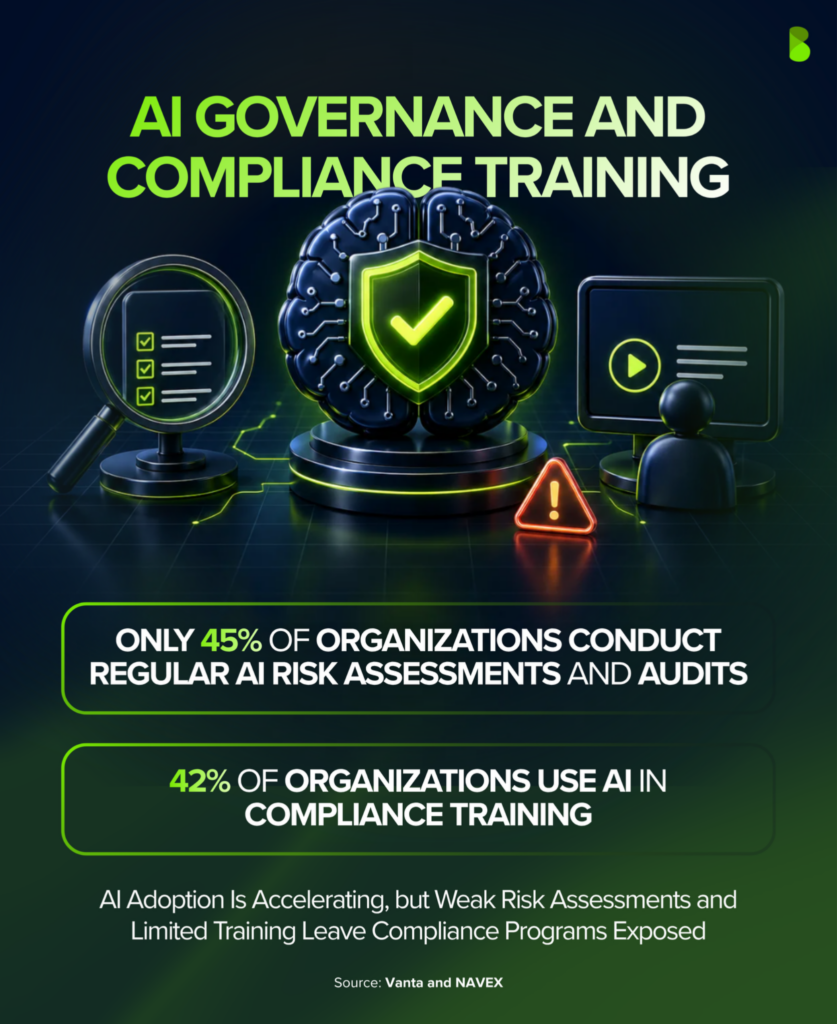
- 42% used AI in compliance training, making it the most common AI application measured by NAVEX. (NAVEX State of Risk and Compliance Report, 2026)
- 33% used AI for monitoring and surveillance of potential wrongdoing. (NAVEX State of Risk and Compliance Report, 2026)
- 32% used AI for program reporting and analytics. (NAVEX State of Risk and Compliance Report, 2026)
- 39% of ethics and compliance programs used AI in at least one area, but fewer than half could explain how it improved program outcomes. (LRN Ethics and Compliance Program Effectiveness Report, 2026)
- High-impact programs were 2.2 times more likely to focus on AI risks, 1.4 times more likely to integrate AI into training, and 1.3 times more likely to address AI in their codes of conduct. (LRN Ethics and Compliance Program Effectiveness Report, 2026)
AI Governance and Oversight
- Compliance teams were involved in organizational AI decisions at 78% of surveyed organizations, including 38% that were very involved and 40% that were somewhat involved. (NAVEX State of Risk and Compliance Report, 2026)
- 79% of organizations were using or actively planning to use agentic AI. (Vanta State of Trust Report, 2025)
- 65% said their use of agentic AI had outpaced their understanding of the technology. (Vanta State of Trust Report, 2025)
- Only 48% had a framework for granting or limiting autonomy in agentic AI systems. (Vanta State of Trust Report, 2025)
- 62% worried that agentic AI could damage or erode customer trust. (Vanta State of Trust Report, 2025)
- 45% conducted regular AI risk assessments and audits. (Vanta State of Trust Report, 2025)
- 44% had developed and implemented a company AI policy. (Vanta State of Trust Report, 2025)
- Only 41% applied strict data-minimization practices to AI use, while 35% relied exclusively on anonymized data when training AI systems. (Vanta State of Trust Report, 2025)
- Only 31% of organizations using customer data for AI training required customers to opt in. (Vanta State of Trust Report, 2025)
- 64% of legal entity compliance practitioners ranked AI governance and oversight as the most important skill for the following three years. (Diligent Global State of Legal Entity Compliance, 2026)
- 31% had formally added AI governance to their compliance responsibilities. (Diligent Global State of Legal Entity Compliance, 2026)
- 38% were comfortable allowing AI to complete basic compliance actions without prior human approval. (Diligent Global State of Legal Entity Compliance, 2026)
- Only 33% of ethics and compliance programs referred to AI ethics in their codes of conduct. (LRN Ethics and Compliance Program Effectiveness Report, 2026)
Cybersecurity, Data Privacy, and Compliance
Cybersecurity compliance increasingly requires proof that controls work during real incidents. Organizations must protect data, manage identities, reduce tool fragmentation, detect attacks, and demonstrate that critical services can continue or recover.
Cybersecurity Readiness and Control Effectiveness
- Only 4% of organizations reached the Mature stage of cybersecurity readiness, while 70% remained in the Formative or Beginner categories. (Cisco Cybersecurity Readiness Index, 2025)
- 49% of organizations experienced at least one cyberattack during the previous year. (Cisco Cybersecurity Readiness Index, 2025)
- 71% believed a cybersecurity incident was likely to disrupt their business within the following 12 to 24 months. (Cisco Cybersecurity Readiness Index, 2025)
- Only 34% were highly confident that their current cybersecurity infrastructure could withstand an attack. (Cisco Cybersecurity Readiness Index, 2025)
- 77% said having too many disconnected security products slowed their ability to detect, respond to, and recover from incidents. (Cisco Cybersecurity Readiness Index, 2025)
- 84% said employees accessed company networks from unmanaged devices. (Cisco Cybersecurity Readiness Index, 2025)
- 86% considered the shortage of cybersecurity talent a challenge, including 39% who described it as a significant challenge. (Cisco Cybersecurity Readiness Index, 2025)
- The global median attacker dwell time reached 14 days in 2025, up from 11 days. (Mandiant M-Trends Report, 2026)
- Exploitation of vulnerabilities caused 32% of incidents where Mandiant could determine the initial infection vector. (Mandiant M-Trends Report, 2026)
- Ransomware-related intrusions had a median dwell time of 9 days, falling to 5 days when attackers disclosed the incident and rising to 12 days when organizations detected it internally. (Mandiant M-Trends Report, 2026)
- More than 97% of identity attacks observed by Microsoft involved password spraying or brute-force techniques. (Microsoft Digital Defense Report, 2025)
- Modern multifactor authentication reduced identity-compromise risk by more than 99%. (Microsoft Digital Defense Report, 2025)
Data Privacy, Trust, and Cross-Border Risk
- 90% of security and privacy professionals believed that data was inherently safer when stored within their own country or region. (Cisco Data Privacy Benchmark Study, 2025)
- 88% said data localization added significant operational costs. (Cisco Data Privacy Benchmark Study, 2025)
- 91% believed global providers could protect data better than providers operating only within a particular country or region. (Cisco Data Privacy Benchmark Study, 2025)
- 86% said privacy legislation had positively affected their organization. (Cisco Data Privacy Benchmark Study, 2025)
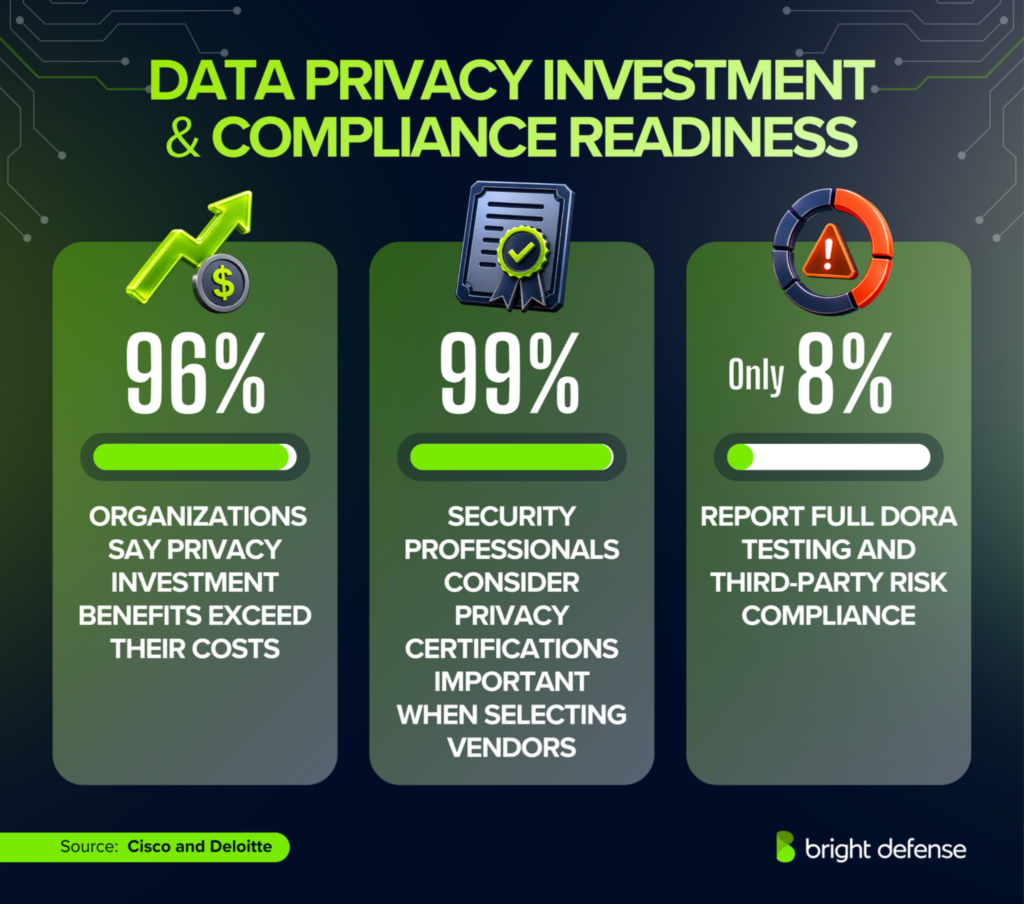
- 96% said the benefits generated by privacy investments exceeded their costs. (Cisco Data Privacy Benchmark Study, 2025)
- Average organizational privacy spending reached $2.7 million. (Cisco Data Privacy Benchmark Study, 2025)
- 53% estimated that privacy spending generated a return of between 1 and 2 times the investment, with a median return of 1.6 times. (Cisco Data Privacy Benchmark Study, 2025)
- Privacy investment produced significant customer loyalty and trust benefits for 79% of organizations. (Cisco Data Privacy Benchmark Study, 2025)
- 76% said privacy investments mitigated security losses, while 75% said they reduced sales delays. (Cisco Data Privacy Benchmark Study, 2025)
- 99% considered external privacy certifications important when selecting vendors. (Cisco Data Privacy Benchmark Study, 2025)
- 95% believed customers would not purchase from organizations that failed to protect their data properly. (Cisco Data Privacy Benchmark Study, 2025)
Operational Resilience and DORA Readiness
- 83% of surveyed European financial entities had estimated their DORA compliance costs. (Deloitte European DORA Survey, 2025)
- 64% expected DORA compliance to cost between €2 million and €5 million, while 8% estimated costs between €5 million and €10 million. (Deloitte European DORA Survey, 2025)
- 48% reported full compliance with DORA’s ICT incident management, classification, and reporting requirements. (Deloitte European DORA Survey, 2025)
- 25% reported full compliance with DORA’s ICT risk-management requirements. (Deloitte European DORA Survey, 2025)
- Only 8% reported full compliance with digital operational resilience testing, and the same percentage reported full compliance with ICT third-party risk management. (Deloitte European DORA Survey, 2025)
- 42% identified ICT network segregation and segmentation as their most difficult network-security requirement. (Deloitte European DORA Survey, 2025)
- Only 42% always recorded the costs and losses caused by ICT incidents and disruptions, while 37% did so only sometimes. (Deloitte European DORA Survey, 2025)
The Importance of Vendor Compliance and Third-Party Risk
Third-party risk is now a central compliance and resilience problem. Companies manage hundreds of vendors, but assessment teams remain small, evidence arrives slowly, and few organizations map or test the full chain of dependencies.
Third-Party Exposure and Vendor Scale
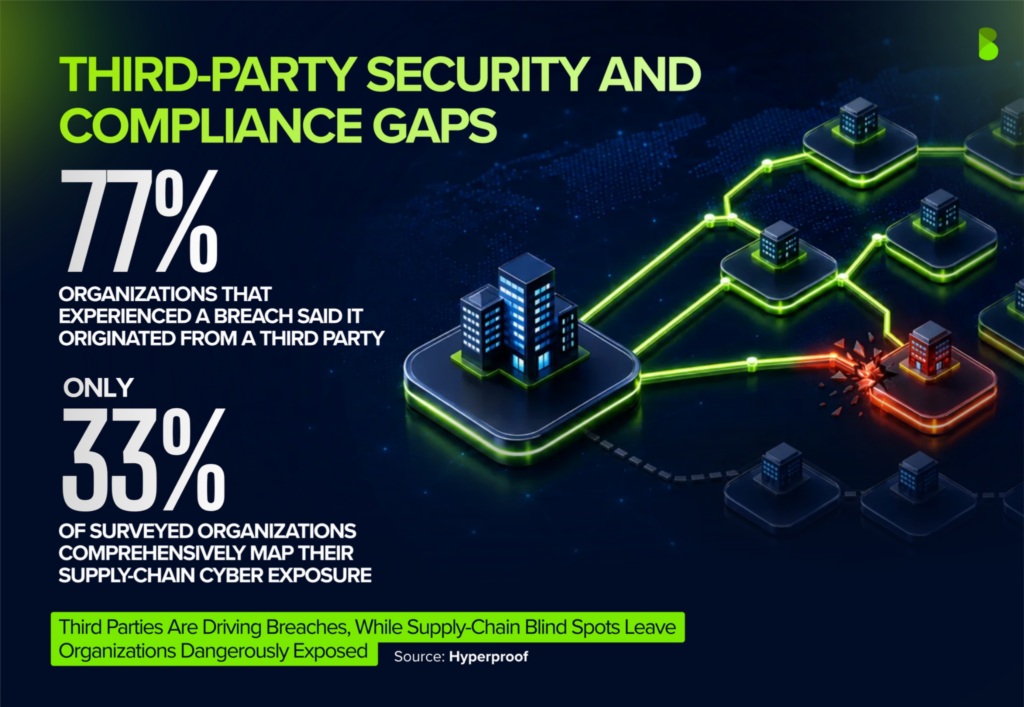
- 70% of organizations experienced a data breach during the previous three years. (Whistic Third-Party Risk Management Impact Report, 2025)
- 77% of those breaches originated from a vendor or another part of the third-party supply chain. (Whistic Third-Party Risk Management Impact Report, 2025)
- 56% of companies worked with more than 100 vendors in 2025. (Whistic Third-Party Risk Management Impact Report, 2025)
- The average company worked with 286 vendors, including suppliers of software, infrastructure, professional services, and business-critical technology. (Whistic Third-Party Risk Management Impact Report, 2025)
- Organizations expected to assess an average of 255 vendors during the year. (Whistic Third-Party Risk Management Impact Report, 2025)
- The average third-party risk management team contained 8.5 people, but 75% of organizations still operated with fewer than 10 TPRM employees. (Whistic Third-Party Risk Management Impact Report, 2025)
- 80% planned to hire additional employees to support vendor assessments during the following 12 months. (Whistic Third-Party Risk Management Impact Report, 2025)
Vendor Assessments and Compliance Evidence
- 94% said they would assess more vendors, and 97% would conduct more detailed assessments, with better processes, staffing, technology, or resources. (Whistic Third-Party Risk Management Impact Report, 2025)
- 58% of organizations spent more than 30 hours per week on vendor assessments, while the average TPRM team spent 37.4 hours. (Whistic Third-Party Risk Management Impact Report, 2025)
- 87% waited more than 4 days for complete vendor information, 56% waited more than 1 week, and the average complete response took about 12 days. (Whistic Third-Party Risk Management Impact Report, 2025)
- 84% of initial vendor assessments required additional evidence, clarification, remediation, or another follow-up action. (Whistic Third-Party Risk Management Impact Report, 2025)
- 88% almost always or always had to search vendor documentation manually for specific evidence, control gaps, or data points. (Whistic Third-Party Risk Management Impact Report, 2025)
- The average organization experienced 7 security events per year that triggered vendor outreach or reassessment. Each event required another 14.8 hours of vendor follow-up. (Whistic Third-Party Risk Management Impact Report, 2025)
- 75% used customized security questionnaires during vendor assessments. (Whistic Third-Party Risk Management Impact Report, 2025)
- 74% accepted a completed standard assessment such as SIG, ISO, or CAIQ, and 93% would at least begin an assessment with one. (Whistic Third-Party Risk Management Impact Report, 2025)
- 34% still managed third-party risk in spreadsheets, while dedicated vendor-risk software was used by 73% of integrated and automated programs versus 49% of integrated but mostly manual programs. (Hyperproof IT Risk and Compliance Benchmark Report, 2026)
- A complete security questionnaire required an average of 4.8 hours, contributing to about 179 hours of vendor employee time per month. (Whistic Third-Party Risk Management Impact Report, 2025)
- 76% of vendors used a customer-facing trust center, and 34% of trust-center users deflected more than half of incoming questionnaires. (Whistic Third-Party Risk Management Impact Report, 2025)
SaaS, Supply Chain, and Third-Party Resilience
- 63% identified external oversharing of sensitive or confidential SaaS data as a significant security risk. (Cloud Security Alliance State of SaaS Security Report, 2025-2026)
- 56% said employees uploaded sensitive data to unauthorized SaaS applications, while 55% reported that employees adopted SaaS tools without security-team involvement. (Cloud Security Alliance State of SaaS Security Report, 2025-2026)
- 56% were concerned that third-party vendors and AI-powered SaaS tools had overprivileged API access to organizational data. (Cloud Security Alliance State of SaaS Security Report, 2025-2026)
- 46% struggled to monitor non-human identities, and 54% lacked automated user provisioning and deprovisioning across SaaS environments. (Cloud Security Alliance State of SaaS Security Report, 2025-2026)
- 66% assessed supplier cybersecurity maturity, and 65% involved cybersecurity teams in procurement or supplier selection. (World Economic Forum Global Cybersecurity Outlook, 2026)
- Only 33% comprehensively mapped supply-chain cyber exposure, and only 27% conducted joint incident or recovery exercises with ecosystem partners. (World Economic Forum Global Cybersecurity Outlook, 2026)
- Inheritance risk, or the inability to verify the integrity of third-party software, hardware, and services, ranked as the leading supply-chain cyber risk in 2026. Limited visibility ranked second, followed by concentration risk. (World Economic Forum Global Cybersecurity Outlook, 2026)
- Only 8% of surveyed European financial entities reported full compliance with DORA’s ICT third-party risk-management requirements. (Deloitte European DORA Survey, 2025)
- 46% identified completion of the DORA Register of Information as their most difficult implementation requirement. (Deloitte European DORA Survey, 2025)
- 54% excluded third-party ICT providers from validation of their incident-response plans. (Deloitte European DORA Survey, 2025)
- Only 25% trained ICT providers on their response responsibilities and included them in crisis-resilience simulations. (Deloitte European DORA Survey, 2025)
- 38% were still mapping their ICT service supply chains, 32% had identified only direct providers, 29% had mapped providers through the second tier, and only 1% had mapped beyond the second tier. (Deloitte European DORA Survey, 2025)
Compliance Framework Adoption Statistics
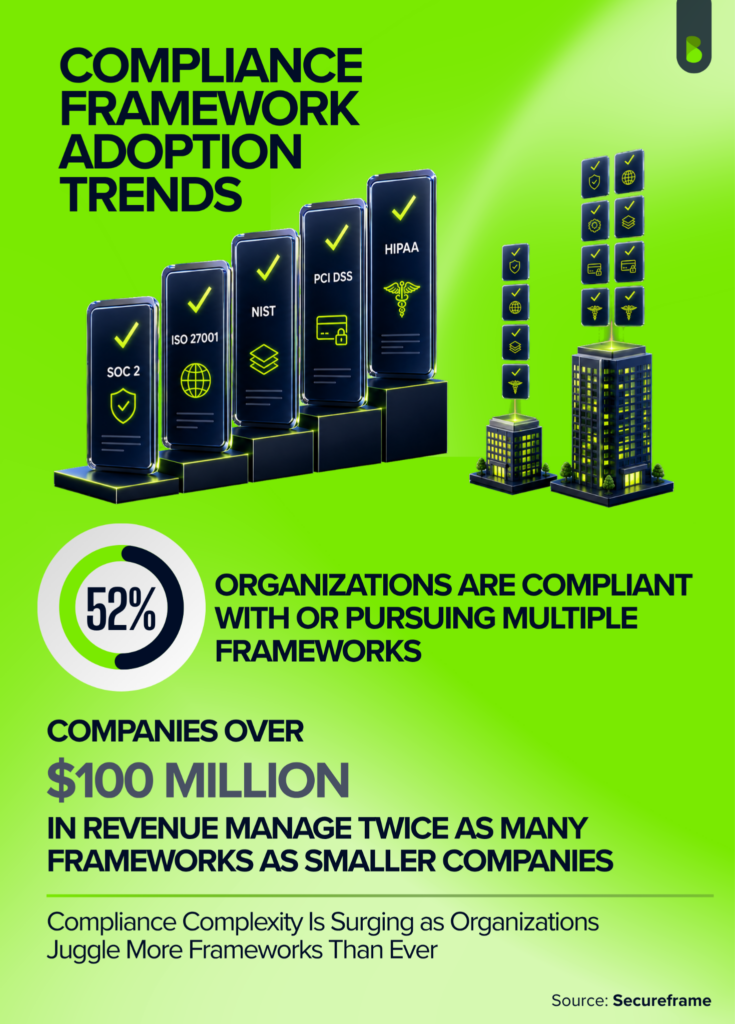
Framework adoption is moving from single certifications toward multi-framework programs. Larger and more regulated companies manage more standards and increasingly rely on common controls to reduce duplicate evidence and testing.
- 52% of surveyed organizations were compliant with or pursuing more than one framework. (Secureframe Cybersecurity and Compliance Benchmark Report, 2026)
- 46% managed one framework, 31% managed two, 17% managed three, and 4% managed four or more. (Secureframe Cybersecurity and Compliance Benchmark Report, 2026)
- Companies generating more than $100 million in annual revenue managed an average of 3.2 frameworks, compared with 1.6 frameworks among companies generating less than $5 million. (Secureframe Cybersecurity and Compliance Benchmark Report, 2026)
- Aerospace and robotics, transportation, and nonprofit organizations managed an average of 3 frameworks each, the highest industry averages in Secureframe’s survey. (Secureframe Cybersecurity and Compliance Benchmark Report, 2026)
- Government and public-sector organizations managed an average of 2.25 frameworks, while healthcare organizations managed 2.1 frameworks. (Secureframe Cybersecurity and Compliance Benchmark Report, 2026)
- 56% of organizations used a common controls framework to combine overlapping requirements from multiple regulations and standards. (Hyperproof IT Risk and Compliance Benchmark Report, 2026)
- 25% managed regional variation by applying the most rigorous law or requirement across the organization. (Hyperproof IT Risk and Compliance Benchmark Report, 2026)
- 12% maintained a dedicated team specializing in regional compliance requirements, while 6% addressed new privacy and security regulations individually as they were enacted. (Hyperproof IT Risk and Compliance Benchmark Report, 2026)
- 72% of Secureframe respondents said achieving a new framework typically took between 1 and 6 months, including 35% requiring one to three months and 37% requiring three to six months. (Secureframe Cybersecurity and Compliance Benchmark Report, 2026)
- 14% required six to nine months to achieve a new framework, 9% required nine to twelve months, and 5% required more than one year. (Secureframe Cybersecurity and Compliance Benchmark Report, 2026)
- 12% identified interpreting framework requirements as a leading compliance challenge, while 8% struggled with framework changes and 7% had difficulty determining which frameworks applied to them. (Secureframe Cybersecurity and Compliance Benchmark Report, 2026)
- 60% of respondents in A-LIGN’s survey worked with the U.S. federal government. Among those organizations, 94% were pursuing CMMC, FISMA, FedRAMP, or GovRAMP compliance. (A-LIGN Compliance Benchmark Report, 2026)
Secureframe, Hyperproof, and A-LIGN surveyed different customer and professional populations. Their percentages should be read as evidence of multi-framework growth, not as global adoption shares.
Compliance Framework Statistics
The following sections focus on framework-specific requirements, adoption, audit timing, costs, control structures, and recent regulatory changes.
SOC 2 Compliance Statistics
SOC 2 remains one of the most commercially important assurance reports for technology and service providers. The strongest current data concerns customer use, audit timing, costs, and recurring control failures.
- SOC 2 examinations can address 5 Trust Services Categories: Security, Availability, Processing Integrity, Confidentiality, and Privacy. (AICPA Trust Services Criteria)
- Security is the only Trust Services Category required in every SOC 2 examination, while the other 4 categories are added according to the organization’s services, risks, and customer requirements. (Vanta SOC 2 Audit Timeline)
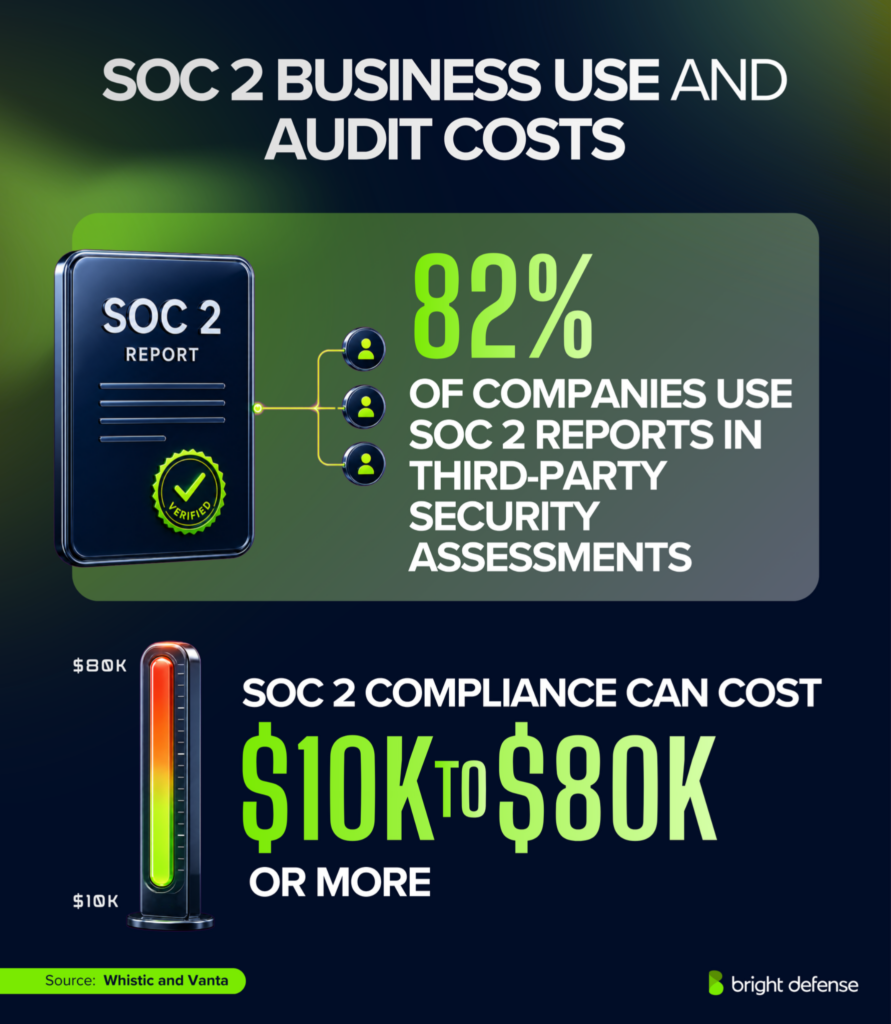
- 82% of companies used a SOC 2 audit report as part of their third-party security assessment process. (Whistic Third-Party Risk Management Impact Report, 2025)
- SOC 2 audit preparation without automation typically takes 1 to 5 months, depending on the organization’s size, control readiness, and use of external support. (Vanta SOC 2 Audit Cost)
- SOC 2 audit fees typically range from $10,000 to $50,000, depending on the auditor, company size, scope, and complexity. (Vanta SOC 2 Audit Cost)
- The combined cost of SOC 2 preparation and the audit can range from $10,000 to $80,000 or more after readiness assessments, security tools, consulting, and audit fees are included. (Vanta SOC 2 Audit Cost)
- A SOC 2 Type 1 engagement generally includes 1 to 3 months of preparation, 2 to 5 weeks of official audit work, and 2 to 6 weeks for report creation and delivery. (Vanta SOC 2 Audit Timeline)
- SOC 2 Type 2 observation windows commonly span 3, 6, 9, or 12 months, with first-time audits often using 3 months and later audits moving to annual periods. (Vanta Audit FAQ, 2026)
- A SOC 2 Type 2 engagement generally requires 2 to 5 weeks of official audit review and another 2 to 6 weeks for report preparation after or near the end of the observation period. (Vanta SOC 2 Audit Timeline)
- KPMG analyzed more than 400 controls assurance reports issued between 2021 and 2023 across SOC 1, SOC 2, AAF, and ISAE reporting frameworks. (KPMG Controls Assurance Benchmarking Report, 2024)
- Manually operated controls accounted for 89% of exceptions identified during operating-effectiveness testing. (KPMG Controls Assurance Benchmarking Report, 2024)
- System access controls produced 17% of all control exceptions despite representing only 8% of the controls included in the analyzed reports. (KPMG Controls Assurance Benchmarking Report, 2024)
- Only 35% of system access controls were automated, leaving most access reviews and related processes dependent on manual operation. (KPMG Controls Assurance Benchmarking Report, 2024)
- 41% of Type 1 reports contained no exceptions, compared with only 2% of Type 2 reports. (KPMG Controls Assurance Benchmarking Report, 2024)
- Around 20% of the controls assurance reports analyzed by KPMG received qualified opinions. (KPMG Controls Assurance Benchmarking Report, 2024)
- Operating-effectiveness issues accounted for 83% of the exceptions that led to qualified reports, while design or implementation issues accounted for 17%. (KPMG Controls Assurance Benchmarking Report, 2024)
- Management review controls generated 30% of operating-effectiveness exceptions, followed by system access controls at 17% and authorization controls at 15%. (KPMG Controls Assurance Benchmarking Report, 2024)
KPMG’s control-exception figures are based on more than 400 assurance reports issued from 2021 through 2023. They remain useful as the latest detailed public benchmark of where operating-effectiveness failures concentrate.
ISO 27001 Compliance Statistics
ISO 27001 data shows strong enterprise use, a completed transition to the 2022 edition, a smaller and reorganized Annex A control set, and substantial variation in certification timelines and costs.
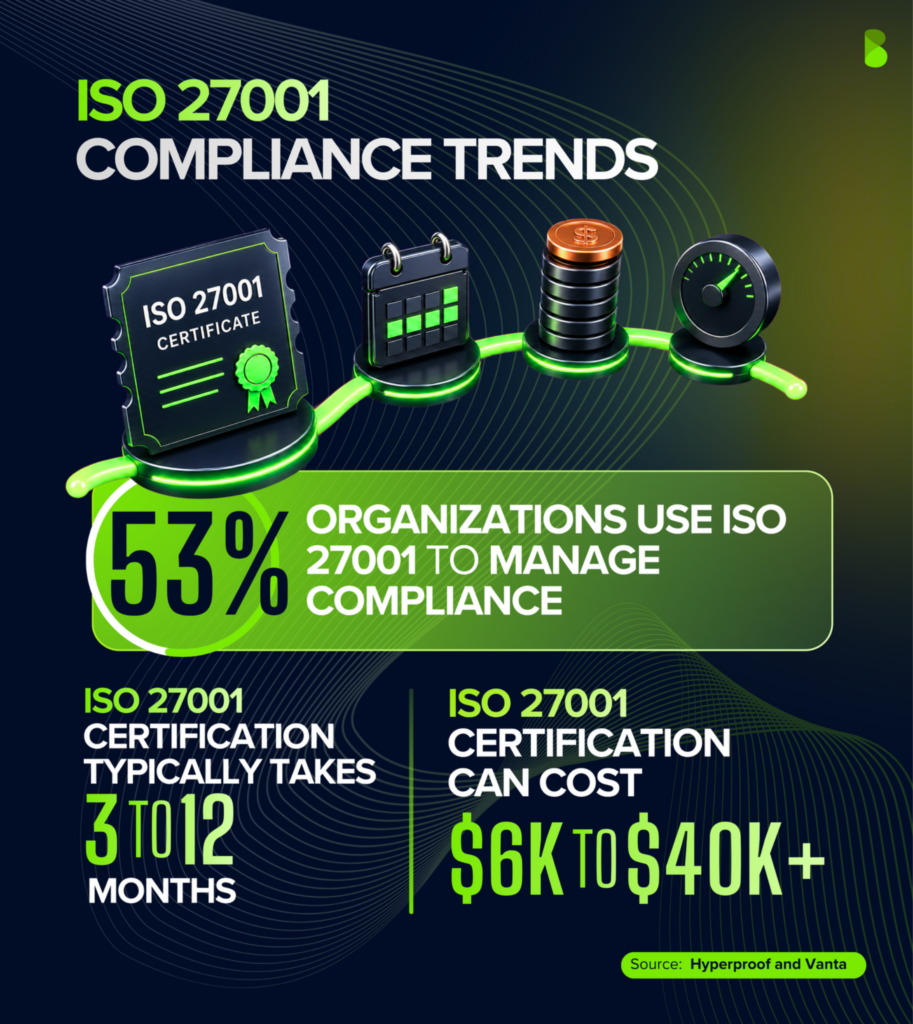
- 53% of organizations used ISO 27001 to manage compliance in Hyperproof’s 2026 survey, making it one of the leading security and privacy frameworks. (Hyperproof IT Risk and Compliance Benchmark Report, 2026)
- Certified organizations had to complete their transition to ISO/IEC 27001:2022 by 31 October 2025. (IAF Transition Requirements for ISO/IEC 27001:2022)
- ISO/IEC 27001:2013 certificates that had not transitioned were required to expire or be withdrawn after 31 October 2025. (NSAI ISO/IEC 27001:2022 Transition Policy)
- ISO/IEC 27001:2022 reduced the Annex A control set from 114 controls to 93 controls. (DNV ISO/IEC 27001:2022 Changes and Benefits)
- The revised standard introduced 11 new controls, updated 58 controls, and merged 24 controls. (DNV ISO/IEC 27001:2022 Changes and Benefits)
- The 93 Annex A controls are organized into 4 themes: Organizational, People, Physical, and Technological. (DNV ISO/IEC 27001:2022 Changes and Benefits)
- ISO/IEC 27001:2022 did not reduce the standard from 14 clauses to 4 clauses. It reorganized 14 control domains into 4 themes, while the core management-system requirements remain in Clauses 4 through 10. (DNV ISO/IEC 27001:2022 Changes and Benefits)
- The ISO 27001 certification lifecycle commonly includes 5 stages: optional pre-assessment, Stage 1 audit, Stage 2 audit, surveillance audit, and recertification. (A-LIGN ISO 27001 Certification Process)
- ISO 27001 certification typically takes 3 to 12 months, depending on organizational readiness, resource allocation, and ISMS complexity. (Vanta ISO 27001 Certification Timeline)
- Pre-audit preparation generally takes 1 to 4 months or longer, including scoping, risk assessment, control implementation, internal auditing, and remediation. (Vanta ISO 27001 Certification Timeline)
- Auditor selection, Stage 1, Stage 2, and certificate issuance can require another 2 to 6 months. (Vanta ISO 27001 Certification Timeline)
- ISO 27001 certification remains valid for up to 3 years, subject to annual surveillance audits and full recertification at the end of the cycle. (Vanta ISO 27001 Certification Timeline)
- ISO 27001 certification costs can range from $6,000 to more than $40,000, depending on company size, ISMS complexity, control maturity, and auditor selection. (Vanta ISO 27001 Certification Cost)
- An external ISO 27001 gap analysis can cost between $5,000 and $8,000. (Vanta ISO 27001 Certification Cost)
- Stage 1 and Stage 2 certification audits typically cost between $14,000 and $16,000 when packaged together. (Vanta ISO 27001 Certification Cost)
- Annual surveillance audits typically cost between $6,000 and $7,500. (Vanta ISO 27001 Certification Cost)
NIST Compliance Statistics
NIST guidance spans enterprise cybersecurity governance, federal control catalogs, CUI protection, security configuration, ransomware readiness, and system planning. Recent revisions have expanded coverage of AI, cloud, supply-chain risk, and software integrity.
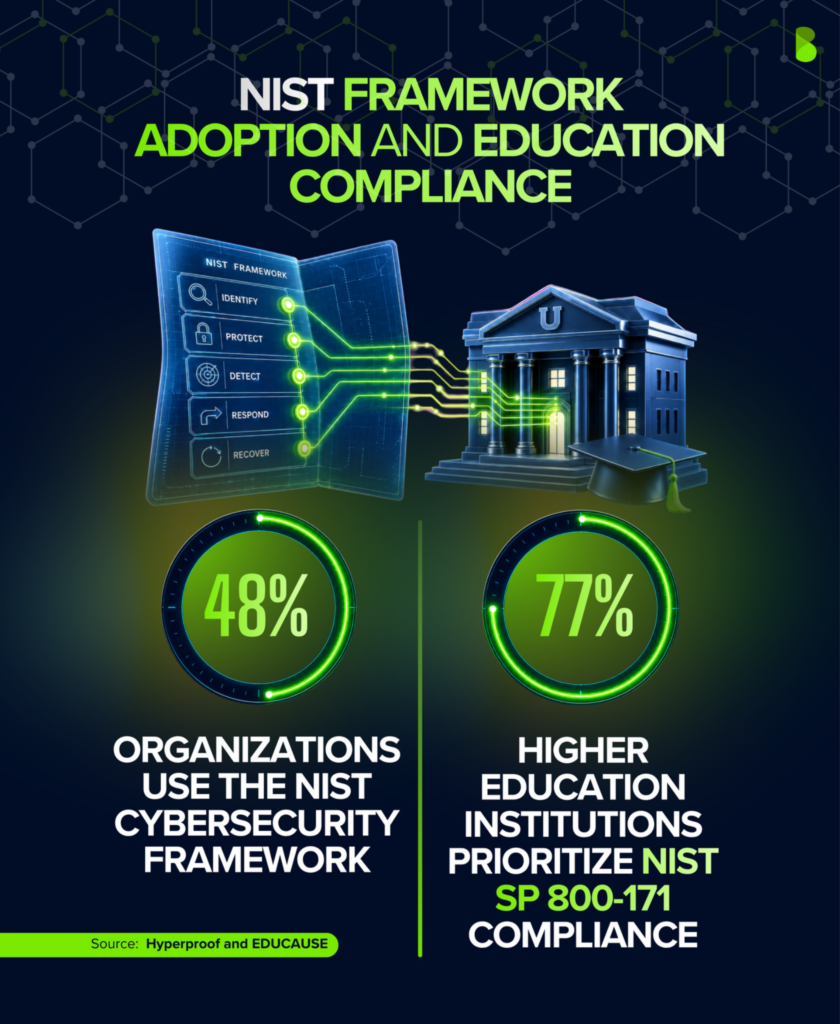
- 48% of organizations used or planned to use the NIST Cybersecurity Framework within the next 12 months in Hyperproof’s 2026 survey. (Hyperproof IT Risk and Compliance Benchmark Report, 2026)
- Large organizations achieved an average cybersecurity maturity level of 54%, based on NIST CSF 2.0 and ISO 27001, up 1 percentage point from the previous year. (Wavestone Cyber Benchmark, 2025)
- NIST CSF 2.0 organizes cybersecurity outcomes under 6 functions: Govern, Identify, Protect, Detect, Respond, and Recover. (NIST Cybersecurity Framework 2.0)
- NIST CSF 2.0 uses 4 implementation tiers: Partial, Risk Informed, Repeatable, and Adaptive. (NIST Cybersecurity Framework 2.0)
- NIST CSF 2.0 added Govern as its sixth core function, increasing the framework’s emphasis on leadership accountability, enterprise risk management, policy, and supply-chain oversight. (NIST Cybersecurity Framework 2.0)
- NIST SP 800-171 Revision 3 organizes CUI security requirements into 17 families. (NIST SP 800-171 Revision 3)
- Revision 3 added 3 requirement families that were not part of the Revision 2 family structure: Planning, System and Services Acquisition, and Supply Chain Risk Management. (NIST SP 800-171 Revision 3)
- NIST released SP 800-172 Revision 3 and its companion assessment publication on May 13, 2026, replacing the earlier SP 800-172 and SP 800-172A publications. (NIST SP 800-172 Revision 3, 2026)
- NIST SP 800-172 Revision 3 expanded enhanced CUI protections covering access controls, network segmentation, asset management, and supply-chain security. (NIST SP 800-172 Revision 3, 2026)
- SP 800-172A Revision 3 supports 3 assessment models: self-assessments, independent third-party assessments, and government-sponsored assessments. (NIST SP 800-172A Revision 3, 2026)
- NIST SP 800-53 Revision 5 contains 20 security and privacy control families, including dedicated families for privacy and supply-chain risk management. (NIST SP 800-53 Revision 5)
- NIST published SP 800-70 Revision 5 on May 8, 2026, replacing Revision 4 from 2018. (NIST SP 800-70 Revision 5)
- SP 800-70 Revision 5 introduced mappings between security-checklist settings, NIST CSF 2.0 outcomes, SP 800-53 controls, and Common Configuration Enumeration identifiers. (NIST SP 800-70 Revision 5)
- NIST published the final IR 8374 Revision 1 ransomware profile on June 11, 2026. (NIST Ransomware Risk Management Profile, 2026)
- NIST IR 8374 Revision 1 maps ransomware prevention, response, and recovery activities to NIST CSF 2.0 outcomes. (NIST Ransomware Risk Management Profile, 2026)
- NIST finalized SP 800-18 Revision 2 on June 30, 2026, expanding system security planning to include privacy and cybersecurity supply-chain risk management plans. (NIST Risk Management Framework Update, 2026)
- 77% of higher education respondents treated NIST SP 800-171 compliance as either a high or moderate institutional priority, including 36% who rated it high and 41% who rated it moderate. (EDUCAUSE NIST SP 800-171 QuickPoll, 2025)
- 54% of respondents had a formal institutional plan for meeting NIST SP 800-171 requirements, while 44% did not. (EDUCAUSE NIST SP 800-171 QuickPoll, 2025)
- Limited personnel obstructed compliance at 76% of institutions, followed by competing priorities at 70% and inadequate funding at 66%. (EDUCAUSE NIST SP 800-171 QuickPoll, 2025)
- Increased funding was the most requested internal resource at 78%, followed by additional dedicated personnel at 76% and greater leadership support at 58%. (EDUCAUSE NIST SP 800-171 QuickPoll, 2025)
PCI DSS Compliance Statistics
PCI DSS v4.0.1 is the current payment-card security standard. Its future-dated requirements are now mandatory, with particular attention on payment-page scripts, change detection, e-skimming, and alternative control designs.
- PCI DSS applies to every entity that stores, processes, or transmits cardholder data or sensitive authentication data, as well as organizations that could affect the security of the cardholder data environment. (PCI Security Standards Council PCI DSS)
- PCI DSS applies to merchants regardless of company size or payment-card transaction volume, although payment brands determine the required validation method. (PCI Security Standards Council Merchant Resources)
- Merchants that outsource all payment processing remain responsible for confirming provider compliance, documenting shared responsibilities, and reviewing service-provider compliance annually. (PCI Security Standards Council Outsourced Payment Processing Guidance)
- PCI DSS v4.0.1 is the only active version of the standard supported by the PCI Security Standards Council. (PCI SSC PCI DSS v4.0.1 Announcement)
- PCI DSS v4.0.1 added no new requirements and removed no existing requirements from PCI DSS v4.0. The revision clarified wording, applicability, and implementation guidance. (PCI SSC PCI DSS v4.0.1 Announcement)
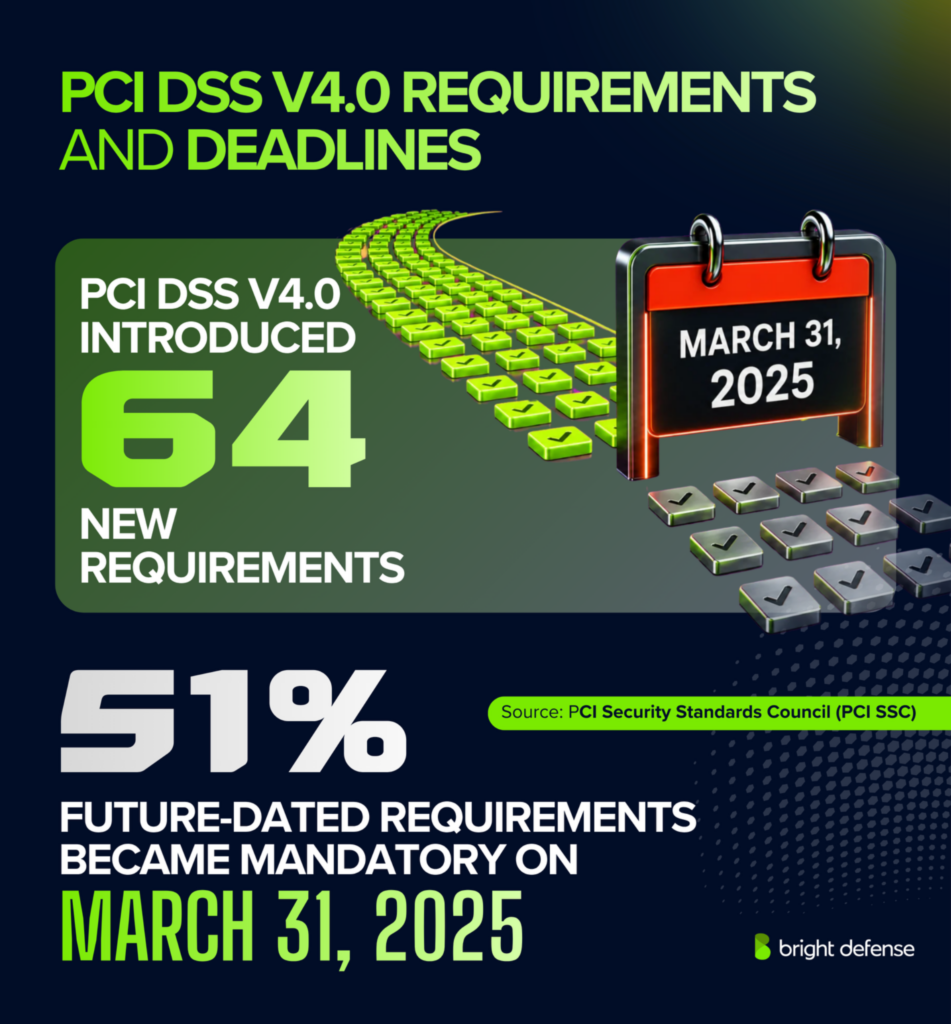
- PCI DSS v4.0 introduced 64 new requirements, including 51 future-dated requirements. (PCI SSC Future-Dated Requirements Guidance)
- The 51 future-dated requirements became mandatory on 31 March 2025. (PCI SSC Future-Dated Requirements Guidance)
- Since 31 March 2025, assessors and organizations must fully evaluate every applicable future-dated requirement during Reports on Compliance and Self-Assessment Questionnaires. (PCI SSC Assessment Reporting Guidance)
- PCI DSS v4.0.1 contains 12 principal requirements covering network security, secure configurations, account-data protection, vulnerability management, access control, monitoring, testing, and security governance. (PCI Security Standards Council PCI DSS Requirements)
- PCI DSS Requirement 6.4.3 requires organizations to authorize payment-page scripts, verify their integrity, and maintain an inventory explaining why each script is necessary. (PCI DSS v4.0.1)
- PCI DSS Requirement 11.6.1 requires change-detection controls that alert organizations to unauthorized modifications of payment-page content and HTTP headers. (PCI DSS v4.0.1)
- Requirements 6.4.3 and 11.6.1 address e-skimming risks involving malicious scripts and unauthorized payment-page changes in consumers’ browsers. (PCI SSC Payment Page Security and E-Skimming Guidance, 2025)
- A January 2025 update removed Requirements 6.4.3, 11.6.1, and 12.3.1 from SAQ A but added an eligibility requirement confirming that the merchant’s website is not vulnerable to script-based attacks. The requirements remain part of the full PCI DSS standard. (PCI SSC SAQ A Update, 2025)
- PCI SSC issued updated guidance on compensating controls and the customized approach in June 2026, supporting organizations that use alternative control designs to meet PCI DSS objectives. (PCI SSC Guidance, 2026)
CMMC Compliance Statistics
CMMC entered a new phase in July 2026 when the Pentagon suspended Phase II requirements and began a program review. Phase I self-assessment requirements remain active, and the certification ecosystem continues to operate.
- The Pentagon suspended CMMC Phase II requirements on July 13, 2026, before their scheduled implementation on November 10, 2026. (Pentagon CMMC Phase II Suspension Announcement, 2026)
- CMMC Phase I self-assessment requirements remain in force following the Phase II suspension. (Pentagon CMMC Phase II Suspension Announcement, 2026)
- The Pentagon established a reform task force for a 60-day review of CMMC implementation, costs, and barriers for smaller contractors. (Cyber AB CMMC Program Update, 2026)
- The final DFARS rule incorporating CMMC requirements into defense contracts was published on September 10, 2025, and became effective on November 10, 2025. (DFARS CMMC Final Rule, 2025)
- CMMC Phase I began on November 10, 2025, primarily covering CMMC Level 1 and Level 2 self-assessment requirements. (DoD CMMC Phase I Implementation, 2025)
- The original 3-year phased implementation schedule is no longer current beyond Phase I because Phase II has been suspended. (Pentagon CMMC Phase II Suspension Announcement, 2026)
- The DFARS rule established 2 principal CMMC contract provisions: DFARS 252.204-7021 and DFARS 252.204-7025. (Defense Federal Acquisition Regulation Supplement)
- Contract solicitations can specify 4 CMMC assessment options: Level 1 Self, Level 2 Self, Level 2 C3PAO, or Level 3 DIBCAC. Third-party and government-led requirements remain part of the framework, although the next contractual implementation phase is suspended. (Defense Federal Acquisition Regulation Supplement)
- The CMMC framework recognizes 7 possible assessment statuses: Final Level 1, Conditional and Final Level 2 Self, Conditional and Final Level 2 C3PAO, and Conditional and Final Level 3 DIBCAC. (Defense Federal Acquisition Regulation Supplement)
- Conditional Level 2 and Level 3 statuses remain current for no more than 180 days, giving contractors time to close permitted assessment gaps. (Defense Federal Acquisition Regulation Supplement)
- Final Level 2 and Level 3 assessment statuses generally remain current for 3 years, provided the contractor maintains compliance and submits annual affirmations. (Defense Federal Acquisition Regulation Supplement)
- Contractors subject to a CMMC clause must maintain the required status throughout the contract’s duration. (Defense Federal Acquisition Regulation Supplement)
- Contractors must submit an affirmation of continuous compliance at least once every 12 months for each applicable contractor information system. (Defense Federal Acquisition Regulation Supplement)
- CMMC Level 1 requires an annual self-assessment and annual affirmation against 15 security requirements from FAR 52.204-21. (DoD Cybersecurity Resources)
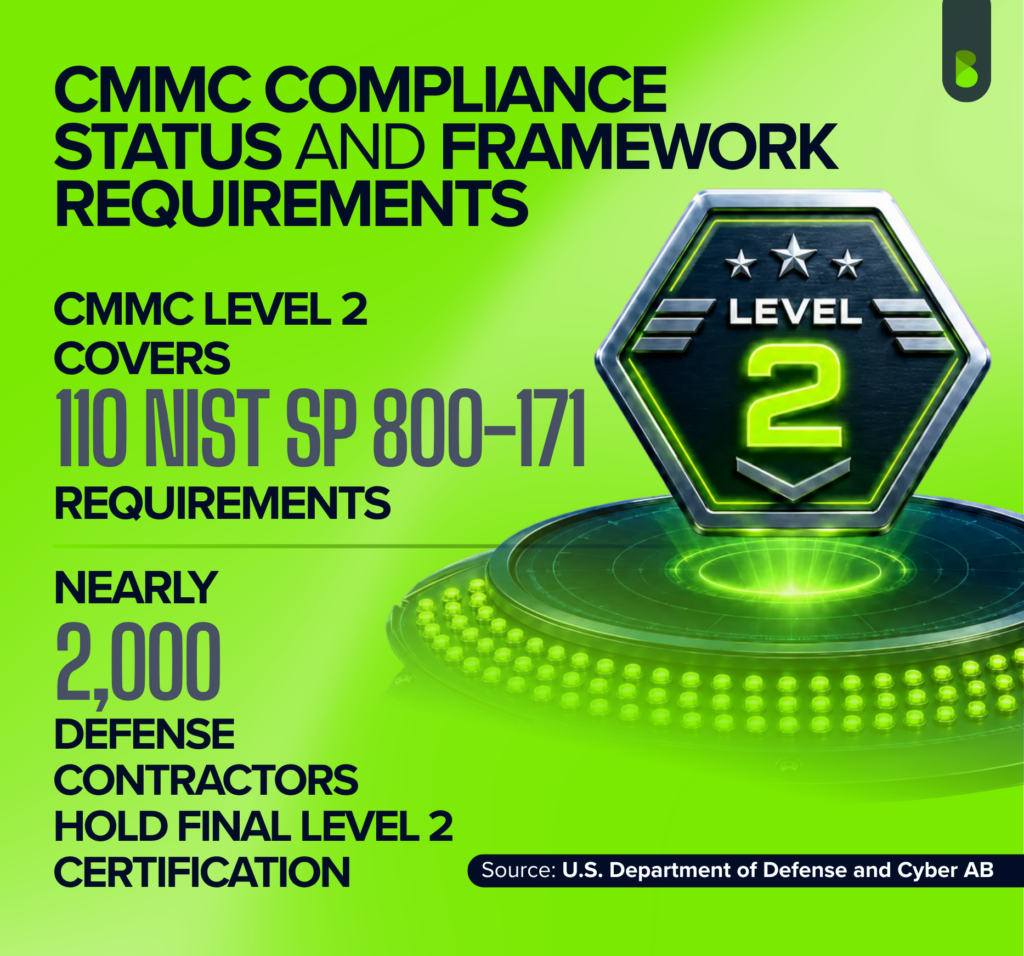
- CMMC Level 2 covers 110 security requirements from NIST SP 800-171 Revision 2 and requires either a self-assessment or C3PAO assessment every 3 years, depending on the solicitation. (DoD Cybersecurity Resources)
- CMMC Level 3 requires Final Level 2 status, an assessment by DIBCAC every 3 years, and annual affirmation against 24 selected requirements from NIST SP 800-172. (DoD Cybersecurity Resources)
- By July 2026, the CMMC ecosystem had more than 1,000 Certified CMMC Assessors, 110 authorized C3PAOs, and nearly 2,000 defense contractors with Final Level 2 certification. (Cyber AB CMMC Program Update, 2026)
- The ecosystem had more than 2,000 CMMC Certified Professionals, more than 2,000 Registered Practitioners, 400 Registered Practitioner Organizations, and 52 approved training providers by July 2026. (Cyber AB CMMC Program Update, 2026)
HIPAA Compliance Statistics
HIPAA statistics cover several different enforcement and operating areas. CMS Administrative Simplification complaints concern transactions, code sets, identifiers, and operating rules, while HHS OCR handles Privacy, Security, breach, and enforcement matters.
- CMS received 140 HIPAA Administrative Simplification complaints during calendar year 2025. (CMS CY 2025 Complaint Enforcement and Compliance Review Analysis Report)
- The leading complaint areas were the 835 Health Care Claim Payment/Advice, 837 Professional Health Care Claim, and 270 Eligibility, Coverage, or Benefit Inquiry transactions. (CMS CY 2025 Complaint Enforcement and Compliance Review Analysis Report)
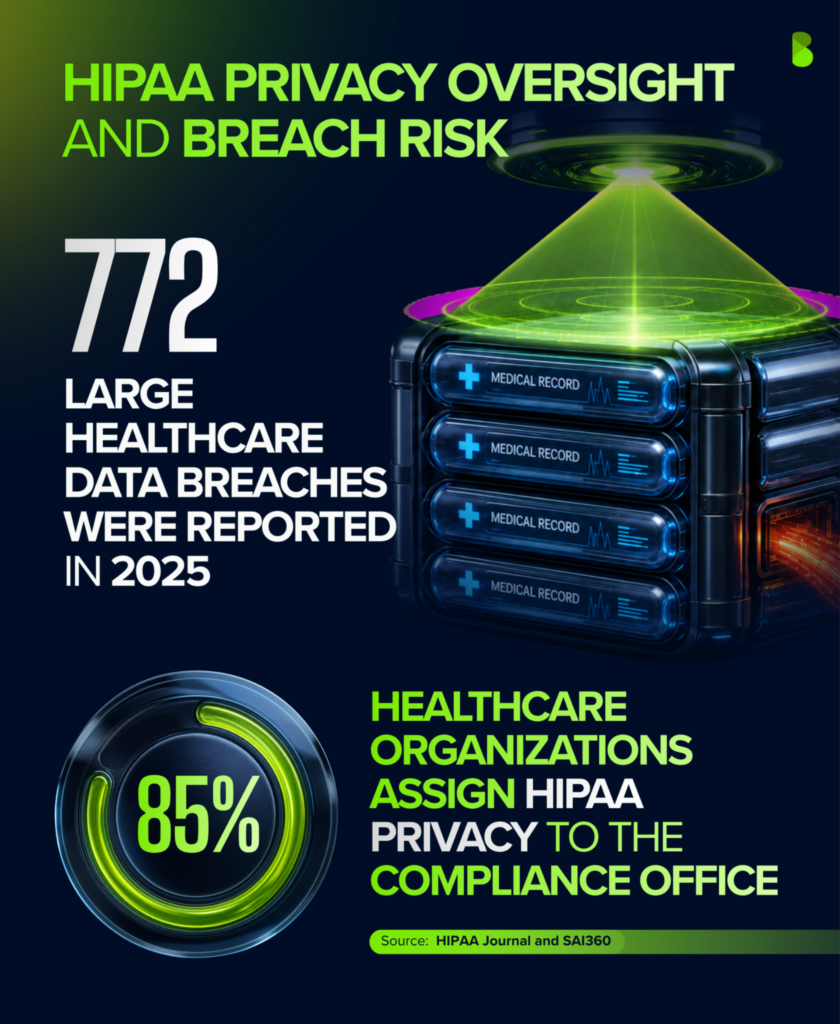
- 772 healthcare data breaches affecting at least 500 individuals were listed for 2025 on the HHS OCR breach portal as of June 2026. (HIPAA Journal Healthcare Data Breach Report, 2026)
- Large healthcare breaches reported for 2025 affected 139,721,832 individuals based on the portal totals available in June 2026. (HIPAA Journal Healthcare Data Breach Report, 2026)
- 16 healthcare data breaches reported for 2025 affected more than 1 million individuals each, while another 7 breaches affected between 500,000 and 999,999 individuals. (HIPAA Journal Healthcare Data Breach Report, 2026)
- The largest healthcare data breach attributed to 2025 affected 62,224,658 individuals and involved Conduent Business Services. (HIPAA Journal Largest Healthcare Data Breaches of 2025)
- By June 18, 2026, HHS OCR had completed 20 HIPAA ransomware enforcement actions and 14 enforcement actions under its Risk Analysis Initiative. (HHS OCR HIPAA Enforcement Announcement, 2026)
- Four HIPAA ransomware settlements announced in April 2026 involved breaches affecting more than 427,000 individuals. (HHS OCR Ransomware Enforcement Actions, 2026)
- HIPAA Privacy responsibilities fell within the compliance office at 85% of surveyed healthcare organizations, while 38% included HIPAA Security or cybersecurity within the compliance office’s responsibilities. (SAI360 Healthcare Compliance Benchmark Report, 2026)
- 30% of healthcare organizations had only one full-time or part-time compliance officer, while 35% had compliance teams containing two to five employees. (SAI360 Healthcare Compliance Benchmark Report, 2026)
- 67% of surveyed healthcare organizations conducted formal compliance risk assessments annually. (SAI360 Healthcare Compliance Benchmark Report, 2026)
- 56% reviewed or updated compliance-related policies annually, while 18% updated them only when necessary. (SAI360 Healthcare Compliance Benchmark Report, 2026)
- 75% provided employee compliance training when employees were hired and annually thereafter. (SAI360 Healthcare Compliance Benchmark Report, 2026)
- 85% of surveyed healthcare organizations had an executive-level compliance oversight committee. (SAI360 Healthcare Compliance Benchmark Report, 2026)
- 65% reported that the compliance officer met with or presented to the board quarterly. (SAI360 Healthcare Compliance Benchmark Report, 2026)
- HIPAA and cybersecurity issues ranked as the leading healthcare compliance risk for 2026, ahead of responding to new federal and state regulations. (SAI360 Healthcare Compliance Benchmark Report, 2026)
- Keeping up with regulatory and enforcement changes was the top compliance-program improvement priority for 24% of healthcare respondents. (SAI360 Healthcare Compliance Benchmark Report, 2026)
- Only about 20% used independent third parties as their primary method for evaluating compliance-program effectiveness, while roughly 60% relied on internal assessments. (SAI360 Healthcare Compliance Benchmark Report, 2026)
Compliance Trends for 2026
The leading compliance trends for 2026 are broader strategic responsibilities, greater investment after security incidents, closer support for digital transformation, and stronger attention to geopolitical and enforcement changes.
- 71% expected compliance teams to support digital transformation initiatives over the following three years, while 41% expected compliance support for new business models. (PwC Global Compliance Survey, 2025)
- Only 7% considered their organizations leaders in compliance, but 38% aimed to reach a leading position within three years. (PwC Global Compliance Survey)
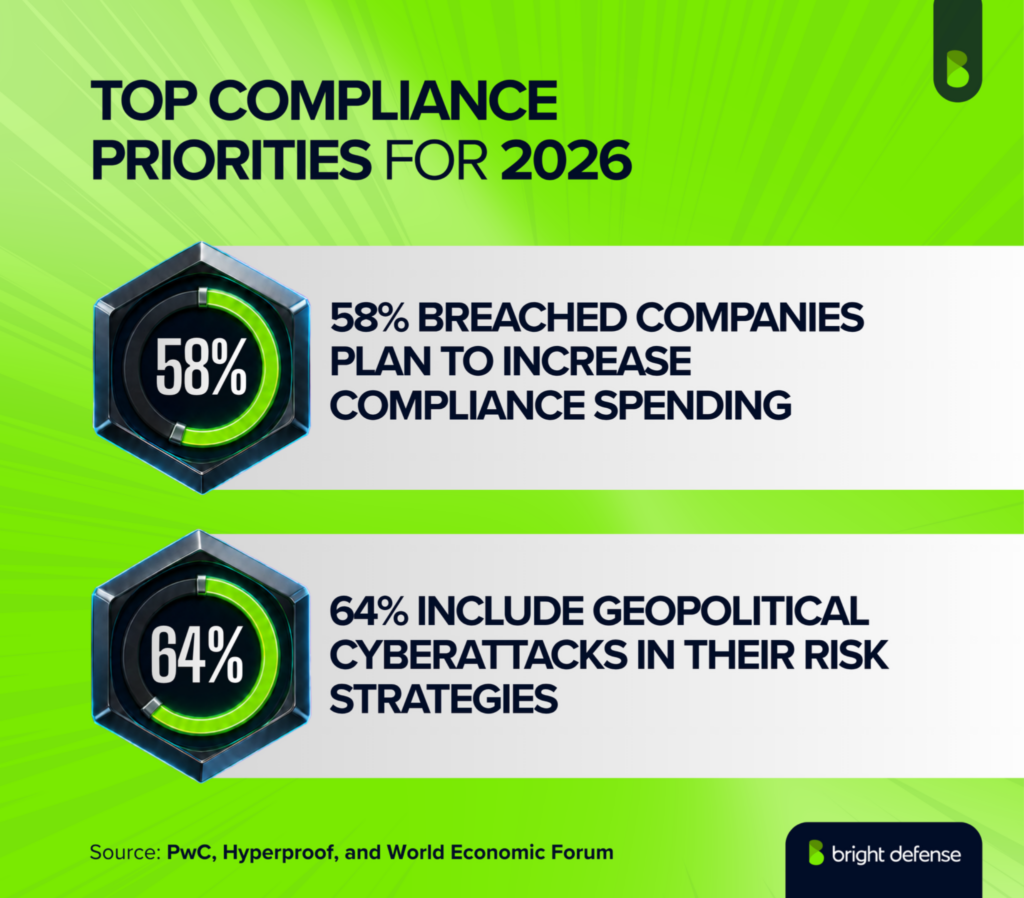
- 58% of companies that had experienced a breach expected to spend more time on IT risk management and compliance during 2026. (Hyperproof IT Risk and Compliance Benchmark Report, 2026)
- 64% included geopolitically motivated cyberattacks in their risk mitigation strategies. (World Economic Forum Global Cybersecurity Outlook, 2026)
- 91% of organizations with more than 100,000 employees had changed their cybersecurity strategies in response to geopolitical volatility. (World Economic Forum Global Cybersecurity Outlook, 2026)
- 25% expected geopolitical tensions to require significant changes to compliance strategy, while 8% believed those tensions could fundamentally alter their business models. (CUBE Cost of Compliance Report, 2025)
- 26% changed their risk assessments in response to shifting U.S. enforcement priorities, while 24% sought third-party compliance guidance or tools. (NAVEX State of Risk and Compliance Report, 2026)
The headline figures show the main direction of compliance in 2026: greater complexity, more audits, stronger commercial pressure for proof, larger budgets, persistent manual work, rapid AI adoption, and serious cyber and third-party exposure.
Wanna read similar stat based articles? Check out:
- 280+ Cybersecurity Compliance Stats
- 100+ Penetration Testing Statistics
- 200+ Cybersecurity Statistics
What These Compliance Statistics Mean for Organizations
The data points to a clear shift in how compliance programs are expected to operate. Compliance is no longer limited to passing an annual audit, maintaining policies, or responding to regulators. It now affects revenue, customer trust, technology adoption, cybersecurity resilience, vendor relationships, and executive decision-making.
The strongest programs are moving away from fragmented, audit-driven activity toward continuous, risk-based compliance. They are consolidating overlapping controls, automating evidence collection, measuring outcomes, and involving compliance professionals earlier in business and technology decisions.
Compliance Has Become a Revenue Function
Compliance increasingly determines whether an organization can enter a market, win an enterprise customer, renew a contract, or complete a partnership.
61% of surveyed organizations said compliance was required to win new contracts or renew existing agreements. Another 38% had lost revenue or competitive bids because they could not provide sufficient compliance evidence. (Secureframe Cybersecurity and Compliance Benchmark Report, 2026)
This changes the role of the compliance team. A certification, audit report, completed security questionnaire, or customer-facing trust center is no longer merely evidence for regulators. It is part of the commercial process.
Compliance teams should work more closely with sales, procurement, legal, information security, and customer-success teams. They should understand which certifications customers request, where security reviews delay contracts, and which missing controls create objections during procurement.
Useful commercial compliance metrics include:
- Revenue influenced by compliance certifications
- Deals delayed by security or compliance reviews
- Contracts lost because evidence was unavailable
- Average time required to complete customer questionnaires
- Percentage of recurring requests answered through reusable evidence
- Renewal rates among customers that requested compliance documentation
Organizations that can provide clear, current, and credible evidence will have an advantage over competitors that treat compliance as an internal administrative function.
Annual Compliance Is No Longer Sufficient
Annual audits provide a snapshot of controls during a defined period. They do not prove that those controls remain effective throughout the year.
Systems change, employees leave, vendors are added, permissions expand, cloud configurations drift, and new applications are deployed. A control that passed testing six months ago may no longer operate as intended.
The data shows the consequences of this gap. 50% of organizations using ad hoc or incident-driven risk management experienced a breach, compared with 27% using an integrated and automated approach. (Hyperproof IT Risk and Compliance Benchmark Report, 2026)
Organizations therefore need to move from periodic compliance toward continuous assurance. This does not mean every control must be tested every day. It means the monitoring frequency should reflect the speed and severity of the underlying risk.
High-risk controls may require continuous or weekly monitoring, while lower-risk governance controls may still be reviewed quarterly or annually.
A continuous compliance model should include:
- Automated evidence collection
- Control-owner notifications
- Configuration and access monitoring
- Recurring risk assessments
- Exception tracking
- Policy and vendor review schedules
- Rapid remediation of failed controls
- Executive reporting on unresolved risks
The objective is not to produce more compliance activity. It is to detect control failures before an auditor, customer, regulator, or attacker finds them.
Multi-Framework Compliance Requires Control Consolidation
Organizations are increasingly responsible for multiple standards, laws, and customer requirements. 52% of Secureframe respondents had achieved or were pursuing more than one framework, while companies generating more than $100 million in annual revenue managed an average of 3.2 frameworks. (Secureframe Cybersecurity and Compliance Benchmark Report, 2026)
Running each framework as a separate project creates unnecessary work. SOC 2, ISO 27001, NIST CSF, HIPAA, PCI DSS, CMMC, and privacy regulations often contain overlapping requirements covering access control, risk assessment, incident response, vendor management, security training, and business continuity.
Organizations should create a unified control environment and map each requirement back to a shared set of controls. 56% already use a common controls framework to reduce duplicated compliance work. (Hyperproof IT Risk and Compliance Benchmark Report, 2026)
A consolidated model allows one control, policy, test, or evidence item to satisfy several obligations. It can reduce repeated interviews, duplicate screenshots, conflicting remediation plans, and separate audit schedules.
Compliance leaders should maintain:
- A central control library
- Framework-to-control mappings
- A shared evidence repository
- Standard control owners
- Common testing procedures
- One remediation process
- Coordinated audit schedules
- Clear records of framework-specific exceptions
The principle is simple: manage the control once, test it once where possible, and reuse the evidence across every applicable framework.
Compliance Teams Need Broader Skills
Compliance responsibilities are expanding faster than many teams. 74% of legal entity compliance practitioners said their roles had expanded during the previous two years, while 46% said workloads had grown faster than their teams. (Diligent Global State of Legal Entity Compliance, 2026)
Hiring more general compliance staff will not solve every problem. Modern programs require a mixture of regulatory, technical, analytical, and communication skills.
Important capabilities now include:
- AI governance
- Cloud and application security
- Data privacy
- Cybersecurity risk assessment
- GRC automation
- Vendor and supply-chain risk
- Data analysis
- Audit management
- Executive communication
- Cross-functional program management
AI governance was ranked as the most important capability for the following three years by 64% of legal entity compliance practitioners. Cybersecurity professionals similarly identified AI, cloud security, and risk assessment among their leading skills needs. (Diligent Global State of Legal Entity Compliance, 2026; ISC2 Cybersecurity Workforce Study, 2025)
Compliance leaders should assess the capabilities of the entire program rather than looking only at headcount. Some gaps can be addressed through training, while others may require technical specialists, external advisers, managed services, or closer integration with cybersecurity and privacy teams.
AI Adoption Is Outpacing AI Governance
Organizations are already using AI in compliance, security, reporting, training, investigations, and policy administration. 97% of surveyed GRC professionals used AI to support at least part of their workflows, while only 4% of NAVEX respondents said their compliance programs did not use AI in any area. (Hyperproof IT Risk and Compliance Benchmark Report, 2026; NAVEX State of Risk and Compliance Report, 2026)
Governance has not developed at the same speed. Only 44% of organizations had implemented a company AI policy, 45% conducted regular AI risk assessments and audits, and 48% had a framework for determining how much autonomy agentic AI systems could receive. (Vanta State of Trust Report, 2025)
Organizations need to govern both internally developed AI and third-party AI embedded in software, SaaS platforms, analytics tools, and productivity applications.
An effective AI governance program should define:
- Which AI tools employees may use
- What data may be entered into AI systems
- Who owns each AI use case
- Which decisions require human review
- How models and outputs are tested
- How AI vendors are assessed
- How errors, bias, security issues, and incidents are reported
- How AI-generated records are retained
- When an AI system must be suspended or withdrawn
Compliance teams should not attempt to govern AI alone. Legal, privacy, cybersecurity, data, procurement, human resources, and business leaders all have responsibilities. Compliance should coordinate the governance model and confirm that controls are documented, assigned, tested, and reported.
Third-Party Compliance Must Continue After Onboarding
Third-party risk cannot be managed through a questionnaire completed before contract signing.
70% of organizations surveyed by Whistic experienced a breach during the previous three years, and 77% of those breaches originated from a vendor or another third party. The average surveyed company worked with 286 vendors, creating a level of exposure that cannot be managed effectively through occasional manual reviews. (Whistic Third-Party Risk Management Impact Report, 2025)
Vendor compliance should extend across the entire relationship, from selection and contracting through monitoring, renewal, incident response, and termination.
Organizations should consider:
- Risk-based vendor classification
- Contractual security and notification requirements
- Recurring evidence reviews
- Continuous risk monitoring
- Fourth-party dependency mapping
- Access and data-flow reviews
- Concentration-risk analysis
- Joint incident-response exercises
- Remediation tracking
- Secure offboarding and data deletion
A SOC 2 report or ISO 27001 certificate remains useful, but neither replaces a risk assessment. Evidence must be interpreted in the context of the services provided, the data involved, the vendor’s access, and the organization’s dependency on that supplier.
Mature Programs Measure Outcomes, Not Only Activity
Compliance teams traditionally report activity metrics such as training completion, policies published, audits completed, controls tested, and issues logged. These figures show that work occurred, but they do not prove that risk declined.
A mature program measures whether its activities change behavior, improve controls, reduce disruption, and support the business.
Only 34% of ethics and compliance programs actively used data analytics to evaluate program effectiveness. High-impact programs were nearly 2 times as likely to use benchmarking, analytics, and automation. (LRN Ethics and Compliance Program Effectiveness Report, 2026)
Compliance leaders should supplement activity metrics with outcome-focused measures, including:
- Repeat audit findings
- Control failure rates
- Average remediation time
- Percentage of controls monitored continuously
- Number of overdue high-risk issues
- Internal versus external incident detection
- Vendor remediation times
- Employee reporting confidence
- Retaliation allegations
- Security-questionnaire response time
- Revenue supported by compliance evidence
- Business interruptions caused by compliance failures
The purpose of measurement is not to make the compliance dashboard larger. It is to determine whether the program is reducing exposure and helping the organization make better decisions.
The overall trend is clear. Compliance programs are being judged less by the number of policies they maintain and more by their ability to provide current evidence, support business growth, govern emerging technology, manage third-party dependencies, and demonstrate that controls work in practice.
5 Key Compliance Takeaways
The statistics point to a broader change in how compliance programs create value. The strongest programs are no longer built only to pass audits or respond to regulators. They help organizations win business, govern technology, reduce operational risk, manage third parties, and give leadership better information.
Each takeaway below converts the research into specific changes compliance teams can make and metrics they can use to measure progress.
1. Treat Compliance as Commercial Infrastructure
What the data shows
Compliance increasingly affects whether organizations can enter markets, close enterprise deals, and renew customer contracts.
61% of organizations said compliance was necessary to win new contracts or renew existing agreements, while 38% had lost revenue or competitive bids because they could not provide sufficient evidence. Another 88% of C-suite respondents viewed compliance as a strategic advantage. (Secureframe Cybersecurity and Compliance Benchmark Report, 2026; NAVEX State of Risk and Compliance Report, 2026)
Why it matters
Customers are no longer satisfied with general statements about security. Procurement teams increasingly request audit reports, certifications, policies, penetration-test summaries, privacy documentation, and evidence that controls operate continuously.
A company may have strong controls but still lose business when it cannot produce credible evidence quickly. Slow questionnaire responses, outdated reports, and unclear control ownership can create the same commercial result as actual noncompliance.
What compliance teams should change
Compliance leaders should create a formal process for supporting sales, customer assurance, and contract renewals.
That process should include:
- A central repository of approved compliance evidence
- A customer-facing trust center
- Standard responses for common security questions
- Clear ownership for questionnaires and evidence requests
- Defined response times for sales and procurement reviews
- Current audit reports, certifications, policies, and test summaries
- A process for recording which requirements repeatedly appear in customer reviews
Compliance teams should meet regularly with sales, legal, security, and customer-success leaders to identify where compliance is helping or delaying revenue.
Metrics to monitor
- Revenue influenced by compliance certifications
- Number and value of deals delayed by compliance reviews
- Number of opportunities lost because evidence was unavailable
- Average security-questionnaire response time
- Percentage of customer requests answered with reusable evidence
- Contract-renewal rate among customers requesting compliance documentation
The objective is to make compliance evidence available before it becomes a sales obstacle.
2. Replace Fragmented Audit Preparation With a Continuous Common-Control Model
What the data shows
Organizations are managing more audits and frameworks, but much of the work remains repetitive.
97% conducted at least two compliance audits annually, 90% worked with multiple audit partners, and 99% believed audit harmonization could save time or money. At the same time, 52% were managing more than one framework, while 56% used a common controls framework to reduce duplicated work. (A-LIGN Compliance Benchmark Report, 2026; Secureframe Cybersecurity and Compliance Benchmark Report, 2026; Hyperproof IT Risk and Compliance Benchmark Report, 2026)
Why it matters
Separate SOC 2, ISO 27001, HIPAA, PCI DSS, NIST, and customer-assurance programs often test the same underlying controls repeatedly.
Access reviews, risk assessments, security training, incident-response procedures, vendor assessments, and change-management controls may be collected and tested several times by different teams.
This creates unnecessary workload and increases the risk of conflicting evidence, inconsistent control descriptions, and duplicated remediation plans.
Annual preparation creates another weakness. Controls may operate correctly during an audit window and fail later because of system changes, staff turnover, cloud configuration drift, or missed reviews.
What compliance teams should change
Organizations should create one authoritative control library and map every applicable framework to it.
The operating model should include:
- A central common-control library
- One named owner for each control
- Framework-to-control mappings
- Standard control descriptions and testing procedures
- A shared evidence repository
- Automated evidence collection where practical
- Risk-based monitoring frequencies
- Coordinated audit and assessment schedules
- One remediation process for findings that affect multiple frameworks
Controls should be monitored according to risk. Critical access, configuration, vulnerability, and logging controls may require continuous or frequent monitoring. Governance controls may remain quarterly or annual.
The goal is to manage the control once, test it once where possible, and reuse the result across applicable requirements.
Metrics to monitor
- Percentage of frameworks mapped to the common-control library
- Percentage of evidence reused across two or more frameworks
- Number of duplicate controls removed
- Audit-preparation hours per framework
- Percentage of controls monitored automatically
- Control failure rate
- Average time to remediate failed controls
- Number of repeat audit findings
The success of consolidation should be measured through reduced duplication and faster detection of control failures, not merely fewer documents.
3. Establish AI Governance Before AI Use Expands Further
What the data shows
AI use is already widespread across compliance and security functions, but governance remains incomplete.
97% of surveyed GRC professionals used AI in at least part of their workflows, and compliance teams were involved in organizational AI decisions at 78% of surveyed organizations. However, only 44% had implemented a company AI policy, 45% conducted regular AI risk assessments, and 48% had a framework for limiting the autonomy of agentic AI systems. (Hyperproof IT Risk and Compliance Benchmark Report, 2026; NAVEX State of Risk and Compliance Report, 2026; Vanta State of Trust Report, 2025)
Why it matters
Organizations are not waiting for governance programs to mature before adopting AI.
Employees are using generative AI, business applications are adding embedded AI features, and vendors are introducing autonomous capabilities into existing products. These systems may process sensitive data, influence decisions, generate regulated content, or act without direct human approval.
Uncontrolled adoption creates risks involving privacy, confidentiality, inaccurate outputs, discrimination, intellectual property, security, records retention, and regulatory accountability.
A general statement that employees should “use AI responsibly” is not a governance program.
What compliance teams should change
Organizations should create a formal AI governance structure covering internal tools, third-party platforms, and embedded AI features.
The program should include:
- An inventory of approved and discovered AI systems
- A classification process based on data sensitivity and decision impact
- Defined business and technical owners for each use case
- Restrictions on data entered into public or external AI tools
- Human-review requirements for high-impact decisions
- Vendor due diligence for AI-enabled products
- Security, privacy, accuracy, and bias testing
- Rules for autonomous actions
- AI incident and exception reporting
- Records-retention requirements
- Periodic reassessment of high-risk systems
- A process for suspending unsafe or noncompliant AI use
Compliance should coordinate the program, but ownership must be shared with cybersecurity, privacy, legal, procurement, data, human resources, and the relevant business function.
Metrics to monitor
- Percentage of AI systems recorded in the official inventory
- Percentage of AI use cases that completed a risk assessment
- Number of high-risk AI systems operating without formal approval
- Percentage of AI vendors that completed security and privacy reviews
- Number of AI policy exceptions
- AI-related incidents and near misses
- Percentage of high-impact AI outputs receiving human review
- Time required to remediate AI governance findings
The central question is not whether the organization uses AI. It is whether leaders know where AI is being used, what it can access, and who remains accountable for its decisions.
4. Turn Vendor Due Diligence Into Continuous Supply-Chain Resilience
What the data shows
Third-party exposure is now one of the largest compliance and operational risks.
70% of organizations surveyed by Whistic experienced a breach during the previous three years, and 77% of those breaches originated from a vendor or another third party. The average surveyed organization worked with 286 vendors, but only 33% of organizations in the World Economic Forum survey had comprehensively mapped their supply-chain ecosystems. (Whistic Third-Party Risk Management Impact Report, 2025; World Economic Forum Global Cybersecurity Outlook, 2026)
Why it matters
A questionnaire completed during procurement provides limited assurance after the contract is signed.
Vendors change infrastructure, subcontractors, personnel, security tools, AI capabilities, and data-processing practices. A supplier that was acceptable during onboarding may present a different risk a year later.
Organizations must consider fourth parties, concentration risk, shared cloud dependencies, non-human identities, and whether critical suppliers can support incident response and recovery.
A SOC 2 report or ISO 27001 certificate is useful evidence, but neither proves that every service, system, location, or subcontractor relevant to the relationship is covered.
What compliance teams should change
Vendor risk management should operate throughout the full supplier lifecycle.
Organizations should implement:
- Risk-based vendor classification
- Clear security and privacy requirements in contracts
- Defined breach-notification deadlines
- Recurring evidence and certification reviews
- Continuous monitoring for critical vendors
- Fourth-party and subcontractor disclosure requirements
- Data-flow and access reviews
- Concentration-risk analysis
- Remediation tracking
- Joint incident-response and recovery exercises
- Secure offboarding and data-deletion verification
Assessment depth should reflect the vendor’s access, data exposure, operational importance, and substitutability. Critical infrastructure providers should not receive the same review as low-risk administrative suppliers.
Metrics to monitor
- Percentage of vendors assigned a risk tier
- Percentage of critical vendors with current assessments
- Number of overdue vendor findings
- Average vendor-remediation time
- Percentage of critical suppliers with identified fourth parties
- Percentage of critical vendors included in recovery exercises
- Number of vendors with excessive or unnecessary access
- Vendor-related incidents and service disruptions
- Concentration of critical services among a small number of providers
The objective is not to complete more questionnaires. It is to understand which vendors could cause material harm and confirm that those risks remain controlled.
5. Measure Compliance Outcomes, Not Just Completed Activities
What the data shows
Many organizations measure compliance activity, but fewer evaluate whether the program actually reduces risk.
Only 34% of ethics and compliance programs actively used data analytics to evaluate effectiveness. High-impact programs were nearly 2 times as likely to use benchmarking, advanced analytics, and automation. (LRN Ethics and Compliance Program Effectiveness Report, 2026)
The gap is visible in workplace culture as well. 88% of employees knew how to report concerns and 86% said they felt comfortable doing so, yet 51% of NAVEX respondents said employees feared negative career consequences for speaking up. (LRN Ethics and Compliance Program Effectiveness Report, 2026; NAVEX State of Risk and Compliance Report, 2026)
Why it matters
Training completion, policy acknowledgements, audits completed, and controls tested are useful operational measures. They show that work occurred.
They do not show whether employees understood the training, whether managers applied the rules consistently, whether risks were reduced, or whether controls continued to operate.
A program can report 100% training completion while employees remain unwilling to raise concerns. It can complete every scheduled audit while repeating the same findings. It can maintain hundreds of documented controls while failing to detect a breach internally.
What compliance teams should change
Compliance reporting should distinguish between activity, performance, and outcomes.
Activity metrics show what the team completed. Performance metrics show how well processes operated. Outcome metrics show whether the organization reduced risk or supported the business.
For example:
- Activity: Number of employees completing training
- Performance: Assessment scores and policy comprehension
- Outcome: Reduction in repeat misconduct or reporting failures
Another example:
- Activity: Number of vendor assessments completed
- Performance: Average assessment turnaround time
- Outcome: Reduction in unresolved critical vendor risks
Dashboards should focus executive attention on high-risk exceptions, recurring weaknesses, overdue remediation, and emerging exposure rather than presenting a large volume of completion data.
Metrics to monitor
- Repeat audit and investigation findings
- Control failure rates
- Average remediation time
- Number of overdue high-risk issues
- Internal versus external incident detection
- Employee reporting confidence
- Retaliation allegations
- Training comprehension and behavior-change indicators
- Vendor-risk remediation time
- Percentage of controls monitored continuously
- Revenue influenced by compliance
- Time required to provide customer assurance evidence
A mature compliance program should be able to explain not only what it completed, but what changed because of that work.
Build a Continuous Compliance Program With Bright Defense
Compliance cannot be treated as a once-a-year audit project. Controls change, employees join and leave, vendors gain access, cloud environments evolve, and new regulations create additional obligations. The data reflects that pressure: 85% of executives said compliance requirements had become more complex, while 38% of organizations had lost revenue or competitive bids because they could not provide sufficient compliance evidence.
At Bright Defense, we help organizations build and maintain cybersecurity compliance programs throughout the year. Our monthly engagement model combines compliance automation with hands-on guidance from security professionals, giving clients continued support before, during, and after certification.
Our continuous compliance service includes:
- Gap analysis and compliance planning
- Cybersecurity risk assessments
- Policy development and implementation
- Control remediation
- Business continuity planning
- Audit and certification assistance
- Managed compliance automation
- Continuous monitoring of compliance status
- Security awareness training and phishing simulations
Bright Defense supports frameworks including SOC 2, HIPAA, and CMMC. Once an organization reaches its initial compliance milestone, we continue maintaining and strengthening the security program as systems, risks, and requirements change.
This approach gives compliance teams clearer visibility into control status, unresolved gaps, evidence requirements, and upcoming responsibilities. It reduces the last-minute scramble before an audit and helps keep policies, controls, risk assessments, and supporting evidence current throughout the year.
Build a Compliance Program That Stays Ready
We work with startups, SaaS and AI companies, small and medium-sized businesses, managed service providers, and defense contractors that need practical security expertise without building a large internal compliance department.
Talk to Bright Defense about building a continuous compliance program that supports certification, reduces manual work, and keeps your organization ready for customers, auditors, and changing security requirements.
Compliance Statistics FAQs
1. What Are the Most Important Compliance Statistics for 2026?
The most significant compliance statistics show that requirements are becoming harder to manage and more commercially important. 85% of executives said compliance requirements had become more complex, 97% of organizations conducted at least two audits annually, and 38% had lost revenue or competitive bids because they could not provide sufficient compliance evidence.
2. How Many Compliance Audits Do Organizations Conduct Each Year?
97% of surveyed organizations conducted at least two compliance audits annually. Many businesses now manage several frameworks, customer assessments, regulatory reviews, and internal audits at the same time. This increased audit volume is pushing organizations toward common-control frameworks, reusable evidence repositories, automated evidence collection, and coordinated audit schedules. (A-LIGN Compliance Benchmark Report, 2026)
3. How Does Compliance Affect Business Revenue?
Compliance increasingly influences sales, contract renewals, and access to enterprise customers. 61% of organizations said compliance was necessary to win or renew contracts, while 38% had lost revenue or competitive bids because they could not provide sufficient evidence. Certifications, audit reports, security questionnaires, and trust centers have therefore become part of the commercial process. (Secureframe Cybersecurity and Compliance Benchmark Report, 2026)
4. How Common Is AI Use in Compliance?
AI use is already widespread across compliance and GRC teams. 97% of surveyed GRC professionals used AI in at least part of their workflows. However, governance remains less mature, with only 44% of organizations reporting a formal company AI policy and 45% conducting regular AI risk assessments. (Hyperproof IT Risk and Compliance Benchmark Report, 2026; Vanta State of Trust Report, 2025)
5. What Percentage of Compliance Work Is Still Managed Manually?
A significant amount of compliance work remains manual despite growing investment in GRC technology. Manual evidence collection, policy administration, security questionnaires, vendor reviews, and audit preparation continue to consume compliance teams’ time. This explains why automation, common controls, continuous monitoring, and centralized evidence management are among the strongest compliance trends for 2026.
6. What Are the 7 Pillars of Compliance?
There is no universally mandated seven-pillar model, but compliance programs are commonly built around:
- Leadership and accountability
- Risk assessment
- Policies and procedures
- Training and communication
- Monitoring and control testing
- Reporting and investigations
- Remediation and continuous improvement
Organizations can measure each pillar through statistics such as training completion, control pass rates, reporting confidence, remediation times, and repeat findings.
7. How Do You Calculate Compliance Rate?
Compliance rate is calculated by dividing the number of compliant requirements or controls by the total number of applicable items and multiplying by 100.
Compliance Rate = Compliant Items ÷ Total Applicable Items × 100
An organization with 180 compliant controls out of 200 applicable controls has a compliance rate of 90%. The same calculation can measure training completion, policy acknowledgements, vendor assessments, or completed remediation tasks.
8. What Are the 5 Key Areas of Compliance?
Five major areas commonly used to organize compliance programs are:
- Regulatory and legal compliance
- Cybersecurity and data privacy
- Employee conduct and internal policies
- Financial and operational controls
- Third-party and vendor compliance
Organizations should measure each area separately because a high overall compliance rate can conceal serious weaknesses in a specific area, such as vendor monitoring or access control.
9. Is Compliance a KPI?
Compliance is not one individual KPI, but it should be measured through a collection of key performance and risk indicators. Common compliance KPIs include control pass rate, unresolved high-risk findings, remediation time, audit findings, training completion, vendor-assessment coverage, and evidence-collection time. Mature programs combine completion statistics with outcome measures that show whether risks and control failures are actually declining.
10. What Compliance Metrics Should Organizations Track?
Organizations should track metrics that show both compliance activity and business outcomes. Useful measures include:
- Control pass and failure rates
- Repeat audit findings
- Average remediation time
- Overdue high-risk issues
- Training completion and comprehension
- Vendor-assessment coverage
- Compliance evidence response time
- Percentage of controls monitored continuously
- Revenue influenced by certifications
- Contracts delayed or lost because of compliance gaps
These metrics provide a more accurate view than one overall compliance score.
Final Thoughts
The strongest compliance teams will not be the ones with the most policies, audits, tools, or dashboards. They will be the teams that can provide credible evidence quickly, detect control failures early, govern AI use, manage critical third parties, and show leadership how compliance decisions affect risk and revenue.
The data should lead to operational changes. Without defined owners, control improvements, monitoring frequencies, and measurable outcomes, even the most detailed compliance statistics remain informational rather than useful.
Sources
- NAVEX 2026 State of Risk & Compliance Report
- NAVEX 2025 State of Risk & Compliance Report
- A-LIGN 2025 Compliance Benchmark Report
- PwC Global Compliance Survey 2025
- Thomson Reuters Institute 2025 C-Suite Survey
- Thomson Reuters Future of Professionals Report 2025
- World Economic Forum Global Cybersecurity Outlook 2025
- IBM Cost of a Data Breach Report 2025
- PwC 2025 Global Digital Trust Insights
- Gartner 2025 Legal and Compliance Risk Management Priorities