FedRAMP 20x Accelerates Continuous Validation
Updated:
August 26, 2026
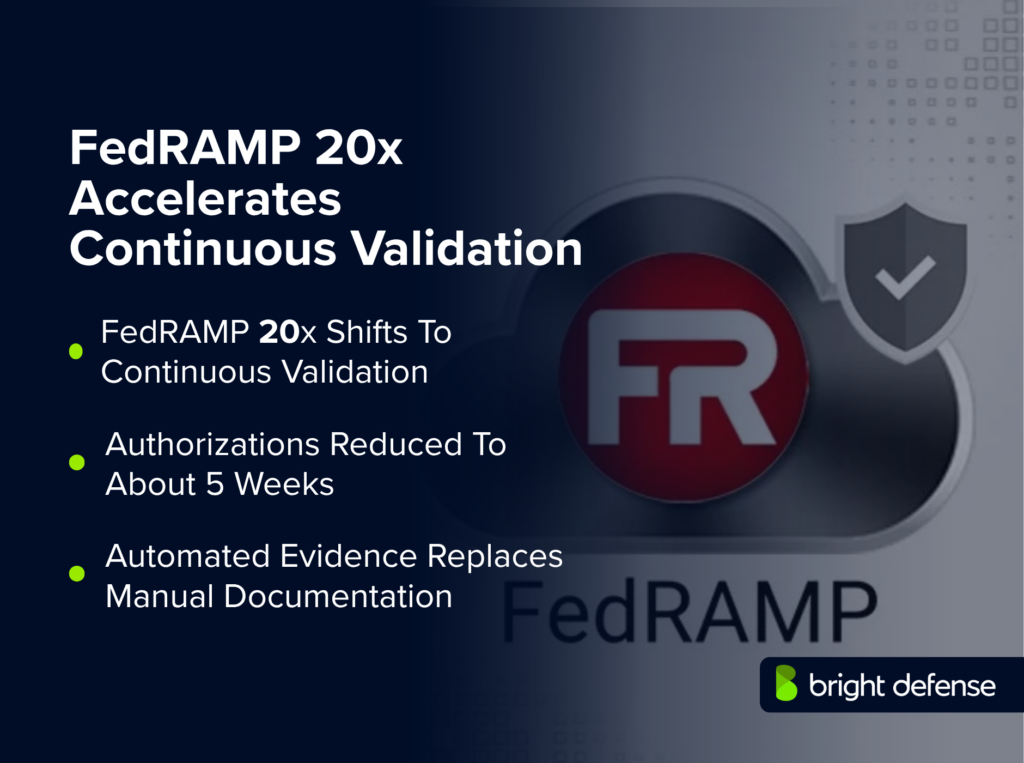
FedRAMP 20x has moved the U.S. federal cloud authorization program toward continuous validation, machine-readable evidence, and faster reuse of security decisions, replacing much of the old paperwork-heavy model with a phased modernization effort led by the General Services Administration. The latest confirmed update is that FedRAMP 20x is in Phase 3, with the Consolidated Rules for 2026 expected by the end of FY26 Q3 and the public submission pipeline expected in FY26 Q4.
What Is FedRAMP 20x And Why Does It Matter For Cloud Compliance Now?
FedRAMP 20x is GSA’s modernization path for federal cloud authorization, designed to move FedRAMP away from static documentation and toward continuous, automated validation of cloud security outcomes. It matters now because the 2025 pilots are complete, Phase 3 is underway, and public 20x submission paths are expected in 2026.
GSA announced FedRAMP 20x on March 24, 2025, saying the program would work with industry on a cloud-native authorization approach. FedRAMP says the model lets providers set security goals, continuously validate whether security capabilities meet those goals, and measure performance over time.
The change is not a repeal of FedRAMP. Traditional Rev 5 agency authorizations continue, but FedRAMP 20x creates a new path that is meant to be faster, more technical, and more closely tied to live system evidence.
What Is The Full FedRAMP 20x Timeline From 2011 To 2026?
FedRAMP began under a federal cloud authorization memo on December 8, 2011, gained statutory footing through the FedRAMP Authorization Act on December 23, 2022, and was reset through OMB Memorandum M-24–15 on July 25, 2024. GSA then announced FedRAMP 20x on March 24, 2025.
FedRAMP 20x Phase 1 ran from April 2025 to September 2025 and focused on Low impact cloud services and Key Security Indicators. FedRAMP said it received 26 complete submission packages, reviewed 13 during the phase, and granted initial Low pilot authorizations in late July 2025.
FedRAMP 20x Phase 2 ran from November 18, 2025, to the end of March 2026. FedRAMP said it received 14 qualifying submissions, granted first-cohort pilot authorizations on March 6, 2026, and had granted 6 additional cloud service provider pilot authorizations by April 27, 2026.
FedRAMP 20x Phase 3 began in April 2026. FedRAMP says the pilots are over, the Consolidated Rules for 2026 will contain the requirements for 20x, and the submission pipeline will open during FY26 Q4, between July 2026 and September 2026.
What Does FedRAMP 20x Require From Cloud Service Providers?
FedRAMP 20x requires cloud service providers to show security capabilities through Key Security Indicators, persistent validation, machine-readable materials, independent assessment where required, and vulnerability reporting tied to validation failures. The model expects evidence from live cloud engineering workflows, not only narrative descriptions of controls.
FedRAMP says all 20x providers are expected to implement persistent validation programs as part of core engineering workflows. Providers must persistently validate Key Security Indicators, treat validation failures as vulnerabilities, report validation activity through vulnerability detection and response processes, and include independent validation results without modification.
For machine-based resources, FedRAMP documentation says validation must occur at least once every 7 days for Low impact systems and at least once every 3 days for Moderate impact systems. For non-machine-based resources, validation must occur at least once every 3 months.
Which Agencies, Vendors, And Assessors Are Affected By FedRAMP 20x?
FedRAMP 20x affects federal agencies seeking faster cloud adoption, cloud service providers seeking federal authorization, third-party assessment organizations, federal buyers, and vendors offering SaaS, AI, GRC, trust-center, and other cloud-native services. The near-term path focuses on Class A Pilot, Class B Low, and Class C Moderate certifications.
The program is especially relevant to cloud providers that were previously delayed by long documentation cycles, agency sponsorship barriers, and queue backlogs. FedRAMP’s own comparison says Rev 5 commonly required years of preparation and investment, while 20x pilot participants received authorization in less than 2 months from start.
Federal agencies are affected because 20x changes how they read and reuse authorization evidence. Instead of relying only on package narratives and annual point-in-time assessments, agencies are expected to receive security signals that show how controls operate over time.
How Does FedRAMP 20x Change Enforcement And Authorization Consequences?
FedRAMP 20x does not create a public fine schedule, but it changes authorization consequences through certification status, Marketplace visibility, reuse decisions, and agency adoption. Providers that cannot produce required evidence, validation results, or assessor support may fail to obtain or maintain a 20x authorization.
FedRAMP documentation says providers must have goals and validation processes assessed by a FedRAMP-recognized independent assessor or FedRAMP directly in limited prioritized cases. Providers must include assessment results in authorization data without modification.
The practical consequence is commercial. A cloud provider that cannot meet 20x expectations may lose access to faster authorization paths, face slower Rev 5 routes, or miss federal sales where buyers prefer current, machine-readable, continuously validated evidence.
What Should Cloud Providers Do Now To Prepare For FedRAMP 20x?
Cloud providers should prepare for FedRAMP 20x through asset scoping, Key Security Indicator mapping, automated evidence collection, vulnerability response integration, independent assessor planning, and machine-readable package readiness. The work should connect engineering systems, cloud configuration, policy evidence, and authorization data.
Providers should review cloud architecture boundaries, define information resources, map security goals to controls, create validation failure criteria, and set reporting workflows for remediation. Engineering and security teams should prepare evidence from infrastructure-as-code, identity systems, logging platforms, ticketing systems, vulnerability scanners, and cloud-native control planes.
Providers should expect deeper technical review from assessors. FedRAMP’s public preview material says 20x assessments require more technical analysis and coding skill than a traditional scheduled audit model.
How Has Industry Responded To FedRAMP 20x Pilots?
Industry response to FedRAMP 20x has been strong, according to FedRAMP’s pilot summaries and public updates. FedRAMP said more than 30 cloud service providers notified the program of intent to submit during the first pilot, 8 providers shared public drafts, and 26 complete Phase 1 packages were received.
GSA said on August 11, 2025, that FedRAMP reached 114 authorizations in fiscal 2025, more than double fiscal 2024, and authorized 4 new cloud services through the 20x Phase 1 pilot. GSA said authorization time had been reduced to about 5 weeks after previously taking more than 1 year on average.
Industry concerns remain practical. Providers and assessors must build automated evidence systems, translate control operations into machine-readable signals, and maintain validation processes that stand up to review. Smaller providers may gain a faster path, but only where engineering evidence is mature enough to support it.
What Government Actions Are Driving FedRAMP 20x?
The main government actions behind FedRAMP 20x are the 2022 FedRAMP Authorization Act, OMB Memorandum M-24–15, GSA’s March 24, 2025 announcement, and FedRAMP’s phased pilot process. Together, they shifted the program toward automation, reuse, direct program review, and faster cloud adoption.
The FedRAMP Authorization Act created a statutory framework for FedRAMP within GSA. OMB M-24–15 rescinded and replaced the 2011 memo, creating a new governance model responsive to federal cybersecurity and commercial cloud changes.
GSA then used FedRAMP 20x to test the model publicly. The program added AI prioritization on August 25, 2025, after a CIO Council request, with a focus on conversational AI cloud services designed for routine federal worker use.
What Are The Financial And Business Consequences Of FedRAMP 20x?
FedRAMP 20x could reduce authorization time and sales friction for cloud providers that can produce strong automated evidence. GSA said authorizations had dropped to about 5 weeks in 2025, while FedRAMP said pilot participants had received authorization in less than 2 months from start.
The business upside is faster access to federal buyers, reduced delay in sales cycles, and more reusable evidence for agencies. The risk is that providers without mature engineering evidence, automated validation, or technical assessor support may face a wider readiness gap than they faced under document-heavy processes.
For agencies, the impact is faster access to commercial SaaS, AI, GRC, and mission software. For assessors, the shift changes the labor model from checking static documents toward reviewing validation design, evidence pipelines, technical proof, and ongoing control performance.
What Questions Remain For FedRAMP 20x In 2026?
The main unresolved FedRAMP 20x questions concern final Consolidated Rules for 2026, the public submission pipeline, certification classes, High impact coverage, Rev 5 transition timing, assessor capacity, and how agencies will compare 20x evidence with traditional authorization packages.
FedRAMP says 20x will initially cover Class A Pilot, Class B Low, and Class C Moderate certifications. High impact authorization requirements remain less settled. FedRAMP’s Phase 3 page says the submission pipeline is expected in FY26 Q4, but exact operational details depend on final rule publication.
The broader question is whether continuous validation can scale without creating new burdens for smaller cloud providers. FedRAMP’s Phase 1 lessons said the model could replace static yearly narratives and improve confidence, but it also found wide variation in implementation quality.
Why Does FedRAMP 20x Matter For Federal Cloud Security?
FedRAMP 20x matters because federal cloud security is moving from document review toward live evidence of how cloud systems operate. The program reflects a federal view that security decisions should be based on current validation data, not only annual audit artifacts.
That shift is significant for agencies handling citizen data, tax records, health data, defense-adjacent information, and AI-enabled workflows. Continuous validation can give agencies more timely insight into drift, control failure, vulnerability response, and cloud configuration risk.
The stakes are wider than a faster approval process. FedRAMP 20x could reset how federal buyers judge cloud trust, how vendors build compliance systems, and how assessors evaluate technical proof in modern cloud environments.
How Bright Defense Helps Cloud Providers Prepare For FedRAMP 20x
Bright Defense helps cloud providers, SaaS vendors, and federal technology suppliers prepare for FedRAMP 20x through Penetration Testing, Continuous Compliance, and Security Assessments. These services support control validation, evidence readiness, vulnerability remediation, cloud security review, and technical preparation for stronger authorization scrutiny.
For FedRAMP 20x, Bright Defense can test cloud applications, assess exposed attack paths, review identity and access controls, validate vulnerability management, examine logging and monitoring coverage, and help teams produce clearer evidence for continuous validation. That work helps providers move from static compliance records to defensible operating proof.
Sources Cited In This FedRAMP 20x Report
- GSA – GSA Announces FedRAMP 20x (March 24, 2025)
- FedRAMP – FedRAMP 20x Overview (Accessed June 18, 2026)
- FedRAMP – FedRAMP 20x Phase 1 Recap (Accessed June 18, 2026)
- FedRAMP – FedRAMP 20x Phase 2 Recap (Accessed June 18, 2026)
- FedRAMP – FedRAMP 20x Phase 3 (Accessed June 18, 2026)
- FedRAMP – FedRAMP 20x Historical Timeline (Accessed June 18, 2026)
- FedRAMP Documentation – Key Security Indicators (Accessed June 18, 2026)
- FedRAMP Documentation – Persistent Validation And Assessment (Accessed June 18, 2026)
- White House OMB – M-24–15 Modernizing The Federal Risk And Authorization Management Program (July 25, 2024)
- FedRAMP Documentation – FedRAMP In United States Law (Accessed June 18, 2026)
- GovInfo – Public Law 117–263, James M. Inhofe National Defense Authorization Act For Fiscal Year 2023 (December 23, 2022)
- GSA – GSA Celebrates Major Milestones In FedRAMP Cloud Authorization Reform (August 11, 2025)
- GSA – GSA And FedRAMP Announce Major Initiative: Prioritizing 20x Authorizations For AI Cloud Solutions (August 25, 2025)
- Federal News Network – FedRAMP Is Getting Faster, New Automation And Pilots Promise Approvals In Months, Not Years (January 23, 2026)
- Federal News Network – FedRAMP Putting Final Pieces In Place For Major Modernization Effort (February 2, 2026)