180+ Cyberbullying Statistics for 2026
Updated:
September 24, 2026
Cyberbullying isn’t just a schoolyard problem anymore, it’s a 24/7 crisis.
Recent cybersecurity statistics paints a disturbing picture: nearly 60% of U.S. teens have now experienced some form of cyberbullying in their lifetime.
Unlike traditional bullying, the harassment doesn’t stop when the school bell rings; it follows them home, into their bedrooms, and onto the screens they look at right before sleep.
With 26.5% of adolescents reporting victimization in just the last 30 days alone, this is no longer an isolated issue; it is a digital epidemic.
In this post, we break down the critical numbers you need to know, from the platforms where it thrives to the real-world impact on youth mental health.
Summary of Statistical Themes
- Global prevalence and lifetime trends
- Demographic differences by age, gender, sexual orientation, race and disability
- Platforms, communication channels, and forms of abuse
- Country-level and regional prevalence comparison
- Workplace and industry impacts
- Motives behind cyberbullying and risk factors
- Consequences for mental health, education, and behavior
- School‑specific statistics and reporting patterns
- Legal and regulatory frameworks
- Corporate and platform responses
- Economic costs and resource needs
- Timeline shifts and evolving patterns
Check Out Our Other Statistical Research Articles:
Global and Long‑Term Cyberbullying Trends
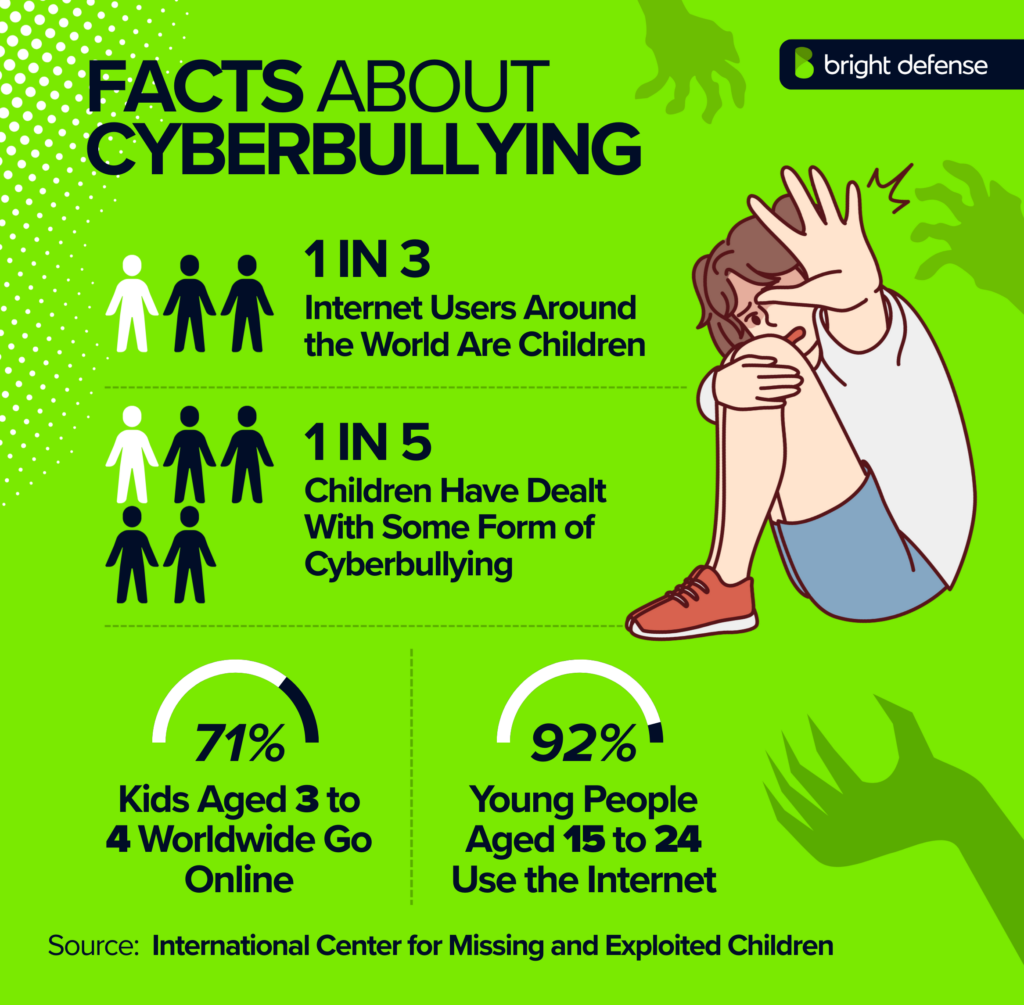
- Globally, 30.5% of adolescents have been bullied at school. (Pacer)
- Between 2016 and 2025, lifetime cyberbullying victimization among young people rose from 33.6% to 58.2 %. (Broadband Search)
- The proportion experiencing cyberbullying in the past 30 days increased from 16.5% in 2016 to 32.7% in 2025. (Broadband Search)
- Cyberbullying offending (individuals admitting to bullying others online) climbed from approximately 5%–6% in 2016 to 16.1% by 2025. (broadbandsearch.net)
- In a survey of 5,000 U.S. middle and high school students, 36.5% reported experiencing cyberbullying at least once. (Singlecare)
- Another study of 6,000 U.S. students aged 10‑18 found that 49% had experienced cyberbullying during their lifetime. (Singlecare)
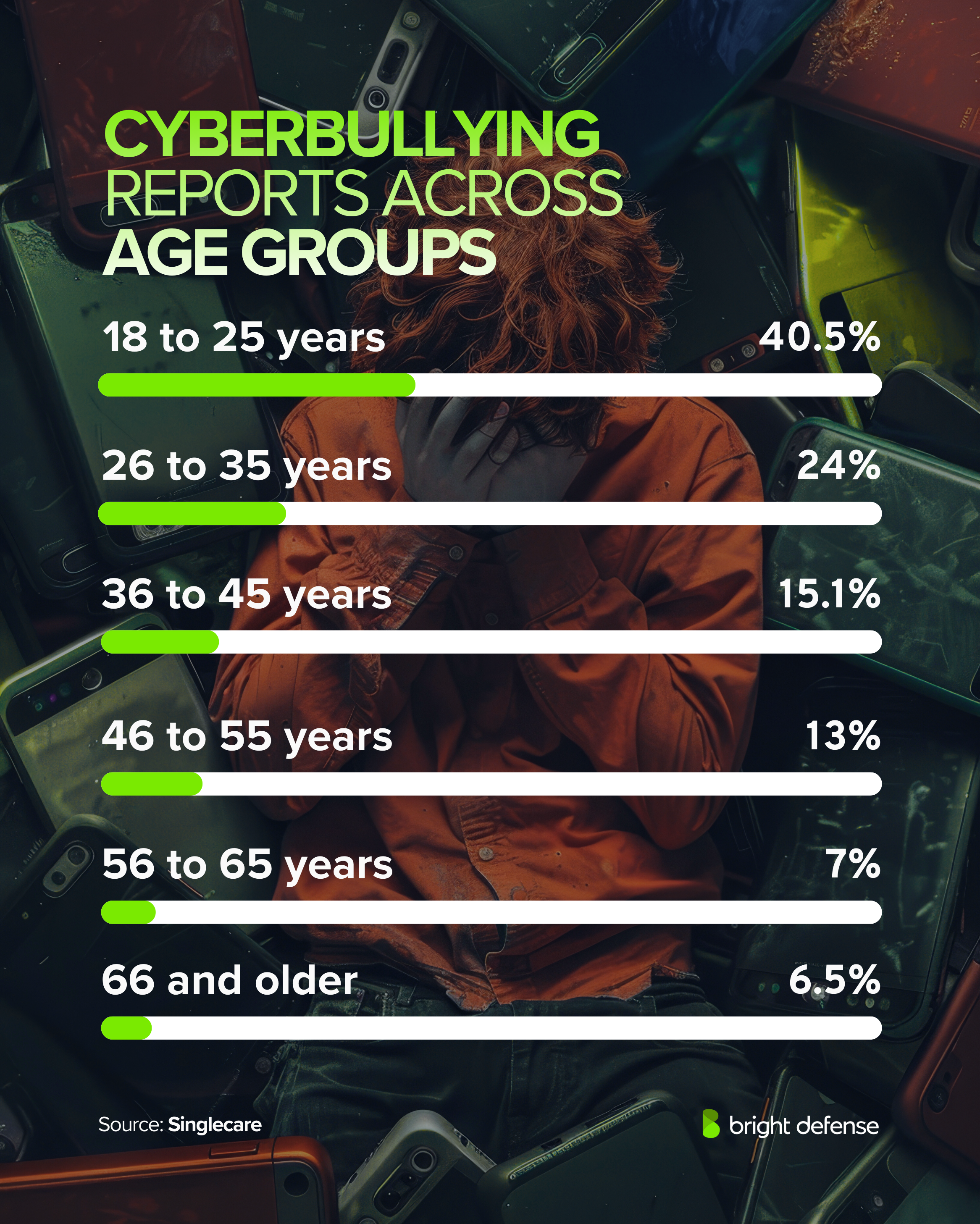
- Cyberbullying Reports Across Age Groups (Sample Size: 20,000)
- 18 to 25 years: 40.5%
- 26 to 35 years: 24%
- 36 to 45 years: 15.1%
- 46 to 55 years: 13%
- 56 to 65 years: 7%
- 66 and older: 6.5% (Singlecare)
- One third of students surveyed across 30 countries said they had been victims of cyberbullying. (Singlecare)
- A worldwide survey of internet users aged 12–17 found that 22% had been cyberbullied. (SQ Magazine)
- Among gamers, 83 million of approximately 110 million online multiplayer players in the U.S. (about 75 %) reported experiencing hate or harassment. (ADL)
- Among children aged 12–14, 38.4% reported being bullied at some point, compared with 29.7% of those aged 15–17. (CDC)
- In a cross‑national survey of 279,000 young people in 44 countries, 12% admitted to cyberbullying others, while 15% said they had been cyberbullied. (WHO)
- During the COVID‑19 pandemic, 44% of students in one U.S. survey noticed an increase in cyberbullying incidents. (Singlecare)
- A federal survey found that 32.5% of bullied U.S. students experienced bullying on 1 day during the school year, 17.6% on 2 days, 31.5% on 3–10 days, and 18.5% on more than 10 days. (Stopbullying)
- In the U.S., 15.4% of students aged 12‑18 were bullied by a more powerful student, and 14.5% experienced repeated bullying. (Stopbullying)
- About 12.7% reported repeated bullying perpetrated by someone more powerful. (Stopbullying)
- Among bullied students, 41.3% expected the bullying to happen again. (Stopbullying)
- Only 44.2% of bullied students notified a trusted adult about their experience. (Stopbullying)
- Roughly 21.5% of teenagers reported being bullied 1‑2 times per year, 6.5% 1‑2 times per month, 4.4% 1‑2 times per week, and 1.7% almost every day. (CDC)
- About 66% of teenagers reported no bullying during the survey period. (CDC)
- Lifetime cyberbullying prevalence increased from 18.8% in 2007 to 54.6% by 2023. (Pacer)
- Past‑30‑day cyberbullying prevalence increased from 16.7% in 2016 to 23.2% in 2021 and 26.5% in 2023. (Pacer)
- In earlier years, 18.5% of students reported being cyberbullied at least once in 30 days, rising to 26.5% by 2023. (Pacer)
- Between 2018 and 2024, the share of adolescents who cyberbully others increased from 11% of boys and 7% of girls to 14% of boys and 9% of girls. (WHO)
- Exposure to white supremacist ideology among youth gamers dropped from 15% in 2022 to 9% in 2023, and among adults from 20% to 15%. (ADL)
- Meta’s content moderation shows declines and improvements: on Facebook, the number of bullying and harassment posts actioned declined from 7.9 million in Jan–Mar 2024 to 4.1 million in Apr–Jun 2025. (Meta)
- The proactive detection rate for bullying and harassment on Facebook improved from 14.4% in 2019 to 88.9% in mid‑2024 and stabilized near 75.3% by Apr–Jun 2025. (Meta)
- On Instagram, Meta’s proactive rate improved to 96.9% by 2024, up from 35% in 2019 (Exploding Topics)
What Is Cybersecurity Compliance And How It Applies To Cyberbullying Risks
Cybersecurity compliance applies to cyberbullying risks through structured policies, monitoring systems, and data protection controls that reduce online harassment exposure and support safer digital environments. Organizations, schools, and platforms must implement access controls, reporting mechanisms, and content moderation practices to address the scale of the issue, where nearly 60% of U.S. teens have experienced cyberbullying and 26.5% reported incidents within the past 30 days .
For platforms that handle user accounts and private messages, a SOC 2 requirements checklist can help teams review access controls, monitoring, and incident response
At Bright Defense, we support compliance efforts with continuous risk assessments, policy enforcement, and user awareness programs, which goes to show that combining governance with active monitoring reduces both regulatory risk and real-world harm from online abuse.
Cyberbullying Patterns Across Gender and Cultural Groups
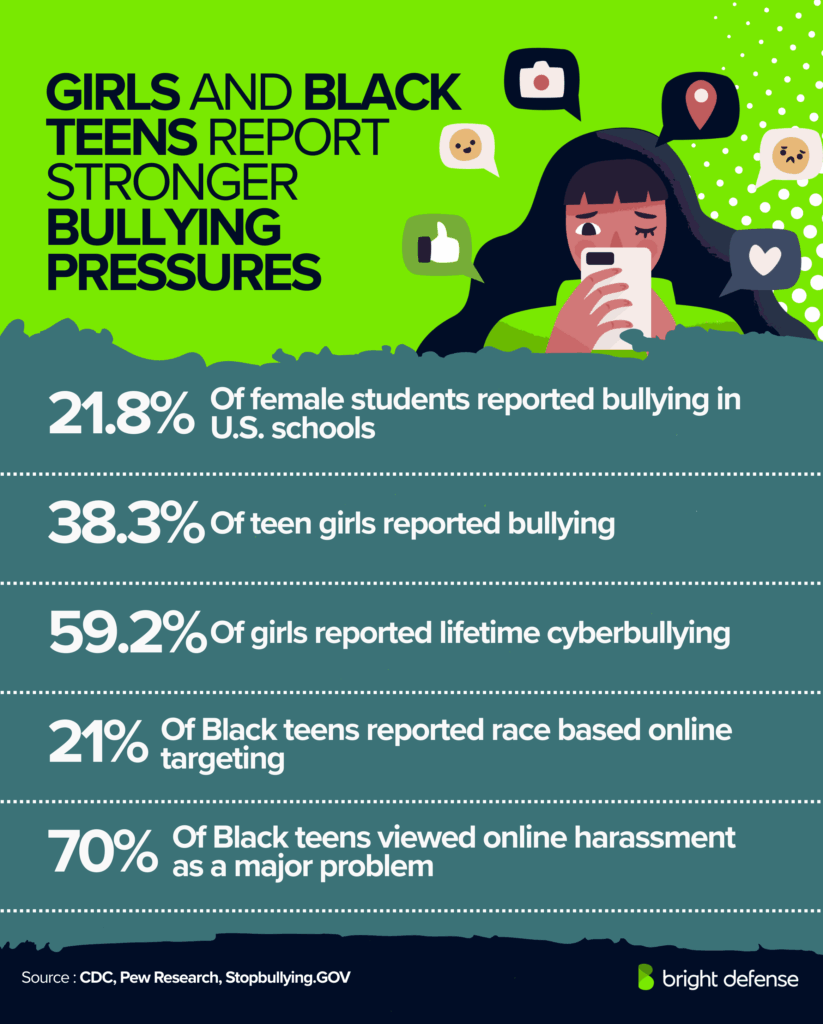
- In U.S. schools, 21.8% of female students and 16.7% of male students reported being bullied. (Stopbullying)
- Among teenagers, girls reported bullying at higher rates (38.3%) than boys (29.9%). (CDC)
- Girls faced higher lifetime cyberbullying prevalence (59.2%) compared with boys (49.5%) (Pacer)
- In the previous 30 days, cyberbullying prevalence was 28.6% among girls versus 24.2% among boys. (Pacer)
- Hispanic US teens are more likely than White or Black teens to say someone constantly asks them online where they are, what they are doing, or who they are with. (Pew Research)
- Among bullied students, 27.7% of females and 14.1% of males were bullied online or via text. (Stopbullying)
- Electronic bullying among U.S. high school students affected 21% of females and 12% of males. (Stopbullying)
- In a Pew survey, 60% of girls and 59% of boys aged 13‑17 reported experiencing at least one form of online harassment. (Singlecare)
- Girls are more likely to receive unsolicited explicit images (29% of girls vs 20% of boys, with 35% of girls aged 15–17 receiving such content). (Singlecare)
- Among teenagers surveyed by the CDC, sexual or gender minority youth reported bullying at 47.1% versus 30% for non‑minority youth. (CDC)
- Identity‑based harassment targeted 37% of gamers aged 10‑17, up from 29% in the previous year. (ADL)
- Among content creators, 48% of harassment focused on gender. (ADL)
- Women and girls were harassed due to gender in 48% of cases and because of race in 50% of cases among Black adult gamers. (ADL)
- Among female internet users under 25, 54% reported receiving threatening messages. (SQ Magazine)
- In Canada, 44% of women and gender‑diverse individuals experienced online hate, and 30% of Indigenous women were targeted. (Broadband Search)
- The CDC found white non‑Hispanic teenagers had a bullying rate of 39.6 %, compared with 16.1 % for Asian teens, 23.8 % for Black teens and 26.7 % for Hispanic teens. (CDC)
- Black U.S. teens aged 13–17 were about twice as likely as other racial groups to be cyberbullied due to race or ethnicity. (Avast)
- Black middle‑school bullying victims were 135 % more likely to consider and plan suicide compared with non‑victimized peers. (Exploding Topics)
- Indigenous women in Canada reported online hate at a rate of 30 %, about 30 percentage points higher than the overall rate for women and gender diverse individuals. (Broadband Search)
- Among adult gamers, 50% of Black players said they had been harassed because of race. (ADL)
- Teenagers with developmental disabilities reported bullying at a rate of 44.4 %, versus 31.3 % for those without disabilities. (CDC)
- Students with disabilities are more likely to be targeted: 9.7% of bullied U.S. students reported being targeted because of disability. (Pacer)
- Cyberbullying affects different age groups differently: 36 % of U.S. teens aged 13–17, 29 % of preteens, 24% of 18–24‑year‑olds, 18 % of children under 10, 14 % of adults aged 25–34 and 7 % of seniors reported being cyberbullied. (SQ Magazine)
- Among middle schoolers, 37% of administrators reported weekly cyberbullying incidents, compared with 25% in high schools and 6 % in elementary schools. (Pacer)
- In the U.K., the prevalence of online bullying rises with age: rates among 15‑year‑olds were nearly double those at 11 years. (Anti-Bullying Alliance)
- Of U.S. high school students, 19 % were bullied on school property in 2021. (Stopbullying)
- Among U.S. high schoolers, 16 % were electronically bullied at least once in the previous year. (Avast)
- Low‑income U.S. households (income under $75,000) reported cyberbullying at twice the rate of high‑income households (22 % vs 11 %). (Security.org).
- In the U.K., children from more affluent families were more likely to report being cyberbullying victims than those from less affluent households. (Anti-Bullying Alliance)
- One survey indicated that 81% of children believed bullying is easier to get away with online. (Broadband Search)
- About 90% of witnesses ignored the cyberbullying incident. (Broadband Search)
- 21% of Black US teens say they were targeted online because of race or ethnicity, compared with 11% of Hispanic teens and 4% of White teens. (Pew Research)
- 70% of Black US teens say online harassment and bullying are a major problem, compared with 62% of Hispanic teens and 46% of White teens. (Pew Research)
- 65% of US teens in urban communities say online harassment and bullying are a major problem, compared with about 50% of teens in suburban and rural communities. (Pew Research)
- 33% of Black US teens say law enforcement is doing a poor job handling online harassment and bullying, compared with 21% of White teens.(Pew Research)
- 49% of US teens ages 15-17 say they have experienced at least one cyberbullying behavior, compared with 42% of teens ages 13-14. (Pew Research)
- 17% of US teens ages 15-17 say someone has persistently questioned them online about where they are, what they are doing, or who they are with, compared with 12% of teens ages 13-14. (Pew Research)
- 32% of US teen girls say they have experienced 2 or more types of cyberbullying, compared with 24% of teen boys. (Pew Research)
- Lower‑income households experienced cyberbullying at double the rate of higher‑income households (22 % vs 11 %) (Security.org)
Cyberbullying Trends Across Major Social Platforms
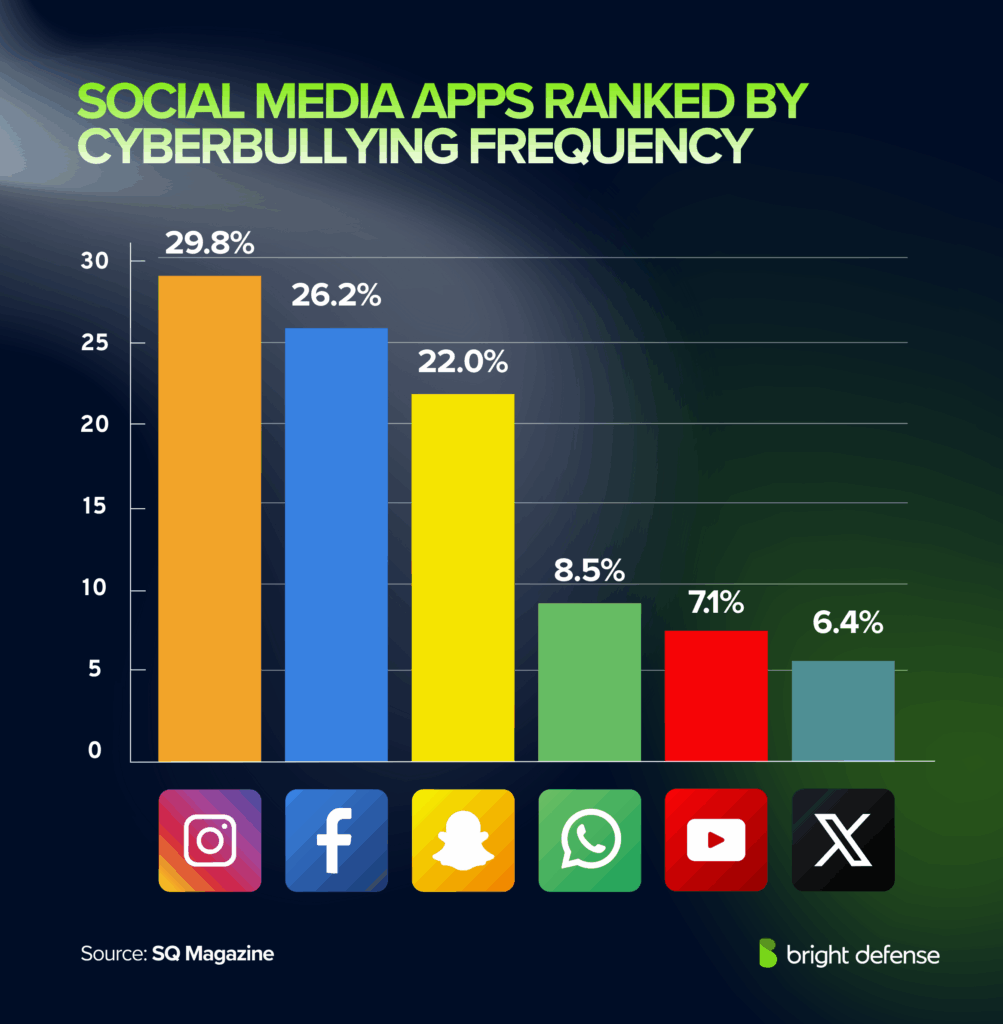
- Cyberbullying incidents reported across major social platforms
- Instagram 29.8%
- Facebook 26.2%
- Snapchat 22%
- WhatsApp 8.5%
- YouTube 7.1%
- X 6.4% (Broadband Search)
- On Facebook, Meta took action on 4.1 million pieces of content for bullying and harassment from Apr–Jun 2025. (Meta)
- Appeals lodged on Facebook regarding bullying and harassment totaled 681,000 in Apr–Jun 2025 and 904,000 in Jan–Mar 2025, highlighting a steady flow of bullying and harassment cases on Facebook. (Meta)
- Among social media content creators, 95% reported experiencing harassment or hate at least once. (ResearchGate)
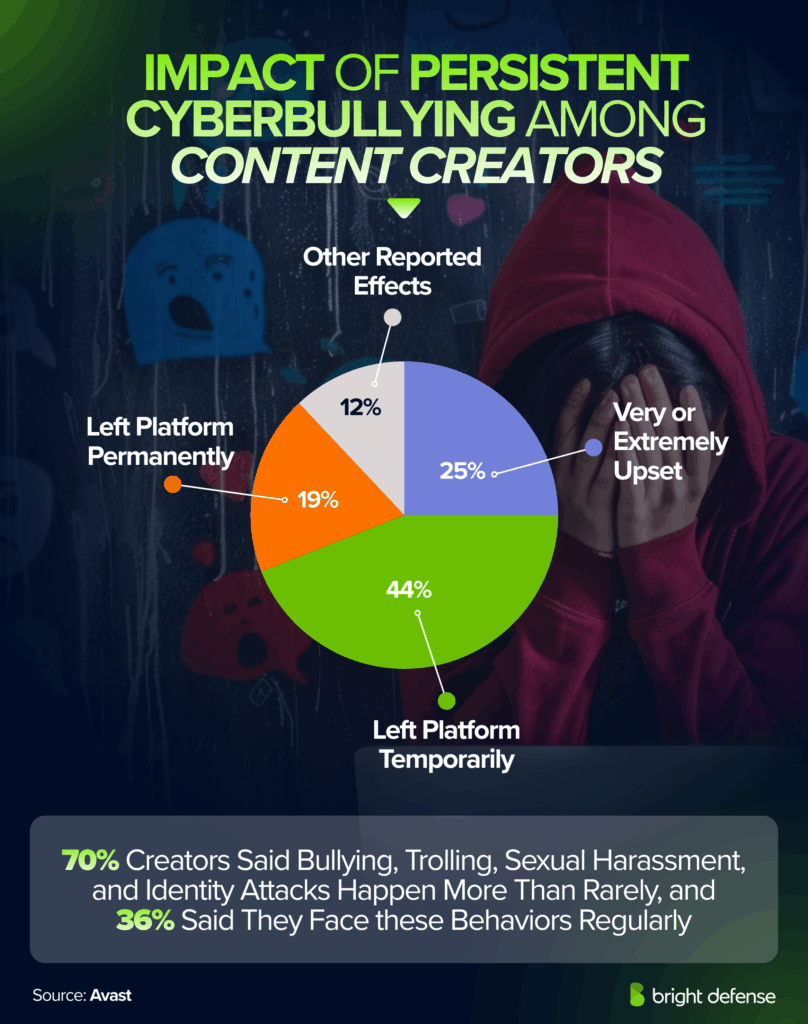
- 70% of content creators said bullying, trolling, sexual harassment, and identity attacks happen more often than rarely. 36% said they suffer those behaviours regularly. (Avast)
- Consequences of cyberbullying among content creators
- Very or extremely upset: 25%
- Left platform temporarily: 44%
- Left platform permanently: 19% (Avast)
- 46% of U.S. teens aged 13‑17 experienced at least one of six forms of cyberbullying. (Avast)
- A quarter of children and teens have admitted to cyberbullying someone in the past five years. (Avast)
- 53% of U.S. children had a smartphone by age 11. (Avast)
- In the U.S., 41% of adults reported experiencing online harassment. (Avast)
- About 65% of people across 17 countries considered cyberbullying the biggest online risk. (Avast)
- 74% of U.S. teens believed social media sites do a fair‑to‑poor job in dealing with online harassment. (Avast)
- Text or messaging apps accounted for 56% of online bullying incidents among U.K. children. (Anti-Bullying Alliance)
- A Crime Survey for England and Wales found that 72% of online bullying happened at school or during school hours. (Anti-Bullying Alliance)
- In the U.S., 39% of bullying occurred in classrooms, 37.5% in hallways, 25.1% in cafeterias, and 24.4% outside on school grounds. (Stopbullying)
- About 21.6% of bullied U.S. students reported being bullied online or by text messages. (Stopbullying)
- Among adults, 41% reported online harassment, and 75% of adult gamers experienced some form of in‑game hate or harassment. (ADL)
- Among U.S. teens, 77% of those who cyberbully others had themselves been victims. (Avast)
- More than 50% of teens felt angry after being cyberbullied, while 33% felt hurt and 15% felt scared. (Avast)
- Approximately 94% of teens reported that cyberbullying negatively affected their lives, with 69.1% reporting impacts on self‑esteem, 31.9% on friendships, 13.1% on physical health, and 6.5% on schoolwork. (Avast)
Common Behaviors Seen in Cyberbullying Cases
- In one survey, 24.9 % of students experienced mean comments, 22.2% experienced rumours and 30.1 % experienced more than one type of cyberbullying. In that sample, 14.8 % admitted to committing cyberbullying. (Singlecare)
- Among U.S. teens, 59% experienced at least one abusive online behaviour, while name‑calling was reported by 42%. (Singlecare)
- Among tweens (ages 9‑12) who experienced cyberbullying, 30.4% reported mean or hurtful comments within the past month. (Pacer)
- Mean or hurtful comments affected 30% of tweens; group chat exclusion affected 28.9%; rumor spreading affected 28.4%; humiliation affected 26.9%, and threats affected about 10%. (Pacer)
- In the U.K., names and insults were the most common form of online bullying (10% of all children aged 10‑15). (Anti-Bullying Alliance)
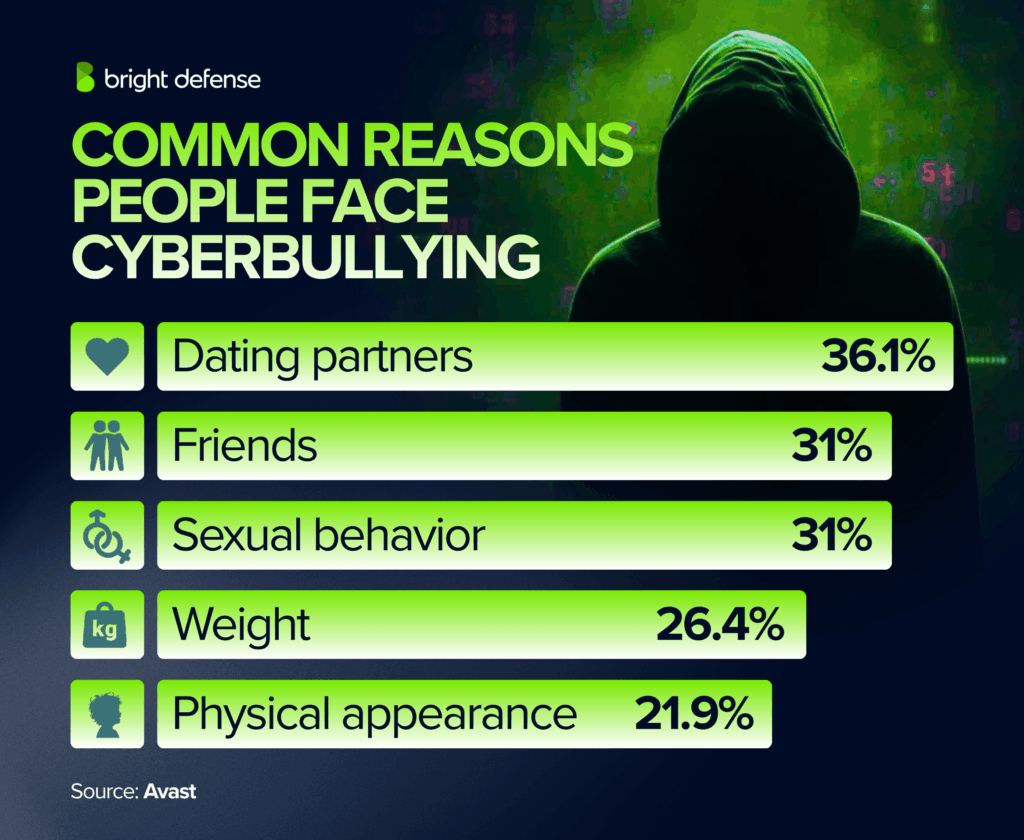
- According to DataProt, the most common triggers included problems involving dating partners at 36.1%. Conflicts with friends and comments about sexual behavior each appeared in 31% of messages. Weight came up in 26.4% of cases, and physical appearance showed up in 21.9% of messages.(Avast)
- Name‑calling accounted for 37% of online harassment. (Security.org)
- When asked how they responded, 36% of victims asked the bully to stop, 34% blocked the bully, 29% did nothing, and 11% told their parents. (Security.org)
- Among tweens, 60.2% blocked the bully, 50.8% told a parent, 42.8% ignored the behavior, 29.8% reported it to the platform, and 29.6% took a break from the device. (Pacer)
- 46% of US teens ages 13-17 say they have experienced at least 1 of 6 cyberbullying behaviors online or on their phone. (Pew Research)
- 28% of US teens say they have experienced multiple types of cyberbullying online or on their phone. (Pew Research)
- 32% of US teens say they have been called an offensive name online or on their phone. (Pew Research)
- 22% of US teens say false rumors have been spread about them online or on their phone. (Pew Research)
- 17% of US teens say they have received explicit images they did not ask for online or on their phone. (Pew Research)
- 15% of US teens say someone other than a parent has constantly asked where they are, what they are doing, or who they are with through digital channels. (Pew Research)
- 10% of US teens say they have received physical threats online or on their phone. (Pew Research)
- 7% of US teens say explicit images of them have been shared without their consent. (Pew Research)
Cyberbullying in the Workplace and Educational Institutions
- Cyberbullying extends into the workplace: 18% of remote workers reported being cyberbullied. (SQ Magazine)
- About 23% of employees aged 25–39 experienced workplace cyberbullying. (SQ Magazine)
- In education, 61% of U.S. schools reported at least one cyberbullying incident. (SQ Magazine)
- 37% of cases reported by schools led to suspension. (SQ Magazine)
- Among bullied students, 44.2% notified an adult. (Stopbullying.gov)
- About 72% of children who faced online bullying reported that at least part of it happened at school or during school hours. (Anti-Bullying Alliance)
- Schools in the U.S. reported cyberbullying weekly in 37% of middle schools, 25% of high schools, and 6% of elementary schools. (Pacer)
- Among U.S. high school students, 16% experienced electronic bullying. (Avast)
- Girls in high school reported being electronically bullied at 21% compared with 12% for boys. (Stopbullying.gov)
- Among bullied students, 27.7% of females and 14.1% of males were bullied online or by text. (Stopbullying.gov)
- In the U.K., nearly a quarter of pupils reported experiencing online bullying at least once, and 6% reported frequent incidents. (Anti-Bullying Alliance)
- Two‑thirds of bullied teens said cyberbullying affected their ability to learn and feel safe in school. (Avast)
- 93% of children in the U.K. said they would tell someone if they saw something upsetting online. (Anti-Bullying Alliance)
- Globally, 81% of young people believed cyberbullying is easier to get away with than face‑to‑face bullying. (Broadband Search)
- In 2007, only 18.8% of students reported having been cyberbullied at some point, rising to 54.6% in 2023. (Pacer)
Motives Behind Cyberbullying and Risk Factors
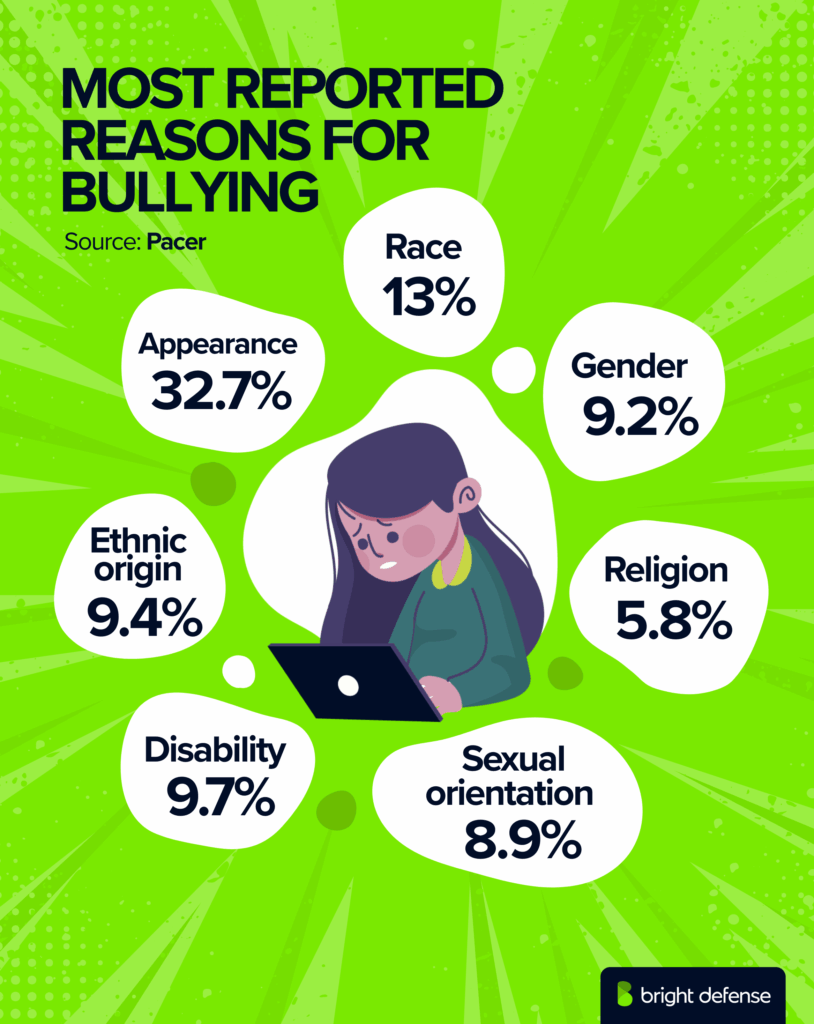
- Common reasons students reported for bullying incidents
- Appearance was the leading reason at 32.7%
- Race was cited in 13% of cases
- Disability accounted for 9.7%
- Ethnic origin accounted for 9.4%
- Gender accounted for 9.2%
- Sexual orientation accounted for 8.9%
- Religion accounted for 5.8% (Pacer)
- Another survey found that dating partners were the reason behind 36.1% of cyberbullying messages, friends behind 31%, sexual behavior behind 31%, weight behind 26.4% and physical appearance behind 21.9%. (Avast)
- Among online gamers, harassment because of gender reached 48%. (ADL)
- 50% of Black adult gamers were harassed due to race. (ADL)
Consequences and Mental Health Effects of Cyberbullying
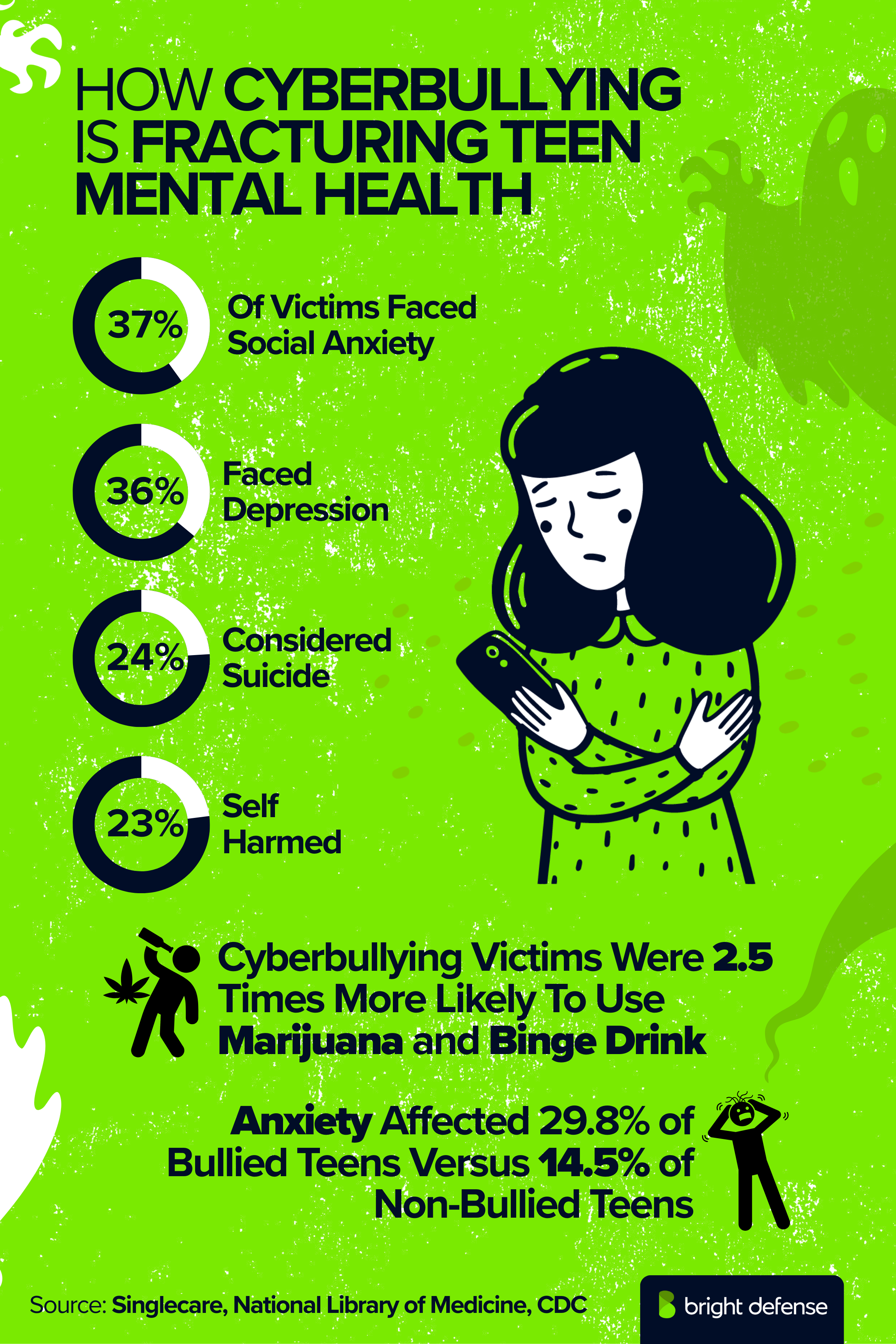
- In a survey, 37% of victims developed social anxiety, 36% developed depression, 24% contemplated suicide, and 23% engaged in self‑harm. (Singlecare)
- Cyberbullying victims were 2.5 times more likely to use marijuana and 2.5 times more likely to engage in binge drinking. (National Library of Medicine)
- 29.8% of bullied teenagers showed anxiety symptoms, compared with 14.5% of those not bullied. (CDC)
- Depression symptoms were present in 28.5% of bullied teens versus 12.1% of non‑bullied peers. (CDC)
- Black middle‑school victims were 135 % more likely to consider and plan suicide compared with their non‑victimized peers. (Exploding Topics)
- Identity‑based harassment increased suicide attempts by 91 %. (Exploding Topics)
- In gaming communities, 20% of players spent less money on games because of hate and harassment. (ADL)
- 45% cyberbullying victims sought therapy. (SQ Magazine)
- About 23% of employees aged 25–39 changed jobs or left positions due to cyberbullying. (SQ Magazine)
- 8% moved to a new home, and 16% changed school due to cyberbullying. (SQ Magazine)
- 13% changed jobs, and 7% sought legal help. (SQ Magazine)
Regulatory Approaches Addressing Cyberbullying
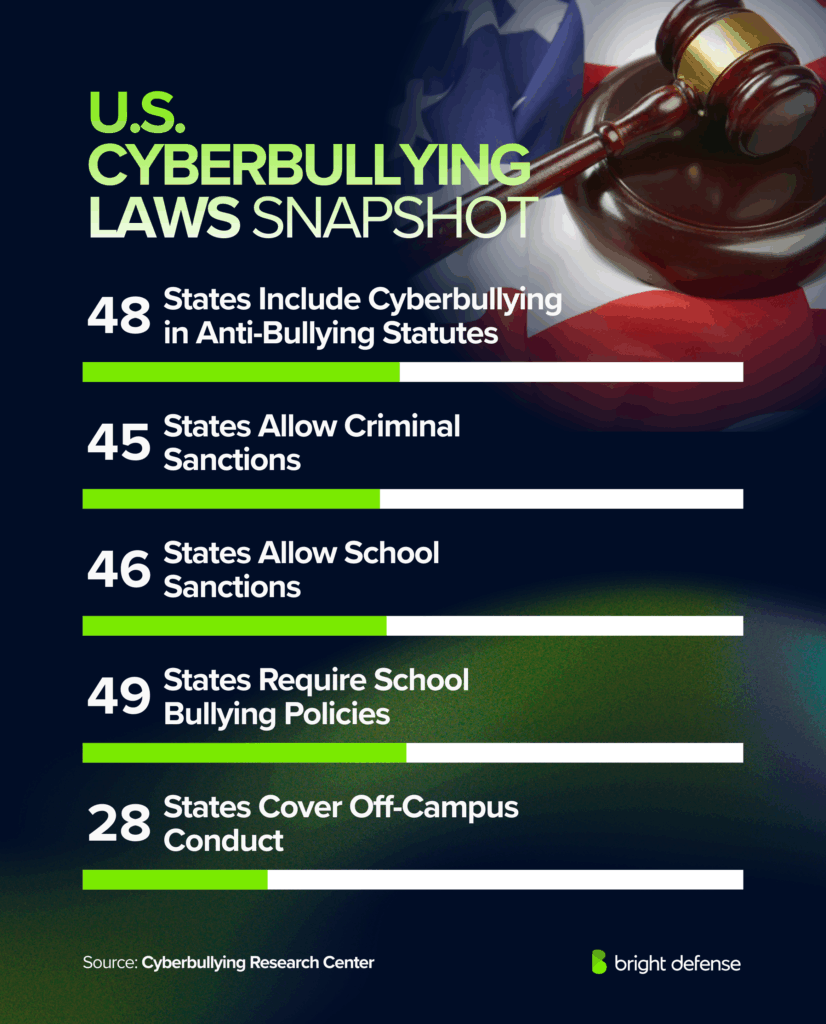
- U.S. Cyberbullying Laws Snapshot
- 48 States Include Cyberbullying in Anti-Bullying Statutes
- 45 States Allow Criminal Sanctions
- 46 States Allow School Sanctions
- 49 States Require School Bullying Policies
- 28 States Cover Off-Campus Conduct (Cyberbullying Research Center)
- 60 states lacked specific cyberbullying laws. (Exploding Topics)
- A misdemeanor tied to cyberbullying can bring up to 1 year in prison or a $1,000 fine, while a felony can lead to as much as 5 years in prison and a $5,000 fine. Penalties increase cyberbullying, which contributes to a suicide. (Singlecare)
- In some countries, new legislation requires social media platforms to remove harmful content quickly or face fines. Australia’s eSafety Commissioner issued more than 500 content removal requests following nearly 1,700 complaints. (Avast)
- Legal costs for therapy sessions to address cyberbullying impacts range from $100 to $200 per session. (Singlecare)
- Canada: Non-consensual sharing of intimate images is a crime punishable with up to 5 years in prison under federal cyberbullying reforms. (Kruse Law Firm)
- United Kingdom: In 2023, UK police made 12,183 arrests (about 33 per day) for offensive or menacing online messages under communications laws. (The Times)
- India: Cyberbullying cases are charged under at least 5 key provisions, including IT Act sections 66E and 67 and IPC sections 354D, 499, and 507. (Lawful Legal)
- Japan: Online insults can now bring up to 1 year in prison and fines up to ¥300,000 under Japan’s 2022 penal code amendments targeting cyberbullying. (Endgadget)
- South Korea: The 2004 School Violence Prevention Act treats cyberbullying as “school violence,” covering incidents inside and outside school. (Korean Law Information Center)
- Brazil: Law 14.811/2024 makes cyberbullying a criminal offense punishable with 2 to 4 years of imprisonment plus a fine. (Planalto)
- South Africa: The Cybercrimes Act 19 of 2020, in force since 1 Dec 2021, criminalizes harmful data messages, including disclosure of intimate images. (Government of South Africa)
- France: When harassment happens online, penalties double from 1 year and a €15,000 fine to 2 years and a €30,000 fine under France’s cyberbullying rules. (Bitdefender)
How Companies and Online Platforms Respond to Cyberbullying
- Meta lowered bullying and harassment content on Facebook from 7.9 million pieces in Jan to Mar 2024 to 4.1 million in Apr to Jun 2025, while proactive detection rose from 14.4% in 2019 to 88.9% in mid 2024. (Exploding Topics)
- On Instagram, detection improved from 35 % in 2019 to 96.9 % in 2024. (Exploding Topics)
- Facebook recorded 681,000 appeals on bullying and harassment decisions in Apr–Jun 2025 and 904,000 in Jan–Mar 2025. (Exploding Topics)
- Meta’s user reports accounted for 24.7% of bullying and harassment removals in Apr–Jun 2025, while automated systems found 75.3 %. (Exploding Topics)
- Proactive detection rate for cyberbullying/harassment on Instagram rose from 35% in 2019 to 96.9% in 2024. (Exploding Topics)
- A global survey found 67% of social media users believe platforms do not address cyberbullying effectively. (SQ Magazine)
- 71% of 13‑24‑year‑olds said social media platforms are not doing enough to prevent cyberbullying. (Singlecare)
- When asked about their approach, 74% of U.S. teens rated social media companies’ handling of online harassment as fair or poor. (Avast)
- 65% of adults across 17 countries believe cyberbullying is the biggest online risk, indicating strong demand for better corporate responses. (Avast)
Content moderation depends on more than detection rates. Organizations can use continuous cybersecurity compliance to keep security controls and response procedures under review. Platforms should also test whether flaws could expose private messages or user accounts. Penetration testing helps identify those technical weaknesses.
Cyberbullying in Online Multiplayer Games
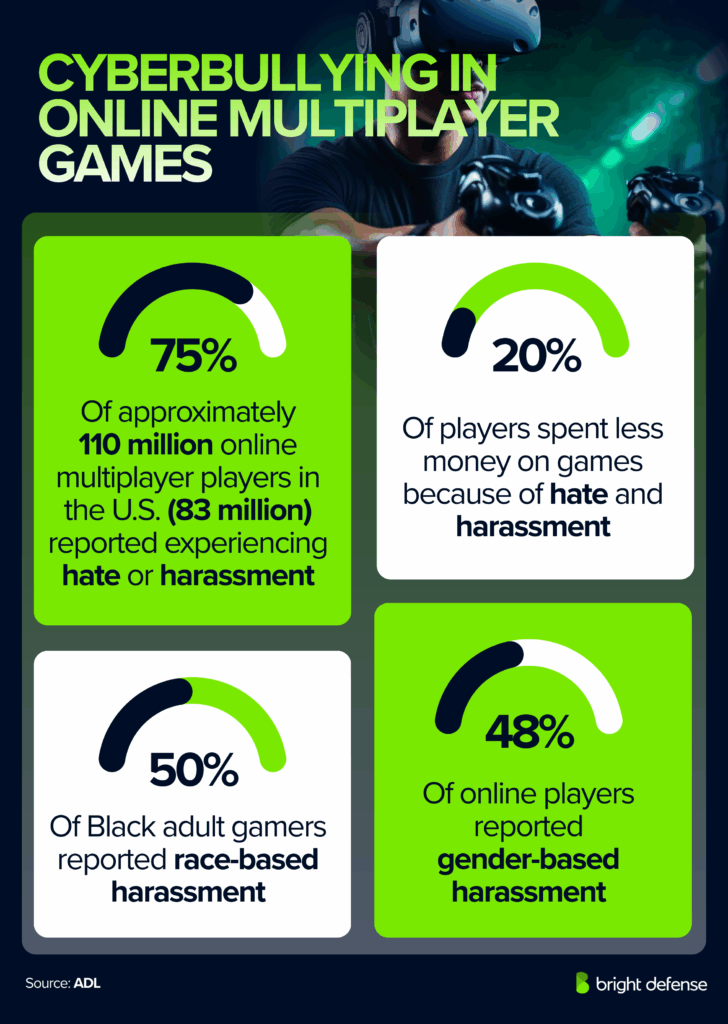
- 75% of approximately 110 million online multiplayer players in the U.S. (83 million) reported experiencing hate or harassment. (ADL)
- Identity-based harassment targeted 37% of gamers aged 10–17, up from 29% in the previous year. (ADL)
- Among adult gamers, 50% of Black players said they had been harassed because of race. (ADL)
- Among online gamers, harassment because of gender reached 48%. (ADL)
- Exposure to white supremacist ideology among youth gamers dropped from 15% in 2022 to 9% in 2023, and among adults from 20% to 15%. (ADL)
- 20% of players spent less money on games because of hate and harassment. (ADL; SQ Magazine)
Regional and Country Level Comparisons of Cyberbullying Trends
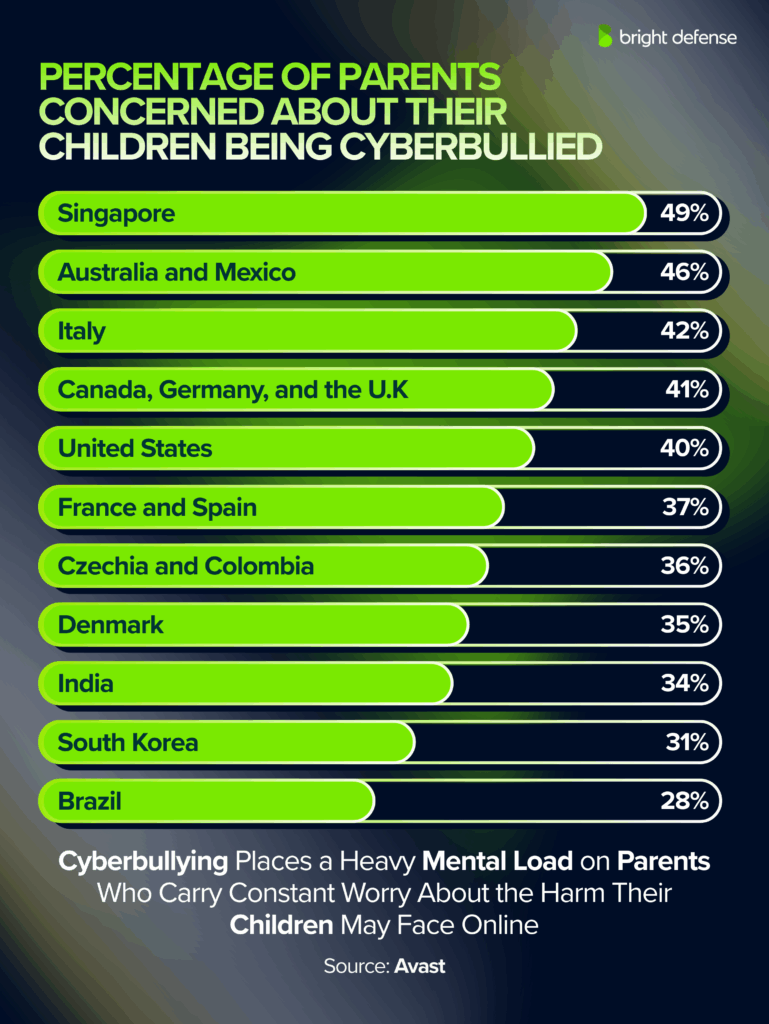
- Percentage of Parents Concerned About their Children Being Cyberbullied
- Singapore reported 49%
- Australia and Mexico 46%
- Italy 42%
- Canada, Germany, and the U.K. 41%
- United States 40%
- France and Spain 37%
- Czechia and Colombia 36%
- Denmark 35%
- India 34%
- South Korea 31%
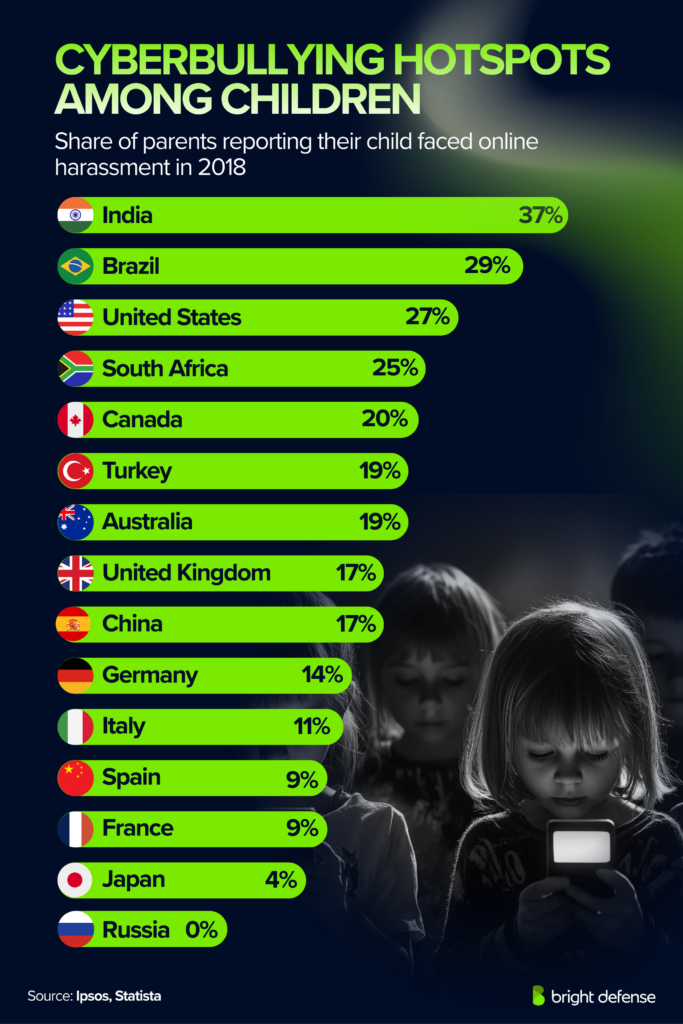
- Brazil 28%
- In the U.S., 19.2% of students aged 12–18 reported being bullied in 2021–22. (Stopbullying)
- About 19% of U.S. high school students were bullied on school property. (Stopbullying)
- Roughly 21.6% of bullied U.S. students were bullied online or by text. (Stopbullying)
- In Canada, 39% of internet users experienced cyberbullying. (SQ Magazine)
- Among Indigenous women in Canada, 30% reported being targeted online. (Broadband Search)
- In Brazil, 41% of internet users reported being cyberbullied. Among Brazilian parents, 29% said their child had been cyberbullied. (Broadband Search, Singlecare)
- A national U.S. program allocated $36 million to support victims of cyberbullying. (Broadband Search)
- The Crime Survey for England and Wales found that 19% of children aged 10–15 experienced at least one type of online bullying. (Anti-Bullying Alliance)
- Singapore topped a 17‑country survey with 49% of parents worried about cyberbullying. (Avast)
- In Japan, 15% of children were reported to have experienced cyberbullying. (Broadband Search)
- In Saudi Arabia, 26% of 12‑18‑year‑olds said cyberbullying affected school performance, and 21% said it made them consider self‑harm. (Avast)
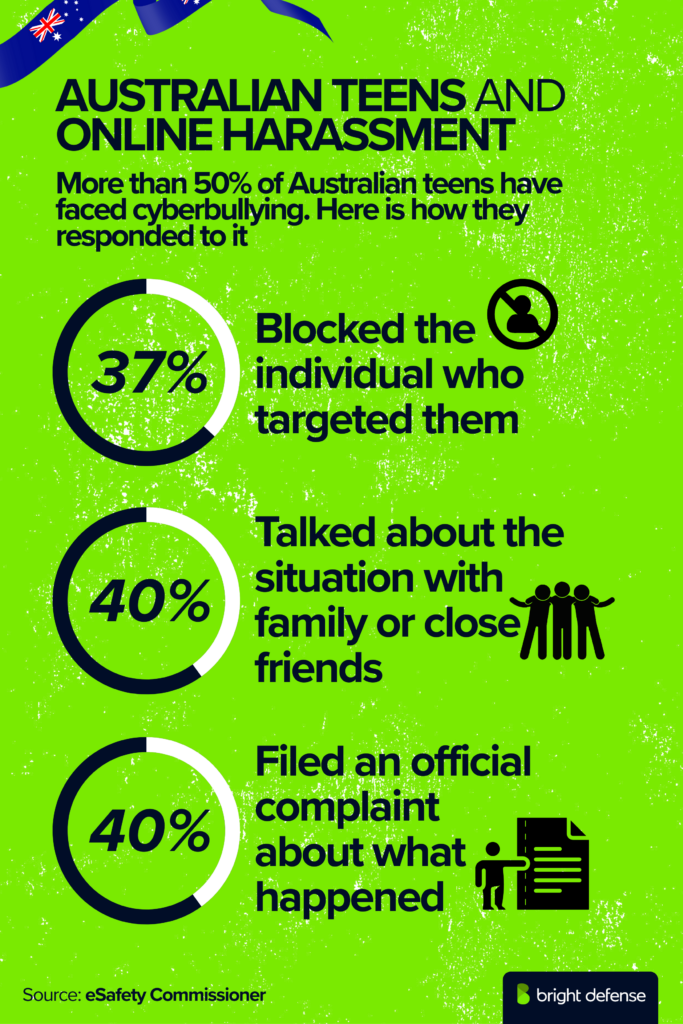
- In Australia, the eSafety Commission investigated nearly 1700 cyberbullying complaints and issued more than 500 content removal requests in a year. (Avast)
How Many People Get Cyberbullied A Year?
According to studies on this topic, roughly 15% to 20% of people, especially school-aged children, are bullied each year. Here are the detailed findings:
United States (high school)
- The CDC’s 2023 Youth Risk Behavior Survey reports 16% of U.S. high school students were electronically bullied. (CDC)
- NCES reports 15.6 million students enrolled in grades 9 to 12 in fall 2023 (public schools, 50 states plus D.C.). National Center for Education Statistics
- Rough estimate: 15.6 million × 16% = 2.496 million, so about 2.5 million U.S. high school students per year.
International comparison (not a direct “per year” count)
WHO/Europe reports 15% of adolescents experienced cyberbullying across 44 countries and regions in HBSC reporting (survey results summarized for 2018–2022). The measure and time window differ from CDC’s, so it should not be treated as the same “annual” figure
Final Thoughts
Cyberbullying remains a pervasive challenge affecting children, teens and adults around the world. The data show rising lifetime and recent victimization, expanding across social media platforms, messaging apps and gaming environments.
Demographic differences reveal that girls, LGBTQ youth, minorities and individuals with disabilities face greater risks, and the psychological and academic consequences are severe.
Government measures, corporate efforts and school policies have progressed, yet reporting remains low and many victims still do not receive adequate support.
Understanding these figures helps security leaders design comprehensive programs that combine awareness, prevention, enforcement and support services.
FAQs
Cyberbullying is bullying that happens through digital devices such as phones, computers, and tablets, including texts, apps, social media, forums, gaming, and email. Federal guidance also notes that it can include harmful or false content and sharing private information to humiliate someone.
A large Pew Research Center survey found that 46% of U.S. teens ages 13 to 17 had experienced at least one of six online bullying or harassment behaviors, and 28% said they had experienced multiple types.
U.S. federal school data show that among students ages 12 to 18 who reported being bullied at school, about 21.6% to 22% said the bullying happened online or by text. Separate CDC-linked youth survey data summarized in federal guidance also state that about 16% of high school students were electronically bullied in the prior 12 months.
Yes, in several datasets girls report higher rates. U.S. federal guidance reports that among bullied students, 27.7% of girls versus 14.1% of boys reported online or text bullying, and for high school electronic bullying the figures were 21% for girls versus 12% for boys. WHO/HBSC data also show girls at 16% and boys at 15% for being cyberbullied in the surveyed countries.
Yes, WHO/HBSC reporting for Europe, Central Asia, and Canada shows increases from 2018 to 2022, including self-reported cyberbullying others rising from 11% to 14% for boys and 7% to 9% for girls, and being cyberbullied rising from 12% to 15% for boys and 13% to 16% for girls.
No, it also happens through text messages, messaging apps, direct messages, forums, chat rooms, email, and online gaming communities, not only on social platforms.
No, federal guidance says not to respond to or forward cyberbullying messages. It recommends keeping evidence such as dates, times, screenshots, emails, and texts, then blocking the person and reporting through the platform.
Yes, reporting to a school is often appropriate because cyberbullying can disrupt the school environment and many state policies require schools to address it. Police reporting is recommended when it includes threats of violence, stalking, hate crimes, or sexually explicit material involving minors or other illegal conduct.
Other relevant question
Across recent studies, cyberbullying affects a large share of young people. About 30% of U.S. teens say they have been cyberbullied at least once, and 13% report incidents in the past 30 days. A major teen survey found 46% have experienced at least one cyberbullying behavior. A large multi country report shows roughly 1 in 6 school aged children face cyberbullying.
Yes, adults experience online abuse that often fits cyberbullying patterns. Surveys show 41% of U.S. adults have faced some form of online harassment, including threats, stalking, or sustained abuse. Another study found 31% of U.S. adults say they have been bullied as adults, with many describing repeated negative behavior intended to harm or intimidate.
Multiple data sets point upward as digital use grows. Long-running U.S. studies show cyberbullying in the previous 30 days rising from around 6% in 2000 to over 26% in recent years. International health researchers also report increases since 2018, magnified through growing digital use among adolescents. U.S. health data link frequent social media use with higher bullying victimization and persistent sadness.
Depression risk jumps sharply for bullied youth, including those targeted online. National data show nearly 29% of bullied U.S. teens report depression symptoms in the past 2 weeks, compared with about 12% of non bullied peers. A global review notes about 15% of adolescents have experienced cyberbullying and more than 13% have attempted suicide in connection with it. Another study cites extremely high levels of hopelessness and sadness among victims.
Depression risk jumps sharply for bullied youth, including those targeted online. National data show nearly 29% of bullied U.S. teens report depression symptoms in the past 2 weeks, compared with about 12% of non bullied peers. A global review notes about 15% of adolescents have experienced cyberbullying and more than 13% have attempted suicide in connection with it. Another study cites extremely high levels of hopelessness and sadness among victims.
Recent U.S. surveys show 46% of teens ages 13 to 17 have faced at least one cyberbullying behavior, such as name calling or online threats. Other long term data show about 30% of U.S. teens have been cyberbullied at some point, with about 13% affected in the previous month. A large international data set reports about 1 in 6 school aged children experience cyberbullying.
Arrest data rarely match the true scale of cyberbullying. Most cases never reach police. In the U.K., roughly 12,000 arrests in a recent year involved harmful or distressing online messages, a sharp rise compared with earlier years. One large Indian state recorded more than 300 cyberbullying related child exploitation cases over a three year span. Compared with millions of victims worldwide, arrests represent a small fraction.
Cyberbullying is a regular, not rare, event for many students. U.S. surveys show about 13% of teens report cyberbullying in the previous 30 days. A 2025 snapshot found weekly cyberbullying reports from more than one third of middle schools and one quarter of high schools. National school crime data estimate more than 16% of high school students experience electronic bullying annually.
Australia’s eSafety data show more than 2,300 cyberbullying reports in 2023, with most involving children ages 12 to 15. The following year saw about 2,700 actionable complaints. National reports have more than tripled, and summaries from the cyberbullying research center and related research center groups mention patterns tied to social media sites, chat rooms, and electronic devices. A portion of cases involve younger teens who often face harassment online that can happen anytime.
Bullying, including online abuse, contributes strongly to mental health problems. U.S. data show bullied teens are about twice as likely to report anxiety and depression. Pew research center and pew internet style surveys show more than half of teens have experienced cyberbullying, and frequent incidents correlate with PTSD symptoms. Disease control reports also mention higher risks of self harm and suicidal thoughts among those who were harassed online.
Across data sets, teen cyberbullying remains common. About 30% of teens report lifetime exposure and more than 26% report incidents in the previous month. Another national survey found 46% of teens ages 13 to 17 had experienced at least one behavior. School crime data show about 16% report electronic bullying each year. Some reports mention nearly half of surveyed high school students faced at least one form of harassment online, with significant difference in exposure for those using electronic communication heavily.
Current US data show about 58% of middle and high school students have experienced cyberbullying. About one third report incidents within the last 30 days. Reviews place lifetime exposure in the 30 to 60% range. Some cyberbullying facts summaries note over half of teens report unwanted contact or mean messages on social platforms, with cell phones forming the primary channel.
A large study across many countries found roughly 15% of adolescents report cyberbullying. Global youth surveys show about one third faced online bullying. Regional census notes highlight variation, and youth ages groups often show higher school absence linked to harassment online.
Bullying peaks in early to mid adolescence. Teens ages 12 to 14 report higher rates than those 15 to 17. Risk rises with social media use. Studies that include electronic devices and time online show a consistent pattern. Some reports from the cyber bullying trend trackers highlight vulnerable groups who stop bullying attempts from peers with varying success.
Instagram often appears at the top, followed by Facebook, Snapchat, WhatsApp, YouTube, and TikTok. Reports from the cyberbullying research center and other research center groups show these apps hold large youth audiences. Key findings sections in several studies mention repeated harassment online on these platforms.
Frequent behaviors include offensive name calling, mean comments, rumor spreading, exclusion, embarrassing images, impersonation, and threats. Surveys list false rumors, explicit images, and unwanted contact as additional concerns. Some summaries point to hurtful content posted through electronic communication channels or shared during online gaming sessions.
International studies suggest about 12% of adolescents admit to cyberbullying someone. US data show roughly one quarter say they have done it at least once and about 16% report doing it within the past month. Some students report a mix of being electronically bullied and bullying others, with cyberbullying experienced in both directions.
About one third of US teens report some form of bullying each year. Roughly 19% of students ages 12 to 18 say they were bullied at school, and a portion of incidents happened online or through text. Reports that combine traditional bullying and online harassment show a clear pattern. In most years, in person bullying remains more common.
Studies link cyberbullying with depression, anxiety, low self esteem, self harm, and suicidal thoughts. Effects appear even after accounting for face to face bullying. Some researchers describe PTSD-like symptoms. Reports also mention problems with well being when exposure continues for long periods.
Girls report higher lifetime exposure than boys. LGBTQ+ youth, racial or ethnic minority groups, and teens with disabilities face higher risks. Data involving black teens, white teens, and hispanic teens show varied patterns. Some elected officials have referenced these trends in youth protection proposals.
Reporting is low. Many teens do not tell anyone due to fear of worsening the problem or doubt that adults will act. Only about 13% report incidents to their school. Some summaries mention frustration with school responses and point to a poor job rating for platform and school action. A few reports mention families who contacted the annapolis police department for severe cases.
Most teen access runs through smartphones. Heavy use of messaging apps, social platforms, and online games forms a major channel for cyberbullying. Nearly all teens use at least one platform. Some summaries mention over half of daily incidents occur through mobile apps or electronic devices.
Research shows strong links between cyberbullying and both suicidal thoughts and attempts. Victims have roughly double the risk of attempting suicide. Reports that include self harm and harassment online show similar outcomes. Some analyses list key findings related to escalating risk when online harassment continues.
Yes. International studies show steady increases since 2018. US data show lifetime victimization rising from about one third in 2016 to more than half in 2025. Monthly victimization has also grown. Many summaries reference growing concern, with social media sites reporting more complaints each year.
Many teens believe platforms and schools do not handle cyberbullying well. Surveys show most rate platform responses as poor or fair. Reports that describe the poor job performance of social media companies note low confidence among students. Several cyberbullying facts summaries mention repeated calls for stronger action.