Brightspeed Breach: 1M Customers on Edge
What Happened
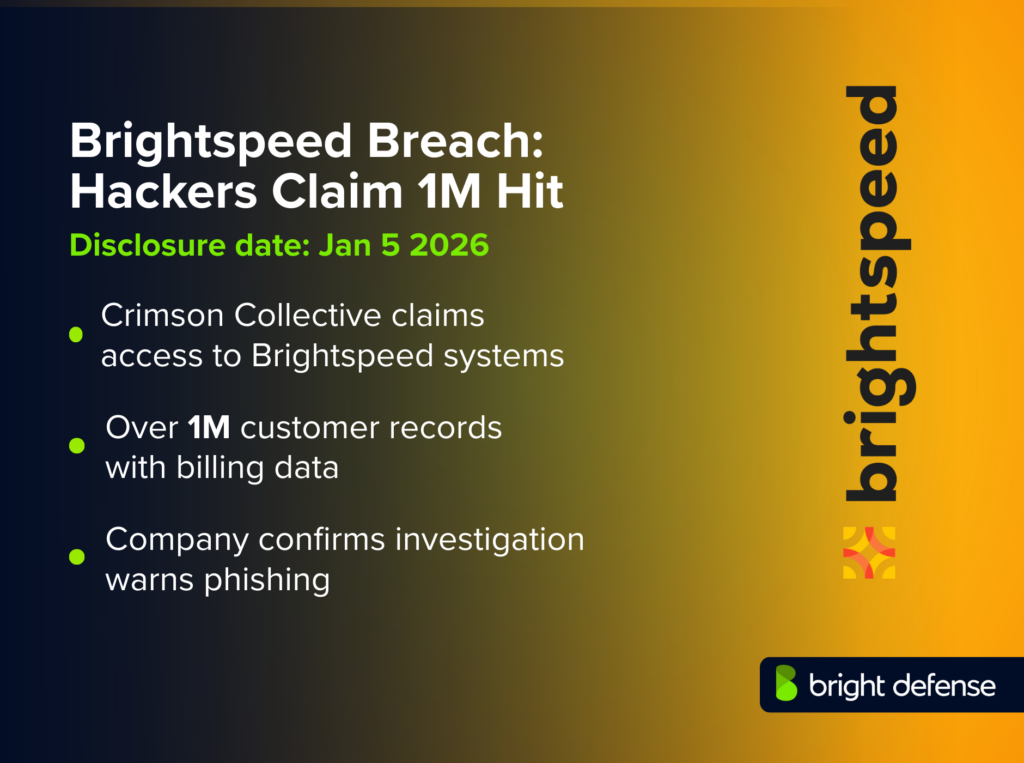
U.S. fiber broadband provider Brightspeed opened an internal cybersecurity investigation in early January 2026 after a criminal group, Crimson Collective, claimed it accessed company systems and stole sensitive customer data affecting more than 1 million individuals.
The group made the allegation public on January 4, 2026 via Telegram and shared screenshots and small data samples as purported proof, though their authenticity has not been independently verified. Brightspeed said it was reviewing the claims and would notify customers, employees, and authorities as more information becomes available.
As of mid January 2026, the company had not confirmed data exfiltration or a compromise of production systems.
Timeline: From First Access To Latest Update
- Late December 2025
Crimson Collective later claimed this was the period during which it first gained access to Brightspeed systems. No independent evidence has been presented to confirm the intrusion date or dwell time. - January 4, 2026
The hacking group publicly alleged responsibility for a breach, posting claims on Telegram and threatening to release data samples unless Brightspeed responded. - January 5–6, 2026
Multiple cybersecurity and technology outlets reported on the claims. Brightspeed confirmed it was investigating a potential cybersecurity incident but did not validate the attackers’ assertions. - January 7, 2026
A proposed class-action lawsuit was filed in U.S. federal court by a Brightspeed customer, alleging negligence and inadequate data-security practices. The suit seeks damages and injunctive relief. Brightspeed has not publicly commented on the litigation. - January 10–11, 2026
Industry briefings and follow-up reporting reiterated that the investigation remained ongoing. No regulator enforcement actions or law-enforcement confirmations had been announced.
What Data Or Systems Were Affected
According to the attackers’ claims, the allegedly compromised information includes:
- Customer names
- Email addresses and phone numbers
- Account identifiers and status information
- Billing addresses and service records
- Payment history and limited payment-card data
Brightspeed has not confirmed that this data was accessed or removed from its systems. There has also been no confirmation that passwords, full payment-card numbers, or government-issued identification numbers were exposed.
Who Was Responsible (Confirmed Vs Alleged)
The only named party claiming responsibility is Crimson Collective, an extortion-focused group that emerged publicly in September 2025. The group has previously targeted cloud-hosted enterprise environments and threatened public data leaks as leverage.
No law-enforcement agency has publicly attributed the incident, and Brightspeed has not confirmed the attackers’ identity or claims.
How The Attack Worked (If Known)
Technical details remain limited. Security researchers note that Crimson Collective has historically targeted misconfigured cloud environments and systems lacking multifactor authentication. In this case, no forensic findings have been released, and it remains unclear whether Brightspeed’s core network, customer databases, or third-party systems were involved.
Company Response And Customer Remediation
Brightspeed said it launched an investigation immediately after becoming aware of the claims. The company stated it would keep affected parties informed and emphasized that protecting customer and employee information is a priority.
As of the latest update, Brightspeed had not announced customer notifications, credit monitoring, compensation programs, or confirmed service disruptions linked to the alleged breach.
Government, Law Enforcement, And Regulator Actions
No U.S. regulator or law-enforcement agency has publicly confirmed an investigation or enforcement action tied to the Brightspeed claims. Telecommunications providers are subject to federal and state data-protection and outage-reporting requirements, and any confirmed breach could prompt regulatory scrutiny.
Financial, Legal, And Business Impact
The most immediate legal consequence is the class-action lawsuit filed on January 7, 2026, which alleges failures in safeguarding customer data. Potential financial exposure will depend on whether a breach is confirmed, the scope of any data loss, and the outcome of litigation.
Reputational risk also remains a concern for Brightspeed, given its role as a broadband provider serving residential and business customers across rural and suburban markets.
What Remains Unclear
Key unanswered questions include:
- Whether attackers accessed production systems or only limited environments
- Whether customer data was actually exfiltrated
- How long any unauthorized access may have lasted
- Whether additional threat actors were involved
- Whether regulators will require formal breach notifications
Why This Incident Matters
The Brightspeed allegations underscore the ongoing risk facing telecommunications and infrastructure providers that store large volumes of personal data. Even unverified breach claims can trigger lawsuits, regulatory attention, and customer distrust.
The case also highlights the tension companies face when responding to public extortion claims, balancing transparency with the risk of amplifying unconfirmed attacker narratives.
Bright Defense’s Perspective: Testing and Continuous Compliance
Incidents like the Brightspeed case show how quickly alleged cloud and network weaknesses can create legal, operational, and reputational risk. Strong security programs reduce the chance that claims turn into confirmed breaches.
Bright Defense supports this work through penetration testing and continuous compliance. Testing assesses apps, networks, APIs, and cloud configurations to find exploitable issues such as misconfigurations, access-control gaps, and exposed services. Continuous compliance helps maintain SOC 2, ISO 27001, HIPAA, and NIST alignment through ongoing monitoring and remediation tracking, so teams can respond with evidence as environments change.
FAQ
Brightspeed has publicly said it is investigating reports of a cybersecurity event after the Crimson Collective group claimed it accessed Brightspeed systems and took customer information, and the company has not publicly confirmed the full scope of the claims in the reporting cited below.
Multiple outlets reported claims involving more than 1 million Brightspeed customers or records, and this figure is widely attributed to the threat actor’s claim rather than a final confirmed customer notification count.
Reporting attributes the claim to the Crimson Collective extortion group, and The Register reported the group listed the stolen records for sale for three bitcoin while Brightspeed said it was investigating the situation.
Public reporting on the claim described personal and account data such as names, email addresses, phone numbers, billing and service addresses, account or session identifiers, and billing-related details, with some reports also describing partial payment card information such as last-four digits.
No confirmed public reporting established mass disconnections tied to the group, and the disconnection claim has been described as coming from the attacker’s own messages rather than a verified Brightspeed statement.
The highest-probability follow-on risks are targeted phishing, fake support calls, and billing-themed scams that reuse exposed details to look believable, and FTC guidance advises avoiding links in unexpected messages and verifying requests through channels you open yourself.
You can reduce account-takeover and fraud risk by changing any reused passwords, turning on multi-factor authentication for your email account first, reviewing bank and card statements for suspicious activity, and ignoring unsolicited “billing problem” links while signing in only through the official app or site you type in yourself.
A credit freeze or fraud alert can make new-account fraud harder, and the FTC explains how both work and how to place them, while IdentityTheft.gov provides guided steps if you suspect misuse of your personal information.
Yahoo said in 2017 that the 2013 theft affected all 3 billion Yahoo accounts, which many sources treat as the largest confirmed account breach
Some rankings also list a June 2025 exposed database with 4 billion records as a larger “data leak,” but that figure is records, not user accounts
Yes, UnitedHealth’s CEO told the U.S. Senate that the decision to pay a ransom was his
Reuters also reported he confirmed a ransom payment after the Change Healthcare intrusion, and reporting around the payment has cited about $22 million in bitcoin
You typically find out through an official breach notice, account-security alerts, signs of identity misuse, and checks against known breach datasets, plus credit monitoring actions such as a credit freeze or fraud alert when sensitive identifiers were exposed
For the Change Healthcare incident, HHS says the impact reached about 192.7 million people, and it points affected individuals to official support paths
Breaches commonly happen after attackers obtain valid credentials, exploit weak access controls, use phishing, or take advantage of exposed systems and misconfigurations, and in the Change Healthcare case the CEO testified that criminals used compromised credentials to access a Citrix portal that lacked multi-factor authentication, then moved through systems, took data, and later deployed ransomware
Sources
- BleepingComputer, “US broadband provider Brightspeed investigates breach claims”
https://www.bleepingcomputer.com/news/security/us-broadband-provider-brightspeed-investigates-breach-claims/ - eSecurity Planet, “1M Customer Records Allegedly Stolen in Brightspeed Breach”
https://www.esecurityplanet.com/threats/1m-customer-records-allegedly-stolen-in-brightspeed-breach/ - CyberWire Daily Briefing, “Dozens of cloud file-sharing breaches tied to a single threat actor.”
https://thecyberwire.com/newsletters/daily-briefing/15/2 - SC Media, “Brightspeed investigates cyberattack claims by Crimson Collective”
https://www.scworld.com/brief/brightspeed-investigates-cyberattack-claims-by-crimson-collective - SecurityWeek, “Brightspeed Investigating Cyberattack”
https://www.securityweek.com/brightspeed-investigating-cyberattack/ - Malwarebytes Labs, “One million customers on alert as extortion group claims massive Brightspeed data haul”
https://www.malwarebytes.com/blog/news/2026/01/one-million-customers-on-alert-as-extortion-group-claims-massive-brightspeed-data-haul - Justia Dockets & Filings, “Polner v. Connect Holding LLC 3:2026cv00014”
https://dockets.justia.com/docket/north-carolina/ncwdce/3:2026cv00014/122333 - Infosecurity Magazine, “Hackers Claim to Disconnect Brightspeed Customers After Breach”
https://www.infosecurity-magazine.com/news/hackers-disconnect-brightspeed/ - The Cyber Express, “Crimson Collective Claims To Disconnect Brightspeed Users”
https://thecyberexpress.com/crimson-collective-disconnects-brightspeed/ - GBHackers, “Crimson Collective Claims Alleged Breach of Brightspeed Fiber Network”
https://gbhackers.com/fiber-network/ - The Register, “Brightspeed investigates breach as crims post data for sale”
https://www.theregister.com/2026/01/06/brightspeed_investigates_breach/ - Pittman Dutton Hellums Bradley & Mann, “Bright Speed Data Breach”
https://pittmandutton.com/firm-news/bright-speed-data-breach - Bright Defense, “Penetration Testing Services”
https://www.brightdefense.com/penetration-testing/ - Bright Defense, “Continuous Cybersecurity Compliance”
https://www.brightdefense.com/continuous-cybersecurity-compliance/ - TechRadar, “One of the largest US broadband providers investigates breach”
https://www.techradar.com/pro/security/one-of-the-largest-us-broadband-providers-investigates-breach - The National CIO Review, “1 Million Brightspeed Customers Allegedly Exposed in Cyberattack”
https://nationalcioreview.com/articles-insights/extra-bytes/1-million-brightspeed-customers-allegedly-exposed-in-cyberattack/ - Inside Towers, “Bad Actors Breach Brightspeed Customer Data”
https://insidetowers.com/bad-actors-breach-brightspeed-customer-data/

Get In Touch