European Commission Staff Data Exposed After Breach
What Happened in the Breach
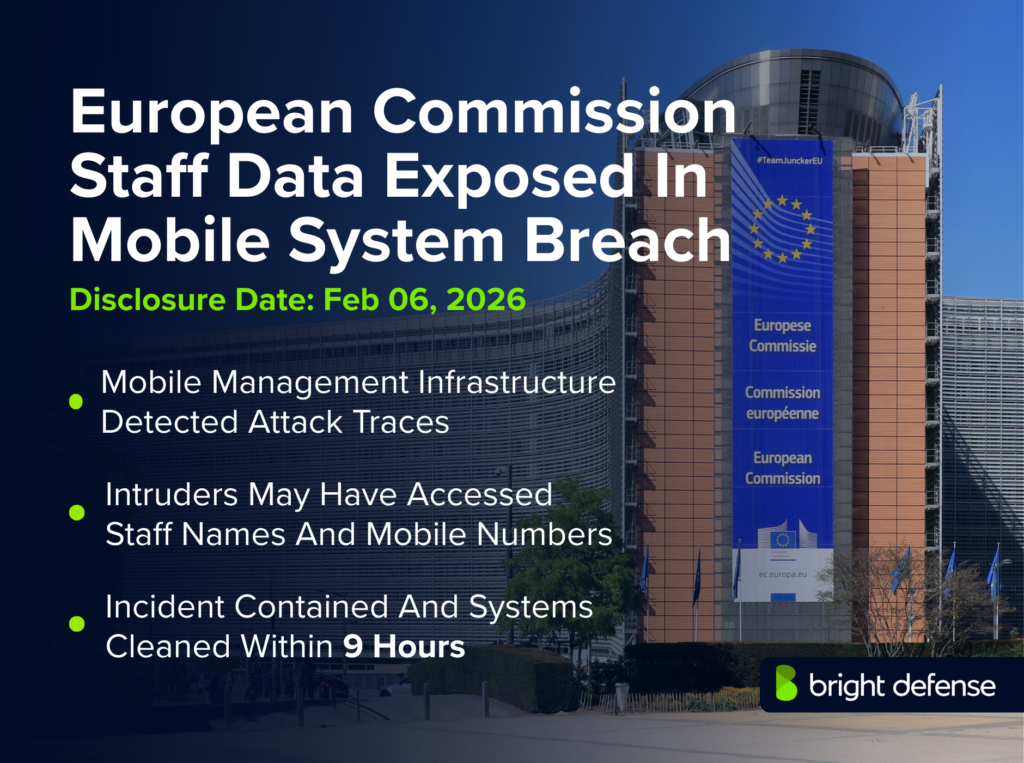
On January 30 2026, the European Commission’s central mobile‑device management (MDM) infrastructure detected signs of a cyber‑attack. Investigators said the intrusion may have exposed some staff members’ names and mobile phone numbers but did not compromise the actual mobile devices. CERT‑EU, the cybersecurity team for EU institutions, contained the intrusion and fully cleaned the MDM system within nine hours.
The Commission later disclosed the incident publicly and said there was no evidence that attackers gained further access to systems or data. The breach coincided with a wave of attacks exploiting newly discovered vulnerabilities in Ivanti’s Endpoint Manager Mobile (EPMM) software used by several European governments.
Timeline: From First Access To Latest Update
- January 20, 2026: The European Commission unveils a Cybersecurity Package focused on stronger EU networks and supply chain security.
- January 30, 2026: CERT EU detects traces of an attack on the Commission’s central MDM infrastructure; staff names and mobile numbers may have been exposed, and the system is isolated and cleaned within 9 hours.
- January 30 to February 6, 2026: Officials investigate and notify internal stakeholders; CERT EU monitors the network and reviews logs for follow on activity.
- February 6, 2026: The Commission posts a press corner statement confirming no mobile devices were compromised while names and phone numbers may have been accessed; Bloomberg reports on the disclosure.
- February 9, 2026: Media coverage expands; reporting links the incident to Ivanti EPMM zero day flaws CVE 2026 1281 and CVE 2026 1340, with references to similar attacks on Dutch and Finnish government systems.
- Mid February, 2026: Experts warn exposed contact data can enable targeted phishing and vishing; the Commission says it will review the incident and strengthen protections.
- Latest Update February 2026: No public claim of responsibility; the vector remains unconfirmed, though multiple sources point to unpatched Ivanti EPMM issues; monitoring and resilience work continue.
What Data Or Systems Were Affected
The attack targeted the European Commission’s backend infrastructure that manages mobile devices. This platform centrally administers smartphones and tablets used by Commission officials and staff, enforcing security policies and controlling applications.
According to the Commission, the attackers may have accessed a database containing staff members’ names and mobile telephone numbers. Some reports said business email addresses could also have been exposed; however, no mobile devices themselves were compromised.
The Commission stressed that no sensitive policy documents or classified information were stored on the affected MDM system. Because the system was isolated quickly, investigators believe the intrusion did not propagate to other EU networks. The CPO Magazine article notes that standard MDM backends typically hold device inventories, user roles, configuration data and authentication tokens.
While only limited contact data was confirmed accessed, the breach illustrates the wider risk that attackers could gain privileged access to other sensitive information if such systems are not securely patched and segmented.
Who Was Responsible (Confirmed Vs Alleged)
No threat actor has publicly claimed responsibility for the breach, and the European Commission has not attributed it to a specific group. Cybernews and other outlets noted that the intrusion appears related to contemporaneous attacks exploiting two critical zero‑day vulnerabilities in Ivanti’s Endpoint Manager Mobile (EPMM) software—CVE‑2026‑1281 and CVE‑2026‑1340—which allow unauthenticated command injection.
These flaws were actively exploited to compromise the Dutch Data Protection Authority and Finland’s Valtori agency around the same time. Security researchers therefore suspect a connection, but neither Ivanti nor investigators have confirmed that EPMM was the Commission’s MDM platform. Some experts believe a state‑sponsored group could be behind the attacks given the targets and the timing just after the EU announced tougher supply‑chain security measures. At present, the breach remains unattributed.
How The Attack Worked
The Commission has not published technical details of the intrusion, but public reporting suggests the attackers exploited weaknesses in the MDM backend rather than the mobile devices themselves. Ivanti disclosed on January 29 2026 two command‑injection vulnerabilities in its EPMM software (CVE‑2026‑1281 and CVE‑2026‑1340) that allow remote, unauthenticated attackers to send malicious commands to the server. Exploiting those flaws would give an intruder administrative access to the MDM system, enabling them to query databases for user contact details, enumerate devices, and potentially pivot into other networks.
HackRead and other publications reported that the Commission detected suspicious access to the MDM platform and rapidly disconnected it from the network, preventing malware deployment. Indicators of compromise included anomalous authentication attempts, unusual API calls and elevated access events in the MDM audit logs.
FireCompass speculated that attackers used MITRE ATT&CK techniques for privilege escalation and file discovery (T1548 and T1083) to harvest data. While these details remain unconfirmed, the pattern matches other Ivanti‑related exploits observed across Europe.
Impact and Risks for Customers
The immediate impact of the breach appears limited to the potential exposure of staff contact information. The Commission stated that names and mobile phone numbers of some employees may have been accessed, with one source reporting that business email addresses could also be involved.
Although such data is not as sensitive as passwords or identity documents, it can facilitate social engineering, phishing or vishing attacks. Security experts warned that attackers could impersonate colleagues or officials to trick staff into revealing credentials or installing malware.
Contact details of EU officials are also valuable for foreign intelligence services seeking to map organizational structures and conduct reconnaissance. The incident therefore underscores the importance of protecting MDM systems which hold aggregated personnel data and provide privileged control over devices.
It also raises questions about compliance with the EU’s General Data Protection Regulation (GDPR). While the Commission has not disclosed how many staff were affected, any unauthorized access to personal data requires notification and remedial measures under GDPR.
Company Response And Customer Remediation
Upon detecting the intrusion, the Commission’s cybersecurity team and CERT‑EU isolated the affected MDM system and initiated incident‑response procedures. According to the official statement, the attack was contained and the system cleaned within nine hours.
The Commission said it would conduct a comprehensive review of the incident and use the findings to enhance cybersecurity capabilities. It also promised to inform any affected staff and take necessary measures to prevent similar breaches.
There is no evidence that the Commission offered credit monitoring or compensation, likely because only contact data was exposed. However, internal awareness campaigns were launched to remind staff about phishing risks. The Commission emphasised that it takes the security and resilience of its internal systems seriously and will continue to monitor for suspicious activity.
Government, Law Enforcement, And Regulator Actions
CERT‑EU led the incident response, supported by the Commission’s Directorate‑General for Informatics. There has been no public announcement of involvement from national law enforcement agencies or EU‑wide regulators. Because the Commission itself acts as a data controller under GDPR, it is responsible for notifying the European Data Protection Supervisor (EDPS) and relevant authorities. Media reports have not indicated any EDPS enforcement action to date.
The incident has nonetheless drawn scrutiny from policymakers because it occurred shortly after the Commission proposed new EU cybersecurity legislation, including a Cybersecurity Act 2.0 and amendments to the NIS2 Directive.
Lawmakers have cited the breach as evidence that even the EU’s own institutions must bolster their defenses against supply‑chain vulnerabilities. The Commission has pledged to work with member states to develop best practices for securing MDM platforms and other critical management systems.
Financial, Legal, And Business Impact
Unlike breaches involving customer data or payment systems, the financial impact of this incident appears minimal. The European Commission does not operate for profit, and there is no evidence that attackers demanded ransom or exfiltrated large volumes of data.
However, the breach could have reputational consequences for an institution that enforces GDPR and promotes cybersecurity regulations.
The Commission has not disclosed the cost of incident response or system upgrades, but such efforts often require additional resources. From a legal standpoint, the Commission must comply with GDPR notification and may face scrutiny from the EDPS or European Parliament if investigations reveal negligence.
Business partners and member states may also question the robustness of the Commission’s internal security, potentially prompting broader audits and investments in secure MDM solutions.
What Remains Unclear About the Breach
- Authorities have not disclosed how many staff members’ details were accessed.
- Authorities have not disclosed whether a specific department was targeted.
- The exact attack vector remains unconfirmed.
- Many experts have pointed to Ivanti EPMM vulnerabilities, but the Commission has not confirmed which MDM platform was compromised.
- The party responsible for the attack has not been identified publicly.
- State sponsorship has not been confirmed.
- Investigators have not said whether data was taken beyond contact details.
- Investigators have not said whether intruders attempted lateral movement into other EU networks.
- Findings from the post incident review have not been reported publicly.
- The lack of public details leaves uncertainty about the broader security posture of EU institutions.
- The lack of public details leaves uncertainty about the effectiveness of EU supply chain risk management.
Why This Incident Matters
This breach is significant because it illustrates how attackers can exploit management infrastructure rather than individual devices to compromise sensitive organizations. Mobile device management platforms hold aggregated data on thousands of users and provide privileged administrative access. Even limited exposure of contact details can facilitate social‑engineering campaigns aimed at high‑level officials.
The incident also highlights the broader threat posed by supply‑chain vulnerabilities: within days of Ivanti disclosing critical EPMM flaws, attackers reportedly exploited them against Dutch, Finnish and EU institutions. The timing underscores the urgency of promptly applying security patches and segmenting management systems from production networks.
Moreover, the breach occurred just after the Commission unveiled a major cybersecurity package, reminding policymakers that legislation alone does not guarantee resilience. For EU citizens and member states, the incident raises questions about whether the body charged with enforcing GDPR can adequately protect its own data.
Bright Defense: Proactive Measures to Minimize Such Breaches
Bright Defense reduces MDM breach risk with continuous penetration testing, automated red team exercises, continuous compliance monitoring, and supply chain risk assessments. Continuous testing checks MDM platforms for unpatched software, misconfigured APIs, and weak authentication, then provides clear remediation steps.
Compliance monitoring adds real time alerts for least privilege, multi factor authentication on admin accounts, and audit log review. Vendor assessments help harden third party tools such as Ivanti EPMM and reduce attacker dwell time.
Sources
- Bloomberg — EU Discloses January Cyberattack That Exposed Some Staff Data (February 6, 2026)
https://www.bloomberg.com/news/articles/2026-02-06/eu-discloses-january-cyberattack-that-exposed-some-staff-data - Computing — European Commission breached – investigating mobile hack (February 2026)
https://www.computing.co.uk/news/2026/security/european-commission-breached - CPO Magazine — The European Commission Data Breach Compromises Infrastructure for Managing Mobile Devices (February 17, 2026)
https://www.cpomagazine.com/cyber-security/the-european-commission-data-breach-compromises-infrastructure-for-managing-mobile-devices/ - Cybernews — European Commission staff data exposed after breach (February 9, 2026)
https://cybernews.com/security/european-commission-staff-data-breach/ - HackRead — Cyber Attack Hits European Commission Staff Mobile Systems (February 9, 2026)
https://hackread.com/cyber-attack-european-commission-staff-mobile-systems/ - Help Net Security — European Commission hit by cyberattackers targeting mobile management platform (February 2026)
https://www.helpnetsecurity.com/2026/02/09/european-commission-ivanti-epmm-vulnerabilities/ - IT Pro — European Commission confirms hackers breached mobile management platform (February 2026)
https://www.itpro.com/technology/artificial-intelligence/european-commission-confirms-hackers-breached-mobile-management-platform - SecurityAffairs — European Commission probes cyberattack on mobile device management system (February 9, 2026)
https://securityaffairs.com/187768/data-breach/european-commission-probes-cyberattack-on-mobile-device-management-system.html - SecurityWeek — European Commission Investigating Cyberattack (February 2026)
https://www.securityweek.com/european-commission-investigating-cyberattack/ - The Register — European Commission probes intrusion into staff mobile management backend (February 2026)
https://www.theregister.com/2026/02/09/european_commission_phone_breach/ - View‑source, European Commission Press Corner — Commission responds to cyber‑attack on its central mobile infrastructure (January 30 2026)
https://ec.europa.eu/commission/presscorner/detail/en/ip_26_342


Get In Touch