Flickr Data Breach Exposes User Data
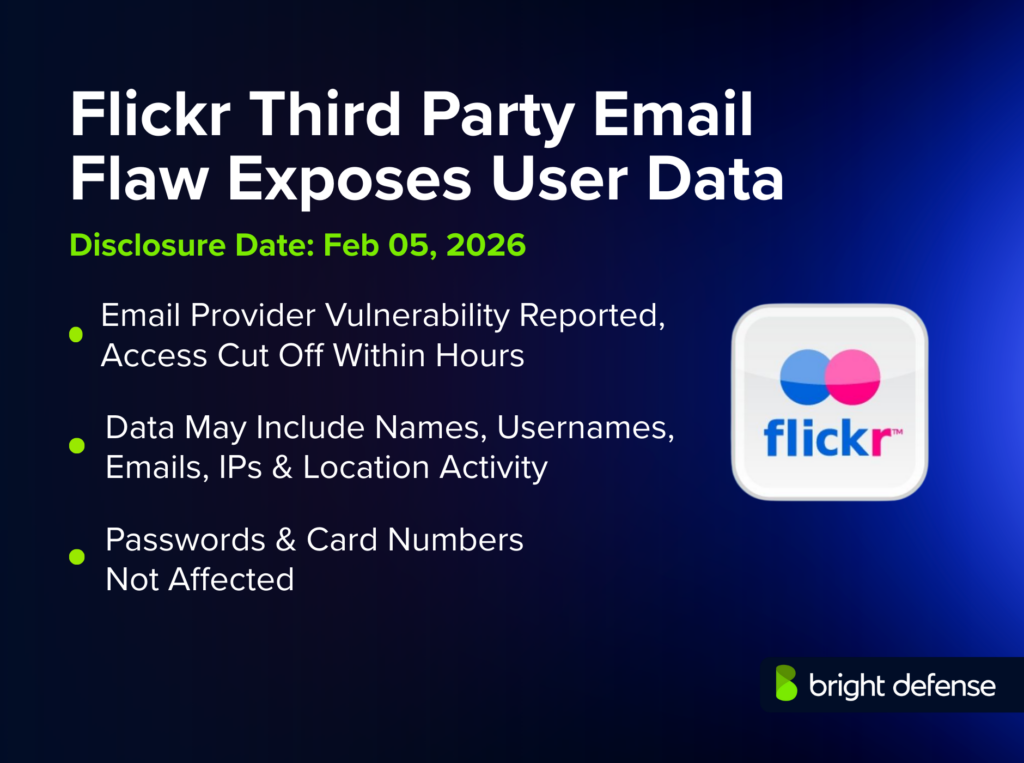
Flickr said a vulnerability in a third-party email service provider’s system on February 5, 2026 may have allowed unauthorized access to certain Flickr user data fields, including names, email addresses, IP addresses, general location, and account activity, while passwords and payment card numbers were not affected.
What Happened in the Breach
Flickr told users it learned on February 5, 2026 about a vulnerability in infrastructure operated by one of its email service providers and said it cut off access to the affected system within hours.
The company did not name the email vendor and did not publish a user count for the potential exposure, according to reporting that cited the user notification email.
Flickr’s notice framed the event as a potential exposure rather than a confirmed theft, stating that unauthorized access “may have” occurred.
Timeline: From First Access To Latest Update
- February 5, 2026: Flickr said it was alerted to a vulnerability at an email service provider and cut off access within hours
- February 6, 2026: Public reporting described the user notification email and the exposed data categories
- February 9, 2026: Follow-up reporting reiterated that the provider was unnamed and that passwords and payment card numbers were not affected
- February 16, 2026: A threat intelligence roundup referenced the incident without adding new confirmed technical detail
- February 18, 2026: A plaintiffs’ firm publicly announced it was investigating claims tied to the incident
What Data Or Systems Were Affected
Flickr’s notification said the data that may have been accessible depended on the user’s account and could include a member’s name and email address, Flickr username, account type, IP address, general location data, and activity on the platform.
Flickr said passwords and payment card numbers were not affected.
The company described the issue as involving a third-party email system rather than Flickr’s core platform, which is owned and operated under SmugMug.
Who Was Responsible (Confirmed Vs Alleged)
Flickr did not attribute the incident to a specific threat actor and did not disclose whether it was the result of exploitation of a software flaw, misuse of credentials, or another access path within the vendor environment.
SecurityWeek said it had not seen a ransomware group or other actor publicly claim to have stolen Flickr data at the time of its report.
How The Attack Worked
Flickr said a “vulnerability” in an email service provider system may have allowed unauthorized access to member information, and it said it shut down access to the affected system within hours of learning of the issue.
The Register reported that Flickr’s email said it removed links to a vulnerable endpoint and asked the vendor to investigate, which suggests the exposure path involved an external-facing integration or API endpoint connected to email delivery or account messaging workflows.
Flickr has not published technical indicators, a root-cause analysis, or a confirmed window of unauthorized access, so the specific exploit chain remains unconfirmed in public reporting.
Impact and Risks for Customers
The exposed categories described in reporting, especially email addresses combined with usernames, account types, IP addresses, location signals, and activity metadata, can raise the success rate of targeted phishing and account takeover attempts that rely on personalization rather than password theft.
Flickr warned users to watch for phishing emails referencing their Flickr account and stated it would not ask for passwords over email.
Users who reused Flickr passwords elsewhere faced added risk even though Flickr said Flickr passwords were not exposed, because attackers often combine identity data from one incident with credential reuse from other sources.
Company Response And Customer Remediation
Flickr said it shut down access to the affected system within hours after it learned of the vulnerability.
The company told users to review account settings for unexpected changes and to remain cautious about emails referencing their Flickr membership.
Public reporting did not describe Flickr offering credit monitoring or direct compensation, which is consistent with the company’s statement that passwords and payment card numbers were not affected and with the absence of government ID data in the described exposure categories.
Government, Law Enforcement, And Regulator Actions
Flickr’s email said it notified relevant data protection authorities, and The Register reported that the email included links to both U.S. and European data protection authorities.
Flickr has not publicly named specific regulators involved, and no public enforcement action had been reported in the sources reviewed as of February 18, 2026.
Financial, Legal, And Business Impact
Flickr did not publish a count of affected users, and public reporting did not contain a disclosed cost estimate tied to incident response or customer remediation.
A plaintiffs’ firm, Lynch Carpenter, announced on February 18, 2026 that it was investigating claims related to the incident, which can be an early signal of potential class-action activity even when no complaint has been confirmed in public coverage.
For scale context in Europe, Flickr’s Digital Services Act disclosure said it had approximately 228 thousand average monthly active users in the European Union during December 1, 2024 to June 1, 2025, a metric that may factor into EU-facing compliance conversations even when a security incident originates in a vendor system.
What Remains Unclear About the Incident
The earliest confirmed start of unauthorized access has not been published, because Flickr’s disclosure described a vulnerability that may have allowed access rather than a confirmed intrusion timeline.
The identity of the third-party email provider has not been disclosed in the company notice or in the cited reporting.
The number of users potentially impacted has not been disclosed, and public reporting has not produced an independent validation of scope beyond the data categories listed in Flickr’s email.
Why This Incident Matters
Third-party services that handle account messaging can sit close to user identity data and behavioral metadata, so a weakness in an adjacent vendor can expose valuable targeting information even when passwords and payment data remain intact.
The incident also shows how fast a consumer platform can be forced into cross-region disclosure posture, because Flickr referenced data protection authorities in the U.S. and Europe in the user-facing notice described in reporting.
Bright Defense: Reducing Vendor-Driven Data Exposure Risk
Bright Defense helps organizations reduce incidents like the Flickr third-party email exposure through targeted testing of the systems and integrations attackers often probe first. A scoped penetration test can pressure-test public endpoints, authentication flows, and API connections that link your product to outside email, analytics, and customer support tools. Ongoing continuous cybersecurity compliance work can tighten vendor access controls, asset inventory, logging expectations, and security reviews that support frameworks such as SOC 2, which many buyers treat as evidence of disciplined security operations. Teams that ship fast and rely on many vendors can use these services to reduce exposure from overlooked integrations and to shorten the time between a vendor issue and internal containment. Learn more at Bright Defense.
Sources
- BleepingComputer — Flickr discloses potential data breach exposing users' names, emails (February 6, 2026)
https://www.bleepingcomputer.com/news/security/flickr-discloses-potential-data-breach-exposing-users-names-emails/ - SecurityWeek — Flickr Security Incident Tied to Third-Party Email System (February 6, 2026)
https://www.securityweek.com/flickr-security-incident-tied-to-third-party-email-system/ - The Register — Flickr emails users about data breach, pins it on third party (February 6, 2026)
https://www.theregister.com/2026/02/06/flickr_emails_users_about_data_breach/ - Forbes — Photo-Sharing Platform Flickr Issues Data Breach Warning (February 6, 2026)
https://www.forbes.com/sites/daveywinder/2026/02/06/photo-sharing-platform-flickr-issues-data-breach-warning/ - TechRepublic — Flickr's 35M Users Affected by Third-Party Data Exposure (February 9, 2026)
https://www.techrepublic.com/article/news-flickr-third-party-email-data-exposure/ - TechRadar — Flickr confirms data breach, tells customers their private info may have been affected (February 2026)
https://www.techradar.com/pro/security/flickr-confirms-data-breach-tells-customers-their-private-info-may-have-been-affected-heres-what-we-know - Flickr Help Center — Digital Services Act - Information on Active Monthly Users in the European Union (August 18, 2025)
https://www.flickrhelp.com/hc/en-us/articles/16048737757716-Digital-Services-Act-Information-on-Active-Monthly-Users-in-the-European-Union - Check Point Research — 16th February Threat Intelligence Report (February 16, 2026)
https://research.checkpoint.com/2026/16th-february-threat-intelligence-report/ - GlobeNewswire — Flickr Data Breach Claims Investigated by Lynch Carpenter (February 18, 2026)
https://www.globenewswire.com/news-release/2026/02/18/3240591/0/en/Flickr-Data-Breach-Claims-Investigated-by-Lynch-Carpenter.html

Get In Touch