Google Rushes Chrome Patch as 3 Billion Users Face Risk
What Happened in the Google Chrome 143 Security Bypass?
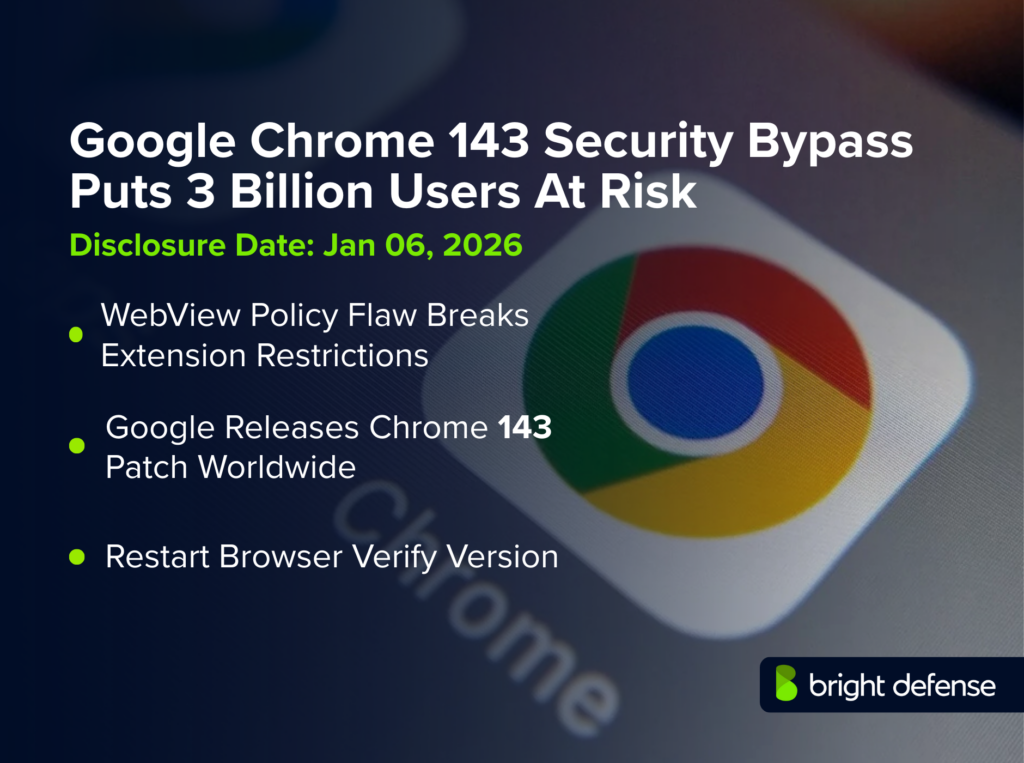
Google issued an urgent Chrome update in early January after a high-severity flaw in Chrome’s WebView tag could let a malicious browser extension inject scripts or HTML into privileged browser pages, weakening key security boundaries. (Chrome Releases)
Several tech outlets framed the exposure as affecting roughly 3 billion Chrome users worldwide, reflecting Chrome’s massive installed base rather than confirmed victim counts.
Google’s Chrome Releases bulletin listed the issue as CVE-2026-0628 and said the fix shipped in Chrome 143.0.7499.192 (and .193 on some platforms).
Timeline: From First Access To Latest Update
- November 23, 2025
The earliest public timeline marker is the date the researcher reported the bug to Google. Google’s Chrome Releases post for the fix credited researcher Gal Weizman and listed the report date as November 23, 2025
- December 2, 2025
Chrome 143 reached the stable channel on December 2, 2025, weeks before the January patch, which meant affected builds existed in the stable population before remediation.
- January 6, 2026
Google published the stable-channel security update that addressed CVE-2026-0628 on January 6, 2026 and described it as insufficient policy enforcement in the WebView tag, with limited technical detail.
- Early January 2026
U.S. government-backed vulnerability tracking followed quickly. NIST’s National Vulnerability Database entry for CVE-2026-0628 appeared in early January and summarized an exploit path that depends on a user installing a malicious extension.
- January 2026
Downstream Chromium browsers and vendors began distributing updates that incorporated the Chromium security changes. Microsoft’s Edge security release notes in January referenced new stable builds that incorporate Chromium security updates, and third-party reporting tied Edge’s January update cadence to the same CVE.
- January 13, 2026
The most recent confirmed upstream milestone in this window came on January 13, 2026, when Google promoted Chrome 144 to stable, continuing the regular patch cadence after the emergency Chrome 143 fix.
What Data Or Systems Were Affected
The vulnerable component was Chrome’s WebView tag, a mechanism commonly associated with embedding web content in certain Chrome contexts. Google’s advisory classified the flaw as high severity but kept details limited while the fix rolled out.
NVD’s description indicates the attack can allow script or HTML injection into privileged pages, which can raise the stakes because privileged pages often interact with browser settings, extension surfaces, or trusted UI flows.
The affected versions were Google Chrome builds prior to 143.0.7499.192, with fixed builds shipping on Windows, macOS, and Linux in the January stable update.
Several outlets noted that other Chromium-based browsers typically need their own updates after Chromium fixes ship upstream, since they ingest Chromium changes on a vendor-specific schedule.
Who Was Responsible (Confirmed Vs Alleged)
The only confirmed named party connected to the finding is the external researcher credited in Google’s release note. Google credited Gal Weizman and listed the report date as Nov 23, 2025.
No government advisory or Google bulletin identified a threat actor, campaign, or victim set. Public descriptions emphasize a conditional exploit path that starts with persuading a user to install a malicious extension, rather than a drive-by compromise from a normal webpage.
Some public trackers also recorded advisory-style scoring that labeled exploitation status as “none” at the time of publication, which supports the absence of confirmed in-the-wild exploitation in the public record during this window.
How The Attack Worked
Public descriptions converge on a scenario where an attacker first gets a victim to install a malicious Chrome extension. NVD’s summary explicitly frames the exploit as contingent on that user action.
After installation, the malicious extension could abuse weak policy enforcement related to the WebView tag and inject scripts or HTML into privileged browser pages. That type of injection can undermine trust boundaries that separate extension content from higher-privilege browser surfaces.
Google did not publish full technical details in the stable-channel post, and at least one downstream explainer noted that Google often limits bug-link visibility until a large share of users receive the patch.
Company Response And Customer Remediation
Google’s primary public action was the stable-channel update that moved users onto patched versions, with Chrome Releases stating the rollout would occur over days or weeks as updates propagate.
The same Google post listed CVE-2026-0628 as the main security fix in that update, and it credited the reporter.
Tech press coverage emphasized routine remediation steps: apply the Chrome update, restart the browser if needed to load the new build, and treat extension installs as high-risk user actions.
For enterprise environments, the incident reinforced a familiar operational issue: browsers patch frequently, and security teams often need explicit update SLAs, device inventory coverage, and controls around extension deployment.
Government, Law Enforcement, And Regulator Actions
No law enforcement action or regulator penalty surfaced in the public record during this time window, consistent with the incident’s nature as a patched vulnerability rather than a confirmed breach with identified victims.
Government-linked vulnerability infrastructure did take routine action. NIST’s NVD published a description of CVE-2026-0628 that outlines the malicious-extension prerequisite and the privileged-page injection outcome.
OpenCVE’s record also reflects CISA ADP enrichment data, including an exploitation status listed as “none” at the time of that record snapshot.
Financial, Legal, And Business Impact
Google did not announce customer compensation, credit monitoring, or refunds, which is typical for a vulnerability patch that has no confirmed victim set or disclosed data exposure.
The practical cost landed on enterprises and IT operations: emergency browser patches disrupt change windows, require testing for compatibility regressions, and create short exposure periods when unmanaged endpoints lag.
Downstream browser vendors also faced patch pressure. Microsoft’s Edge release communications in January referenced stable builds that incorporate Chromium security updates, signaling the usual dependency chain where Chromium fixes trigger multiple vendor updates.
No class action filings, regulatory investigations, or disclosed breach-notification letters tied to CVE-2026-0628 surfaced in reputable public sources reviewed for this report as of Jan 15, 2026.
What Remains Unclear About the Google Chrome Incident
Google’s stable-channel post did not include exploit detail beyond a short description, and Google’s standard practice can keep some bug links restricted until broad patch adoption.
Public records also do not confirm whether active exploitation occurred before the patch. Multiple public summaries emphasize the malicious-extension prerequisite, which narrows exposure compared with fully remote bugs, but it still presents serious risk in environments where users can install extensions freely.
Some exploit proof-of-concept references exist in public tracking feeds, but those references do not establish real-world exploitation or victim counts.
It also remains unclear how many endpoints received the patched build during the first days of rollout, since Google does not publish adoption percentages in these advisories.
Why This Incident Matters
- Browser security incidents matter because the browser now functions as the primary work surface for email, identity flows, cloud consoles, and administrative tooling. A policy bypass on a high-privilege path can create outsized downstream impact.
- This case highlights a recurring weak point: the extension ecosystem. The NVD description places the user’s extension-install decision at the center of exploitation, which shifts risk control from patching alone to governance, allowlisting, and user privilege design.
- The Chromium dependency chain means 1 upstream vulnerability can trigger a multi-vendor race across Chrome, Edge, and other Chromium-based browsers. That dynamic complicates enterprise patch coordination across mixed fleets.
Bright Defense Can Help Reduce Browser-Driven Risk
Bright Defense can help organizations lower the odds that a browser issue turns into a real compromise, especially when the attack path relies on weak governance around web access and extensions. Penetration tests can validate controls around browser-based admin portals, identity workflows, and sensitive SaaS environments, with a focus on practical exploit paths such as malicious extensions, token theft, and privileged session abuse.
Continuous compliance adds guardrails that matter during fast-moving patch cycles. Coverage often includes asset inventory discipline, patch SLAs, configuration baselines, and evidence collection that maps to common frameworks. When a high-severity browser issue lands, teams can show what is patched, what remains exposed, and what compensating controls exist, with less guesswork and less manual chasing.
Sources
- TechRepublic — Google Chrome Pushes Critical Security Update for 3B Users (Jan 12, 2026)
https://www.techrepublic.com/article/news-google-chrome-vulnerabilities-3b/ - Google Chrome Releases — Stable Channel Update for Desktop (Jan 6, 2026)
https://chromereleases.googleblog.com/2026/01/stable-channel-update-for-desktop.html - NIST NVD — CVE-2026-0628 Detail (Jan 2026)
https://nvd.nist.gov/vuln/detail/CVE-2026-0628 - OpenCVE — CVE-2026-0628 Record and enrichment (Jan 2026)
https://app.opencve.io/cve/CVE-2026-0628 - PCWorld — Chrome fixes a problematic security flaw in first update of 2026 (Jan 7, 2026)
https://www.pcworld.com/article/3025747/chrome-fixes-a-problematic-security-flaw-in-first-update-of-2026.html - Forbes — Google Issues Chrome Emergency Update: What You Need To Know (Jan 8, 2026)
https://www.forbes.com/sites/daveywinder/2026/01/08/google-issues-chrome-emergency-update-what-you-need-to-know/ - Microsoft Learn — Release notes for Microsoft Edge Security Updates (Jan 9, 2026 entry)
https://learn.microsoft.com/en-us/DeployEdge/microsoft-edge-relnotes-security - Tenable — Microsoft Edge (Chromium) < 143.0.3650.139 (CVE-2026-0628) plugin/advisory reference (Jan 2026)
https://www.tenable.com/plugins/nessus/282534 - Google Chrome Releases — Stable Channel Update for Desktop (Chrome 143 promoted to stable) (Dec 2, 2025)
https://chromereleases.googleblog.com/2025/12/stable-channel-update-for-desktop.html - SecurityWeek — Chrome 143 Patches High-Severity Vulnerabilities (Dec 3, 2025)
https://www.securityweek.com/chrome-143-patches-high-severity-vulnerabilities/ - Google Chrome Releases — Stable Channel Update for Desktop (Chrome 144 promoted to stable) (Jan 13, 2026)
https://chromereleases.googleblog.com/

Get In Touch