Hawk Law Group Hit by Incransom Ransomware
What Happened in the Breach
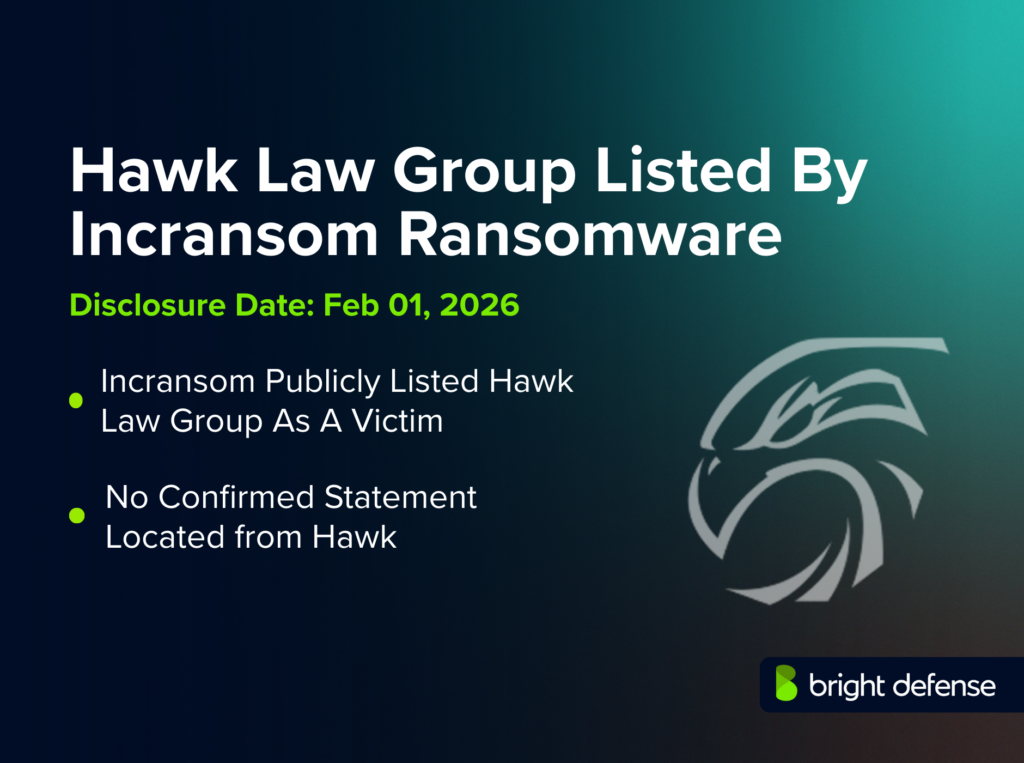
On January 31 2026 the ransomware group Incransom (also known as INC Ransom) allegedly breached systems belonging to Hawk Law Group, a personal injury law firm based in Augusta, Georgia. Threat‑intelligence monitoring site Ransomware.live listed Hawk Law Group as a victim of Incransom with an estimated attack date of January 31 2026 and a discovery date of February 1 2026.
A blog post by DeXpose reported that on February 1 2026 the attackers claimed responsibility on their leak site and threatened to publish stolen data unless the firm negotiated. Marketing‑focused write‑ups from SharkStriker and ScanComply later echoed the claim, saying the attack targeted sensitive client data such as government‑issued IDs and case files.
As of the end of February 2026 there has been no official statement from Hawk Law Group, law enforcement or regulators confirming the incident, the nature of the intrusion or the scale of any data exposure.
Timeline: From First Access to Latest Update
- January 31, 2026: Estimated intrusion date according to Ransomware.live.
- February 1, 2026: Ransomware.live detects the breach and lists Hawk Law Group as a victim; the Incransom leak site posts a message claiming responsibility and threatens to publish stolen data.
- February 2 to February 23, 2026: Cybersecurity blogs and threat intelligence aggregators repeat the claim; SharkStriker and ScanComply articles state that personal information and case documents were likely compromised. The firm has issued no confirmed disclosure.
- February 23, 2026 (Latest Update): No new statements from Hawk Law Group or regulators. Ransomware.live continues to list the law firm as an Incransom ransomware victim with a discovery date of February 1, 2026.
What Data or Systems Were Affected
The only publicly available information comes from third‑party cybersecurity blogs. SharkStriker’s February 2026 breach roundup claimed the ransomware attack compromised personal information of Hawk Law Group clients, including government‑issued IDs, forms and civil and criminal case data. ScanComply’s monthly breach report similarly stated that the attack potentially exposed privileged client communications. These assertions are attributed to hookphish.com but are not corroborated by the firm or regulators. Ransomware.live’s victim page does not specify any stolen data; it simply describes the law firm’s years of experience and expertise. Without an official disclosure the scope of affected data remains unknown.
Who Was Responsible (Confirmed vs Alleged)
Cyber‑intelligence feeds attribute the attack to the Incransom (INC Ransom) group. Ransomware.live lists Hawk Law Group under the Incransom group, with the earliest leak post appearing on February 1 2026. DeXpose’s incident report cites a threat actor statement warning that “the full leak will be published soon, unless a company representative contacts us”. No independent evidence confirms that Incransom successfully gained access or stole data from the law firm; the attribution is based solely on the ransomware gang’s claims. Hawk Law Group has not publicly acknowledged the incident, and there are no court filings or regulatory statements verifying the breach.
How the Attack Worked
Details of the intrusion have not been made public. However, analysis of Incransom/INC Ransom operations by Secureworks and Proven Data provides insight into the group’s typical tactics. Secureworks researchers, who track the group under the codename Gold Ionic, note that the gang emerged in August 2023 and conducts “double extortion” attacks, stealing data before encrypting systems and then threatening disclosure to pressure victims.
Gold Ionic appears to operate as a closed group rather than an affiliate‑based ransomware‑as‑a‑service; most victims are located in the United States and span diverse sectors.
In at least one incident, attackers exploited the “Citrix Bleed” vulnerability (CVE‑2023‑4966) to gain initial access before deploying tools such as AdFind to enumerate Active Directory, WinRAR and MegaSync to archive and exfiltrate data, and PsExec to run the INC ransomware executable across more than 500 systems. The group’s operations typically end with encryption of files and deployment of an “INC‑README” ransom note instructing victims to contact them via Tor sites.
According to a separate analysis from Proven Data, INC Ransom operates as a ransomware‑as‑a‑service (RaaS) platform launched in mid‑2023, employs double‑extortion tactics and maintains leak sites on the Tor network.
The group is financially motivated and is believed to be based in Eastern Europe. It targets Windows, Linux and VMware ESXi systems, with a Linux variant enabling attacks against virtualised environments. Initial access methods include phishing emails, compromised credentials purchased from criminal marketplaces and exploitation of vulnerabilities like Citrix NetScaler (CVE‑2023‑3519) and Fortinet FortiClient EMS (CVE‑2023‑48788).
After establishing a foothold, attackers harvest credentials, move laterally using PsExec or WMI and exfiltrate data using cloud services such as MegaSync before encryption.
While these techniques offer insight into how Incransom operates, there is no published forensic report confirming that Hawk Law Group’s systems were infiltrated using these methods. The absence of technical details underscores the speculative nature of the incident.
Impact and Risks for Customers
If the alleged attack is accurate, the most serious risk is the exposure of sensitive client information. SharkStriker reports that compromised data includes government IDs and litigation case records, while ScanComply mentions that privileged communications may have been exposed. Such data could enable identity theft, fraud or extortion.
Law firms routinely handle medical records, financial information and confidential legal strategies; any leakage could jeopardize client privacy and potentially influence ongoing cases. Because Incransom employs double‑extortion tactics, victims face not only service disruption but also the threat of public disclosure if ransoms are unpaid. Absent official confirmation, clients should treat the incident as unverified but remain alert to phishing attempts or suspicious communications referencing their cases.
Company Response and Customer Remediation
As of the latest update (February 23 2026), Hawk Law Group has not issued a public statement confirming or denying the attack. There are no notifications on the firm’s website and no breach reports filed with regulators. Without disclosure, it is unclear whether the law firm has engaged incident response services, reported the incident to authorities or notified affected clients.
Ransomware.live indicates the law firm remains listed on the Incransom leak site, suggesting negotiations may be ongoing. Clients seeking guidance should monitor official communications from the firm. In the absence of formal advice, experts recommend changing account credentials, enabling multi‑factor authentication and being cautious of phishing emails that may leverage stolen details.
Government, Law Enforcement and Regulator Actions
There have been no public statements from U.S. federal or state regulators, law enforcement agencies or professional bar associations regarding this incident. Because Hawk Law Group operates in Georgia and South Carolina, any confirmed breach involving personally identifiable information would trigger obligations under state breach‑notification laws and potentially under federal regulations such as HIPAA if medical information were involved. To date, there are no reports of regulatory investigations or lawsuits.
Financial, Legal and Business Impact
Without verifiable details about the breach, it is difficult to assess the financial impact. The law firm’s reputation could suffer if sensitive client data were exposed, leading to loss of business and potential malpractice claims. Law firms are subject to strict professional conduct rules; failure to safeguard client information can result in disciplinary actions. If the Incransom group’s claims are true, the firm could face legal liability for any harm caused by the disclosure. Absent official confirmation, these impacts remain speculative.
What Remains Unclear About the Incident
Several key aspects of the incident are unresolved:
- Breach confirmation: There is no official confirmation from Hawk Law Group or regulators that the ransomware attack occurred.
- Extent of intrusion: It is unknown whether attackers accessed the firm’s internal network, client databases or only externally facing systems.
- Data exfiltration: Claims about stolen client data are unverified; the size and content of any exfiltrated files have not been disclosed.
- Ransom demand: The ransom amount and whether any negotiations are taking place have not been made public.
- Remediation status: There is no information on whether the law firm restored operations, paid a ransom or engaged third‑party incident responders.
Why This Incident Matters
Even without official confirmation, the alleged breach highlights how law firms are attractive targets for ransomware groups. Firms like Hawk Law Group handle highly sensitive personal and legal information; a successful breach could expose confidential client communications, legal strategies, medical records and financial details.
The incident underscores the proliferation of double‑extortion attacks, in which threat actors steal data before encrypting systems, and the evolving tactics of Incransom, a group that exploits vulnerabilities and uses sophisticated tooling to maximise leverage. Regardless of whether the Incransom claim proves accurate, the case serves as a reminder that legal practices must implement robust cyber‑security controls, prepare incident response plans and proactively monitor for unusual access to protect their clients’ trust.
How Bright Defense Can Minimize the Risk of Similar Breaches
At Bright Defense, we help organizations reduce their exposure to ransomware and data‑theft attacks like the alleged Hawk Law Group incident. Our Penetration Testing service simulates sophisticated threat actors to identify misconfigurations and access control weaknesses that ransomware gangs exploit. Through Web Application and Network Security assessments, we uncover vulnerabilities in public‑facing systems and internal networks, enabling clients to remediate before adversaries exploit them.
We also offer Cloud Security testing and Continuous compliance monitoring to ensure that backups, identity management and third‑party integrations adhere to best practices and regulatory requirements. By combining technical testing with policy guidance, Bright Defense empowers law firms and professional services organizations to strengthen defences, shorten detection time and reduce the likelihood of falling prey to double‑extortion schemes.
Sources
- The Digital Commonwealth — “February 2026 Data Breach Landscape Intensifies”
https://www.thedigitalcommonwealth.com/posts/dcw-frontier-focus-edition-11 - DeXpose — “Incransom Strikes Hawk Law Group in Targeted Ransomware Attack” (February 1 2026)
https://www.dexpose.io/incransom-strikes-hawk-law-group-in-targeted-ransomware-attack/ - Ransomware.live — Victim page for Hawk Law Group
https://www.ransomware.live/id/SGF3ayBMYXcgR3JvdXBAaW5jcmFuc29t - SharkStriker — “Top data breaches of February 2026 (so far)”
https://sharkstriker.com/blog/today-data-breaches-in-february-2026/ - ScanComply — “Feb 2026 Breach Report: 6.2M Telecom Users & ShinyHunters Strike Again”
- https://scancomply.com/blog/february-2026-data-breach-report
- Secureworks — “Gold Ionic Deploys INC Ransomware”
https://www.sophos.com/en-us/blog/gold-ionic-deploys-inc-ransomware - Proven Data — “INC Ransomware: Tactics, Evolution, and Incident Response Guide”
https://www.provendata.com/blog/inc-ransomware/ - Hawk Law Group — firm website (background information)
https://hawklawgroup.com/
Get In Touch