Updated:
March 15, 2026
DHS Data Leak Reveals 4k ICE Identities
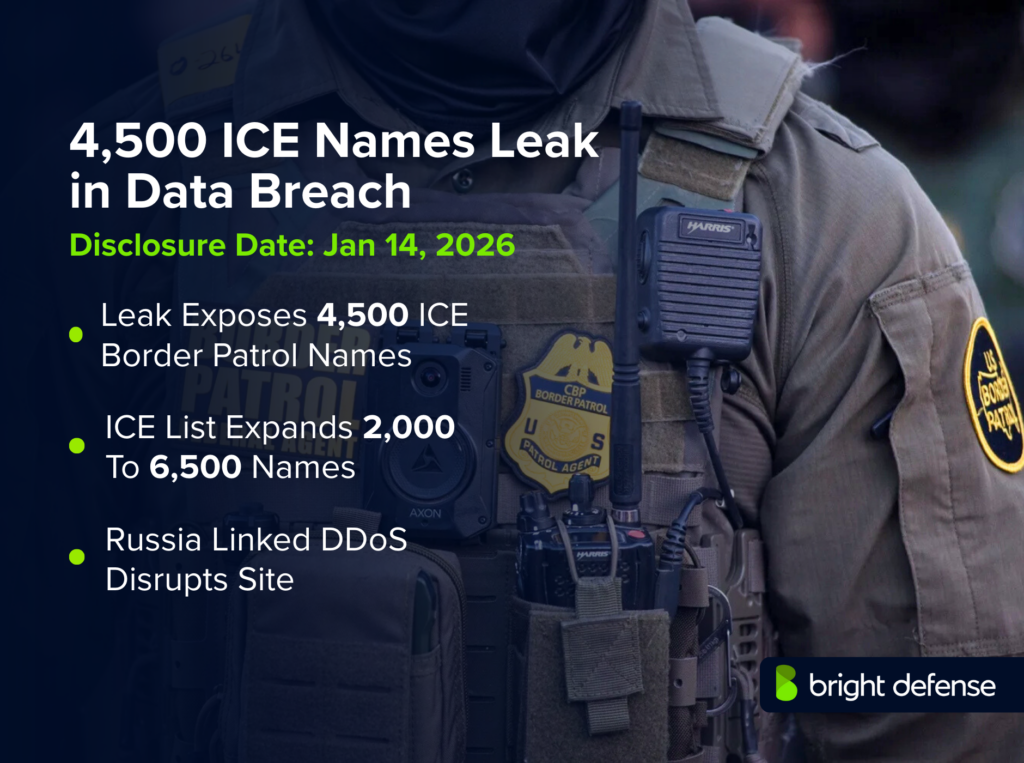
Personal details tied to about 4,500 Immigration and Customs Enforcement and Border Patrol personnel were reported as leaked to the ICE List website, an episode that has intensified a U.S. debate over privacy, transparency, and the safety of federal officers.
What Happened in the 4,500 ICE Names Leak Data Breach
The ICE List website and multiple news outlets reported that a cache of data tied to roughly 4,500 Department of Homeland Security personnel, including ICE and Border Patrol, was provided to the site after the fatal shooting of Renée Good in Minneapolis.
The site’s operator, Dominick Skinner, told reporters the cache included work contact details and job information, and that ICE List planned to publish most names it could verify while carving out exceptions for certain roles.
DHS condemned the alleged leak and framed it as endangering officers and their families, while also signaling potential prosecution, even as reporting noted DHS had not publicly confirmed the leak or disclosed whether an internal inquiry was underway.
Timeline: From First Access To Latest Update
ICE List began operating in June 2025, months before the reported January 2026 cache, and it relied on a mix of volunteer submissions and online records, according to reporting.
A reported chronology of the incident follows, using the earliest confirmed public markers and the latest reported steps:
- June 2025: ICE List begins operating and builds a database over time.
- Jan. 13, 2026: Reporting describes a claimed cache tied to about 4,500 DHS personnel reaching ICE List after the Renée Good shooting.
- Jan. 14, 2026: ICE List says a sustained DDoS attack knocks the site offline as it prepares to post names, with the operator citing traffic that appeared to originate in Russia while also saying attribution was hard because of proxy use.
- Jan. 22, 2026: WIRED reports that its review found the list relied heavily on information DHS and ICE employees posted publicly online, complicating claims about an internal breach.
- Jan. 27, 2026: WIRED reports Meta begins blocking links to ICE List across Facebook, Instagram, and Threads, and a Meta spokesperson points to policies tied to personally identifiable information.
- Feb. 2, 2026: DHS Secretary Kristi Noem says federal officers in Minneapolis will receive body cameras “effective immediately,” with plans to expand the program nationally as funding allows, following the Minneapolis shootings that helped drive public scrutiny.
The timeline includes both the reported data exposure and the follow-on platform and policy actions that shaped the story’s latest phase.
What Data Or Systems Were Affected
Reporting described the alleged cache as containing names, work email addresses, phone numbers, job titles, roles, and resume-style work history.
Public reporting did not identify a specific DHS system that was penetrated, and a key dispute emerged over whether the episode reflected an internal data loss or a compilation of publicly available information.
WIRED said its analysis found ICE List pages often cited public sources such as LinkedIn and other databases, and it reported that the DHS did not respond to its requests for comment.
Who Was Responsible (Confirmed Vs Alleged)
No U.S. law enforcement agency publicly identified a suspect responsible for obtaining or transferring the 4,500-person cache described in January reporting.
The ICE List operator said a DHS “whistleblower” provided the data, and multiple outlets reported the claim while also noting DHS did not publicly confirm the alleged leak.
A separate actor or set of actors targeted ICE List itself, according to the site’s operator, who described a DDoS attack and said some traffic appeared to come from Russia while acknowledging that proxy use blocked clear attribution.
How The Attack Worked
The central allegation described an insider-style disclosure rather than a traditional ransomware intrusion, with the ICE List operator saying a DHS employee transferred a dataset containing work contact details and role information.
At the same time, WIRED reported that the ICE List database relied heavily on information that apparent DHS and ICE employees posted publicly online, meaning a large portion of identification could come from open sources rather than restricted DHS systems.
After the reporting surge, the ICE List operator said a DDoS attack overwhelmed the site’s servers, temporarily blocking access and delaying publication plans.

Impact and Risks for Customers
The most direct safety risk fell on federal officers and their families, because work contact details and location-linked role information can support harassment, impersonation, and targeted threats even without home addresses.
DHS officials argued the disclosures increase danger for officers, and one DHS statement to The Independent described large percentage increases in assaults, vehicular attacks, and death threats, although those figures were presented as DHS claims in news coverage rather than independently audited metrics.
The episode also raised transparency and civil liberties questions, because activists and some observers argue public identification can support oversight when agents wear masks or operate without visible identifiers, while the administration and DHS have characterized many disclosure efforts as criminal “doxing.”
Company Response And Customer Remediation
DHS condemned the alleged leak and said it viewed doxxing of law enforcement officers as a serious threat, with officials signaling that people responsible could face prosecution.
Public reporting did not describe a specific DHS remediation package for affected personnel tied to the 4,500-person cache, such as credit monitoring, identity protection, or direct notification letters, and reporting noted DHS had not confirmed the leak publicly.
In a related Minneapolis fallout track, DHS and the White House pointed to body cameras as a measure to reduce disputes over enforcement encounters, with DHS announcing immediate body camera issuance for DHS officers on the ground in Minneapolis and a broader expansion plan tied to funding.
Government, Law Enforcement, And Regulator Actions
Federal officials publicly threatened prosecution tied to doxxing, but public reporting did not identify arrests connected to the ICE List cache or the DDoS attack as of early February 2026.
Congressional and political pressure around doxxing has included proposed legislation such as the Protecting Law Enforcement from Doxxing Act (S.1952), which a legislative tracker summary described as creating criminal penalties, including up to 5 years in prison, for publicly releasing a federal law enforcement officer’s name with intent to obstruct a criminal investigation or immigration enforcement operation.
In the House, Rep. Andy Ogles also promoted doxxing-focused legislation, reflecting how the issue has become a policy flashpoint alongside immigration enforcement tactics and public backlash.
Financial, Legal, And Business Impact
No public reporting in the cited coverage described DHS paying compensation, offering refunds, or issuing broad credit monitoring tied specifically to the alleged 4,500-person cache.
The legal exposure described in coverage has largely focused on potential criminal liability for doxxing, with DHS officials and lawmakers framing disclosure as a prosecutable act, and pending proposals that could expand penalties depending on intent and how courts interpret publication.
The incident also carried platform and reputational consequences for the disclosure ecosystem itself, with WIRED reporting that Meta blocked links to ICE List and offered policy-based explanations, limiting the site’s distribution on major networks even as debate continued over what information was truly private.
What Remains Unclear About the 4,500 ICE Names Leak in Data Breach
The origin of the data remains unresolved in public reporting, because some accounts described a whistleblower transferring internal records while WIRED reported the database relied heavily on public sources, and DHS did not publicly confirm the breach path.
The full scope of exposure also remains unclear, including whether the dataset contained nonpublic personal identifiers beyond work contact details, and whether all 4,500 records were ever posted or verified on the site.
Attribution for the DDoS attack is also unclear, because the ICE List operator described traffic that appeared to come from Russia while also stating that proxy routing limited certainty about the attacker’s true location or sponsor.
Why This Incident Matters
This episode matters because it sits at the intersection of internal dissent, public-record data aggregation, and the safety risks that come with modern identity exposure, where a small set of work details can become a roadmap for harassment or impersonation.
It also shows how quickly an incident can shift from a claimed breach into a broader information conflict, with counterattacks against the publishing site, link blocking from a major platform, and policy responses such as body camera rollouts and renewed congressional attention to doxxing.
How Bright Defense Can Reduce Similar Exposure
Bright Defense can reduce the odds and impact of incidents like this through two practical tracks: penetration testing that finds real paths to data loss, and continuous compliance that keeps controls working after audits and point-in-time reviews. A focused internal attack simulation can test identity-data handling, access controls, logging, and insider-risk gaps across HR systems, directories, and case-management tools.
Continuous compliance then keeps guardrails in place through change tracking, control monitoring, and evidence-ready reporting, so drift in permissions or data sharing does not turn into a silent exposure. Bright Defense can also help teams validate least-privilege access, tighten data segmentation, and improve alerting on bulk exports and unusual queries. A short assessment with Bright Defense can map the highest-risk identity data flows and produce a remediation plan that fits operational reality.
FAQ
ICE List is a crowdsourced wiki-style site whose creators said they received what they described as leaked personal information about nearly 4,500 DHS employees, and Reuters described it as publishing purportedly leaked personal details of around 4,500 ICE and Border Patrol employees.
Public reporting commonly used a figure of about 4,500 people, and Reuters said it could not independently confirm the accuracy of the list or how the data was obtained.
Reported fields included names, work emails, phone numbers, job roles, and resume-style background details in at least some entries.
No public source in the reporting set established a confirmed DHS-system compromise, and WIRED said its review found the database relied heavily on information DHS employees had posted publicly online while Reuters said the list’s accuracy and origin could not be independently confirmed.
The topic spread rapidly on social platforms, and WIRED reported Meta began blocking links to ICE List on Facebook, Instagram, and Threads, citing policies related to personal information.
Start with actions that reduce account takeover and impersonation risk: 1) turn on multi-factor authentication wherever available 2) review account recovery methods and remove outdated options 3) avoid sharing extra personal details online that can be reused in security questions or impersonation attempts 4) brief your team that unusual “urgent” requests need a second-channel check.
No, and the FBI advises not clicking anything in unsolicited emails or texts and instead using a phone number you look up yourself to confirm whether a request is legitimate.
ICE accepts anonymous reports by phone and online, and USA.gov lists the ICE online tip form plus the Homeland Security Investigations tip line at 1-866-347-2423 for the U.S. and Canada as reporting options.
Sources
- WIRED — Meta Is Blocking Links to ICE List on Facebook, Instagram, and Threads (Jan. 27, 2026)
https://www.wired.com/story/meta-is-blocking-links-to-ice-list-on-facebook-instagram-and-threads/ - WIRED — ICE Agents Are ‘Doxing’ Themselves (Jan. 22, 2026)
https://www.wired.com/story/ice-agents-are-doxing-themselves/ - Axios — Protesters Go Digital Against ICE (Jan. 20, 2026)
https://www.axios.com/2026/01/20/ice-data-leaks-hacktivism-protests - The Daily Beast — Personal Details of Thousands of Border Patrol and ICE Goons Allegedly Leaked in Huge Data Breach (Jan. 13, 2026)
https://www.thedailybeast.com/personal-details-of-thousands-of-border-patrol-and-ice-goons-allegedly-leaked-in-huge-data-breach/ - The Daily Beast — Massive ICE List ID Leak Halted by Cyber Attack From Russia (Jan. 14, 2026)
https://www.thedailybeast.com/massive-ice-list-id-leak-halted-by-cyber-attack-from-russia/ - The Independent — Personal Information of 4,500 ICE and Border Patrol Agents Leaked Online (Jan. 14, 2026)
https://www.independent.co.uk/news/world/americas/us-politics/ice-agents-personal-information-leak-doxxed-b2899973.html - Police1 — ‘ICE List’ Doxxing Site Alleges DHS Whistleblower Leaked Identities of 4,500 Agents (Jan. 14, 2026)
https://www.police1.com/officer-safety/ice-list-doxxing-site-alleges-dhs-whistleblower-leaked-identities-of-4-500-agents - TechRepublic — Leaked Data Exposes Thousands of Border Patrol, ICE Agents After Renee Good Shooting (Jan. 14, 2026)
https://www.techrepublic.com/article/news-leaked-data-exposes-thousands-border-patrol-ice-agents/ - The National Desk — Report: Whistleblower Leaks Personal Data of 4,500 DHS and ICE Agents to Doxxing Website (Jan. 14, 2026)
https://thenationaldesk.com/news/americas-news-now/report-whistleblower-leaks-personal-data-of-4500-dhs-and-ice-agents-to-doxxing-website-anti-ice-prtotesters - AP News — Every Homeland Security Officer in Minneapolis Is Now Being Issued a Body-Worn Camera, Noem Says (Feb. 2, 2026)
https://apnews.com/article/immigration-enforcement-minneapolis-secretary-noem-homeland-security-37af4947057e64efee5e43a8f2e018bb - The Washington Post — Federal Officers in Minneapolis to Start Wearing Body Cams, DHS Says (Feb. 2, 2026)
https://www.washingtonpost.com/politics/2026/02/02/dhs-ice-body-cameras/ - Congress.gov — S.1952, Protecting Law Enforcement from Doxxing Act (June 4, 2025)
https://www.congress.gov/bill/119th-congress/senate-bill/1952 - Rep. Andy Ogles (Official Site) — Rep. Ogles Introduces Bill to Lock Up ICE Doxxers (Aug. 28, 2025)
https://ogles.house.gov/media/press-releases/rep-ogles-introduces-bill-lock-ice-doxxers

Get In Touch