Iron Mountain 1.4 TB Data Breach Sparks Panic
What Happened in the Breach
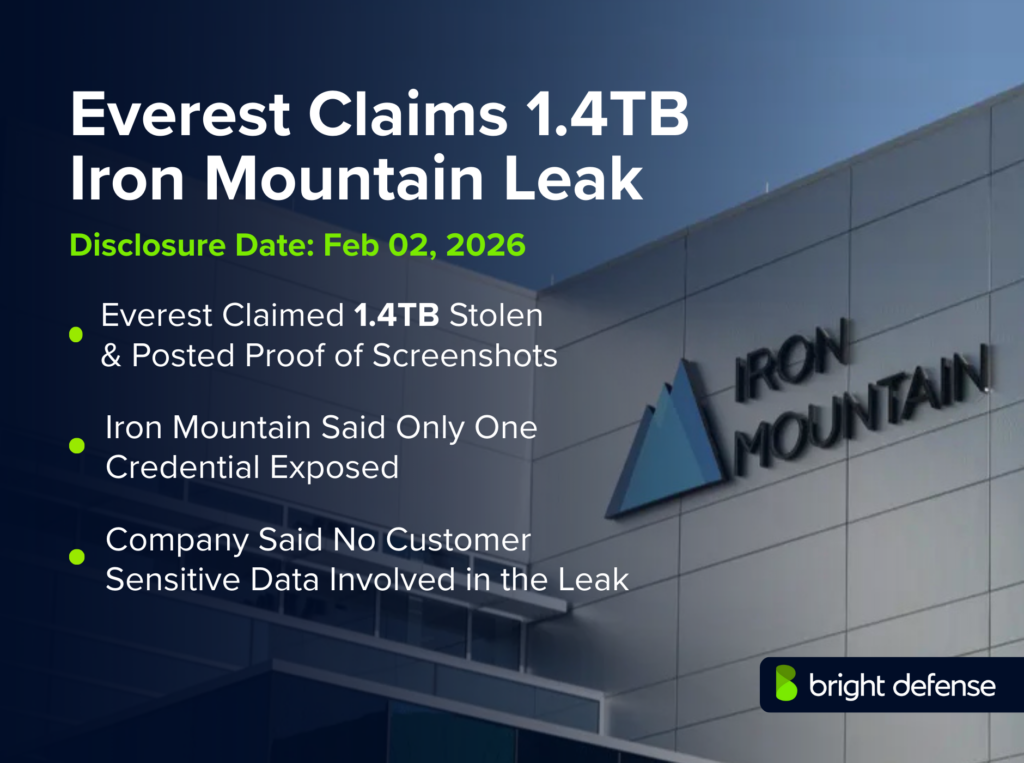
In early February 2026, the Everest ransomware collective published a post on its dark‑web leak site claiming to have stolen 1.4 terabytes of internal documents and client information from Iron Mountain, a U.S.‑based enterprise information‑management company.
The gang said it had exfiltrated internal files and personal documents belonging to Iron Mountain’s clients and gave the company a negotiation deadline of February 11, 2026. Iron Mountain responded on February 2 with a press release stating that a single compromised login credential allowed an attacker to access one folder on a public‑facing file‑sharing site that contained marketing materials used by third‑party vendors.
The company emphasized that no customer confidential or sensitive information was exposed and that no ransomware or malware was deployed. Subsequent media reports confirmed Iron Mountain’s statement, describing the incident as limited and mostly affecting marketing files. To date, there is no independent evidence that 1.4 TB of sensitive data was stolen, and investigators consider the claim unverified.
Timeline: From First Access To Latest Update
- Feb 2, 2026: Everest posts to its leak site alleging it accessed Iron Mountain’s systems and stole 1.4 TB of internal documents and client data, setting a negotiation deadline of Feb 11.
- Feb 2, 2026: Iron Mountain issues a public statement saying it was alerted to a cybersecurity issue limited to a folder containing marketing materials, stating no customer confidential data or ransomware was involved, confirming compromised credentials were deactivated, and stating it is assessing the situation.
- Feb 3, 2026: BleepingComputer publishes an article quoting Iron Mountain’s statement and reporting that Everest did not deploy ransomware and the file sharing server held marketing materials.
- Feb 3, 2026: Information Security Buzz and CyberNews summarize Everest’s claim, highlighting the 1.4 TB figure, dark web proof consisting of folder names, and the Feb 11 ransom deadline, with CyberNews noting the screenshots showed mostly directory names and no downloadable data.
- Feb 4, 2026: SC Media reports that Iron Mountain said the incident was confined to marketing materials and that no sensitive information was exposed.
- Feb 6, 2026: ZeroFox Intelligence releases a flash report assessing that Everest likely overstated the volume and sensitivity of the alleged breach, citing Everest’s history of exaggeration and the contradiction between Everest’s claim and Iron Mountain’s press release.
- Feb 10, 2026: Comparitech’s January ransomware roundup records Everest’s claim against Iron Mountain, noting the issue appeared mostly limited to marketing materials and that no ransomware was launched.
- Feb 11, 2026: The Everest negotiation deadline passes with no public evidence of data leaks or confirmation of ransom payment, and no public updates from Iron Mountain or regulators are reported as of Feb 22, 2026.
What Data Or Systems Were Affected
Everest claimed that it exfiltrated 1.4 TB of data, including internal company documents and client information, and posted screenshots of directory names as proof. The screenshots suggested the presence of files related to marketing materials, research documents, and client folders, with some names implying movie‑studio or jewelry clients.
However, Iron Mountain’s investigation determined that only a single folder on a public‑facing file‑sharing site was accessed using compromised credentials. This folder contained marketing materials shared with third‑party vendors, and the company said no customer confidential or sensitive data was involved. As of late February 2026, there is no confirmed evidence that customer data, intellectual property, or core system backups were compromised.
Who Was Responsible (Confirmed vs. Alleged)
The incident is attributed to the Everest ransomware collective. Everest is a Russian‑language cyber‑extortion group that emerged in December 2020 and evolved from data‑exfiltration attacks to full ransomware operations. It operates a hybrid model combining ransomware‑as‑a‑service with initial access brokering and insider recruitment.
The group often exaggerates claims on its leak site to pressure victims into paying ransoms; ZeroFox intelligence assesses that Everest likely inflated the Iron Mountain breach and may have fabricated data volumes.
Because Iron Mountain reports that the intruder only accessed a marketing folder using a compromised login credential, law‑enforcement agencies have not publicly confirmed Everest’s involvement. No arrests or indictments have been announced related to this incident as of February 22, 2026.
How The Attack Worked
According to Iron Mountain, the breach exploited a single compromised login credential for a public‑facing file‑sharing server. Attackers used this credential to access one folder containing marketing materials used by vendors. There is no evidence that malware or ransomware payloads were deployed on Iron Mountain’s network.
Everest’s typical modus operandi involves acquiring access through credential harvesting, exploiting exposed remote desktop services, purchasing network access from initial access brokers, or recruiting insiders.
The group then exfiltrates data and threatens to leak it on its dark‑web site if the victim does not meet extortion demands. In this case, Everest appears to have leveraged a credential to access a low‑sensitivity folder and then claimed a massive breach to pressure Iron Mountain into negotiations.
Impact and Risks for Customers
Because Iron Mountain’s data‑vault services handle sensitive records for more than 240,000 customers worldwide, any suspected breach raises concerns about confidential documents, intellectual property, and compliance obligations.
The claim of 1.4 TB of stolen data caused widespread anxiety among clients whose data could include film archives, legal records, and corporate documents. If Everest’s allegations were true, affected companies could face phishing, identity theft, and business‑email compromise attacks.
However, Iron Mountain maintains that no confidential customer data was exposed, and risk is currently limited to potential phishing attempts referencing the incident. Customers should nonetheless remain vigilant by changing passwords, enabling multi‑factor authentication, and monitoring accounts for suspicious activity.
Company Response and Customer Remediation
Iron Mountain’s immediate response included deactivating the compromised credentials, investigating the scope of the unauthorized access, and publicly disclosing the incident. In its statement, the company emphasized that its core systems were not breached and that it would continue to monitor its environment for unusual activity.
The company has not offered credit‑monitoring services or compensation because it believes no sensitive data was involved. UpGuard and other cybersecurity outlets recommend that potentially affected third‑party vendors change passwords, adopt phishing‑resistant multi‑factor authentication, and monitor for signs of misuse. Clients concerned about the security of their data should contact Iron Mountain and review their vendor agreements to ensure proper segregation of confidential information.
Government, Law Enforcement, and Regulator Actions
As of February 22, 2026, there have been no publicly announced investigations by U.S. federal or state regulators regarding the Iron Mountain incident. Unlike breaches involving healthcare organizations, this event did not trigger notices from the U.S. Department of Health and Human Services or other regulators because no customer confidential information was confirmed exposed.
Law‑enforcement agencies have not commented on the alleged hack, and there are no court filings or official statements beyond Iron Mountain’s press release. Should evidence emerge that sensitive data was compromised, Iron Mountain would likely be required to notify state attorneys general under data‑breach notification laws.
Financial, Legal, and Business Impact
The incident has not resulted in major financial penalties or lawsuits. Iron Mountain’s share price did not exhibit significant volatility following the claim. On February 12, 2026, Reuters reported that Iron Mountain forecast annual revenue above $7.6 billion for fiscal 2026 due to strong data‑center demand; the article did not mention the alleged breach, suggesting that investors considered the event immaterial.
However, the reputational risk of being associated with a major ransomware group could affect client trust and lead to increased scrutiny from regulators and auditors. Customers may demand assurances regarding segmentation of marketing files and critical storage systems. To mitigate litigation risk, Iron Mountain must continue transparent communication and implement robust security controls.
What Remains Unclear About the Breach
Several aspects of the incident remain unresolved:
- Extent of the Access – It is unclear whether Everest accessed any other folders or systems beyond the marketing directory. The company insists no core systems were compromised, but independent forensic reports have not been published.
- Data Exfiltration – Everest claims to have stolen 1.4 TB of data, yet there is no evidence of data dumps or proof of life beyond directory names. Whether any data was actually exfiltrated remains uncertain.
- Negotiation Outcome – The February 11 deadline passed without public disclosure. There is no information on whether Iron Mountain engaged with the attackers, paid a ransom, or negotiated a deletion of stolen data. Transparency about negotiations would help clarify the outcome.
- Attribution Confidence – Iron Mountain has not explicitly acknowledged Everest as the attacker; the attribution relies on Everest’s own claims. Law‑enforcement verification has not been reported.
Why This Incident Matters
Iron Mountain manages and protects critical information for some of the world’s largest organizations; a successful compromise could have far‑reaching consequences for clients and supply chains. Even though this incident appears limited, the claim underscores how threat actors can use small footholds, such as a marketing folder accessed via a single credential, to launch extortion campaigns and pressure companies into paying ransoms.
The case also illustrates the challenges organizations face in disproving exaggerated claims posted on leak sites. For cybersecurity professionals, the Iron Mountain incident highlights the importance of robust identity and access management, network segmentation, and transparent communication when responding to extortion attempts.
How Bright Defense Can Reduce Risk
Bright Defense helps organizations cut breach risk with proactive testing and continuous compliance services. In incidents like Iron Mountain’s 2026 case, one compromised credential on a public facing file sharing server can create exposure.
Penetration testing and web application assessments can flag exposed services and weak authentication before attackers act. Network security assessments check segmentation to limit lateral movement. Continuous compliance monitoring supports ISO 27001, HIPAA, and state breach requirements, which goes to show faster detection of drift and misconfigurations.
Sources
- Cybernews — Hackers claim 1.4 TB theft from Iron Mountain, major data management company (Feb 2, 2026).
https://cybernews.com/security/iron-mountain-data-breach-claims/ - Iron Mountain — Iron Mountain statement: cybersecurity issue (Feb 2, 2026).
https://www.ironmountain.com/about-us/media-center/press-releases/2026/february/iron-mountain-statement-cybersecurity-issue - BleepingComputer — Iron Mountain: Data breach mostly limited to marketing materials (Feb 3, 2026).
https://www.bleepingcomputer.com/news/security/iron-mountain-data-breach-mostly-limited-to-marketing-materials/ - Information Security Buzz — Attackers allege 1.4 TB data breach at Iron Mountain (Feb 3, 2026).
https://informationsecuritybuzz.com/attackers-allege-1-4tb-data-breach-at-iron-mountain/ - SC Media — Iron Mountain reports limited impact from Everest gang breach (Feb 4, 2026).
https://www.scworld.com/brief/iron-mountain-reports-limited-impact-from-everest-gang-breach - ZeroFox — Flash report: Everest continues to tout prominent brands in latest disclosures (Feb 6, 2026).
https://www.zerofox.com/intelligence/flash-report-everest-continues-to-tout-prominent-brands-in-latest-disclosures/ - Comparitech — Ransomware roundup: January 2026 (Feb 10, 2026).
https://www.comparitech.com/news/ransomware-roundup-january-2026/ - Halcyon — Everest threat actor profile (accessed Feb 22, 2026).
https://www.halcyon.ai/threat-group/everest - HIPAA Journal — Healthcare sector warned about Everest ransomware group (Aug 23, 2024).
https://www.hipaajournal.com/everest-ransomware-warning-healthcare/ - UpGuard — Iron Mountain suffers alleged breach according to dark web reports (Feb 3, 2026).
https://www.upguard.com/news/iron-mountain-data-breach-2026-04-02 - Reuters — Iron Mountain forecasts annual revenue above estimates (Feb 12, 2026).
https://www.reuters.com/technology/iron-mountain-forecasts-annual-revenue-above-estimates-strong-data-center-demand-2026-02-12/
Get In Touch