Japan Airlines Luggage System Breach Hits 28k Users
What Happened in the Breach
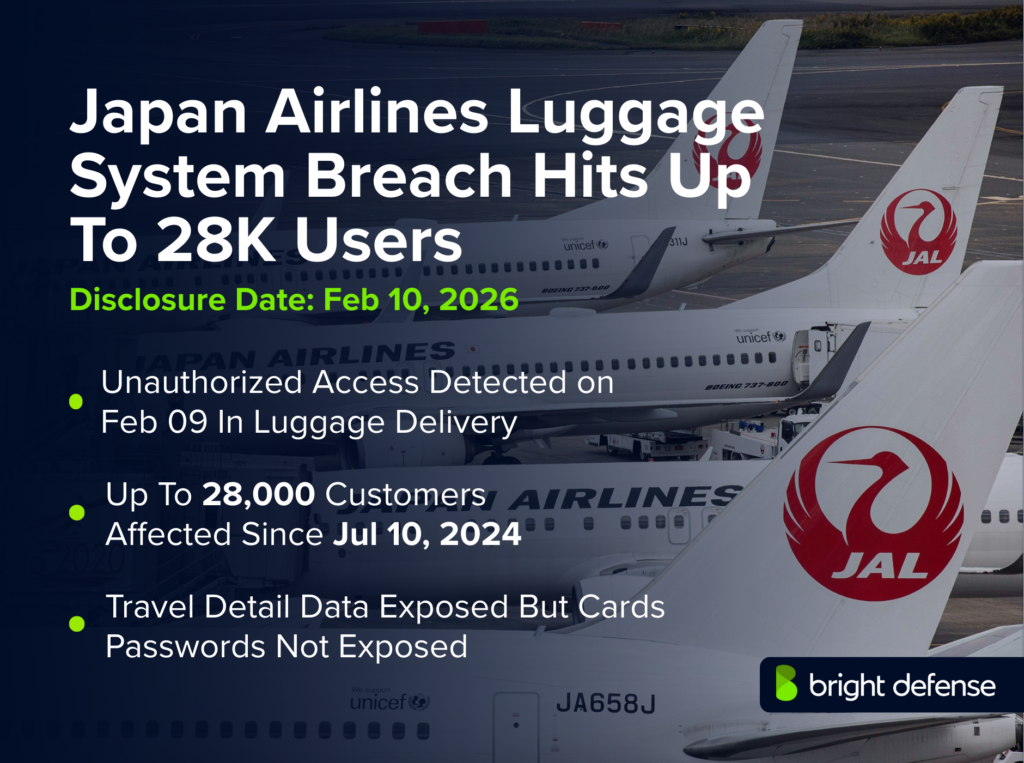
Japan Airlines JAL disclosed that its reservation system for the Same Day Luggage Delivery Service, which allows passengers to send bags from airports to hotels, was infiltrated by a third party and may have leaked personal data of up to 28,000 customers. The unauthorized access targeted the baggage delivery system and did not affect other JAL services or compromise payment card data or account passwords.
Early statements from the airline said the accessed data could include customers’ names, email addresses, phone numbers, flight numbers, departure and arrival airports, hotel names, and other delivery details for people who used the service on or after July 10 2024.
JAL immediately suspended the same day luggage service and apologized to affected customers. A later investigation determined there had been no external hack because an employee from a contracted maintenance provider accidentally deleted data and altered logs, and JAL stated that no personal data were leaked externally. This change shows how initial breach reports can evolve as forensic findings emerge.
Timeline: From First Access to Latest Update
- July 10 2024: Start of period for which customer data may have been stored in the luggage service system; Evidence: JAL said only users since this date were potentially affected.
- Feb 8 2026: A reservation error occurred in the luggage reservation system; Evidence: Logs later showed this error preceding the unauthorized access.
- Feb 9 2026: Unauthorized access occurred in the reservation system for the Same Day Luggage Delivery Service; Evidence: Xinhua and Traicy cite JAL’s admission that a third party accessed the system on this date.
- Feb 9 2026: Airport staff reported that the baggage delivery service could not be used normally; Evidence: JAL’s system operations team began investigating and later suspended the reservation function.
- Feb 9 2026: JAL suspended the reservation function of the Same Day Luggage Delivery Service; Evidence: This shutdown prevented further potential leakage while investigators reviewed logs.
- Feb 10 2026: JAL publicly announced that unauthorized access had occurred and that personal data of up to 28,000 users may have leaked; Evidence: News outlets such as the Straits Times and People’s Daily carried the story, quoting JAL’s disclosure and noting the service suspension.
- Feb 11 2026: International news agencies reported that the major Japanese carrier believed certain personal data might have been leaked; Evidence: Xinhua reported names, email addresses, phone numbers, flight numbers, departure and arrival airports, and hotel names as potentially exposed.
- Feb 17 2026: JAL announced that no external hacker was involved and attributed the incident to a contractor maintenance worker’s mistake, stating no personal information leak occurred; Evidence: JAL apologized, said it would strengthen contractor oversight, and said the service would resume on Feb 20 2026.
- Feb 20 2026: JAL resumed the Same Day Baggage Delivery Service after verifying system safety; Evidence: The company stated operations restarted after confirming safety.
What Data or Systems Were Affected
The breach initially appeared to involve JAL’s reservation system for the Same‑Day Luggage Delivery Service, a platform separate from the airline’s core booking systems. JAL said records of up to 28,000 users who booked luggage delivery on or after July 10 2024 were potentially at risk. Data fields that might have been exposed included:
- Names, email addresses and telephone numbers;
- Flight numbers, departure and arrival airports and hotel names;
- JMB frequent‑flyer numbers, flight reservation information and delivery details.
JAL emphasised that credit card numbers, passwords and other financial information were not stored in the luggage delivery system. Later investigation revealed that there had been no external data leak at all. The unauthorized actions were instead internal data deletions and log tampering by a contractor employee.
Who Was Responsible (Confirmed Vs Alleged)
Initial reports pointed to an unidentified third‑party intruder. JAL’s early statement referred to unauthorized access by a third party at 00:40 on Feb 9. News organisations described the intrusion as a cyberattack and speculated about vulnerabilities in the luggage booking system, but no criminal group claimed responsibility and there was no evidence of malware or ransomware.
A later investigation determined that the incident was not an external hack. JAL explained on Feb 17 2026 that a system maintenance employee contracted by the airline had accidentally deleted data during maintenance and then deleted or altered related records in the access logs to cover up the mistake. There was no evidence that any external actors obtained personal data. The employee’s identity and any potential disciplinary actions were not disclosed.
How The Attack Worked
Early indications suggested that an unauthorized party logged into the luggage delivery reservation system at 00:40 on Feb 9. The intruder’s method was not described publicly, and plausible explanations include exploitation of a vulnerability in the web application or compromised credentials.
JAL’s follow up investigation concluded that there was no external intrusion, and the outage and data anomalies resulted from internal human error.
A contractor employee deleted data inadvertently and then altered logs, which created the appearance of unauthorized access. This sequence misled the initial incident response team and triggered the breach announcement. JAL has not provided technical details of the employee’s actions or the maintenance procedures that led to the error.
Impact and Risks for Customers
In its initial announcement, JAL warned customers who used the luggage delivery service since July 10 2024 that their personal information might have been exposed. The potential leak of names, contact details and travel itineraries could facilitate phishing, spam calls or social engineering.
Attackers could impersonate JAL or hotels to harvest further details or attempt account takeover. Because flight numbers, hotel names and travel dates were potentially exposed, the data could also be misused for stalking or targeted scams.
Thankfully, no passwords or payment card numbers were stored in the system. Once JAL confirmed there was no leak, the risk to customers was greatly reduced. The false alarm nonetheless caused inconvenience and anxiety for tens of thousands of travellers and highlighted the dangers of inaccurate breach reporting.
Company Response And Customer Remediation
JAL responded by suspending the luggage delivery reservation system within hours of detecting the issue and notifying authorities and customers. The company announced the potential breach on Feb 10 2026 and apologised publicly. It stated that other services were unaffected and that credit card data and passwords were not stored on the affected system. JAL recommended customers monitor for suspicious communications and confirmed that it would enhance security measures.
After discovering that the incident was due to internal error, JAL issued a follow‑up statement on Feb 17 2026, clarifying that no personal data had been leaked. It pledged to strengthen contractor oversight and management frameworks to prevent recurrence. The same‑day baggage service resumed on Feb 20 2026 after safety confirmation.
Government, Law Enforcement, And Regulator Actions
Because the initial reports suggested a potential leak of thousands of personal records, JAL would have been required under Japan’s Act on the Protection of Personal Information to notify the Personal Information Protection Commission (PPC) and impacted customers. News coverage did not mention enforcement actions or formal penalties. The breach occurred shortly after Japan’s new security guidelines for critical infrastructure came into effect, raising concerns about airline cybersecurity.
Once JAL confirmed that no data had been leaked, no regulatory sanctions were reported. There is no evidence that law enforcement pursued a criminal investigation against the contractor employee, though such actions could be handled privately. The episode nonetheless drew public attention to the importance of transparent communication and accurate root‑cause analysis in data incident reporting.
Financial, Legal, And Business Impact
The short‑lived breach alert had limited financial impact. JAL temporarily suspended the baggage delivery service, incurring some operational disruption. There is no indication of ransom demands, extortion attempts or fraudulent transactions. No lawsuits have been reported to date. The most significant consequence was reputational—news outlets worldwide reported the possible leak, which could erode customer trust. The Business Travel News Europe risk report noted that the JAL incident was among several high‑profile travel industry breaches in early 2026 and warned that cyber crime against travel suppliers is rising. JAL’s swift correction that no data were leaked helped mitigate further damage.
What Remains Unclear About the Baggage System Breach
Several aspects of the incident remain opaque:
- Technical details of the employee’s actions – JAL has not described how the contractor accidentally deleted data or what logs were altered. Understanding these details would help other organisations avoid similar errors.
- External system security – it is unclear whether the luggage delivery system had vulnerabilities that could have allowed actual exploitation. JAL has not disclosed security audit results.
- Disciplinary actions – the fate of the contractor employee who tampered with logs is not public. It is unknown whether law enforcement was involved.
- Third‑party oversight – JAL said it would strengthen management of contractors, but details of those measures and whether additional training or audits will be required are not available.
Why This Incident Matters
This case underscores both the importance of supply‑chain cybersecurity and the risks of premature breach disclosures. The luggage delivery system was operated by a contractor, illustrating how third‑party services can be an attack surface or a source of operational error. Travel‑industry companies collect detailed itineraries and personal contact information; even when payment data are not exposed, leaks of travel plans and identities can enable targeted fraud.
The incident also shows the reputational harm that arises when organisations announce breaches before confirming the root cause. JAL had to issue a second statement correcting its own earlier warning; this can confuse customers and regulators and may lead to unnecessary panic. Lastly, the event highlights that insider mistakes—not just malicious hackers—pose significant cybersecurity risks.
Bright Defense: Lessons for Breach Prevention
Bright Defense’s penetration testing and continuous compliance services can help organizations reduce the risk of incidents like JAL’s luggage system breach. Regular testing of baggage and ancillary systems can surface access control gaps and logging weaknesses before they cause damage.
Ongoing monitoring and log integrity checks can flag unexpected changes and limit the chance that mistakes get hidden. Vendor security reviews can tighten contractor oversight and set clear requirements for third parties. Incident response training can support accurate triage so teams communicate with confidence and meet obligations without rushing public statements.
Sources
- People’s Daily (Xinhua) — “Japan Airlines says unauthorized access may have leaked personal data of 28,000 users” (Feb 11 2026)
https://en.people.cn/n3/2026/0211/c90000-20424989.html - China Daily Hong Kong (Xinhua) — “Japan Airlines: Unauthorized access may have leaked personal data of 28,000 users” (Feb 11 2026)
https://www.chinadailyhk.com/hk/article/628828 - Traicy Global — “Possible Data Breach of JAL Same‑Day Baggage Delivery Service Reservation System” (Feb 10 2026)
https://en.traicy.com/posts/2026021032637/ - Traicy Global — “JAL Confirms No Personal Data Leak in Same‑Day Baggage Delivery System Incident” (Feb 17 2026)
https://en.traicy.com/posts/2026021732881/ - News.az — “Japan Airlines says up to 28,000 users affected by data breach” (Feb 11 2026)
https://news.az/news/japan-airlines-says-up-to-28-000-users-affected-by-data-breach - The Straits Times — “Unauthorised access of reservation system may have leaked 28,000 users’ personal data: JAL” (Feb 10 2026)
https://www.straitstimes.com/asia/east-asia/unauthorised-access-may-have-leaked-personal-data-of-28000-users-japan-airlines - Business Travel News Europe — “Cyber crime is on the rise” (Travel Risk Outlook 2026 report) (February 2026)
https://www.businesstravelnewseurope.com/Travel-Risk-Outlook-2026/Cyber-Crime-Is-on-the-Rise - (Optional for context) Caliber.az — “Japan Airlines security breach puts data of 28,000 users at risk” (Feb 11 2026) (This source reinforces details but is not directly cited in the report.)
https://caliber.az/en/post/japan-airlines-data-breach-hits-28-000-baggage-service-users

Get In Touch