Japan’s Washington Hotel Breached
What Happened in the Breach
Japan’s Washington Hotel group, part of the Fujita Kanko hospitality company, disclosed that it had suffered a ransomware attack on February 13 2026. In a statement on its Japanese-language corporate site, the company said it detected unauthorized access to several servers at 22:00 local time and identified malware consistent with ransomware.
Staff immediately disconnected the affected servers from the external network to stop the intrusion and reported the incident to police and external cybersecurity specialists.
The attackers accessed internal business data stored on the compromised servers, but there was no evidence of customer data exposure because the company’s loyalty programme (“Washington Net”) is hosted by a separate provider.
Following the disclosure, Washington Hotel confirmed that some hotels experienced temporary outages of credit‑card terminals, though overall operations continued with minimal disruption. The company apologized to customers and said it was working to restore systems and assess the impact on its business.
Timeline: From First Access To Latest Update
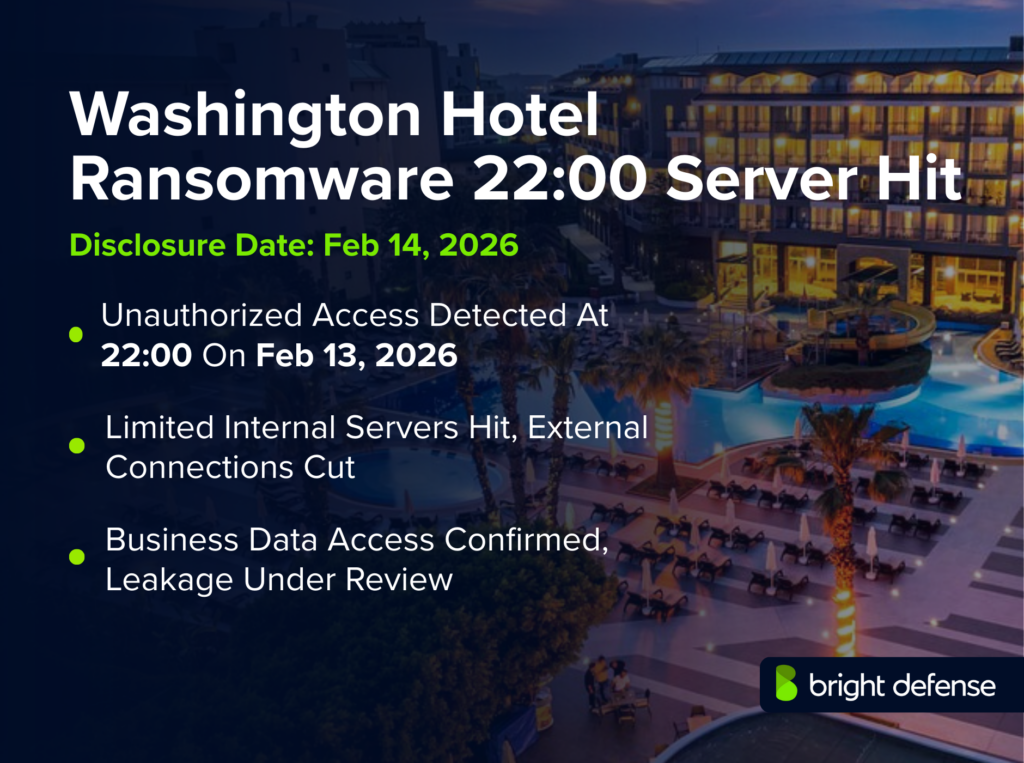
- February 13 2026 – 22:00 local time: The Washington Hotel group detects unauthorized access to some of its servers and identifies a ransomware infection. IT staff disconnect external network links and isolate the servers to prevent lateral movement.
- February 14 2026: The company establishes an internal task force to oversee the response and consults both police and outside cybersecurity experts. Credit‑card terminals at some properties become temporarily unavailable, but hotel operations largely continue.
- February 14–16 2026: Investigations begin. Washington Hotel confirms that various business data stored on the servers was accessed and that it is checking whether any information has been leaked. The firm reports that customer membership data is stored on systems operated by a different company and remains unaffected.
- February 16 2026: The company issues an official disclosure on its website and notifies the public. Bleeping Computer and other outlets report the breach, noting that no ransomware group has claimed responsibility and that the financial impact is under review.
- February 17 2026: UpGuard and several cybersecurity publications summarise the event, listing February 16 as the disclosure date and reiterating that the breach was first detected at 10:00 p.m. on February 13. Reports describe the incident as medium‑severity because it impacted internal operations and payment terminals but did not involve customer data.
- February 20 2026: Frontier Enterprise publishes an English‑language summary of the company’s statement. It notes that the task force was formed on February 14, that police and external experts are involved, and that investigations into the attack’s origin and scope continue.
- Late February 2026: Additional coverage from security sites like eSecurity Planet reiterates that the company activated its incident‑response plan, confirmed unauthorized access to business data, and reported temporary credit‑card terminal issues. As of the latest reporting, the identity of the attackers, the method of intrusion and whether any ransom was demanded remain unknown.
What Data Or Systems Were Affected
Washington Hotel’s statement and media reports consistently note that the attackers accessed “various business data” stored on internal servers. This likely included operational documents, schedules and other internal information used by hotel staff. The loyalty programme (“Washington Net”) and guest membership data were unaffected because they are hosted on a separate third‑party system.
UpGuard and eSecurity Planet describe the incident as medium in severity because it primarily disrupted internal operations rather than exposing personally identifiable information. Reports emphasise that there was no confirmed leak of payment card details; however, some point‑of‑sale terminals at hotels were temporarily unavailable.
Who Was Responsible (Confirmed Vs Alleged)
As of late February 2026, no ransomware group has publicly claimed responsibility for the Washington Hotel attack. Neither the company nor police have named a threat actor, and no extortion postings associated with the brand have been observed on dark‑web leak sites monitored by Bleeping Computer.
Security analysts have speculated that the attack could be part of a broader wave of ransomware incidents targeting Japanese organisations, but there is no concrete evidence linking it to known groups. Without confirmation from investigators, any attribution remains speculative.
How The Attack Worked
The company has not released technical details about the intrusion, leaving the initial access vector unknown. Security commentary suggests several possible pathways: phishing emails that harvest credentials, exploitation of unpatched vulnerabilities in externally exposed services, or misuse of valid vendor credentials.
Japan’s computer emergency response team, JPCERT/CC, warned around the same time about active exploitation of a command‑injection flaw in Soliton Systems’ FileZen file‑sharing appliance (CVE‑2026‑25108), but there is no direct evidence connecting that vulnerability to this incident.
Once inside, the attackers deployed ransomware that encrypted internal servers, leading the company to cut network links and shut down systems to prevent further spread. These containment measures limited lateral movement and reduced the potential for data exfiltration.
Impact and Risks for Customers
Because the attack targeted internal business servers, the primary risk for customers was operational rather than financial. Payment processing at some properties was disrupted when credit‑card terminals became temporarily unavailable, and guests may have experienced delays during check‑in or check‑out.
However, Washington Hotel reported no significant interruptions to room availability or reservations, and overall hotel operations continued.
The company stressed that customer membership data is stored on a separate server managed by another firm and that no unauthorized access had been confirmed. eSecurity Planet notes that guests should remain cautious because ransomware incidents can still lead to phishing or credential abuse if attackers obtained contact information.
Customers are advised to monitor their accounts, beware of unsolicited communications and update passwords as a precaution.
Company Response And Customer Remediation
Immediately after detecting the breach, Washington Hotel disconnected affected servers from the internet and shut down external network connections to halt the intrusion. On February 14, it formed a dedicated task force and enlisted external cybersecurity experts alongside law‑enforcement officials to investigate the cause and scope.
The company issued a public apology and pledged to support any customers affected by the incident. Restoration work began promptly, with systems brought back online in a controlled manner and credit‑card terminals returning to service. As of the latest updates,
Washington Hotel has not offered credit‑monitoring services because no customer data is believed to have been compromised. The company is examining whether the incident will have a material impact on its financial results and stated it will make additional disclosures if necessary.
Government, Law Enforcement, And Regulator Actions
Washington Hotel notified local police immediately after detecting the breach and has been working with law‑enforcement authorities and external cybersecurity firms to investigate. The company’s public statement does not mention any regulatory penalties or government investigations, and no fines or enforcement actions have been announced.
Because the attack did not involve confirmed leakage of personal data, it is unlikely to trigger strict data‑breach notification requirements under Japan’s Personal Information Protection Law. However, authorities are monitoring the situation, and Washington Hotel has committed to providing updates to regulators if the scope changes.
Financial, Legal, And Business Impact
The financial impact of the ransomware incident is still under review. Media outlets describe the severity as medium because the attack targeted internal operations rather than customer data. Temporary payment‑terminal outages likely caused some revenue loss, and the cost of engaging external experts and restoring systems will add to expenses.
As of mid‑February 2026, there have been no reports of legal action, lawsuits or regulatory penalties. The hotel chain said it would examine whether the incident has any material effect on its business performance and promised to disclose such information if necessary. Analysts note that the reputational impact may be contained because the company acted quickly and because no customer data was compromised.
What Remains Unclear About the Attack
- The initial access path remains unknown, including phishing, software vulnerability exploitation, or compromised credentials.
- The ransomware strain has not been identified, and any ransom demand has not been confirmed.
- Data exfiltration status remains unclear, including whether data left the environment before isolation.
- The company has not detailed which categories of business data were accessed.
- Exposure risk for intellectual property, internal financial records, and sensitive operational data remains unconfirmed, limiting full impact assessment for the hotel group and business partners.
Why This Incident Matters
Ransomware has become one of the most disruptive threats to the hospitality sector because hotels process large volumes of reservations and payment data and rely on continuous system availability. The Washington Hotel attack underscores that even mid‑scale chains with 30 locations and 11,000 rooms, hosting nearly 5 million guests annually, can be targeted.
The incident demonstrates the importance of network segmentation: by separating customer‑facing systems from internal business servers, Washington Hotel was able to prevent guest data from being exposed. The quick decision to disconnect servers and involve law‑enforcement and cybersecurity professionals helped limit the attack’s impact and may have prevented extortion or broader disruption.
This case also highlights the lack of public information about many ransomware incidents, as companies often provide only minimal details while investigations are ongoing. Transparent reporting and timely notifications are critical to maintaining customer trust and to helping other organisations learn from these events.
Bright Defense: Reducing Ransomware Risk Through Pen Testing and Continuous Compliance
Bright Defense reduces ransomware risk through penetration testing and continuous compliance that surface exploitable gaps early. Pen tests simulate phishing and vulnerability abuse to find weaknesses in segmentation, remote access, and credential controls, followed by prioritized fixes. Continuous monitoring tracks patching and configuration changes, supporting ISO 27001 and NIST CSF controls such as multifactor authentication, privileged access management, and system isolation.
Sources
- Bleeping Computer — Washington Hotel in Japan discloses ransomware infection incident (February 16, 2026)
https://www.bleepingcomputer.com/news/security/washington-hotel-in-japan-discloses-ransomware-infection-incident/ - Washington Hotel Co., Ltd. (official statement) — ランサムウェア感染被害のお知らせ (February 14, 2026)
https://www.washingtonhotel.co.jp/corporation/news/197/ - UpGuard — Washington Hotel (Japan) investigating ransomware attack (February 17, 2026)
https://www.upguard.com/news/whg-hotels-jp-data-breach-2026-02-17 - Frontier Enterprise — Washington Hotel group in Japan flags ransomware attack (February 20, 2026)
https://www.frontier-enterprise.com/washington-hotel-group-in-japan-flags-ransomware-attack/ - SC Media — Washington Hotel in Japan hit by ransomware attack, business data exposed (February 17, 2026)
https://www.scworld.com/brief/washington-hotel-in-japan-hit-by-ransomware-attack-business-data-exposed - TechRadar — Top Japanese hotel brand reveals cyberattack – Washington hotels hit by ransomware (February 17, 2026)
https://www.techradar.com/pro/security/top-japanese-hotel-brand-reveals-cyberattack-washington-hotels-hit-by-ransomware - eSecurity Planet — Japan’s Washington Hotel reports ransomware attack (February 17, 2026)
https://www.esecurityplanet.com/threats/japans-washington-hotel-reports-ransomware-attack/ - JPCERT/CC — Advisory on command‑injection flaw in Soliton Systems FileZen (February 2026)
https://www.bleepingcomputer.com/news/security/washington-hotel-in-japan-discloses-ransomware-infection-incident/
Get In Touch