Updated:
March 15, 2026
Nissan Data Breach Exposes 21K Fukuoka Customers
What Actually Happened
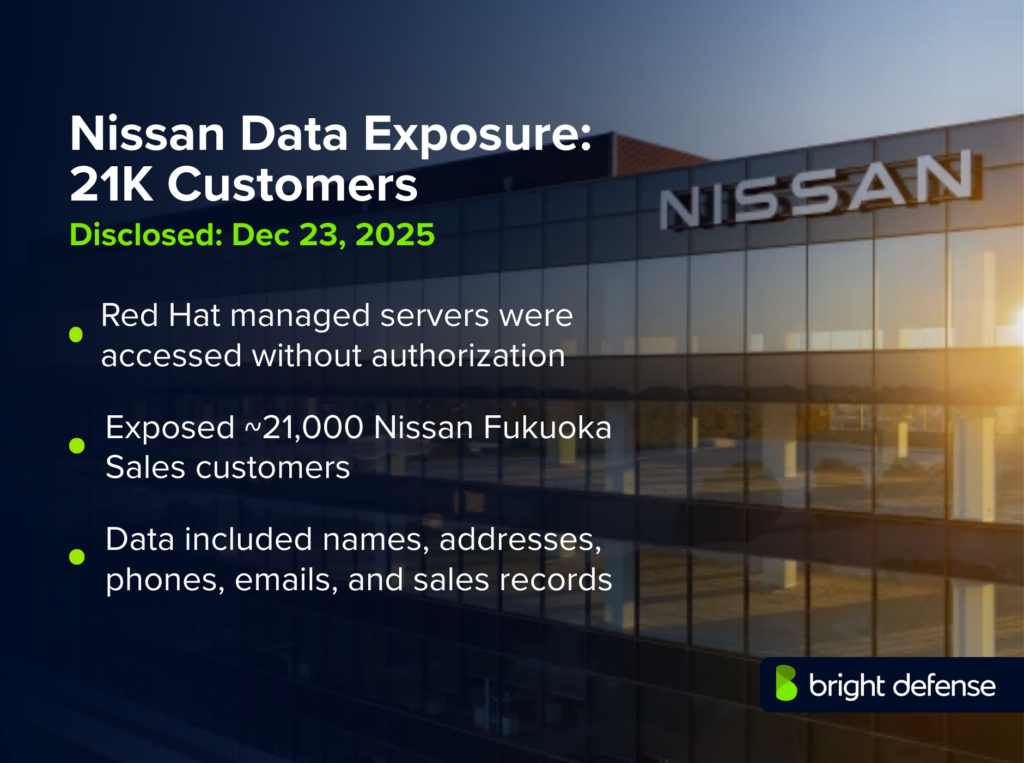
In December 2025, Nissan Motor Co. Ltd. confirmed that personal data for about 21,000 customers tied to a former Fukuoka dealership in Japan was copied from a Red Hat Consulting server used to build a customer management system. Attackers accessed Red Hat’s self-managed GitLab earlier in autumn, and Red Hat notified Nissan on October 3, 2025. Nissan reported the incident to Japan’s Personal Information Protection Commission and began notifying affected people.
Nissan said the exposed repository contained development sample data and artifacts, not Nissan internal systems. The leaked details included names, addresses, phone numbers, partial email addresses, and customer sales-related information. Nissan stated no credit card or financial data was stored there. The breach has been linked to a wider GitLab theft claimed by “Crimson Collective,” with ShinyHunters later posting sample files publicly, though neither Red Hat nor Nissan has officially named the attackers.
Timeline: From First Access to Latest Update
- September 26 2025 – Red Hat detects unauthorized access. Red Hat found an intrusion in a self-managed GitLab instance around Sept. 26 and removed the connection soon after. Some reporting suggests the compromise may have started earlier.
- October 3 2025 – Nissan notified. Red Hat informed Nissan of the breach, and Nissan reported it to the Personal Information Protection Commission. Nissan also began contacting potentially affected customers.
- Early October 2025 – Claims and extortion attempts emerge. Crimson Collective claimed it stole hundreds of GB from Red Hat repositories and posted samples on Telegram. ShinyHunters later shared portions on its extortion site.
- December 2025 – Nissan discloses customer impact. On Dec. 19 2025, Nissan issued a Japanese notice confirming about 21,000 former Fukuoka Nissan Motor Co. customers were affected and listing exposed data fields. International outlets then picked up the story.
- December 23 2025 – Additional media reporting. SecurityWeek, InfoSecurity Magazine, The Register, SC Media, and Techzine summarized Nissan’s notice. Reports repeated the Sept. detection, Oct. 3 notification, and no financial data exposure.
- Late December 2025 – Broader supply-chain impact clearer. Analysts tied the incident to a 570 GB Red Hat data theft affecting multiple organizations, including Nissan Fukuoka customers. Reporting also linked it to other Nissan-related incidents in 2025.
- January 2026 – No further updates. As of early January 2026, there are no public reports of fraud tied to the leaked data, and no added details from Nissan or Red Hat.
What Data or Systems Were Affected
The compromised data consisted of personal information belonging to approximately 21,000 customers of Nissan Fukuoka Sales. According to the official Nissan notice, the following elements were exposed:
- Names and mailing addresses
- Telephone numbers
- Partial email addresses
- Additional customer information used for sales activities, such as service history or details relevant to marketing or follow‑up communication
Nissan stressed that no credit card data or other financial information was stored on the compromised server. The environment was described as a Red Hat Consulting‑managed GitLab instance used to develop a customer management system; it contained sample code and data but was not part of Nissan’s production systems. Red Hat asserted that the server did not house any other customer records beyond those affected and that it had taken steps to prevent further unauthorized access. (Nissan)
Who Was Responsible (Confirmed vs Alleged)
No law enforcement agency or regulator has publicly identified a specific individual or group responsible for the breach. Nissan and Red Hat did not name any threat actors in their announcements.
Alleged: Soon after the intrusion became public, a group calling itself Crimson Collective claimed responsibility for accessing Red Hat’s private GitLab repositories and stealing 570 GB of data. Cybercrime researchers noted that the group bragged about its exploits on Telegram and threatened to extort Red Hat.
Subsequently, the well‑known ShinyHunters gang posted samples of the stolen data on its extortion platform, suggesting a partnership or handoff between the groups. These allegations have not been verified by authorities, and there is no public indication that Nissan was targeted directly; rather, the carmaker was one of many organizations indirectly impacted by the breach of Red Hat’s systems. (shieldworkz.com)
How the Attack Worked (If Known)
The intrusion appears to have been part of a larger supply‑chain attack on Red Hat Consulting. According to analysis from cybersecurity researchers and industry reports, the sequence was likely as follows:
- Compromise of Red Hat’s GitLab environment. Attackers gained unauthorized access to a self‑managed GitLab instance operated by Red Hat Consulting. The method of entry has not been publicly disclosed, but investigators noted that the environment held example code, internal communications and project specifications for numerous clients.
- Exfiltration of data. Once inside, the attackers copied data from the GitLab instance, including project repositories and associated customer information. The Crimson Collective claimed it stole 570 GB of data across 28,000 projects, including customer engagement reports containing infrastructure details, configurations and tokens.
- Notification and containment. Red Hat detected the unauthorized access on September 26 2025 and removed the malicious connections. Within a week, the company informed Nissan and other affected clients. Red Hat said it implemented measures to prevent a recurrence.
- Extortion attempts. The Crimson Collective and ShinyHunters later posted samples of the data online to pressure Red Hat. Some security analysts noted that the stolen information included authentication tokens that could be used to access customer networks. There is no evidence such tokens were used to penetrate Nissan systems.
Because the breach occurred in a supplier’s environment, there is no indication that Nissan’s own systems were directly compromised. The incident underscores the risk of third‑party integrations and consultant‑managed infrastructure. (Security Affiars)
Company Response and Customer Remediation
Nissan stated that upon learning of the breach, it immediately reported the incident to Japan’s Personal Information Protection Commission and began notifying affected customers. Key aspects of its response include:
- Direct customer notification. Nissan said it is contacting individuals whose data may have been compromised. The company provided a customer service hotline for inquiries and posted the notice on its website.
- Public apology and assurances. The notice apologizes for the inconvenience and concern caused to customers and asserts that the leaked data has not been confirmed as misused. It warns customers to be cautious of suspicious calls or mail.
- Security review and subcontractor oversight. Nissan committed to strengthening its monitoring of subcontractors and enhancing information security controls. It emphasized that the Red Hat server did not contain other customer information, reducing the risk of additional leaks.
Notably, Nissan has not announced any compensation program or identity‑theft protection services. The company explained that financial data was not compromised, which may influence the decision to offer remedies such as credit monitoring. Customers were advised to remain vigilant but were not offered vouchers or monetary compensation.
Red Hat stated that protecting its systems and clients’ data is a priority and that it has hardened its infrastructure. It has not provided specifics on remediation steps beyond acknowledging the breach and cooperating with customers and law enforcement.
Government, Law Enforcement, and Regulator Actions
After Red Hat informed Nissan of the breach, Nissan reported the incident to the Personal Information Protection Commission, Japan’s data‑privacy regulator. There have been no public statements from the commission regarding enforcement actions or investigations. The incident has not led to any publicly announced law enforcement investigations in Japan or elsewhere, and there have been no reports of arrests or raids connected to the Crimson Collective or ShinyHunters claims.
Several national and regional privacy laws impose obligations on organizations handling Japanese consumer data. Nissan’s quick reporting to the commission and direct customer notifications suggest compliance with Japan’s Act on the Protection of Personal Information, which requires prompt reporting and notification when certain personal data is leaked. Beyond these steps, there have been no announced fines or penalties.
Financial, Legal, and Business Impact
As of early January 2026, there are no public reports of lawsuits filed against Nissan over this incident. Legal analysts note that the breach involved contact information rather than financial or government identification numbers, which may reduce the likelihood of class‑action litigation compared with breaches exposing Social Security or payment data. Nevertheless, the incident adds to a series of cybersecurity events for Nissan. In late August 2025, the Qilin ransomware group compromised a Nissan design subsidiary, and in 2024 a separate breach exposed personal information of more than 53,000 North American employees. The recurrence of security incidents could erode customer trust and invite greater regulatory scrutiny.
From a business standpoint, the breach underscores the costs of securing supply‑chain partners. Nissan must allocate resources to notify 21,000 customers, manage hotline support and assess its vendor oversight practices. Red Hat, meanwhile, faces reputational damage and potential loss of consulting contracts due to the scale of its GitLab compromise. No financial impact figures have been publicly disclosed by either company. (bleepingcomputer.com)
What Remains Unclear
- Attack vector and initial intrusion method. Red Hat and Nissan have not disclosed how attackers gained access to the GitLab server. Whether it was through stolen credentials, a vulnerability or insider compromise remains unknown.
- Full scope of exfiltrated information. While Nissan says only 21,000 customer records were affected, the Crimson Collective claimed to have stolen 570 GB of data, and it is unclear how much of that data relates to other organizations or includes additional Nissan information beyond the Fukuoka customers.
- Ultimate use of the data. Both companies say there is no evidence of misuse, but it is unknown whether the stolen names, addresses and partial email addresses have been sold or distributed privately. The lack of financial data reduces but does not eliminate risks such as targeted phishing or social engineering.
- Regulatory consequences. The Personal Information Protection Commission has not announced any enforcement actions. It is unclear whether authorities will issue fines, require remedial measures or conduct further investigations.
- Potential legal claims. As of January 2026, there are no public lawsuits, but affected customers could still pursue legal action or compensation, especially if evidence emerges of data misuse.
Why This Incident Matters
This breach highlights the growing exposure of personal data through third‑party service providers and the ripple effects that can ensue. Nissan was not directly breached; instead, its customers’ information was exposed through a supply‑chain compromise at Red Hat Consulting. The case illustrates how organizations must vet and monitor vendors, consultants and integration partners who handle customer data. It also underscores the importance of secure code repositories and strict access controls for development environments.
For consumers, even a limited set of personal data can enable targeted phishing, fake invoices or other scams. Because the stolen dataset includes names, addresses and telephone numbers, affected customers may receive convincing fraudulent communications. Nissan’s repeated data‑related incidents over the past few years may raise questions about its overall cybersecurity posture. The company says it is strengthening controls over subcontractors and enhancing security practices; how effectively it does so may influence public trust.
For industry observers and policymakers, the incident serves as a reminder that supply‑chain security is not just an issue for critical infrastructure and software distribution; it also affects automotive and retail sectors. Regulators may watch this case to assess whether existing privacy laws and vendor oversight requirements adequately protect consumers when global companies outsource system development to technology partners.
Read About More Data Breaches Here!
Sources
- SecurityWeek — Nissan Confirms Impact From Red Hat Data Breach (December 22 2025)
https://www.securityweek.com/nissan-confirms-impact-from-red-hat-data-breach/ - Bitdefender — 21,000 Nissan Customers Exposed After Third-Party Server Breach (December 24 2025)
https://www.bitdefender.com/en-us/blog/hotforsecurity/21-000-nissan-customers-exposed-after-third-party-server-breach - Security Affairs — Red Hat GitLab breach exposes data of 21,000 Nissan customers (December 23 2025)
https://securityaffairs.com/186048/data-breach/red-hat-gitlab-breach-exposes-data-of-21000-nissan-customers.html - BleepingComputer — Nissan says thousands of customers exposed in Red Hat breach (December 22 2025)
https://www.bleepingcomputer.com/news/security/nissan-says-thousands-of-customers-exposed-in-red-hat-breach/ - InfoSecurity Magazine — Nissan: Thousands Impacted By Red Hat Breach (December 23 2025)
https://www.infosecurity-magazine.com/news/nissan-thousands-impacted-by-red/ - The Register — 21K Nissan customers’ data stolen in Red Hat raid (December 23 2025)
https://www.theregister.com/2025/12/23/21k_nissan_customers_data_stolen/ - SC Media — Nissan confirms data compromise from Red Hat hack (December 23 2025)
https://www.scworld.com/brief/nissan-confirms-data-compromise-from-red-hat-hack - Techzine Global — Data of 21,000 Nissan customers leaked via Red Hat (December 23 2025)
https://www.techzine.eu/news/security/137491/data-of-21000-nissan-customers-leaked-via-red-hat/ - Nissan Motor Co. — Apology and report regarding personal information leak due to unauthorized access to a subcontractor (December 2025)
https://www3.nissan.co.jp/siteinfo/information_251205.html - Shieldworkz — The extended blast radius: what we know about the Nissan‑Red Hat breach (December 23 2025)
https://shieldworkz.com/blogs/the-extended-blast-radius-what-we-know-about-the-nissan-red-hat-breach
Get In Touch