Spotify Data Leak Panic: 256M Tracks Exposed
What Happened
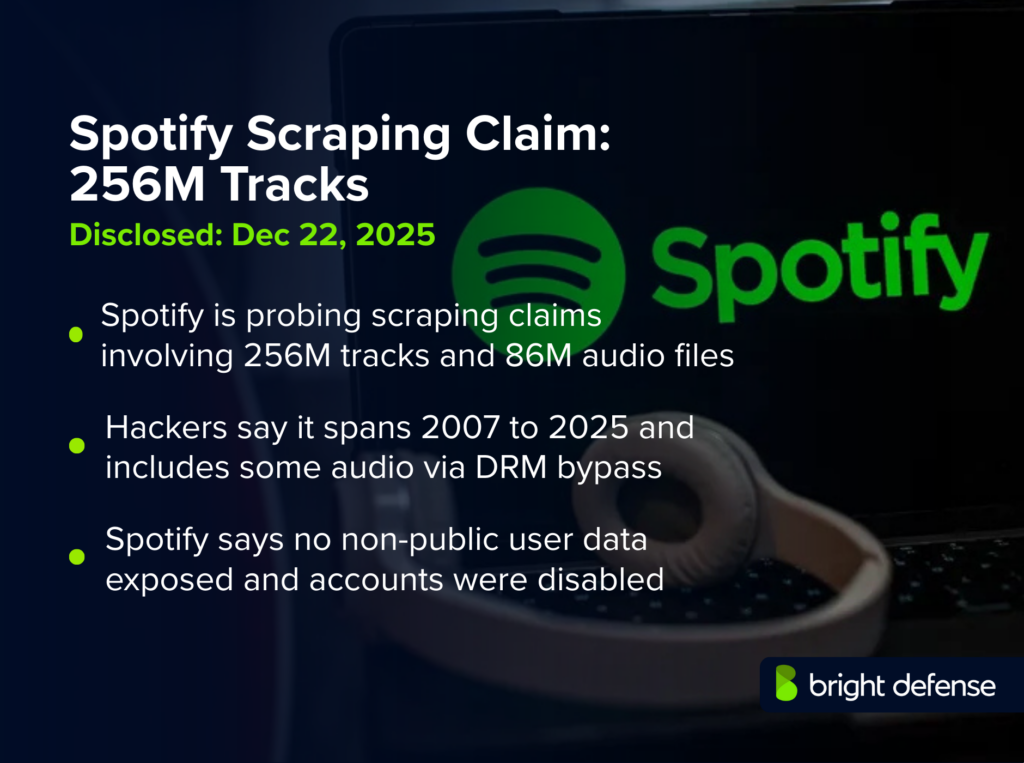
In late December 2025, Spotify confirmed it was investigating unauthorized scraping of its music library after a pirate activist group, Anna’s Archive, claimed it had backed up a massive portion of Spotify’s catalog. The group said it released metadata for hundreds of millions of tracks and intended to distribute tens of millions of audio files through peer to peer sharing networks.
Spotify described the activity as unlawful scraping and said the third party used illicit tactics to bypass digital rights management controls to access some audio files. The company said it had disabled the user accounts involved and implemented additional safeguards, while continuing to monitor for suspicious behavior.
The incident triggered renewed attention on the security and anti abuse limits of large scale streaming platforms, and raised new questions about how quickly content at industrial scale can be replicated, redistributed, and reused for piracy or AI training.
Timeline: From First Access To Latest Update
- Dec. 20, 2025 (public claim and initial release)
Anna’s Archive published a blog post claiming it discovered a method to scrape Spotify at scale. The group said it released metadata for 256 million tracks and had archived 86 million audio files. It described the project as a “preservation archive” and said it would distribute the dataset through torrents.
- Dec. 22, 2025 (Spotify confirms investigation begins publicly)
Major news outlets reported that Spotify confirmed unauthorized access and said it was actively monitoring the incident. The company stated that a third party scraped public metadata and used illicit tactics to circumvent DRM to access some audio files.
- Dec. 22 to Dec. 23, 2025 (Spotify containment steps reported)
Spotify said it identified and disabled the user accounts engaged in unlawful scraping and introduced new safeguards designed to reduce similar anti copyright attacks.
- Dec. 23, 2025 (broader reporting on scale and distribution methods)
Cybersecurity reporting described the dataset as close to 300TB and said it was being seeded through BitTorrent and bulk torrent distribution.
- Late Dec. 2025 (ongoing monitoring and industry concern)
Spotify said it was working with industry partners to protect creators and rights holders. Analysts and copyright tracking firms warned the dataset could make large scale AI training on modern music significantly easier.
What Data Or Systems Were Affected
Reporting and Spotify’s statements indicate the incident involved two broad categories:
- Public metadata for track catalogs
Anna’s Archive claimed it released metadata for roughly 256 million tracks, including fields such as artist name, track title, album details, identifiers like ISRC codes, and related catalog attributes. - Audio files for a portion of Spotify’s catalog
The group claimed it archived roughly 86 million audio files, which it described as representing about 99.6 percent of listens on the platform. Spotify did not confirm the full scope but said some audio files were accessed through DRM circumvention.
Spotify stated the incident did not involve non public user information. It said the only user related data was tied to public playlists, which are visible to other users.
Who Was Responsible (Confirmed Vs Alleged)
Confirmed
Spotify attributed the scraping to a third party that used unlawful methods and said it disabled accounts used in the activity. Spotify did not publicly identify individuals or organizations behind the accounts.
Claimed
Anna’s Archive publicly claimed responsibility, describing itself as an open source search engine for shadow libraries and stating the scrape was part of an effort to build a preservation archive for music.
No law enforcement agency has publicly announced arrests or formal attribution as of the latest confirmed reporting.
How The Attack Worked
Spotify has not published technical details of the scraping method, but reporting and commentary from cybersecurity analysts suggests a likely pattern consistent with large scale automated extraction:
- Use of multiple accounts, automated tooling, and repeated requests to pull large volumes of content and metadata
- Abuse of public endpoints and platform features intended for user playback rather than bulk extraction
- Attempts to evade rate limits and behavioral detection mechanisms
- Use of DRM circumvention methods to obtain audio files in a form usable outside Spotify’s official apps
Spotify said it disabled the accounts involved and added safeguards designed to reduce similar activity in the future.
Company Response And Customer Remediation
Spotify characterized the incident primarily as a piracy and content protection issue rather than a compromise of user databases. The company said it:
- Identified and disabled user accounts tied to scraping
- Implemented new safeguards for similar anti copyright activity
- Continued monitoring for suspicious behavior
- Worked with industry partners to defend creators’ rights
Spotify said there was no indication that private user data was compromised.
The company did not announce user compensation or credit monitoring programs, since reporting did not indicate the breach involved payment information, passwords, or private subscriber data.
Government, Law Enforcement, And Regulator Actions
There has been no public statement from a regulator indicating a consumer data breach investigation tied to the Spotify scraping claims. The publicly discussed impact centers on copyright, platform abuse controls, and DRM circumvention rather than exposure of personal user records.
Legal and enforcement risk is more likely to come from copyright holders, record labels, or rights management organizations. Industry observers said large scale redistribution of copyrighted audio could attract swift enforcement action, although the decentralized torrent distribution model makes takedown efforts difficult.
Financial, Legal, And Business Impact
Spotify’s immediate financial exposure remains unclear, but several risks are widely discussed:
- Copyright enforcement and rights holder pressure
A dataset containing millions of audio files could trigger coordinated enforcement efforts from labels and rights holders. Spotify could face pressure to show that safeguards are sufficient to prevent repeated scraping. - Piracy and revenue impact
If the dataset becomes easy to browse and download for average users, it could facilitate widespread access to copyrighted music outside paid streaming models. - AI training and licensing disputes
Researchers and IP tracking firms warned that a large, high quality modern music dataset could lower barriers for AI model training on copyrighted music, potentially intensifying legal conflict over licensing, fair use, and model provenance. - Platform trust and security optics
Even if user data is unaffected, large scale scraping can raise concerns about whether platforms are adequately controlling abuse, automation, and account manipulation.
What Remains Unclear
Key details remain unresolved:
- The exact technical method used to scrape at scale
- Whether the audio files were captured directly from Spotify’s streaming pipeline or from an alternate workflow
- How long the scraping occurred before discovery
- Whether the dataset will remain available long term and how widely it will be mirrored
- Whether record labels or rights holders will pursue coordinated legal action against Anna’s Archive or related actors
- Whether Spotify will publish more details on safeguards or detection mechanisms
- Whether any user accounts were compromised versus created and operated solely for scraping
Spotify has not confirmed the full scope of audio file access and has not said how many audio files were actually taken.
Why This Incident Matters
This case matters because it shows how large scale scraping and account abuse can shift from isolated piracy into industrial scale content replication. Spotify is one of the world’s largest music distributors, and the claim that a third party can extract a dataset measured in hundreds of terabytes underscores how difficult it can be to prevent determined actors from turning a streaming platform into a content source for redistribution.
It also highlights the growing overlap between piracy, security, and AI. A dataset containing modern music at scale could be used not just for illegal redistribution, but also for training generative AI systems, raising major questions about licensing, model ethics, and enforcement. Even when user data is not involved, the ability to defeat content protection at scale is a major risk for any platform dependent on copyrighted distribution.
Read More Breach Reports Here!
FAQ
Public reporting described unlawful scraping tied to a group called Anna’s Archive, with Spotify confirming unauthorized access involving public metadata and some audio files.
The 256 million figure refers to rows of track metadata, and TechCrunch reported the group claimed metadata coverage for an estimated 99.9% of Spotify’s catalog.
No, Spotify told Recorded Future News that it did not consider the incident a “hack” and described it as stream-ripping and scraping that used third-party user accounts rather than access to Spotify business systems.
Reporting described two main components: a large metadata database (artist, album, titles, and related fields) and a bulk archive described as about 86 million music files, with Spotify saying a third party used illicit tactics to get access to some audio files.
Spotify said it identified and disabled the user accounts involved and put additional safeguards in place while monitoring for suspicious behavior.
No clear public reporting tied this incident to stolen listener login data, and Spotify framed the event as unlawful scraping via user accounts rather than a compromise of user records.
Yes, treat it as high-risk and avoid clicking links in unsolicited messages, then check your account only in the Spotify app or by typing the official site address yourself.
Spotify says it will not ask for personal information over email such as your password or payment info and it will not ask you to download anything from its emails, so messages asking for those items should be treated as scams.
Yes, Spotify disclosed a 2020 incident where a vulnerability exposed some users’ Spotify account registration information to certain business partners and Spotify reset affected passwords.
It means the password you used has shown up in known breached credential data, so it is higher risk if reused on any account and should be replaced with a unique password.
Jay Z’s catalog was largely removed from Spotify in 2017 at the artist’s request while his music remained on TIDAL, and reporting tied the move to streaming availability strategy around TIDAL and competing services.
About 0.04 GB per hour at Normal quality (about 96 kbit/s), about 0.07 GB per hour at High (about 160 kbit/s), and about 0.14 GB per hour at Very High (about 320 kbit/s), with exact usage varying by settings and network conditions.
Sources
- Euronews Next — Spotify investigates data breach after pirate group claims it scraped its music library (Dec. 22, 2025)
https://www.euronews.com/next/2025/12/22/spotify-investigates-data-breach-after-pirate-group-claims-it-scraped-its-music-library - The Guardian — Activist group says it has scraped 86m music files from Spotify (Dec. 22, 2025)
https://www.theguardian.com/technology/2025/dec/22/spotify-music-scraped-annas-archive - Billboard — Spotify Music Library Scraped by Pirate Activist Group (Dec. 22, 2025)
https://www.billboard.com/pro/spotify-music-library-scraped-pirate-activist-group/ - The Record — Spotify disables accounts after open source group scrapes 86 million songs (Dec. 2025)
https://therecord.media/spotify-disables-accounts-after-open-source-group-scrapes-86-million-songs - TechCrunch — Pirate group Anna’s Archive says it scraped 86 million songs from Spotify (Dec. 23, 2025)
https://techcrunch.com/2025/12/23/pirate-group-annas-archive-says-it-has-scraped-86-million-songs-from-spotify/ - Malwarebytes — Hacktivists claim near total Spotify music scrape (Dec. 23, 2025)
https://www.malwarebytes.com/blog/news/2025/12/hacktivists-claim-near-total-spotify-music-scrape - Engadget — Pirate group Anna’s Archive says it has scraped Spotify in its entirety (Dec. 23, 2025)
https://www.engadget.com/entertainment/streaming/pirate-group-annas-archive-says-it-has-scraped-spotify-in-its-entirety-211914755.html - Android Central — Anna’s Archive backed up 300TB of Spotify songs and metadata (Dec. 2025)
https://www.androidcentral.com/apps-software/spotify/annas-archive-backed-up-300tb-spotify - Yahoo News / Decrypt — Shadow ‘Archive’ says it copied virtually all of Spotify’s music (Dec. 22, 2025)
https://www.yahoo.com/news/articles/shadow-archive-says-copied-virtually-170622522.html

Get In Touch