
Volvo Group Data Breach – 17K Exposed in Conduent Hack
What Happened in the Breach
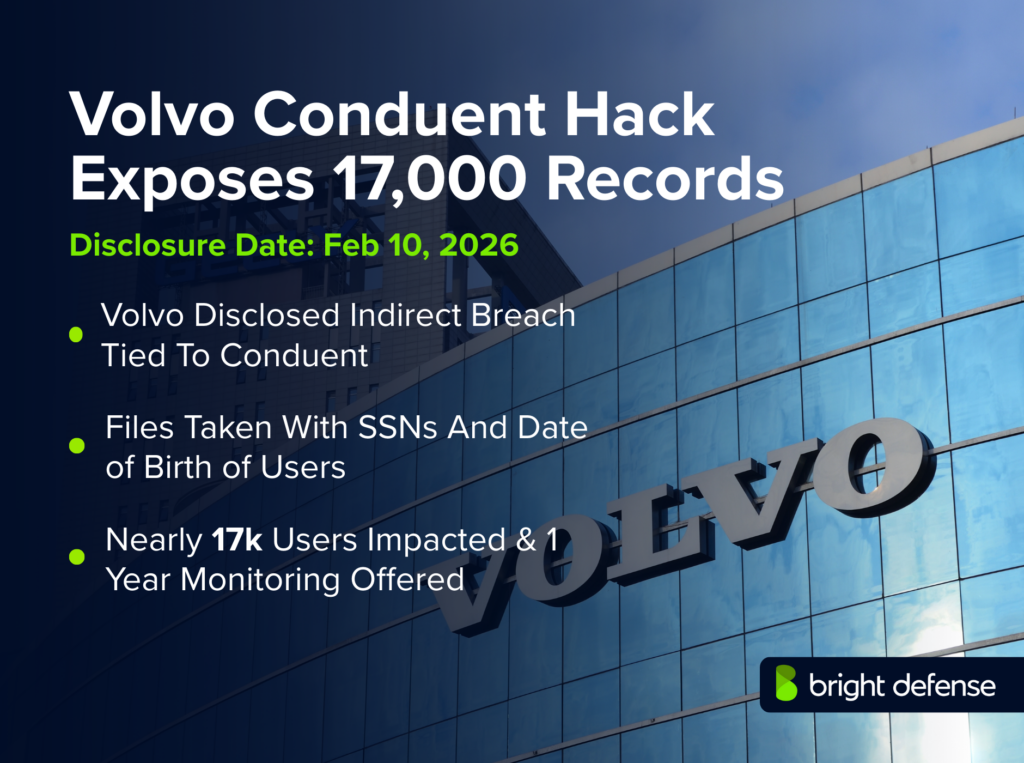
Volvo Group North America reported that a third party breach at Conduent exposed personal data tied to nearly 17,000 Volvo employees and customers, after Conduent’s systems were accessed from Oct 21, 2024 to Jan 13, 2025. Stolen files included names, addresses, Social Security numbers, dates of birth, health insurance details, identification numbers, and medical information, and Conduent detected the intrusion on Jan 13, 2025 and brought in law enforcement and forensics.
Conduent disclosed the incident in an April 2025 SEC filing and initially estimated up to 10 million impacted, later revising the total to more than 25 million, while Volvo learned on Jan 21, 2026 that its population was affected and stated its internal systems were not breached, which goes to show how vendor exposure can create major supply chain risk.
Timeline: From First Access To Latest Update
- October 21 2024 – January 13 2025: Attackers had unauthorized access to Conduent’s network during this period, later described as an 84‑day dwell time. Investigators believe the hackers quietly exfiltrated sensitive files over several weeks without raising alarms.
- January 13 2025: Conduent discovered suspicious activity and shut down affected systems. The company contacted law enforcement, brought in third‑party forensics teams, and disclosed that personal information had been stolen.
- February 2025: The SafePay ransomware group posted the company on its leak site and claimed to have stolen 8.5 TB of data. Conduent did not publicly acknowledge the group’s claim.
- April 2025: Conduent filed a Form 8‑K with the SEC and issued public statements describing the breach, saying it had agreed to send notification letters on behalf of affected clients. Early state filings indicated about 10 million individuals were affected.
- October 2025: Conduent notified state attorneys general in Texas, Oregon and other states. Texas initially reported 4 million victims; later updates raised that figure to 15.4 million. Oregon estimated 10.5 million people were affected.
- January 21 2026: Volvo Group North America confirmed to the Maine Attorney General that 16,991 individuals associated with the company were impacted. Conduent said it was still reviewing files to determine exactly whose data had been compromised.
- January 28 2026: Volvo sent written notices to affected individuals, including three Maine residents, offering identity‑protection services.
- February 10 2026: News outlets such as BleepingComputer and The Register reported on Volvo’s disclosure, drawing attention to the long notification delay and the growing number of victims.
- February 11 2026: SecurityWeek reported that updated state filings indicated the overall breach impacted more than 25 million people and noted Conduent’s statement that it had no evidence of misuse.
- February 13 2026: Texas Attorney General Ken Paxton announced an investigation into the breach, calling it potentially the largest in U.S. history and demanding answers from Blue Cross Blue Shield of Texas and Conduent.
- February 18 2026: A GovTech report highlighted that several states were scrutinizing the breach, noted that class‑action lawsuits had been filed, and emphasised that Conduent’s clients include major insurers and government agencies. At the time of writing, Conduent continued to send notifications and regulators were still assessing the final scope.
What Data or Systems Were Affected
Attackers stole sensitive personal data from Conduent, including names, addresses, Social Security numbers, dates of birth, health insurance policy numbers, and medical information, tied to employee benefit plan records that can include identification and enrollment details.
Volvo Group North America reported 16,991 affected individuals, with exposure varying per person because all notices listed names while some included Social Security numbers or medical information, and the Maine Attorney General filing notes identity monitoring was offered.
FireCompass speculated that access involved valid credentials under MITRE T1078 and a public facing application exploit under T1190, followed by unauthorized SQL queries, and those claims remain unverified.
Who Was Responsible (Confirmed vs Alleged)
Conduent has not named a specific adversary, but the SafePay ransomware group claimed responsibility for the attack in February 2025. SafePay is a lesser‑known ransomware gang that operates a data‑leak site.
According to TechRadar, the group asserted that it stole 8.5 TB of data from Conduent and threatened to release it if ransom demands were not met. SecurityWeek notes that Conduent declined to confirm the group’s involvement but acknowledged that the hackers obtained personal information and that investigations were ongoing.
Law enforcement agencies have not publicly linked any arrests to the case. The prolonged dwell time suggests a sophisticated intrusion, but there is no evidence that the attack was directed specifically at Volvo; instead, Volvo’s data was swept up because Conduent serves as a vendor.
How the Attack Worked
The attackers infiltrated Conduent’s network on October 21 2024 and remained undetected until January 13 2025, giving them nearly three months to navigate systems and exfiltrate files. Conduent’s 8‑K filing states that once suspicious activity was spotted, the company immediately cut off access, isolated affected servers and hired third‑party forensics experts. Forensic analysis concluded that hackers accessed personal data stored in Conduent’s environment but did not compromise
Volvo’s internal systems or networks. Conduent has not disclosed the precise initial attack vector, but FireCompass suggested that attackers might have combined stolen credentials with an exploit for a public‑facing application and then executed SQL queries to harvest data.
Because the company operates a complex environment that aggregates data for numerous clients, determining which files were taken and which customers were affected required manual review of unstructured data and contributed to delays in notification.
Once inside, the attackers extracted names, Social Security numbers, health‑insurance details and medical information related to employee benefits and healthcare claims. SafePay’s claim that it exfiltrated 8.5 TB of data suggests that the breach encompassed not only Volvo’s records but also those of many other clients. However, Conduent’s statement to SecurityWeek said it has “no evidence of any attempted or actual misuse of any information” and is continuing to monitor for signs of fraud.
Impact and Risks for Customers
For Volvo Group North America employees and customers, the breach exposed names and, for some, Social Security numbers, dates of birth, health‑insurance information and medical records. Such data can be exploited for identity theft, medical identity fraud, phishing or unauthorized claims, potentially leading to financial losses and compromised health benefits.
BleepingComputer reported that Conduent is offering all affected Volvo customers at least one year of free identity‑monitoring services, including credit and dark‑web monitoring and identity restoration assistance. Notification letters also advised recipients to place fraud alerts or credit freezes on their accounts. Because only three Maine residents were involved, the Maine AG’s notice underscores that the majority of victims are located in other states.
The broader Conduent breach presents far greater risks. State filings reveal that more than 25 million people may have had sensitive data stolen. In Texas alone, the number of affected individuals escalated from 4 million to 15.4 million as Conduent’s review progressed.
Oregon reported 10.5 million victims. Many of the exposed records pertain to Medicaid and other government benefits administered through Conduent’s systems, meaning stolen data could be used to file false claims or commit tax fraud.
SafePay’s boast of 8.5 TB of exfiltrated data also implies that complete medical histories, insurance policy numbers and possibly diagnostic codes may be circulating among cybercriminals. Such information can command high prices on dark‑web markets, increasing the likelihood of exploitation.
Company Response and Customer Remediation
After discovering the breach on January 13 2025, Conduent says it immediately implemented its incident‑response plan, secured networks, notified law enforcement and hired external forensic specialists. In statements to SecurityWeek and BleepingComputer, the company emphasized that it had agreed to send notification letters on behalf of its clients and established a dedicated call center to handle consumer inquiries. Conduent pledged to finish issuing notifications by April 15 2026 and continues to review data to identify all affected individuals.
The company stated that it has no evidence of “attempted or actual misuse” of information and offered identity‑monitoring services through Epiq as part of the remediation package. Conduent also said it was working with a “dedicated review team” to analyze the large volumes of affected files and regrets the inconvenience caused.
Volvo Group North America learned of the breach in late January 2026 and notified affected employees and customers on January 28 2026. Letters filed with the Maine Attorney General explained that Conduent’s systems rather than Volvo’s own networks were compromised and that Volvo offered free identity monitoring.
Volvo advised employees to review account statements, change passwords, and stay alert for phishing attempts. The company noted that a third party breach at Swedish HR software supplier Miljödata in August 2025 exposed 1.5 million records, which goes to show supply chain incidents can repeat.
Government, Law Enforcement and Regulator Actions
Numerous regulators have become involved. The Maine Attorney General’s office published a data‑breach notice confirming 16,991 affected individuals and noting that the incident occurred between October 21 2024 and January 13 2025, was discovered on January 21 2026, and that written notifications were sent on January 28 2026.
Texas Attorney General Ken Paxton announced an investigation on February 13 2026, calling the Conduent breach “likely the largest breach in U.S. history” and seeking information from Blue Cross Blue Shield of Texas and Conduent. Paxton said he would investigate whether any insurance provider cut corners or withheld information that could prevent future incidents.
State consumer‑protection agencies in Oregon, New Hampshire and other states have also published alerts and are reviewing the breach’s impact. Oregon estimates 10.5 million victims, New Hampshire reported nearly 11,000 state residents affected, and Texas officials believe 15.4 million people were exposed.
The U.S. Department of Health and Human Services’ Office for Civil Rights lists the incident under investigation because it involves protected health information. At least one consolidated class‑action lawsuit has been filed in New Jersey federal court, alleging that Conduent failed to implement adequate security measures and delayed notifications. Conduent has said it will cooperate with regulators and continues to maintain that there is no evidence of data misuse.
Financial, Legal and Business Impact
Beyond the immediate privacy risks, the breach poses significant financial and legal challenges. In its earnings reports, Conduent estimated that breach‑related costs would total about $25 million by the first quarter of 2026, including $9 million already spent on notifications by the end of September 2025.
The company carries cyber‑insurance to cover additional expenses but warned that litigation, regulatory fines and reputational damage could affect future earnings. Class‑action plaintiffs are seeking damages for negligence and violations of privacy laws. With tens of millions of potential victims, settlement amounts could be substantial if courts find Conduent failed to safeguard data.
Volvo’s indirect exposure underscores how supply‑chain breaches can impose costs on unsuspecting clients. While Volvo has not disclosed specific financial impacts, it has had to allocate resources for notification, credit monitoring and support services.
The company also experienced a similar third‑party breach in August 2025, when Swedish HR software supplier Miljödata was compromised. Repeated incidents may prompt Volvo and other enterprises to tighten vendor‑risk management and audit requirements. Investors and customers may scrutinize Conduent’s security posture and question whether other service providers pose similar risks.
What Remains Unclear About the Incident
- Conduent has not disclosed how attackers initially gained access to its network.
- FireCompass speculated about stolen credentials and exploited web applications, but those scenarios remain unconfirmed.
- SafePay’s claim of 8.5 TB of stolen data remains unverified, and potential involvement from other threat actors remains unclear.
- The number of affected individuals continues to rise as Conduent reviews more files, which goes to show the incident’s full scope may remain uncertain for months.
- Regulators have not stated whether fines will be issued, and investigations and lawsuits remain unresolved.
- No verified evidence shows stolen data has been sold or used, though experts note that sensitive data holds significant value in underground markets.
Why This Incident Matters
The Conduent breach shows how interconnected supply chains can magnify cyber risk, and Volvo’s case shows that strong internal security does not prevent exposure when a trusted vendor is compromised. The attackers’ 84 day dwell time and the discovery delay point to the value of continuous monitoring and faster detection.
The incident affected more than 25 million people across multiple states, and the range of stolen data raises the stakes for organizations handling health and benefits information. The Texas attorney general’s investigation and pending lawsuits may shape how regulators treat vendor initiated breaches, including notification timelines and fines. Consumers can reduce risk with credit monitoring, strong authentication, and phishing awareness.
At a policy level, experts argue that the case illustrates the need for “disclosure‑first” approaches and real‑time access to vendor security data so that affected customers can be notified quickly. Supply‑chain breaches are becoming more common, and failure to promptly inform impacted parties can erode trust and increase harm.
As data ecosystems grow, organizations must treat major service providers as critical risks and invest in continuous security assessments and vendor governance. Without such measures, incidents like Conduent’s will continue to ripple through industries and expose millions of individuals.
Strengthening Defenses: How Bright Defense Can Help
Bright Defense reduces supply chain breach risk through threat modeling, targeted penetration testing, and continuous monitoring across vendor connections. The program maps data flows, tests for exposed credentials and misconfigured or unpatched systems, and watches for unusual logins, suspicious transfers, and abnormal SQL activity to cut dwell time. MFA, least privilege access, and ongoing vendor compliance checks support faster response and protect employee and customer data.
Sources
- BleepingComputer — “Volvo Group North America customer data exposed in Conduent hack” (February 10 2026).
https://www.bleepingcomputer.com/news/security/volvo-group-north-america-customer-data-exposed-in-conduent-hack/ - SecurityWeek — “Conduent Breach Hits Volvo Group: Nearly 17,000 Employees’ Data Exposed” (February 11 2026).
https://www.securityweek.com/conduent-breach-hits-volvo-group-nearly-17000-employees-data-exposed/ - The Register — “Nearly 17,000 Volvo staff dinged in supplier breach” (February 10 2026).
https://www.theregister.com/2026/02/10/conduent_volvo_breach/ - SC Media — “Conduent case breaks open after Volvo reports third‑party compromise” (February 11 2026).
https://www.scworld.com/news/conduent-case-breaks-open-after-volvo-reports-third-party-compromise - TechRadar — “Thousands of Volvo customers possibly affected in major data breach — 17,000 affected, here’s what we know” (February 11 2026).
https://www.techradar.com/pro/security/thousands-of-volvo-customers-possibly-affected-in-major-data-breach-17-000-affected-heres-what-we-know - GovTech (NJ.com syndication) — “States Scrutinize Nationwide Data Breach Affecting Millions” (February 18 2026).
https://www.govtech.com/security/states-scrutinize-nationwide-data-breach-affecting-millions - HIPAA Journal — “Texas Attorney General Launches Investigation into Conduent Business Services Data Breach” (February 13 2026).
https://www.hipaajournal.com/conduent-business-solutions-data-breach/ - Maine Attorney General — Data Breach Notification for Volvo Group North America (January 28 2026).
https://www.maine.gov/agviewer/content/ag/985235c7-cb95-4be2-8792-a1252b4f8318/5f8e9d3f-dfdb-4be0-8826-d7fe9d27a328.html - FireCompass blog — “Conduent Data Breach (Impacting Volvo Group North America)” (February 11 2026) (speculative analysis of attack vector and remediation).
https://firecompass.com/conduent-data-breach-impacting-volvo-group-north-america/ - Additional context from SecurityWeek, BleepingComputer and GovTech updates on affected populations and SafePay attribution.
https://www.securityweek.com/conduent-breach-hits-volvo-group-nearly-17000-employees-data-exposed/
https://www.techradar.com/pro/security/thousands-of-volvo-customers-possibly-affected-in-major-data-breach-17-000-affected-heres-what-we-know
https://www.govtech.com/security/states-scrutinize-nationwide-data-breach-affecting-millions
Get In Touch