What Is Compliance Monitoring? Why is it Important?
Updated:
September 27, 2026
Compliance monitoring is the continuous process of checking whether an organization’s security controls, policies, and procedures meet regulatory and framework requirements. It gives teams ongoing visibility into control performance instead of limiting compliance work to annual audits.
Regulators increasingly expect organizations to show that their controls work in practice. Corlytics tracked $5.49 billion in global regulatory fines in 2025 alone, which reflects the financial exposure linked to weak oversight and incomplete compliance records.
Compliance monitoring tools help organizations track control performance, detect gaps, send alerts, and maintain audit-ready evidence. NIST describes continuous monitoring as an ongoing process for maintaining awareness of assets, threats, vulnerabilities, and deployed controls.
This article explains how continuous compliance monitoring works, what an effective system includes, and how organizations can maintain it over time.
- The shift from periodic audits to continuous compliance monitoring
- The key components of an effective monitoring system
- Common implementation challenges and practical solutions
- Best practices for maintaining continuous compliance
What is Compliance Monitoring?
Compliance monitoring is the ongoing process of checking that an organization follows laws, regulations, policies, and standards. It helps detect issues early and supports corrective action before they become serious problems.
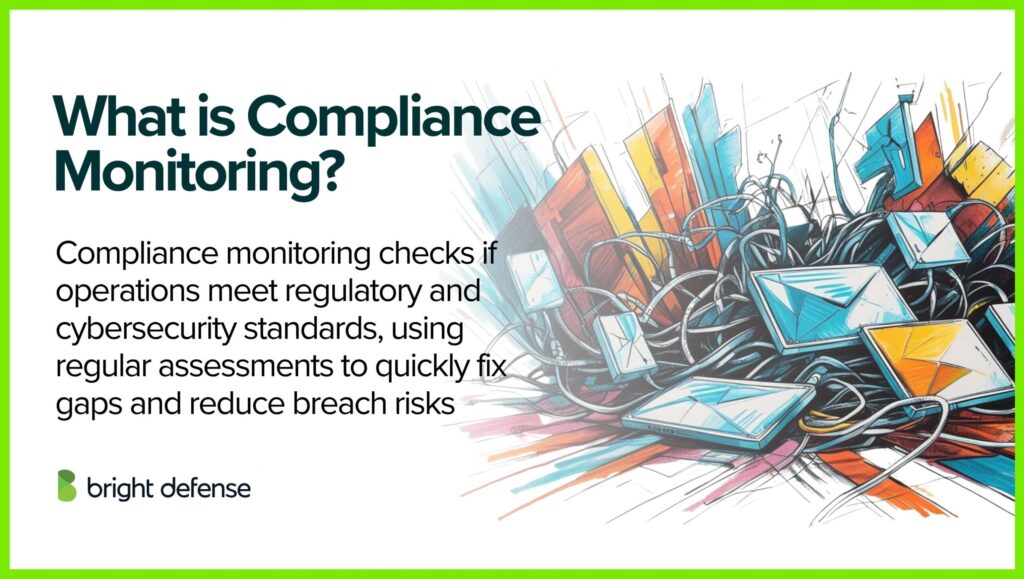
At its core, compliance monitoring involves regular checks that help detect and address compliance gaps in real time. It connects daily operations with compliance requirements so issues can be corrected quickly and the risk of violations stays lower.
This integration allows for immediate adjustments, reducing the risk of compliance breaches.
Why Compliance Monitoring Is Important
Compliance monitoring matters because compliance weakens gradually rather than breaking in a single moment.
Controls drift, systems change, employees leave or switch roles, and processes that passed an audit months earlier stop matching their audited state. Monitoring catches those gaps early so teams can correct them before they become audit findings, contract delays, or regulatory penalties.
Five factors make compliance monitoring critical right now:
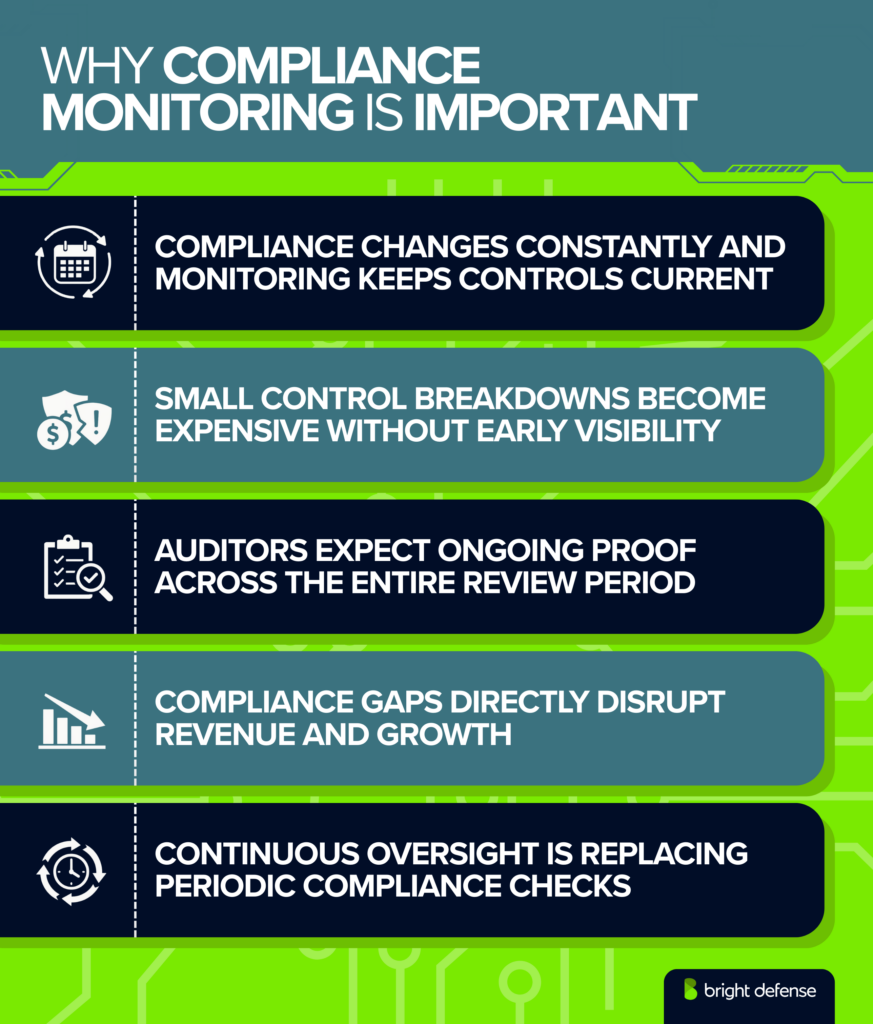
1. Compliance Requirements Change Continuously
Most companies still treat compliance as a point-in-time exercise, such as a SOC 2 audit, an annual risk review, or a certification. That approach no longer reflects the pace of regulatory change.
In PwC’s Global Compliance Survey 2025, 85% of respondents said compliance requirements had become more complex over the past three years. A once-a-year check cannot keep pace with requirements that shift this quickly.
Monitoring turns compliance into a living process. Teams can see whether controls operate today under current conditions, and the annual audit confirms what the monitoring data has shown all year.
2. Small Gaps Create Large Costs
Most compliance failures begin with small control gaps. An access review may stop taking place, a vendor may go without reassessment, or system logging may fail after an update. These issues can grow more serious when they remain undetected.
Ponemon Institute research estimates that non-compliance costs organizations an average of $14.82 million. Maintaining compliance costs an average of $5.47 million, making non-compliance about 2.7 times more expensive. IBM’s Cost of a Data Breach Report, on the other hand, has found that the average breach cost in the United States reached $10.22 million.
Higher regulatory fines contributed to that record figure.
Continuous monitoring helps teams detect control gaps early, when remediation is usually less costly and disruptive.
3. Auditors Expect Ongoing Evidence
Audit expectations have changed. SOC 2 Type 2 audits require evidence that controls operated effectively across a defined review period, and that window typically spans 3 to 12 months. A-LIGN’s 2026 Compliance Benchmark Report found that 97% of organizations now conduct at least 2 audits per year, and 74% of large enterprises conduct 4 or more. Manual, last-minute evidence collection breaks down under that level of scrutiny.
Continuous monitoring keeps evidence current. Tracked controls produce documentation as they operate, so proof exists the moment auditors request it, and teams close audit cycles without a scramble.
4. Monitoring Protects Revenue
Compliance failures can slow business growth and increase regulatory exposure. PwC’s Global Compliance Survey found that 77% of respondents had experienced negative effects in at least 5 growth-related areas as compliance requirements became more complex.
Future business plans will place more pressure on compliance teams. New products, corporate transactions, market expansion, and new business models will all require greater compliance support.
Continuous monitoring gives teams a clear view of their compliance status. This visibility can speed up customer reviews, audits, and due diligence while reducing delays in the sales process.
5. Continuous Oversight Is Becoming the Norm
Industry data shows that organizations are moving toward continuous compliance monitoring. RegScale’s 2026 State of Continuous Controls Monitoring report found that 95% of organizations use some form of GRC automation. However, only 28% monitor security controls continuously, while most still rely on periodic assessments.
Manual compliance work continues to cause delays and strain internal resources. Continuous monitoring reduces this reactive workload by helping teams detect control issues earlier and maintain a clear view of their compliance status throughout the year.
The Shift From Periodic to Continuous Compliance
Continuous compliance monitoring replaces scheduled reviews with ongoing checks of controls, and policy requirements.
Three factors are driving this shift:
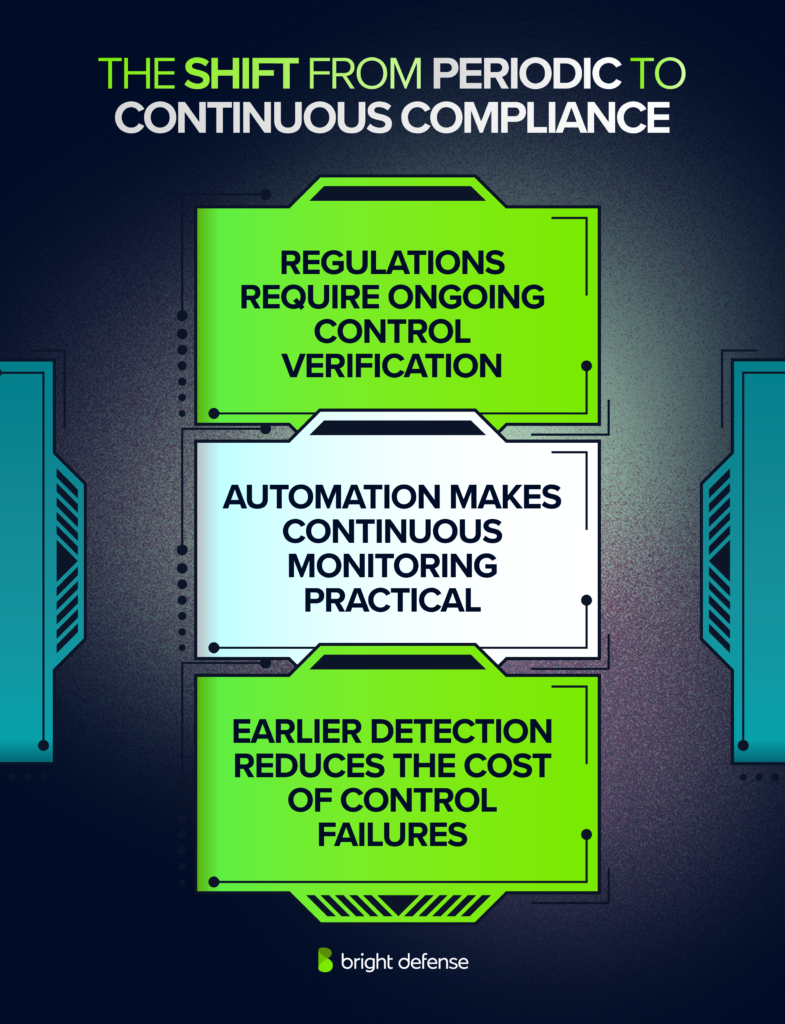
Regulations Require Ongoing Control Verification
Regulatory programs increasingly require organizations to verify controls between audits. FedRAMP requires monthly vulnerability scans covering 100% of inventory components.
Under its 2026 rules, providers must supply an Ongoing Certification Report every three months. These requirements give agencies current evidence that controls remain effective throughout the authorization period.
Automation Makes Continuous Monitoring Practical
Modern compliance platforms can collect evidence, test controls, and flag configuration drift automatically. Gartner predicts that AI will support 75% of DevOps continuous compliance automation processes by 2028. These systems will reduce the manual work involved in auditing, reporting, validation, and remediation.
Earlier Detection Reduces the Cost of Control Failures
Control failures become more expensive when they remain undetected. Continuous monitoring reduces the time between a control failure and its discovery. Teams can correct gaps months before an audit or incident investigation would surface them.
Continuous compliance makes monitoring part of daily operations. Controls remain verified between audits, evidence accumulates throughout the year, and teams can respond faster when requirements change.
Key Components of an Effective Compliance Monitoring Program
An effective compliance monitoring program defines what must be monitored, assigns responsibility, collects evidence consistently, and corrects issues quickly.
The following eight components support an effective compliance monitoring program:
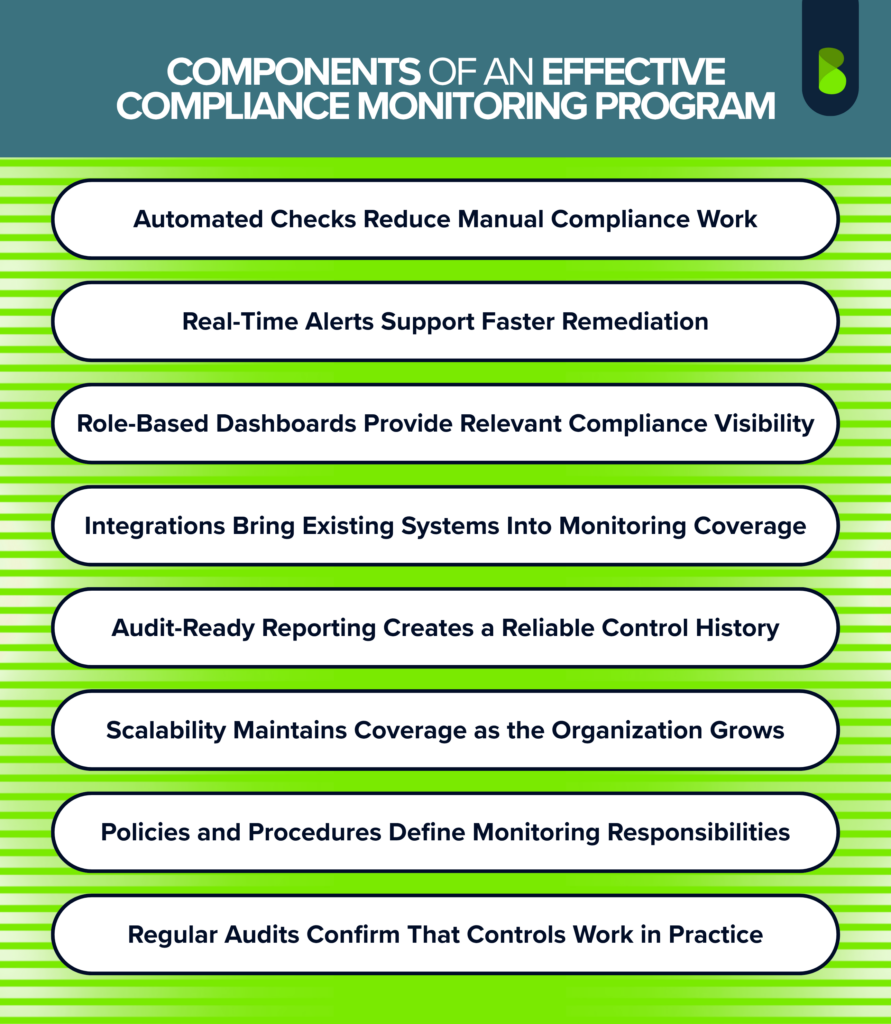
1. Automated Checks Reduce Manual Compliance Work
Automated checks review controls, configurations, and evidence for changes or failures. RegScale’s 2026 State of Continuous Controls Monitoring report found that evidence collection consumes the equivalent of one full-time employee at 53% of organizations.
Compliance automation can support vulnerability management, patch management, event monitoring, asset management, and configuration management. Alerts then direct failed checks to the appropriate control owner.
2. Real-Time Alerts Support Faster Remediation
Real-time alerts notify teams when a control fails, evidence expires, or a configuration changes. Early notification helps teams close small gaps within days, long before an audit would surface them.
Alerts should include the affected control, the detected issue, the responsible owner, and the required response date. Clear routing prevents findings from remaining unresolved.
3. Role-Based Dashboards Provide Relevant Compliance Visibility
Dashboards give teams a current view of compliance status. Security teams can track control health and open findings, while compliance teams monitor evidence coverage and remediation deadlines. Executives can review broader posture trends.
Each dashboard should reflect the needs of its audience. Showing every user the same metrics can make important information harder to find.
4. Integrations Bring Existing Systems Into Monitoring Coverage
Compliance monitoring platforms should connect with cloud services, identity providers, ticketing systems, HR platforms, and code repositories. These integrations allow the platform to collect evidence directly from the systems where controls operate.
Integrated monitoring can detect changes soon after they occur. Systems left outside these connections may create gaps in evidence and control coverage.
5. Audit-Ready Reporting Creates a Reliable Control History
Audit-ready reports document control performance throughout the review period. They can show evidence collection, failed checks, exceptions, remediation activity, and changes in compliance status.
This record gives auditors a clearer view of how controls operated over time. Leadership can use the same reporting to review trends, allocate resources, and address recurring weaknesses.
6. Scalability Maintains Coverage as the Organization Grows
A compliance monitoring program must support additional systems, users, data, and control evidence without reducing reliability. New business units and technical environments should enter the program without disrupting existing monitoring.
Scalable systems help organizations maintain consistent oversight as compliance requirements and operational complexity increase.
7. Policies and Procedures Define Monitoring Responsibilities
Written policies and procedures explain how monitoring operates, who owns each control, and how teams respond to failures. They create a consistent process for evidence collection, escalation, remediation, and review.
Policies should be reviewed on a scheduled basis. Changes in systems, personnel, and regulations can make older procedures inaccurate.
8. Regular Audits Confirm That Controls Work in Practice
Audits test whether policies and controls operate as intended. They can reveal weak control performance, inconsistent processes, and unresolved findings that automated checks may not fully explain.
Effective audit programs combine scheduled reviews with targeted follow-up. Prior findings, operational changes, and new risk indicators may require additional testing.
Challenges in Implementing Compliance Monitoring
Implementing compliance monitoring requires organizations to keep controls, policies, evidence, and responsibilities current as systems and regulatory requirements change.
The following challenges can make that process difficult:
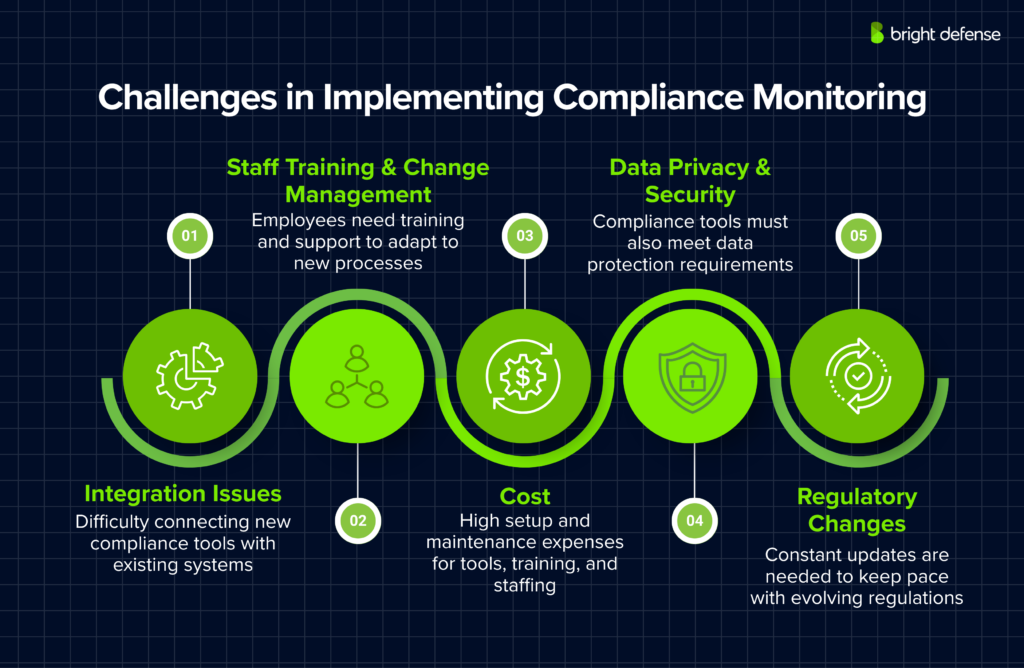
1. Existing Systems Can Be Difficult to Integrate
Compliance monitoring tools must connect with identity platforms, cloud services, asset inventories, ticketing systems, and security tools. Differences in data formats, access permissions, and workflows can make these integrations difficult.
Organizations may need to map data sources, redesign workflows, and update existing infrastructure before monitoring can operate consistently. Poor integration leaves evidence scattered across systems and creates gaps in control coverage. NIST recommends integrating continuous monitoring into the system development life cycle, while CISA’s Continuous Diagnostics and Mitigation program uses connected tools and dashboards to provide organization-wide visibility.
2. Employees Need Training and Clear Responsibilities
A compliance monitoring platform cannot operate effectively without trained employees and clearly assigned control owners. Staff need to understand how to use the system, respond to alerts, collect evidence, and escalate unresolved findings.
The Department of Justice treats tailored training and communication as parts of a well-designed compliance program. HHS OIG guidance similarly includes employee education among the core elements of compliance oversight.
Organizations moving from manual or audit-focused processes may face resistance to new workflows. Defined responsibilities, practical training, and clear escalation procedures can reduce confusion during the transition.
3. Implementation Can Require Significant Upfront Spending
The cost of compliance monitoring may include software licensing, integrations, employee training, consultants, and additional internal staff. Automation can reduce manual work, but the technology still requires configuration, maintenance, and oversight.
RegScale’s 2026 State of Continuous Controls Monitoring report found that 83% of organizations experience moderate or major delays from manual compliance processes.
Organizations should compare implementation costs with lower manual workloads, faster remediation, and stronger audit readiness.
4. Monitoring Systems Can Create Privacy and Security Risks
Compliance monitoring platforms may process sensitive employee, customer, operational, or health information. Weak access controls or excessive data collection can expose the organization to new privacy and security risks.
The GDPR requires data minimization, secure processing, and data protection by design and by default. The HIPAA Security Rule requires covered entities and business associates to protect electronic health information through administrative, physical, and technical safeguards.
Organizations should limit collected data, restrict access by role, encrypt sensitive information, and review how monitoring vendors store and process evidence.
5. Regulatory Changes Require Continuous Program Updates
Compliance monitoring programs must change when laws, frameworks, systems, and business operations change. New requirements may require updates to controls, policies, evidence procedures, dashboards, and reporting workflows.
The Department of Justice expects organizations to keep risk assessments current and use operational data to update compliance controls. NIST similarly recommends reviewing monitoring strategies regularly for accuracy and continued relevance.
Keeping the program current requires coordination between compliance, legal, security, and IT teams. Outdated controls can create inaccurate reporting and leave new regulatory obligations outside monitoring coverage.
Overcoming Compliance Monitoring Challenges
Organizations can overcome compliance monitoring challenges through careful planning, clear ownership, employee training, and regular program reviews. A structured approach makes monitoring easier to operate and maintain as systems and regulatory requirements change.
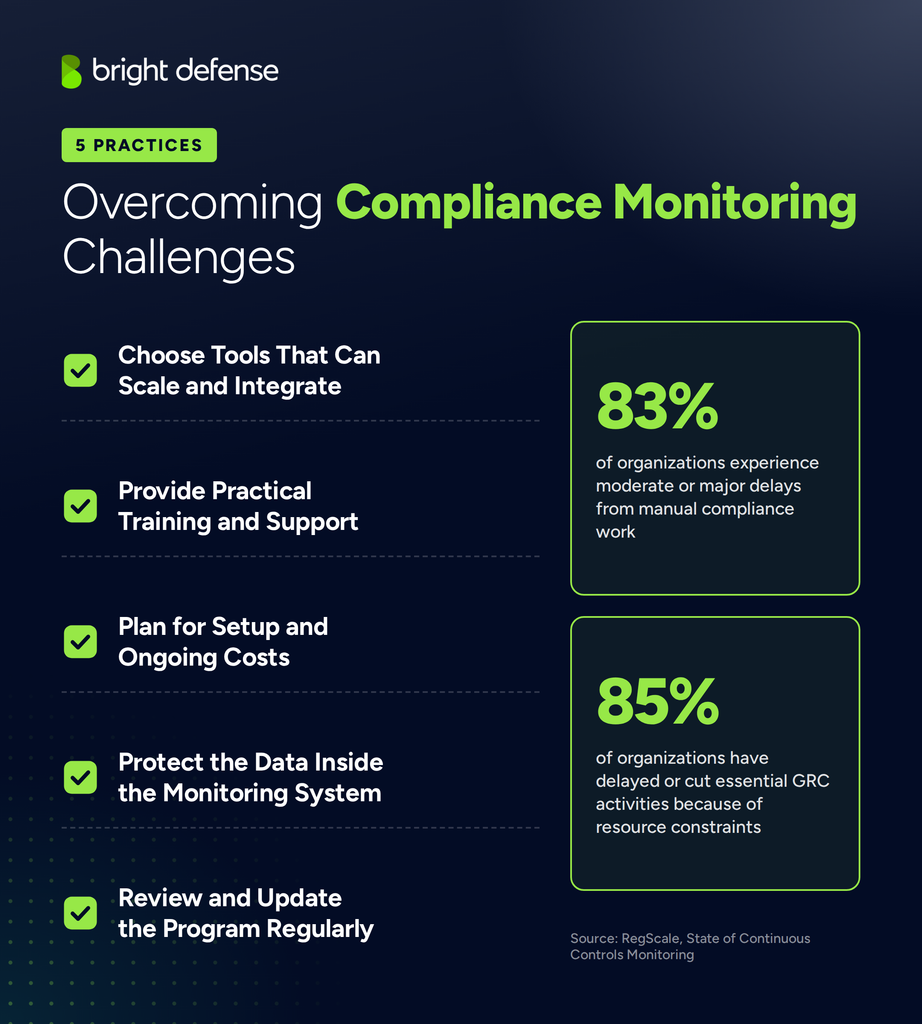
- Choose Tools That Can Scale and Integrate: Select monitoring tools that can support new systems, users, controls, and reporting requirements as the organization grows. The platform should connect with existing technology and provide visibility across the compliance environment. The need for further automation remains clear. RegScale’s 2026 State of Continuous Controls Monitoring report found that 83% of organizations experience moderate or major delays from manual compliance work.
- Provide Practical Training and Support: Train employees to use the monitoring system, respond to alerts, submit evidence, and escalate unresolved issues. Clear instructions and ongoing support can reduce errors and help teams adapt to new responsibilities.
- Plan for Setup and Ongoing Costs: Budget for software, integrations, employee time, training, maintenance, and external support. RegScale found that resource constraints had forced 85% of organizations to delay or eliminate essential GRC activities. Adequate financial planning helps organizations maintain monitoring coverage and respond to findings without cutting other compliance activities.
- Protect the Data Inside the Monitoring System: Apply role-based access controls, encryption, written procedures, and regular security reviews to the monitoring platform. Sensitive evidence and operational data should receive the same protection as the systems being monitored.
- Review and Update the Program Regularly: Compliance monitoring programs should change as regulations, risks, systems, and business operations evolve. Regular reviews help organizations update controls, reporting processes, and monitoring priorities before gaps develop.
What Are Three Techniques for Monitoring Compliance?
The three primary techniques for monitoring compliance are internal audits, automated monitoring, and control self-assessments. Each technique provides a different level of oversight and helps organizations detect control failures before they remain unresolved.
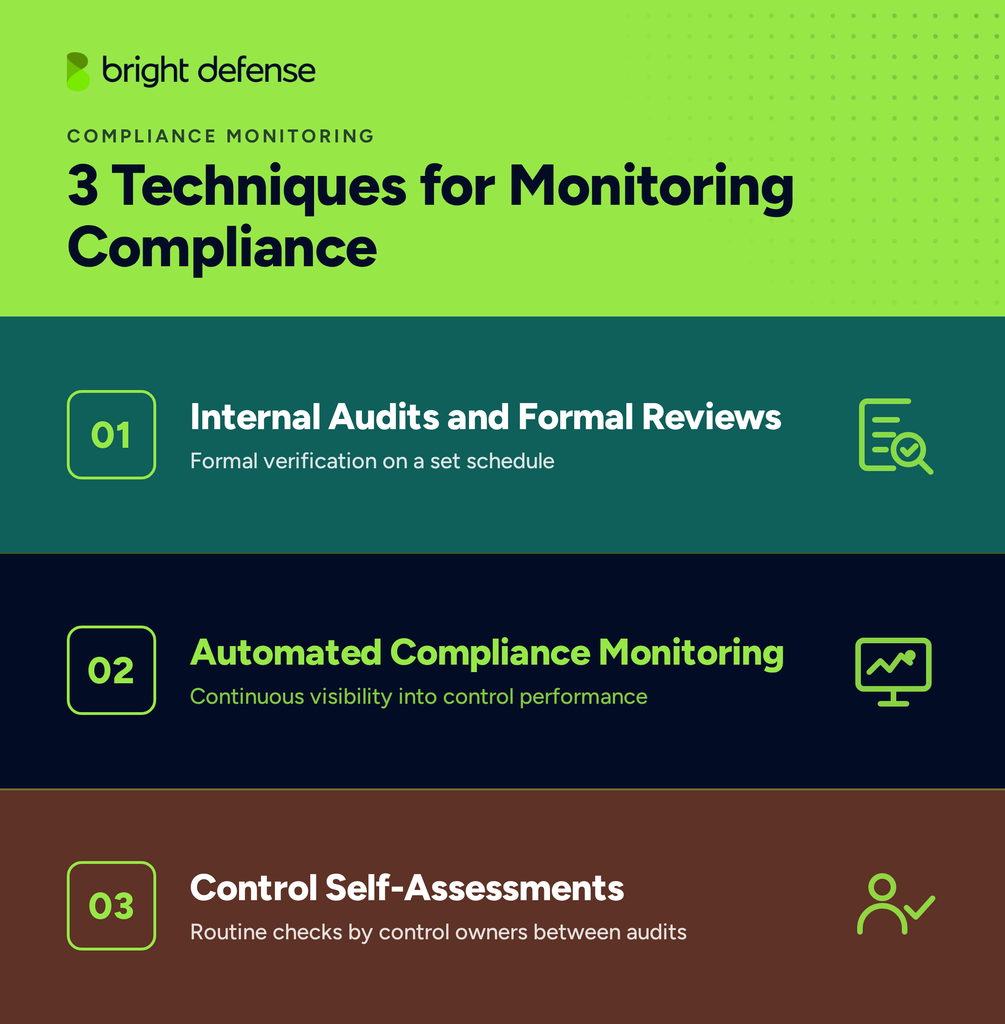
1. Internal Audits and Formal Reviews
Internal audits examine whether processes, policies, and controls meet regulatory and organizational requirements. These reviews are usually performed on a scheduled basis or when a specific risk requires closer examination.
HHS OIG and DOJ guidance recognize auditing and testing as central parts of an effective compliance program. Audit findings give organizations documented evidence of weaknesses that require corrective action.
2. Automated Compliance Monitoring
Automated monitoring tools continuously review security configurations, evidence, policy requirements, and control performance. They can flag failed checks, expired evidence, and unauthorized changes soon after they occur.
NIST recommends using automation where practical to maintain current awareness of vulnerabilities, threats, and control effectiveness.
3. Control Self-Assessments
Control self-assessments are routine reviews completed by control owners and compliance teams. These assessments confirm whether controls are operating as intended and whether the required evidence remains complete.
Self-assessments help teams find smaller issues between formal audits. They can then document the problem, assign corrective action, and track remediation.
Together, audits provide formal verification, automation provides continuous visibility, and self-assessments provide regular operational checks.
What Is Government Programs Compliance Monitoring
Government programs compliance monitoring is the ongoing process of checking whether a public program follows applicable laws, regulations, grant terms, funding conditions, and internal policies. It supports accurate reporting, responsible use of public resources, and consistent program administration.
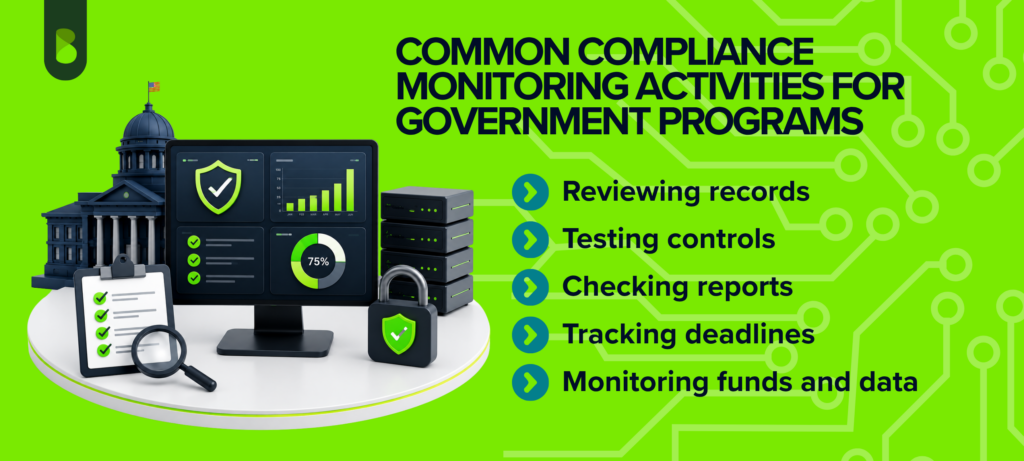
Government programs compliance monitoring commonly includes the following activities:
- Reviewing program records for completeness, accuracy, and regulatory compliance
- Evaluating whether internal controls operate as intended
- Checking reports against required formats and reporting standards
- Tracking filing deadlines, program milestones, and funding requirements
- Reviewing how funds, services, and sensitive data are managed
The process helps detect fraud, waste, abuse, reporting errors, eligibility problems, and improper use of funds. Identified issues can then be documented, corrected, and monitored through follow-up reviews.
Monitoring methods may include audits, site visits, document reviews, staff interviews, performance testing, and corrective action tracking. These methods are commonly used in programs involving Medicaid, education grants, housing assistance, and workforce funding.
What Does Compliance Monitoring Mean in AP Gov?
Compliance monitoring in AP Gov is the process of checking whether bureaucratic agencies and government programs follow laws, regulations, reporting requirements, and funding conditions. It is one method used to hold the federal bureaucracy accountable after policies are enacted.
Congress, executive officials, inspectors general, and other oversight bodies may use audits, reports, hearings, site visits, and performance reviews to examine agency activities. These checks can reveal improper spending, reporting errors, weak enforcement, or failure to implement a law as intended.
Compliance monitoring supports government accountability by giving elected officials information about agency performance. Extensive monitoring requirements can place additional reporting and administrative demands on federal, state, and local agencies.
Tools That Support Effective Compliance Monitoring
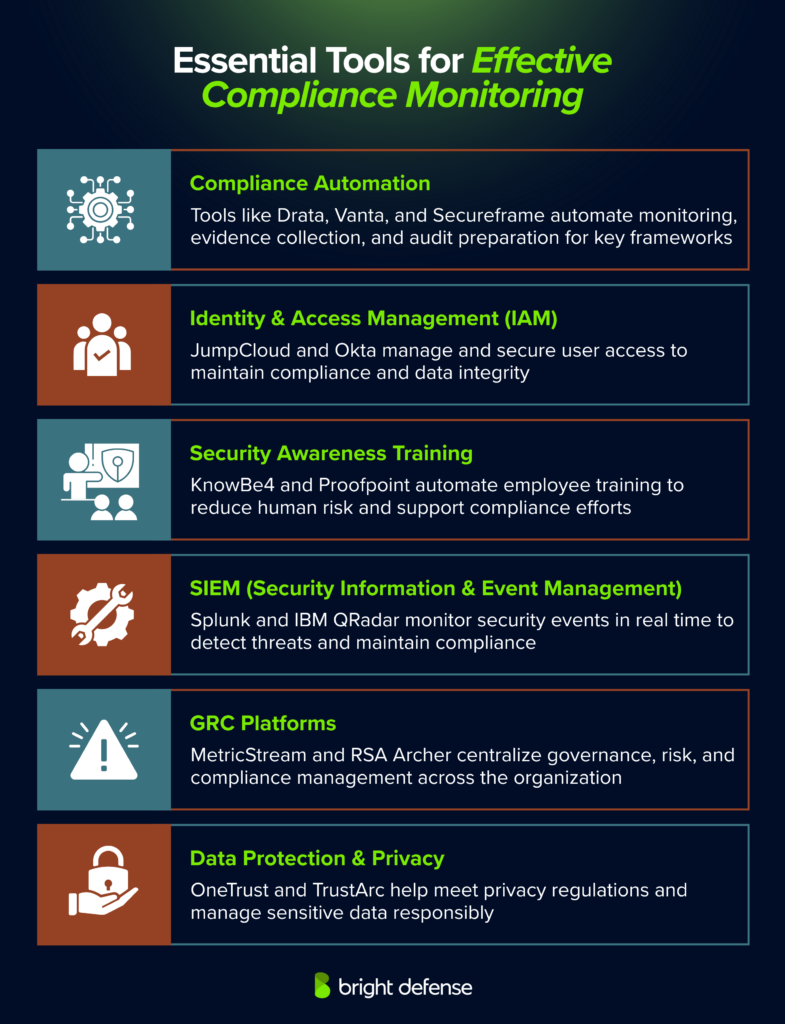
Compliance monitoring often requires several types of software rather than one platform. Compliance automation tools track controls and collect evidence, while IAM, SIEM, training, GRC, and privacy platforms support specific parts of the compliance program.
1. Compliance Automation Tools
Compliance automation platforms monitor controls, collect evidence, track findings, and prepare organizations for audits.
- Drata: Drata automates control monitoring, evidence collection, and remediation tracking across frameworks such as SOC 2, ISO 27001, and HIPAA. The company reports more than 300 integrations and provides an open API for custom connections.
- Vanta: Vanta provides automated testing, evidence collection, and control monitoring across more than 35 security and privacy frameworks. Its platform supports more than 400 prebuilt integrations.
- Secureframe: Secureframe supports continuous control monitoring, automated evidence collection, and compliance testing for frameworks such as SOC 2, ISO 27001, HIPAA, and PCI DSS. The platform currently reports more than 300 integrations, with connected systems syncing daily.
2. Identity and Access Management Tools
IAM platforms help organizations control who can access systems and data. They support requirements related to authentication, access reviews, account provisioning, and segregation of duties.
- JumpCloud: JumpCloud combines identity, device, and access management in one platform. Its capabilities include SSO, MFA, device management, and conditional access policies based on user, network, and device conditions.
- Okta: Okta provides SSO, adaptive MFA, lifecycle management, and identity governance. These capabilities help organizations manage user access, review entitlements, and remove access when roles or employment status change.
3. Security Awareness Training Platforms
Security awareness platforms help organizations deliver recurring training, test employee behavior, document completion, and report on human-related security risk.
- KnowBe4: KnowBe4 combines automated security training, phishing simulations, risk assessments, and user reporting. Its training library supports more than 35 languages.
- Proofpoint Security Awareness Training: Proofpoint provides phishing simulations, knowledge tests, cultural assessments, and risk-based training. Organizations can use these tools to locate higher-risk users and measure changes in employee behavior.
4. Security Information and Event Management Tools
SIEM platforms collect and analyze security logs from systems across the organization. They support continuous security monitoring, incident detection, log-retention requirements, and audit reporting.
- Splunk: Splunk collects and analyzes machine data to provide visibility into security events and control status. Its compliance features support scheduled searches, audit reports, and monitoring of logs and configurations.
- IBM QRadar: IBM QRadar centralizes security data for real-time threat detection, investigation, and compliance reporting. IBM reports more than 700 supported integrations and partner extensions.
5. Governance, Risk, and Compliance Platforms
GRC platforms connect policies, risks, controls, audits, regulatory requirements, and third-party oversight within one system.
- MetricStream: MetricStream connects risk, compliance, audit, cyber risk, third-party risk, and resilience data through a centralized model. Shared control and regulatory libraries help teams coordinate changes across multiple compliance functions.
- Archer: Archer provides an integrated platform for managing regulatory obligations, policies, controls, risks, and compliance reporting. Its current products include automated control monitoring and regulatory change management capabilities.
6. Data Protection and Privacy Management Tools
Privacy management platforms support data mapping, privacy assessments, data rights requests, consent records, and compliance with privacy laws.
- OneTrust: OneTrust centralizes privacy compliance workflows for regulations such as the GDPR and CCPA. Its platform supports data mapping, risk assessments, regulatory reporting, and privacy rights management.
- TrustArc: TrustArc provides privacy compliance, data mapping, risk assessment, and reporting tools. The company states that its privacy and data governance platform can automate up to 80% of privacy compliance and data-risk management work.
The right combination depends on the organization’s frameworks, technical environment, data types, and monitoring responsibilities. Compliance automation may serve as the central platform, while IAM, SIEM, training, GRC, and privacy tools provide evidence and oversight for specific control areas.
Final Thoughts
Compliance monitoring turns an annual scramble into a steady operational habit. Evidence stays current because tracked controls document themselves as they run. Gaps surface within days of appearing, when the fix is a configuration change and not an audit finding. The audit itself changes character: it confirms what the monitoring data has shown all year.
The tooling supports that outcome without defining it. Compliance automation platforms, IAM systems, SIEM tools, and training platforms each cover a specific control area, and the program holds together through clear ownership, documented procedures, and regular review. Organizations that treat monitoring as a daily process enter every audit, customer security review, and due diligence request with proof already in hand.
Bright Defense Delivers Continuous Compliance Monitoring!
If you are ready to implement continuous compliance, Bright Defense can help. Our monthly engagement model combines our vCISO expertise with compliance automation to help you meet frameworks like SOC 2, ISO 27001, HIPAA, PCI, CMMC, and more. We help you build the policies and procedures to meet your compliance requirements and work with you through the audit process and beyond.
FAQs
Compliance monitoring is the ongoing process of checking whether an organization follows applicable laws, regulations, standards, contracts, and internal policies.
It uses control testing, evidence reviews, reporting, and automated checks to detect compliance gaps.
NIST describes continuous monitoring as maintaining current awareness of risks and control effectiveness to support risk-based decisions.
Compliance monitoring helps organizations detect control failures, policy violations, and missing evidence before they develop into larger problems.
Early detection supports faster remediation, reduces regulatory exposure, and provides a clearer record for audits. It gives management a current view of compliance between annual assessments.
Effective compliance monitoring is continuous, risk-based, documented, adaptable, and supported by clear ownership.
Monitoring frequency should reflect the level of risk associated with each system or process.
The program should respond to regulatory changes, operational changes, control failures, and new technologies while maintaining reliable evidence of completed checks.
A compliance monitoring report records the results of control reviews and other monitoring activities.
It normally includes the controls tested, evidence reviewed, compliance status, identified findings, responsible owners, remediation deadlines, and follow-up results.
The report gives management and auditors a documented view of how the compliance program performed during the reporting period.
Internal monitoring is the routine or continuous review of controls and daily operations. It helps teams detect and correct issues as they occur.
A compliance audit is a formal assessment conducted at a defined time to evaluate whether the organization meets specific requirements.
Monitoring provides ongoing visibility, while auditing provides structured assurance.
Organizations monitor compliance through a repeatable process:
– Determine the applicable requirements.
– Map requirements to policies and controls.
– Assign control owners.
– Set monitoring methods and frequencies.
– Collect and review evidence.
– Record findings and corrective actions.
– Track remediation to completion.
– Review the program as risks and requirements change.
The main objectives of compliance monitoring are to detect control failures, reduce regulatory risk, maintain accurate evidence, assign accountability, and support timely corrective action. Monitoring should give decision-makers a current view of compliance status and show whether controls continue to operate as intended.
Compliance monitoring systems are platforms used to manage controls, requirements, evidence, findings, and reporting.
Common capabilities include automated control checks, evidence collection, regulatory mapping, alerting, remediation tracking, dashboards, and audit reporting.
These systems help organizations coordinate monitoring activities across departments and technical environments.
Compliance monitoring activities may include reviewing user access, checking security configurations, tracking patch status, examining system logs, testing backups, reviewing vendor compliance, confirming employee training, and validating policy requirements.
The specific activities depend on the organization’s regulatory obligations, systems, data, and risk profile.
Compliance monitoring frequency should reflect the risk and rate of change associated with each control. High-risk controls may require continuous or daily monitoring. Other controls may be reviewed weekly, monthly, quarterly, or annually. The schedule should account for regulatory deadlines, system changes, previous findings, and the potential effect of a control failure.
A small business should begin with controls that reduce its most immediate security and compliance risks. Initial priorities commonly include administrator access, multifactor authentication, critical software patches, backup completion, restoration testing, security alerts, and employee account removal. These checks create a practical foundation before the monitoring program expands.
In AP U.S. Government and Politics, compliance monitoring is a method used by Congress and the president to oversee the federal bureaucracy and hold agencies accountable. Oversight activities examine whether agencies implement laws, use delegated authority appropriately, and follow government requirements. Compliance monitoring can influence bureaucratic decisions and limit agency discretion.
The U.S. Department of Health and Human Services Office for Civil Rights administers and enforces the HIPAA Security Rule. OCR investigates complaints, conducts compliance reviews, and may require corrective action or impose civil monetary penalties when regulated entities fail to meet HIPAA requirements.
14. Do I need compliance monitoring if I am not legally regulated?
Yes, monitoring still helps because customer security reviews and common assurance approaches focus on whether controls actually operate over time, not only whether they exist on paper
15. What should I do when monitoring shows a control failure?
Record what failed and when, contain immediate risk if needed, fix the root cause, retest the control, and keep the evidence trail so you can explain the incident and the corrective action later
16. What is a simple way to start a compliance monitoring program?
Define the control set and owners, decide what evidence proves each control works, set a review cadence, automate collection where possible, and track exceptions through a ticketed process until closure
17. What are the 3 C’s of compliance?
There is no single official set of the “3 C’s of compliance.” Major U.S. guidance centers on DOJ’s three fundamental questions and OIG’s seven elements, while industry sources use different informal versions of the phrase, which is why it is better treated as shorthand than as a formal standard.
18. What are the 7 pillars of compliance?
The 7 pillars of compliance usually mean the seven elements of an effective compliance program: written policies and standards, a compliance officer or oversight, training and education, open communication, internal monitoring and auditing, disciplinary standards, and corrective action after problems are found.
Add Bright Defense as a Preferred Source on Google