How Much Does Compliance Cost?

Updated:
November 10, 2026
Compliance cost is the money and employee time a business spends meeting applicable laws, regulations, and standards. The full budget covers preparation, audits, security tools, and ongoing control maintenance.
Employee time belongs in that budget. Evidence collection, policy reviews, and assessment questions consume capacity alongside regular work. Separating setup expenses from recurring commitments makes the total easier to plan.
This guide explains the main cost drivers and shows how to build a practical budget.
How Much Do Businesses Spend on Compliance: Key Stats
- $12,800 per employee: The annual federal regulatory cost across U.S. businesses. This includes economic, environmental, tax, and other requirements, so a cybersecurity budget covers only part of that workload.
- $14,700 per employee: The annual burden for firms with fewer than 50 employees, about 20% above the $12,200 figure for firms with at least 100 employees. Smaller teams need to budget for recurring obligations spread across fewer people.
The federal regulatory cost breakdown provides historical context. Build your current budget from the controls, assessments, and staff time your organization needs.
Check out our compliance statistics for broader context as you plan.
What Is Compliance Cost?
Compliance cost combines external spending with internal work. The following categories capture the main expenses:
• Direct spending: Audit fees, specialist advice, software, and required security improvements.
• Internal labor: Time spent maintaining policies, operating controls, gathering evidence, and closing gaps.
A SOC 2 program, for example, includes the independent auditor’s fee and employees’ work on access reviews and policies. Some expenses occur during preparation; others continue after the examination.
Track fines and breach response separately as costs of noncompliance or incidents. Keeping them outside the operating compliance budget makes spending easier to compare.
What Factors Influence Compliance Costs?
Two companies working toward the same compliance standard can spend different amounts. The following six factors explain what increases the workload and what to consider when building your budget.
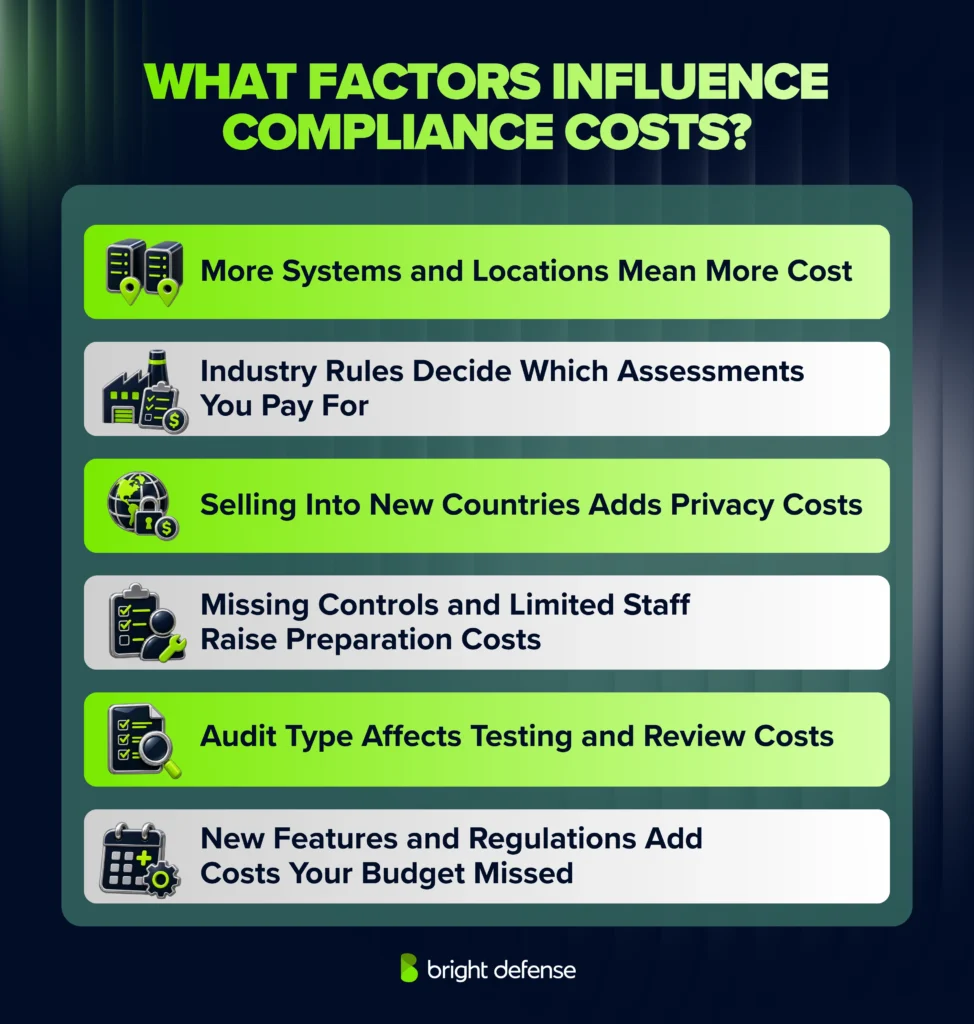
1. More Systems and Locations Mean More Cost
Including more systems and locations in an audit raises costs because assessors spend more time testing controls and staff spend more time gathering evidence. A company bringing three products and two cloud environments into scope has more settings to check and more records to collect than one covering a single application.
Scope is the set of systems, data, locations, and teams an audit covers. The auditor reviews the controls that apply within those boundaries.
2.Industry Rules Decide Which Assessments You Pay For
Industry rules affect compliance costs through the assessments they require. Some allow self-assessment, while others require a paid outside audit. Payment service providers show how a single threshold can change the bill. For example, Visa’s validation rules group payment service providers into levels based on their annual Visa transaction volume. Each level has different assessment requirements.
A provider handling fewer than 300,000 Visa transactions a year sits at Level 2. It can prove compliance with a self-assessment questionnaire, a form its own team fills out. The main cost is staff time.
A provider handling 300,000 or more Visa transactions a year sits at Level 1 and has to hire a Qualified Security Assessor (QSA), an outside auditor approved by the PCI Security Standards Council. The QSA tests the provider’s systems and reviews its records every year. The provider pays the QSA’s fee on top of the staff time needed to prepare evidence and support the assessment.
Smaller providers can face that fee too. A Level 2 provider that wants a spot in Visa’s Global Registry of Service Providers, a list banks and merchants use to find service providers, needs a QSA assessment anyway.
A provider close to the Level 1 threshold should budget for the QSA before reaching it, because the audit becomes a yearly expense from then on. Merchants that accept card payments follow separate thresholds, covered in our guide: PCI Compliance for Small Business.
3. Selling Into New Countries Adds Privacy Costs
Selling into new countries can raise compliance costs because each market may bring additional privacy requirements. GDPR is the clearest example.
Under GDPR’s applicability rules, even if a company is based outside the EU, it can still fall within scope when it processes personal data while offering goods or services to people in the EU or monitoring their behavior there.
For example, a U.S. software company that actively targets customers in France and processes their personal data can fall within those rules.
In this particular case, the company may face the following legal and operating costs when entering the French market:
- Lawyer fees for reviewing and updating the privacy notice.
- Legal fees for reviewing France-to-U.S. data transfers.
- Staff and software costs for managing data requests.
- Ongoing costs for staff training and request handling.
- Recurring EU representative fees, when required.
- Legal review costs when practices or requirements change.
A company outside the EU can have GDPR obligations even without an EU office. Offering services to people in the EU and processing their personal data can bring the company within scope.
GDPR requires a company in this position to name a representative inside the EU, unless its processing is occasional and low risk.
Most companies hire an outside firm for that role and pay a yearly fee. Plan the legal review as a one-time cost before the first sale, and carry the request handling and the representative as costs that repeat every year.
4. Missing Controls and Limited Staff Raise Preparation Costs
Missing controls cost time and money to put in place before an audit. If your team is small, you may need to hire outside help or take employees away from their usual work.
Backups show how this work adds up. A company that regularly tests its backups already has recovery records to show the auditor. A company that has never tested them needs to run a recovery test and fix anything that fails. If backups are missing, it must set them up first. Each step takes engineering time.
Consultants and compliance software can help organize these tasks, but your employees still need to approve policies, change system settings, and provide evidence. Budget for their time alongside any consulting fees or software subscriptions.
A control is a safeguard or process that protects your systems and data, such as backing up files or removing access when an employee leaves.
5. Audit Type Affects Testing and Review Costs
Audits that require more testing and evidence review generally carry higher fees. The difference becomes clearer when comparing SOC 2 Type 1 and Type 2 examinations.
A Type 1 examination checks control design on a single date. Type 2 adds testing of how those controls operated over several months, giving the auditor more records to examine and results to document.
SOC 2 Type 1 vs. Type 2 Audit Costs
| Cost Factor | SOC 2 Type 1 | SOC 2 Type 2 |
| Ballpark Audit Fee | $10,000 to $15,000. | $20,000 to $30,000. |
| Why the Fee Differs | Reviewing controls on a single date involves less testing and documentation. | Testing controls across several months requires more evidence sampling and review. |
| What the Auditor Checks | Whether controls are designed appropriately on a specific date. | Whether controls are designed appropriately and operated effectively throughout the review period. |
These approximate planning ranges cover auditor fees and vary with company size, scope, and the audit firm. Preparation, software, fixes, and employee time add to the total compliance budget.
For a closer look at Type 1 and Type 2 pricing, preparation expenses, and ongoing costs, read our SOC 2 audit cost guide.
6. New Features and Regulations Add Costs Your Budget Missed
New features and changing regulations can create compliance expenses that your original budget did not cover. A product update may bring additional testing, documentation, or oversight requirements.
The EU’s AI Act shows how a feature’s purpose changes the workload. Spam filters fall into the minimal-risk category. AI tools that screen and rank job applicants generally fall into the high-risk category, which carries additional obligations.
A company adding an applicant-screening feature needs to budget for activity logs, technical documentation, risk assessments, and human oversight measures. Engineers must build and test the required functions, while staff need time to maintain records and oversee the tool’s use. These duties add development and operating costs.
High-risk AI rules apply from December 2, 2027, for uses such as recruitment, and from August 2, 2028, for qualifying AI systems built into regulated products such as lifts or toys.
Review compliance needs during product planning, while the launch budget is still open. Include the initial implementation work and any ongoing costs for testing, recordkeeping, and oversight before the feature ships.
What Are the Main Types of Compliance Costs?
The following categories show where resources go and when spending occurs. Track opportunity costs separately from the cash and labor budget to avoid double counting.
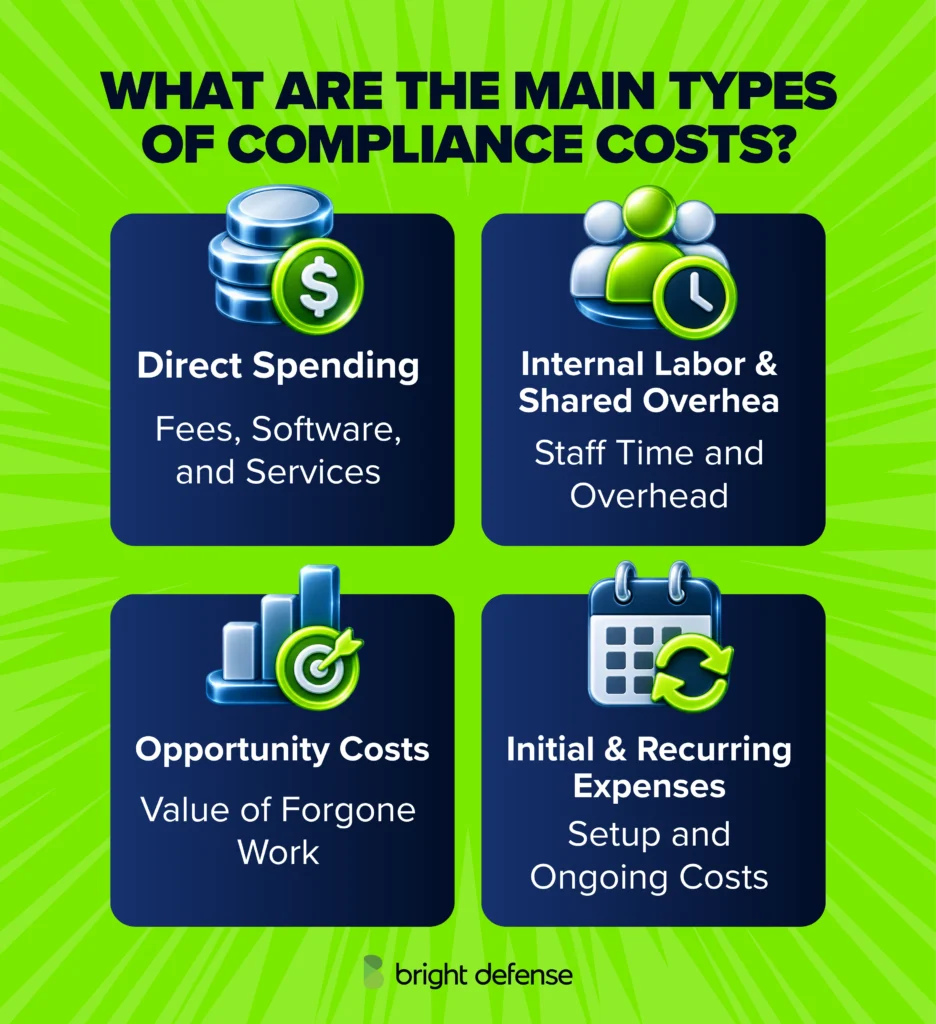
1. Direct Spending
Audit fees, readiness assessments, specialist advice, and dedicated software are direct expenses. Compare deliverables before accepting a quote: implementation, remediation support, and follow-up testing may carry separate charges.
2. Internal Labor and Shared Overhead
In an illustrative example, an HR lead spends four hours administering training. A loaded rate of $50 per hour makes the task cost $200. Include wages, employer payroll costs, and benefits consistently when calculating the rate.
Allocate shared security tools using a consistent method. Charging a platform’s full price to each framework overstates total spending.
3. Opportunity Costs
Opportunity cost is the value of the next-best use of resources committed to compliance. A product team postponing a customer integration to fix control gaps gives up the potential value of that work.
Payroll belongs under internal labor. Adding full payroll costs to the full value of forgone output can overstate the impact because those wages would have helped produce that output. Count only defensible effects; a delayed feature does not automatically mean a lost sale.
4. Initial and Recurring Expenses
Timing cuts across the categories above. The following comparison separates setup work from ongoing commitments.
| Cost Category | Initial Expense | Recurring Expense |
| Direct spending | Readiness assessment and software setup | Subscription renewals and repeat assessments |
| Internal labor | Policy development and control configuration | Access reviews and evidence maintenance |
| Opportunity cost | Product work displaced during remediation | Planned work displaced by assessment demands |
What Should You Include in a Compliance Budget?
A compliance budget should cover outside services, employee time, and the work needed to meet applicable requirements. Separate initial setup costs from recurring expenses, and calculate amounts using vendor quotes and estimated staff hours.
The following categories provide a starting point. Include the expenses relevant to your business, industry, and compliance obligations.
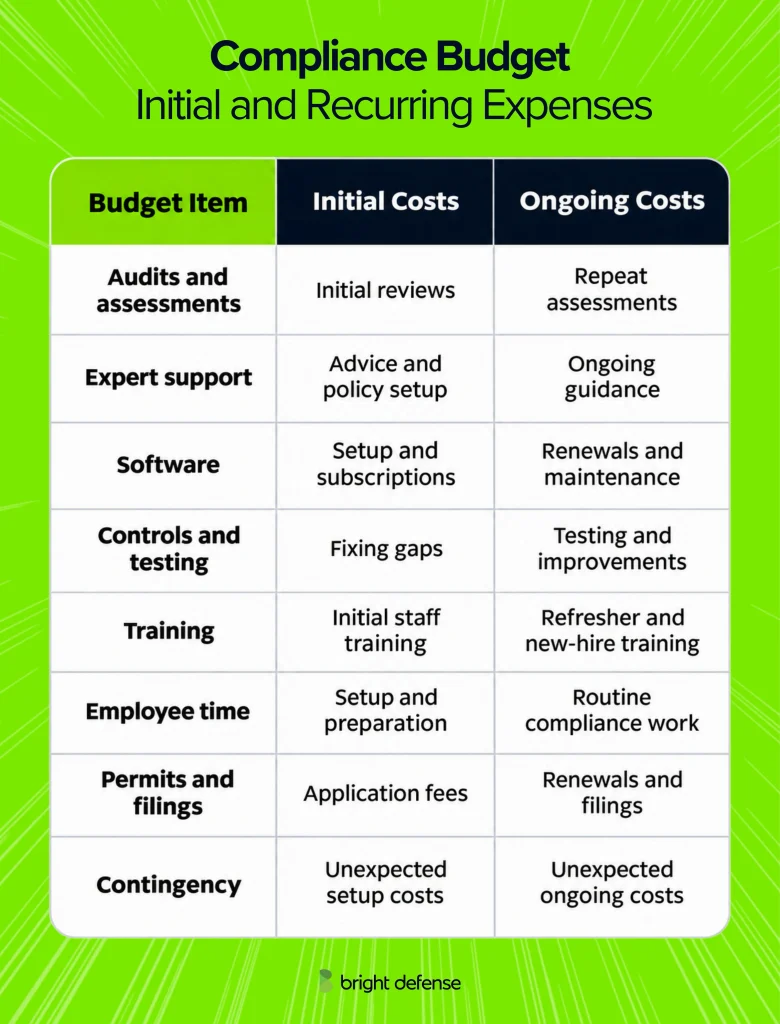
Estimate employee costs by multiplying expected hours by a fully loaded hourly rate, including pay and employer costs such as benefits. Track this separately from vendor payments to show both staff capacity and external spending.
Check service packages before adding separate allowances for software, training, or testing. Allocate shared expenses consistently so the same cost is counted only once.
First-year spending may be higher when substantial setup is needed, but later costs can increase as the business grows or requirements change. Review the budget regularly and base contingency allowances on identified uncertainties.
How Do Compliance Cost Drivers Differ by Industry?
Useful comparisons account for company size and regulated activities. The following table identifies the main expenses and the measures that make peer comparisons meaningful.
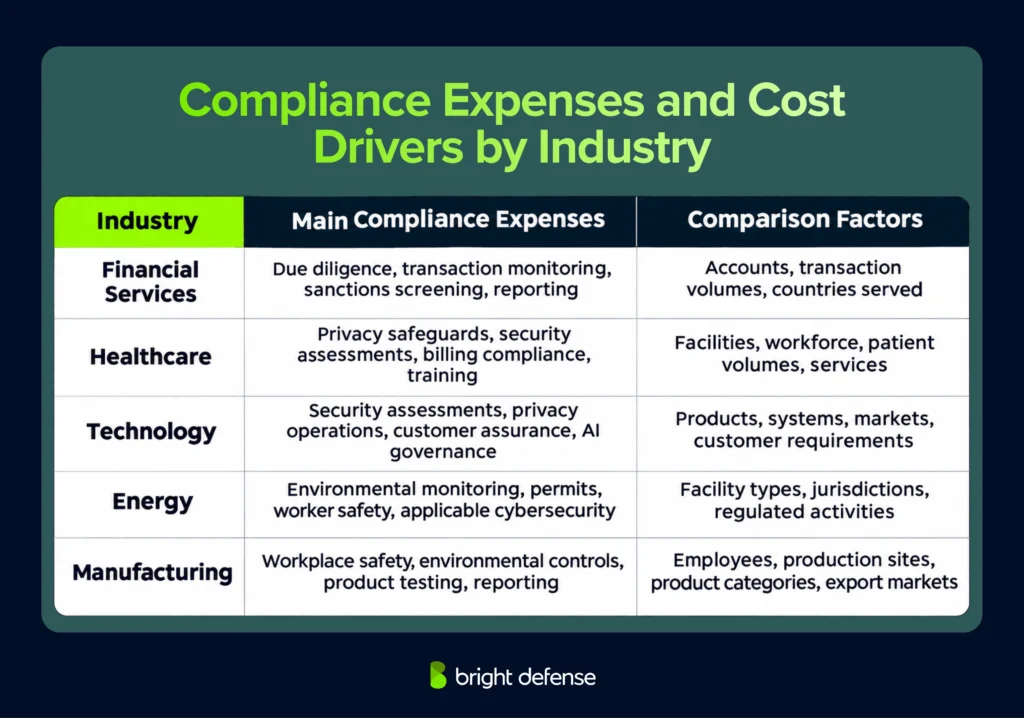
Manufacturers’ annual federal regulatory costs reached $29,100 per employee in the 2022 cost model, expressed in 2023 dollars. That measure covers a broader regulatory burden than cybersecurity compliance. Check the year, geography, company size, and included expenses before applying a benchmark.
How Can You Manage and Reduce Compliance Costs?
Managing compliance costs starts with knowing what work your business needs and what it takes to complete it.
The following six practices reduce repeated tasks, prevent unnecessary purchases, and make spending easier to plan:
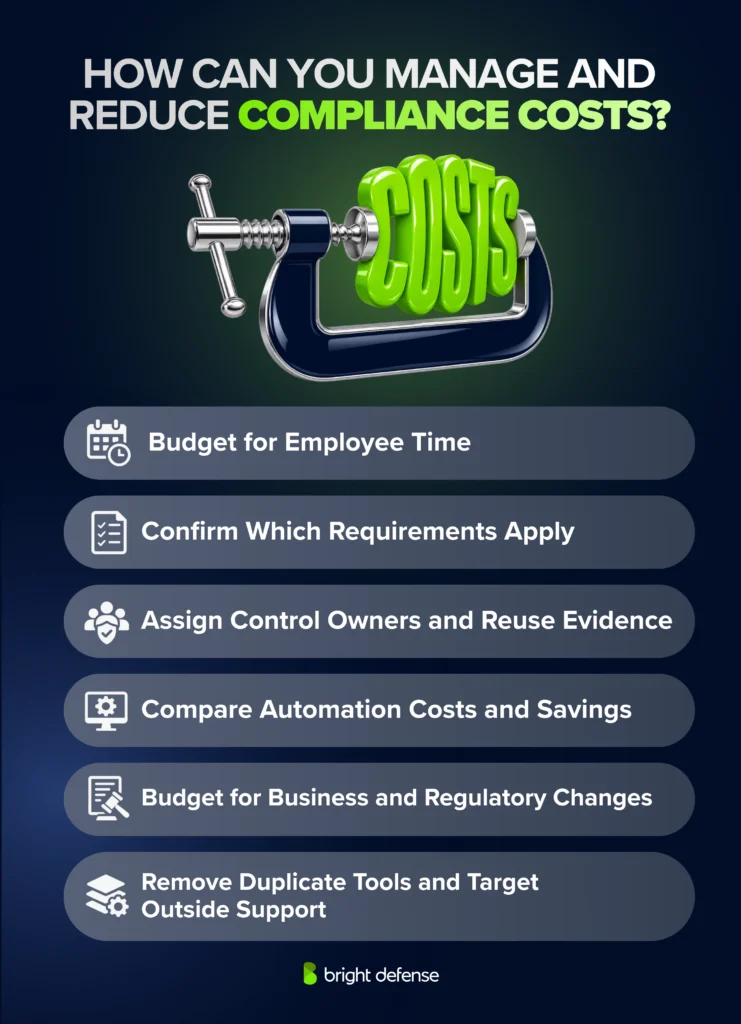
1. Include Employee Time in Your Compliance Budget
Including employee time gives you a more complete budget and makes unexpected workloads easier to spot. Employees spend time reviewing policies, collecting records, and answering auditors’ questions alongside their usual duties.
Assign each recurring task to an owner and reserve time for it on a shared calendar. Compare actual hours with the budget each quarter. A review that repeatedly takes longer than planned may need clearer instructions, better records, or additional support.
For an illustrative calculation, a review taking four hours at a loaded employee rate of $60 per hour adds $240 to the compliance budget. The loaded rate includes pay and employer costs such as benefits.
2. Check Requirements Before Paying for New Roles or Services
Confirming which requirements apply prevents spending on roles, assessments, or services your business does not need. Start with the law or customer request behind the proposed expense.
Under GDPR’s data protection officer requirements, appointing a data protection officer, or DPO, is mandatory in three principal situations:
- A public authority or body processes personal data, except courts acting in their judicial role.
- The organization’s main activities require regular, systematic monitoring of people on a large scale.
- The organization’s main activities involve large-scale processing of sensitive data, such as health information, or data about criminal convictions and offenses.
National law can add requirements. Check those conditions before budgeting for a DPO appointment.
For an assessment such as SOC 2, agree on the service and systems covered, along with the relevant Trust Services Categories, before implementation begins. This keeps preparation aligned with the report customers need.
3. Assign Shared Controls One Owner and Reuse Suitable Evidence
Clear ownership and shared records reduce the time teams spend repeating compliance work. A control register is a shared list of safeguards and processes, showing who manages each one and where its supporting records are stored.
An HR team can save one training completion report for the compliance team to reference across suitable requirements. Separate exports for every framework add work when the same report already provides the required information.
Before reusing a record, check that it covers the right systems, employees, and assessment dates. Keep approved versions in one location with access limited to the people who need them.
4. Compare Automation Savings With the Full Cost of Running It
Automation reduces costs when the value of the work it removes exceeds setup and running expenses. Measure how often employees perform the task and how long it takes before buying a platform.
The illustration below assumes automation removes 10 hours of manual evidence collection each month. Running costs include the employee time needed to review collected records and investigate collection failures.
Illustrative Annual Cost and Benefit of Compliance Automation
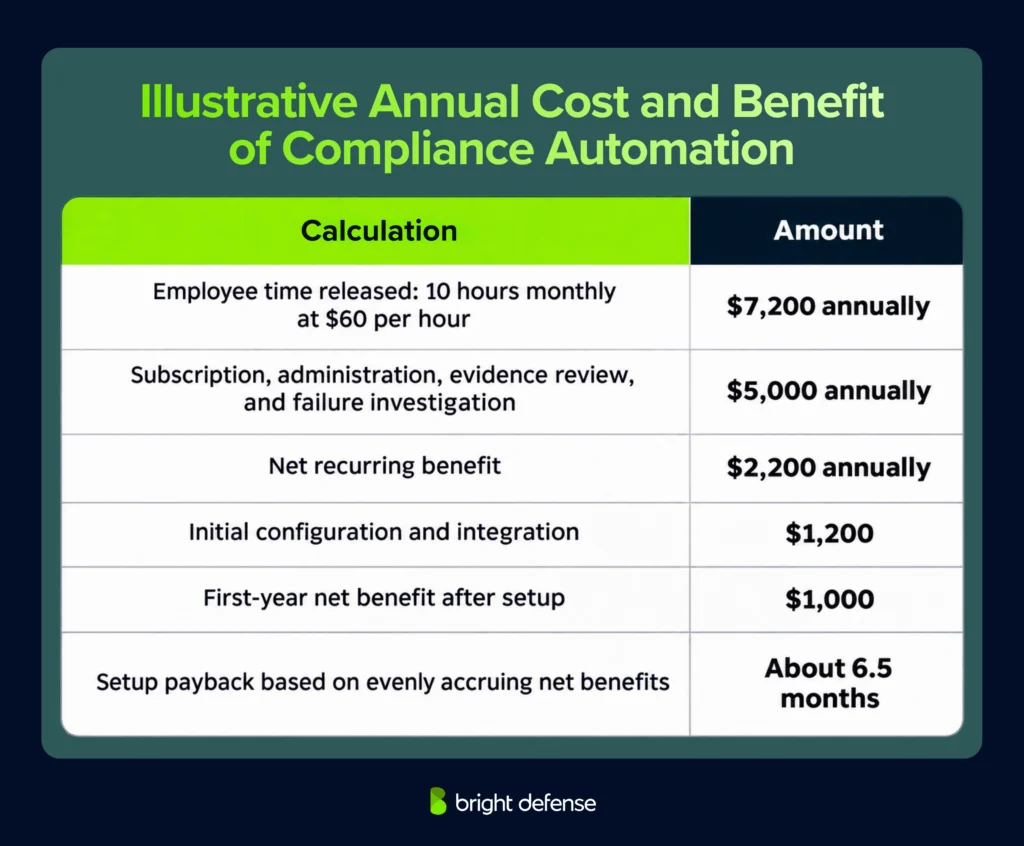
Released time gives employees capacity for other work. It produces cash savings when spending falls, such as reduced overtime or contractor hours.
Once the platform works reliably, retire duplicate spreadsheets and manual exports. Continuing both workflows preserves costs the purchase was intended to remove.
5. Set Aside Time and Money for Business and Regulatory Changes
A budget reserve gives your team resources for compliance work introduced between assessments. New markets, product features, and regulations can require changes to policies, systems, and staff training.
A company adding a new billing platform may need to review the vendor, update data-handling procedures, and train employees before launch. Include that work in the project budget while decisions are still being made.
Give each applicable change an owner, a due date, and an allowance for the required work. Review the reserve quarterly against known changes and expected costs.
6. Remove Duplicate Tools and Buy Support for Specific Needs
Removing unused subscriptions and overlapping services cuts recurring spending. Start renewal reviews with usage records and check whether an existing system already performs the required task.
Your HR system may already assign training and track completion. Testing that capability before renewing a separate training tool shows whether the additional subscription remains necessary.
Match outside support to the work your team cannot complete internally. A specialist fixing one technical problem serves a different purpose from a provider managing the compliance program throughout the year.
Track the licenses removed, employee hours released, and external spending reduced. Use those results when planning the next budget.
How Can Bright Defense Keep Your Compliance Costs Low?
Bright Defense combines security leadership, compliance automation, and ongoing support through monthly compliance plans starting at $1,000. Our pricing gives small businesses a clear starting point for budgeting.
The following rates cover organizations with 10 employees or fewer and one audit framework:
| Plan | Monthly Price | Annual Service Cost* | Selected Inclusions |
| Sentry | $1,000 | $12,000 | Program implementation and 24 hours of vCISO services annually |
| Guardian | $2,000 | $24,000 | Ongoing evidence management, control monitoring, training, vulnerability scanning, and 10 security questionnaires annually |
| Defender | $3,000 | $36,000 | Guardian capabilities, an annual SOC 2 or ISO 27001 audit, an annual Ignite penetration test, and 30 security questionnaires annually |
Annual amounts equal 12 monthly payments. Your complete budget depends on scope, additional services, and internal implementation work.
Sentry provides a starting point for teams needing guidance and setup. Guardian assigns ongoing compliance work to our team, reducing the administrative load on employees. Defender bundles the audit and penetration test into the service budget, simplifying planning for those expenses.
Our managed automation connects evidence collection and control monitoring with expert review. Centralized records reduce repeated requests, while tracked remediation keeps unfinished work visible before audit preparation becomes urgent. Our vCISO guidance gives your team security leadership through a fractional engagement.
To assess potential savings, compare the appropriate plan with your current spending on consulting, tools, testing, and employee preparation time. Count services that the plan would replace and retain a budget for work your employees still perform.
Talk to Bright Defense about your framework, team size, and audit deadline. We’ll scope the support around your requirements and show which costs belong in your compliance budget.
Frequently Asked Questions
1. How Much Does Compliance Cost for a Small Business?
Compliance costs depend on the requirements, systems, and employees covered. A useful budget includes employee time, security tools, outside support, and any required assessments.
2. What Are the Main Costs of Compliance?
The main costs include staff time, policy development, training, security tools, testing, and audits. Fixing missing or ineffective safeguards adds to the initial expense.
3. What Is the Difference Between Audit Costs and Compliance Costs?
Audit costs cover the independent assessment of your controls and evidence. Total compliance costs also include preparing for that assessment and maintaining the processes it examines.
4. Why Can the First Year of Compliance Cost More?
The first year can involve creating policies, assigning responsibilities, and implementing missing safeguards. Later budgets focus more on maintenance, although business growth or new requirements can increase spending.
5. What Hidden Compliance Costs Should Businesses Budget For?
Commonly overlooked costs include employee hours, evidence collection, audit follow-up, and replacing unsuitable tools. Calculate internal labor by multiplying the hours spent by each employee’s fully loaded hourly cost.
6. Is Compliance a One-Time Expense?
Compliance requires ongoing work, including access reviews, employee training, monitoring, and policy updates. Depending on the program, recurring audits or assessments also need a budget.
7. Can Compliance Automation Reduce Costs?
Automation can reduce time spent collecting evidence, tracking tasks, and identifying overdue reviews. Compare those savings with subscription fees, setup work, and the staff time still required.
8. Is Outsourcing Compliance Cheaper Than Hiring Internally?
Outsourcing can cost less when a business needs specialist help without a full-time role. Compare the service’s scope and fees with hiring costs, while accounting for the internal work your team must still perform.
9. Does Meeting Multiple Compliance Frameworks Double the Cost?
Multiple frameworks can share controls, such as access management, training, and incident response. Reusing suitable evidence reduces duplicate work, but separate requirements and assessments still add costs.
10. How Can a Business Reduce Compliance Costs?
Define the scope early, assign clear owners, and reuse controls that satisfy overlapping requirements. Track employee hours and vendor spending to identify duplicate work and unnecessary subscriptions.