Updated:
April 16, 2026
200K Driver’s Licenses Hacked in youX Breach
What Happened in the Breach
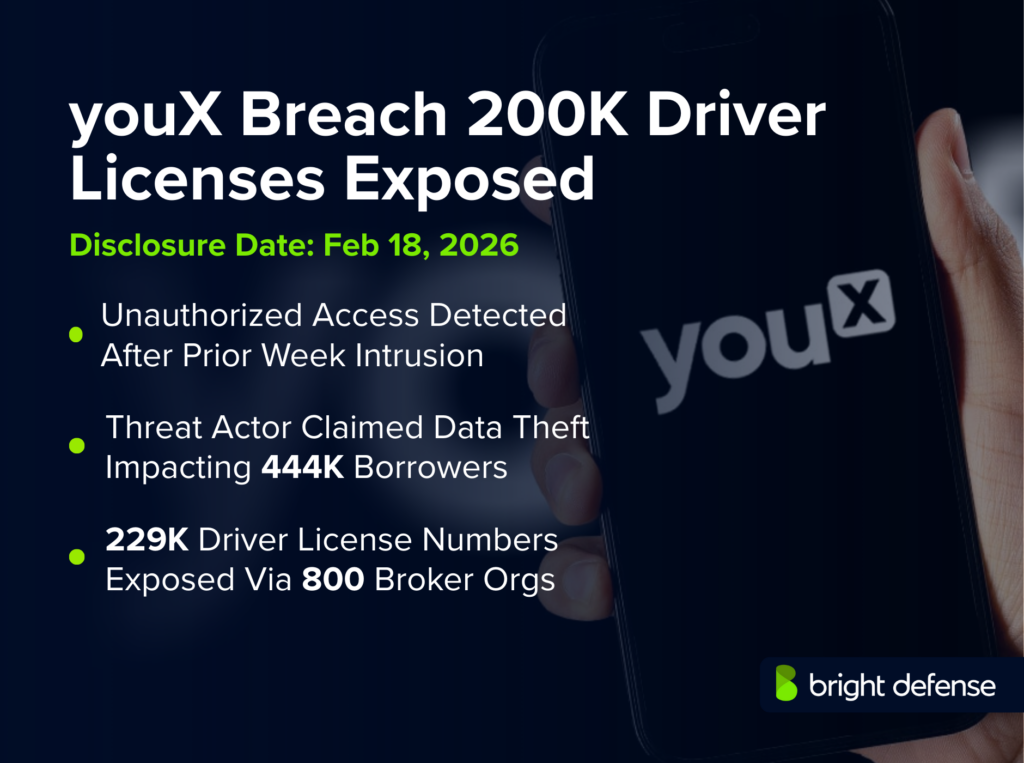
A massive data breach at Australian fintech platform youX exposed the personal information of hundreds of thousands of borrowers, including more than 200,000 driver’s‑licence numbers and 629,597 loan applications.
youX, a Sydney‑based asset‑finance technology company used by motor‑dealers and lenders, discovered in mid‑February 2026 that a hacker had gained unauthorized access to a MongoDB Atlas cluster used to store customer data.
Search snippets from cyber‑security news sites said the hacker claimed to have exfiltrated 141 GB of data and published a sample on a hacking forum. The company later confirmed that a threat actor had accessed its systems and released data online.
Timeline: From First Access To Latest Update
- Early February 2026 — Initial intrusion. According to subsequent investigations, an intruder exploited misconfigured security controls on youX’s cloud database in early February. A white‑hat researcher reportedly warned youX about the vulnerability days before the breach, but the warning went unanswered.
- 14 February 2026 — Unauthorized access detected. youX first became aware of a potential cyber incident around mid‑February 2026 when monitoring systems flagged suspicious activity. The initial compromise is believed to have occurred between 14 and 15 February 2026.
- 17 February 2026 — Disclosure to investors. MotorCycle Holdings, which uses youX’s platform for financing motorcycles, filed an ASX announcement stating that a cyber‑criminal had unlawfully gained access to systems operated by youX. The notice warned that customer data may have been compromised and said youX had engaged forensic specialists.
- 18 February 2026 — Public confirmation. youX released a statement confirming that it had identified unauthorized access by a third party and that a threat actor had released sample data online.
- 19 February 2026 — Data dump posted. The attacker published a dataset on a hacking forum, claiming it contained 629,597 loan applications, 229,236 driver’s‑licence scans and 607,822 residential addresses. Cyber‑security outlets reported that the leaked files included names, addresses, phone numbers, emails, birth dates, bank statements and copies of Australian driver licences.
- 20 February 2026 — Media reports and guidance. News organisations reported that more than 200,000 driver licences were exposed. The Mortgage and Finance Association of Australia (MFAA) issued guidance to brokers on how to respond to the breach and advised affected applicants to monitor accounts and consider replacing compromised licences.
- Late February 2026 — Investigation and remediation. youX notified the Australian Cyber Security Centre (ACSC) and the Office of the Australian Information Commissioner (OAIC) and began working with digital‑forensics experts to determine the scope of the breach. Officials urged customers to watch for phishing scams. By late February the company said it had closed the exploited vulnerability and there was no evidence of further unauthorized access.
- **Latest update (as of 22 February 2026) — Ongoing investigation. The ACSC and OAIC are still investigating potential violations of the Privacy Act 1988. No arrests have been announced, and the hacker’s identity remains unknown.
What Data Or Systems Were Affected
The breach targeted youX’s MongoDB Atlas cloud database, which stored sensitive information for car, boat and equipment loan applications. According to cyber‑news outlets, the leaked dataset included loan application forms with personal and financial details, scans of driver licences and identity documents, and residential addresses.
The attacker claimed to have compromised 141 GB of data, including names, dates of birth, email addresses, phone numbers, residential addresses, employer details, income and expense information, bank statements and copies of government‑issued identification.
No payment card numbers or passwords were reported to be in the dataset. The breach also exposed metadata such as IP addresses and timestamps from application submissions.
Who Was Responsible (Confirmed Vs Alleged)
As of this writing, authorities have not named a perpetrator. A hacker using an alias on a dark‑web forum claimed responsibility and posted a sample dataset. youX’s statement referred to the attacker as a “third party” and said law‑enforcement agencies were investigating.
There is speculation that the breach resulted from negligence rather than a sophisticated intrusion; security researchers said misconfigured MongoDB Atlas settings left the database accessible from the internet. The hacker’s true identity remains unknown, and no arrest has been reported.
How The Attack Worked
Preliminary analysis suggests the attacker exploited poor security hygiene. youX’s MongoDB Atlas cluster allegedly lacked proper network restrictions, allowing unauthenticated connections. Cyber‑security experts said the database did not enforce IP whitelisting and may have relied on default credentials. Once inside, the hacker exfiltrated 141 GB of data.
The data was compressed and downloaded in stages, and the attacker subsequently uploaded a sample to a hacking forum to prove authenticity. There was no evidence that ransomware was used or that systems were encrypted; the attack appears to have been purely data theft.
Impact and Risks for Customers
The breach is significant because it exposed extremely sensitive personal information. Driver’s‑licence numbers and scans are valuable to identity thieves who can open fraudulent accounts, obtain loans and conduct social‑engineering attacks.
The exposure of loan application details means that attackers have access to bank statements, employer information and income data, increasing the risk of identity theft, credit‑fraud and targeted phishing. The publication of residential addresses and contact details could also lead to harassment or physical safety risks.
Customers whose licences were compromised may need to replace them and update records with lenders and government agencies. The MFAA advised applicants to monitor credit reports and consider placing fraud alerts.
Company Response And Customer Remediation
youX said it discovered the breach in mid‑February and immediately disabled the compromised database, engaged a cyber‑security consultancy and notified relevant authorities. The company advised customers to remain vigilant for suspicious emails, SMS messages and calls.
Customers whose driver’s‑licence numbers were exposed were told they could apply for replacement licences through their state’s transport agency.
Some states offered replacements free of charge. youX offered affected applicants 12 months of credit‑monitoring and identity‑theft protection and said it would reimburse costs associated with replacing licences.
The company also reviewed its cloud configuration and implemented stricter access controls and encryption.
Government, Law Enforcement, And Regulator Actions
The Australian Cyber Security Centre (ACSC) issued an alert urging affected citizens to change passwords, enable multi‑factor authentication and watch for scam messages.
The Office of the Australian Information Commissioner (OAIC) opened an investigation into whether youX complied with the Notifiable Data Breaches (NDB) scheme and data‑security provisions of the Privacy Act 1988.
State transport agencies, particularly in New South Wales and Victoria, announced that they would waive fees for replacing compromised driver’s‑licence numbers. The Mortgage and Finance Association of Australia issued guidance for brokers and lenders. Law‑enforcement agencies have not announced any arrests, but a multi‑agency task force is working to identify the hacker.
Financial, Legal, And Business Impact
The breach has serious financial and legal implications for youX and its clients. Customers may incur costs to replace driver licences and monitor credit. youX faces potential class‑action lawsuits from borrowers alleging negligence, similar to suits filed after previous Australian data breaches.
Regulatory penalties under the Privacy Act 1988, which allows fines up to AU$50 million, are possible if the OAIC finds the company failed to protect personal data. The incident may also affect relationships with lenders who rely on youX’s platform; some dealers temporarily suspended use of the system after the breach.
Insurance carriers are evaluating claims related to notification costs and credit‑monitoring services. The breach may harm youX’s reputation, leading to customer attrition and increased scrutiny from regulators and investors.
What Remains Unclear About the Incident
- The exact method of initial access has not been disclosed.
- Investigators have not confirmed whether the attacker used an unprotected port, stolen credentials, or a vulnerability in the youX application.
- The dwell time remains unknown, meaning the length of time the intruder stayed in the system before detection has not been shared.
- youX has not published a precise count of affected individuals.
- Media estimates vary from 440,000 to 629,597 records.
- Data sale or later misuse beyond the leak remains unclear.
- Authorities have not released results from digital forensics analyses.
- Authorities have not indicated whether international law enforcement agencies are assisting.
Why This Incident Matters
The youX breach underscores the growing threat of data theft attacks against fintech platforms that handle sensitive financial data. The scale of the breach, hundreds of thousands of loan applications and driver licences, highlights the consequences of misconfigured cloud databases. Australia has experienced several major breaches in recent years, including the Optus and Medibank hacks, prompting tougher penalties and calls for stronger cyber security obligations.
The youX incident shows that small and medium‑sized service providers can be high‑value targets because they aggregate data from multiple lenders.
It also illustrates the downstream risk for businesses that rely on third‑party platforms; MotorCycle Holdings and other dealers faced reputational and operational impacts even though their own systems were not breached.
For consumers, the breach serves as a reminder to limit the amount of personal information shared with service providers and to monitor for identity‑theft.
Bright Defense: Pen Testing and Continuous Compliance
Bright Defense helps reduce breach risk through penetration testing and continuous compliance monitoring that catch cloud misconfigurations early. Pen tests reveal issues such as open database ports and weak authentication, followed by rapid remediation. Continuous checks against ISO 27001 and CIS Benchmarks flag configuration drift, keeping controls in place over time.
Sources
- CyberNewsCentre — 19th February 2026 Cyber Update: youX Breach Exposes 444,000 Australians (19 Feb 2026) :https://www.cybernewscentre.com/19th-february-2026-cyber-update-youx-breach-exposes-444-000-australians/
- DataBreaches.net — Loan applications, drivers licences, personal data of 440k Aussies exposed after hacker hits Sydney finance tech company youX (20 Feb 2026). https://www.cybernewscentre.com/19th-february-2026-cyber-update-youx-breach-exposes-444-000-australians/
- YourLifeChoices — Huge data leak hits fintech platform as hacker dumps personal info (Feb 2026). https://www.yourlifechoices.com.au/technology/huge-data-leak-hits-fintech-platform-as-hacker-dumps-personal-info/
- CyberDaily — Aussie fintech platform youX confirms data breach as hacker shares massive dataset online (Feb 2026).https://www.cyberdaily.au/security/13226-aussie-fintech-platform-youx-confirms-data-breach-as-hacker-shares-massive-dataset-online
- DigWatch — Australian fintech youX suffers major cyberattack; over 600,000 loan applications may be exposed (Feb 2026). https://dig.watch/updates/australian-fintech-youx-suffers-major-cyberattack
- BrokerDaily — MFAA issues guidance in wake of youX data breach (Feb 2026). https://www.brokerdaily.au/broker/21281-mfaa-issues-guidance-in-wake-of-youx-data-breach
- InsuranceBusinessMag — youX confirms breach after data leak (Feb 2026). https://www.insurancebusinessmag.com/au/news/cyber/youx-confirms-breach-after-data-leak-565911.aspx
- 9News — Hacker releases data after claiming to have accessed ‘hundreds of thousands’ of Aussies’ loans, driver’s licences (Feb 2026). https://www.9news.com.au/national/youx-data-breach-threat-actor-releases-information/30c77623-6d64-4422-94d9-3f4c4569ac55
- ProCapitas — Australian data breach: In a youX cyberattack 200,000 driver licences hacked, what you need to do now (20 Feb 2026).: https://www.procapitas.com/news/world/australian-data-breach-in-a-youx-cyberattack-200000-driver-licences-hacked-what-you-need-to-do-now
Get In Touch