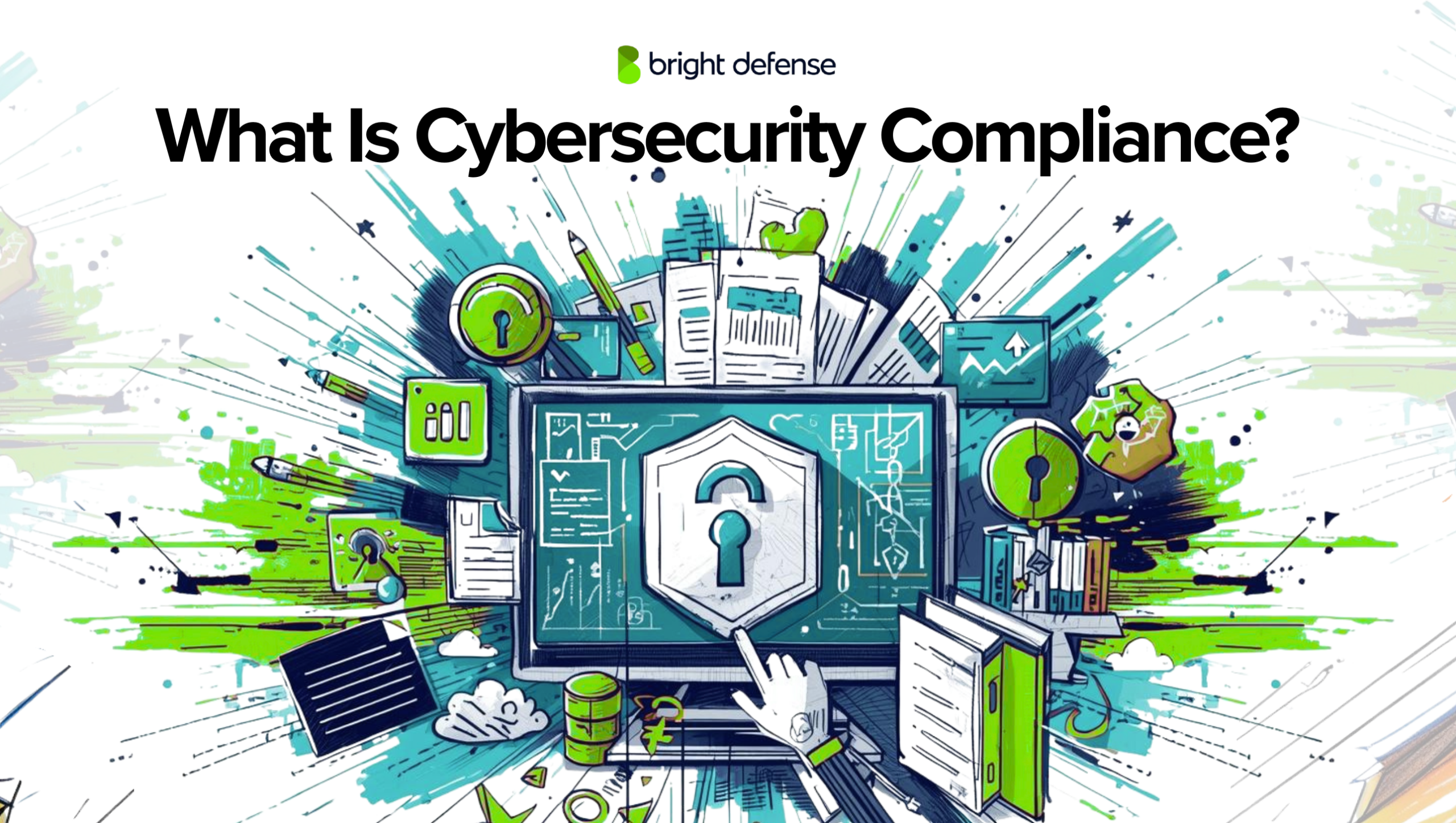
What Is Cybersecurity Compliance?
Updated:
September 21, 2026
Cybersecurity compliance is the practice of meeting legal, regulatory, industry, and contractual security requirements that apply to an organization’s systems, data, and operations. It requires following specific frameworks, implementing controls, documenting practices, and proving effectiveness through audits to protect sensitive information and avoid penalties.
For example, a healthcare company that stores patient records must follow HIPAA rules. HIPAA requires access controls, risk analysis, staff training, and other safeguards to protect sensitive data and demonstrate compliance during audits.
The global enterprise governance, risk, and compliance market will reach $82.93 billion in 2026, growing at a 13.7% CAGR through 2033, according to Grand View Research, which goes to show how important compliance has become for organizations that need stronger control management, audit readiness, and regulatory oversight.
Compliance is crucial these days because it protects sensitive information, reduces legal and financial risk, and meets the security expectations of customers and regulators. A structured compliance program supports security control management, practice documentation, and proof of responsible data handling. That reduces penalties, builds trust, and helps win contracts in regulated industries.
What Are the Main Cybersecurity Compliance Frameworks?
Cybersecurity frameworks and regulations provide structured rules, controls, and standards for protecting digital assets and sensitive data. They fall into three categories:
- Sector-specific regulations that target particular data types
- Global and regional data-protection laws that govern personal information across jurisdictions
- Foundational frameworks that provide reusable security management structures
Most organizations apply multiple frameworks at once depending on their sector, data scope, and customer geography.
Following are some of the most commonly used frameworks by businesses around the world:
1. HIPAA (Health Insurance Portability and Accountability Act)
HIPAA is a 1996 U.S. federal law that governs the protection of protected health information (PHI). It requires healthcare providers, health plans, healthcare clearinghouses, and their business associates to apply administrative, physical, and technical safeguards to PHI.
HIPAA enforces three pillar obligations:
- Safeguards for PHI covering administrative, physical, and technical controls
- Breach notification to affected individuals, the Department of Health and Human Services (HHS), and in some cases the media
- Patient rights over their own health information, including access, amendment, and accounting of disclosures
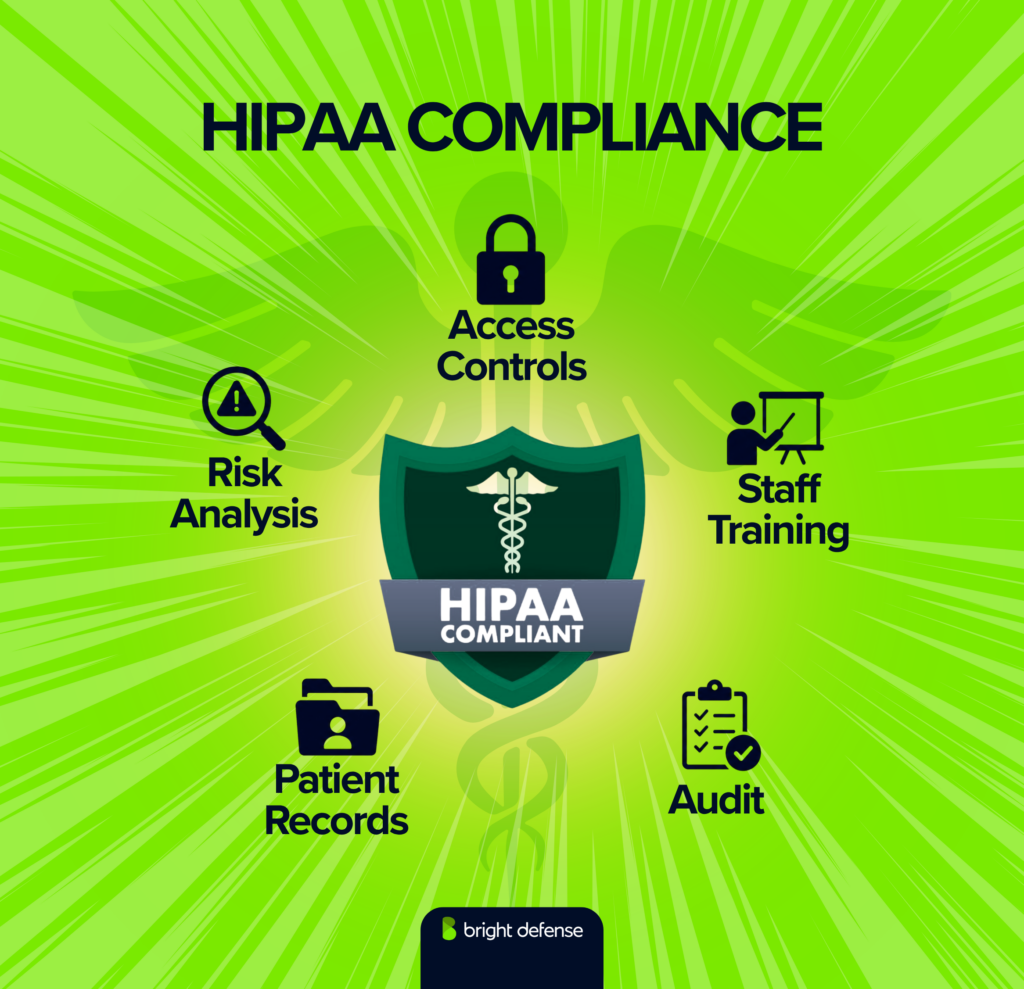
Required technical controls include data encryption, strict access controls, and periodic security risk assessments. Enforcement sits with the HHS Office for Civil Rights (OCR), which continues to issue actions against providers for unaddressed risk assessments and unencrypted PHI.
2. PCI-DSS (Payment Card Industry Data Security Standard)
PCI DSS is a security standard set by the major card brands (Visa, Mastercard, American Express, Discover, JCB) and administered through the Payment Card Industry Security Standards Council. Any entity that processes, stores, or transmits cardholder data must comply, regardless of transaction volume.
PCI DSS is built on six control objectives expressed as 12 core requirements:
- Build and maintain a secure network and systems
- Protect stored cardholder data
- Maintain a vulnerability management program
- Implement strong access control measures
- Regularly monitor and test networks
- Maintain an information security policy
Non-compliance does not trigger government fines, but the commercial consequences are severe. Non-compliant entities can lose the ability to process payments through major card brands, face contractual penalties from acquiring banks, and carry full financial liability for fraud losses traced to a breach.
3. GDPR (General Data Protection Regulation)
GDPR is a 2018 European Union regulation governing how personal data of EU residents is collected, processed, stored, and transferred. GDPR applies to any organization anywhere in the world that processes data on EU residents, giving the regulation extraterritorial reach.
GDPR sets seven core processing principles:
- Lawfulness, fairness, and transparency
- Purpose limitation
- Data minimization
- Accuracy
- Storage limitation
- Integrity and confidentiality
- Accountability
Data subject rights include access, rectification, erasure, data portability, objection to processing, and rights against automated decision-making. Organizations must implement data protection by design and by default and must report qualifying breaches to the supervisory authority within 72 hours.
Maximum fines reach €20 million or 4 percent of annual global turnover, whichever is higher.
4. NIST Cybersecurity Framework
The NIST Cybersecurity Framework (CSF) is a voluntary framework developed by the U.S. National Institute of Standards and Technology for managing and reducing cybersecurity risk. Version 2.0, released in February 2024, organizes cybersecurity work into six core functions:
- Govern: sets and monitors the organization’s cybersecurity risk management strategy, expectations, and policy
- Identify: catalogs assets, data, and the cybersecurity risks associated with them
- Protect: applies safeguards that keep critical services running
- Detect: runs continuous monitoring to spot anomalies and potential incidents
- Respond: defines actions taken once an incident is confirmed
- Recover: restores capabilities and services impaired by an incident
NIST CSF 2.0 added Govern as an explicit top-level function, reflecting the growing regulatory focus on board-level accountability for cyber risk. The framework is used voluntarily by private organizations and serves as the foundation for several U.S. federal requirements, including Federal Information Security Management Act (FISMA) controls.
5. ISO 27001
ISO/IEC 27001 is the international standard for information security management systems (ISMS), jointly published by the International Organization for Standardization (ISO) and the International Electrotechnical Commission (IEC). Certification demonstrates that an organization has a documented, audited, and continually improving approach to managing information security risk.
Core ISO 27001 requirements cover:
- Establishing, implementing, maintaining, and continually improving an ISMS
- Conducting formal risk assessment and risk treatment
- Applying controls from Annex A’s 93 controls, covering access control, cryptography, physical security, operations security, communications security, supplier relationships, and incident management
Organizations pursue certification through an accredited certification body, with a Stage 1 readiness review, a Stage 2 certification audit, annual surveillance audits, and full recertification every three years. ISO 27001 is often selected by organizations with international customers because a single certification is recognized across jurisdictions.
6. SOC 2 (System and Organization Controls 2)
SOC 2 is a trust-based compliance framework developed by the American Institute of Certified Public Accountants (AICPA). The framework verifies that service organizations securely manage customer data across. SOC 2 is the de facto standard for SaaS companies, cloud providers, and technology vendors selling to enterprise buyers in North America.
SOC 2 is built on five Trust Services Criteria:
- Security: protection of systems and data against unauthorized access (required in every SOC 2 report)
- Availability: systems are accessible for operation and use as committed
- Processing Integrity: system processing is complete, valid, accurate, timely, and authorized
- Confidentiality: information designated as confidential is protected
- Privacy: personal information is collected, used, retained, disclosed, and disposed of in line with commitments
Security is the only mandatory criterion. The other four are selected based on the services provided and the commitments made to customers.
A SOC 2 audit must be performed by a licensed CPA firm, and the resulting report is an attestation rather than a certification. Unlike HIPAA or PCI DSS, SOC 2 is not a law or an industry mandate. SOC 2 pairs naturally with ISO 27001. The two frameworks share substantial control overlap, and organizations often run a unified program to satisfy both audiences.
Cybersecurity Regulations by Industry
Cybersecurity compliance regulations vary by industry because each sector handles different data types, operates distinct systems, and faces unique legal obligations. Organizations often need to comply with multiple sector-specific and cross-industry laws at the same time.
The following are the primary cybersecurity regulations and compliance requirements that organizations commonly follow across major industries based on the type of data they handle and the security risks they face:
Healthcare
Healthcare organizations primarily follow HIPAA and the Health Information Technology for Economic and Clinical Health (HITECH) Act. The HIPAA Security Rule requires administrative, physical, and technical safeguards for electronic protected health information.
The Breach Notification Rule mandates notice to affected individuals, HHS, and sometimes the media after breaches. Organizations that accept payment cards must comply with PCI DSS to protect cardholder data.
Financial Services
Financial institutions typically operate under the Gramm-Leach-Bliley Act (GLBA), the FTC Safeguards Rule, and sector-specific regulations such as FFIEC guidance, SEC disclosure rules, and New York Department of Financial Services (NYDFS) requirements.
GLBA’s Privacy Rule requires institutions to notify consumers about data-collection practices and provide opt-outs for certain data sharing. The Safeguards Rule requires institutions to develop a written information-security program, conduct continuous monitoring or penetration testing, match controls to data sensitivity, encrypt customer information at rest and in transit, and train employees.
Covered institutions must notify the FTC as soon as possible and no later than 30 days after a breach involving over 500 individuals. These institutions must monitor third-party vendors for compliance.
U.S. Federal and Government Contracts
U.S. federal contractors handle Federal Contract Information and Controlled Unclassified Information. They must comply with Federal Acquisition Regulation 52.204-21, which sets minimum safeguarding controls.
They must comply with the Federal Information Security Modernization Act (FISMA), which requires agencies and contractors to maintain information-security programs. Cloud service providers seeking federal contracts must meet FedRAMP authorization requirements, which follow NIST standards and require independent assessments.
Defense
Defense contractors must comply with the Defense Federal Acquisition Regulation Supplement (DFARS) cybersecurity clauses and the Cybersecurity Maturity Model Certification (CMMC) when contract work involves Federal Contract Information or Controlled Unclassified Information.
DFARS clauses require adherence to NIST SP 800-171 controls. CMMC introduces third-party certification tied to contract eligibility.
Energy
Organizations that operate bulk electric system assets are subject to North American Electric Reliability Corporation Critical Infrastructure Protection (NERC CIP) standards.
These standards define requirements for asset cataloging, risk assessment, access control, incident reporting, and continuous monitoring. Utilities must segment networks, secure operational-technology environments, and maintain logs for regulatory audits.
Retail
Retail businesses that store, process, or transmit payment card data must comply with PCI DSS. These retailers face state privacy laws such as the California Consumer Privacy Act (CCPA), which grants consumers rights over personal data and requires disclosure of data-collection practices. Breaches often involve point-of-sale systems and third-party service providers.
Consumer Businesses
Consumer-facing businesses must address cybersecurity and privacy obligations enforced by the U.S. Federal Trade Commission under Section 5, which prohibits unfair or deceptive data practices.

State privacy laws such as CCPA apply at the same time. Companies that offer services to children must comply with the Children’s Online Privacy Protection Act (COPPA), which limits data collection and requires parental consent. Businesses must maintain clear privacy policies and put reasonable data-protection measures in place.
Publicly Traded Companies
Public companies in the United States must follow U.S. Securities and Exchange Commission (SEC) cybersecurity disclosure rules in addition to their underlying security obligations.

These rules require timely disclosure of material cybersecurity incidents and detailed reporting on governance, risk management, and board oversight. Investors use these disclosures to assess corporate risk management and governance practices.
Insurance
Insurance companies face a state-based mix of cybersecurity rules.
The National Association of Insurance Commissioners (NAIC) Insurance Data Security Model Law requires insurers to conduct risk assessments, develop information-security programs, monitor third-party service providers, and report cybersecurity events.
States such as New York enforce extra requirements under NYDFS Part 500. Insurers must assess vendor risks and maintain incident-response capabilities.
How to Build an Effective Cybersecurity Compliance Program
A strong cybersecurity compliance program starts with clear policies and regular oversight. Written rules define how the organization handles data, assigns responsibilities, and manages security controls. Recurring audits verify that policies work as intended. The program should integrate data-protection controls, dedicated personnel, employee training, incident planning, and automation to maintain compliance efficiently.
The following are the key steps organizations use to build and maintain an effective cybersecurity compliance program:
1. Set Clear Compliance Policies
Effective policies give a compliance program its structure and make security expectations specific. Policies should match applicable laws, regulations, and frameworks. They should cover data handling, access control, incident response, employee responsibilities, monitoring, and reporting.
They should define accountability for implementation. Written policies only work when organizations enforce them. That requires clear ownership, documented processes, and consequences for violations.
2. Conduct Regular Security Audits
Regular audits test whether the compliance program works as intended and expose gaps. Recurring risk assessments, internal reviews, and external validations verify that controls fit current frameworks and regulations.
Audit findings should be documented, assigned to responsible teams, and tracked through remediation for continuous improvement.
3. Implement Strong Data-Protection Controls
Data-protection controls reduce compliance risk and limit unauthorized access to sensitive information. Organizations should protect data at rest and in transit, put least-privilege access and segregation of duties in place, use encryption where appropriate, maintain intrusion detection and logging, and enforce multi-factor authentication.
Controls should match the requirements of frameworks such as HIPAA, PCI DSS, NIST, ISO 27001, and GLBA.
4. Build a Dedicated Security Team
A dedicated security team provides clear ownership for cybersecurity compliance. Organizations should assign leadership roles for overall security strategy, compliance management, and incident response.
Teams may include specialists in risk assessment, governance, vulnerability management, vendor management, and security operations. A clear reporting structure supports accountability and effective coordination with other business functions.
5. Train Employees on Cybersecurity
Employee training reduces compliance risk when it raises awareness of threats and policies. Regular programs should cover topics such as phishing, password hygiene, secure data handling, incident reporting, and regulatory obligations.
Specific training for privileged users and executives reinforces accountability. Organizations should document training completion and evaluate its effectiveness through testing and metrics.
6. Maintain an Incident Response Plan
An incident-response plan provides a clear process for containing, managing, and reporting security incidents.
The plan should define incident classifications, roles and responsibilities, communication protocols, legal and regulatory notification requirements, and steps for containment and recovery.
Regular exercises and updates keep teams prepared and confirm that the plan reflects current threats and obligations.
7. Use Compliance Tools and Automation
Compliance tools and automation help organizations manage complex cybersecurity requirements with greater consistency and visibility.
Security-information and event-management systems, vulnerability scanners, compliance management platforms, and continuous monitoring tools simplify evidence collection, control testing, and reporting.
Automation reduces manual workload, increases accuracy, and supports real-time compliance posture.
What Are the Benefits of Cybersecurity Compliance?
Cybersecurity compliance delivers practical business value beyond passing an audit. It protects sensitive data, lowers business risk, reduces regulatory exposure, and supports trust among customers and partners.
The following are the main business and security benefits organizations gain from maintaining cybersecurity compliance:
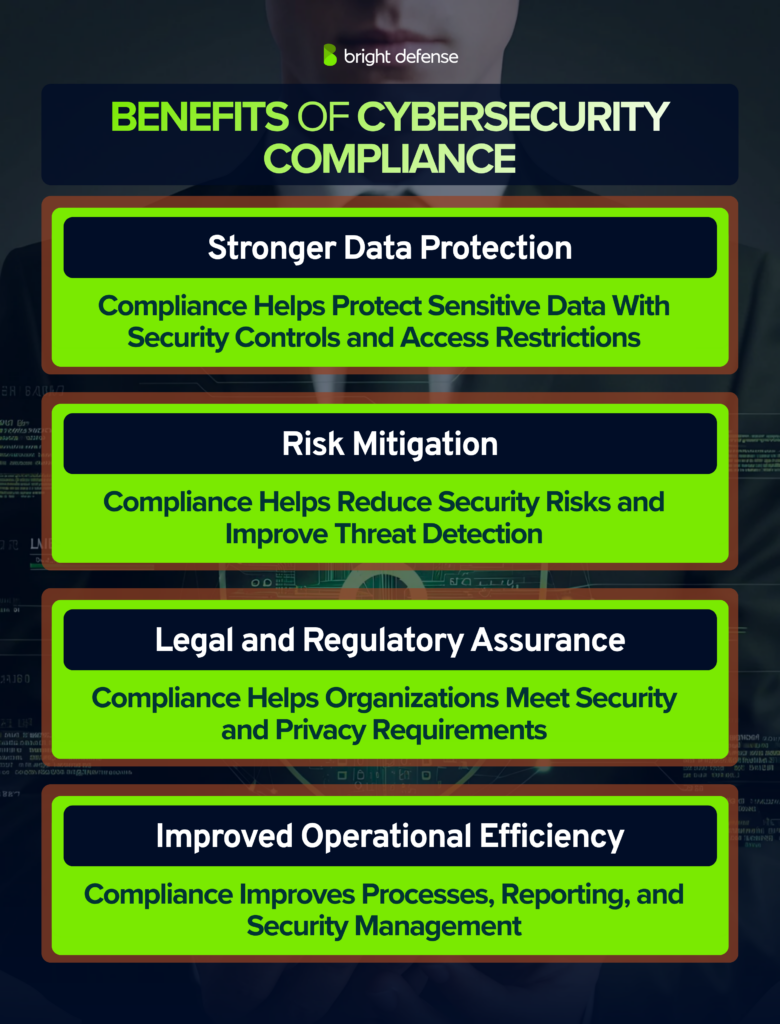
1. Stronger Data Protection
Compliance frameworks turn security expectations into defined controls, documented processes, and continuous oversight. Organizations that follow requirements such as HIPAA’s administrative, physical, and technical safeguards and PCI DSS’s encryption and access controls reduce the likelihood of unauthorized access or disclosure. Strong controls support data minimization, retention limits, and secure disposal.
2. Risk Mitigation
Structured compliance activities improve visibility into exposures and speed up issue resolution. PwC’s Global Compliance Survey 2025 found that compliance technology delivers better visibility of risks and risk-management activities for 64% of organizations, allows 53% to find and respond to compliance issues more quickly, improves reporting quality for 48%, and increases productivity and cost savings for 43%.
3. Legal and Regulatory Assurance
Documented compliance practices demonstrate that an organization meets legal and contractual obligations. Organizations that implement frameworks like GDPR and ISO 27001 and maintain evidence of controls can show regulators, customers, and partners that they manage data responsibly. That reduces the risk of fines, contract loss, and reputational damage.
4. Improved Operational Efficiency
Compliance improves operational efficiency when teams replace scattered manual work with shared controls, standard evidence, and clear ownership. PwC’s Global Compliance Survey 2025 reported that 43% of companies saw increased productivity and cost savings from compliance technology and 48 % reported higher-quality reporting. Consistent processes and automation reduce duplication, close control gaps, and free teams to focus on higher-value activities.
What Are the Main Challenges in Cybersecurity Compliance?
Cybersecurity compliance is difficult because teams must keep up with changing regulations, fast-moving threats, staffing pressures, rising program costs, operational trade-offs, vendor exposure, and weak measurement practices at the same time.
PwC’s Global Compliance Survey 2025 found that 85% of executives said compliance requirements have become more complex in the past three years and 77% reported negative impacts on multiple growth-driving areas. Organizations must address these problems proactively.
The following are the main challenges organizations face when managing cybersecurity compliance programs:
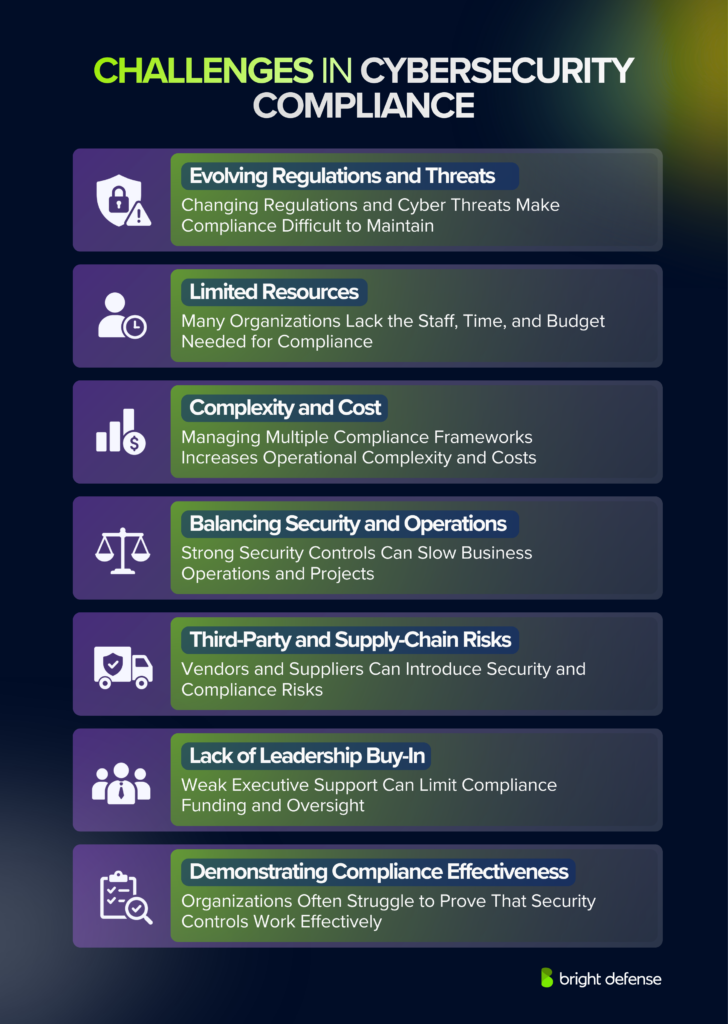
1. Evolving Regulations and Threats
Regulations and threats evolve constantly, forcing organizations to update controls and policies. The World Economic Forum’s Global Cybersecurity Outlook 2025 found that 72% of respondents reported an increase in organizational cyber risks. Ransomware remains a top concern.
Nearly 47% cited adversarial advances powered by generative AI as their primary concern. Compliance teams must address legal change and emerging AI-powered threats at the same time. PwC reported that 71% of organizations expect digital-transformation initiatives over the next three years that will require compliance support.
2. Limited Resources
Limited resources slow compliance because security and compliance work depend on people, time, and specialized skills that many organizations lack. Accenture’s State of Cybersecurity Resilience 2025 found that only 42% of organizations are balancing AI development and security investment.
Just 28% embed security into transformation initiatives from the outset. 83% of executives cite workforce limitations as a major barrier to sustaining a secure posture. Organizations must invest in staffing and training to overcome these constraints.
3. Complexity and Cost of Compliance Management
Compliance management becomes expensive and hard to control when teams juggle multiple frameworks, manual evidence collection, scattered ownership, and constant updates.
PwC reported that 77 % of executives said rising complexity negatively affects several areas that drive growth. Simpler processes, standard controls, and automation help manage cost and complexity.
4. Balancing Security Controls with Business Operations
Balancing strong security controls with business operations is difficult. Strict controls slow projects. Weak controls raise legal and security exposure. Security, compliance, and business execution often pull on the same resources, which forces trade-offs between speed and protection.
5. Third-Party Vendor and Supply-Chain Risks
Third-party and supply-chain risks complicate compliance because critical systems, data, and services often sit outside an organization’s direct control. Verizon’s 2025 Data Breach Investigations Report highlighted that incidents involving third parties doubled from 15 % to 30 % in a year, with ransomware present in 44 % of attacks and system intrusion accounting for 81 % of third-party attacks.
The World Economic Forum’s Global Cybersecurity Outlook 2025 reported that 54 % of large organizations flag supply-chain security as their top barrier to cyber resilience and 71 % of cyber leaders believe small vendors have reached a breaking point in their security capabilities. Organizations must assess vendor risk management, include data-protection obligations in contracts, and monitor suppliers continuously
6. Lack of Leadership Buy-In
Lack of leadership buy-in remains a real compliance problem because programs rarely receive enough budget, authority, or follow-through without visible executive backing.
PwC’s survey found that only 7 % of executives consider their organizations to be leading in compliance, yet 38 % aim to achieve that status within three years.
A compelling business case for compliance investment that links outcomes to strategic goals helps secure leadership support.
7. Demonstrating Compliance and Control Effectiveness
Demonstrating that controls work is difficult when organizations lack regular testing, benchmarking, and clear measurement.
PwC reported that 59 % of executives cited greater confidence in compliance decision-making because of better coordination, yet only a small fraction currently consider themselves compliance leaders.
Continuous compliance monitoring, evidence collection, and metrics that link control performance to business outcomes show effectiveness.
How Will AI Shape Cybersecurity Compliance?
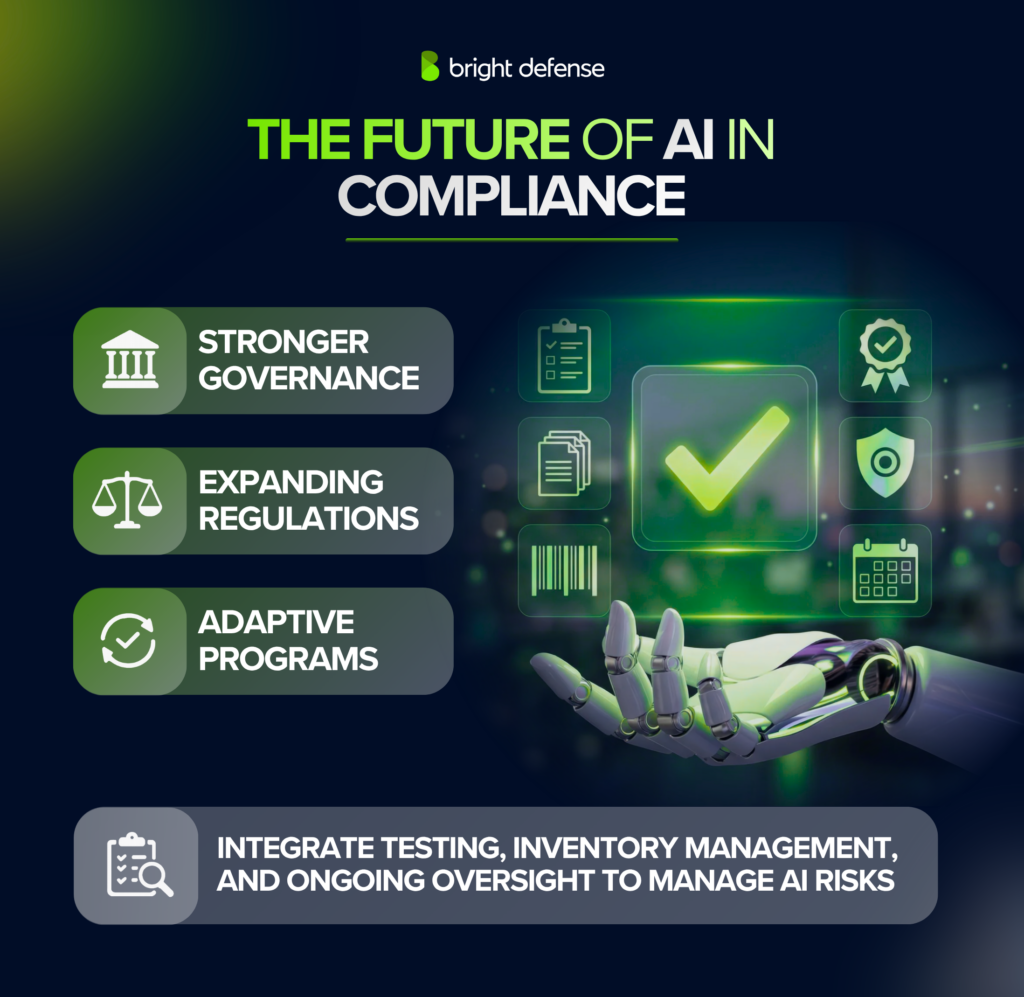
Cybersecurity compliance will increasingly revolve around AI governance, continuous control monitoring, tighter third-party oversight, and broader board accountability. As AI tools move deeper into daily operations and regulations expand across jurisdictions, organizations will need adaptive programs that integrate testing, inventory management, and ongoing oversight.
Impact of AI on Compliance
AI changes compliance in two directions at once. AI automates detection, classification, and response, which improves visibility and speed. AI creates a larger control surface that needs policy, testing, access control, and oversight. Compliance programs will need to incorporate AI inventories, approved-use policies, risk assessments, and continuous monitoring to manage these new risks.
Emerging Trends in Cybersecurity Compliance
Emerging trends point toward more continuous, technical, and distributed oversight across organizations and their vendors. PwC’s Global Compliance Survey 2025 found that investment in compliance technology delivers increased visibility and responsiveness. Future-ready compliance programs will rely on continuous monitoring, automated evidence collection, AI-specific governance, vendor-risk verification, and greater board involvement as regulations like NIST CSF 2.0, DORA, and NIS2 raise expectations for governance and reporting.
FAQ
Cybersecurity compliance is the set of activities used to meet security requirements and prove control operation through evidence such as policies, access records, logging, and review sign-offs.
Cybersecurity compliance requirements usually come from laws and regulations, customer contracts, and formal standards and frameworks such as ISO/IEC 27001, SOC 2, and control catalogs like NIST SP 800-53.
No. Compliance focuses on meeting stated requirements and maintaining evidence, while security work focuses on reducing risk across systems and operations beyond any single checklist.
Evidence is the proof that controls exist and operate, such as access-control records, change tickets, incident runbooks, risk decisions, and monitoring outputs that show control status over time.
Monitoring matters because control status changes as people, systems, and vendors change, and NIST describes continuous monitoring as maintaining ongoing awareness of security, vulnerabilities, and threats to support risk decisions.
Often, yes. Customer requirements, payment processing, regulated data, or B2B sales cycles commonly create compliance obligations even for small teams.
Start with a clear plan: 1) confirm the report type and scope the customer expects, 2) define your system boundary and in-scope services, 3) set an evidence cadence that runs through the reporting period and maps to the Trust Services Criteria.
Yes, in some cases. CIRCIA requires CISA to issue reporting regulations for covered entities, and the proposed rulemaking discusses reporting covered cyber incidents within 72 hours and ransomware payments within 24 hours after the trigger conditions.
No. Tools can reduce manual effort, but compliance still depends on control ownership, documented processes, and evidence that controls operate on a steady cadence.
Ask which specific standard or requirement they claim to meet, request the relevant report or evidence package that matches that claim, and confirm the scope matches the product or service you are buying, not a separate internal system.