CISA BOD 26-04 Accelerates Federal Patching
Updated:
August 25, 2026
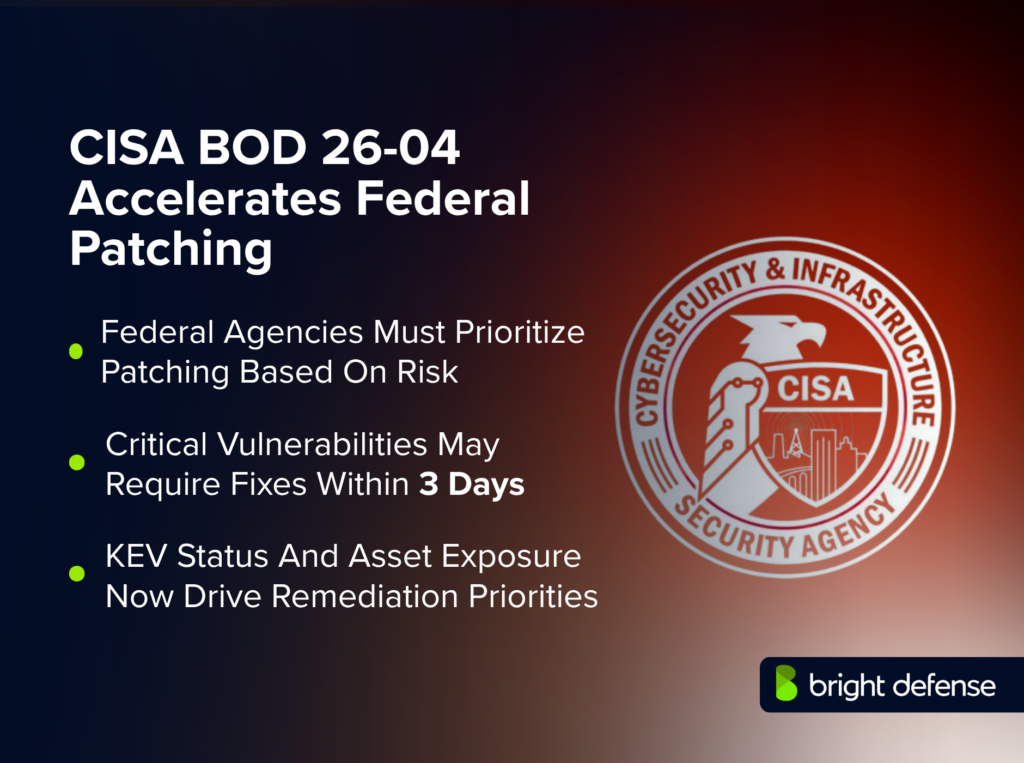
CISA’s Binding Operational Directive 26-04 has reset federal vulnerability management around risk, exposure and exploitation instead of severity scores alone. Issued on June 10, 2026, the directive requires Federal Civilian Executive Branch agencies to prioritize security updates using asset exposure, Known Exploited Vulnerabilities status, exploit automation and post-exploitation technical impact, with the most urgent cases due in as little as 3 calendar days.
What Does CISA BOD 26-04 Require Federal Agencies To Do?
CISA BOD 26-04 requires federal civilian agencies to update vulnerability management programs so the riskiest flaws receive the fastest action. Agencies must rank vulnerabilities based on asset exposure, KEV status, exploit automation and technical impact, then remediate them under CISA’s new response timelines.
The directive is titled “Prioritizing Security Updates Based on Risk.” CISA said it is meant to target vulnerabilities that create the greatest operational risk while allowing agencies to defer lower-risk issues to scheduled system upgrades.
The change affects how agencies patch internet-facing systems, known exploited vulnerabilities and vulnerabilities that can give attackers partial or total control of affected systems. It also requires forensic triage in designated high-risk scenarios to determine whether attackers already compromised the asset before remediation.
When Did CISA BOD 26-04 Replace Earlier Federal Patching Directives?
CISA BOD 26-04 replaced BOD 19-02 and BOD 22-01 on June 10, 2026, after several years of federal patching rules that focused on internet exposure and known exploitation. The new directive consolidates those programs into one risk-based model for federal vulnerability remediation.
CISA issued BOD 19-02 on April 29, 2019, requiring remediation of critical and high vulnerabilities on internet-accessible systems. CISA then issued BOD 22-01 on November 3, 2021, creating the Known Exploited Vulnerabilities catalog and requiring agencies to remediate listed flaws on defined deadlines.
BOD 26-04 keeps the KEV catalog central but changes how urgency is calculated. A vulnerability no longer moves only because it is severe or listed. The directive weighs whether the asset is publicly exposed, whether real-world exploitation is known, whether attack steps can be automated and how much control an attacker gains.
How Does CISA BOD 26-04 Prioritize Vulnerabilities?
CISA BOD 26-04 prioritizes vulnerabilities with a four-factor model: asset exposure, KEV status, exploit automation and post-exploitation technical impact. A continuous vulnerability management program can combine these risk factors with asset context, remediation ownership and validation records.
The model reflects whether attackers can reach the asset, whether exploitation is confirmed, whether exploitation can scale and whether the result gives partial or total control.
CISA said it publishes KEV status, exploit automation and technical impact through services such as its Vulnrichment program. Agencies must supply the asset exposure context because only the agency can confirm whether a vulnerable system is publicly reachable.
Industry analysts said the model moves federal agencies away from a flat CVSS-driven process. CyberScoop reported that CISA told agencies to emphasize vulnerabilities affecting public assets, automatable exploits, control of systems and evidence of active exploitation.
How Fast Must Agencies Patch Under CISA BOD 26-04?
CISA BOD 26-04 creates response timelines that can require remediation in as little as 3 calendar days for the highest-risk vulnerability combinations. Other combinations can fall into longer windows, including 14 days, 60 days or the next scheduled major system upgrade.
The fastest tier applies where the risk factors show public exposure, known exploitation, automatable exploitation and serious post-exploitation impact. CISA’s implementation guidance pairs those urgent cases with forensic triage expectations because patching alone does not prove the system was not already compromised.
Wired reported that CISA officials linked the compressed timeline to AI-enabled vulnerability discovery and exploit development. The agency’s position is that defenders may have less time between patch release, public knowledge and attacker weaponization.
Which Agencies, Systems And Vendors Fall Under CISA BOD 26-04?
CISA BOD 26-04 applies to Federal Civilian Executive Branch agencies and agency assets in federal information systems. CISA defines the scope through OMB Circular A-130, covering information systems used or operated by an agency or another entity on behalf of an agency.
That scope can reach contractor-operated systems when they collect, process, store, transmit or maintain agency information on behalf of the federal government. A formal vendor risk management program can document patching responsibilities, access requirements, logging obligations and incident-support expectations for federal suppliers.
The directive does not directly bind private companies that do not operate federal systems, but it is likely to affect them through contracts, reporting expectations and security reviews.
CISA said the directive’s risk-based approach and asset management methods can serve as practical guidance for other organizations. Private companies are likely to face customer, insurer or board pressure to explain why their vulnerability program differs from the new federal benchmark.
What Enforcement Or Legal Consequences Come With CISA BOD 26-04?
CISA BOD 26-04 is a compulsory federal directive for covered executive branch agencies under federal cybersecurity authorities. It does not create a private-sector fine regime, but agencies must follow the directive, provide vulnerability management policies to CISA on request and report remediation status through federal channels.
CISA’s directive continues automated reporting through the Continuous Diagnostics and Mitigation dashboard for KEV status. A structured compliance monitoring program can track remediation deadlines, reporting status, overdue findings and changes to public-exposure data. Agencies without full automation must manually report status biweekly, continue Cyber Hygiene scanning and update scope information quarterly or when CISA requests it.
The practical legal risk for contractors is indirect. A vendor that supports agency systems may face contract scrutiny, incident response demands, security assessment findings or procurement consequences when it cannot support the timelines, evidence and reporting expectations agencies must meet.
What Should Agencies Do To Comply With CISA BOD 26-04?
Agencies should treat BOD 26-04 as an exposure management mandate tied to asset ownership, threat intelligence, remediation operations and forensic readiness. The operational priority is to know which assets are exposed, which CVEs are present, which flaws are in KEV and which systems could give attackers meaningful control.
1. Maintain a current inventory of hardware, software, cloud assets, domains and internet-facing systems.
2. Connect vulnerability scanning, KEV data, Vulnrichment data and asset exposure data into one prioritization workflow.
3. Classify vulnerabilities using CISA’s four factors and assign remediation timelines based on the directive’s decision table.
4. Prepare forensic triage procedures for the highest-risk cases before patching windows start.
5. Track remediation evidence, compensating controls, business approvals and post-remediation validation.
6. Update vendor agreements so contractors can support patch timelines, data access, logging and incident analysis.
7. Report status through the CDM dashboard or required manual channels.
How Did Security Experts And Industry Groups Respond To CISA BOD 26-04?
Security experts generally described CISA BOD 26-04 as a major move toward exposure-based vulnerability management. CyberScoop reported that CISA had discussed the faster timeline with agencies and that one large agency analysis found about 1% of vulnerabilities would fall into the 3-day tier.
Tenable said organizations with continuous asset discovery, risk-based prioritization and exposure management are better positioned for the directive than organizations that still rely on periodic scans and CVSS-first workflows. Automox said the directive creates a federal benchmark that auditors, insurers and boards may treat as a reference point beyond government.
Some experts warned that rapid patching is not enough. Architectural controls that limit attacker movement should support remediation because vulnerable assets may remain exposed when a patch is delayed, unavailable or operationally disruptive.
This is one reason penetration testing is important, since it can show whether attackers can combine configuration weaknesses, access gaps and unpatched flaws into a practical attack path.
What Government Actions Are Tied To CISA BOD 26-04?
The main government action is CISA’s issuance of BOD 26-04 and its implementation guidance on June 10, 2026. CISA’s guidance lays out forensic triage steps, vulnerability response timelines, KEV handling, mission critical assets, high-value assets, third-party providers, Vulnrichment, Cyber Hygiene and CISA support.
CISA’s implementation guidance lists forensic triage steps including scoping, preserving and collecting evidence, critical patching and stabilization, containment and control, triage analysis and escalation decisions. The guidance says the specific triage timeline is recommended, while adequate forensic triage is the directive requirement.
The latest official related update found in this review was CISA’s June 11, 2026 KEV alert, which cited BOD 26-04 as the controlling vulnerability management directive for Federal Civilian Executive Branch agencies. No court challenge or formal amendment to BOD 26-04 was found as of June 19, 2026.
What Costs And Business Risks Follow From CISA BOD 26-04?
CISA BOD 26-04 raises operational pressure because agencies must connect asset discovery, vulnerability detection, threat intelligence, remediation ownership, change control and forensic triage at speed. The cost depends on scanning coverage, public-exposure accuracy, automation maturity, legacy systems, cloud complexity and vendor cooperation.
The business risk for suppliers is clear. Federal contractors that cannot provide timely patch support, asset visibility, exposure evidence, logs or incident cooperation may face longer reviews and tougher contract conversations. Agencies cannot meet the directive alone when vulnerable systems are run or supported outside agency teams.
The broader market risk is benchmark drift. BOD 26-04 applies to federal agencies, but insurers, auditors and enterprise customers may ask why private-sector remediation programs still treat all KEV entries alike or rely mainly on CVSS severity.
What Remains Unclear About CISA BOD 26-04?
The biggest unresolved issue is how consistently agencies can implement the model across legacy systems, cloud assets, third-party platforms and operational systems with limited downtime windows. CISA’s decision table is clear, but asset exposure and system ownership can be messy in large federal environments.
A second open issue is how often CISA will update implementation guidance. CISA said it will update the guidance page to provide users and agencies with the latest information, which means agencies may need to track revisions as the program matures.
A third issue is private-sector adoption. CISA encourages broader use of the approach, but non-federal organizations are not legally bound unless contracts, regulators or customer requirements incorporate similar timelines.
How Bright Defense Helps Agencies And Vendors Meet CISA BOD 26-04 Requirements
Bright Defense helps agencies and federal vendors prepare for exposure-based security requirements through Attack Surface Management. We identify internet-facing assets, exposed services, misconfigurations, shadow IT, and exploitable attack paths to help organizations reduce external risk and prioritize remediation efforts.
Sources Cited In This CISA BOD 26-04
- CISA — BOD 19-02: Vulnerability Remediation Requirements For Internet-Accessible Systems (April 29, 2019)
- CISA — CISA Issues BOD 22-01: Reducing The Significant Risk Of Known Exploited Vulnerabilities (November 3, 2021)
- CISA — BOD 22-01: Reducing The Significant Risk Of Known Exploited Vulnerabilities, Revoked (June 10, 2026)
- CISA — Known Exploited Vulnerabilities Catalog (2026)
- CISA — BOD 26-04: Prioritizing Security Updates Based On Risk (June 10, 2026)
- CISA — BOD 26-04 Implementation Guidance For Prioritizing Security Updates Based On Risk (June 10, 2026)
- CISA — CISA Issues New Directive Improving How Federal Agencies Prioritize The Mitigation Of Cyber Vulnerabilities (June 10, 2026)
- CISA GovDelivery — CISA Releases Binding Operational Directive 26-04 On Prioritizing Security Updates Based On Risk (June 10, 2026)
- CISA — Patch Smarter, Not Harder (June 2026)
- CISA — CISA Adds One Known Exploited Vulnerability To Catalog (June 11, 2026)
- OMB — Circular A-130, Managing Information As A Strategic Resource (July 28, 2016)
- Federal Register — Revision Of OMB Circular No. A-130, Managing Information As A Strategic Resource (July 28, 2016)
- CERT/CC — How To Use The CISA Response Timeline SSVC Decision Tree (June 2026)
- Wired — CISA Tells US Agencies To Fix Security Bugs In As Little As 3 Days Thanks To AI Threats (June 10, 2026)
- CyberScoop — CISA Directive Orders Agencies To Prioritize Vulnerability Patching In New Way (June 2026)
- CSO Online — CISA Tells Agencies To Patch Smarter, Not Harder (June 2026)
- Tenable — CISA BOD 26-04: Frequently Asked Questions About The New Risk-Based Patching Directive (June 2026)
- Automox — CISA BOD 26-04: The 3-Day Patching Clock (June 11, 2026)