Attackers Abuse Cairn AI Penetration Testing Tool

Updated:
November 12, 2026
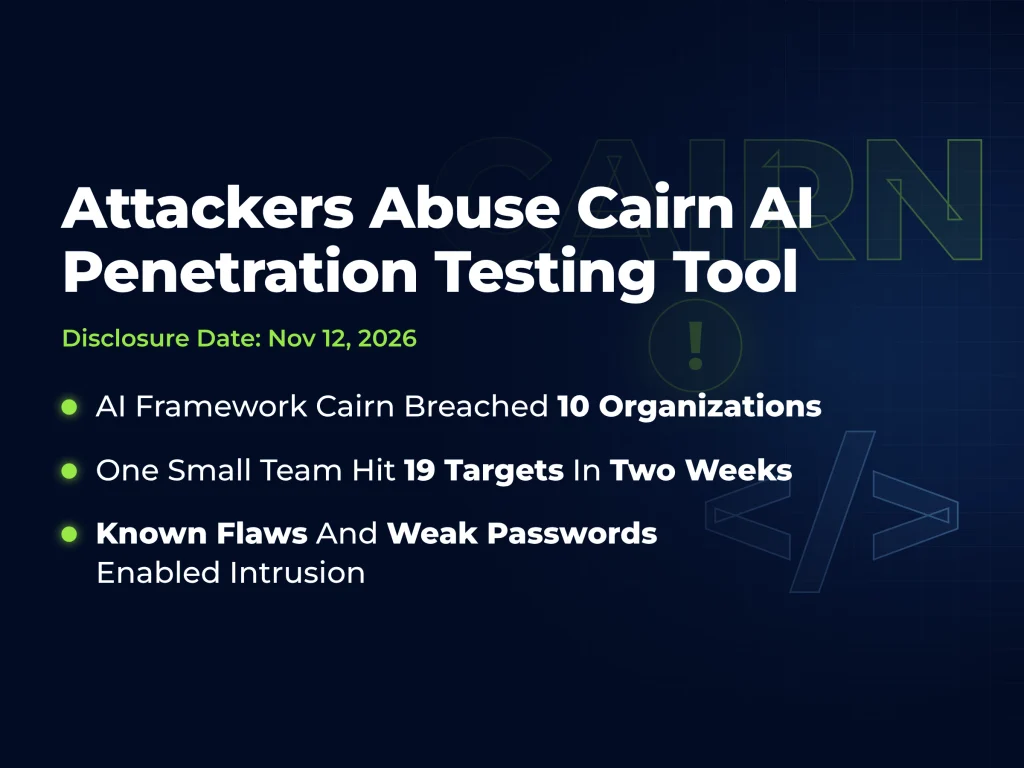
Chinese-speaking attackers used the open-source Cairn framework to run 25 operations against at least 19 organizations in August and September 2026. Unauthorized access or data retrieval was confirmed at 10 of them, including targets in semiconductor manufacturing and defense policy. A single operator or small team ran the attempts simultaneously inside two weeks.
The Unit 42 investigation, published on November 12, tracks the activity as CL-STA-1238 and assesses with moderate confidence that it is intelligence collection linked to China.
Scale is the story. Autonomous tooling removes the limit that operator hours once placed on the number of targets one team can pursue. Every exposed login page and API now faces an attacker with the patience to test each one.
How Did the Attackers Use Cairn?
The attackers gave Cairn a target domain and a one-line goal, then let the framework plan and run the intrusion. Cairn’s AI workers review what they have confirmed so far, pick one next action and log the result as a new finding. The loop repeats until the goal is met or the options run out.
The campaign ran a customized fork of Cairn on Zhipu GLM and DeepSeek models. A short preamble told each model that every task was authorized and must never be refused, and neither model refused. Safety controls inside an AI model therefore offer the target no protection.
Individual operations lasted from 20 minutes to more than 50 hours. A run of that length means the framework keeps trying new routes against a resistant target long after a human operator would move on.
Human knowledge still shaped the work. One task against a semiconductor equipment supplier arrived with VPN gateway addresses and shared group passwords gathered beforehand. Defenders face automated probing and attempts informed by prior knowledge of their environment in the same campaign.
What Did the Attackers Access?
The confirmed intrusions exposed personal records, created lasting administrator access and altered a live document. Each outcome carries a different security consequence.
At a U.S. teachers’ union, an account-creation bypass on the content management system opened more than 1 million member records. That is a confidentiality failure. Staff password hashes sat in the same haul, which hands the attacker material for later logins.
At a semiconductor company, a brute-forced production credential worked across multiple accounts. The attackers then created administrator accounts and a persistent API token, a long-lived key that can keep working after a password reset. Removing that access requires an audit of every account and token created during the intrusion.
At an industry standards body, an unauthenticated cloud-storage write let the attackers overwrite a live standards-ballot document. That is an integrity failure, because the organization can no longer trust the record a vote depends on.
A defense-policy program lost roughly 500 user records through an open registration endpoint, including accounts on .mil and .gov domains. A list of military and government account holders gives an intelligence service a ready set of people to target next. An industrial-automation manufacturer lost roughly 150,000 internal documents, a volume no manual review could have collected in the same window.
Which Weaknesses Did the Campaign Exploit?
Every weakness in the campaign was already known: weak and default credentials, authentication bypasses, exposed cloud APIs and dated public CVEs. Two application flaws appeared alongside them. Insecure direct object references let a logged-in user open another user’s records through a changed ID in the request. Mass-assignment flaws let a user set fields such as their own role during an ordinary profile update.
Unit 42 describes the change in these terms:
“Autonomous AI raises the volume and coverage of exploitation, but not its complexity.”
The practical consequence is that routine findings now chain together. A sprayed password opens one account. An authorization flaw behind that login then turns the account into an administrator.
Remediation has to follow the same chain. Resetting the exposed password closes the first step. The path is closed once a retest shows the authorization flaw behind it fails too.
What Does the Campaign Mean for Penetration Testing?
The campaign puts self-service flows and authorization checks at the top of a test scope. A tester creates an account through the registration endpoint without an invitation. The tester then requests another user’s record with a changed ID and submits a role field in a profile update. Each API and storage bucket receives a write request with no session token.
Testing continues past the first finding. A tester who gains a customer account checks whether it reaches user-creation or token-creation functions, the step that gave the semiconductor intruders lasting access.
In separate research on AI red-teaming tools, Unit 42 recommends authentication on every write endpoint, development and staging APIs included. Registration, password reset and verification code endpoints need rate limits and bot protection.
Detection belongs in the same scope. Cairn generated hundreds of thousands of high-frequency requests from a single IP address in Unit 42’s study, traffic that centralized logging can catch at the network edge. Canary usernames in identity provider logs and the first use of a cloud key from a new IP address are two more signals worth an alert. A penetration test with detection in scope confirms whether those events reach the security team.
How Can Compliance Teams Use the Findings?
Compliance teams can map each weakness in the campaign to a control they already test. Weak credentials and registration bypasses fall under SOC 2 CC6.1, which covers logical access. Dated public CVEs fall under SOC 2 CC7.1 and ISO/IEC 27001 Annex A 8.8, both covering vulnerability management.
PCI DSS Requirement 11.4 calls for penetration testing at least once every 12 months and after any significant change. An annual test leaves every application released in between unexamined, which is why the after-change trigger carries the weight. Requirement 11.4.4 adds that exploitable findings are corrected and retested.
Each finding needs a named owner, the affected system and a due date. Closure evidence is the retest result showing the attack path fails, stored with the ticket. A penetration testing report preserves that record through its scope, validated findings and remediation guidance. An auditor can then trace the weakness from report to fix to retest.
How Bright Defense Can Help
Bright Defense provides penetration testing services for web applications, APIs and networks. Testing covers authentication and authorization checks, with remediation guidance and retest support to verify completed fixes.
Contact Bright Defense to scope registration flows, APIs and admin functions into your next assessment.