17.5M Instagram Leak: The Reset Email You Must Avoid
Updated:
September 21, 2026
What Happened in the Instagram Breach?
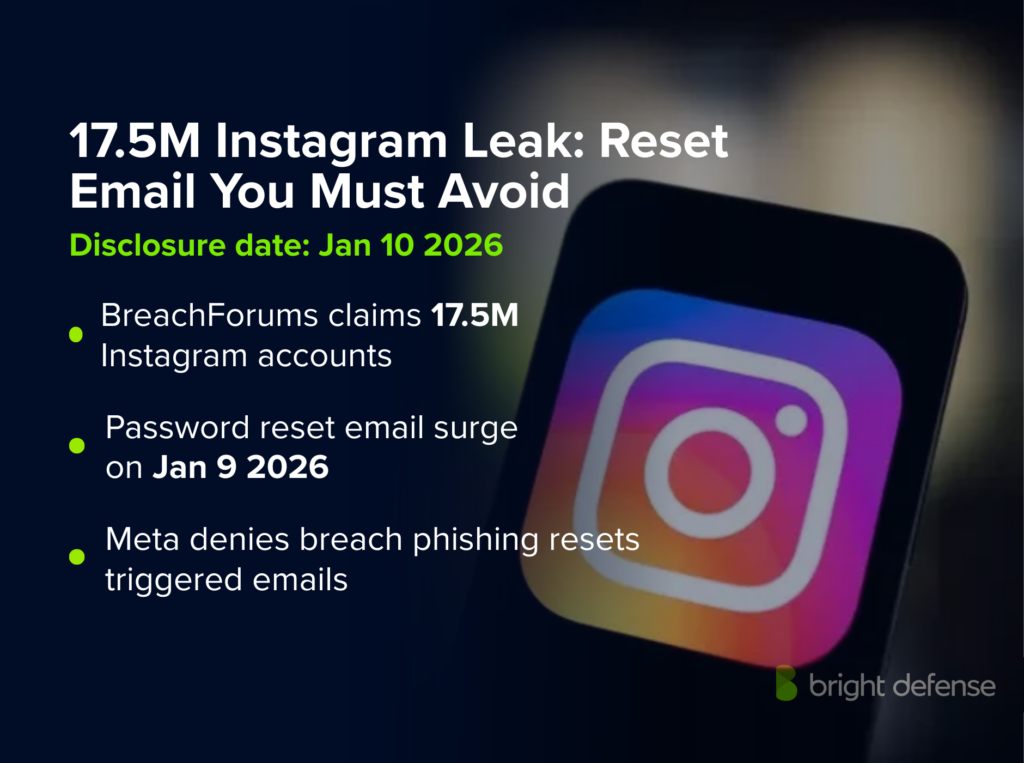
In early January 2026, a threat actor known as “Solonik” posted a dataset titled “INSTAGRAM.COM 17M GLOBAL USERS — 2024 API LEAK” on a dark-web marketplace. The data reportedly covered about 17.5 million Instagram accounts and included usernames, names, email addresses, phone numbers, and some partial physical addresses.
Shortly after the post appeared, users worldwide reported unsolicited Instagram password-reset emails sent from the platform’s legitimate domain. Security researchers found that attackers used exposed contact details to trigger real reset requests and verify which accounts were active, raising concerns around phishing, SIM-swapping, and other targeted abuse.
Initial reports framed the incident as an Instagram breach. On January 11, 2026, Meta denied a breach, cited a flaw that allowed reset emails to be triggered externally, confirmed a fix, and advised users to ignore unexpected reset messages.
Timeline: From First Access to Latest Update
- Late 2024: Security researchers believe the dataset originated from an Instagram API exposure during 2024. Data collected at that time appears to have been stored until early 2026.
- Jan 7, 2026: A threat actor posting as “Solonik” released a dataset of about 17.5 million Instagram user records on a dark-web forum. The files resembled structured API responses and included usernames, names, email addresses, phone numbers, and partial addresses.
- Jan 8, 2026: Users in multiple regions reported receiving unexpected password-reset emails. Some noticed these emails did not appear in Instagram’s in-app security history.
- Jan 9–10, 2026: Security firms warned that millions of user records were circulating for sale. News coverage increased, focusing on the volume of reset emails and the connection to an older API exposure.
- Jan 11, 2026: Meta responded publicly. The company said its systems were not breached, no passwords were exposed, and accounts remained secure. It confirmed a flaw had allowed outsiders to request password resets and said the issue was resolved.
- Jan 11, 2026 (current): No regulator or law-enforcement body has announced a formal investigation. The dataset reportedly remains available on illicit forums, and there have been no further updates from Meta.
What Data or Systems Were Affected
The exposed dataset contained usernames, full names, email addresses, phone numbers, partial addresses and other profile metadata. A data exfiltration prevention strategy can detect automated collection, unusual API requests and bulk transfers of user information. No passwords appeared in the files, which points to an API exposure or data aggregation rather than direct access to Instagram’s password systems.
Even without passwords, the combination of contact and location data increases the risk of phishing, SIM-swapping, stalking, and account recovery abuse. Many users reported repeated reset requests and suspicious follow-up messages.
Who Was Responsible for the Insta Breach?
Meta has not acknowledged any hack and maintains that a technical flaw only allowed password-reset requests. Independent researchers attribute the dataset to a BreachForums user named “Solonik” and believe the information was scraped during a 2024 API exposure. Some evidence suggests the dataset may include enrichment from third-party sources.
No individual or group has claimed responsibility for the reset email activity, and no suspects have been named by authorities.
How the Attack Worked
Investigators believe a misconfigured API endpoint allowed profile data collection, producing files that resembled native API responses. API penetration testing can expose weak authorization, excessive data responses, rate-limit failures and endpoints that reveal information without proper authentication. The Instagram data appears to have been collected in late 2024 and retained until early 2026.
After the dataset became public, attackers used the exposed email addresses and phone numbers to trigger password-reset emails at scale. This activity caused confusion and opened the door for social-engineering attempts. The presence of physical address data suggests enrichment from marketing databases or other external sources.
Company Response and Customer Remediation
Meta stated on January 11 that it fixed the flaw that allowed outsiders to request reset emails. A documented cyber threat intelligence and incident response process can help teams connect unusual account-recovery activity with circulating datasets, contain abuse and communicate verified findings to users.
Meta denied that its systems were breached and said no passwords were exposed. It did not issue individual notifications to affected users or explain how address data appeared in the dataset.
Security professionals advised users to ignore unsolicited reset emails, change passwords directly within the app, enable two-factor authentication using an authenticator app instead of SMS, and review connected apps for unusual activity. Receiving a reset email alone does not indicate account compromise, and Instagram’s recovery tools remain available.
Government, Law Enforcement, and Regulator Actions
As of January 11, 2026, no regulator has announced an investigation. Meta has not reported the incident as a breach, which limits immediate regulatory action in many jurisdictions. No law-enforcement agency has publicly confirmed criminal cases or identified suspects.
Financial, Legal, and Business Impact
Meta has disclosed no financial losses or legal exposure since it denies that a breach occurred. User trust has taken a hit, and regulatory scrutiny remains possible if authorities later classify the incident as a personal-data breach.
India, which has one of Instagram’s largest user populations, recently enacted stricter data-protection requirements. If regulators determine that an API vulnerability caused unauthorized data disclosure, penalties or corrective orders could follow.
The dataset reportedly circulates in segmented batches, sorted by region and follower count. This structure places high-profile users at greater risk for fraud and extortion. Some users have reported attempted account takeovers, though no large-scale theft has been confirmed.
What Remains Unclear About the Instagram Breach
1. Data source
Meta has not explained the precise origin of the exposed data. Independent analysis links it to a 2024 API issue.
2. Enrichment and scale
The source of physical address data remains unknown, and the true number of affected accounts may exceed 17.5 million.
3. Regulatory and criminal follow-up
Authorities have not classified the incident or announced enforcement actions, and public details on confirmed compromises remain limited.
Why This Incident Matters
Instagram’s massive user base makes it a valuable target even without password exposure. Large-scale release of names, contact details, and partial addresses can support identity theft, extortion, and targeted fraud.
The incident shows how older API exposures can resurface years later and combine with legitimate account-recovery features to target users.
A continuous vulnerability management program can help organizations track API weaknesses, verify remediation and monitor whether previously exposed data creates new attack paths. Meta denied that its systems were breached, but affected users may still face phishing and impersonation risks.
From a security perspective, this event reinforces the need for strict API controls and strong multi-factor authentication. For everyday users, caution around unsolicited emails and use of unique passwords remain essential.
How Bright Defense Helps Reduce Breach Risk
Bright Defense helps organizations reduce exposure from API flaws, account recovery abuse, and overlooked compliance gaps. Our penetration testing focuses on real attacker paths such as API misuse and data aggregation risks, not just checklist items.
We also support SOC 2, ISO 27001, and privacy compliance efforts, linking technical findings to regulatory impact. Breaches happen even at mature companies. An external security view can surface risks early. Contact Bright Defense to review your exposure and next steps.
FAQ
Reports in January 2026 tied a surge of unexpected Instagram password reset emails to claims that data linked to about 17.5 million accounts was circulating, but Instagram publicly said there was no breach of its systems and that it fixed an issue that let an external party trigger reset emails.
No. Instagram said it fixed a technical issue that allowed an external party to request password reset emails for some people and stated there was no breach of its systems and accounts were secure.
Malwarebytes reported that a threat actor offered a dataset said to contain roughly 17 million Instagram records and listed fields such as usernames, full names, user IDs, email addresses, phone numbers, countries, and partial locations, and it also stated the dataset did not include passwords.
You should avoid clicking any password reset link you did not personally trigger, because attackers can use panic and timing to push people into clicking lookalike emails, and the FBI’s guidance is to not click anything in unsolicited emails or texts and to verify through official channels you open yourself.
No. Instagram said the reset-email wave came from a fixed issue and did not mean accounts were compromised, and a reset request only means someone tried to start the reset flow, not that they successfully logged in.
You should use the app, not the email, and take these steps: 1) ignore the email and open Instagram directly 2) review account security and active sessions in Accounts Center and sign out of devices you do not recognize 3) change your password only inside the app 4) turn on two-factor authentication, preferably with an authenticator app, because Malwarebytes and Instagram both pointed users toward in-app changes and safer account protections.
You should treat it as a possible phishing event and act fast: 1) change your Instagram password in the app 2) change the email password for the email account tied to Instagram 3) turn on two-factor authentication 4) review recent logins and sessions and remove unknown devices, and the FTC also recommends reporting phishing when it happens.
You can report phishing emails by forwarding them to the Anti-Phishing Working Group and reporting the attempt to the FTC, and you can also report suspicious activity through your email provider’s built-in phishing report option.
A reset email can appear when you requested it, when someone else typed your email into the reset form, or when someone is trying to get you to click a fake reset link; Instagram’s own help guidance says you can ignore a reset email you did not request because your password does not change unless you take action.
Recent waves of unsolicited reset emails also happened due to a technical issue that let an external party trigger reset emails without account access, which Instagram said it fixed.
A “tap to reset” SMS from an unfamiliar shortcode should be treated as a smishing attempt because attackers commonly use texts with links to steal logins, and sender IDs in texts can be manipulated.
The safe action is to avoid the link and use the Instagram app or the official Instagram reset page only.
Instagram provides an in-app list of security emails it sent in the last 14 days, which is the most reliable way to verify a message.
Steps: 1) Open Instagram 2) Go to Settings 3) Open Security or Accounts Center 4) Open Recent emails 5) Confirm the email appears in the list before trusting it.
A reset email or reset text alone does not prove your password leaked, so focus on signs of compromise and credential exposure checks.
Practical checks: 1) Review Login Activity and log out unknown sessions 2) Change your Instagram password, especially if you reuse it 3) Turn on two-factor authentication 4) Check whether your email appears in known breach datasets using Have I Been Pwned.
Sources
- The Register — (January 6 2026)
- Malwarebytes Labs — (January 7 2026)
- BleepingComputer — (January 5 2026)
- InfoSecurity Magazine — (January 7 2026)
- eSecurity Planet — (January 7 2026)
- Cybernews — (January 6 2026)
- SC Media — (January 6 2026)
- The Cyber Express — (January 6 2026)
- Inside Towers — (January 8 2026)
- National CIO Review — (January 9 2026)