AI Governance Gains Ground With ISO 42001
Updated:
September 21, 2026
Organizations are moving from informal AI policies to formal Artificial Intelligence Management Systems as ISO/IEC 42001 turns AI governance into an auditable business process. The shift accelerated after ISO published ISO/IEC 42001:2023 in December 2023, the EU AI Act entered force in 2024, and major AI and cloud vendors began publishing third-party certifications for AI management systems.
What Is Driving Companies From Informal AI Policies To ISO/IEC 42001 AI Governance?
Companies are replacing informal AI policies with ISO/IEC 42001 programs because buyers, regulators and boards now expect evidence of control over AI systems. A short policy can set rules for employees, but an Artificial Intelligence Management System assigns ownership, tracks risk, records decisions and creates audit evidence.
ISO says ISO/IEC 42001 specifies requirements for setting up, maintaining and improving an AI management system for organizations that develop, provide or use AI products and services. The standard turns AI governance into a repeatable management process rather than a memo about acceptable use.
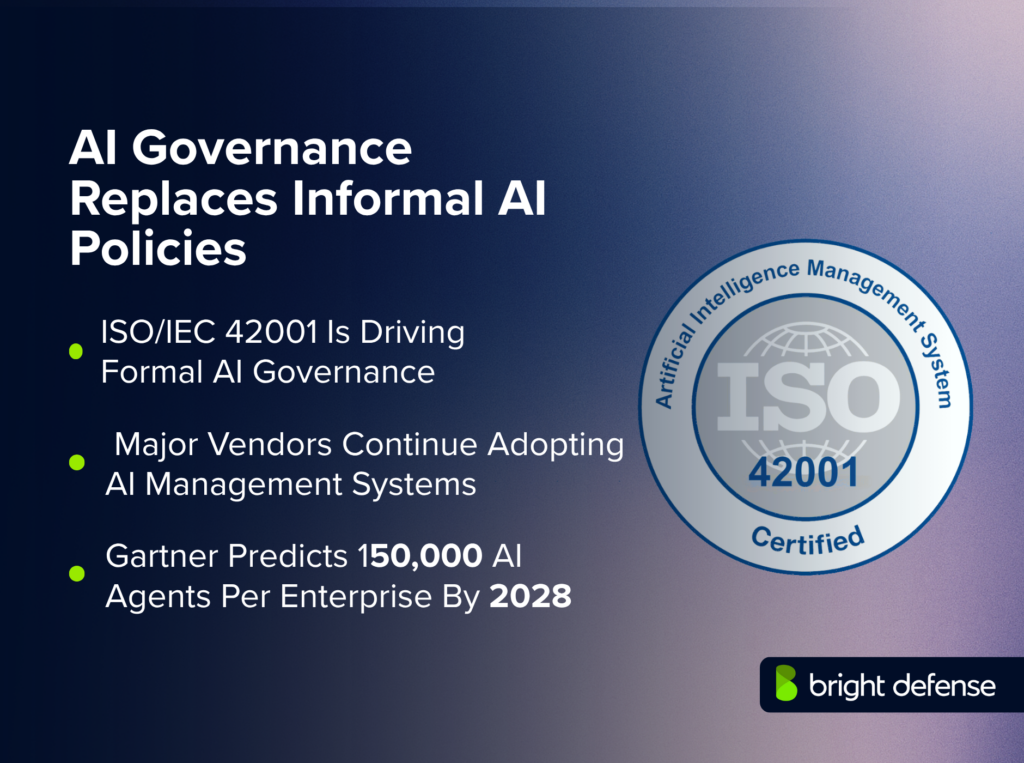
The shift reflects a practical problem. Generative AI, embedded AI and AI agents can spread across departments faster than central teams can review them. Gartner said on April 28, 2026 that an average Global Fortune 500 enterprise could have more than 150,000 agents in use by 2028, compared with fewer than 15 in 2025, while only 13% of organizations believed they had the right agent governance in place.
When Did ISO/IEC 42001 Move AI Governance Into Formal Management Systems?
ISO/IEC 42001 became the central AI governance standard after publication on December 18, 2023, according to UKAS. NIST had already released AI RMF 1.0 in January 2023, and the EU AI Act was published in the Official Journal on July 12, 2024, creating a broader compliance push.
The early market signal came from certification bodies and large vendors. Schellman said it became the first ANAB-accredited ISO 42001 certification body on September 24, 2024. KPMG Australia said on October 17, 2024 that it had become the first organization globally to achieve ISO 42001 certification through BSI.
AWS announced ISO/IEC 42001:2023 certification for Amazon Bedrock, Amazon Q Business, Amazon Textract and Amazon Transcribe on November 25, 2024. Anthropic announced certification on January 13, 2025. Microsoft said Azure AI Foundry Models and Microsoft Security Copilot achieved certification in 2025. OpenAI later stated that its ISO/IEC 42001:2023 AI Management System covers its consumer and business AI products and models.
What Does ISO/IEC 42001 Require In An Artificial Intelligence Management System?
ISO/IEC 42001 requires an AI management system that connects policies, objectives, roles, risk controls, monitoring, documentation and improvement cycles. The system is meant to manage AI risks and opportunities across the organization, including security, safety, fairness, transparency, data quality and third-party AI dependencies.
The standard follows the management system pattern familiar from ISO/IEC 27001 and other ISO frameworks. That structure makes it easier for security, privacy, risk and compliance teams to connect AI governance to existing policies, controls and audit processes.
In practice, an AIMS usually includes an AI inventory, risk classification records, impact assessments, model approval workflows, data governance controls, human oversight procedures, logging, incident response steps, supplier reviews and periodic management review. Informal AI policies rarely contain that level of traceable evidence.
Which Organizations Are Most Affected By The Shift To ISO/IEC 42001 AI Governance?
The shift affects AI model providers, software companies, cloud platforms, professional services firms, healthcare technology vendors, financial technology providers, security companies and enterprises using AI in regulated workflows. The pressure is strongest where AI affects employment, credit, healthcare, public services, safety, identity or security operations.
Enterprise customers increasingly want proof that vendors can govern AI across the system lifecycle. ISO/IEC 42001 certification gives vendors a recognizable audit artifact, though the certificate depends on the defined scope.
The standard can apply to organizations that use AI, not only organizations that build models. That point matters for companies that deploy copilots, customer-service bots, document review tools, AI coding assistants or agentic workflows inside business operations.
How Does ISO/IEC 42001 Connect To The EU AI Act And NIST AI RMF?
ISO 42001 compliance connects to the EU AI Act and NIST AI RMF as a management system layer for AI governance evidence. NIST AI RMF 1.0 is voluntary and risk-focused, the EU AI Act is binding for covered EU use cases, and ISO/IEC 42001 provides an auditable system for governance operations.
The EU AI Act requires providers of high-risk AI systems to maintain a documented quality management system under Article 17. That system covers compliance strategy, design and development procedures, testing, validation, data management, risk management, post-market monitoring, incident reporting, communication with authorities and accountability.
ISO/IEC 42001 does not automatically prove EU AI Act compliance. The European Commission says harmonized standards can give legal certainty after citation in the Official Journal. Until that point, ISO/IEC 42001 works as a strong governance and evidence framework, not a standalone legal pass.
What Penalties And Legal Risks Make Informal AI Policies Harder To Defend?
ISO/IEC 42001 has no direct fine structure because it is voluntary. The legal risk comes from AI laws, privacy laws, contract claims, audit failures, procurement exclusions, misleading statements and negligence arguments after AI-related harm.
Under the EU AI Act, prohibited AI practices can trigger fines up to €35 million or 7% of global annual turnover, whichever is higher. Other violations can reach €15 million or 3%, and misleading information to authorities can trigger fines up to €7.5 million or 1%.
A company with only an informal AI policy may struggle to prove how AI risks were reviewed, who approved deployment, what controls were tested and how incidents were handled.
A continuous compliance program can preserve approval records, testing evidence, control changes and remediation work throughout the AI system lifecycle. A documented AIMS gives legal, security and executive teams a stronger record of governance decisions.
What Compliance Steps Should Companies Take To Replace Ad Hoc AI Policies With ISO/IEC 42001 AIMS?
Companies should replace ad hoc AI policies with an AIMS that tracks AI systems, assigns owners and creates audit evidence. The fastest practical route is to connect ISO/IEC 42001 work to existing security, privacy, product governance and internal audit processes.
A formal vendor risk management program can also help organizations assess external AI providers, cloud platforms, data processors and embedded AI services.
1. Create an AI inventory covering internal tools, customer-facing systems, embedded AI, vendor AI and employee use of generative AI.
2. Define the AIMS scope, including products, teams, regions, data flows and third-party AI services.
3. Assign owners for AI governance, risk review, model monitoring, legal review, security testing and supplier oversight.
4. Classify AI systems by use case, impact, data sensitivity, autonomy, user exposure and regulatory trigger.
5. Create approval records for model selection, data use, testing, release, monitoring and major changes.
6. Build evidence for logging, human oversight, access control, incident handling, vulnerability management and supplier review.
7. Run an ISO 42001 internal audit before seeking certification to evaluate whether the AIMS conforms to organizational and ISO/IEC 42001 requirements, review objective evidence, document findings, and address nonconformities before the external certification audit.
8. Organizations should also understand how to prepare for an ISO 42001 audit, including defining the AIMS scope, organizing audit evidence, reviewing control performance, completing management review, correcting identified gaps, and preparing teams for the certification audit.
How Are Vendors And Certification Bodies Responding To ISO/IEC 42001 Demand?
Vendors and certification bodies are responding with public certifications, trust-center updates and new audit services. AWS, Anthropic, Microsoft and OpenAI have all published ISO/IEC 42001 assurance statements or certification announcements, turning AIMS evidence into a market signal.
Certification infrastructure expanded quickly. ANAB lists accreditation for certification bodies that issue ISO/IEC 42001 certifications. UKAS said on January 15, 2026 that it granted BSI the first UKAS accreditation for ISO/IEC 42001:2023 AIMS certification.
ISO/IEC 42006:2025 added another step in audit maturity. ISO says the standard sets extra requirements for bodies that audit and certify AIMS programs under ISO/IEC 42001, adding rules for competence, consistency and reliability in the certification process.
What Costs And Business Risks Come With Formal AI Management Systems?
Formal AI management systems can add cost because they require cross-functional work from security, legal, compliance, product, engineering, data science, procurement and internal audit. The cost depends on AI system count, data sensitivity, vendor complexity, model autonomy and existing security governance maturity.
The business risk of waiting is sales friction. AI vendors without formal AIMS evidence may face longer questionnaires, more customer audit requests, delayed procurement reviews and weaker responses to AI Act readiness questions.
Operational risk is another factor. Informal policies rarely stop shadow AI, unapproved agents, unmanaged prompts, weak logging or unclear model ownership.
The OWASP Top 10 for LLM applications can help security teams assess prompt injection, sensitive data exposure, insecure integrations and other common AI application risks. An AIMS reduces that gap because it requires governance processes to operate throughout the AI system lifecycle.
What Remains Unclear About ISO/IEC 42001 As AI Governance Replaces Informal Policies?
The main unresolved issue is how quickly ISO/IEC 42001 will become a default procurement requirement rather than a preferred assurance signal. No official global adoption count was found in ISO, IEC, NIST, EU or major news sources reviewed for this report.
Another open question is how regulators and courts will treat ISO/IEC 42001 after AI incidents. Certification may support a reasonable-security argument, but it cannot replace facts about the specific system, data, harm, testing history and control failures.
EU treatment is still developing. The AI Act’s harmonized-standard path may raise the value of structured AI governance evidence, but companies should avoid claiming that ISO/IEC 42001 certification alone satisfies every AI Act duty.
How Bright Defense Helps Organizations Replace Informal AI Policies With ISO/IEC 42001 Governance
Bright Defense helps organizations replace informal AI policies with practical AI governance evidence through Penetration Testing, Continuous Compliance and Security Assessments. The work focuses on AI systems, cloud environments, APIs, vendor connections, data flows and security controls that support ISO/IEC 42001 readiness.
For organizations building an AIMS, Bright Defense can test model-facing applications, review access paths, assess logging, evaluate cloud exposure and validate incident response workflows.
API penetration testing can examine authentication, authorization, data exposure and input-handling weaknesses within applications connected to AI models. Security findings can then be documented for management review and audit use. That gives leadership clearer proof that AI governance is not limited to policy language and that controls operate in real environments.
Sources Cited In This ISO/IEC 42001 AI Governance Report
ISO — ISO/IEC 42001:2023 AI Management Systems (2023)
ISO — ISO/IEC 42001 Explained (2026)
IEC — ISO/IEC 42001:2023 Information Technology, Artificial Intelligence, Management System (2023)
ISO — ISO/IEC 42006:2025 Requirements For AIMS Audit And Certification Bodies (July 2025)
NIST — Artificial Intelligence Risk Management Framework AI RMF 1.0 (January 2023)
EUR-Lex — Regulation (EU) 2024/1689 Artificial Intelligence Act (July 12, 2024)
European Commission — Standardisation Of The AI Act (2026)
AP — EU Unveils AI Code Of Practice To Help Businesses Comply With Bloc’s Rules (July 10, 2025)
Reuters Via AOL — EU To Delay High Risk AI Rules Until 2027 After Big Tech Pushback (November 19, 2025)
Wall Street Journal — Companies Have A New AI Problem: Too Many Agents (May 2026)
Gartner — Gartner Identifies Six Steps To Manage Artificial Intelligence Agent Sprawl (April 28, 2026)
ANAB — Artificial Intelligence Management Systems, ISO/IEC 42001 Certification Bodies (2026)
UKAS — UKAS Grants First Accreditation For Artificial Intelligence Management Systems (January 15, 2026)
Schellman — Schellman Becomes First ISO 42001 ANAB Accredited Certification Body (September 24, 2024)
AWS — AWS Achieves ISO/IEC 42001:2023 Artificial Intelligence Management System Accredited Certification (November 25, 2024)
Anthropic — Anthropic Achieves ISO 42001 Certification For Responsible AI (January 13, 2025)
Microsoft — Azure AI Foundry Models And Microsoft Security Copilot Achieve ISO/IEC 42001:2023 Certification (2025)
OpenAI — Security And Privacy At OpenAI (2026)