10 Best VAPT Companies in 2026
Updated:
August 25, 2026
Vulnerability assessments and penetration tests serve different roles in a security program.
A vulnerability assessment finds weaknesses across a defined environment, while a penetration test uses controlled manual testing to confirm which weaknesses can lead to unauthorized access, data exposure, privilege escalation, or service disruption.
VAPT combines broad detection with manual validation to give security teams a clearer view of real technical risk.
Cobalt’s 2026 AI and Pentesting Pulse Report found that automated scanners missed critical vulnerabilities at 78% of surveyed organizations.
We have compiled a list of 10 of the best VAPT service provider companies so that you can make informed decisions for your organization.
Our ranking prioritizes manual testing depth, credible credentials, useful reporting, retesting terms, and coverage across common targets. Testing quality and engagement fit carry more weight than company size or brand recognition.
VAPT Company Comparison
| Company | Delivery Model | Notable Credential | Best Fit |
|---|---|---|---|
| Bright Defense | Consultant-led fixed-scope testing tied to compliance work | Drata Gold Partner | Small and mid-sized firms that need clear pricing and compliance support |
| NetSPI | Enterprise PTaaS with in-house testers | Published OSCP, OSCE, GXPN, GPEN, GWAPT, CISSP, and CREST expertise | Large programs with many assets and recurring tests |
| Bishop Fox | Specialist consultancy with continuous and point-in-time services | CREST-accredited services | High-risk applications, cloud systems, and attack simulation |
| Coalfire | Compliance assessment plus offensive security through DivisionHex | FedRAMP 3PAO | Regulated cloud and payment environments |
| NCC Group | Manual, hybrid, and autonomous testing | CREST Member Company and NCSC CHECK provider | Global enterprises and regulated infrastructure |
| Cobalt | Credit-based PTaaS with a tester community and autonomous web testing | CREST accreditation, ISO 27001, and SOC 2 Type II | Software teams that need fast scheduling and workflow integrations |
| Synack | Vetted researcher network with human and AI testing | FedRAMP Moderate authorization | Federal agencies and enterprises that need continuous external testing |
| TrustedSec | Senior consultant-led security assessments | CREST certification | Buyers that want direct access to experienced consultants |
| Rapid7 | Professional services paired with security products | CREST membership for penetration testing | Existing Rapid7 customers and broad security programs |
| UnderDefense | Consultant-led testing with managed security services | ISO 27001 and SOC 2 company certifications | Organizations that want VAPT connected to MDR, managed SOC, incident response, and compliance services |
10 Best VAPT Companies in 2026
The following list highlights 10 of the best VAPT companies to consider in 2026. The companies appear in no particular order, so their position does not represent a ranking from strongest to weakest.
Each provider has an active presence in the cybersecurity market, proven VAPT capabilities, and experience working with real-world client environments.
Here are the 10 VAPT companies included in our list:
1. Bright Defense: Compliance-Integrated Penetration Testing
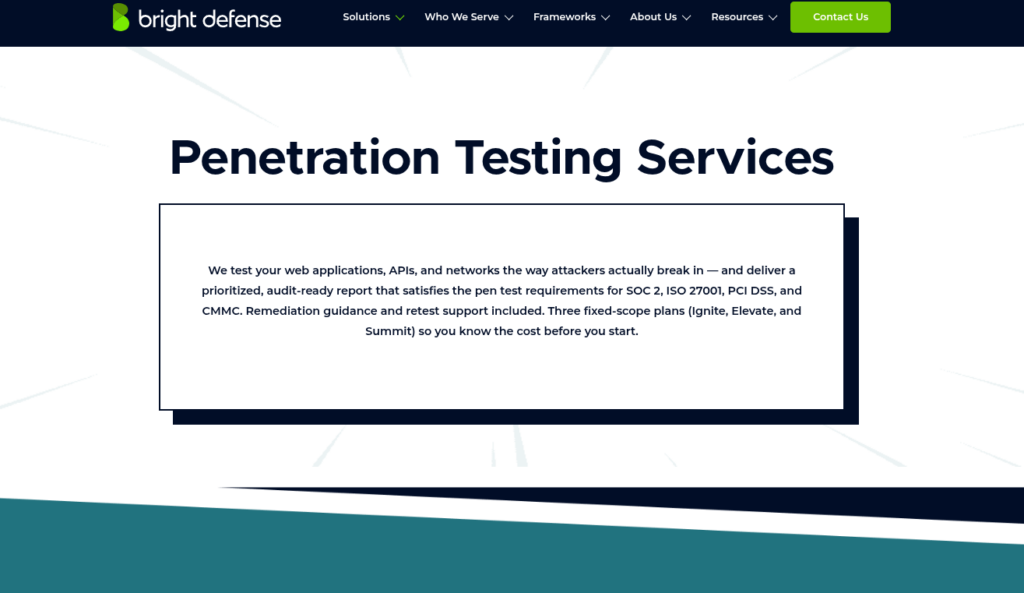
Bright Defense provides fixed-price VAPT for small and mid-sized organizations that want security testing connected to an active compliance program.
Founded in 2023 and based in Culver City, California, the company is led by co-founders Tim Mektrakarn and John Minnix. Mektrakarn holds CISSP, CISA, and ISO 27001 Lead Auditor credentials, while Minnix brings managed services and technology consulting experience.
Bright Defense tests web applications, APIs, and internal and external networks. Public plans state testing hours and asset limits in advance. Manual testing follows automated enumeration and focuses on weaknesses that can be exploited in practice
The technical report documents each confirmed finding. It includes evidence, severity, affected assets, and remediation guidance. The service fits firms pursuing SOC 2, ISO 27001, HIPAA, PCI DSS, NIST, or CMMC. The same engagement can connect findings to risk treatment, policy work, remediation tracking, and audit evidence.
| Attribute | Bright Defense |
|---|---|
| Founded | 2023 |
| Base | Culver City, California |
| Leadership | Tim Mektrakarn and John Minnix |
| Delivery | Fixed-scope consultant-led engagements |
| Core Scope | Web, API, internal network, and external network testing |
| Notable Standing | Drata Gold Partner |
| Reporting | Technical findings plus compliance and remediation context |
| Retesting | Included within the purchased engagement terms |
Strengths
- Public packages state testing hours, web endpoints, API endpoints, and price.
- Compliance consultants can move confirmed findings into a wider remediation program.
- The service model suits organizations with limited internal security staffing.
- Customers receive one provider for testing, compliance preparation, vCISO work, and ongoing risk management.
Limitations
- The fixed packages cover fewer assets than many enterprise PTaaS contracts.
Pricing: Public plans list $2,750 for 48 testing hours, $5,250 for 96 hours, and $9,250 for 176 hours. Final scope depends on the target count and test type.
Best For: Small and mid-sized firms that need predictable pricing, practical remediation support, and VAPT evidence for compliance work.
2. NetSPI: Enterprise Penetration Testing as a Service
NetSPI provides VAPT services to enterprises that need a large in-house testing team, a mature PTaaS platform, and recurring coverage across many asset classes. The company was founded in 2001 and operates from Minneapolis. Aaron Shilts serves as president and CEO, while co-founder Deke George serves as chairman.
NetSPI tests applications, APIs, networks, and cloud environments. Its scope extends to mobile applications, mainframes, hardware, AI systems, and attack simulation.
Its platform combines scoping, scheduling, findings, remediation workflows, and historical results.
Manual exploitation remains central to the service. Testers validate scanner findings and examine business logic. They can then connect weaknesses into attack paths and document practical impact. Teams can track findings inside the platform, assign owners, integrate tickets, compare repeated tests, and request validation after remediation.
| Attribute | NetSPI |
|---|---|
| Founded | 2001 |
| Base | Minneapolis, Minnesota |
| Leadership | Aaron Shilts, President and CEO; Deke George, Chairman |
| Delivery | In-house PTaaS |
| Core Scope | Application, network, cloud, mainframe, hardware, and AI testing |
| Tester Credentials | OSCP, OSCE, GXPN, GPEN, GWAPT, CISSP, CEH, and CREST examples |
| Reporting | Live findings, dashboards, exports, and workflow integrations |
| Retesting | Contract and program dependent |
Strengths
- An in-house team supports consistent delivery controls across large programs.
- The platform centralizes results from repeated assessments and many business units.
- Scope reaches legacy systems, cloud, hardware, and newer AI targets.
- Published tester credential examples help procurement teams evaluate technical staffing.
Limitations
- The enterprise operating model may exceed the needs of a company with one small application.
- Platform onboarding and governance can require more planning than a one-time consultancy engagement.
Pricing: NetSPI provides custom quotes based on scope, cadence, asset count, and service type. The company does not publish a standard VAPT price list.
Best For: Enterprises that run repeated tests across applications, infrastructure, cloud systems, business units, and regulatory programs.
We see NetSPI as a better fit for organizations running recurring penetration testing across a large environment. A smaller company purchasing one fixed-scope test may not need the full PTaaS platform and program structure.
3. Bishop Fox: Research-Led Offensive Security Consulting
Bishop Fox offers VAPT services to organizations that value deep manual testing, specialist research, and high-consequence attack simulation. The firm was founded in 2005 by Vincent Liu and Francis Brown. Vincent Liu serves as CEO, and the company lists Tempe as its headquarters, a remote-first workforce, and offices in San Francisco, London, and Barcelona.
Bishop Fox tests web, mobile, cloud, network, and embedded systems. Its services extend to red teaming, product security, architecture reviews, and vendor assessments. Its consultants use manual attack methods supported by internal tooling and security research.
Engagements can examine business logic, trust boundaries, identity systems, cloud control planes, source code, and full attack paths.
Reports separate executive risk from technical findings. Technical sections provide evidence and remediation guidance. The company’s compliance services map testing to standards such as PCI DSS, FedRAMP, NIST, and other customer requirements, while its CREST standing gives procurement teams an external service-quality signal.
| Attribute | Bishop Fox |
|---|---|
| Founded | 2005 |
| Base | Tempe, Arizona |
| Leadership | Vincent Liu, CEO and Co-Founder; Francis Brown, Co-Founder |
| Delivery | Specialist consultancy with recurring service options |
| Core Scope | Applications, cloud, networks, red teams, and compliance testing |
| Accreditation | CREST-accredited in the United States and United Kingdom |
| Reporting | Executive analysis, technical evidence, and remediation guidance |
| Retesting | Set through engagement scope |
Strengths
- Security research and internal tooling support work on unusual or high-risk targets.
- The firm covers product security and attack simulation beyond routine application tests.
- CREST accreditation supports enterprise and international procurement reviews.
- Senior consultants can examine architecture and trust assumptions that scanners miss.
Limitations
- Public standard prices and fixed retest terms are not available.
- The consultancy model does not present the same self-service buying path as a credit-based PTaaS platform.
- Deep specialist engagements can require longer scoping and scheduling cycles.
Pricing: Bishop Fox quotes each engagement after scope review. Buyers should request named retest terms, delivery dates, tester seniority, and report samples in the statement of work.
Best For: Enterprises with high-value applications, complex cloud architecture, product security needs, or realistic adversary simulation requirements.
We would consider Bishop Fox when technical depth and specialist offensive security expertise carry more weight than pricing transparency or a simple purchasing process. Its model fits complex applications and attack simulation particularly well.
4. Coalfire: VAPT Tied to Formal Compliance Assessment
Coalfire offers VAPT services to regulated organizations that need penetration testing connected to FedRAMP, PCI DSS, cloud assurance, or formal assessment work. Founded in 2001, Coalfire lists a Chicago mailing address and uses Chicago in its January 2026 CEO announcement. Brad Little became CEO on January 6, 2026. Some third-party company directories still show Westminster, Colorado, reflecting the firm’s prior public location.
Coalfire delivers offensive security through DivisionHex and performs compliance penetration testing through its assessment teams. Services cover applications, networks, cloud systems, red teams, adversary simulation, vulnerability research, and regulated attack vectors. FedRAMP work includes the six prescribed penetration test vectors and assessment reporting.
The firm has unusual strength where a penetration test forms one part of a formal authorization or audit. Customers can pair technical testing with PCI, FedRAMP, ISO, SOC, healthcare, and federal assessment expertise, subject to independence rules that separate advisory work from the final independent assessment.
| Attribute | Coalfire |
|---|---|
| Founded | 2001 |
| Base | Chicago mailing address |
| Leadership | Brad Little, CEO, effective January 6, 2026 |
| Delivery | Assessment teams plus DivisionHex offensive security |
| Core Scope | Penetration testing, red teams, vulnerability research, and compliance assessments |
| Accreditation | FedRAMP 3PAO |
| Reporting | Technical reports and formal assessment artifacts |
| Retesting | Framework and contract dependent |
Strengths
- FedRAMP expertise covers prescribed attack vectors and formal security assessment reports.
- PCI and cloud assessment experience suits highly regulated environments.
- DivisionHex gives the firm a dedicated offensive security practice.
- Assessment and advisory teams understand how technical findings affect authorization evidence.
Limitations
- Independence rules prevent one Coalfire team from providing advisory work and the final 3PAO assessment for the same FedRAMP authorization.
- Customers may need separate workstreams across DivisionHex, advisory, and assessment services.
- Public VAPT pricing and standard retest windows are not stated.
Pricing: Coalfire uses custom pricing based on attack vectors, framework, assessment role, environment size, and reporting duties.
Best For: Cloud service providers, payment environments, and enterprises that need VAPT within a formal compliance assessment.
We see Coalfire as particularly relevant when penetration testing forms part of a FedRAMP, PCI DSS, or other formal assessment program. Buyers should confirm independence requirements before combining advisory and assessment services.
5. NCC Group: Global Manual, Hybrid, and Autonomous Testing
NCC Group is a strong option for multinational organizations that need broad technical coverage, global delivery capacity, and procurement-recognized accreditation. It was formed in 1999, operates from Manchester, and is led by CEO Mike Maddison. Its operating history reaches back through the United Kingdom’s National Computing Centre.
NCC Group tests applications, networks, cloud platforms, and containers. Its scope extends to hardware, embedded systems, cryptography, wireless systems, and human attack paths.
Buyers can select manual consulting, autonomous testing, or a hybrid model. Its Cyber Services Portal presents findings, priorities, progress, and historical trends.
The hybrid and autonomous network tiers use Horizon3.ai’s NodeZero platform, while NCC consultants handle scoping, interpretation, and deeper manual work. This gives customers a choice between lower-cost repeatable validation and high-touch assessment for critical systems.
| Attribute | NCC Group |
|---|---|
| Formed | 1999 |
| Base | Manchester, United Kingdom |
| Leadership | Mike Maddison, CEO |
| Delivery | Manual, hybrid, and autonomous testing |
| Core Scope | Applications, networks, cloud, hardware, containers, and attack simulation |
| Accreditation | CREST, NCSC CHECK, PCI QSA, and PCI ASV standing |
| Reporting | Cyber Services Portal and formal reports |
| Retesting | Contract and service-tier dependent |
Strengths
- Coverage reaches software, infrastructure, hardware, embedded systems, and cryptography.
- CREST, NCSC CHECK, and PCI status support regulated procurement.
- Global teams suit programs that span regions and time zones.
- Manual, hybrid, and autonomous options let buyers vary depth and cadence by asset.
Limitations
- The hybrid and autonomous network tiers depend on third-party NodeZero technology.
- Autonomous coverage centers on network use cases and does not replace every specialist assessment.
- A large global service catalog can make ownership and scoping more complex.
Pricing: NCC Group provides custom quotes. Buyers should separate platform-led network validation from consultant-led application, cloud, hardware, or red team work in the proposal.
Best For: Global enterprises, critical infrastructure operators, and regulated buyers that need recognized accreditation across many test types.
6. Cobalt: Credit-Based PTaaS for Software Teams
Cobalt fits software organizations that value fast scheduling, flexible credit-based purchasing, and a PTaaS model built around continuous access to findings.
Founded in 2013 by Jacob Hansen, Christian Hansen, Jakob Storm, and Esben Friis Jensen, the company is now led by CEO Sonali Shah. Its locations include San Francisco, Boston, Oxford, and Berlin.
Cobalt tests web applications, APIs, mobile applications, external networks, cloud systems, and related software targets. One credit equals eight testing hours, and published plans state launch targets of three, two, or one business day with retest windows of six or 12 months, depending on tier.
The platform supports scoping, scheduling, live findings, tester communication, integrations, and retesting. Cobalt introduced Autonomous Pentest at Black Hat USA 2026, with general availability in August 2026. The autonomous service starts with web application coverage and routes selected results through human quality review.
| Attribute | Cobalt |
|---|---|
| Founded | 2013 |
| Locations | San Francisco, Boston, Oxford, and Berlin |
| Leadership | Sonali Shah, CEO |
| Delivery | Credit-based PTaaS plus autonomous web testing |
| Core Scope | Web, API, mobile, external network, cloud, and software testing |
| Accreditation | CREST, ISO 27001, and SOC 2 Type II |
| Reporting | Live findings, collaboration, integrations, and final reports |
| Retesting | Six or 12 months, based on plan |
Strengths
- Credits give product teams a reusable purchasing unit across several test types.
- Published launch and retest terms make operational planning easier.
- The platform keeps tester communication and remediation evidence close to each finding.
- Autonomous web testing adds a lower-cost option for wider application coverage.
Limitations
- Cobalt’s pricing table states that Enterprise customers may roll over up to 10% of credits, while the FAQ on the same page says credits do not roll over.
- Credit validity can leave unused capacity at risk near the contract end date.
- Autonomous Pentest begins with web applications and does not replace all human-led scopes.
Pricing: Cobalt sells credits through plan tiers and custom contracts. A limited promotion lists Autonomous Pentest at $3,500 through December 31, 2026.
Best For: SaaS and product teams that need fast launch times, integrated workflows, and multiple tests under one credit contract.
We would consider Cobalt for product teams that run several tests each year and can use the credit model consistently. Teams purchasing one limited-scope assessment should compare the credit contract with a fixed-scope engagement.
7. Synack: Vetted Researcher Network for Continuous Testing
Synack is well suited to federal and enterprise buyers looking for a tightly vetted researcher network, continuous testing capacity, and a FedRAMP-authorized platform.
Former federal security operators Jay Kaplan and Dr. Mark Kuhr founded the company in 2013. Kaplan serves as CEO, Kuhr serves as CTO, and Synack lists Redwood City, California, as its principal office.
Synack combines the Synack Red Team with its platform and Sara autonomous testing. Services cover web applications, APIs, mobile applications, networks, cloud systems, and external attack surfaces. Researchers pass technical screening, identity verification, and background checks before they receive access to customer work.
Customers can purchase focused Sara testing or human-led packages such as Synack14, Synack90, and Synack365. Findings appear in the platform with evidence, validation, severity, and remediation status. The company’s FedRAMP Moderate authorization and CREST accreditation support public-sector and regulated procurement.
| Attribute | Synack |
|---|---|
| Founded | 2013 |
| Base | Redwood City, California |
| Leadership | Jay Kaplan, CEO; Dr. Mark Kuhr, CTO |
| Delivery | Vetted researcher network plus AI-assisted testing |
| Core Scope | Web, API, mobile, network, cloud, and external assets |
| Accreditation | FedRAMP Moderate and CREST accreditation |
| Reporting | Platform findings, evidence, status, and reporting exports |
| Retesting | Uses purchased testing periods and credits |
Strengths
- FedRAMP Moderate authorization creates a clear route for federal procurement.
- Researcher screening includes identity, background, and technical checks.
- Human and autonomous testing can run under one operating platform.
- Public package prices give buyers a starting point before custom enterprise scoping.
Limitations
- The platform fee appears as a separate line item from testing packages.
- Purchased credits expire after one year under the published pricing terms.
- The researcher-network model can require extra legal, data-access, and governance review for sensitive systems.
Pricing: Synack lists starting prices of $4,181 for Sara Pentest, $10,283 for SynackST, and $27,120 for Synack14. Longer Synack90 and Synack365 programs require custom quotes, and the platform carries separate pricing.
Best For: Federal agencies and enterprises that want continuous testing from vetted researchers under a controlled platform.
8. TrustedSec: Senior Consultant-Led Security Assessments
TrustedSec appeals to buyers seeking direct access to experienced consultants and broad technical testing without relying on a crowdsourced PTaaS model.
David Kennedy founded the company in 2012, and TrustedSec operates from Fairlawn, Ohio. Kennedy remains the company’s founder and CEO, according to its headquarters announcement.
TrustedSec performs application, network, wireless, cloud, social engineering, red team, physical, source code, hardware, IoT, and software security assessments. Its application work references OWASP methods, while its consultants test authentication, authorization, business logic, APIs, mobile software, and code-level weaknesses.
Reports include executive context, technical proof, and corrective guidance. The company states that retesting forms part of its penetration testing service, and its CREST certification and PCI QSA company status support procurement where those qualifications matter.
| Attribute | TrustedSec |
|---|---|
| Founded | 2012 |
| Base | Fairlawn, Ohio |
| Leadership | David Kennedy, Founder and CEO |
| Delivery | Senior consultant-led engagements |
| Core Scope | Applications, networks, cloud, red teams, social engineering, and physical testing |
| Accreditation | CREST certified; PCI QSA company |
| Reporting | Executive findings, technical evidence, and remediation detail |
| Retesting | Available within penetration testing engagements |
Strengths
- The service catalog reaches software, infrastructure, human, physical, and connected-device risks.
- Direct consultant access suits unusual environments and deep technical questions.
- CREST and PCI QSA standing support regulated procurement.
- Hardware and IoT work gives product companies a specialist option beyond standard web testing.
Limitations
- The firm does not offer the same self-service scheduling and live program interface as leading PTaaS platforms.
- Its public cloud assessment page names AWS and Azure, with thinner published detail for Google Cloud.
- Pricing, launch targets, and universal retest periods require a custom statement of work.
Pricing: TrustedSec quotes engagements after technical scoping. Buyers should request the assigned team, test window, retest allowance, and report format in writing.
Best For: Organizations that prefer a specialist consultancy and want experienced testers across software, infrastructure, social, physical, or hardware scopes.
9. Rapid7: Penetration Testing Within a Wider Security Portfolio
Rapid7 works particularly well for existing customers and enterprises that want manual penetration testing connected to vulnerability management, Metasploit, and continuous red team services.
The company was initially incorporated in July 2000 and maintains its global headquarters in Boston. Wael Mohamed became CEO on June 1, 2026, while Corey Thomas moved to executive chairman.
Rapid7 tests internal and external networks, web applications, mobile applications, wireless networks, social engineering controls, IoT, industrial systems, and red team scenarios.
Its application, mobile, and wireless methods reference OWASP, OSSTMM, and PTES. Consultants draw from Metasploit research and produce reports with technical findings and program-level recommendations.
The company sells professional services, managed services, and software under separate offerings. Buyers should distinguish a human penetration test from InsightVM, InsightAppSec, InsightCloudSec, Metasploit, and Vector Command licensing when reviewing a proposal.
| Attribute | Rapid7 |
|---|---|
| Founded | 2000 |
| Base | Boston, Massachusetts |
| Leadership | Wael Mohamed, CEO; Corey Thomas, Executive Chairman |
| Delivery | Professional services plus software and managed services |
| Core Scope | Network, application, mobile, wireless, IoT, social, and red team testing |
| Accreditation | CREST membership for penetration testing services |
| Reporting | Technical findings and strategic recommendations |
| Retesting | Defined in the professional services contract |
Strengths
- Manual services cover people, processes, applications, infrastructure, and connected devices.
- Metasploit research gives consultants direct access to a major exploitation project.
- Existing Rapid7 customers can connect testing to familiar vulnerability and security operations tools.
- The service covers IoT and industrial control environments that many general VAPT providers omit.
Limitations
- Penetration testing, continuous red teaming, managed application testing, and software licensing can require separate contracts.
- Public software prices do not represent the cost of a consultant-led penetration test.
- A broad portfolio may make the buying path less direct for a customer seeking one fixed-scope test.
Pricing: Rapid7 does not publish consultant-led penetration testing prices. The following amounts apply to software products, not penetration tests.
| Product | Published Starting Price |
|---|---|
| InsightVM | $1.62 per asset per month at 500 assets |
| InsightAppSec | $175 per application per month |
| InsightCloudSec | $5,775 per month for up to 500 instances |
Best For: Enterprises already invested in Rapid7 products or teams that need VAPT near a wider managed security program.
We see the clearest fit for existing Rapid7 customers. Buyers should separate consultant-led penetration testing from software licensing so the actual testing effort can be compared fairly with other providers.
10. UnderDefense: Penetration Testing, MDR, and Compliance Security
UnderDefense is a practical fit for organizations that want penetration testing connected with managed detection and response (MDR), incident response, and compliance services.
Founded in 2017, the company is headquartered in New York and is led by founder and CEO Nazar Tymoshyk. UnderDefense began with a focus on penetration testing before expanding into managed security services.
Its testing covers web applications, mobile applications, APIs, cloud environments, networks, wireless systems, IoT, social engineering, and red teaming. UnderDefense provides MDR, managed SOC, incident response, cloud security, vCISO, and compliance consulting services as well.
| Attribute | UnderDefense |
| Founded | 2017 |
| Base | New York, United States |
| Leadership | Nazar Tymoshyk, Founder and CEO |
| Delivery | Consultant-led penetration testing with managed security services |
| Core Scope | Web, mobile, API, cloud, network, wireless, IoT, social engineering, and red teaming |
| Certifications | ISO 27001 and SOC 2 company certifications |
| Reporting | Executive summary, technical findings, business risks, remediation guidance, and detailed evidence |
| Retesting | Free post-remediation assessment |
Company history and headquarters information are based on current UnderDefense materials. Its published penetration testing information confirms the free post-remediation assessment, while an anonymized report shows detailed findings, risk summaries, methodology, recommendations, and MITRE ATT&CK mapping.
Strengths
- Penetration testing covers application, network, cloud, IoT, wireless, and human attack surfaces.
- Clients can combine offensive testing with 24/7 MDR, managed SOC, and incident response services.
- A free post-remediation assessment gives clients a defined way to verify fixes after the initial test.
- Published sample reports provide useful evidence of the reporting structure and technical depth.
Limitations
- ISO 27001 and SOC 2 certifications relate to UnderDefense’s organizational controls and should not be treated as specialist penetration-testing accreditations.
- Engagement cost varies with scope, complexity, testing depth, and duration, so a final price requires scoping.
- Buyers with industry-specific procurement rules should verify tester credentials, testing location, contractual requirements, and regulatory acceptance before signing.
Pricing: UnderDefense states that penetration testing commonly ranges from $5,000 to $30,000, depending on the complexity and duration of the attack simulation. Custom quotes are available through its penetration testing pricing process.
Best For: Organizations that want penetration testing from a provider that can continue working with the security program through MDR, managed SOC, incident response, cloud security, and compliance services.
What VAPT Actually Includes
VAPT combines two related forms of technical security testing. The vulnerability assessment creates breadth across the defined scope, while the penetration test creates depth through controlled exploitation and attack-path analysis.
| Component | Primary Purpose | Typical Activities | Main Output |
|---|---|---|---|
| Vulnerability Assessment | Detect and prioritize potential weaknesses | Asset enumeration, authenticated and unauthenticated scanning, configuration review, patch checks, version analysis, and false-positive review | A prioritized inventory of suspected weaknesses with affected assets and severity |
| Penetration Testing | Confirm exploitability and business impact | Manual exploitation, business-logic testing, privilege escalation, credential attacks, lateral movement, data-access tests, and chained attack paths | Validated findings with proof, attack narrative, impact, and remediation guidance |
A sound VAPT program states which testing method applies to each target. Scope documents normally name the specific types of penetration testing in use, along with the black box, grey box, or white box access model assigned to each one.
OWASP WSTG supplies detailed web and API test cases. PTES covers pre-engagement work, intelligence gathering, threat modeling, vulnerability analysis, exploitation, post-exploitation, and reporting. OSSTMM addresses operational security testing across technical and human channels. NIST SP 800-115 gives federal guidance for planning tests, running examinations, analyzing results, and forming mitigation strategies. MITRE ATT&CK provides a common model for adversary tactics and techniques that supports red team and attack-path scenarios.
Credentials offer useful staffing signals. Report review, references, and interviews with the assigned testers remain necessary. OSCP supports hands-on penetration testing competence. CISSP suits program leads who manage security strategy, architecture, risk, and testing. CISA suits leaders who connect technical evidence to audit, controls, governance, and compliance.
Compliance Frameworks That Require VAPT
Some frameworks directly mandate penetration testing, while others require risk analysis, vulnerability management, control testing, or independent assessment that often uses VAPT as evidence. Buyers should trace the exact obligation to the applicable version, entity type, system boundary, and regulator.
- PCI DSS Requirement 11.4: PCI DSS v4.0.1 requires external and internal penetration testing at least annually and after significant changes, with segmentation testing where segmentation reduces cardholder-data scope.
- SOC 2: The AICPA Trust Services Criteria do not impose one universal penetration-test schedule. A service organization may use VAPT as evidence for risk assessment, control monitoring, vulnerability management, change controls, and system security. SOC 2 penetration testing covers how auditors treat that evidence and where scanning alone stops short.
- ISO 27001: ISO/IEC 27001:2022 requires an information-security risk management system. VAPT commonly supports risk assessment and technical control evaluation, but the standard does not prescribe one test frequency for every certified organization.
- HIPAA: The current HIPAA Security Rule requires accurate and thorough risk analysis and periodic evaluation, not a universal annual penetration test. HHS guidance names vulnerability scanning as one method. A proposed rule would require scans every six months and penetration testing every 12 months, but that proposal is not the current final rule.
- FedRAMP: FedRAMP control CA-08 requires penetration testing at an assigned frequency. FedRAMP guidance defines mandatory attack vectors and ties testing to vulnerability detection and authorization work.
- CMMC: CMMC Level 2 draws from NIST SP 800-171. Requirement 03.11.02 requires vulnerability monitoring, scanning, remediation, and scanning updates. It does not create one blanket penetration-test schedule for every contractor, though VAPT can provide strong assessment evidence.
- RBI: The RBI information-technology governance directions require vulnerability assessment at least every six months and penetration testing at least every 12 months for critical or customer-facing DMZ systems, plus testing after major changes.
- SEBI: The SEBI Cybersecurity and Cyber Resilience Framework sets VAPT duties for regulated entities, with scope, cadence, remediation, and reporting based on entity category and current clarifications.
- IRDAI: IRDAI’s cyber-security amendment requires insurers to conduct periodic VAPT across the ICT infrastructure and repeat VA and PT when software applications or configurations change.
How to Choose a VAPT Company
Choose a VAPT company through documented technical expertise, manual testing depth, report quality, secure data handling, remediation support, and procurement readiness. Compare every provider against the same scope and deliverables, then confirm that the assigned testers have experience with the target environment.
1. Define the VAPT Engagement Scope
Define the VAPT engagement scope before requesting proposals so each company prices and plans the same work. The scope should name the systems, environments, boundaries, user roles, locations, and operating restrictions included in the test.
Common targets include:
- Internet-facing networks and cloud infrastructure
- Internal networks and Active Directory
- Web applications and APIs
- Mobile applications
- Containers and Kubernetes environments
- Wireless networks and connected devices
Internal and external ranges carry different assumptions about attacker position. Network penetration testing scopes should state which perimeter, segments, and directory services the tester may reach. Record the number of IP addresses, domains, applications, cloud accounts, authenticated roles, and physical locations. State whether production testing is permitted, which assets are excluded, and which hours allow active testing.
A qualified VAPT company reviews these details before issuing a final proposal. Immediate quotations based on limited information can hide reduced coverage, unclear assumptions, or additional fees.
2. Evaluate the VAPT Company’s Technical Expertise
Evaluate technical expertise against the exact systems and technologies included in the engagement. Web applications, APIs, cloud platforms, mobile applications, and internal networks require different testing skills.
The provider should document experience with the platforms in scope, such as AWS, Microsoft Azure, Google Cloud, Kubernetes, Active Directory, Android, iOS, REST APIs, GraphQL, and single sign-on systems. REST and GraphQL endpoints warrant separate confirmation, because API penetration testing depends on authorization logic and object-level access controls that generic web testing skips.
The proposal should name the assigned testers, their seniority, relevant project experience, and any subcontractors who may access client systems.
Certifications such as OSCP, OSWE, OSEP, GPEN, GWAPT, PNPT, and CREST provide evidence of technical training. Practical experience with comparable applications and infrastructure remains a central buying criterion.
Bright Defense provides cloud, web application, API, network, and mobile penetration testing. Organizations considering Bright Defense can use the scoping process to confirm that the assigned testers have direct experience with each technology included in the engagement.
3. Review the VAPT Testing Methodology
Review the testing methodology to confirm that the provider follows a repeatable process suited to the target environment. Common reference standards include the OWASP Web Security Testing Guide, OWASP API Security Top 10, OWASP Mobile Application Security Testing Guide, NIST SP 800-115, PTES, and MITRE ATT&CK.
A complete methodology should describe this sequence:
- Confirm the scope and written authorization.
- Gather technical and architectural information.
- Map attack surfaces and potential attack paths.
- Run controlled automated reconnaissance.
- Perform manual testing and controlled exploitation.
- Report findings and verify remediation.
The methodology should reflect the engagement type. API testing examines authorization, object-level access, token handling, rate limits, input controls, and business logic. Cloud penetration testing examines identity permissions, exposed storage, network rules, secrets, logging, and trust relationships, with scope set against the shared responsibility model for the platform in use.
A generic methodology with no connection to the actual systems provides limited evidence of testing depth.
4. Compare Vulnerability Assessment, Automation, and Manual Penetration Testing
A complete VAPT engagement combines vulnerability assessment, automated testing, manual validation, and controlled exploitation. A vulnerability assessment detects known weaknesses. Penetration testing validates those weaknesses, tests attack paths, and measures practical impact.
| Testing Component | Primary Purpose | Buying Significance |
| Automated scanning | Finds known vulnerabilities, exposed services, outdated software, and configuration errors | Provides broad and repeatable coverage |
| Manual validation | Confirms whether scanner findings are genuine and exploitable | Reduces false positives and improves severity accuracy |
| Manual penetration testing | Examines access control, authentication, session handling, and privilege boundaries | Finds weaknesses that scanners cannot evaluate reliably |
| Business logic testing | Tests workflows, role separation, transaction rules, and abuse cases | Finds application-specific risks with operational impact |
| Controlled exploitation | Demonstrates the access, data, or privilege an attacker could obtain | Shows the real consequence of a weakness |
Manual coverage should include broken access control, authentication bypass, privilege escalation, business logic abuse, insecure object references, and multi-step attack paths. The final report should separate verified vulnerabilities from automated scanner output.
At Bright Defense, we separate automated reconnaissance from manual testing so clients can see where hands-on testing effort goes. The scope can define manual validation, business logic testing, controlled exploitation, and the systems included in each activity.
5. Evaluate a Sample VAPT Report
Evaluate a redacted sample report before selecting a VAPT company. A penetration testing report is the principal technical record used by executives, engineers, compliance teams, customers, and auditors.
A strong report includes:
- Executive summary and overall risk position
- Scope, dates, methodology, and limitations
- Severity summary and finding inventory
- Evidence, affected assets, and reproduction steps
- Business impact and technical remediation
- Retest status and closure evidence
Each finding should state the weakness, affected location, validation method, potential impact, and required correction. Screenshots, requests, responses, payloads, and logs should support the conclusion without exposing unnecessary sensitive data.
The executive summary should explain material risk in language that business leaders can understand. The technical section should give developers and infrastructure teams enough detail to reproduce and correct each issue.
We recommend reviewing a redacted sample report before selecting any penetration testing provider, including Bright Defense. It gives buyers a practical way to assess evidence quality, reproduction steps, remediation guidance, and the level of technical detail they will receive. The sample should show how Bright Defense documents evidence, explains business impact, presents reproduction steps, and recommends practical corrections.
6. Review the VAPT Risk Rating Method
Review the risk rating method to confirm that severity reflects technical exploitability and business context. CVSS provides a consistent technical score, though the final rating should account for exposure, privilege, sensitive data, affected users, compensating controls, and the role of the vulnerable system.
A technically moderate issue can create high business risk when it affects administrative functions, payment workflows, regulated records, or customer data. An exposed weakness may receive a higher priority than an internal issue with stronger access controls.
A qualified provider documents the reason for each severity level. The report should explain any adjustment made after reviewing the client’s operating context.
7. Verify Industry and Regulatory Experience
Verify experience with organizations that share similar technologies, data types, and regulatory obligations. Industry familiarity helps testers focus on realistic attack paths and prepare evidence that supports internal compliance work.
Relevant frameworks may include:
- SOC 2
- ISO 27001
- PCI DSS
- HIPAA
- CMMC
- FedRAMP
The provider should explain which control requirements the engagement supports and which obligations remain outside the test. A penetration test can provide evidence for an audit or assessment, though it does not create full compliance on its own.
Sector experience matters most when the environment contains specialized systems, regulated data, or strict procurement requirements.
8. Review VAPT Data Security and Confidentiality
Review how the company protects credentials, evidence, reports, source code, and architecture information. Weak storage, access, or deletion controls can expose critical systems and sensitive data.
The provider should document:
- Encryption for stored and transferred data
- Role-based access to client materials
- Credential storage and revocation procedures
- Evidence retention and secure deletion periods
- Employee screening and subcontractor controls
- Incident response and client notification processes
Contracts should define confidentiality duties, report ownership, storage locations, access rights, retention periods, and deletion requirements. Secure portals with named-user access provide greater control over report and evidence delivery.
9. Confirm the VAPT Rules of Engagement
Confirm written rules of engagement before any testing begins. These rules define authorized targets, permitted techniques, operating limits, and emergency procedures.
The document should cover:
- Approved targets and excluded systems
- Testing dates, hours, and source addresses
- Permitted and prohibited techniques
- Critical contacts and escalation paths
- Stop-testing conditions
- Data access, extraction, and destruction limits
High-risk activities require explicit written approval. Examples include phishing, password spraying, persistence testing, production data access, physical intrusion, and denial-of-service testing.
Third-party systems require separate authorization from their owner. The client and testing company should retain written approval throughout the engagement.
10. Evaluate Communication During VAPT Testing
Evaluate the communication plan so critical findings and operational issues reach the correct people quickly. The engagement plan should name the primary contact, status cadence, approved communication channel, emergency contacts, and escalation procedure.
Confirmed critical vulnerabilities should be reported as soon as the tester validates them. Scheduled updates help teams resolve access problems, clarify system behavior, and track progress.
The final report review should include technical owners who can discuss evidence, remediation steps, and retesting requirements.
11. Review Remediation and Retesting Support
Review remediation and retesting terms before contract signature. Effective support includes a findings review, technical clarification, a defined retest period, verification, and an updated report or retest letter.
The proposal should state:
- Number of included retest rounds
- Findings eligible for retesting
- Length of the retest window
- Required evidence from the client
- Updated report format
- Additional retest fees
Retesting should confirm that the original weakness no longer works and that no equivalent attack path remains. Open findings should retain evidence and a clear explanation of residual risk.
12. Confirm Attestation Letter Availability
Confirm attestation letter availability when the penetration test supports SOC 2, ISO 27001, or a customer security questionnaire. An attestation letter gives auditors, prospects, and business partners a concise record that testing occurred without disclosing sensitive technical findings.
The letter should state the provider, client, engagement type, scope summary, testing dates, methodology, and high-level result. It may state whether critical findings were present and whether remediation or retesting occurred.
The document should omit credentials, internal asset names, exploit details, screenshots, and reproduction steps. Request the letter during procurement so its format, delivery date, revision terms, and approved recipients appear in the contract.
Organizations purchasing penetration testing from Bright Defense for SOC 2, ISO 27001, or customer assurance should confirm attestation letter terms during scoping. Bright Defense can then account for the requested letter, delivery timeline, and retest status within the engagement plan.
13. Choose a VAPT Testing Cadence and Delivery Model
Choose the testing cadence and delivery model according to release frequency, system change, and assurance requirements. Annual point-in-time testing suits stable environments with limited architectural change and a yearly audit cycle.
Continuous testing and penetration testing as a service, commonly called PTaaS, suit SaaS platforms, cloud-native environments, and teams that release frequently. These models can connect testing to new APIs, major software releases, cloud migrations, and infrastructure changes.
| Delivery Model | Best-Suited Environment | Main Buying Consideration |
| Annual point-in-time test | Stable applications and infrastructure | Records risk during a defined audit period |
| Release-based testing | Applications with scheduled major releases | Tests material changes before or after deployment |
| Continuous or PTaaS testing | SaaS and cloud systems with frequent updates | Provides recurring testing access across the year |
Buyers should define included testing hours, coverage windows, reporting frequency, and the events that trigger each test cycle.
14. Verify Professional Liability and Cyber Insurance
Verify professional liability and cyber insurance before the vendor enters security or procurement review. Procurement teams commonly request certificates of insurance that prove the provider can respond to claims connected to errors, service failures, data exposure, or security incidents.
Relevant coverage includes:
- Professional liability
- Errors and omissions insurance
- Cyber liability insurance
- Commercial general liability
- Workers’ compensation
- Umbrella or excess liability
Certificates should state policy limits, effective dates, insurer, covered legal entity, and cancellation terms. Contract value, data sensitivity, and testing risk may determine the minimum limits.
Uninsured providers frequently fail vendor review because the client carries greater financial exposure after an error, outage, or data incident.
15. Compare VAPT Pricing and Normalize Quotes
Compare VAPT pricing through equivalent scope, effort, and deliverables. Published penetration testing pricing ranges give a baseline before quotes arrive, though total price has limited meaning when proposals contain different testing depths, report standards, retest access, or support terms.
Normalize each quote against:
- Exact systems, roles, and environments in scope
- Estimated manual testing hours
- Assigned tester seniority
- Report depth and evidence requirements
- Included remediation meetings
- Retest rounds, window, and deliverables
The proposal should state exclusions, assumptions, travel costs, expedited fees, and change-control terms. Manual testing hours deserve close attention because two providers may quote the same scope with very different levels of effort.
A normalized comparison helps procurement teams determine whether a lower quote reflects operational efficiency or reduced coverage. Unclear hours or deliverables should be revised before the proposals receive final scoring.
16. Check VAPT References and Independent Reputation
Check references and independent evidence to confirm delivery quality, technical depth, and responsiveness. Useful sources include client references, case studies, public research, conference presentations, responsible disclosures, and tester profiles.
References should address:
- Accuracy of the original scope
- Quality of the assigned testers
- Usefulness of the final report
- Speed of critical finding notification
- Quality of remediation guidance
- Reliability of retesting support
Public technical work can confirm active expertise in the required testing discipline. Direct evidence from comparable engagements should carry the greatest weight during selection.
17. Recognize VAPT Company Red Flags
Recognize red flags that indicate weak testing depth, unclear accountability, or poor procurement readiness.
| Red Flag | Buying Risk |
| Automated scans are sold as a complete penetration test | Manual attack paths may remain untested |
| The provider refuses to share a redacted sample report | Report quality cannot be assessed before purchase |
| The methodology remains vague or generic | Testing depth and coverage cannot be compared |
| The provider promises to find every vulnerability | The claim misrepresents the limits of security testing |
| The proposed timeline is implausibly short | Coverage may be superficial |
| Subcontractors are used without disclosure | Accountability and data access become unclear |
| Data retention and deletion terms are absent | Sensitive evidence may remain exposed |
| The contract offers no practical retesting path | Remediation cannot be independently verified |
A good VAPT engagement starts with a clear scope and qualified testers. Buyers need meaningful manual testing, useful reports, secure data handling, and defined retesting terms. The selected company should give technical, compliance, legal, and procurement teams a shared understanding of coverage, evidence, responsibilities, and limitations.
Frequently Asked Questions
What Is a VAPT Company?
A VAPT company assesses technical weaknesses and validates which weaknesses an attacker can exploit. Its work normally combines asset enumeration, vulnerability scanning, manual testing, exploitation, evidence collection, risk rating, reporting, remediation guidance, and retesting. Strong providers define the test boundary and attack permissions before work starts.
What Is the Difference Between a Vulnerability Assessment and a Penetration Test?
A vulnerability assessment detects possible weaknesses, while a penetration test confirms exploitability and impact. Assessments favor breadth across many assets. Penetration tests favor depth, manual reasoning, attack chains, business logic, and controlled access attempts. A VAPT engagement combines both when the scope and budget support that depth.
How Much Does VAPT Cost?
VAPT pricing depends on the test boundary, technical depth, delivery model, and retesting terms. Price changes with endpoints, roles, APIs, IP ranges, cloud accounts, source access, hardware, delivery speed, report duties, and platform fees.
How Often Should a Company Run VAPT?
VAPT frequency depends on regulation, system change rate, and technical risk. PCI DSS, FedRAMP, and RBI directions set specific cadences for covered environments. High-change software teams may need continuous or release-based testing, while stable systems may follow annual and change-triggered schedules.
What Should a VAPT Report Contain?
A VAPT report should contain an executive summary, scope, dates, methodology, constraints, validated findings, affected assets, evidence, severity logic, business impact, reproduction steps, remediation guidance, and retest status. Buyers should request separate technical and executive views when engineers, auditors, customers, and directors need different levels of detail.
Which Certifications Matter for a VAPT Provider?
Relevant certifications depend on the buyer’s scope and regulatory obligations. OSCP supports hands-on tester competence, CISSP supports security program leadership, and CISA supports audit and control knowledge. CREST, PCI QSA, FedRAMP 3PAO, NCSC CHECK, and CERT-In standing can matter at the company level for specific procurement paths.
Can Automated Testing Replace a Manual Penetration Test?
Automated testing cannot fully replace a skilled manual penetration test for complex or high-value systems. Automation scales asset coverage and repeats known checks quickly. Human testers examine business logic, authorization boundaries, chained weaknesses, unusual trust relationships, and practical attack decisions that scanners and autonomous tools may miss.
Related Reading
- 10 Best Penetration Testing Companies in the USA
- Top 30 Penetration Testing Companies Worldwide in 2026
Bright Defense provides fixed-scope web, API, internal network, and external network testing with remediation and compliance support. Review the Penetration Testing Services page to compare scope and pricing or request a test plan.