Claude Fable 5 Restored After U.S. Lifts Export Controls
Updated:
September 21, 2026
Anthropic restored global access to Claude Fable 5 on July 1, 2026, ending an 18-day suspension triggered by U.S. export controls over a reported jailbreak discovered during Amazon security testing.
Although the restrictions were lifted, the incident exposed unresolved questions about government oversight of frontier AI models, export-control authority, enterprise AI governance, and the responsibilities of organizations deploying advanced AI systems.
This article explains why the U.S. restricted Claude Fable 5 and Mythos 5, how the export-control dispute unfolded, the safeguards Anthropic introduced before restoring access, and the continuing restrictions on Mythos 5.
It examines the new data-retention requirements, cloud data-sharing obligations, export-control considerations, Executive Order 14409, industry reactions, enterprise governance recommendations, and the broader implications for future frontier AI releases.
The article concludes with the key legal and regulatory questions that remain unresolved as governments develop oversight frameworks for increasingly capable AI models.
Bright Defense helps organizations securely adopt AI technologies through Security Assessments, Continuous Compliance, and Penetration Testing that evaluate AI deployments, cloud environments, third-party vendor risk, and sensitive data protection.

What Happened To Claude Fable 5 Under The U.S. Export-Control Directive?
The U.S. government ordered Anthropic on June 12, 2026, to prevent every foreign national from accessing Claude Fable 5 and Mythos 5, including foreign nationals located inside the United States.
Anthropic said it could not verify user nationality in real time, so it disabled both models for all customers worldwide.
Anthropic said it received the directive at 5:21 p.m. Eastern Time. The government cited national security authorities but did not initially provide the company with detailed evidence explaining the concern, according to Anthropic’s public statement.
The restriction did not affect Claude Opus 4.8, Sonnet or Anthropic’s other generally available models. Anthropic asked AWS to revoke access to Claude Fable 5 and Claude Mythos 5 for all
Amazon Bedrock users to support compliance with the directive, according to a June 12, 2026, editor’s note on the AWS News Blog.
The government approved limited Mythos 5 access for a set of U.S. organizations on June 26, 2026, and Anthropic restored access on or around that date.
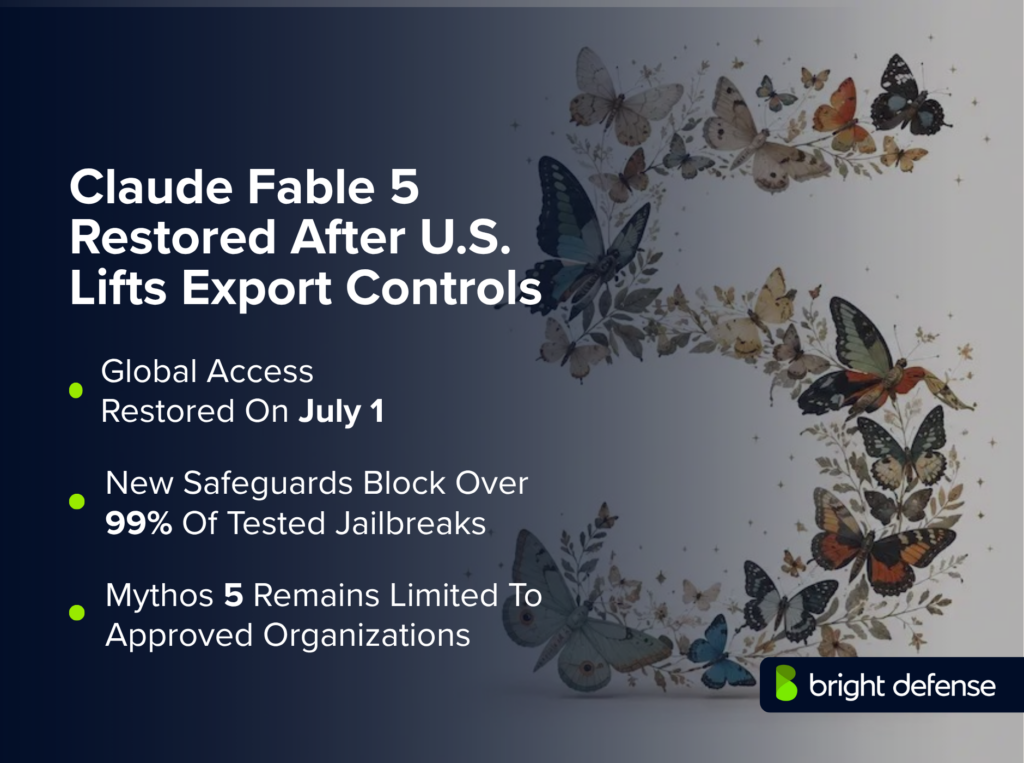
The Commerce Department lifted the broader controls on June 30, 2026. Anthropic restored Fable 5 globally the following day.
Why Did The U.S. Restrict Claude Fable 5 And Mythos 5?
The restrictions followed an Amazon report describing a prompt technique that bypassed Fable 5’s cybersecurity safeguards. Anthropic said the technique prompted the model to locate several known software vulnerabilities and, in one case, produce demonstration code showing how a vulnerability could be exploited.
Anthropic disputed the severity of the finding. Its tests found that Claude Opus 4.8, OpenAI GPT-5.5 and Kimi K2.7 could locate the same vulnerabilities. Several older models could produce the same exploit demonstration without the Fable 5 jailbreak, the company said.
Anthropic described the activity as routine defensive security research rather than access to a unique offensive capability. Amazon’s report and government reviewers treated the bypass as serious enough to justify an immediate national security response.
Mythos 5 presented a wider concern. Anthropic said the model can find and exploit software vulnerabilities more effectively than other models and all but the most skilled human researchers. Mythos 5 therefore remains restricted to vetted Project Glasswing partners working on defensive cybersecurity and critical infrastructure.
How Did The Claude Fable 5 Export-Control Dispute Unfold?
The dispute began three days after Anthropic released Fable 5 and Mythos 5 on June 9, 2026. The government imposed its directive on June 12, security leaders called for its reversal from June 14, and Commerce withdrew the controls on June 30 after Anthropic deployed and tested new safeguards.
The main events were:
- June 2, 2026: President Donald Trump signed Executive Order 14409, directing agencies to develop classified benchmarks and a voluntary prerelease review process for frontier AI models.
- June 9, 2026: Anthropic launched Claude Fable 5 for general use and Mythos 5 for a limited group of vetted partners.
- June 12, 2026: The government ordered Anthropic to prevent foreign-national access. Anthropic removed both models worldwide.
- June 14, 2026: Cybersecurity executives and researchers published an open letter asking Commerce to reverse the controls and use a transparent technical review process.
- June 26, 2026: The government approved restored Mythos 5 access for a limited group of U.S. organizations, and Anthropic restored access on or around that date.
- June 30, 2026: Commerce lifted the Fable 5 and Mythos 5 export controls after reviewing Anthropic’s new mitigation.
- July 1, 2026: Fable 5 returned globally.
- July 2, 2026: Anthropic published more details about its classifiers, jailbreak-reporting program and proposed severity framework.
Reuters reported on June 16, 2026, that Commerce Secretary Howard Lutnick’s letter to Anthropic invoked authorities granted under the Export Control Reform Act of 2018. The letter cited the risk that Fable 5 and Mythos 5 could be deployed by military intelligence users in China, Russia or other countries of concern. It required a license for any export, re-export or domestic transfer of the models to a foreign national. No Federal Register rule or public BIS order describing the model-specific directive was published. The evidence threshold and appeal process remain undisclosed.
What Safeguards Did Anthropic Add To Claude Fable 5?
Anthropic trained a targeted classifier that detects and blocks the prompt technique described in Amazon’s report in more than 99% of tested cases. Requests flagged by the classifier are transferred to Claude Opus 4.8, and users receive notice that the system switched models.
Anthropic said researchers from the Commerce Department’s Center for AI Standards and Innovation tested both its prior and new safeguards and agree that they are extraordinarily strong. The company acknowledged that the stricter classifier can reject legitimate coding, debugging and defensive-security requests.
Fable 5’s cybersecurity classifier divides activity into four categories:
| Category | Fable 5 Response |
| Prohibited Use | Blocks activity such as ransomware, destructive malware, data theft and critical-infrastructure sabotage |
| High-Risk Dual Use | Blocks activities commonly used in attacks, including exploit development and privilege escalation |
| Low-Risk Dual Use | Monitors requests and may block them within a wider safety margin |
| Benign Use | Permits the request with limited monitoring |
Anthropic opened a dedicated HackerOne program for Fable 5 jailbreak reports. It proposed an industry severity framework that considers capability gain, attack breadth, weaponization effort and jailbreak discoverability. Amazon, Google, Microsoft and other Project Glasswing partners participated in the framework’s development.
What Export-Control And Data-Retention Duties Affect Claude Fable 5 Customers?
The rescission removed the immediate foreign-national access ban, but enterprises must still review export controls, privacy obligations, internal AI policies and cloud data flows before redeploying Fable 5.
These reviews should form part of the organization’s wider cybersecurity compliance program, particularly when AI systems process regulated, confidential or contract-restricted information. Anthropic requires 30-day retention of prompts and outputs for covered models, including some environments previously configured for zero data retention.
The retention requirement applies to organizations using zero-data-retention workspaces in Claude Console, Claude Code Enterprise or supported cloud services. Anthropic said retained interactions may undergo automated analysis and human review to detect jailbreaks, coordinated misuse and patterns that emerge across multiple prompts.
Amazon Bedrock customers must activate the provider_data_share setting before invoking Fable 5. AWS states that inference data can leave its normal data and security boundary under this configuration. Organizations handling regulated, confidential or contractual data should assess that transfer before enabling the model.
The export-control episode shows that nationality-based restrictions can affect employees, contractors, administrators and cloud users located in the same country. Enterprises should retain records covering user location, citizenship restrictions, model entitlement, data classification and approved use cases when a government directive or vendor restriction applies.
How Does Executive Order 14409 Affect Future Frontier AI Releases?
Executive Order 14409, signed on June 2, 2026, directs U.S. agencies to create a classified process for measuring advanced cyber capabilities and deciding which systems qualify as covered frontier models. It calls for voluntary government access for up to 30 days before models reach trusted partners.
The order states that the framework cannot create a mandatory federal licensing, preclearance or permitting requirement for AI releases. It preserves existing agency authorities, which may explain how officials pursued an export-control directive outside the voluntary review structure.
Fable 5 did not complete the new prerelease process before its launch, according to The Hacker News. Anthropic has since agreed to closer prerelease testing, information sharing and collaboration with U.S. agencies.
The episode may become an early test of how voluntary AI oversight interacts with export law and emergency national security powers. Organizations can use ISO 42001 compliance to document AI governance responsibilities, risk assessments, monitoring procedures and management controls while regulatory expectations continue to develop.
Clear rules remain unavailable for determining when a model capability, safeguard failure or individual jailbreak justifies worldwide access restrictions.
How Did Cybersecurity Leaders Respond To The Fable 5 Restrictions?
The open letter published at freefable.org on June 14, 2026, addressed Commerce Secretary Howard Lutnick and National Cyber Director Sean Cairncross. Cybersecurity Dive reported that the letter opened with 76 signatures. It passed 100 within days, and SC Media later reported that it had reached 126 signatures, including at least 26 current and former CISOs and CSOs and 21 CEOs.
European officials and technology figures raised sovereignty concerns. The order demonstrated that a U.S. decision could interrupt an AI service for allied users, multinational businesses and foreign employees without a published consultation or transition period.
Other security specialists supported stronger government scrutiny of models that can automate vulnerability discovery and exploit development. Organizations adopting these capabilities should maintain a continuous vulnerability management program that tracks newly discovered weaknesses, prioritizes remediation and verifies whether security fixes remain effective.
The White House has directed agencies to create benchmarks for advanced cyber capabilities and improve critical-infrastructure access to defensive AI tools.
What Should Enterprises Do Before Restoring Claude Fable 5?
Because a restored AI vendor introduces fresh supplier exposure, enterprises should treat Fable 5 as a formal vendor risk assessment, documenting vendor terms, data flows and access entitlements before any team resumes production use.
The model’s updated classifiers, retention policy, cloud data-sharing configuration and possible government access restrictions can affect privacy notices, customer contracts, incident procedures and internal authorization controls.
- Review Data Classification. Prohibit regulated or contract-restricted data until legal, privacy and security teams approve the 30-day retention terms.
- Update Vendor-Risk Records. Document the shutdown, restoration, safeguard changes, cloud providers and government review arrangements.
- Restrict Model Access. Use role-based entitlements to limit Fable 5 to approved teams and use cases.
- Log Model Switching. Record situations in which a request moves from Fable 5 to Opus 4.8, particularly within security testing and software development.
- Test False Positives. Validate critical workflows against the stricter classifier before production deployment.
- Review Export-Control Exposure. Obtain qualified legal advice for nationality restrictions, cross-border access and controlled technical information.
- Maintain A Shutdown Plan. Prepare an approved fallback model and continuity process for another vendor or government suspension.
What Questions Remain About U.S. Controls On Frontier AI Models?
The directive’s reported statutory basis is the Export Control Reform Act of 2018. Reuters reported that Lutnick’s letter invoked that law, cited the risk of use by military intelligence organizations in China, Russia or other countries of concern, and imposed a license requirement for exports, re-exports and domestic transfers to foreign nationals. No Federal Register rule or public BIS order describing the model-specific action was published. The technical evidence threshold, internal review standard and appeal process remain undisclosed.
The White House framework is voluntary and expressly rejects mandatory model-release licensing. Agencies retain other statutory powers, including export-control and national security authorities. The boundary between those powers and the voluntary process remains unresolved.
Mythos 5 access remains restricted to approved organizations, and Anthropic continues discussions about expanding access to domestic and international Project Glasswing partners. No public deadline has been announced for broader availability.
How Bright Defense Helps Organizations Govern Claude Fable 5 Use
Bright Defense helps organizations assess Claude Fable 5 deployments through Security Assessments, Continuous Compliance and Penetration Testing. These services can examine identity controls, cloud configurations, model access, sensitive-data exposure, security logging and the controls used to govern AI-assisted cybersecurity work.
Continuous Compliance can help teams track changes to model settings, vendor terms and evidence requirements. Security Assessments can review data flows, access policies and third-party risk. Because Fable 5 becomes a third-party dependency inside your stack, penetration testing for third-party vendors can probe the applications, APIs and cloud integrations that rely on Claude without attempting to replace Anthropic’s own model-safety evaluation.
Bright Defense does not replace export-control counsel or government authorization. Legal specialists should determine whether nationality restrictions, controlled technology rules or contractual limitations apply to a particular organization.
Sources Cited In This Report
- Anthropic, “Claude Fable 5 and Claude Mythos 5” (June 9, 2026)
- Anthropic, “Statement on the U.S. Government Directive to Suspend Access to Fable 5 and Mythos 5” (June 12, 2026)
- Anthropic, “Redeploying Fable 5” (June 30, 2026)
- Anthropic, “More Details on Fable 5’s Cyber Safeguards and Our Jailbreak Framework” (July 2, 2026)
- Reuters, “U.S. Saw Risk of Anthropic Models Being Diverted to Foreign Military Intelligence” (June 16, 2026)
- Associated Press, “Trump Administration Lifts Restrictions on Anthropic’s Claude Models After Cybersecurity Alarm” (July 1, 2026)
- Associated Press, “Anthropic Says It Has Taken Its Latest AI Models Offline to Comply With New Export Controls” (June 12, 2026)
- Financial Times, “White House Lifts Ban on Anthropic Models” (July 1, 2026)
- The Wall Street Journal, “Amazon CEO’s Talks With U.S. Officials Triggered Crackdown on Anthropic Models” (June 2026)
- The Hacker News, “Anthropic Restores Claude Fable 5 After U.S. Lifts Jailbreak-Linked Export Controls” (July 1, 2026)
- The White House, “Promoting Advanced Artificial Intelligence Innovation and Security” (June 2, 2026)
- Amazon Web Services, “Anthropic Claude Fable 5 on AWS” (June 9, 2026, editor’s note added June 12, 2026, updated July 1, 2026)
- Claude Help Center, “Data Retention Practices for Covered Models” (updated July 2026)
- Free Fable, “Open Letter on Transparent AI Cyber Protections” (June 14, 2026)
- Cybersecurity Dive, “Cybersecurity Experts Blast U.S. Government for Restricting Anthropic’s Most Powerful AI Models” (June 15, 2026)
- SC Media, “100-Plus Cyber Leaders, Experts Urge Feds Not to Block Fable Access” (June 16, 2026)
- HackerOne, “Anthropic Cyber Jailbreak Vulnerability Disclosure Program” (accessed July 14, 2026)