What Is Penetration Testing in Third-Party Risk Management?
Updated:
August 25, 2026
Penetration testing in third-party risk management (TPRM) is controlled security testing of a vendor’s applications, APIs, cloud environments, networks, and access paths. It shows whether vendor security controls can resist realistic attack attempts and gives security, procurement, compliance, and risk teams technical evidence beyond self-attestation.
SecurityScorecard’s 2025 Global Third-Party Breach Report found that 35.5% of breaches in 2024 were third-party related, up 6.5 percentage points from 2023. The number shows why supplier-related data breaches need dedicated oversight across the third-party ecosystem.
In this article, we explain why penetration testing is a key part of third-party risk management and how it supports vendor assessments, remediation validation, onboarding, renewals, contracts, and ongoing monitoring.
Key Takeaways
- Penetration testing gives third-party risk teams evidence beyond vendor self-assessments.
- Vendor tests can cover applications, APIs, cloud, networks, hardware, personnel controls, and physical security.
- Strong test results link vulnerabilities to exploit paths, affected assets, business impact, and remediation priorities.
- TPRM teams use results for onboarding, monitoring, contracts, renewals, offboarding, and access changes.
- Mature TPRM programs use penetration testing as recurring vendor assurance evidence.
Why Penetration Testing Matters In Third-Party Risk Management
Penetration testing is critical in third-party risk management. Vendors often manage software, infrastructure, data flows, SaaS platforms, payment services, or regulated workloads outside direct organizational control. Weak, misconfigured, or untested controls can turn these third-party relationships into attack paths, which is exactly the exposure a structured vendor risk management program is built to contain.
The first objective is to find exploitable weaknesses before attackers do. A test can show whether exposed services, weak authentication, insecure APIs, or poor access controls could lead to sensitive systems or data.
Control validation is the second objective. Vendor questionnaires may claim that multi-factor authentication, encryption, segmentation, and access management are active. Penetration testing checks whether those controls work during realistic attack attempts and gives security teams stronger evidence of the vendor’s actual security posture.
Penetration testing strengthens vendor risk assessment by turning technical findings into risk data. Critical vulnerabilities, weak tenant isolation, or exposed administration panels may require closer oversight, stricter remediation deadlines, proof of correction, or stronger contract terms.
Penetration testing supports compliance evidence as well. The Payment Card Industry Data Security Standard (PCI DSS) contains explicit penetration testing expectations, General Data Protection Regulation (GDPR) Article 32 calls for regular testing and evaluation of technical and organizational measures, and Health Insurance Portability and Accountability Act (HIPAA) risk analysis expectations can be supported through documented technical testing.
The practical goal is to understand how an attacker could enter a vendor environment, how far they could move, what data they could reach, which controls failed, and which fixes should come first. That makes penetration testing one of the clearest ways to connect vendor cybersecurity to business risk.
Core Components Of A Penetration Test
A penetration test follows a structured process from planning through remediation and validation. The following are the core components of an effective penetration test. These key components give the test enough structure for consistent review.
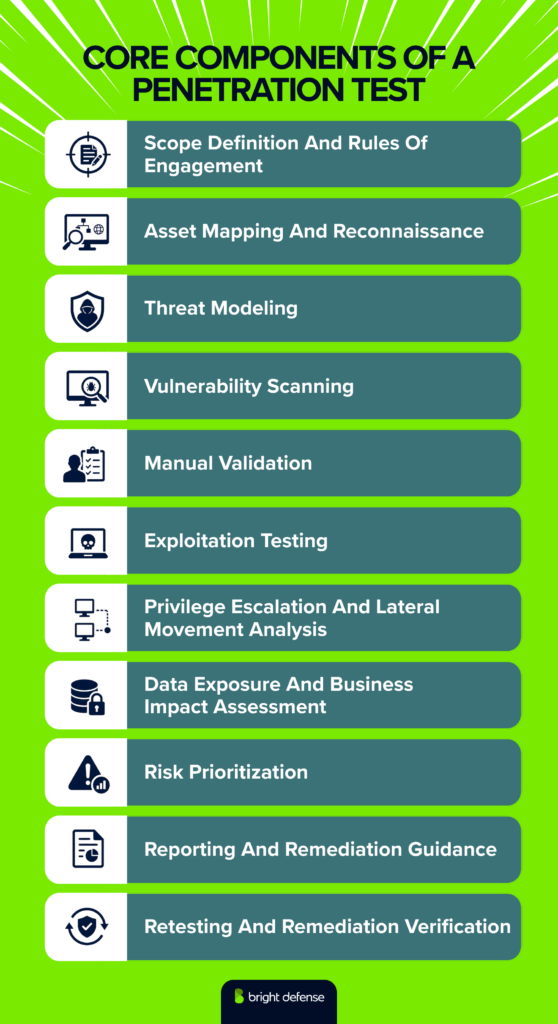
1. Scope Definition And Rules Of Engagement
Scope definition sets the boundaries for the test. This stage confirms the assets, access levels, testing windows, and safety limits that apply before any testing begins. A vendor penetration test should define: It should confirm contractual requirements that affect testing access or reporting.
- Included systems, applications, APIs, and cloud assets
- Networks, IP ranges, user roles, and data flows
- Excluded assets and production safety limits
- Contact points, emergency stop procedures, and written authorization
A vendor may operate shared systems where uncontrolled testing could affect other customers or live operations, so scope definition plays a crucial role here. The scope should account for other third parties that share the same environment.
2. Asset Mapping And Reconnaissance
Asset mapping shows what the testing team needs to evaluate before deeper testing begins. Testers review the vendor’s visible attack surface, including domains, subdomains, exposed services, login portals, and internet-facing infrastructure. It gives the organization a clearer view of what an attacker can see from outside the environment. This view helps teams see where security gaps may exist before testing begins.
Reconnaissance gathers technical and contextual information about the vendor environment. Useful evidence can include:
- Domain name system records and technology stacks
- Authentication flows and exposed metadata
- Employee-facing portals and software versions
- Public documentation and leaked credential indicators
This stage can reveal forgotten systems, and public entry points that may not appear in a questionnaire. A security questionnaire may miss these assets when vendor inventory is incomplete.
3. Threat Modeling
Threat modeling connects reconnaissance findings to realistic attack paths. A test may examine whether an exposed virtual private network (VPN), weak API authentication, poorly protected admin portal, or misconfigured cloud service could give an attacker access to vendor-managed data. This stage keeps the test focused on plausible paths to business impact. The model keeps cyber risk tied to realistic business impact instead of isolated technical findings.
4. Vulnerability Scanning
Vulnerability scanning detects known weaknesses across approved systems. Scanners can find missing patches, weak encryption, and exposed software flaws at scale. Scanner output still requires review because automated results may be duplicated or irrelevant without technical context. Automated tools can speed up coverage, but scanner output still needs technical validation.
5. Manual Validation
Manual validation separates theoretical findings from vulnerabilities that create real security exposure. Automated scanners can produce false positives and miss issues that depend on context. Business logic flaws, chained vulnerabilities, broken access controls, authorization errors, and tenant isolation failures often require human testing. This review helps separate theoretical issues from potential risks that can affect the business.
6. Exploitation Testing
Exploitation testing confirms whether a weakness can be used in practice. Testers may attempt to bypass authentication, exploit vulnerable software, manipulate API requests, access restricted records, or gain unauthorized access to systems. The test proves real-world impact under controlled conditions. In vendor risk management, this proof helps risk teams understand whether a finding is minor, serious, or business-critical. The result shows what must be done to mitigate risks before the weakness is accepted or left open.
7. Privilege Escalation And Lateral Movement Analysis
Privilege escalation testing checks whether an attacker with limited access can gain higher permissions. Lateral movement analysis checks whether one compromised account, workstation, token, server, or vendor system can be used to reach other systems.
8. Data Exposure And Business Impact Assessment
A strong penetration test explains what a vulnerability means for the business. This component assesses whether attackers could access sensitive information, such as: In a vendor context, that can include sensitive organizational data.
- Customer data, payment data, or patient data.
- Intellectual property and financial records.
- Internal credentials, logs, and backups.
- Regulated information managed by the vendor.
It measures the potential blast radius, affected users, affected systems, and likely operational impact. This turns technical findings into risk language that executives, compliance teams, vendor managers, and procurement teams can act on. It gives vendor management teams and security leaders a shared basis for action.
9. Risk Prioritization
Risk prioritization ranks findings based on severity, exploitability, asset sensitivity, business impact, exposure level, and likelihood of attack. This step makes the test operationally useful. Vendors rarely have unlimited remediation capacity, so the report must make clear which issues require immediate action, planned remediation, or compensating controls.
10. Reporting And Remediation Guidance
The final report should give both technical teams and risk owners enough evidence to act. A useful vendor penetration testing report should include:
- An executive summary and technical findings.
- Affected assets and proof of exploitation.
- Screenshots or other testing evidence.
- Severity ratings and business impact.
- Root cause analysis and remediation steps.
Good reporting must work for security engineers, compliance teams, executives, auditors, and third-party risk managers. A strong report explains how each issue can be exploited, why it matters, and how the vendor can fix it. The report should show how remediation efforts will be verified after fixes are applied.
11. Retesting And Remediation Verification
Retesting confirms whether the vendor or internal team fixed the issues correctly. A patch, configuration change, or access-control update can fail or leave part of the original attack path open. Retesting closes the loop and gives the organization evidence that remediation was completed. For high-risk vendors, retesting can become a requirement before approval.
Together, these components make penetration testing repeatable, defensible, and useful for third-party risk management. A complete test shows how an attacker could enter, how far the attacker could move, what data could be reached, which controls failed, and which remediation steps should come first. It can highlight where incident response plans need stronger vendor-specific assumptions.
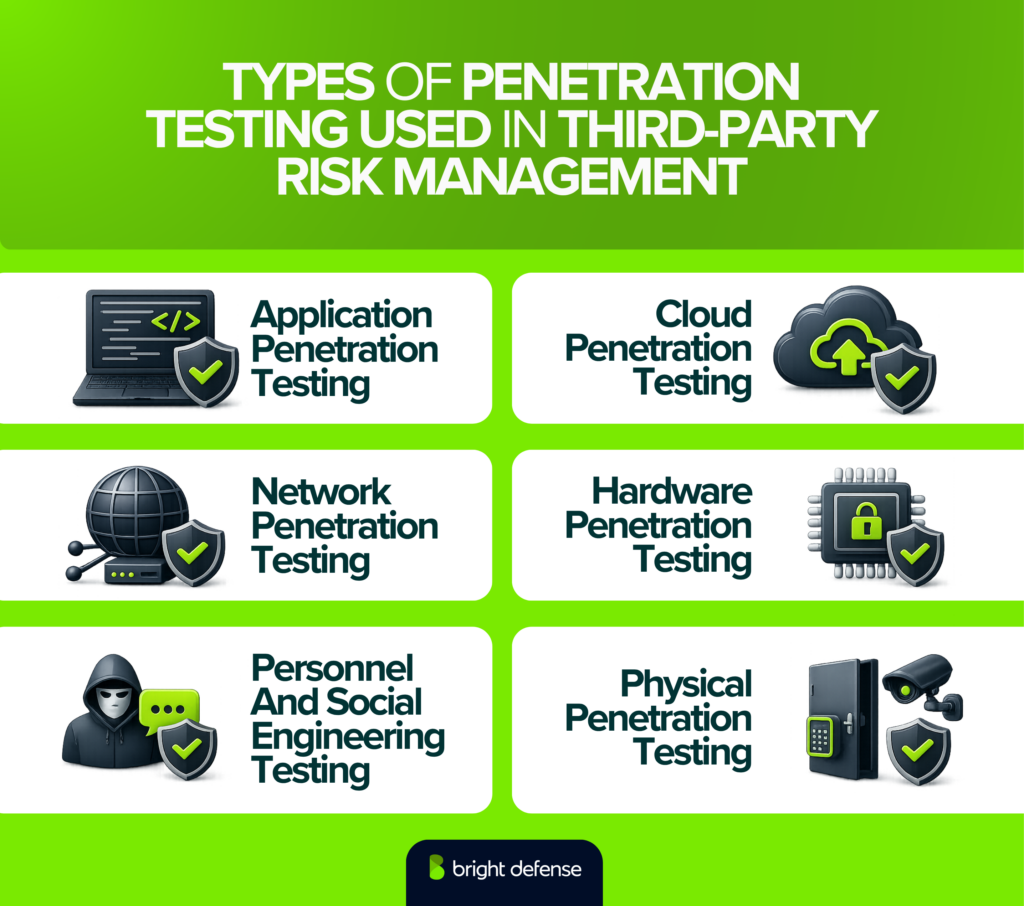
Types Of Penetration Testing Used In Third-Party Risk Management
Penetration testing in third-party risk management can be classified by tester knowledge level and vendor environment. The following are the main types of penetration testing used to assess vendor environments in third-party risk management: These vendor assessments can be scoped differently based on access, data sensitivity, and the vendor’s role in the service chain.
1. Application Penetration Testing
Application penetration testing focuses on how software behaves under attack. The assessment may cover web applications, mobile applications and SaaS platforms. Common test areas include:
- Broken authentication
- Authorization failures
- Insecure file uploads
- Injection vulnerabilities
- Session weaknesses
- Business logic flaws
This test type is especially important when a vendor stores, processes, or transmits customer data through software. A questionnaire may miss exploitable flaws in login systems, admin panels, APIs, or user permission models. It can show whether the vendor’s security practices hold up under attack.
2. Cloud Penetration Testing
Cloud penetration testing reviews cloud environments such as Amazon Web Services (AWS), Microsoft Azure, Google Cloud, and cloud-hosted SaaS infrastructure. The assessment can examine:
- Identity and access management.
- Storage permissions and exposed services.
- Serverless functions and container security.
- Kubernetes configurations and network security groups.
- Logging, encryption, and secrets management.
Vendors that host workloads, store customer files, process regulated data, or support production systems in cloud environments often need this type of testing. The goal is to safeguard data across shared cloud services and customer-facing workloads.
3. Network Penetration Testing
Network penetration testing examines the infrastructure paths that attackers could use to enter or move through a vendor environment. Firewalls, VPNs, routers, servers, and remote access systems may fall within scope. Identity services, open ports, and segmentation controls may be reviewed when they affect attack movement.
External testing checks what attackers can reach from the internet. Internal testing checks how far an attacker could move after gaining access. Network pentests can be utilized when vendors maintain remote support access, or privileged access into customer systems. This is important when remote access supports a supply chain integration or privileged customer connection.
4. Hardware Penetration Testing
Hardware penetration testing moves the assessment from software paths to physical and embedded technology. The test may cover physical devices, embedded systems, connected products, IoT devices, and network appliances. Medical devices, payment terminals, and access-control systems may be included when they affect regulated or sensitive environments.
Testers may assess firmware, physical ports, debug interfaces, and default credentials. Update mechanisms, data storage, device communication, and tamper resistance may be reviewed when the device risk profile supports deeper testing. Hardware testing is relevant when vendor devices connect to business networks, collect sensitive data, control physical access, or support operational technology.
5. Personnel And Social Engineering Testing
Personnel and social engineering penetration testing measures how vendor employees and support processes respond to manipulation. This test type applies to vendors with customer support teams, privileged administrators, help desks, managed service teams, or employees who can approve access, reset accounts, or change sensitive settings.
Controlled phishing, vishing, help desk verification testing, and security awareness checks may be used within approved rules. The assessment can show whether employees follow identity verification procedures, resist credential theft attempts, and handle suspicious requests correctly.
Vendor breaches can begin with stolen credentials, weak identity verification, poor support procedures, or a manipulated employee who grants access to the wrong person. Personnel-focused testing gives third-party risk teams a practical view of how human and process controls perform under controlled attack conditions. The same testing can model scenarios that resemble supply chain attacks.
6. Physical Penetration Testing
Physical penetration testing asks whether an attacker could enter restricted vendor spaces or reach sensitive equipment. This test type is most relevant for vendors that operate their own data centers, server rooms, secure offices, storage facilities, document-handling sites, or regulated physical environments.
The assessment may cover badge controls, visitor procedures, camera coverage, locked cabinets, equipment protection, and access to sensitive physical materials. For cloud-native SaaS vendors, physical security is often inherited from cloud providers and verified through provider assurance reports. Physical penetration testing becomes more relevant when the vendor directly controls facilities where physical access could lead to data exposure, service disruption, or tampering.
How Penetration Testing Fits Across The Vendor Lifecycle
Penetration testing supports third-party risk management throughout the vendor lifecycle, from onboarding and due diligence to ongoing monitoring, contract renewal, and offboarding. The testing record gives teams recurring evidence for continuous monitoring.
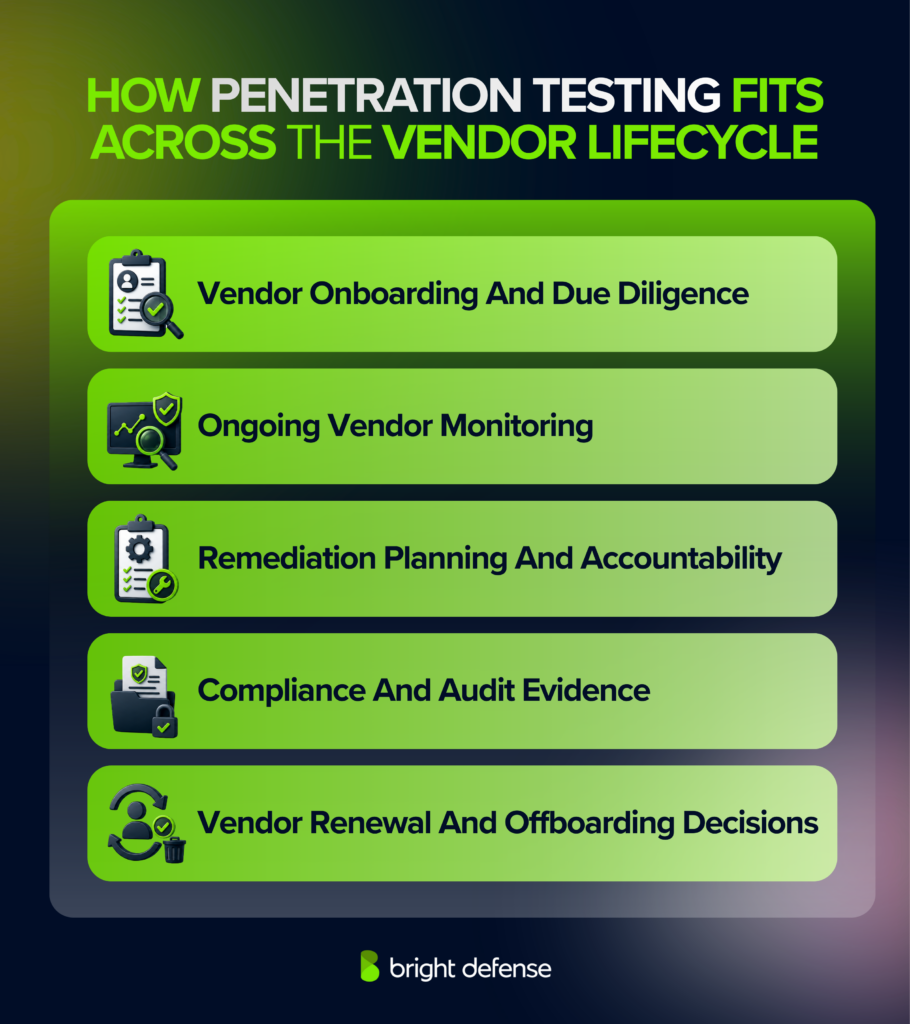
The following are the key stages where penetration testing provides value:
1. Vendor Onboarding And Due Diligence
Penetration testing can support onboarding before a contract is signed or before a vendor receives access to sensitive systems, customer data, regulated information, or internal infrastructure. This stage is especially important for SaaS providers, payment processors, healthcare vendors, and managed service providers. Cloud service providers, software developers, and vendors with privileged access may require the same level of review. At this stage, vendor contracts can define testing rights and minimum evidence requirements.
The test can reveal weak authentication, exposed admin panels, API flaws, insecure cloud storage, poor segmentation, or unpatched internet-facing systems. These findings give procurement and security teams stronger evidence before they approve the relationship.
2. Ongoing Vendor Monitoring
Vendor risk changes after onboarding. Vendors release new applications, update cloud infrastructure, add integrations, modify access rights, and expose new services. Regular penetration testing helps TPRM teams detect control drift, confirm patching effectiveness, and find new exposure before it becomes a business incident.
3. Remediation Planning And Accountability
Penetration test results give the organization and the vendor a shared remediation plan. The report should make clear which findings require urgent fixes, which findings need scheduled remediation, and which findings can be accepted only with documented compensating controls. Retesting then confirms whether the fix worked and whether the risk has been reduced.
4. Compliance And Audit Evidence
Penetration testing creates evidence that can support risk-based vendor oversight and control validation. GDPR Article 32 requires a process for regularly testing, assessing, and evaluating the effectiveness of security measures. HHS HIPAA Security Rule guidance focuses on administrative, physical, and technical safeguards for electronic protected health information. PCI DSS provides a baseline of technical and operational requirements for protecting payment account data. In TPRM, penetration testing helps turn those control expectations into practical evidence that auditors and customers can review.
5. Vendor Renewal And Offboarding Decisions
Penetration testing can support renewal decisions by showing whether a vendor has maintained or improved its security posture over time. Repeated critical findings, slow remediation, or poor retesting outcomes may justify contract changes, reduced access, executive review, or vendor replacement.
Testing can support offboarding by verifying that access paths, user accounts, service accounts, and tokens are removed or restricted. Integrations, APIs, and data connections should receive the same review when the vendor relationship ends.
Best Practices For Adding Penetration Testing To A TPRM Program
Best practices for adding penetration testing to a TPRM program connect vendor risk tiering to scope, authorization, testing depth, remediation, and evidence storage. The process works best when procurement, security, compliance, and vendor owners agree on timing before the test and decide how retesting affects approval, renewal, or access decisions. Industry best practices usually connect testing cadence to access level, data sensitivity, and business dependence.
- Use risk tiering to decide which vendors need penetration testing, deeper testing, or retesting after material changes. Not all vendors need the same depth of testing.
- Require written authorization, approved scope, and clear rules of engagement before any vendor testing begins.
- Map each test to the vendor environment, such as application, API, cloud, or network exposure. Add hardware, personnel, or physical testing when the vendor risk profile supports it. Security ratings can help decide which vendors need deeper review, but they should not replace technical testing.
- Require reports that explain exploit paths, affected assets, business impact, remediation steps, and evidence of testing.
- Set remediation timelines based on severity, exposure, data sensitivity, and contractual obligations. Cybersecurity risk should influence deadlines when findings affect exposed systems or sensitive data.
- Use retesting to verify fixes rather than accepting vendor statements without proof.
- Store testing reports, remediation records, and retest evidence inside the vendor risk record for audit and renewal reviews.
How Bright Defense Supports Vendor Penetration Testing
Bright Defense supports vendor and third-party penetration testing by testing real applications, APIs, cloud exposure, network paths, and remediation evidence. Organizations can use Bright Defense testing results to support vendor approval, contract review, audit evidence, and renewal decisions when third-party systems affect customer data, regulated workloads, or business-critical access.
Bright Defense can help security, compliance, and procurement teams scope vendor penetration tests, document findings, verify remediation, and maintain evidence for third-party risk reviews.
Frequently Asked Questions
High-risk vendors should be penetration tested before onboarding, after material system changes, and on a recurring cycle set by risk tier. Material changes can include new applications, major cloud changes, new integrations, or expanded access. Lower-risk vendors may need testing only after meaningful changes or during renewal review.
A qualified independent testing team should perform a vendor penetration test when the results support risk decisions, audit evidence, or contract review. Independence reduces conflicts of interest and gives the organization stronger assurance that findings reflect real exposure. Internal security teams can still help define scope and track remediation.
A vulnerability scan detects known weaknesses through automated checks, while a penetration test manually validates whether weaknesses can be exploited under controlled conditions. The scan gives broad technical coverage. The penetration test proves attack paths, control failures, and business impact. High-risk vendor reviews often use both methods, and the full difference between a penetration test and a vulnerability scan explains when each one belongs in a TPRM program.
A Service Organization Control 2 (SOC 2) report does not automatically replace a vendor penetration test. SOC 2 reports describe audited controls over a defined period, while a penetration test checks whether specific systems can be exploited. Because the two answer different questions, SOC 2 penetration testing requirements are often evaluated alongside the report, and TPRM teams may use both sources when a vendor handles sensitive data or critical services.\
Penetration testing should be considered before onboarding when a vendor will handle sensitive data, connect to internal systems, process payments, or support regulated workflows. The test gives procurement and security teams evidence before access is approved. Lower-risk vendors may be reviewed through questionnaires, certifications, and contractual controls.
A vendor penetration testing report should include scope, methodology, affected assets, and validated findings. It should also include proof of exploitation, severity ratings, business impact, and remediation guidance. The report should state which issues were retested and which attack paths were closed. This evidence helps TPRM teams track accountability across the vendor lifecycle. The report should group findings into risk categories so owners can track accountability.
Final Thoughts On Penetration Testing In TPRM
Penetration testing makes third-party risk management more reliable because it tests vendor security controls in practice. It helps organizations find exploitable weaknesses, validate control performance, prioritize remediation, and verify fixes. It also supports compliance evidence and better decisions across onboarding, monitoring, renewal, and offboarding. Penetration testing plays a practical role in converting technical evidence into vendor risk decisions.
A mature TPRM program uses penetration testing as recurring vendor assurance evidence. The value comes from connecting test results to business impact, contractual accountability, remediation progress, and long-term vendor risk reduction. It shows how vendor weaknesses could affect the entire supply chain and the organization’s overall security posture.