Updated:
March 15, 2026
Match Group Hit by 10M Dating Record Leak
What Happened in the Breach
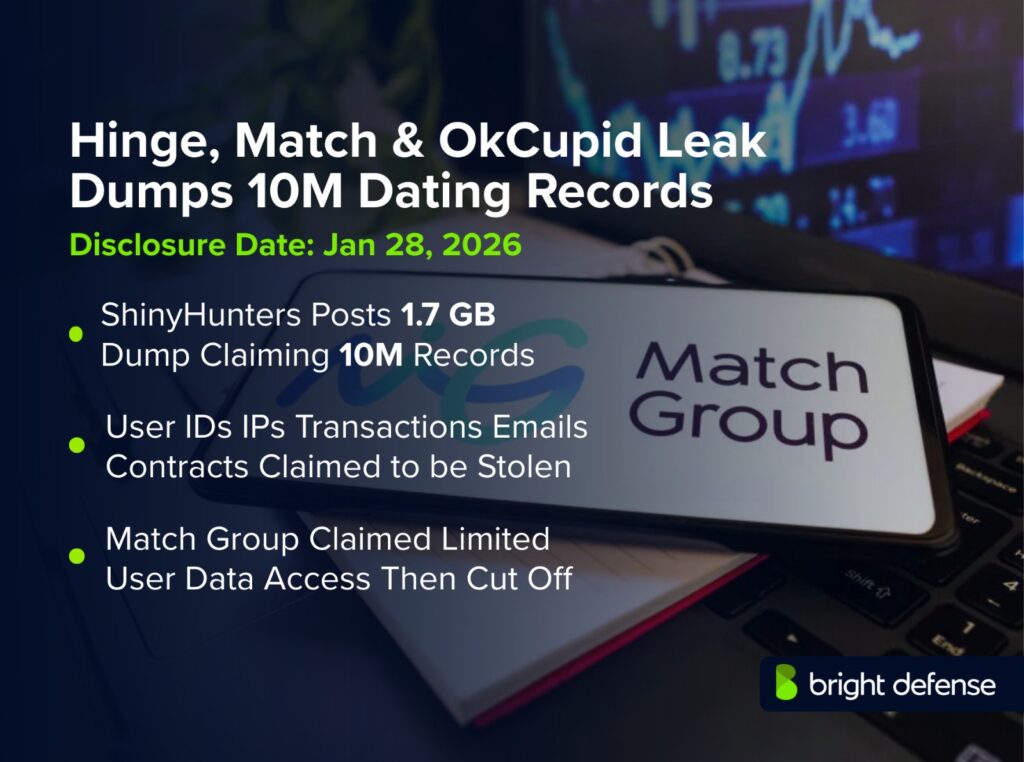
Match Group said it is investigating a security incident after the ShinyHunters extortion group claimed it obtained more than 10 million records tied to Match Group dating services, including Hinge, OkCupid, and Match.com.
Match Group told media outlets it moved quickly to terminate unauthorized access and said it has not seen evidence that user login credentials, financial information, or private communications were accessed, while the attackers and several security outlets described the exposed material as a mix of usage data and internal documents.
The incident has drawn attention because it involves high sensitivity user context and has been linked in reporting to a broader wave of social engineering activity aimed at single sign-on environments.
Timeline: From First Access To Latest Update
- Mid-January 2026 (reported earliest access): Some incident trackers and reporting indicated unauthorized access may have occurred as early as mid-January, though the exact start date has not been publicly confirmed by the company.
- January 16, 2026 (reported incident date): A breach database tracker listed January 16, 2026 as the breach date, while noting that key timeline details remained unspecified publicly.
- January 27 to January 28, 2026 (attacker claim appears): ShinyHunters posted claims on its leak site that it had “over 10 million” lines of data and “hundreds” of internal documents connected to Match Group brands, according to multiple security and tech outlets that reviewed the listing.
- January 28, 2026 (company acknowledgement reported): Tech press reported that Match Group confirmed a cybersecurity incident affecting a limited amount of user data and began steps to notify impacted individuals as appropriate.
- January 29 to January 30, 2026 (scope reporting expands): Reporting described the leaked sample as including user identifiers, IP addresses, and transaction-related fields tied to subscriptions, while Match Group reiterated that it had no indication of exposure of passwords, financial details, or private messages.
- Early February 2026 (lawsuits reported): Bloomberg Law reported lawsuits tied to the late-January breach wave, including claims against Match Group connected to the incident and alleged ShinyHunters activity.
- February 4, 2026 (broader threat context highlighted): Google’s Threat Intelligence reporting, as covered by ITPro, warned about ShinyHunters-branded vishing and credential-harvesting patterns targeting SSO and MFA, adding context consistent with how several victims in the same campaign cluster were described in press coverage.
What Data Or Systems Were Affected
Reporting based on samples attributed to ShinyHunters described the exposed material as including user IDs, app and device identifiers, IP addresses, and usage or event logs, plus some transaction-related fields tied to subscriptions and internal corporate documents.
Multiple outlets characterized the leak as centered on analytics or tracking-style data rather than raw password databases, while noting that even limited datasets can become identifying when combined with other sources.
Match Group said it believed the incident affected a limited amount of user data and stated it had no indication that user login credentials, financial information, or private communications were accessed.
Who Was Responsible (Confirmed Vs Alleged)
ShinyHunters claimed responsibility for the theft and publication of data connected to Match Group dating brands, but independent confirmation of full responsibility and collection method remains limited in public reporting.
Match Group has publicly described the matter as a security incident under investigation and has not, in the reporting cited here, confirmed a definitive attribution beyond acknowledging unauthorized access.
Some coverage connected the campaign to social engineering tactics linked to ShinyHunters branding and to broader clusters targeting SSO credential flows, while describing those links as intelligence assessments rather than courtroom-proven findings.
How The Attack Worked
Several outlets reported that the intrusion may have involved social engineering aimed at corporate access tooling, with attention on single sign-on and employee credential workflows. Cybernews reported that the attackers suggested the incident was connected to mobile analytics provider AppsFlyer, while AppsFlyer denied involvement in the alleged breach in that reporting.
More broadly, Google threat reporting summarized a pattern in which callers impersonate IT support, route targets to credential-harvesting pages, and attempt to capture both SSO credentials and MFA codes or enroll a new MFA factor, which can allow follow-on access to SaaS data stores and internal documents. Match Group has not publicly confirmed the specific initial access vector in the coverage cited here, and key details about dwell time and the exact compromised systems remain unpublicized.
Impact and Risks for Customers
Even when passwords and payment card numbers are not in scope, exposure of identifiers, IP addresses, and app usage metadata can increase the risk of targeted scams, account takeover attempts via credential stuffing, and harassment or extortion that exploits dating context.
Users may also face elevated phishing risk when attackers can reference an app brand, subscription status, or other believable context in messages designed to trick recipients into sharing verification codes or clicking malicious links.
The reputational risk tends to be amplified for dating platforms because the mere association of a person with a dating service can be sensitive even without message content, and several commentators and outlets stressed that the perceived sensitivity can drive outsized harm relative to the raw field list.
Company Response And Customer Remediation
Match Group told media outlets it acted quickly to terminate unauthorized access and said it was continuing its investigation with external cybersecurity assistance. The company said it had no indication that login credentials, financial information, or private communications were accessed, and reporting described Match Group as notifying impacted individuals as appropriate.
Public reporting did not consistently describe credit monitoring, refunds, or vouchers tied to this incident, and the absence of confirmed payment-card exposure in company statements may affect what remedies are offered and who qualifies for them.
Government, Law Enforcement, And Regulator Actions
Public reporting referenced notifications and investigative activity, but it did not show a single regulator notice or enforcement action specifically tied to this Match Group incident as of the latest cited updates.
Reuters coverage in the broader late-January breach wave reported that multiple consumer brands faced cyberattacks around the same time, reflecting heightened attention from authorities and company incident-response teams even when formal regulator actions are not immediately visible.
Separately, Google’s threat reporting highlighted the wider vishing and credential-theft pattern affecting US organizations, which can drive defensive advisories and coordination even when a specific victim’s law-enforcement steps are not publicly detailed.
Financial, Legal, And Business Impact
Bloomberg Law reported lawsuits tied to the incident, placing Match Group among companies facing legal exposure in the aftermath of ShinyHunters-linked breach claims.
The most material near-term business impact for dating platforms often comes from trust erosion and churn risk, especially when headlines focus on “dating records” even if passwords and chats are not implicated, and multiple outlets emphasized that reputational harm can exceed the direct technical scope.
Longer-term costs can include incident response, forensic work, customer notification, security hardening, and litigation management, with totals depending on the confirmed population affected and any findings about employee access controls or vendor pathways.
What Remains Unclear
The public record has not pinned down a single confirmed breach start date, detection date, or dwell time, and sources have used ranges such as “mid-January” rather than a definitive window.
The exact field set remains partially disputed, with reporting describing analytics and transaction-adjacent data and internal documents, while the company has emphasized what it has not seen evidence of, including passwords, financial data, and private communications.
The precise initial access method also remains unconfirmed publicly, with some outlets tying the campaign to vishing or SSO compromise patterns and others highlighting an alleged analytics-provider connection that the named provider denied in coverage.
Why This Incident Matters
This incident matters because it shows how “limited” datasets can still carry meaningful privacy risk when they relate to intimate services and can be paired with social engineering that targets identity and access systems rather than application code.
It also underscores how extortion groups increasingly focus on data theft and publication pressure, which can create real harm even without ransomware encryption or payment-card exposure. Finally, the reporting around SSO-focused vishing patterns reinforces that security outcomes can hinge on employee-facing authentication flows and third-party SaaS controls as much as on traditional perimeter defenses.
How Bright Defense Can Help Reduce Similar Breach Risk
Bright Defense can help reduce the risk of similar incidents through targeted penetration tests that focus on identity, SaaS access paths, and vendor-connected data flows, which are common pressure points in social engineering-driven intrusions.
A modern pen test program can include realistic testing of SSO entry points, MFA reset and enrollment paths, and high-value SaaS targets such as CRM, ticketing, and document systems, with clear remediation guidance tied to attack paths that matter.
Continuous compliance support can keep control evidence current and reduce drift in areas such as access reviews, logging coverage, and third-party risk workflows, which often determine whether a single compromised account becomes a broad data exposure.
Sources
- Reuters (via Yahoo News) — Bumble, Match Group, and CrunchBase hit by cyberattacks, Bloomberg News reported (January 29, 2026)
https://www.yahoo.com/news/articles/bumble-match-panera-bread-crunchbase-001850142.html - Bloomberg Law — Match Group, CarMax Targeted in ShinyHunters Data-Breach Spree (February 3, 2026)
https://news.bloomberglaw.com/litigation/match-group-carmax-targeted-in-shinyhunters-data-breach-spree - BleepingComputer — Match Group breach exposes data from Hinge, Tinder, OkCupid, and Match (January 29, 2026)
https://www.bleepingcomputer.com/news/security/match-group-breach-exposes-data-from-hinge-tinder-okcupid-and-match/ - Cybernews — Hinge and OkCupid data leak: 10M records claimed by ShinyHunters (January 28, 2026)
https://cybernews.com/security/hinge-okcupid-data-leak-shinyhunters-claims/ - The Register — ShinyHunters claims it stole 10M records from dating apps (January 29, 2026)
https://www.theregister.com/2026/01/29/shinyhunters_match_group/ - ITPro — Google issues warning over ShinyHunters-branded vishing campaigns (February 4, 2026)
https://www.itpro.com/security/google-issues-warning-over-shinyhunters-branded-vishing-campaigns - UpGuard — Match Group Suffers Alleged Breach According to Dark Web Reports (January 29, 2026)
https://www.upguard.com/news/match-data-breach-2026-01-29 - Malwarebytes — Match, Hinge, OkCupid, and Panera Bread breached by ransomware group (January 30, 2026)
https://www.malwarebytes.com/blog/news/2026/01/match-hinge-okcupid-and-panera-bread-breached-by-ransomware-group - Bitdefender — Breach at Tinder, Hinge and OkCupid parent Match Group exposes user data (January 2026)
https://www.bitdefender.com/en-us/blog/hotforsecurity/breach-at-tinder-hinge-and-okcupid-parent-match-group-exposes-user-data - TechRadar — Dating apps Bumble and Match reportedly hit in cyberattack (January 2026)
https://www.techradar.com/pro/security/dating-apps-bumble-and-match-reportedly-hit-in-cyberattack - SC Media (SCWorld) — Over 10M Match Group dating app records purportedly pilfered by ShinyHunters (January 2026)
https://www.scworld.com/brief/over-10m-match-group-dating-app-records-purportedly-pilfered-by-shinyhunters - Cyber Security Incident Database — Match.com Cyber-Attack Hack Breach (entry referencing January 16, 2026)
https://www.csidb.net/csidb/incidents/ab2a72fa-805a-4ca6-9df2-ae62b23a0dd7/
Get In Touch