1.4TB Of Alleged Nike Data Posted Online Sparks Investigation
Updated:
August 26, 2026
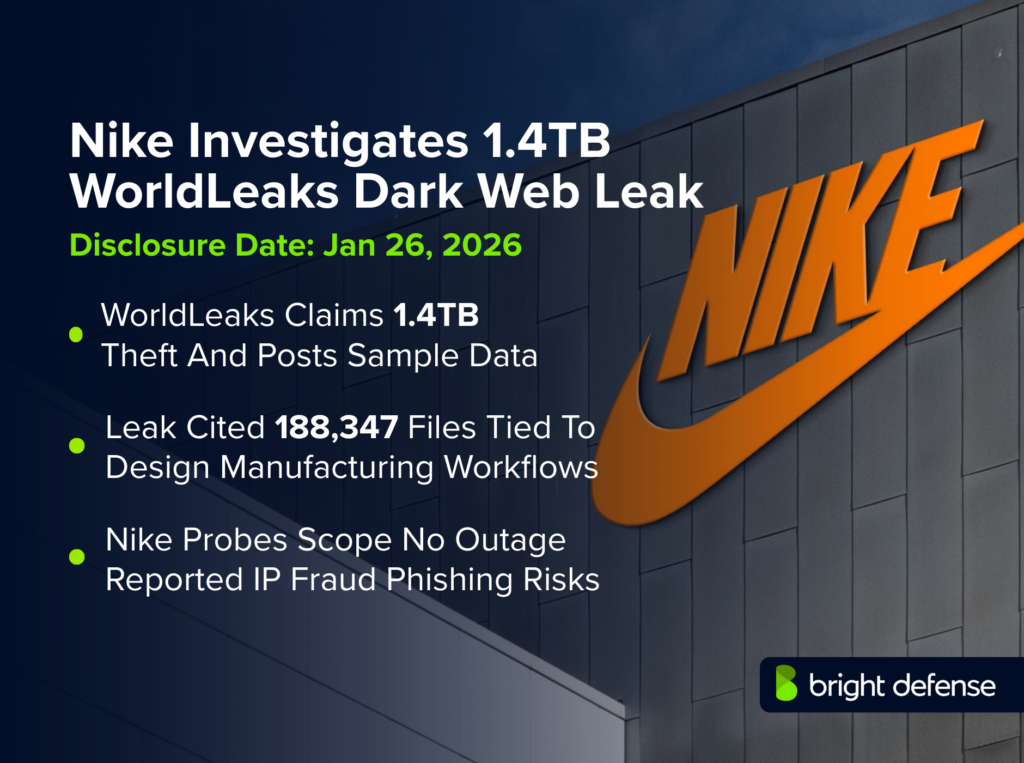
Nike is investigating a potential cybersecurity incident after the extortion group WorldLeaks claimed it stole and leaked about 1.4TB of internal files tied to the sportswear giant, a case that could expose sensitive product and factory documentation even if customer records remain unaffected.
What Happened in the Breach
WorldLeaks, an extortion crew that posts victims on a Tor based leak site, alleged it accessed Nike systems and exfiltrated a large dataset, listing roughly 188,347 files in reporting that reviewed the group’s posting.
Nike confirmed only that it is investigating and “actively assessing” the situation, while stopping short of validating the criminals’ claims or describing what data may have been taken.
Timeline: From First Access To Latest Update
Nike has not disclosed an intrusion start date or a detection date, so the public timeline begins when WorldLeaks posted Nike on its leak infrastructure and outside reporting began tracking the countdown and subsequent leak claims.
- January 22, 2026: WorldLeaks listed Nike on its Tor based leak site, according to SecurityWeek and other reporting, with a countdown tied to a planned release if no payment occurred.
- January 24, 2026: SecurityWeek reported a timer indicating the data would be made public on January 24, 2026 unless a ransom was paid, and it published Nike’s statement confirming an investigation.
- January 25, 2026: Security Affairs reported that WorldLeaks added Nike on January 22, 2026 and then published 1.4TB of data on January 24, 2026, a sequence that differs slightly from other outlets’ timing.
- January 26, 2026: The Register reported WorldLeaks’ claim of 1.4TB and 188,347 files, and said filenames pointed toward design and manufacturing workflows rather than customer databases.
- January 27, 2026: BleepingComputer reported the gang leaked 1.4TB of files and said the Nike listing was removed from WorldLeaks’ site before publication, which it said could indicate negotiations, while Nike still had not confirmed the theft.
- February 9, 2026: As of February 9, 2026, Nike had not publicly provided a scope figure, a confirmed data inventory, or a customer notification plan in the statements reported across multiple outlets.

What Data Or Systems Were Affected
Multiple outlets said sample directory names and filenames suggested the exposed material centered on product development and factory or training documentation, with examples such as “Women’s Sportswear,” “Men’s Sportswear,” “Training Resource – Factory,” and “Garment Making Process.”
Several reports also said they had not seen evidence in the sample that pointed to consumer databases, although reporters cautioned that neither Nike nor independent analysts had validated the full contents of the leak.
Who Was Responsible (Confirmed Vs Alleged)
No authority has publicly attributed the incident to a specific actor, and Nike has not named a suspect, so responsibility remains based on WorldLeaks’ own claim of theft and the group’s leak site activity.
SecurityWeek and BleepingComputer described WorldLeaks as a successor or rebrand connected to Hunters International, with reporting that the operation shifted toward data theft and extortion focused pressure rather than encryption centered ransomware.
How The Attack Worked
The public evidence points to a common extortion pattern: a victim appears on a Tor-based leak site, a payment deadline is displayed and stolen samples are published to increase pressure. A data exfiltration prevention strategy can help organizations detect large file transfers, unusual repository access and unauthorized movement of sensitive documents before attackers publish a broader dump.
The intrusion method has not been disclosed, and none of the reviewed reports identified a confirmed initial access vector such as compromised credentials, third party compromise, or exploitation of a specific vulnerability.
Impact and Risks for Customers
Current reporting suggests limited direct consumer harm if customer identifiers, passwords, or payment data were not part of the stolen dataset, but the absence of visible consumer data in a sample is not proof that no personal data exists in the full leak.
The more immediate risk may fall on Nike’s business operations. Product roadmaps, design assets and manufacturing documents can support counterfeit production, gray-market activity and supplier targeting.
A formal vendor risk management program can help companies review factory partners, restrict third-party access and set clear security requirements for organizations handling proprietary information.
Company Response And Customer Remediation
Nike’s public posture has been narrow and consistent across outlets: the company said it takes consumer privacy and data security seriously and that it is investigating a potential cybersecurity incident while it assesses the situation.
A documented cyber threat intelligence and incident response process can help organizations validate extortion claims, preserve forensic evidence, track leaked samples and determine which systems or files were actually accessed.
Nike has not announced credit monitoring, refunds, or other consumer remediation tied to this incident, and The Register reported that the company declined to say what data was stolen or whether it planned to pay a ransom demand.
Government, Law Enforcement, And Regulator Actions
No public law enforcement statement or regulator notice tied to this Nike incident appeared in the reporting reviewed here, and Nike’s quoted statements did not mention a police report, a regulator filing, or a formal notification campaign.
In the United States, the SEC’s cybersecurity incident disclosure framework can require public companies to disclose material incidents on Form 8-K, which sets expectations for when investors may receive formal incident details if Nike later deems the event material.

Financial, Legal, And Business Impact
Nike has not disclosed costs, operational disruption, or confirmed data categories, so any financial impact remains unquantified, with the primary exposure centered on intellectual property, supplier relationships, and competitive information rather than confirmed consumer fraud losses.
Commentary cited in IT Pro warned that leaks of internal product and supply chain documents can create long term competitive and reputational damage even when customer records are not involved, a risk that grows when files include manufacturing processes and training resources.
What Remains Unclear About the Breach
Key facts remain unresolved, including the intrusion start date, the discovery date, the initial access method, whether any employee or partner personal data appears in the full dataset, and whether Nike engaged in negotiations or made a payment after WorldLeaks removed the Nike listing from its site.
Another open question is the exact publication timing and completeness of the dump, since outlets described the countdown and release window with minor differences, and reporters emphasized they could not independently verify the full contents.
Why This Incident Matters
This case highlights how extortion groups can impose real business harm without encrypting systems, especially for brands whose value depends on frequent product refresh cycles, proprietary design work, and distributed manufacturing partners.
The incident also shows that breach severity is not limited to exposed consumer records. Stolen internal documents can support counterfeiting, supplier compromise attempts and follow-on attacks against employees and contractors.
Using penetration testing in third-party risk management can help organizations test whether compromised partner accounts can reach sensitive design, manufacturing or product-development repositories.
How Bright Defense Can Reduce Similar Leak And Extortion Risk
Bright Defense can reduce exposure to data theft extortion through recurring penetration tests that focus on the paths attackers use for initial access and large scale exfiltration, including identity controls, external attack surface, SaaS access, and high value internal repositories.
Continuous compliance can keep access controls, logging and evidence collection current across systems that store sensitive product and manufacturing information. Recurring checks can reveal excessive permissions, missing alerts and configuration drift while also supporting SOC 2 and ISO 27001 requirements.
Bright Defense can also prioritize testing around vendor and factory connectivity, privileged access, and data egress controls so sensitive design and manufacturing content stays segmented and monitored, even when partners need access. This combination lowers the chance that a single compromised account turns into a broad internal document haul, and it improves incident readiness with clear control ownership and audit ready artifacts.
Sources
- SecurityWeek – Nike Probing Potential Security Incident as Hackers Threaten to Leak Data (January 24, 2026)
- Security Affairs – Nike is investigating a possible data breach, after WorldLeaks claims (January 25, 2026)
- The Register – Data thieves borrow Nike’s ‘Just Do It’ mantra, claim they ran off with 1.4TB (January 26, 2026)
- BleepingComputer – Nike investigates data breach after extortion gang leaks files (January 27, 2026)
- IT Pro – Everything we know so far about the Nike data breach (January 27, 2026)
- TechRadar – Nike investigates potential data breach after 1.4TB of data stolen and leaked on dark web (January 27, 2026)
- U.S. Securities and Exchange Commission – SEC Adopts Rules on Cybersecurity Risk Management, Strategy, Governance, and Incident Disclosure (Fact Sheet) (July 26, 2023)
- The Wall Street Journal – Nike Is in an Innovation Race. It Is Losing. (October 21, 2023)
- Financial Times – Nike share price and company information (accessed February 9, 2026)