All You Need to Know About Cybersecurity Gap Analysis
Updated:
September 21, 2026
Imagine trying to secure a house by installing the most expensive smart locks on the front door, while leaving the back window unlatched and the basement door wide open. You’ve spent the money, but are you actually safer?
A cybersecurity gap assessment is essentially a “home security audit” for your digital estate. It looks past the flashy tools to find the forgotten windows and weak hinges in your security policies, existing controls, and security controls across people, process, and technology.
And that’s not theoretical: Verizon’s 2024 DBIR reports that 68% of breaches involve the human element, which is exactly where “unlatched windows” tend to hide. Today, we’ll explore how this process helps you identify vulnerabilities, meet regulatory requirements and compliance requirements, and improve security maturity without wasting effort.
What is a Cybersecurity Gap Analysis?
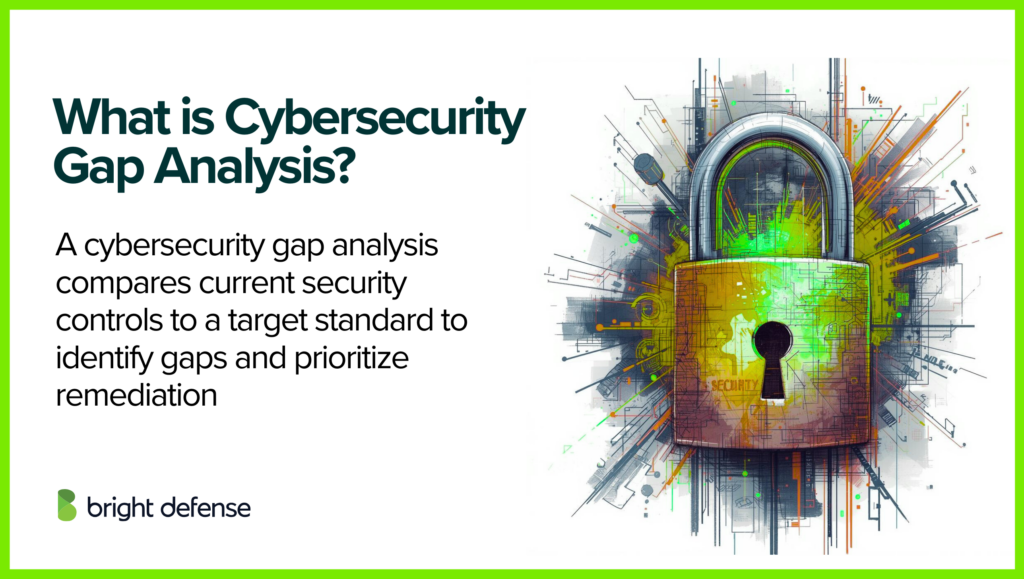
A cybersecurity gap analysis, sometimes called an IT security gap analysis, is a structured assessment that compares an organization’s current security posture to a desired target state (such as a standard, framework, policy, or risk goal). The purpose is to find missing controls, weak processes, and compliance gaps, then prioritize actions to close those gaps across information security.
What it Compares
A gap analysis typically measures the difference between:
- Current state: What controls, policies, tools, and practices you have today, including how they fit your technology stack
- Target state: What you should have to meet a requirement (example: NIST CSF, ISO 27001, CIS Controls, HIPAA, PCI DSS)
What it Evaluates
It often looks across areas like:
- Governance, risk, and compliance (GRC)
- Asset management and inventory
- Identity and access management (IAM)
- Network and endpoint security
- Vulnerability management
- Logging, monitoring, and detection
- Incident response readiness
- Data protection and encryption
- Third-party and supply chain risk
- Security awareness and training
- Validation activities such as penetration testing, especially against evolving threats
Outputs you usually get
A good cybersecurity gap analysis produces:
- A list of gaps mapped to requirements
- Risk ratings for each gap (impact and likelihood)
- A remediation roadmap with priorities, owners, and timelines
- Sometimes a maturity score (example: 1–5) for each security domain
Simple example
If a framework requires multi-factor authentication (MFA) on all privileged accounts, but your environment only has MFA on email, the gap analysis flags:
- Gap: MFA not applied to privileged accounts
- Risk: High (account takeover impact)
- Fix: Enforce MFA for admin roles, implement conditional access, validate coverage
Difference Between a Gap Analysis and a Risk Assessment
Gap analysis and risk assessment often get grouped together, but they answer different questions and produce different outputs. Here’s a table that clearly shows the difference between a gap analysis and a risk assessment:
Gap Analysis vs Risk Assessment Table
| Category | Gap Analysis | Risk Assessment |
|---|---|---|
| Primary goal | Measure where your current security posture falls short of a target standard or requirement | Measure what can realistically harm the organization and how serious it would be |
| Focus | Control coverage, maturity, compliance readiness | Threats, vulnerabilities, likelihood, impact, and residual risk |
| Typical inputs | Policies, procedures, control evidence, audit artifacts, framework checklists | Asset inventory, threat modeling, vulnerability data, incident history, business impact analysis |
| Typical output | Gap list, maturity scores, remediation roadmap mapped to framework requirements | Risk register, risk ratings, treatment plan (reduce/accept/transfer/avoid), prioritized risk actions |
| Best use case | Preparing for audits, building baseline controls, assessing compliance readiness | Prioritizing security spend and effort based on real-world business risk |
| Example (No MFA for admins) | “MFA is required under our framework. This is a gap.” | “Admin takeover risk is high impact. Likelihood depends on exposure and controls. Fix is urgent.” |
| When to run it | During audits, program buildout, annual control reviews | Quarterly or annually, after major changes, after incidents, or when threat activity shifts |
How To Perform a Successful Cybersecurity Gap Analysis (9-Step Method)
A cybersecurity compliance gap analysis becomes useful when it gives you a defensible view of your current security posture, shows exactly what is missing, and turns those findings into a prioritized action plan. The steps below are practical for real environments, whether you’re preparing for an audit, reducing risk fast, or building a cybersecurity compliance program.
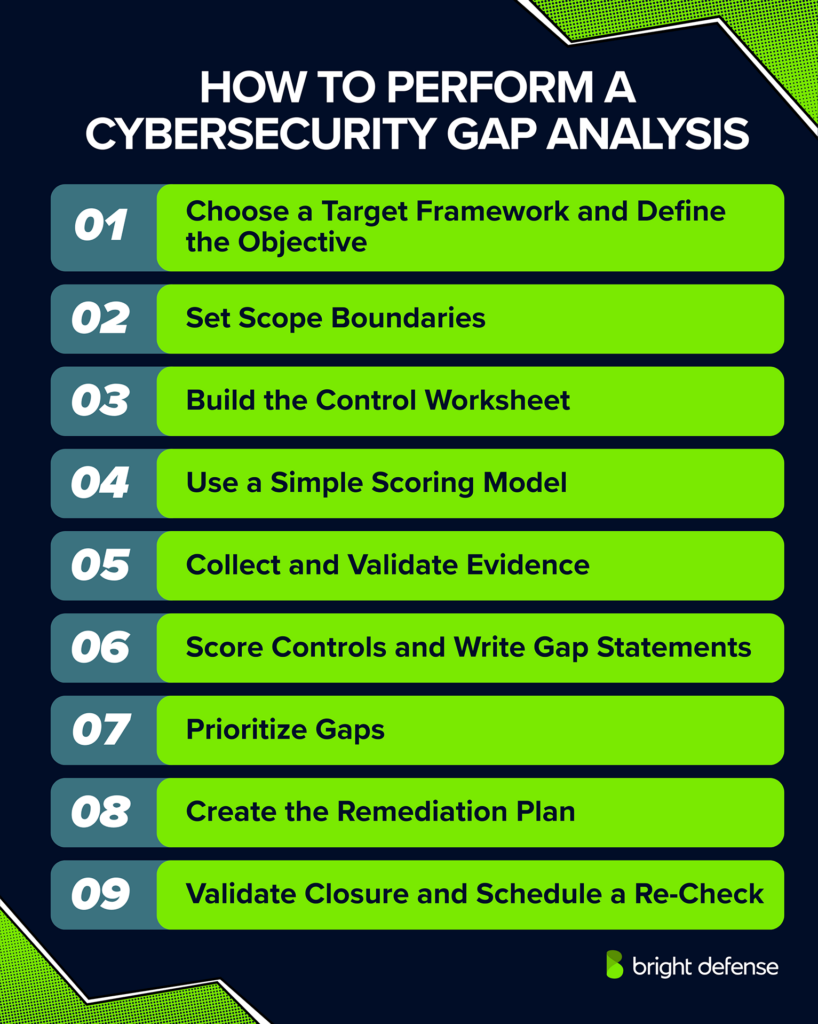
1) Choose 1 Target Framework and Define the Objective
Start with a single benchmark, not a mix. A gap analysis works best when it has a clear reference point such as NIST CSF 2.0, CIS Controls v8, ISO/IEC 27001:2022, PCI DSS, or your internal standard. Write a short objective statement that explains why you are doing the analysis and what decisions it should support, especially as evolving threats and insider threats continue to shift the risk picture.
Good objective examples:
- “Assess our environment against CIS IG1 and produce a 6-month remediation plan.”
- “Evaluate our controls against ISO 27001:2022 to prepare for certification readiness.”
- “Map our current controls to NIST CSF 2.0 and define a target profile for leadership.”
This small step prevents scope creep and reduces disagreement later.
2) Set Scope Boundaries
Scope determines what your results actually mean. Document what is included and excluded so stakeholders understand where the assessment applies. Also define an evidence window so scoring is consistent across teams. This is also where you confirm which systems contain customer data and sensitive data and which teams own access management responsibilities, since those usually drive the highest risk exposure and can quickly impact customer trust.
Include:
- Business units, regions, and subsidiaries
- Cloud accounts, on-prem environments, and key SaaS apps
- Critical systems and sensitive data types
Exclude:
- Systems scheduled for retirement
- Assets fully owned and operated outside your control
Evidence window examples:
- “Last 90 days of logs”
- “Current configurations as of assessment date”
- “Training records for the last 12 months”
If you skip this, people will assume your findings apply everywhere, even when they don’t.
3) Build Your Control Worksheet
Your worksheet is the main deliverable, so treat it like a live operational tool, not a one-time report. Each row should represent one control, requirement, or outcome. Your worksheet should also show which security controls already exist, which ones are missing, and how those map to compliance gaps against your chosen baseline, including any compliance requirements tied to audit objectives.
Minimum columns I recommend:
- Control ID and short requirement statement
- Applicability (Yes/No) with rationale
- Current score (0 to 3)
- Evidence links (documents, screenshots, exports, tickets)
- Gap statement (what’s missing and where)
- Owner (single accountable person)
- Priority (High/Medium/Low)
- Remediation plan and target date
This format becomes your gap register and your remediation tracker in the same place.
4) Use a Simple Scoring Model
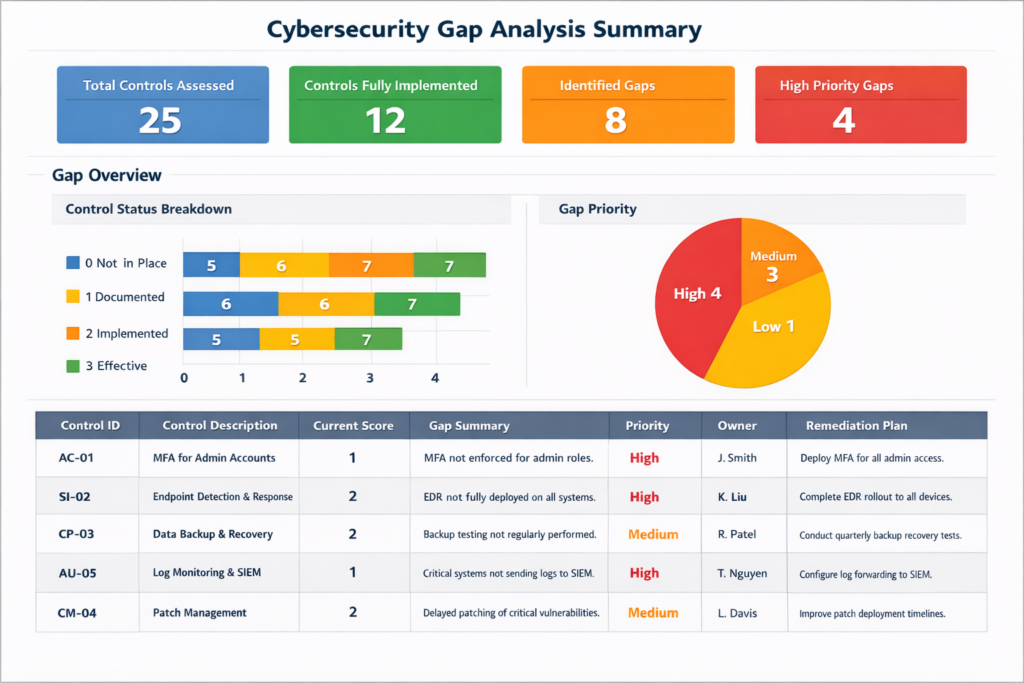
A scoring model keeps discussions grounded and prevents subjective ratings. Use a simple 0 to 3 scale that separates paper controls from operational effectiveness.
Recommended scoring:
- 0: Not in place
- 1: Documented only (policy exists, no operational proof)
- 2: Implemented (operational, some proof exists)
- 3: Effective (tested, measured, consistently enforced)
A common scoring mistake is giving “2” or “3” based on intent instead of proof. The score should reflect what works today.
5) Collect Evidence and Validate Key Controls
Evidence separates a real gap analysis from a self-attestation. Gather evidence for each control, then validate high-risk controls with technical checks instead of assumptions, especially where your organization may be organization vulnerable due to coverage gaps.
Evidence examples:
- Policies and standards (approved and current)
- Screenshots of enforced settings (MFA, device compliance, password policies)
- Configuration exports (IdP rules, firewall rules, EDR policy settings)
- Logs and SIEM ingestion proof
- Patch compliance reports and vulnerability scans
- Incident response artifacts (plan, tabletop results, post-incident reviews)
- Backup reports and restore test results
Key validations worth doing:
- Confirm privileged MFA enforcement across all admin roles
- Verify EDR coverage, tamper protection, and alert generation
- Test at least 1 restore for Tier 1 systems
- Check logging coverage for key systems (IdP, endpoints, cloud control plane)
- Run targeted checks for social engineering risk in support processes
If you can’t prove it, it doesn’t earn a high score.
6) Score Each Control and Write Gap Statements
This is where you convert evidence into action. Score each control and write gap statements that are clear and specific. Avoid vague language like “needs improvement.”
A strong gap statement includes:
- What the requirement expects
- What exists today
- What’s missing
- Why it matters (risk or compliance impact)
Gap statement example:
“MFA is enforced for email and VPN, but not for cloud admin roles. Privileged accounts remain exposed to credential compromise, increasing risk of full tenant takeover.”
Clear gap statements reduce friction with engineering teams because they spell out exactly what needs to change.
7) Prioritize Gaps
Not every gap is urgent. Prioritize using business impact, likelihood, and obligations such as contractual requirements, especially where specific industry requirements apply. Add a timeline so the plan becomes executable.
Priority factors:
- Likely business impact (data loss, downtime, fraud)
- Likelihood of exploitation (exposure, known attack patterns)
- Regulatory or client deadlines
- Dependency chain (what must happen first)
Practical timeline buckets:
- 0 to 90 days: critical risk reducers (MFA, logging gaps, exposed assets)
- 3 to 6 months: foundational improvements (patch SLAs, segmentation, IR exercises)
- 6 to 12 months: maturity improvements (advanced detections, automation, deeper governance)
If everything is “high,” nothing will be acted on.
8) Create the Remediation Plan
A gap analysis is only valuable if it leads to execution. For each high priority gap, define exactly what will be delivered, who owns it, and how success is measured. A Plan of Action and Milestones (POA&M) can document weaknesses, corrective actions, owners, milestones, and completion dates.
For each gap, document:
- Owner (1 accountable person)
- Deliverable (specific change)
- Dependencies (what must be done first)
- Timeline (start, milestone, completion)
- Success metric (coverage %, SLA, test pass result)
Examples of measurable deliverables:
- “Enforce MFA for all privileged roles across all tenants, including break-glass accounts.”
- “Reach 98% EDR coverage with tamper protection enabled.”
- “Patch critical vulnerabilities within 14 days, exceptions tracked and approved.”
This turns your worksheet into a real security roadmap with a repeatable, structured approach.
9) Validate Closure and Schedule a Re-Check
A gap closes when there is proof, not when someone says it’s done. Require updated evidence for closure, then set a cadence for re-checks because control drift is constant. This recurring review supports continuous compliance as the control environment changes, including new third party vendors and major platform shifts.
Closure proof examples:
- Screenshot of policy enforcement
- Audit logs showing coverage
- Test results (restore tests, detection tests)
- Completed tabletop exercise documentation
Suggested cadence:
- Quarterly for fast-moving environments
- Biannual for stable environments
- Re-run after major changes (cloud migrations, mergers, new vendors, new identity platform)
This prevents security regression and keeps your gap analysis from becoming stale, while keeping a clear picture of what still needs attention.
Below is a sample Cybersecurity Gap Analysis report for your reference and review:
How Bright Defense Can Help
At Bright Defense, we help you understand where your security program stands today and what needs to change to meet your risk and compliance goals. Our team conducts structured cybersecurity gap analyses that map your current controls against your chosen framework, then turns the findings into a practical remediation plan your team can execute.
We focus on clear priorities, measurable progress, and audit-ready evidence. Whether you need SOC 2 readiness, ISO 27001 support, HIPAA alignment, or a broader security posture review, we help you close gaps faster and build a program that holds up under real-world pressure.
FAQs
It usually compares a current state against a target state. NIST CSF 2.0 describes using Current and Target Profiles and then analyzing the differences between them.
No. A vulnerability scan checks technical weaknesses in systems, while a gap analysis is broader and reviews policies, risk priorities, tools, roles, and control outcomes against a target framework.
Common choices include NIST CSF and CIS Controls. NIST CSF supports profile-based comparisons, and CIS Controls provides a prioritized set of safeguards with Implementation Groups for different resource levels.
A useful output includes a prioritized remediation plan, owners, timelines, and risk tracking items. NIST CSF 2.0 specifically points to action-plan outputs such as a risk register, risk detail report, or POA&M.
Start with a tightly scoped gap analysis and a basic target, not a full enterprise review. CIS states every enterprise should start with IG1, which it describes as essential cyber hygiene and a foundational set of safeguards against common attacks.
Yes. A passed audit does not mean your security program stays fixed, and NIST CSF 2.0 describes profile use as part of continual improvement with repeatable updates over time.
Bring your key policies, risk priorities, asset and system information, business impact records, applicable standards, current security tools, and role/responsibility details. NIST lists these types of inputs as examples for building an Organizational Profile.
Cybersecurity gap analysis is a review that compares your current security state with a target state (such as a framework, regulation, or internal standard) to find missing or weak controls and create a prioritized action plan. NIST CSF 2.0 describes gap analysis as analyzing differences between current and target profiles and building a prioritized plan to address them.
The 80/20 rule in cybersecurity is a prioritization heuristic based on the Pareto principle, meaning a small number of issues or controls may drive most of the risk or most of the benefit. In practice, teams use it to focus effort on the highest-impact risks first, and the exact ratio can vary.
ISO 27001 gap analysis is a readiness review that compares your current information security practices and ISMS against ISO/IEC 27001 requirements to find gaps, define scope, and plan remediation before certification or improvement work. ISO defines ISO/IEC 27001 as the ISMS requirements standard, and implementation guidance commonly uses gap analysis as an early preparation step.