Penetration Testing as a Service (PTaaS): Definition & Benefits
Updated:
August 25, 2026
Most companies already know penetration testing matters, but the old testing model is starting to show its age. Recent industry research found that 95% of organizations prioritize penetration testing, yet only 32% of their attack surface is actually tested.
That gap explains why security teams are moving from slow, point-in-time assessments to platform-based testing that can keep pace with modern systems.
Penetration Testing as a Service (PTaaS) gives organizations a more practical way to test applications, networks, APIs, cloud systems, and external-facing assets.
It combines manual, human-led testing with automation so security teams can find, validate, and fix security vulnerabilities and other exploitable weaknesses across networks, web applications, mobile applications, APIs, and cloud environments.
In this guide, we will discuss Penetration Testing as a Service (PTaaS) in detail, including its definition, benefits, and differences from other types of penetration tests.
Let’s get into the details.
What Is Penetration Testing as a Service (PTaaS)?
Penetration Testing as a Service (PTaaS) is a cloud-based delivery model that lets organizations run on-demand penetration tests through a managed platform.
It combines manual, human-led testing with automation so security teams can find, validate, and fix exploitable weaknesses across networks, web applications, mobile applications, APIs, and cloud environments.
PTaaS enables organizations to test systems more flexibly without hiring full-time penetration testers.
Teams can use it for one-time assessments, recurring tests, or retesting after fixes. Fortra’s 2024 Penetration Testing Report found that 62% of organizations cited a lack of remediation resources as their top penetration testing challenge, which makes built-in retesting and remediation tracking especially useful.
PTaaS is different from cloud penetration testing because cloud penetration testing describes the target being tested, while PTaaS describes how the test is delivered, managed, reported, and retested. Most PTaaS engagements are remote-only and do not include onsite physical testing.
Why Did PTaaS Replace Traditional Penetration Testing?
PTaaS replaced traditional penetration testing because annual or semiannual tests move too slowly for modern software and cloud environments.
Traditional pen tests often depend on consultant availability, fixed testing windows, and final PDF reports that arrive after the engagement ends. That delay can leave exploitable vulnerabilities open while teams wait for results.
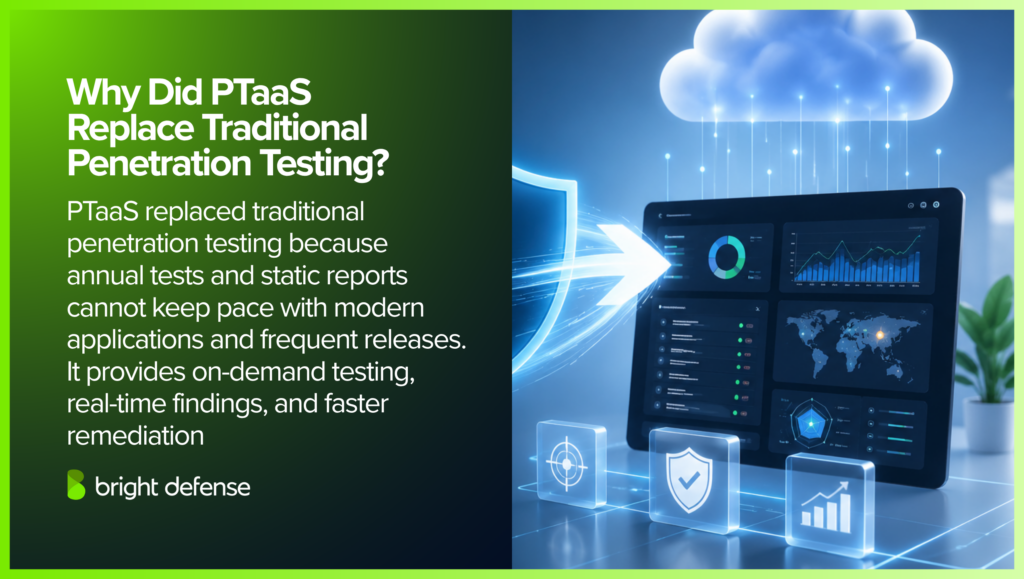
PTaaS gives security teams a faster and more practical way to test changing systems. Distributed workforces, cloud-native infrastructure, APIs, and frequent code releases create new risks more often than a yearly test can catch.
With PTaaS, teams can launch tests on demand, view findings in real time, connect remediation to the SDLC, and retest fixes through the same platform.
How Does PTaaS Work?
PTaaS works through a managed dashboard where security teams scope, launch, monitor, fix, and retest penetration tests from one platform.
The platform gives teams a central place to define the rules of engagement, start tests on demand, review real-time findings, and work with testers during remediation.
A typical PTaaS engagement follows this flow:
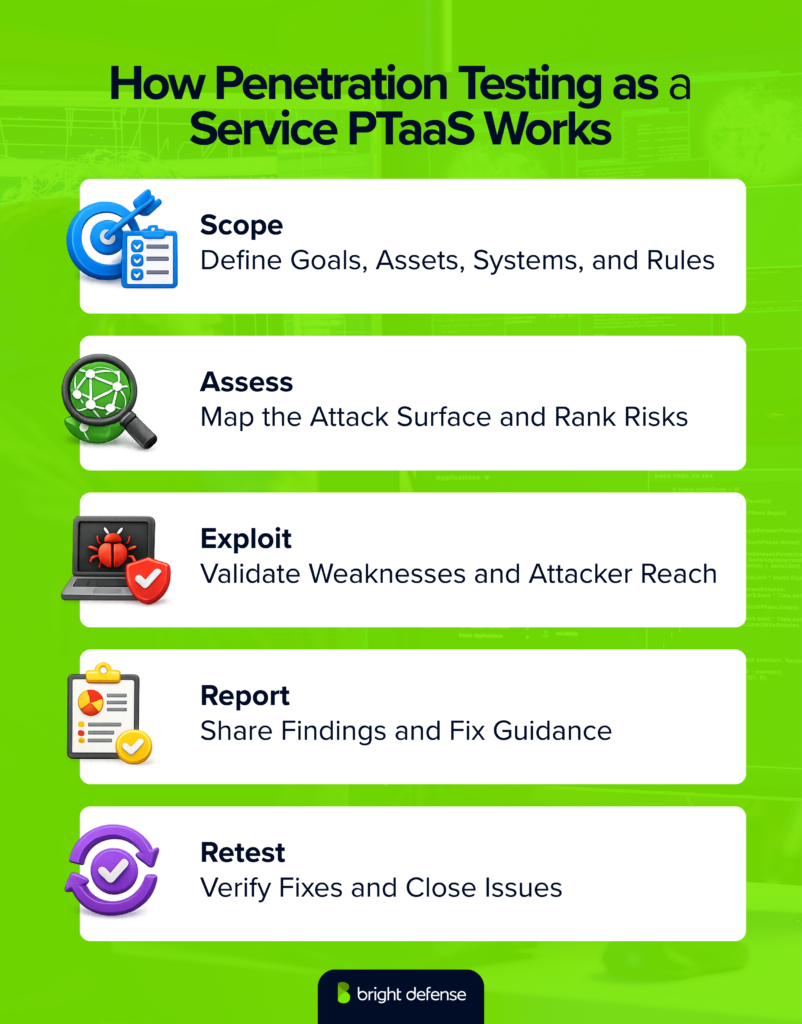
- Planning and Scoping: The team defines the test objectives, systems in scope, protected assets, test windows, and rules of engagement.
- Reconnaissance and Vulnerability Assessment: Testers map the attack surface, check exposed services, perform vulnerability discovery, analyze results, and prioritize the issues most likely to create real risk.
- Exploitation and Post-Exploitation: Ethical hackers attempt to exploit vulnerabilities, chain weaknesses where possible, escalate access, and test how far an attacker could move inside the environment.
- Reporting and Remediation: Findings appear in the dashboard as testing happens, with manual validation, proof of concept, severity, technical detail, and fix guidance.
- Retesting and Closure: Security engineers and development teams fix the issues, testers verify the remediation, and validated findings are closed inside the same workflow.
This model supports continuous penetration tests after major releases, infrastructure changes, and application updates. That makes PTaaS easier to fit into modern security programs than a one-time penetration test with delayed reporting.
What Are The Types Of Penetration Testing?
Each type examines a different part of the attack surface or uses a different testing perspective.
The following are the most common types of penetration testing:
- Network Penetration Testing: Assesses network infrastructure, access controls, exposed services, routers, firewalls, and incident response weaknesses.
- Web Application Penetration Testing: Tests web applications and SaaS apps for design flaws and coding vulnerabilities such as SQL injection, cross-site scripting, and authentication errors.
- Mobile Application Penetration Testing: Evaluates iOS and Android apps, APIs, platform-specific controls, data leakage risks, insecure authentication, and code-level weaknesses.
- Cloud Penetration Testing: Reviews cloud environments such as AWS, Azure, and Google Cloud for misconfigurations, weak permissions, exposed storage, and cloud-specific vulnerabilities.
- Wi-Fi Penetration Testing: Tests wireless networks for weak encryption, poor access controls, rogue access points, and paths attackers could use to gain unauthorized access.
- Internal And External Penetration Testing: Internal testing simulates an attacker or insider with network access, while external testing targets internet-facing assets such as domains, VPNs, APIs, and public applications.
- Black Box, White Box, And Gray Box Testing: Black box testing gives testers no prior knowledge, white box testing gives full system knowledge, and gray box testing gives partial knowledge to balance realism with efficiency.
- Purple Teaming: Brings offensive testers and defensive security teams together to assess detection, investigation, and incident response capabilities.
- Manual And Automated Penetration Testing: Manual testing uses human judgment to find complex flaws and chained attack paths, while automated testing uses tools to scale checks for known weaknesses.
- Social Engineering And Physical Penetration Testing: Social engineering tests employee susceptibility to phishing and pretexting, while physical penetration testing examines controls such as locks, badges, alarms, and access points.
Penetration tests can be targeted or full scope. A targeted engagement focuses on specific assets, applications, or attack paths, while a full-scope engagement reviews a broader part of the organization’s environment.
Why Does Human Expertise Matter In PTaaS?
Human expertise matters in PTaaS because automation can find known weaknesses quickly, but it often misses business logic flaws, chained exploits, context-specific risks, and attack paths used in real world attacks.
Automated tools are useful for scale, speed, and repeatable checks, but they cannot always understand how an application is supposed to work, how users behave, or how separate low-risk issues can combine into a real attack path. This limitation is reflected in recent industry sentiment, as support for fully automated penetration testing dropped to just 9% in 2026, down from 29% in 2025. The shift shows why PTaaS still depends on human testers to interpret context, validate findings, investigate complex attack paths, and determine whether weaknesses create meaningful security risk.
Research on web vulnerability scanners has found differences in detection quality and a high number of false positives, which shows why manual review still matters.
OWASP treats business logic testing as its own testing category, covering issues such as workflow bypass, request forging, process timing, misuse defenses, and payment functionality.
These are areas where a skilled tester’s judgment is critical because the weakness often depends on how the business process works.
In PTaaS, human testers validate findings, remove false positives, test exploitability, and decide when to dig deeper. A crowdsourced model can bring broader perspectives and niche technical skills, while a dedicated or curated tester model can provide more consistency, accountability, and familiarity with the environment. The strongest PTaaS programs use automation for coverage and human testers for judgment.
What Are The Benefits Of PTaaS?
The main benefits of PTaaS are continuous testing, lower testing costs, and broader coverage. These benefits make PTaaS a better fit for organizations that release software often, run cloud infrastructure, or need a more active way to manage security risk.
The following are the core benefits of PTaaS:
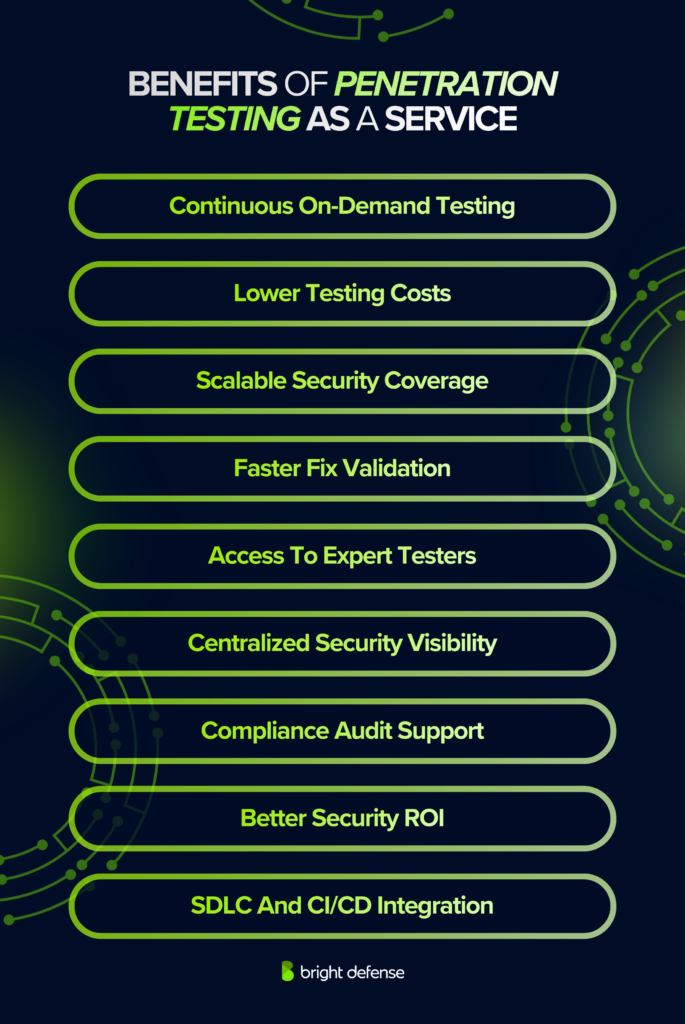
1. Continuous, On-Demand Testing
PTaaS allows security teams to run penetration tests when systems change, not only once or twice per year. Core Security’s 2024 Penetration Testing Report found that 43% of organizations run a penetration test only a couple times a year, leaving long stretches where new vulnerabilities go undetected. Other penetration testing statistics point to the same lag between testing cycles and real-world risk.
A continuous model gives teams a current attacker’s-eye view of their environment and helps them catch weaknesses after new releases, configuration changes, or infrastructure updates.
If you are deciding between a continuous model and a fixed schedule, our guide on how often you should conduct penetration tests breaks down recommended intervals by organization type and risk.
2. Lower Testing Costs
PTaaS can reduce the cost of penetration testing because organizations do not need to hire full-time penetration testers or start a new consulting engagement for every test. The pay-as-you-go model gives teams more control over scope, frequency, and budget. Understanding standard penetration testing pricing helps teams compare a pay-as-you-go model against fixed project fees.
3. Scalability Across The Attack Surface
PTaaS platforms handle a single application review, a targeted cloud assessment, or an enterprise-wide engagement on the same contract, so scope expands across networks, web applications, APIs, mobile apps, and cloud environments as the organization grows.
Those surfaces are also where growth concentrates. Palo Alto Networks’ State of Cloud Security Report 2025 recorded a 41% annual rise in API attacks as AI workloads pushed more activity onto cloud infrastructure, establishing APIs as a primary entry point.
Cloud depth varies widely between providers, which our comparison of cloud penetration testing firms examines in detail.
4. Faster Remediation
PTaaS shortens the gap between discovery and remediation because findings appear in real time and include prioritization, proof of concept, and fix guidance.
Cobalt’s State of Pentesting Report 2026 found that organizations running pentesting as a continuous program resolve half of their high-risk findings within 10 days, while those treating it as a one-time compliance exercise take 249 days to reach the same point.
Security and engineering teams can start working on critical issues before the full engagement ends.
5. Access To Specialized Testers
PTaaS gives organizations access to testers and security experts with different skill sets across web, mobile, cloud, API, network, and application security.
This matters because one tester may not have deep experience across every technology stack or attack technique, and assembling that range in-house is hard.
In ISC2’s 2025 Cybersecurity Workforce Study, 29% of organizations said they could not afford to hire staff with the skills needed to properly secure their environments.
6. Continuous Visibility And Centralized Control
PTaaS dashboards give teams one place to view test status, active findings, remediation progress, retest results, and historical data. This helps security leaders manage scheduling, scope, severity, ownership, and closure without relying on disconnected reports.
7. Compliance And Audit Support
PTaaS can help organizations produce documented security testing evidence for frameworks, regulations, and testing standards such as PCI DSS, HIPAA, ISO 27001, SOC 2, GDPR, and OWASP. PTaaS can support recurring compliance testing activities required by these frameworks and internal governance programs.
Compliance is a steady driver of this work: in Core Security’s 2024 Penetration Testing Report, the share of organizations using third-party penetration testing services for compliance rose 11% year over year to 56%. The value comes from repeatable testing, clear reporting, and validation that fixes were retested. For SOC 2 specifically, this evidence maps to SOC 2 penetration testing expectations during an audit.
8. Stronger Security ROI
PTaaS improves return on security spending because it helps teams find exploitable weaknesses earlier, prioritize the issues that matter most, and reduce the likelihood of expensive incidents. The platform model gives teams measurable data on findings, remediation speed, and risk reduction.
9. SDLC And CI/CD Integration
PTaaS can fit into modern development workflows and the software development lifecycle so teams receive security feedback closer to code changes. This supports DevSecOps and shift-left security because developers can fix issues earlier, before vulnerabilities reach production or become harder to remediate.
PTaaS Vs Vulnerability Scanning, In-House Testing, And Traditional Pen Tests
PPTaaS differs from vulnerability scanning, in-house testing, and traditional penetration testing because it combines platform-based delivery, human testing, real-time reporting, and repeatable retesting.
Each approach has value, but they solve different security problems. Many organizations use continuous vulnerability scanning alongside PTaaS to monitor known weaknesses between manual assessments.
Vulnerability scanning, on the other hand, helps teams find known issues at scale. In-house testing gives internal teams more control. Traditional penetration testing provides a structured manual assessment. PTaaS brings these ideas closer together through a cloud platform that supports faster testing, clearer remediation, and ongoing validation.
The following comparison shows where each approach fits:
| Aspect | PTaaS | Vulnerability Scanning | In-House Testing | Traditional Pen Tests |
| Main Purpose | Validate real risk | Flag known issues | Test internally | Assess fixed scope |
| Delivery Model | Managed platform | Automated tool | Internal team | Consulting project |
| Testing Depth | Human plus automation | Tool-based checks | Team-dependent | Manual assessment |
| Exploit Proof | Usually included | Usually missing | Varies | Usually included |
| False Positives | Lower after validation | Often higher | Skill-dependent | Lower after review |
| Reporting Speed | Real time | Scan output | Internal process | End of engagement |
| Remediation Support | Prioritized guidance | Limited context | Team-dependent | Report-based guidance |
| Retesting | Built into workflow | Re-scan focused | Manual process | Separate request |
| Cost Profile | Pay as needed | Lower tool cost | Higher staffing cost | Fixed project cost |
| Coverage | Broad and scalable | Known vulnerabilities | Limited capacity | Fixed scope |
| SDLC Fit | Strong fit | Limited fit | Requires setup | Often separate |
| Best Use Case | Ongoing validation | Routine scanning | Internal control | Deep custom review |
PTaaS is more advanced than vulnerability scanning because it does not stop at automated detection. A scanner may flag a missing patch, weak header, outdated dependency, or exposed service. PTaaS goes further because human testers validate whether the issue is exploitable, document the attack path, remove false positives, and explain the business impact. These are the core differences between penetration testing and vulnerability scanning.
PTaaS can be more practical than in-house testing because most organizations cannot hire and retain every type of security specialist they need. A mature PTaaS provider can give teams access to web, cloud, mobile, API, and network security expertise without building a full internal red team. Some provider data cites cost savings of up to 30% compared with in-house testing, mainly because teams avoid full-time staffing, tooling, and training costs.
PTaaS is more flexible than traditional penetration testing because teams can launch tests faster, track findings as they appear, assign fixes earlier, and request retesting through the same platform. Traditional pen tests still have value for fixed-scope assessments, custom environments, and regulatory projects that need a formal consulting process. PTaaS works better when the organization needs recurring validation, SDLC feedback, and a live view of remediation progress.
When Is Traditional Penetration Testing The Better Choice?
Traditional penetration testing is the better choice when an organization needs a highly customized assessment, onsite testing, strict data control, or a fixed-scope project that does not require continuous retesting. PTaaS works well for recurring, remote, and platform-managed testing, but some environments still need a deeper consulting-led approach.
Traditional penetration testing may be the better fit in these situations:
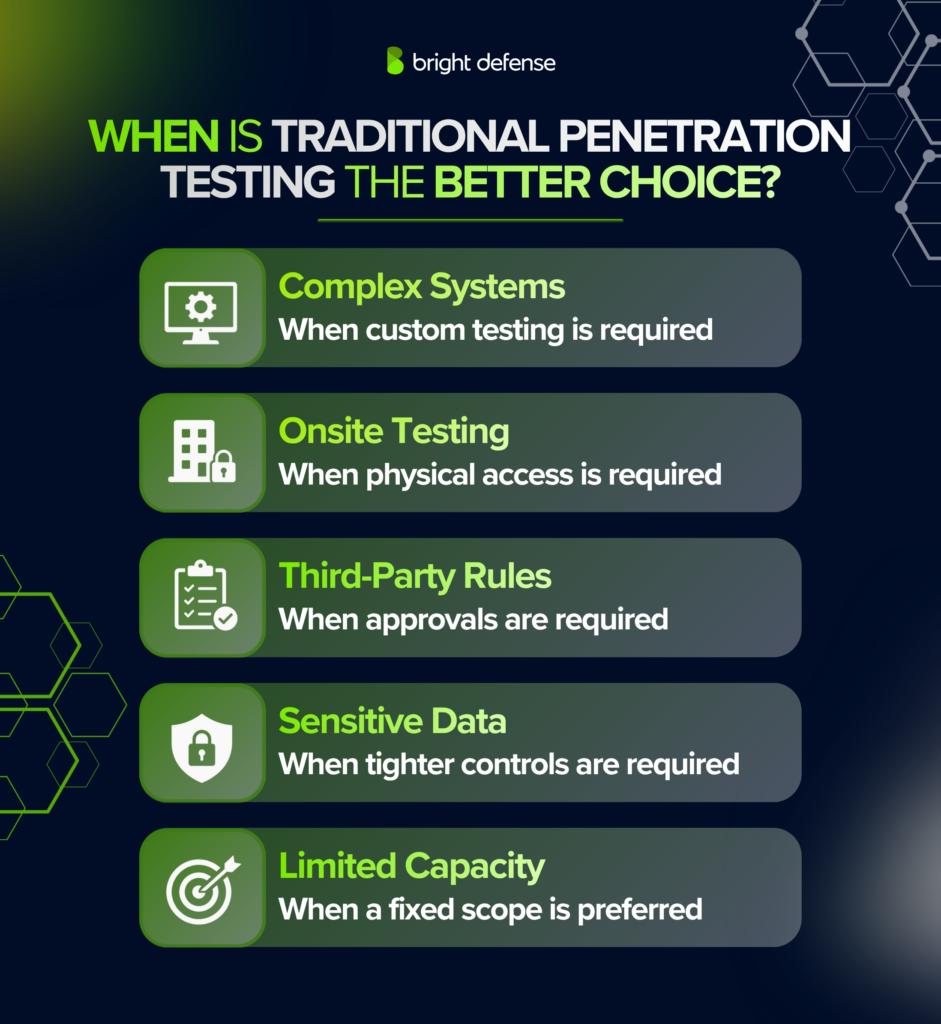
Specialized Or Complex Environments
Industrial control systems, operational technology, legacy infrastructure, custom protocols, and bespoke applications often need a custom testing plan. These environments may involve safety concerns, fragile systems, unique business logic, or limited documentation. A traditional penetration test gives the provider more room to plan carefully, coordinate with internal teams, and adjust the methodology around the environment.
Onsite Or Physical Testing Requirements
Most PTaaS engagements are remote-only, which makes them less suitable for physical penetration testing, wireless testing inside a facility, badge access checks, or onsite network testing. A traditional engagement is a better option when testers need to visit offices, data centers, production sites, or restricted facilities to assess physical controls and local network exposure.
Third-Party Testing Constraints
Some systems cannot be tested continuously because cloud providers, vendors, partners, or managed service providers require advance approval. These restrictions may limit test windows, traffic volume, testing methods, or frequency. A traditional pen test gives teams more time to coordinate approvals, document boundaries, and run the engagement within the approved window.
Sensitive Data Handling And Key Management
Organizations that handle highly sensitive data may need tighter control over tester access, evidence storage, encryption keys, logs, and report distribution. A traditional assessment can support stricter data handling rules, custom nondisclosure terms, controlled evidence collection, and internal review before results are shared across teams.
Budget Or Remediation Capacity Limits
PTaaS works best when teams can fix issues quickly and support recurring retesting. Organizations with limited security staff, slow patch cycles, or unresolved findings from earlier tests may not benefit from a continuous model right away. A targeted traditional test may be more practical because it limits scope, focuses on the most important systems, and gives teams a manageable set of findings to remediate.
How To Choose A PTaaS Provider
The best PTaaS provider offers broad testing coverage, skilled human testers, clear reporting, platform integrations, and a transparent testing process. A provider should not only run tests, but help your team understand risk, fix issues, verify remediation, and prove security progress over time.
The following criteria matter most when choosing a PTaaS provider:
Full-Stack Coverage
A PTaaS provider should test networks, cloud environments, web applications, mobile applications, APIs, and both internal and external assets. Attackers rarely stay inside one system category, so narrow testing can leave major security gaps unexamined.
Verizon’s 2025 DBIR found that exploitation of vulnerabilities grew 34% and accounted for 20% of breaches, which shows why PTaaS coverage needs to include exposed systems, internal infrastructure, cloud permissions, and application-layer weaknesses.
A strong provider should assess the full attack surface rather than only reviewing public-facing systems.
Human, Hands-On Testing
A PTaaS provider should use skilled human testers to manually verify findings, reduce false positives, and find complex vulnerabilities that automated scanners often miss.
Scanners are useful for repeatable checks, but they often struggle with business logic flaws, chained exploits, privilege escalation paths, and vulnerabilities that depend on user roles or application behavior.
Human testers can evaluate how weaknesses interact with existing security measures and determine whether attackers could realistically abuse them.
Qualified And Certified Testers
A PTaaS provider should have testers with proven penetration testing experience and relevant certifications.
Credentials such as OSCP, OSCE, OSWE, CREST, CEH, CompTIA PenTest+, and CPTE can show formal training in offensive security, exploitation, reporting, and testing methodology.
Certifications should not be the only measure of quality, but they help validate baseline technical skill. The provider should be able to explain who performs the testing, what experience those testers have, and how results are reviewed before they reach your team.
Tester Bench Size And Skill Diversity
A larger tester bench gives the provider more flexibility to match the right skills to the right environment.
This is useful for organizations with cloud infrastructure, APIs, mobile apps, SaaS platforms, industrial systems, or regulated environments that require specific technical knowledge.
A strong PTaaS provider should have testers with different backgrounds, including cloud security, application security, network exploitation, source code review, mobile testing, and compliance-focused testing.
Some programs may need testers with security clearance, regional experience, or past work in healthcare, finance, government, or enterprise SaaS.
Actionable Reporting
PTaaS reports should include an executive summary, technical detail, proof of concept, severity ratings, business impact, affected assets, reproduction steps, and prioritized remediation guidance.
A useful report should help leaders understand business risk and help engineers fix the issue without guessing. Strong reporting explains what was found, how it was validated, how likely exploitation is, what could happen after exploitation, and which fix should come first.
Platform Integrations And Data Exports
The PTaaS platform should connect with SDLC tools, CI/CD workflows, ticketing systems, vulnerability management tools, and GRC platforms.
These integrations help teams assign findings, track remediation, export reports, and measure progress without creating a separate workflow.
Useful integrations may include Jira, GitHub, GitLab, ServiceNow, Slack, Microsoft Teams, Azure DevOps, and compliance tools.
The platform should make it easy to export data in common formats, share evidence with auditors, and keep remediation work tied to existing engineering processes.
Clear Methodology And Communication
A PTaaS provider should explain how testing is scoped, how testers are selected, which methods are used, and how findings are validated. Clear methodology helps your team understand what is included, what is excluded, and how the engagement will be measured.
Communication should continue after kickoff through status updates, open channels, escalation paths, and access to testers when clarification is needed. Sample reports, scoping documents, rules of engagement, and testing timelines help teams understand the service before work begins.
Compliance And Evidence Support
A strong PTaaS provider should help teams produce testing evidence for standards and regulations such as PCI DSS, HIPAA, ISO 27001, SOC 2, GDPR, OWASP, and SANS. The platform should make it easy to show testing scope, findings, remediation status, retest results, tester notes, and final reports during audits.
Compliance support is especially valuable when security teams need recurring tests, proof of remediation, and clear records for control owners. The provider should understand how penetration testing evidence maps to common audit and risk requirements.
Ask each prospective provider to explain its full-stack coverage, tester qualifications, sample reporting format, retesting process, integration options, communication model, and past work with similar environments. These answers reveal whether the provider can support real security outcomes or only deliver another testing report.
Where Does PTaaS Fit In Continuous Threat Exposure Management (CTEM)?
PTaaS fits into Continuous Threat Exposure Management (CTEM) as the validation layer that shows which exposures can actually be exploited. CTEM focuses on finding, prioritizing, validating, and reducing security exposures created by evolving cyber threats across the organization. PTaaS supports that process with human-led testing, real-time findings, remediation guidance, and retesting after fixes.
PTaaS gives security teams a practical way to move from theoretical risk to proven risk when evaluating modern security threats. Vulnerability scanners, attack surface tools, and threat intelligence can show where weaknesses may exist, but PTaaS tests whether those weaknesses can become real attack paths. This helps teams prioritize the issues that matter most instead of treating every alert the same way.
PTaaS is especially useful for proactive threat hunting because testers think like attackers and examine how exposed assets, weak security controls, misconfigurations, and application flaws connect. When PTaaS works with vulnerability management, attack surface monitoring, and threat intelligence, it gives organizations a more current view of their security posture and a clearer path to reducing risk over time.
Why Choose Bright Defense For PTaaS?
Bright Defense provides penetration testing services that combine human-led testing, actionable reporting, and practical risk validation. Our team tests web applications, APIs, cloud environments, networks, mobile apps, and critical assets to find exploitable vulnerabilities before attackers can use them.
We validate findings, reduce false positives, prioritize risk, and give clear remediation guidance. This helps security engineers and development teams fix issues faster, support compliance testing, and improve security posture with confidence.
Frequently Asked Questions
PTaaS is a cloud-based model that delivers on-demand penetration testing through a platform combining manual and automated techniques.
SaaS penetration testing focuses on assessing the security of software-as-a-service applications, identifying vulnerabilities in multi-tenant architectures, APIs and access controls, but it is independent of the PTaaS delivery model.
An SOP (standard operating procedure) defines the methodology, rules of engagement, legal considerations and reporting requirements for a penetration test. PTaaS providers typically share an SOP during the scoping phase to ensure alignment.
Frequency depends on business needs, but many organizations schedule baseline tests followed by continuous or periodic retests aligned with release cycles, compliance deadlines and changes in infrastructure.