What Is Penetration Testing? Everything You Need to Know
Updated:
October 15, 2026
Penetration testing is an authorized security assessment that simulates attacks to identify exploitable weaknesses in applications, networks, and systems.
Testers work within an agreed scope to demonstrate how vulnerabilities could expose sensitive data or allow unauthorized access. Findings help organizations prioritize repairs and evaluate their security controls.
The Identity Theft Resource Center recorded 1,803 data compromises and approximately 471.2 million victim notices during the first half of 2026.
The victim-notice total exceeded the number issued throughout 2025. These figures count reported compromises and notifications, rather than unique individuals affected.
IBM’s 2026 Cost of a Data Breach Report placed the global average breach cost at $4.99 million, a 12% increase over the previous year. The report attributed the increase to higher detection, escalation, and lost business costs.
Penetration testing helps organizations identify attack paths and turn technical findings into corrective actions. This guide explains how testing works, its main types and techniques, and how to use the results to address security weaknesses.
What is Penetration Testing?
Penetration testing is an authorized security assessment that simulates attacks to identify and validate exploitable weaknesses in systems, networks, and applications.
Testers combine manual techniques with automated tools to determine whether vulnerabilities allow unauthorized access, data exposure, or other security failures.
Each engagement follows an agreed scope that defines approved targets, methods, and restrictions.
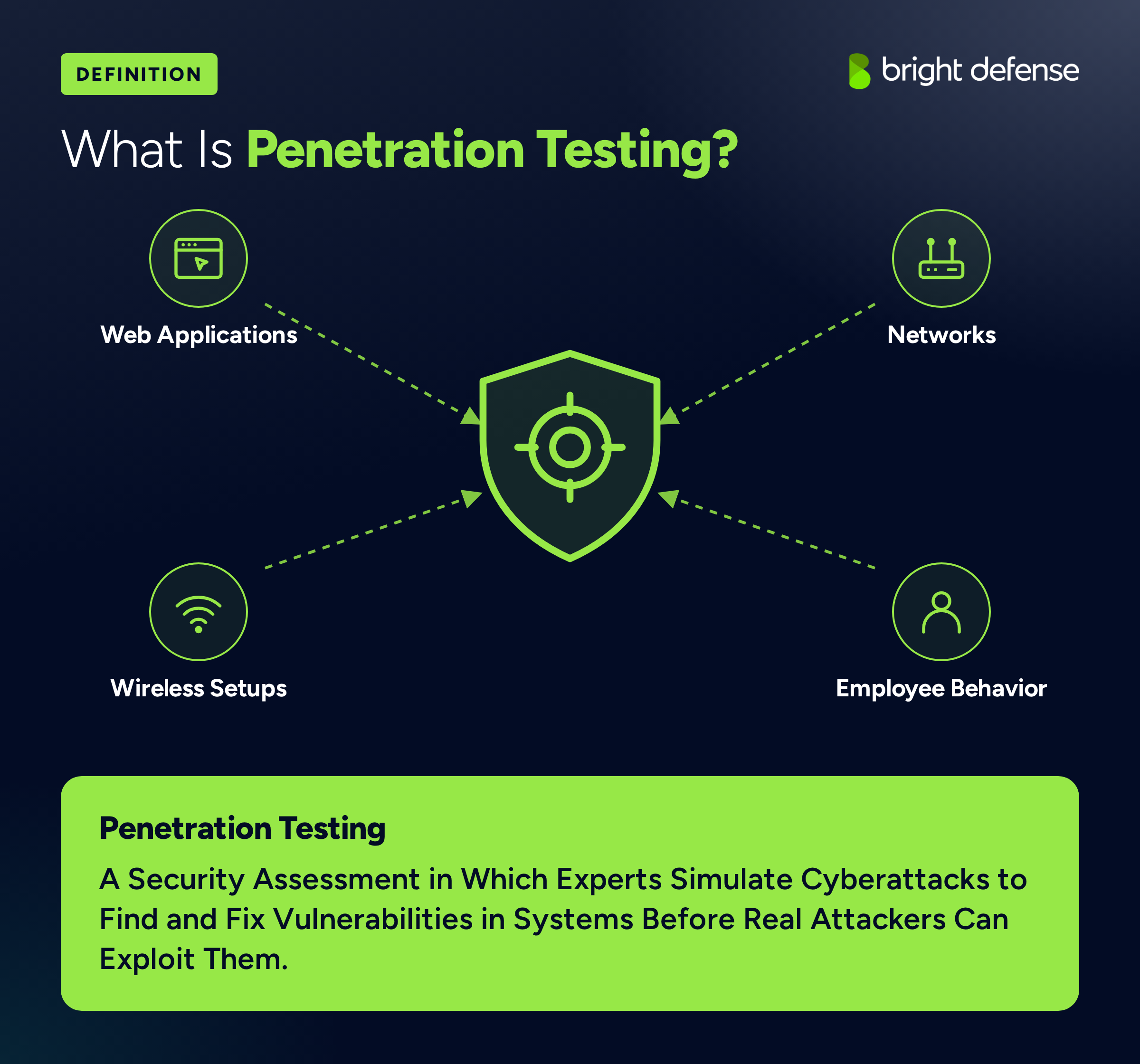
Testing can cover web applications, internal and external networks, wireless systems, and explicitly authorized social engineering scenarios.
The resulting report documents findings, supporting evidence, potential business impact, and recommended fixes, helping organizations prioritize remediation.
Get Trusted Penetration Testing By Bright Defense Run a Pen TestPenetration Testing Methodologies
Penetration testing methodologies describe how assessments are planned, performed, and reported. Black box, white box, and grey box testing describe the information available to testers.
These approaches can support different assessment scopes, including internal networks and public-facing applications. The tester’s knowledge and the systems being tested are separate scoping decisions.
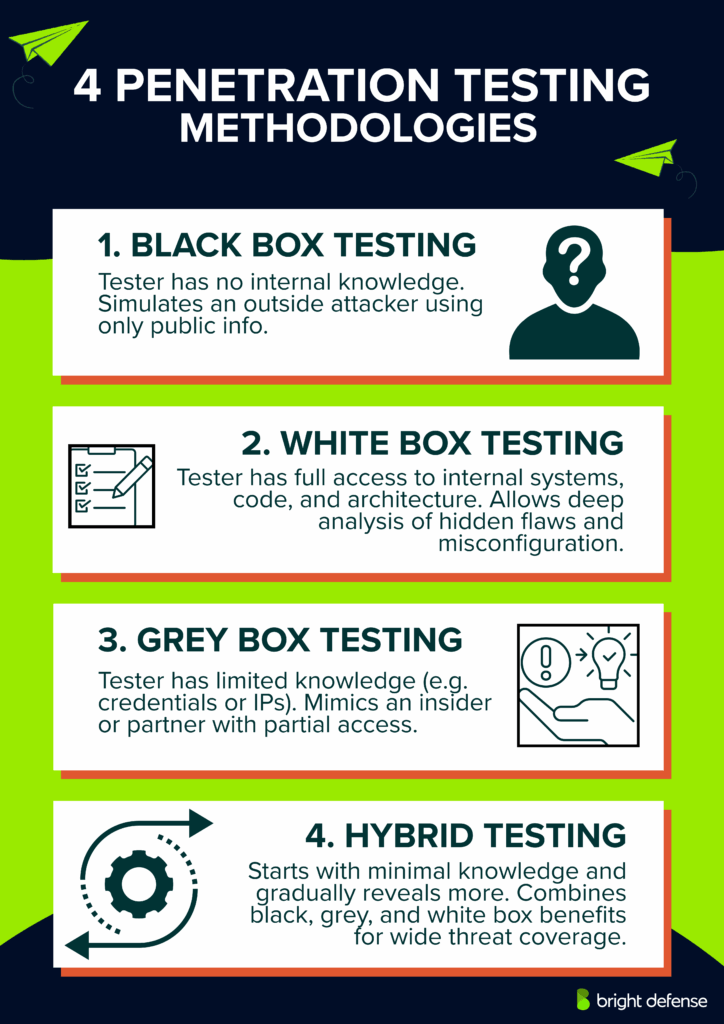
1. Black Box Testing
Black box penetration testing evaluates systems with minimal information about their internal design or configuration. Testers receive authorized targets and engagement boundaries, then use reconnaissance, scanning, and manual testing to identify exploitable weaknesses.
This approach represents an attacker with limited knowledge. It often targets public-facing systems, but the agreed scope determines the testing location and access. Time spent gathering information can limit coverage of deeper functionality.
2. White Box Testing
White box penetration testing gives testers detailed information about the systems being assessed. This can include source code, architecture diagrams, configurations, credentials, and technical documentation.
Testers use that visibility to investigate implementation flaws, access-control weaknesses, and complex attack paths.
White box testing applies to both internal systems and public-facing applications. Its depth depends on the agreed scope, available information, and testing time.
3. Grey Box Testing
Grey box penetration testing provides testers with partial knowledge or limited access to the target environment. Examples include standard user accounts, selected documentation, or details about specific application components.
This approach supports scenarios involving an authenticated user or an attacker with an initial foothold.
Testers examine authentication, session management, authorization, and privilege boundaries to determine whether that access permits unauthorized actions or exposure of other users’ data.
4. Hybrid Testing
Hybrid penetration testing combines automated tools with manual assessment in Bright Defense’s approach.
Automated scanning identifies potential vulnerabilities, while testers validate findings and investigate business logic flaws, access-control issues, and connected attack paths.
This combination can operate within black box, white box, or grey box engagements. The engagement agreement should define the information provided, testing methods, and assessment boundaries.
Benefits of Penetration Testing
Penetration testing identifies exploitable weaknesses, guides remediation, and provides evidence for security and compliance decisions. Its practical value depends on addressing findings and verifying that corrective actions work.
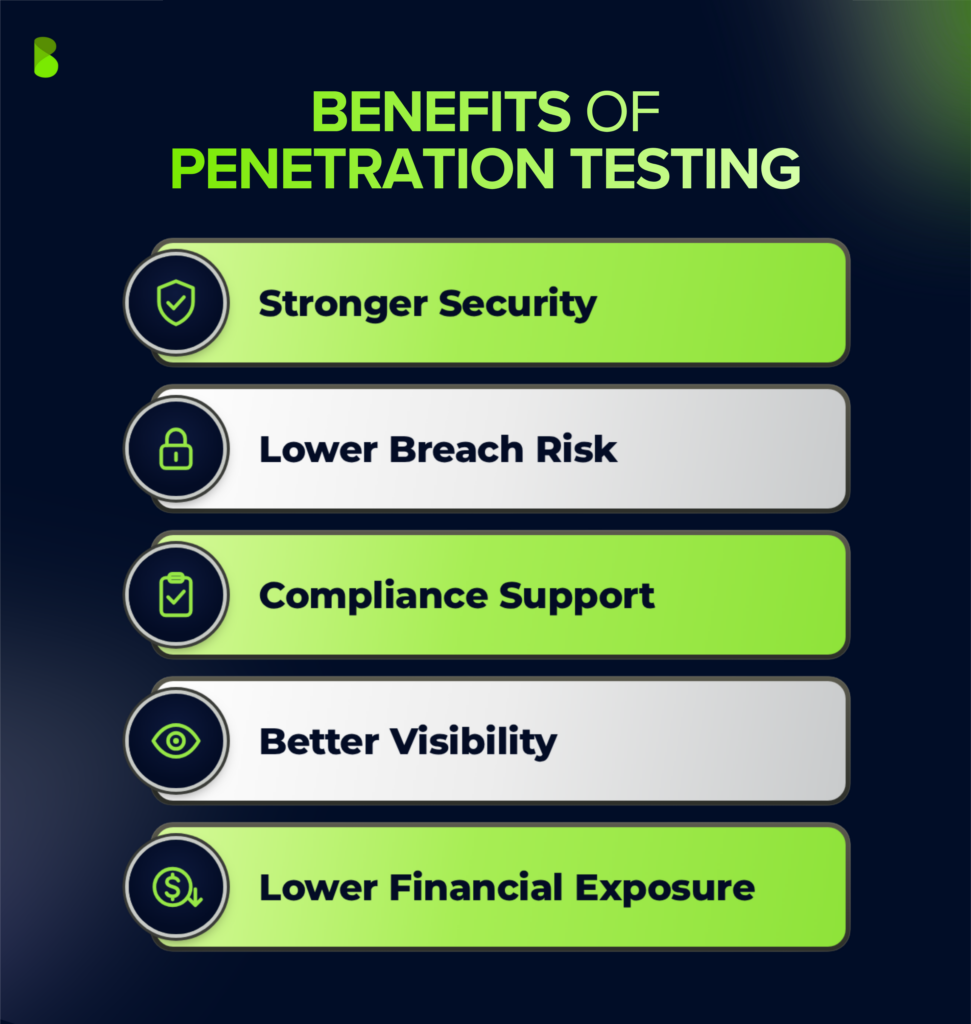
The following five benefits explain how testing supports an organization’s security program.
1. Improved Security Posture
Penetration testing demonstrates how weaknesses affect systems, applications, and sensitive information. Findings show the access an attacker could gain and help teams prioritize repairs according to business impact.
Assigning remediation owners, setting deadlines, and retesting corrected vulnerabilities turns the assessment into measurable improvements.
2. Reduced Risk of Security Breaches
Penetration testing exposes attack paths that could lead to unauthorized access, data loss, or operational disruption. Fixing these weaknesses reduces opportunities for exploitation.
In Fortra’s 2024 survey, 72% of respondents believed penetration testing had prevented a breach at their organization.
This finding reflects respondents’ perceptions and does not measure a reduction in breach probability. Bright Defense’s penetration testing statistics provide further research on testing practices and remediation.
3. Support for Compliance Requirements
Penetration testing helps organizations meet specific security testing obligations and produce evidence for assessments.
Where applicable, PCI DSS requires internal and external penetration testing at least annually and after significant infrastructure or application changes, with further testing to verify corrections.
Requirements differ across regulations. GDPR calls for appropriate testing and evaluation of security measures, while the current HIPAA Security Rule requires risk analysis and periodic security evaluations; neither establishes a universal, explicit penetration-testing mandate. HHS’s proposed HIPAA changes would introduce an annual penetration-testing requirement.
Test reports, remediation records, and retest results help demonstrate how an organization identifies and addresses security weaknesses.
They support a compliance review but do not establish compliance on their own. For SOC 2, penetration testing can support security-control evidence according to the organization’s risks, system boundary, and control design.
4. Better Visibility Into Connected Systems
Penetration testing examines how weaknesses combine across systems within the agreed scope. An application flaw, for example, could expose credentials that provide access to another service.
Demonstrating these connections helps teams improve permissions, credential handling, and network segmentation. Coverage depends on the assets, access, techniques, and time included in the engagement.
5. Reduced Exposure to Financial Loss
Penetration testing connects technical weaknesses to business consequences, including interrupted services, exposed customer records, and compromised recovery systems.
These findings help leaders direct resources toward the most consequential risks. Any reduction in financial exposure depends on effective remediation and continued maintenance of the affected controls.
Get Trusted Penetration Testing By Bright Defense Run a Pen TestPenetration Testing Phases and Execution Steps
Penetration testing follows a documented process of authorization, investigation, controlled exploitation, reporting, and remediation.
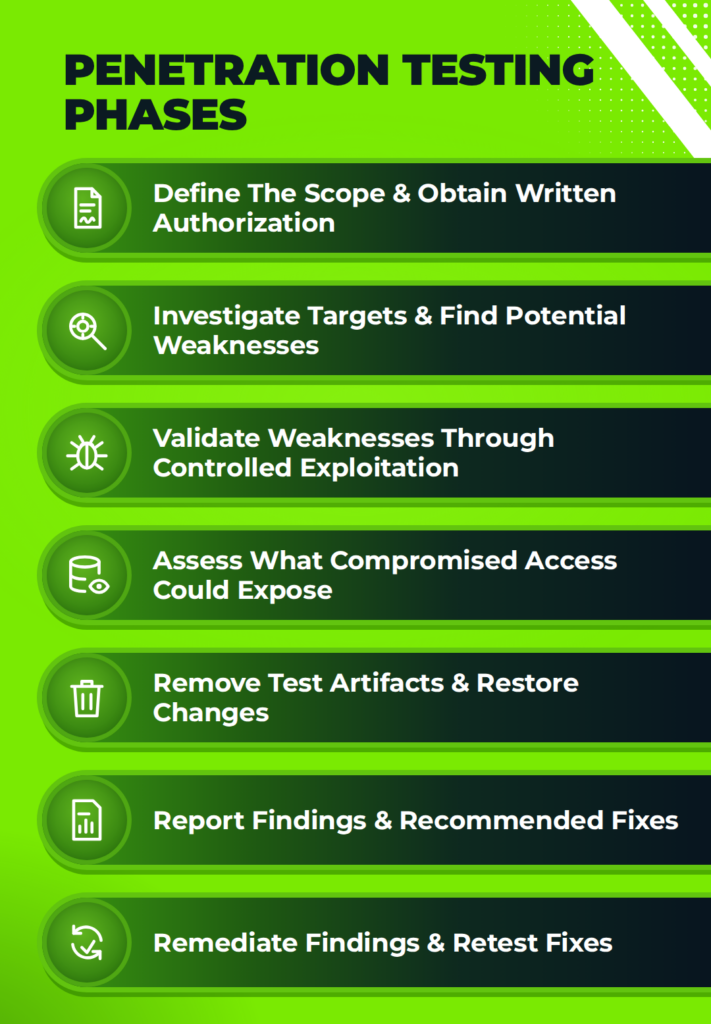
The following seven-step workflow covers an engagement from initial planning through cleanup and verification of fixes.
Step 1: Define the Scope and Obtain Authorization
Planning establishes the objectives, approved targets, testing methods, and operational boundaries. Obtain written authorization and document the rules of engagement before testing begins.
Specify testing windows, excluded systems, emergency contacts, stop conditions, and evidence-handling requirements. Confirm any permissions needed for third-party systems included in the assessment.
For vendor assessments, penetration testing in third-party risk management connects the agreed scope with evidence review and remediation responsibilities.
Step 2: Conduct Reconnaissance and Vulnerability Analysis
Testers gather information about approved targets and examine their exposed services, applications, and configurations. Automated scanning and manual investigation help identify potential weaknesses, including outdated software, excessive permissions, and insecure settings.
Testers review results to distinguish credible findings from false positives and select issues for validation. The distinction between penetration testing and vulnerability scanning explains why identifying a potential weakness differs from demonstrating its impact.
Step 3: Validate Vulnerabilities Through Controlled Exploitation
Controlled exploitation determines whether identified weaknesses can produce a security impact. Testers attempt approved actions that demonstrate unauthorized access, exposed information, or other failures.
They record the conditions, evidence, and impact of successful attempts while observing the engagement’s limits. Exploitation should establish the finding without unnecessary disruption.
Step 4: Assess the Impact of Compromised Access
Post-exploitation assessment examines what an attacker could accomplish after gaining access. Depending on the agreed scope, testers evaluate privilege escalation, access to sensitive information, and movement between systems.
Persistence testing requires explicit authorization and documented removal procedures. The extent of this work should follow the engagement’s objectives and restrictions.
Step 5: Remove Test Artifacts and Restore Changes
Cleanup removes temporary accounts, uploaded files, deployed tools, and other artifacts introduced during testing. Testers coordinate with system owners to reverse approved configuration changes and revoke temporary access.
Record completed cleanup actions and any outstanding work. Preserve relevant audit logs and retain assessment evidence according to the agreed handling requirements.
Step 6: Analyze Findings and Deliver the Report
The penetration testing report documents the scope, methods, limitations, validated findings, supporting evidence, and recommended fixes. Risk ratings should consider exploitability and business impact.
Provide an executive summary for leadership and technical details for remediation teams. Escalate urgent findings during testing so corrective work can begin promptly.
Step 7: Remediate Findings and Retest Fixes
System owners address findings through changes such as software patches, corrected permissions, safer configurations, and application fixes. Assign an owner and deadline to each action, with priorities based on risk.
Retesting verifies whether the original weakness remains exploitable. Record resolved findings, incomplete fixes, and formally accepted residual risks to maintain an accurate remediation history.
Types of Penetration Testing
Penetration testing types describe the systems, environments, or attack scenarios being assessed. PCI DSS testing adds compliance-specific requirements, while continuous and periodic testing describe frequency.
\These categories overlap, and one engagement can cover several areas. The following sections explain their purpose and scope.
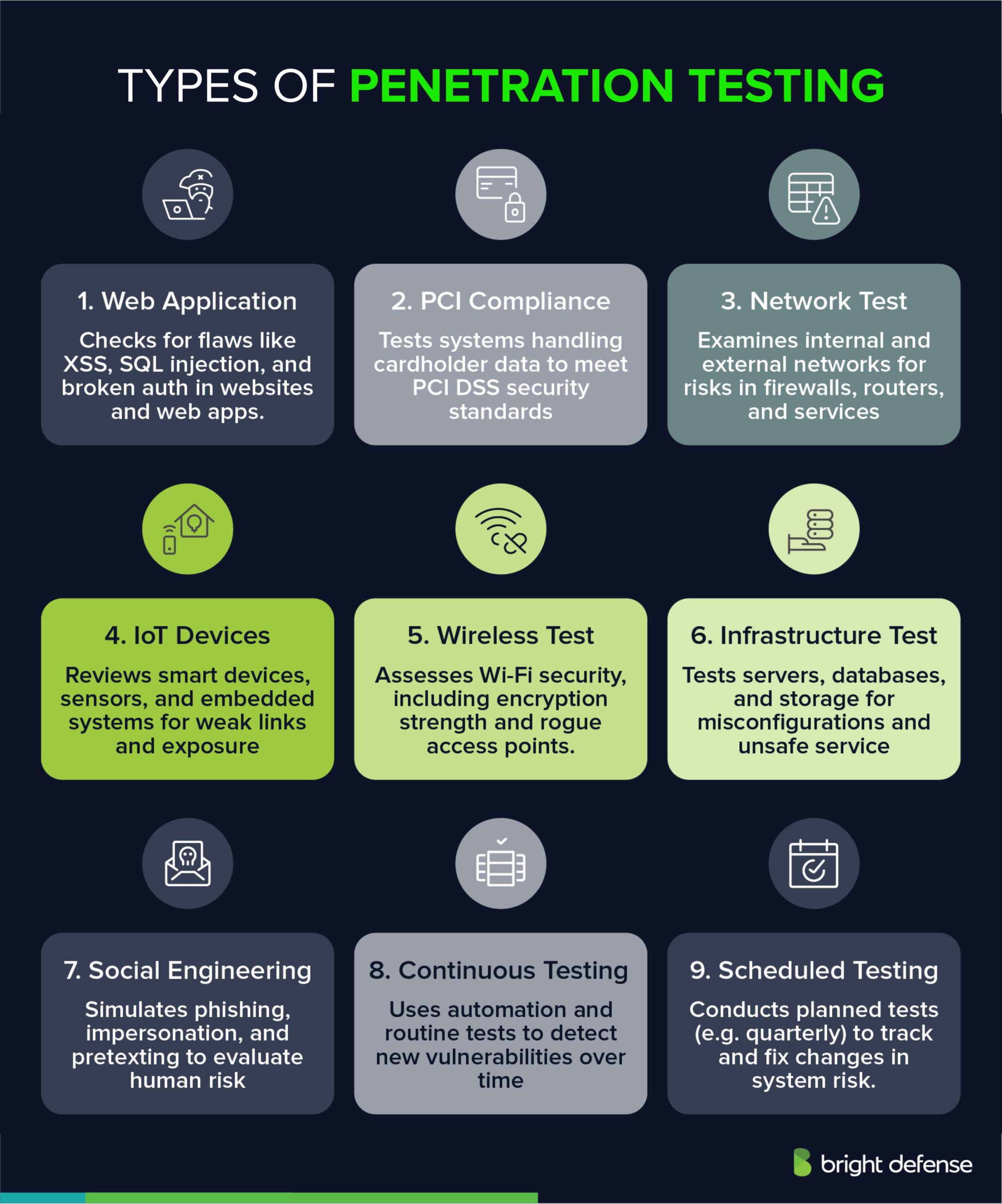
1. Web Application Penetration Testing
Web application penetration testing evaluates vulnerabilities in application functionality and security controls. Testers examine authentication, authorization, session management, input handling, and business logic.
Findings can include SQL injection, cross-site scripting (XSS), and unauthorized access to another user’s records. Testing demonstrates how these weaknesses affect the application and its data.
2. PCI DSS Penetration Testing
PCI DSS penetration testing supports applicable requirements of the Payment Card Industry Data Security Standard. Its scope includes the cardholder data environment, critical systems, and relevant segmentation controls.
Applicable internal and external tests occur at least annually and after significant infrastructure or application changes, followed by verification of corrections. A penetration test addresses part of PCI DSS compliance.
3. Network Penetration Testing
Network penetration testing evaluates exploitable weaknesses in network services, exposed systems, authentication, and segmentation. External testing examines access from outside the network perimeter.
Internal testing evaluates risks from an existing foothold or authorized network connection. Disruptive denial-of-service testing requires explicit agreement on methods and operational limits.
4. IoT Penetration Testing
Internet of Things (IoT) penetration testing examines connected devices and their supporting components. The scope can include firmware, update mechanisms, stored information, physical interfaces, wireless communications, and management interfaces.
Testers investigate weaknesses that could expose device data or permit unauthorized control. Hardware access and available technical documentation influence testing depth.
5. Wireless Penetration Testing
Wireless penetration testing evaluates Wi-Fi networks and other wireless technologies included in the scope. Testers examine authentication, encryption, access-point configurations, and separation between guest and internal networks.
Assessments can identify unauthorized access points, insecure connections, and paths from wireless access into restricted systems.
6. Infrastructure Penetration Testing
Infrastructure penetration testing examines servers, operating systems, databases, storage, virtualization platforms, and administrative interfaces.
It focuses on weaknesses such as excessive permissions, insecure services, exposed management tools, and configuration errors. Infrastructure and network testing frequently overlap, making an explicit list of included assets and services important.
7. Social Engineering Penetration Testing
Social engineering penetration testing evaluates how people and organizational procedures respond to approved manipulation scenarios. Techniques can include phishing, impersonation, and pretexting.
Findings help assess identity-verification procedures, incident reporting, and access decisions. The engagement should define permitted scenarios, participating groups, and restrictions on collecting sensitive information.
8. Continuous Penetration Testing
Continuous penetration testing describes a recurring program of security validation that responds to changes and newly identified risks. Its scope should specify automated checks, manual assessment, exploitation validation, and retesting.
Penetration Testing as a Service (PTaaS) provides a platform for managing engagements and findings. PTaaS can support one-time or recurring tests; platform access alone does not establish continuous coverage.
9. Periodic Penetration Testing
Periodic penetration testing follows a defined schedule based on business risk, system changes, and applicable obligations. Organizations may schedule annual, semiannual, or quarterly assessments, with targeted testing after significant changes.
Each report reflects the environment assessed during that testing window. Remediation and retesting keep the findings useful between scheduled engagements.
Get Trusted Penetration Testing By Bright Defense Run a Pen TestHow Much Does Penetration Testing Cost?
Manual penetration testing commonly costs $5,000 to $50,000 per engagement, according to BreachLock’s published pricing guide. Larger or more complex assessments can exceed this range. These figures provide budgeting guidance; the final quote depends on the systems, testing depth, and deliverables included.
Pricing factors include the number of applications, IP addresses, API endpoints, user roles, and business workflows tested.
Manual testing time, reporting requirements, and remediation retesting affect the total. Comparing these details helps buyers assess whether proposals provide equivalent coverage.
Bright Defense publishes the following fixed-scope plan prices:
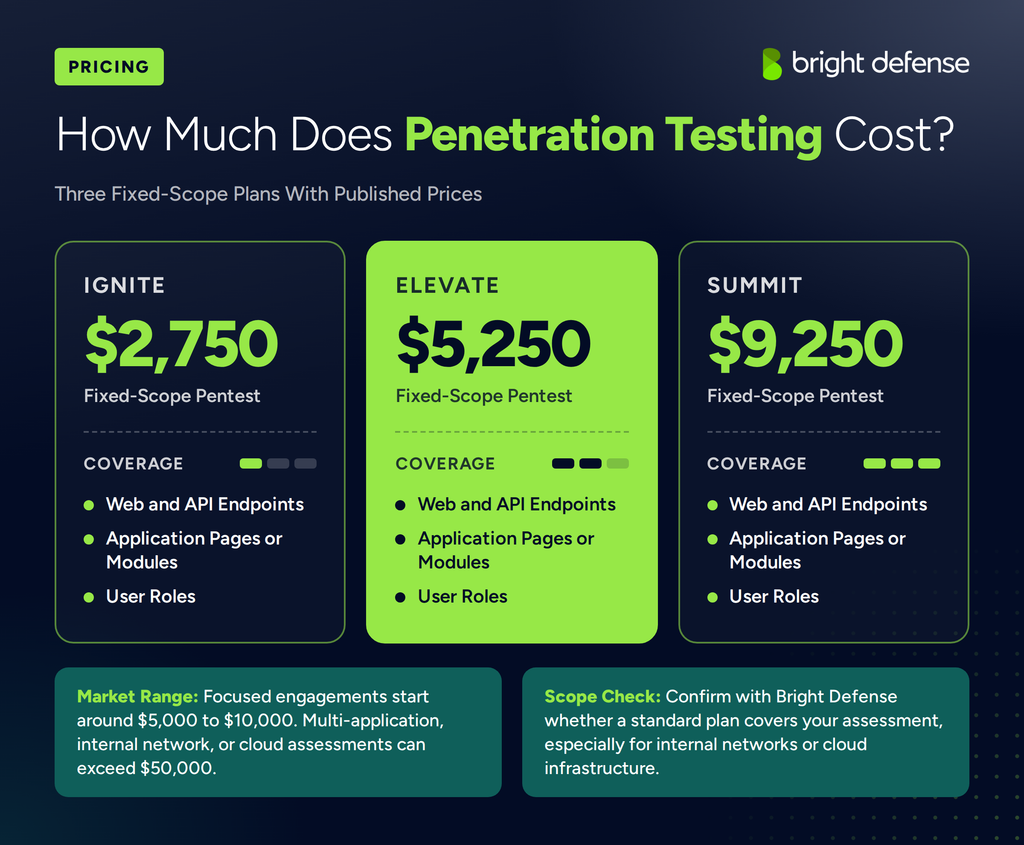
The plans provide increasing coverage for web and API endpoints, application pages or modules, and user roles. Bright Defense lists remediation guidance and retest support among its service features.
Confirm the included assets, retesting limits, and any additional charges in the proposal, particularly for internal networks or cloud infrastructure.
The Pentest Pricing Guide explains cost factors in more detail. The roundup of penetration testing firms in the USA provides further context for comparing providers.
Recommended Penetration Testing Frequency
Annual penetration testing is a practical baseline for many organizations, supported by additional testing after significant changes.
Systems that handle sensitive data, face greater exposure, or change frequently may warrant assessments every six months or quarterly. The scope should reflect current risks, including affected systems and their connections to other assets.
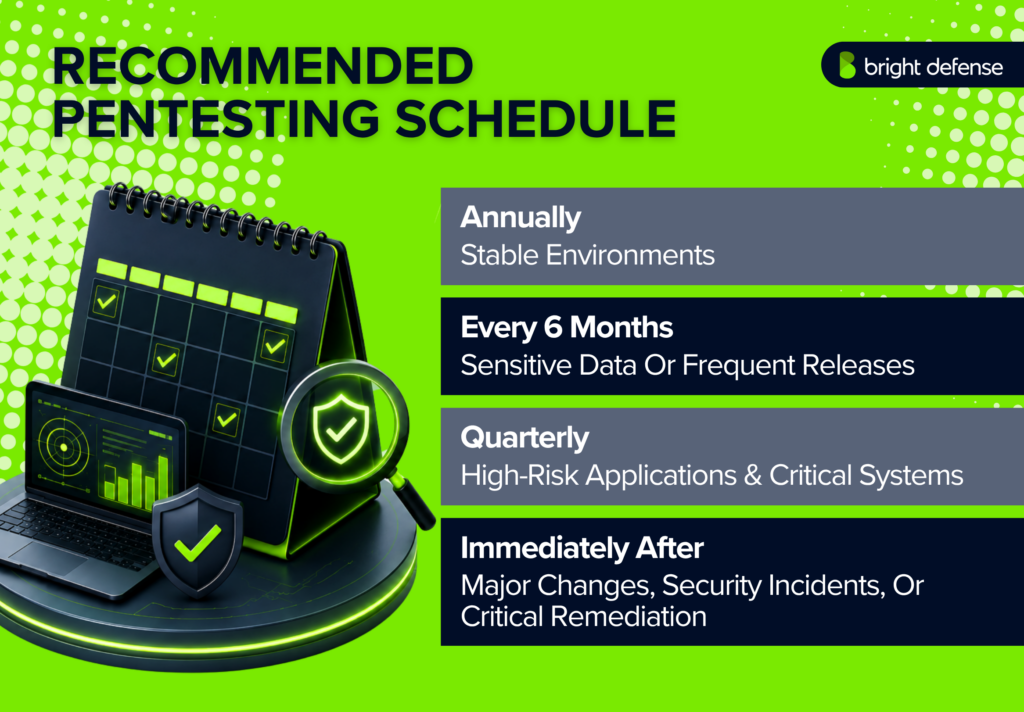
Testing frequency should account for data sensitivity, business impact, release schedules, previous findings, and applicable obligations.
PCI DSS, for example, requires applicable internal and external penetration tests at least annually and after significant infrastructure or application changes. It requires retesting to verify corrections. These requirements establish minimums for the relevant environment.
A cloud migration, major software release, new application programming interface (API), authentication change, network redesign, or privileged vendor connection can justify an additional assessment.
Targeted testing should address the changed components and any connected attack paths. Following a security incident, coordinate testing with incident-response and recovery activities.
A previous report remains evidence of the environment tested at that time, with its usefulness affected by subsequent changes.
The full guide covers schedules by organization type, testing triggers, and compliance requirements: How Often Should You Conduct Penetration Tests?.
How Bright Defense Supports Penetration Testing?
Bright Defense provides penetration testing for web applications, application programming interfaces (APIs), and networks, with prioritized reporting, remediation guidance, and retest support.
Its services help organizations identify exploitable weaknesses and determine which corrective actions need attention. The following areas explain how that support fits into a testing engagement.
Assessment Scope and Coverage
Bright Defense offers the Ignite, Elevate, and Summit plans with different coverage limits for web and API endpoints, application pages or modules, and user roles. Before selecting a plan, confirm which assets, workflows, and access levels require testing.
Internal networks and cloud infrastructure should be explicitly addressed in the agreed scope.
Vulnerability Investigation and Validation
Published testing features include application reconnaissance, authentication checks, API fuzzing, known-vulnerability searches, and testing for weaknesses covered by the OWASP Top 10.
These activities help identify failures in application behavior and security controls. The assessment scope determines which systems and scenarios receive testing.
Reporting That Supports Remediation
Bright Defense provides reports with prioritized findings and remediation recommendations. A useful penetration testing report connects each weakness to affected assets, supporting evidence, and potential business consequences.
Technical teams need sufficient detail to reproduce and correct findings, while leadership needs a clear explanation of the risks and remediation priorities.
Remediation Guidance and Retest Support
Remediation guidance and retest support help teams move from identifying weaknesses to verifying corrections. Confirm the retesting scope and timing during engagement planning.
Tracking each finding through remediation gives stakeholders a clearer record of completed fixes and outstanding risks.
Contact Bright Defense to discuss your systems, assessment objectives, reporting needs, and preferred testing window. These details help establish an appropriate scope and proposal before the engagement begins.
Get Trusted Penetration Testing By Bright Defense Run a Pen TestFAQs
1. What Is Penetration Testing?
Penetration testing is an authorized security assessment that uses simulated attacks to identify exploitable weaknesses. Testers examine systems, applications, or networks within an agreed scope and demonstrate the potential consequences of successful exploitation.
2. Is Penetration Testing the Same as Vulnerability Scanning?
No. Vulnerability scanning identifies potential weaknesses, while penetration testing investigates whether those weaknesses can lead to compromise.
3. Does Penetration Testing Usually Involve Exploitation Attempts?
Yes. Controlled exploitation is a central part of penetration testing. Testers attempt to validate weaknesses and demonstrate their impact within the approved rules of engagement.
4. What Are Black-Box, White-Box, and Grey-Box Penetration Tests?
- Black-box testing gives testers little or no internal information beyond the approved targets and scope. It represents an attacker who initially knows little about the environment.
- White-box testing provides detailed information, such as source code, architecture diagrams, documentation, and credentials. This access supports a deeper examination of security controls and implementation weaknesses.
- Grey-box testing provides partial information or limited access, such as a standard user account. It helps assess threats involving existing access, including privilege escalation and unauthorized access to other users’ data.
5. What Do You Receive at the End of a Penetration Test?
The main deliverable is a report explaining the findings, supporting evidence, business impact, and recommended fixes. It should identify the tested assets, methods, testing dates, exclusions, and limitations.
6. Will a Penetration Test Cause Downtime or Break My Website?
Disruption is possible, but careful planning can reduce the risk. Active testing may trigger account lockouts, application errors, security alerts, or performance problems.
7. How Often Should Penetration Testing Be Done?
Annual testing is a practical starting point for many organizations, supplemented by testing after significant changes. Systems with sensitive data, substantial internet exposure, or frequent releases may warrant assessments every six months or quarterly.
Yes. Obtain written authorization from the appropriate system owner and agree on the scope before testing begins.
The rules of engagement should define approved targets, exclusions, permitted methods, testing windows, data-handling requirements, escalation contacts, and stop conditions. Obtain any necessary third-party permissions for externally owned systems. Access to a service or customer account does not automatically authorize testing the underlying provider’s infrastructure.
There is no universally required five-phase sequence. A practical way to group the work is:
Planning and authorization: Agree on objectives, scope, permissions, and operating restrictions.
Reconnaissance and analysis: Gather information, identify exposed services, and investigate potential weaknesses.
Controlled exploitation: Validate vulnerabilities and assess their impact within the approved limits.
Cleanup and reporting: Remove testing artifacts, document findings, and explain recommended fixes.
Remediation and retesting: Correct weaknesses and verify that the fixes address the reported issues.
Network security: Protecting network connections, traffic, and infrastructure.
Information security: Protecting information against unauthorized access, alteration, or loss.
Endpoint security: Protecting laptops, desktops, servers, and other devices.
Cloud security: Protecting cloud workloads, configurations, identities, and data.
Application security: Identifying and addressing weaknesses in software and APIs.
Operational security: Managing sensitive operational information and the processes that could expose it.
Disaster recovery and business continuity: Restoring technology and maintaining essential operations after disruption.
VA means vulnerability assessment, and PT means penetration testing.
A penetration test demonstrates weaknesses and attack paths that testers could validate under specific conditions. Findings may show unauthorized access, exposed information, excessive privileges, or ineffective controls.
Approved targets and exclusions: Applications, domains, IP ranges, APIs, and relevant system boundaries.
Business context: Critical workflows, sensitive information, and operational priorities.
Testing arrangements: Approved windows, emergency contacts, escalation procedures, and stop conditions.
Access and documentation: Test accounts, user roles, architecture diagrams, or API documentation appropriate to the testing approach.
Data-handling instructions: Rules for collecting, protecting, retaining, and deleting evidence.
Authorization: Written approval and any required third-party permissions.
Begin with networking, Linux and Windows administration, web technologies, and basic scripting. Understanding how systems operate makes it easier to recognize insecure behavior and explain its consequences.