How Often Should You Conduct Penetration Tests?
Updated:
October 13, 2026
An annual penetration test is a practical baseline for most organizations. Systems that handle sensitive data, change frequently, or face greater exposure may need testing every six months or quarterly. Significant changes should prompt a test of the affected systems rather than waiting for the next scheduled assessment.
PCI DSS, for example, requires applicable internal and external penetration tests at least once every 12 months and after significant infrastructure or application changes.
A penetration test captures the security of a system during a specific testing period. A new application programming interface (API), cloud migration, authentication change, or third-party integration can introduce weaknesses that an earlier report could not assess.
The 2026 Verizon Data Breach Investigations Report found that vulnerability exploitation was the initial entry point in 31% of breaches. It surpassed stolen credentials as the leading entry point for the first time in the report’s 19-year history.
IBM’s 2026 Cost of a Data Breach Report put the average breach cost at $4.99 million globally and $11.5 million in the United States. These figures show the potential impact of a breach, though they do not prescribe a testing schedule.
This guide explains how to set a penetration testing schedule, when changes call for another test, and what to expect from a qualified provider.
Key Takeaways
- Annual penetration testing is a practical baseline; specific requirements depend on the organization and its applicable standards.
- Significant infrastructure or application changes can call for an additional test.
- Higher-risk systems may warrant testing every six months or quarterly.
- Vulnerability scanning supports regular checks but does not replace a penetration test.
- Findings should be retested after remediation to verify that the fixes work.
How Often Should You Conduct Penetration Tests?
An annual penetration test is a practical starting point for most organizations, with additional testing after significant changes. Systems with frequent releases, sensitive data, or greater exposure may warrant testing every six months or quarterly.
The schedule should reflect the systems at risk and any applicable contractual or compliance requirements.
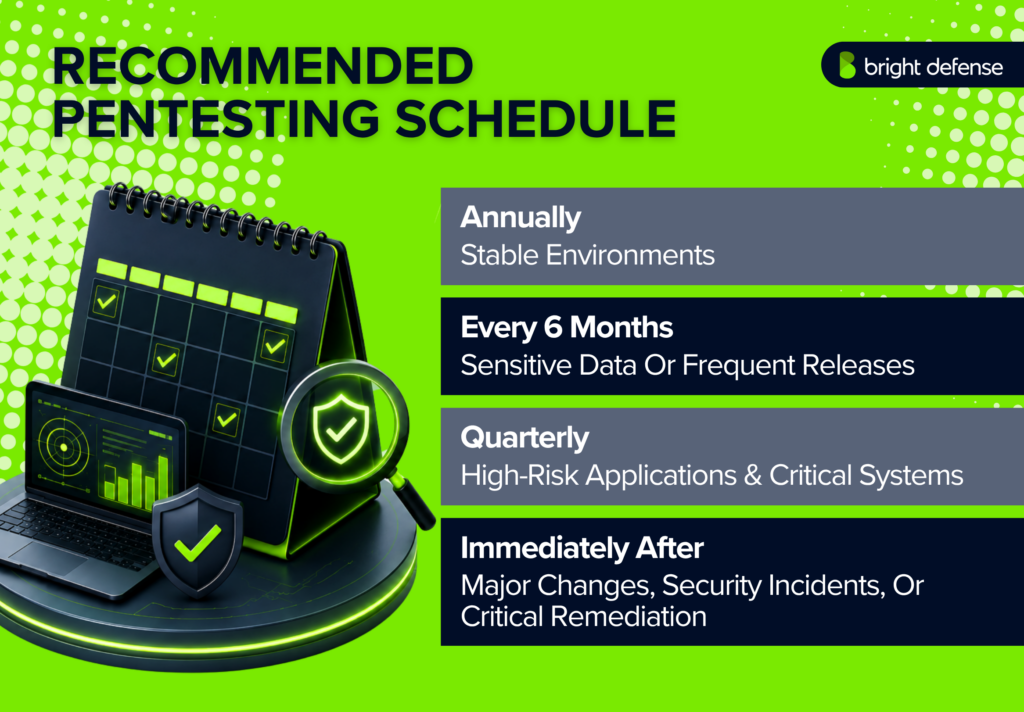
A useful program has two parts: a scheduled baseline test and focused testing when changes create new attack paths.
A stable internal system may need an annual test, while a public software platform may need targeted tests after major releases, API changes, or updates to authentication.
Annual, Six-Month, Quarterly, and Event-Driven Testing
The following intervals are planning options. They do not represent universal requirements:
| Testing Frequency | Appropriate Use |
|---|---|
| Annually | A baseline assessment for a relatively stable environment |
| Every six months | Systems with greater exposure or a regular pace of significant changes |
| Quarterly | Selected high-risk applications or services that change frequently |
| After significant changes | Focused testing of affected systems following a major release, cloud migration, new integration, or network redesign |
| After a security incident | Testing the affected environment after containment and recovery to check for remaining weaknesses |
| After remediation | Retesting specific findings to verify that corrective work was effective |
PCI DSS requires applicable internal and external penetration tests at least every 12 months and after significant changes. Its separate vulnerability scanning requirements include scans at least once every three months.
Quarterly PCI scans should not be described as a general requirement for quarterly penetration tests.
Frequency by Organization Type
The following recommendations provide a practical starting point. They should be adjusted based on system changes, data sensitivity, compliance requirements, and the organization’s ability to fix findings quickly.
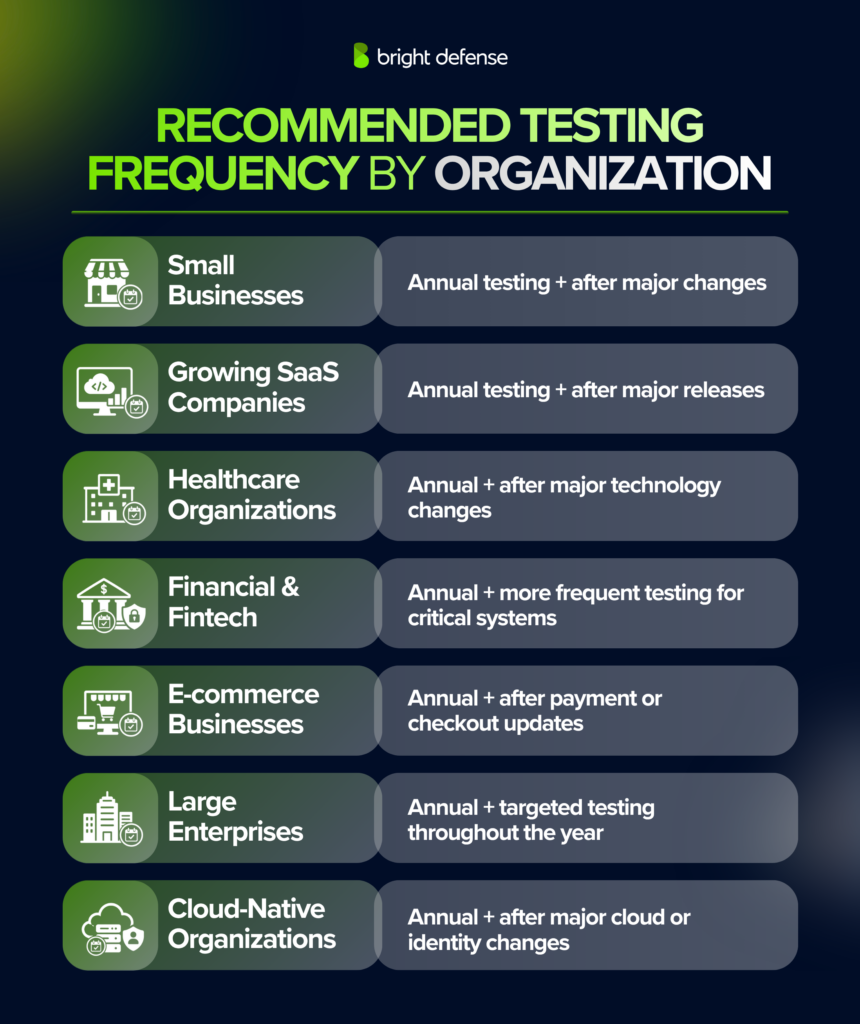
Two organizations in the same industry may need different schedules. Testing should occur often enough that the findings still describe the systems an attacker could reach.
Why Penetration Testing Frequency Matters
Penetration testing frequency matters because a test reflects the systems and controls in place when it was performed. New software features, application programming interfaces (APIs), cloud permissions, and identity settings can create paths that an earlier test did not examine.
A penetration test helps determine whether an attacker could use those paths to reach sensitive systems or data.
Testing should follow the pace of meaningful changes in the environment. An annual test can provide a baseline, while a major release or infrastructure change may call for a focused test before the next scheduled assessment.
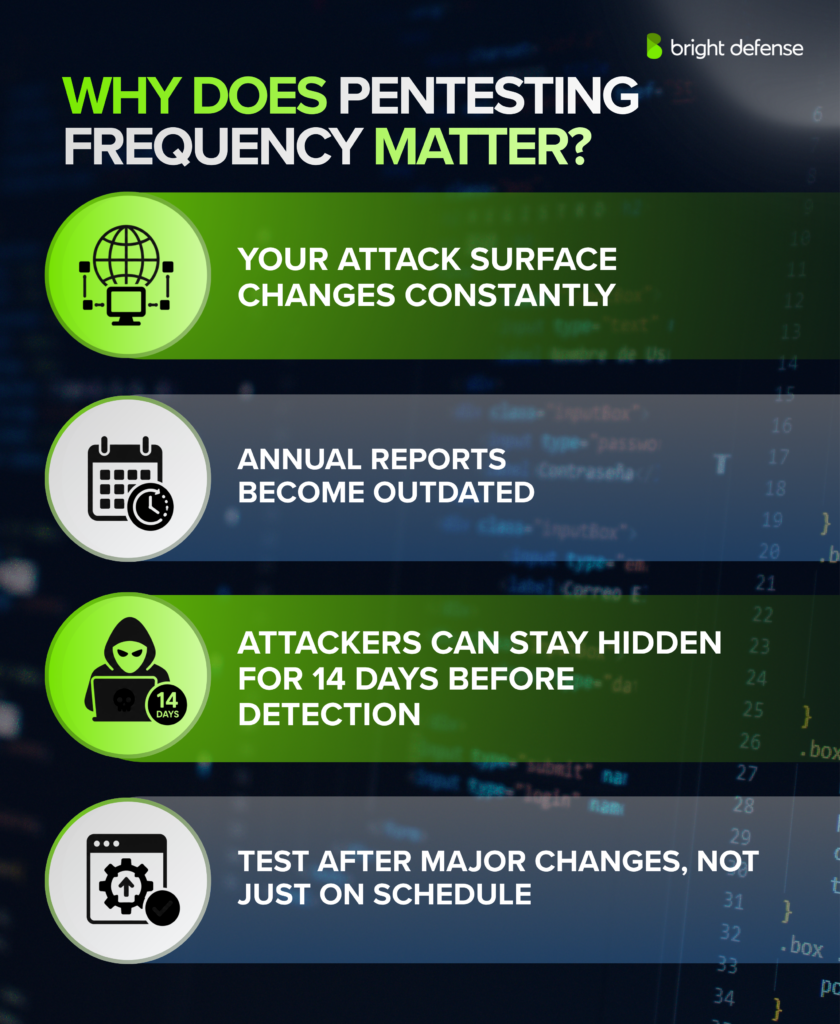
Mandiant’s M-Trends 2026 report found that global median attacker dwell time rose from 11 days to 14 days in the incidents it investigated during 2025. Dwell time is the period from an attacker’s initial compromise to discovery.
This finding supports the need for ongoing detection and response; it does not establish how often an organization must conduct penetration tests.
Penetration testing works alongside monitoring, patching, vulnerability management, and incident response. It provides a focused check of whether identified weaknesses can be exploited and whether security controls resist a realistic attack.
Get Trusted Penetration Testing By Bright Defense Run a Pen TestWhy Is Annual Penetration Testing Only a Baseline?
Annual penetration testing provides a regular security checkpoint, but significant changes can make its findings incomplete before the next test. A report describes the systems and controls tested at that time. It cannot assess a feature, cloud configuration, or identity service introduced later.
A company might complete a full test in January, launch a customer feature in March, migrate workloads in June, and change its identity provider in September. Each change should be reviewed for its security impact.
A significant change may call for a focused test of the affected systems rather than another full test of the entire environment. PCI DSS follows this annual-plus-significant-change approach for applicable penetration tests.
Testing every six months may be appropriate for organizations with sensitive systems, frequent substantial releases, or high-value public applications. That interval is a risk-based choice unless a specific requirement or contract sets the schedule.
What Determines Your Penetration Testing Frequency?
Penetration testing frequency depends on data sensitivity, system changes, external exposure, and how quickly previous findings are fixed. Company size alone is a poor guide.
A small SaaS provider with a public API and sensitive customer data may need more frequent testing than a larger organization with stable internal systems.
Four factors help determine when a scheduled test needs to be supplemented with focused testing:
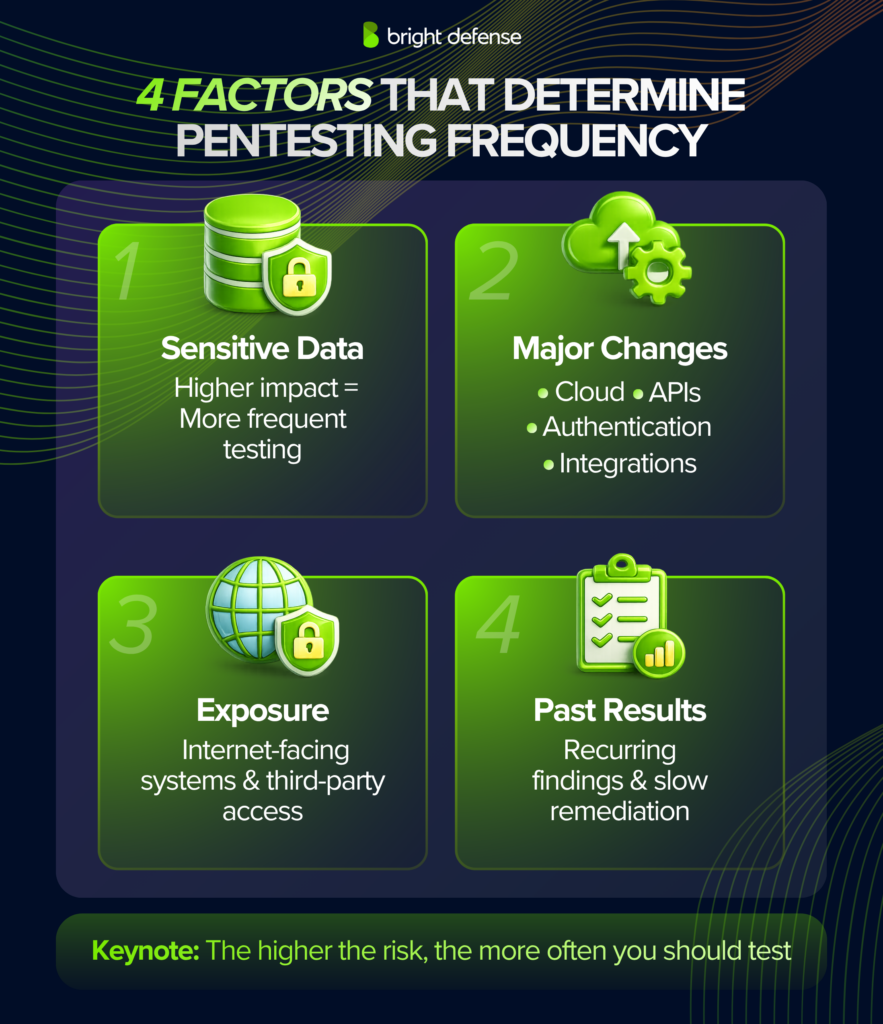
1. Data Sensitivity and Business Impact
Systems handling payment information, health records, credentials, financial data, or intellectual property warrant close attention because a compromise could have serious consequences.
Business function matters too. An identity platform or customer portal may be critical even when it stores little regulated data. These factors can justify more frequent testing of the affected systems.
2. Environmental Changes
A cloud migration, new API, authentication update, or major application release can create attack paths that a previous test did not cover.
Review changes that alter public access, user permissions, data flows, or connections between systems. Significant changes may call for a focused test before the next scheduled assessment.
Practical Tip: Treat changes to how users log in, how sensitive data moves, or how systems connect as potential testing triggers.
3. Internet Exposure and Third-Party Access
Public applications, APIs, VPN gateways, and remote-access services give attackers more opportunities to reach an organization’s systems. New vendors and service providers can introduce trusted connections or privileged access.
Test the affected access paths when a new integration materially changes who or what can reach sensitive systems. In third-party risk management, agree on scope and authorization with the vendor before testing vendor-controlled systems.
4. Previous Findings and Remediation
Repeated authentication flaws, insecure APIs, exposed administrative services, or slow remediation may indicate that the current schedule leaves weaknesses open too long.
Cobalt’s 2026 State of Pentesting Report analyzed more than 16,500 tests across nearly 3,000 organizations.
The time needed to remediate half of high-risk findings was 10 days for the top-performing 10% of organizations, compared with 249 days for the bottom-performing 10%. That measure describes remediation speed, not a recommended interval between tests.
A useful testing schedule gives teams time to fix findings and retest the affected systems. Further data on findings and remediation appears in Bright Defense’s penetration testing statistics.
When Should You Conduct an Additional or Event-Driven Penetration Test?
Conduct an additional penetration test when a change materially alters how attackers could reach a system, gain access, or handle sensitive data.
The test can focus on the affected application or infrastructure rather than repeat the entire scheduled assessment. PCI DSS requires applicable penetration testing after significant infrastructure or application changes.
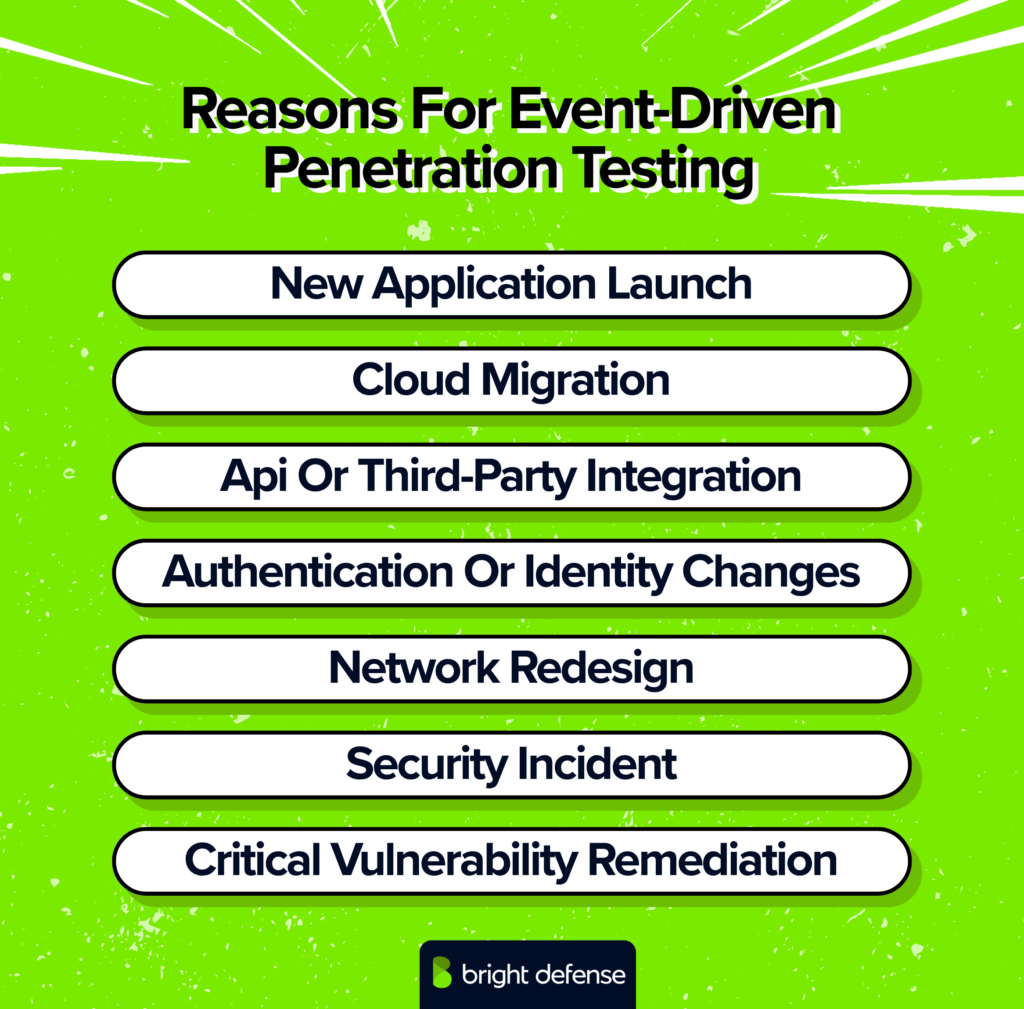
The following events warrant a review of testing scope:
| Change or Event | What to Test |
|---|---|
| New customer-facing application | Public access, user roles, and data flows |
| Major software release | Changed authentication, authorization, and data handling |
| New API or third-party integration | API access controls and trust between connected systems |
| Cloud migration | Assess permissions, storage, networking, and exposed services through cloud penetration testing. |
| Single sign-on or multi-factor authentication change | Login flows, account recovery, and session controls |
| Network redesign | Segmentation and routes between sensitive systems |
| New privileged vendor access | Permissions and routes available to the provider |
| Security incident | Relevant weaknesses after the incident has been contained |
| Critical vulnerability remediation | The specific finding, to verify that the fix works |
A change to authentication, system connections, or sensitive data processing is a reason to evaluate whether another test is needed; it does not automatically require a full penetration test.
Security teams should join major projects early enough to set the test scope, address findings, and retest fixes before launch when practical.
How Compliance Requirements Affect Penetration Testing Frequency
Compliance requirements can set a testing minimum, while system risk and significant changes may call for additional tests. The distinction is whether a framework requires a penetration test specifically or permits a broader method of security evaluation.
| Framework or Regulation | Penetration Testing Expectation |
|---|---|
| PCI DSS | Applicable internal and external penetration tests must be performed at least every 12 months and after significant infrastructure or application changes. |
| FTC Safeguards Rule | Covered financial institutions may use continuous monitoring of information systems. Without it, they must conduct annual penetration tests and vulnerability assessments, including system-wide scans, at least every six months. Testing is required following material changes. |
| HIPAA Security Rule | Requires periodic technical and nontechnical evaluations and evaluations in response to changes affecting electronic protected health information. The current rule does not set an annual penetration testing interval. |
| GDPR | Article 32 calls for a process to regularly test and evaluate security measures. It does not prescribe a penetration testing interval. |
| SOC 2 | SOC 2 penetration testing follows the organization’s risks, control commitments, and evidence needs rather than a universal testing interval. |
| ISO/IEC 27001 | Uses an information security management system and risk assessment process. It does not set one penetration testing interval for every organization. |
The proposed HIPAA Security Rule would require penetration testing at least once every 12 months, but that proposal should not be presented as a current requirement.
Organizations subject to multiple frameworks should map each requirement to the systems it covers. They can then meet the strictest applicable interval for those systems and add testing when changes or risk justify it.
Penetration Testing vs. Vulnerability Scanning
Vulnerability scanning and penetration testing support different decisions. Scanning identifies and prioritizes potential weaknesses, while penetration testing examines how an attacker could use them to gain access or affect a system.
The two practices support different decisions and work best together. PCI Security Standards Council guidance distinguishes scans from penetration tests by their purpose, methods, and reporting.
| Area | Vulnerability Scanning | Penetration Testing |
|---|---|---|
| Approach | Primarily automated, with human review of results | Human-directed testing supported by tools |
| Purpose | Identifies known vulnerabilities and possible misconfigurations | Tests potential attack paths within an agreed scope |
| Frequency | Often recurring or continuous, according to risk and applicable requirements | Scheduled according to risk and requirements, with focused tests after significant changes |
| Depth | Covers many assets and known weakness patterns | Investigates selected systems and how weaknesses may be combined |
| Output | Findings to verify, prioritize, and remediate | Tested findings, potential impact, and remediation guidance |
Scanners may miss business logic flaws, broken access controls, or attack paths that depend on several weaknesses working together.
In Cobalt’s 2026 survey of 455 cybersecurity professionals, 78% reported that fully automated scanning tools had missed critical vulnerabilities. This is a survey finding about respondents’ experience, not a measured miss rate for all scanning tools.
Regular scans help teams find new weaknesses between penetration tests. A penetration test then examines selected risks in greater depth.
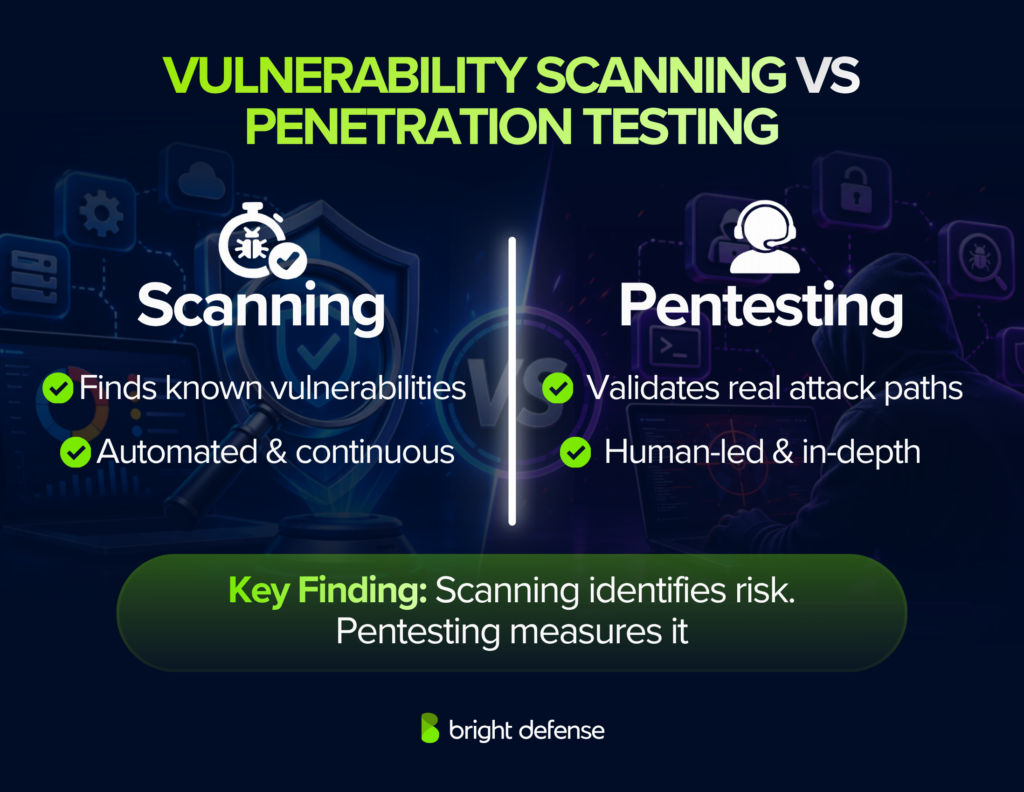
That’s why vulnerability management and continuous scanning should run between penetration tests, not replace them. Together, scanning and human-led testing give organizations a more accurate view of risk.
Pentesting Best Practices for IT Buyers
A useful penetration test starts with a clear scope and ends with verified fixes. These five practices help buyers plan the engagement and act on its findings:
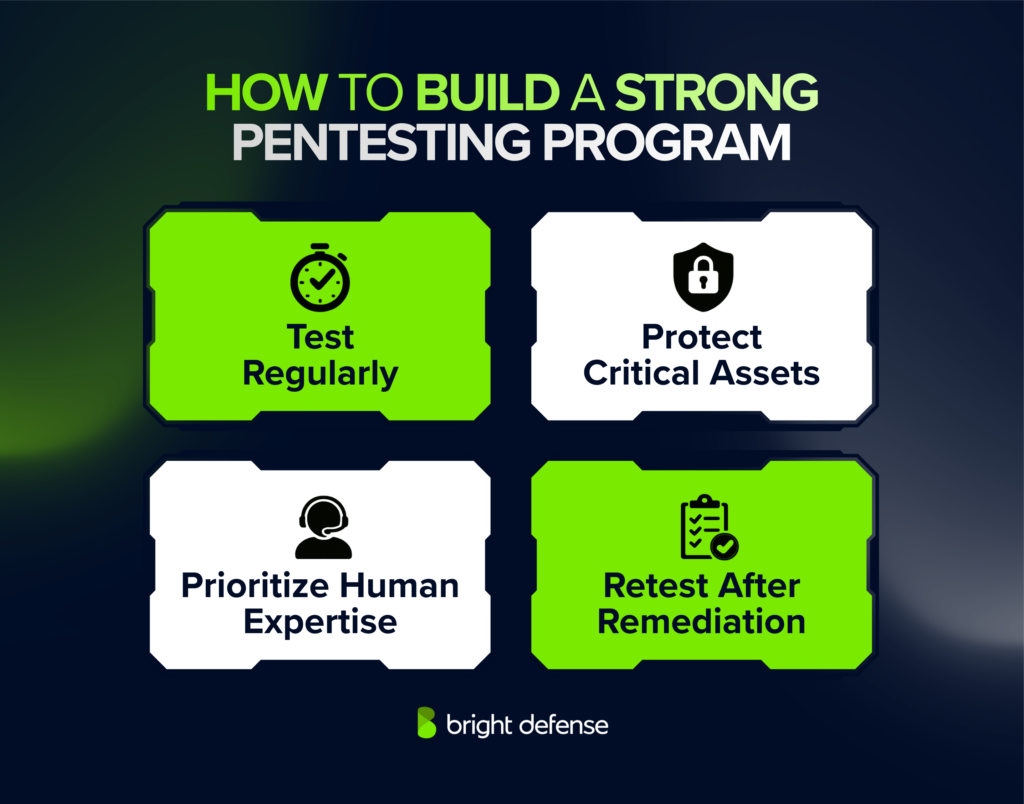
- Set a risk-based schedule. Use annual testing as a planning baseline, then add targeted tests after significant changes or when exposure warrants them. Run vulnerability scans between engagements. Applicable standards may set a minimum frequency; PCI DSS, for example, requires testing at least every 12 months and after significant changes.
- Define the scope and rules of engagement. Prioritize public applications, APIs, cloud services, identity systems, and critical infrastructure. Agree in writing on the systems and accounts to test, permitted techniques, testing windows, exclusions, and emergency contacts. Rules of engagement establish the testers’ authority and limits before work begins.
- Choose testers with relevant experience. Ask how the provider will test your specific technologies and whether its method includes human-led checks for business logic flaws, access-control weaknesses, and connected attack paths. Automated tools can support this work, but the engagement should have a defined method and qualified testers.
- Require a penetration testing report your team can use. Findings should identify affected assets, explain how weaknesses were validated and what they could expose, and provide practical remediation guidance. Assign an owner and target date to each significant finding.
- Retest fixes and update the next scope. Verify that critical and high-risk findings have been corrected. Before the next engagement, review new assets and system changes so the test covers the environment you actually operate.
How Bright Defense Supports Regular Penetration Testing
Bright Defense helps organizations plan and conduct penetration tests, prioritize findings, and verify critical fixes. Its human-led testing covers web applications, APIs, and networks, with cloud environments assessed when included in the agreed scope.
Engagements provide prioritized findings, remediation guidance, reporting for audit review, and retest support. Penetration Testing as a Service provides a delivery model for managing recurring assessments, findings, remediation, and retesting through a platform.
The team can help define a testing schedule based on your systems, changes, and applicable SOC 2, ISO 27001, PCI DSS, or CMMC obligations.
A penetration test can support compliance evidence, but the required scope and frequency depend on the framework and your circumstances.Schedule a penetration test with Bright Defense to discuss your scope and testing frequency.
Get Trusted Penetration Testing By Bright Defense Run a Pen TestFinal Thoughts
Annual penetration testing is a practical baseline for many organizations. Systems with greater exposure or frequent changes may need testing every six months or quarterly.
Major application releases, cloud migrations, identity changes, and network redesigns can justify targeted testing before the next scheduled assessment. Testing frequency should reflect risk and any applicable requirements.
A useful testing program combines scheduled assessments with vulnerability scanning, prompt remediation, and retesting of serious findings.
Review the scope whenever systems change so each test reflects the assets and access paths your organization currently uses.
FAQs
1. What Is the Recommended Frequency for Penetration Testing?
Answer: Annual testing is a practical starting point for many organizations. Higher-risk systems may warrant testing every six months or quarterly. PCI DSS requires applicable internal and external penetration tests at least once every 12 months and after significant infrastructure or application changes.
2. Is Annual Penetration Testing Enough?
Answer: Annual testing may be sufficient for a stable environment with limited exposure. Frequent software releases, new APIs, cloud changes, or sensitive data can justify targeted tests between annual assessments.
3. What Should Trigger a Penetration Test?
Answer: A new public application, major API release, cloud migration, identity change, network redesign, or significant third-party connection may warrant testing of the affected systems. A security incident may require testing after containment. Fixing a serious finding calls for a focused retest to verify the correction, rather than automatically repeating the full assessment.
4. What Is the Difference Between Scheduled and Event-Driven Penetration Testing?
Answer: Scheduled testing follows a planned interval, such as annually or every six months. Event-driven testing examines systems affected by a significant change, newly identified risk, or security incident. An organization can use both to keep its assessment results relevant.
5. Should Penetration Testing Be Done After a Cloud Migration?
Answer: A cloud migration can change permissions, network paths, storage exposure, and identity controls. Targeted cloud penetration testing is appropriate when those changes materially affect risk or introduce assets outside the previous test’s scope.
Answer: Annual testing is a reasonable baseline for a SaaS company, with targeted testing after major releases or changes to APIs, authentication, or cloud infrastructure. A service with frequent releases or sensitive customer data may need a shorter scheduled interval.
Answer: A small business can begin with annual testing and reassess the schedule when its systems change. Public-facing applications, payment processing, sensitive customer data, and previous serious findings may justify more frequent targeted testing. Business size alone does not determine the interval.
Answer: Testing can take a few days to several weeks. Duration depends on the number and complexity of assets, the access provided to testers, the agreed testing depth, and reporting needs.
Answer: Vulnerability scanning identifies potential weaknesses, while penetration testing investigates whether weaknesses can be exploited and what an attacker could reach. In Cobalt’s 2026 survey of 455 security professionals, 78% reported that fully automated scanning tools had missed critical vulnerabilities. This survey finding does not mean every scan has that failure rate.
Answer: AI tools can help teams examine systems between scheduled tests, but their use does not establish a new testing interval. Risk, system changes, and applicable requirements still determine the schedule. In Cobalt’s 2026 survey, 9% of respondents said their organizations relied entirely on AI automation for testing, down from 29% the previous year.