Updated:
May 6, 2026
CISO as a Service: 5 Benefits for SMBs in 2026
In a world of constantly evolving cybersecurity threats and compliance regulations, the Chief Information Security Officer (CISO) role has never been more critical. However, with an average salary of $267,000, many small and medium-sized businesses (SMBs) struggle to afford a full-time, in-house CISO. This is where CISO as a Service comes into play.
Using CISO as a Service allows companies to access top-tier cybersecurity expertise without the overhead of a full-time executive. This approach gives businesses strategic leadership, risk management, and compliance guidance, offering strong protection against cyber threats.
This article explores CISO as a service and its many advantages. Join us as we explore this approach further.
What CISO as a Service?
CISO as a Service (CaaS) is a subscription based model in which an organization engages an external cybersecurity executive or a specialized security firm to perform the duties of a Chief Information Security Officer (CISO) without hiring a full time, in house executive.
A CaaS provider delivers strategic and operational security leadership tailored to the organization’s size, industry, and risk profile. Typical responsibilities include:
- Security strategy & roadmap aligned to business objectives
- Risk management & governance (policies, standards, metrics)
- Regulatory compliance (e.g., ISO 27001, SOC 2, HIPAA, PCI DSS)
- Incident response leadership and breach preparedness
- Security architecture & vendor oversight
- Board and executive reporting on cyber risk posture
Engagements can be part-time, fractional, or on-demand, depending on need.
Difference Between a PTCISO and a Full-Time CISO
A PTCISO is ideal for companies that need cybersecurity leadership without hiring a full-time executive, while a CISO is better suited for organizations with complex and ongoing security needs.
Here’s a table comparing a PTCISO (Part-Time Chief Information Security Officer) and a Full-Time CISO:
| Feature | PTCISO (Part-Time CISO) | Full-Time CISO |
| Employment Type | Contract/Part-Time | Full-Time Employee |
| Cost | Comparatively lower, paid per project or hours worked | Higher, includes salary, benefits, and bonuses |
| Availability | Works on a flexible schedule as needed | Dedicated full-time to the company |
| Best For | Small to mid-sized businesses needing cybersecurity expertise without full-time costs | Large organizations with ongoing cybersecurity needs |
| Responsibilities | Provides strategic guidance, risk management, compliance, and incident response support | Oversees entire cybersecurity strategy, manages security teams, and ensures compliance |
| Team Integration | Works with existing IT and security teams as an advisor | Directly manages security teams and policies |
| Commitment | Short-term or project-based | Long-term cybersecurity leadership |
Key Benefits of CISO as a Service
Let’s explore the key benefits that CISO as a Service offers to businesses aiming to bolster their security posture effectively and efficiently.
1. Cost-Effective Expertise
One of the primary benefits of CISO as a Service, or PTCISO, is its cost-effectiveness, especially for SMBs. Hiring a full-time CISO can be prohibitively expensive due to high salaries and benefits. CISO as a Service provides access to top-tier cybersecurity expertise at a fraction of the cost. This makes it a viable option for businesses with limited budgets.
2. Enhanced Security Posture
Using CISO as a Service strengthens a company’s security posture. These experts focus on proactive risk management and threat mitigation, implementing best practices and compliance measures to safeguard businesses from cyber threats. With continuous monitoring and rapid incident response, potential issues are detected and resolved quickly.
3. Access to Top Talent
CISO as a Service allows businesses to leverage the skills and experience of highly qualified cybersecurity professionals. These experts stay abreast of the latest cybersecurity trends and threats, ensuring your organization benefits from cutting-edge knowledge and practices. This access to top talent is often unattainable for SMBs through traditional hiring methods.
4. Scalability and Flexibility
The scalability and flexibility of CISO as a Service make it an attractive option for businesses of all sizes. Services can be tailored to meet your organization’s specific needs, whether you require ongoing support or assistance with a particular project. Additionally, as your business grows or your security needs change, you can easily scale the level of service up or down.
5. Preventing AI-Related Cyber Threats
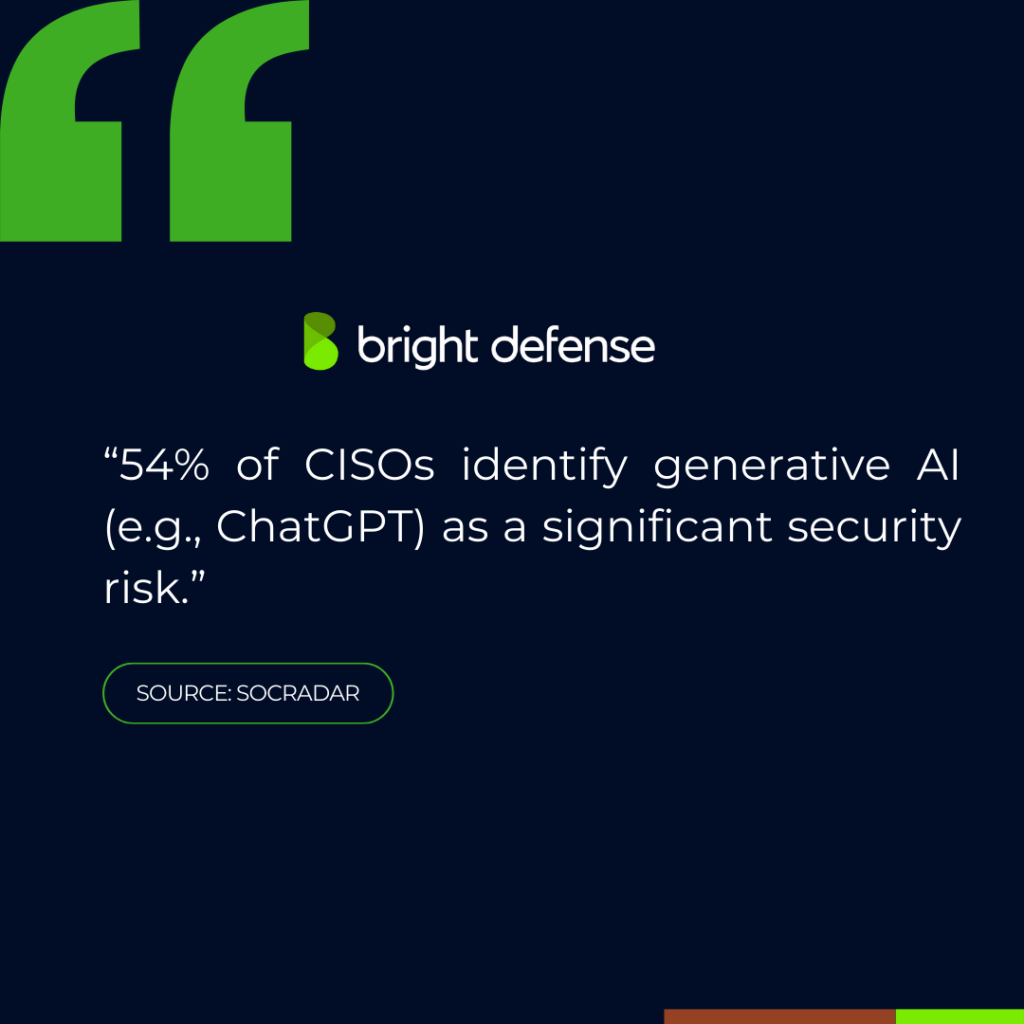
As generative AI and large language models evolve, attackers use them to develop more advanced phishing, malware, and deepfake capabilities. In fact, 54% of CISOs identify AI as a significant security risk, with 72% of U.S. CISOs particularly concerned about data leaks and breaches through AI-powered tools (2024 survey).
CISO as a Service professionals are equipped to handle these emerging threats, ensuring that sensitive company data isn’t misused and that employees are trained to recognize AI-driven attacks.
In summary, the benefits of CISO as a Service are manifold. They offer businesses a cost-effective way to access high-level cybersecurity expertise and develop an enhanced security posture. This innovative approach ensures that companies can stay protected in an increasingly complex threat landscape without the financial burden of a full-time CISO.
Components of CISO as a Service
CISO as a Service delivers essential cybersecurity leadership, risk management, and compliance support aligned with business goals. Here are the key components of CISO as a Service:
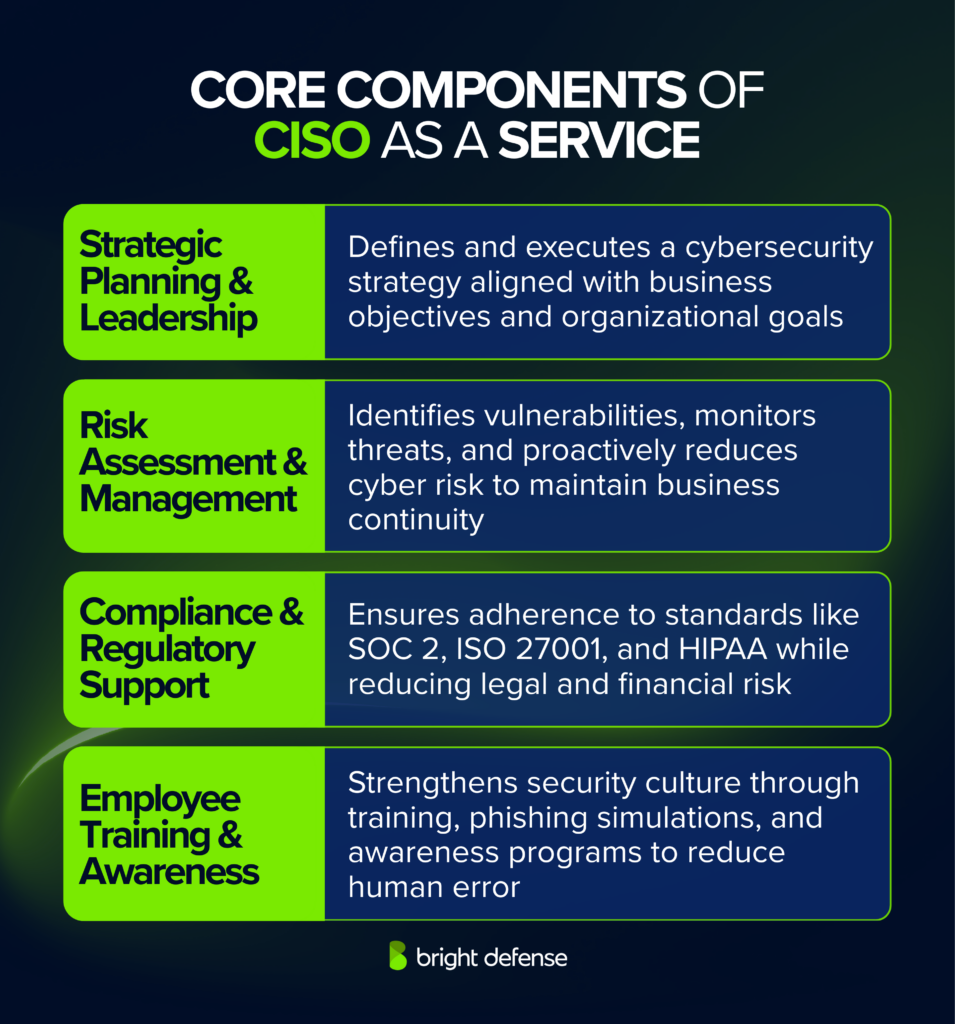
1. Strategic Planning and Leadership
CISO as a Service provides businesses with strategic cybersecurity planning and leadership. This involves developing and executing a robust cybersecurity strategy that aligns with the company’s business objectives. The CISO helps set the direction for cybersecurity initiatives, ensuring they support the overall goals of the organization.
2. Risk Assessment and Management
A critical component of CISO as a Service is risk assessment and management. This includes identifying and addressing vulnerabilities within the organization’s IT infrastructure. Continuous monitoring and proactive threat detection are employed to mitigate risks and respond to incidents swiftly. This proactive approach helps minimize potential damage and ensures business continuity.
3. Compliance and Regulatory Support
Navigating the complex landscape of compliance and regulatory requirements can be challenging for many businesses. CISO as a Service provides expert guidance on adhering to industry standards such as SOC 2, ISO 27001, and HIPAA. This ensures that the organization meets all necessary compliance requirements and avoids potential legal and financial penalties.
4. Employee Training and Awareness
Human error remains one of the biggest cybersecurity risks. 66% of U.S. CISOs identify human error as the top vulnerability in 2024. CISO as a Service includes comprehensive employee training programs, phishing simulations, and awareness campaigns to foster a culture of security within the organization. These initiatives help employees recognize and respond to threats effectively, reducing the likelihood of costly breaches.
Incorporating these components allows CISO as a Service to provide a comprehensive cybersecurity approach. This helps businesses protect their assets, maintain compliance, and promote a security-conscious workplace culture.
GET IN TOUCH
Talk to a vCISO Today
Choosing the Right CISO as a Service Provider
Selecting the right CISO as a Service provider is crucial for ensuring that your organization receives the best possible cybersecurity support.
Here are key factors to consider when making this important decision:
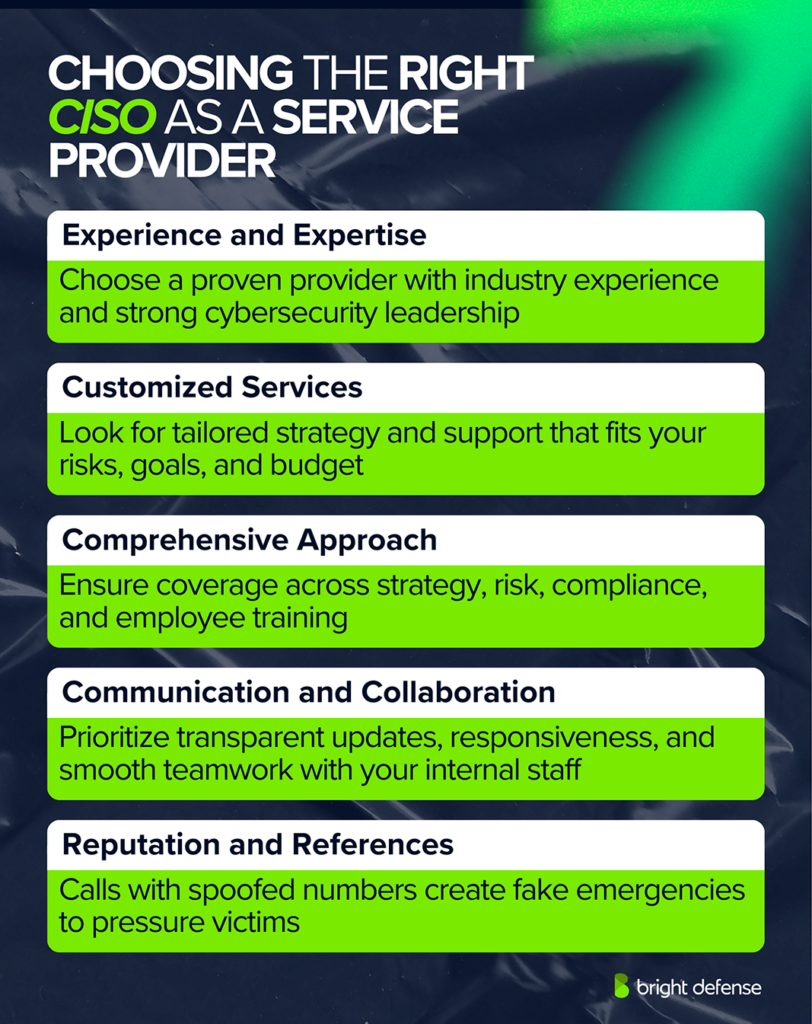
1. Experience and Expertise
Look for a provider with a proven track record in delivering CISO as a Service. The provider should have extensive experience in various industries and a deep understanding of the specific cybersecurity challenges your business faces. Their team should consist of seasoned professionals with expertise in the latest cybersecurity trends, technologies, and best practices.
2. Customized Services
Every business has unique security needs, so it’s essential to choose a provider that offers customized services tailored to your specific requirements. The right provider will work closely with you to develop a bespoke cybersecurity strategy that aligns with your business goals and addresses your unique vulnerabilities and risks. The provider should also be able to tailor a solution that meets your budget.
3. Comprehensive Approach
A reliable CISO as a Service provider should offer a comprehensive approach to cybersecurity, covering all aspects from strategic planning and risk management to compliance and employee training. Ensure that the provider’s services encompass the full spectrum of cybersecurity needs, including compliance.
4. Communication and Collaboration
Effective communication and collaboration are vital for a successful partnership. Choose a provider that maintains open lines of communication and provides regular updates on your cybersecurity posture. They should be responsive, transparent, and willing to work collaboratively with your internal teams to ensure seamless integration of their services.
5. Reputation and References
Before making a final decision, research the provider’s reputation and seek references from their existing or past clients. Positive testimonials and case studies demonstrating their success in improving other businesses’ security postures can provide valuable insights into their reliability and effectiveness. Don’t hesitate to ask for references and contact them to get firsthand feedback on their experience with the provider.
Evaluating these factors thoroughly helps you choose a CISO as a Service provider that strengthens your cybersecurity defenses while supporting your organization’s growth in a secure environment.
Future Trends in CISO as a Service
As the cybersecurity landscape continues to evolve, several key trends are shaping the future of CISO as a Service.
These trends highlight the growing importance of advanced technologies, automation, and proactive strategies in maintaining robust cybersecurity defenses.
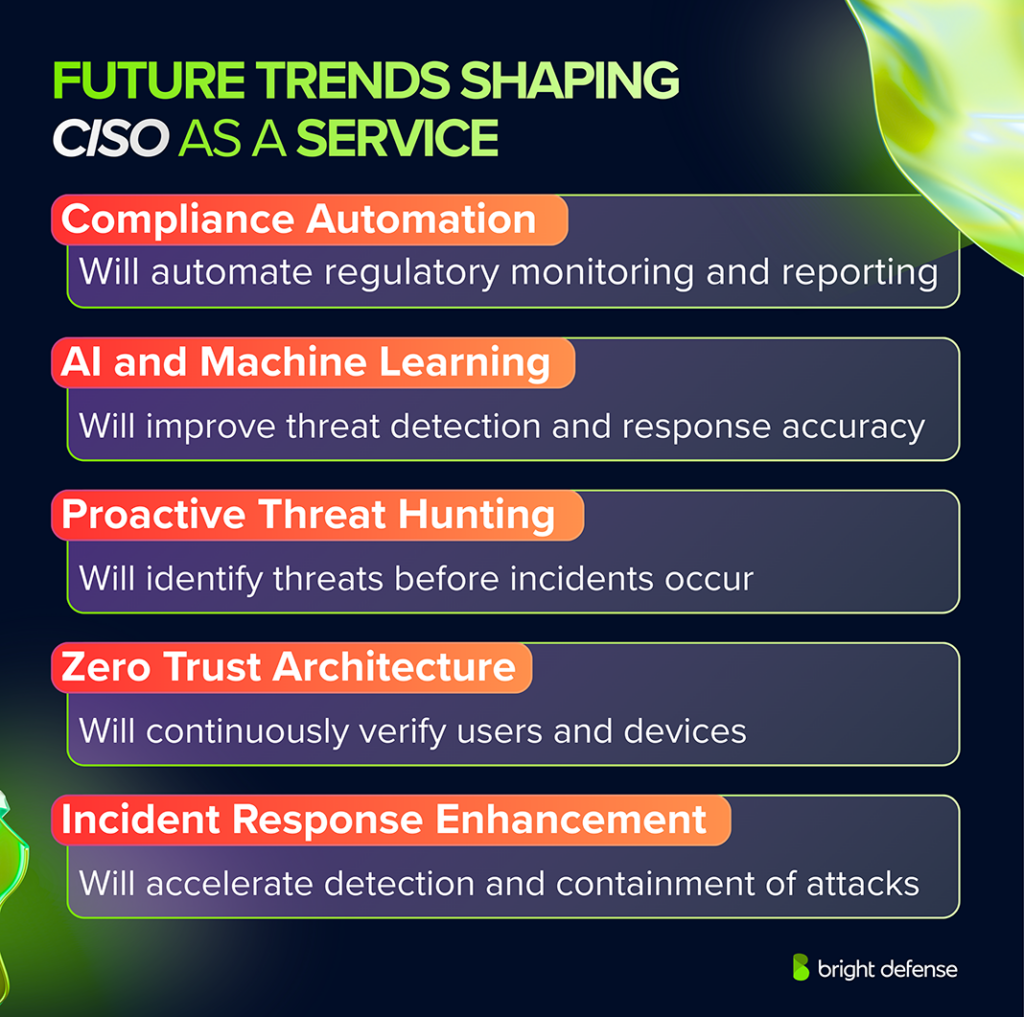
1. Compliance Automation
One of the most significant trends in CISO as a Service is the automation of compliance processes. With regulatory requirements becoming increasingly complex, businesses are turning to automated solutions to streamline compliance management. Compliance automation tools help organizations continuously monitor and document their adherence to standards such as SOC 2, ISO 27001, and HIPAA. This not only reduces the risk of non-compliance but also frees up valuable resources that can be redirected towards other critical security tasks.
2. AI and Machine Learning Integration
Artificial Intelligence (AI) and Machine Learning (ML) are playing an increasingly crucial role in cybersecurity. CISO as a Service providers are leveraging these technologies to enhance threat detection and response capabilities. AI and ML can analyze vast amounts of data to identify patterns and anomalies that may indicate potential security threats. This allows for faster and more accurate detection of cyber threats, enabling proactive mitigation measures.
However, the integration of AI and ML in cybersecurity also presents challenges. The rapid advancement of AI technologies has led to more sophisticated cyber threats, such as AI-generated phishing scams targeting corporate executives. These scams use AI to craft highly personalized and convincing fraudulent emails, making them harder to detect and prevent.
Despite these challenges, the adoption of AI and ML in cybersecurity is a critical step forward. CISO as a Service providers can optimize their threat detection and response capabilities utilizing AI and ML technlogies.
3. Proactive Threat Hunting
Proactive threat hunting is becoming a standard practice among CISO as a Service providers. Rather than waiting for security incidents to occur, proactive threat hunting involves actively searching for signs of potential threats within an organization’s network. This approach helps in identifying and neutralizing threats before they can cause significant damage, thereby enhancing the overall security posture of the organization.
Recent statistics highlight the growing adoption and effectiveness of proactive threat hunting:
- Increased Adoption: A 2024 survey revealed that 64% of organizations now formally assess the effectiveness of their threat-hunting efforts, a significant rise from previous years.
- Enhanced Security Posture: Organizations that have implemented proactive threat hunting report measurable improvements in their overall security posture, with many experiencing a reduction in the time attackers remain undetected within their networks.
- Cost Reduction: Early detection of threats through proactive hunting can lead to substantial cost savings. According to IBM’s “Cost of a Data Breach Report 2024,” the global average cost of a data breach is $4.88 million, and this cost increases the longer a threat goes undetected. Proactive threat hunting helps reduce this timeline by actively seeking out hidden dangers before they emerge.
4. Zero Trust Architecture
The adoption of Zero Trust architecture is another emerging trend in CISO as a Service. Zero Trust is a security model that assumes no user or device, inside or outside the network, can be trusted by default. Instead, continuous verification is required for access to resources. Implementing Zero Trust architecture helps minimize the risk of unauthorized access and lateral movement within the network, providing a more secure environment for businesses.
5. Improved Incident Response Capabilities
As cyber threats become more sophisticated, having robust incident response capabilities is crucial. Future CISO as a Service offerings will likely include enhanced incident response strategies that integrate automation, AI, and collaboration tools. These advanced capabilities will enable faster detection, analysis, and mitigation of security incidents, reducing the potential impact on the organization.
Keeping up with these trends helps businesses stay prepared for emerging cybersecurity challenges. With the expertise and advanced technologies of CISO as a Service providers, companies can maintain a strong security posture and protect their valuable assets in an increasingly digital world.
Final Thoughts
Cybersecurity shouldn’t be a bottleneck; it should be a business enabler. For SMBs, CISO as a Service offers a unique opportunity to gain a competitive edge by demonstrating a mature security posture to partners, investors, and customers alike. By leveraging top-tier expertise at a fraction of the cost of a full-time hire, you can stop reacting to threats and start proactively building a resilient organization. 2025 is the year to turn your security strategy from a cost center into a core strength.

Bright Defense Delivers CISO as a Service!
If your business is in need of CISO as a Service, Bright Defense can help. Our vCISO services deliver an information security program that will help you meet the challenges of emerging threats and lower your cyber risk. We will also help you develop security controls that meet compliance frameworks including SOC 2, ISO 27001, CMMC, HIPAA, and PCI.
Bright Defense’s CISO services include information security strategy, gap analysis, risk mitigation, business continuity planning, and compliance certification assistance. Our security team hold certifications inlcuding CISSP, CISA, ISO 27001 lead auditor, and more. Get the security resources your growing business needs by contacting Bright Defense today!
Virtual CISO Cost
Engaging a Virtual Chief Information Security Officer (vCISO) provides organizations with expert cybersecurity leadership without the commitment of a full-time executive. The cost of vCISO services varies based on factors such as the scope of work, the provider’s expertise, the organization’s size, and the duration of the engagement.
Common Pricing Models:
- Hourly Rate: Ideal for organizations needing occasional expertise, hourly rates for vCISOs typically range from $150 to $400, depending on experience and the complexity of tasks.
- Monthly Retainer: For ongoing support, organizations can opt for a monthly retainer, which provides a set number of service hours. Retainer fees generally range from $5,000 to $20,000 per month, offering consistent access to vCISO expertise.
- Project-Based Fees: Suitable for specific tasks like security assessments or policy development, project-based engagements can range from $5,000 to $50,000 or more, depending on the project’s scope and complexity.
Factors Influencing Cost:
- Scope of Services: Comprehensive services, including ongoing management and incident response, will be priced higher than basic assessments or policy creation.
- Provider’s Expertise: vCISOs with specialized knowledge in areas like regulatory compliance or industry-specific standards may command higher fees.
- Organization Size: Larger organizations with complex infrastructures may require more extensive services, impacting the overall cost.
- Engagement Duration: Long-term contracts might offer cost advantages over short-term or ad-hoc engagements.
While engaging a vCISO involves costs, it is often more cost-effective than hiring a full-time CISO. Organizations can save up to 70% by opting for a vCISO over an in-house CISO.
In summary, vCISO services provide flexible and scalable cybersecurity leadership tailored to an organization’s specific needs, making them a valuable investment in today’s threat landscape.
FAQ: Understanding CISO as a Service
Absolutely. CISO as a Service becomes strategic when the provider owns the security roadmap, enforces standards, tracks risk, and reports to leadership. It stops being strategic when it turns into occasional advice with no authority. The difference is program ownership and accountability.
Yes, with structure. A fractional CISO can design the framework, prioritize risk, align to compliance requirements, and manage reporting. They cannot execute daily technical tasks alone, so an internal resource must handle operational follow-through. Leadership and execution must be clearly separated.
In most cases, yes. Regulators and enterprise buyers want a named, accountable security leader with documented oversight. When formally designated and actively reporting to executives, a CISO as a Service meets that expectation.
Definitely. An IT manager focuses on systems and support. A CISO focuses on risk ownership, governance, compliance alignment, audit readiness, and executive communication. The service brings strategic direction and authority that operational IT typically does not carry.
Significant authority, but not unchecked control. The CISO should set policy, require remediation, and block decisions that violate security standards. Final risk acceptance and budget control remain with executive leadership. Clear authority lines prevent security from becoming optional guidance.
CISO as a service is an outsourced security leadership arrangement where a third party provides CISO level guidance on a part time, fractional, or on demand basis instead of a full time executive hire. A typical engagement starts with risk and maturity assessments, then moves into a security strategy plan that covers policies, threat scenarios, vendor risk, remediation plans, awareness training, and compliance planning, with regular leadership reporting and deliverables. (BlueVoyant)
No. Cybersecurity is a broad discipline, while SaaS is a cloud software delivery model where users access a provider’s applications and do not manage the underlying infrastructure, with limited configuration at most. Cybersecurity products can be SaaS when the security tool is delivered as a cloud hosted application under that model. (NIST Computer Security Resource Center)
CISO pay commonly lands in the mid six figures in the United States, with wide variation driven by equity, bonus structure, industry, company size, and region. IANS and Artico Search reported U.S. CISO total compensation averaging $565,000 with a $403,000 median, with the top 10% above $1.02 million and the top 1% starting at $3 million.
Yes. Earning $500,000 a year in cybersecurity is realistic in senior leadership roles such as CISO, since IANS and Artico Search reported average U.S. CISO total compensation at $565,000 and the top quartile starting at $621,000, with tech sector CISOs averaging $721,000.
Yes. The CISO role is widely viewed as high stress because expectations, incident pressure, and accountability stay high even when readiness gaps exist, and surveys regularly flag burnout and excessive expectations among security leaders.
Proofpoint reported that 66% of CISOs face excessive expectations and 63% experienced or witnessed burnout in the prior year, and Heidrick and Struggles reported “too much stress in the role” as a frequently cited recruiting challenge, including 46% in the United States. (Proofpoint)
Get In Touch