Confidence in Automated Pen Testing Drops to 9%
Updated:
September 21, 2026
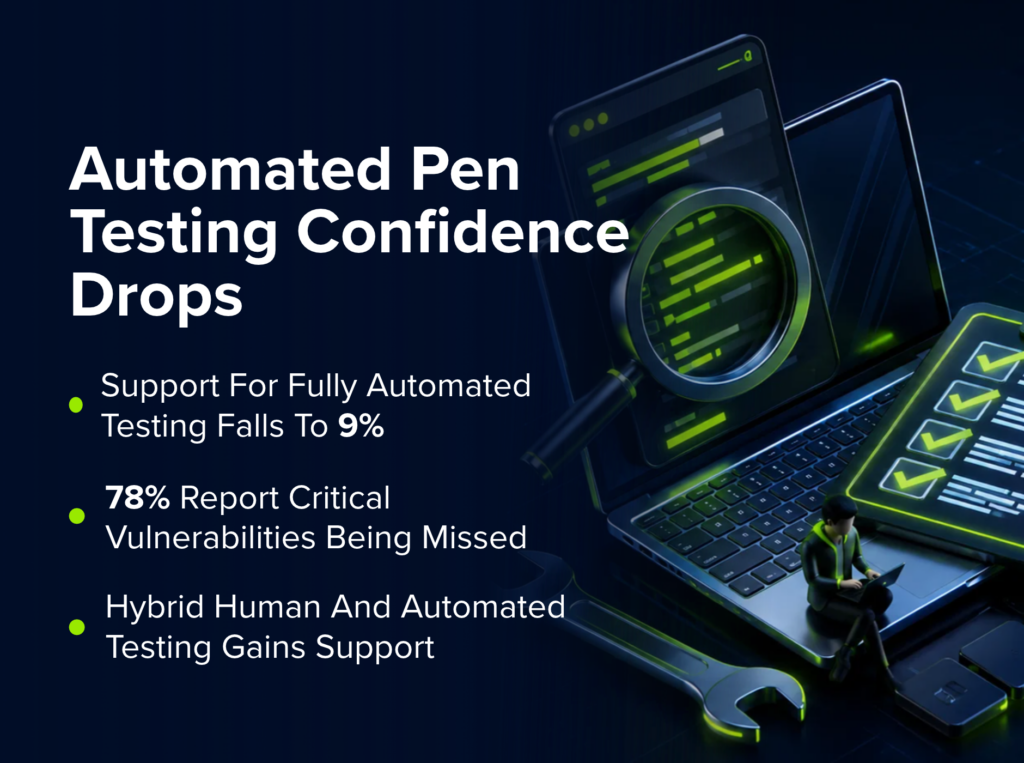
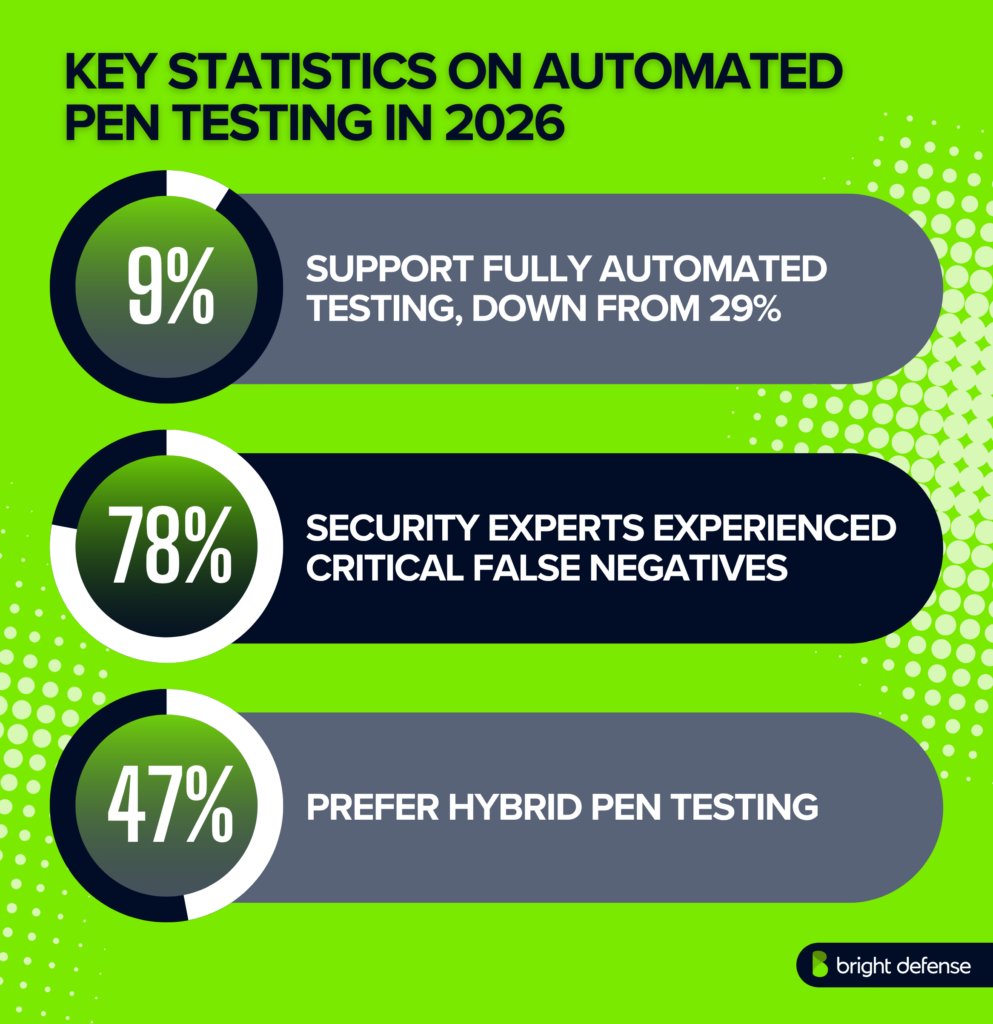
Support for fully automated penetration testing fell sharply in 2026 as security teams reported missed critical vulnerabilities and moved toward testing models that combine automation with human expertise. Cobalt’s AI and Pentesting Pulse Report 2026 found that only 9% of surveyed security professionals support relying entirely on automation for security testing, down from 29% in 2025, while 47% prefer a hybrid approach.
The change follows a year of increased experimentation with AI-driven security tools. Cobalt surveyed 455 security leaders and practitioners, and 78% reported experiencing critical false negatives from fully automated scanning tools. The findings do not show that organizations are abandoning AI security testing. They show a shift toward narrower automation roles while human testers remain involved in exploitation, validation and attack-path analysis.
What Does The 9% Fully Automated Pentesting Figure Actually Measure?
The 9% figure measures support for relying entirely on AI automation for security testing, rather than a technical confidence score assigned to autonomous penetration-testing systems. Cobalt reported that the comparable figure was 29% in 2025, representing a 20-percentage-point decline within one year.
The survey does not show that autonomous pentesting works only 9% of the time or that 91% of security professionals reject AI tools.
Security teams continue using automated testing extensively. The change concerns whether automation should perform the entire penetration-testing function without human involvement.
Cobalt found that 47% now favor a hybrid model where automation works alongside human expertise. Support for that model increased 22 percentage points from the previous year. Another 44% supported automation for lower-risk environments.
The shift fits a broader pattern in 2026 penetration testing data, where organizations are increasing testing frequency while customers and compliance teams continue to expect validated findings and usable third-party reports.
Why Did Support For Fully Automated Pen Testing Fall?
Support for fully automated pentesting fell primarily after security teams encountered false negatives and limitations in testing complex vulnerabilities. Seventy-eight percent of respondents said they had experienced automated scanning tools missing critical vulnerabilities.
False negatives create a different problem from noisy scanner findings. A false positive creates investigation work around something that may not represent a real weakness. A false negative can leave a genuinely exploitable vulnerability undiscovered while the security team assumes testing has covered it.
Dark Reading reported that organizations experimenting with autonomous security testing encountered blind spots, false positives and AI operating costs that contributed to more restrained expectations in 2026. The publication described the change as a move away from the optimism seen a year earlier rather than a rejection of AI itself.
The Register reported the same downward trend and connected it directly to tools failing to detect critical vulnerabilities. Its coverage noted that Cobalt’s respondent group was relatively small, meaning the 9% figure should be interpreted as survey evidence rather than a measurement of the entire security industry.
What Vulnerabilities Are Automated Pen Testing Tools Missing?
Automated tools remain effective at detecting many known and repeatable vulnerability patterns, but complex business logic, chained attack paths and context-dependent weaknesses remain difficult to test without human judgment.
OWASP’s Web Security Testing Guide states that business-logic testing requires security professionals to develop abuse and misuse cases around the way an application actually works. OWASP describes automation of business-logic abuse cases as impractical and characterizes this testing as dependent on tester skill and knowledge of the complete business process.
OWASP’s guidance on dynamic application security testing makes a similar distinction. Automated DAST tools can detect numerous weaknesses at scale, while manual assessments are needed for vulnerabilities such as business-logic errors, race conditions and some previously unknown vulnerabilities.
The concern extends beyond whether a scanner detects an individual CVE. Penetration testers frequently need to determine whether several moderate weaknesses can be chained into privilege escalation, sensitive-data access or another meaningful attack path.
That division of labor is the basis of hybrid penetration testing, where automated discovery expands coverage while human testers investigate exploitability, business logic and attack chains that require contextual judgment.
Why Are AI And LLM Applications Harder To Test Automatically?
AI and large language model applications introduce behavioral and context-dependent attack paths that traditional vulnerability scanners were not designed to evaluate. Prompt injection, excessive agency, insecure output handling and interactions between models and external tools can require repeated adversarial interactions rather than a single automated request.
Cobalt reported that 32% of AI and LLM pentest findings were high risk, approximately 2.7 times the rate across conventional application testing in its dataset. Only 38% of high-risk AI and LLM findings were resolved, giving this category the lowest remediation rate measured in the report.
The company’s 2026 research states that two out of three high-risk AI vulnerabilities remain unresolved. Its report highlights prompt injection, insecure output handling and excessive agency as risks that require AI and LLM testing to be treated as a distinct security discipline.
Cobalt’s pentesting volume reflects the growing exposure. The company reported that AI and LLM testing increased substantially as organizations deployed more AI applications, while security professionals’ confidence in keeping pace with AI adoption fell from 64% in 2025 to 51% in 2026.
These findings come from Cobalt’s own testing dataset and survey population. They provide a useful industry signal but should not be treated as a universal vulnerability rate for every AI application.
Why Is Hybrid Penetration Testing Gaining Support?
Hybrid penetration testing is gaining support because security teams can use automation for speed and coverage while retaining human expertise for exploitation, business logic and contextual risk analysis. Cobalt found that 47% of security professionals preferred this model in 2026, up 22 percentage points from the prior year.
Automated systems can repeatedly enumerate assets, test known patterns and perform high-volume validation. Human testers can investigate unusual behavior, modify attack strategies and determine how apparently separate weaknesses interact.
OWASP’s Developer Guide recommends both approaches. Its security-testing guidance describes automated testing as useful for speed and scale while stating that manual expert testing is valuable for high-risk components requiring knowledge of the application and its business logic.
This combination increasingly resembles Penetration Testing as a Service, where recurring testing, automation, remediation tracking and human-led assessment operate as parts of the same security-testing program rather than as competing approaches.
Are Security Teams Abandoning Autonomous Penetration Testing?
Security teams are not abandoning autonomous penetration testing. The evidence points toward narrower use of autonomous tools rather than complete replacement of human penetration testers.
Cobalt found that 44% of respondents still favor automation in low-risk environments. That makes autonomous testing attractive for applications and assets where teams need frequent coverage but cannot economically commission a full manual assessment after every release.
The market response provides another indication. Cobalt launched its own Autonomous Pentest product on July 23, 2026, less than one month after publishing the survey showing declining support for full automation. The product is designed to provide findings within 24 hours and expand continuous testing across application portfolios.
Cobalt positions autonomous testing alongside human-led testing rather than as a universal replacement. Its current product guidance distinguishes continuous autonomous coverage from compliance-oriented human-led pentesting.
The emerging model therefore assigns different testing methods to different risk levels. Automated systems can increase testing frequency, while expert-led assessments remain focused on high-value, complex or audit-sensitive targets.
What Does OWASP Say About Autonomous Penetration Testing?
OWASP created a dedicated Autonomous Penetration Testing Standard, or APTS, in 2026 to address governance risks that arise when testing systems make targeting, exploitation and operational decisions without continuous human control.
APTS contains 173 tier-required requirements across eight governance domains. Those domains cover scope enforcement, safety controls, human oversight, graduated autonomy, auditability, manipulation resistance, supply-chain trust and reporting.
Human oversight receives its own domain with 19 requirements. OWASP says autonomous platforms should support approval gates, monitoring, intervention, pause and kill controls, escalation procedures, qualified operators and accountable human sign-off.
The standard does not define a new penetration-testing methodology. OWASP states that it complements existing methodologies such as PTES, WSTG and OSSTMM while addressing risks created specifically by autonomous operation.
The creation of a separate governance standard indicates that autonomous penetration testing is becoming established enough to require formal controls. It simultaneously reinforces that autonomous operation does not remove human accountability.
Can Fully Automated Pen Testing Meet Compliance Requirements?
Fully automated penetration testing cannot be assumed to satisfy every compliance requirement that calls for a penetration test. The applicable framework, assessment methodology and auditor expectations determine whether an automated test provides sufficient evidence.
PCI DSS provides one of the clearest examples. Requirement 11.4 requires internal and external penetration testing to be performed by a qualified internal resource or qualified external third party, with organizational independence of the tester. The standard requires exploitable vulnerabilities to be corrected and penetration testing to be repeated to verify remediation.
PCI SSC published PCI DSS v4.0.1 in June 2024 and stated that the revision added no new requirements and deleted none from v4.0. The qualification structure for penetration testing therefore remained part of the current standard.
Other frameworks need separate analysis. SOC 2, for example, does not contain a blanket requirement that every organization conduct a penetration test. The relationship between SOC 2 and penetration testing depends on the organization’s risks, control design and the evidence used to demonstrate that relevant security controls operate effectively.
Organizations relying on autonomous testing for compliance evidence should therefore verify the framework requirement, tester qualification criteria, report expectations and auditor acceptance before replacing a human-led assessment.
What Should Security Teams Do About Automated Pen Testing In 2026?
Security teams should use autonomous pentesting according to asset risk and testing objectives rather than treating automation as a direct replacement for every manual assessment.
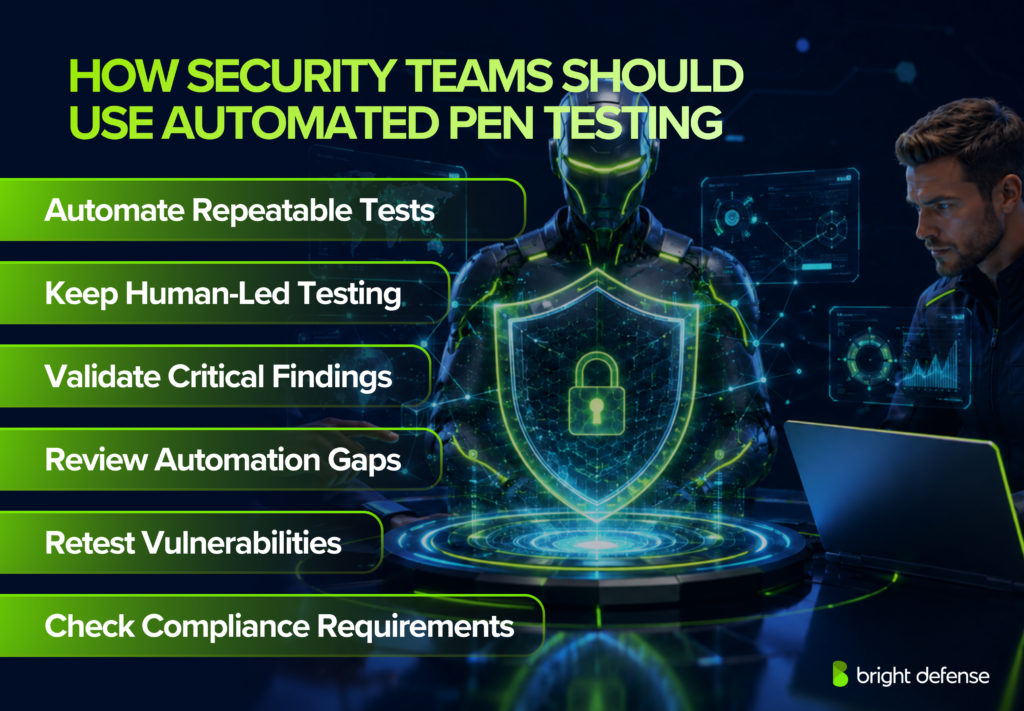
- Use automation for repeatable coverage: Apply automated testing between deeper assessments, particularly across larger application portfolios and lower-risk systems.
- Keep human testing for complex attack paths: Assign expert testers to business logic, authorization, chained exploitation, high-value applications and AI-specific attack scenarios.
- Validate critical automated findings: Confirm exploitability and business impact before remediation teams spend resources on high-severity findings.
- Track Automation Gaps With Human Review: Compare automated findings with human-led testing to track false negatives, while requiring human approval for disruptive exploitation, sensitive-data access, or production-impacting actions.
- Retest remediated vulnerabilities: Confirm that the original attack path has been removed rather than relying only on a ticket being marked complete.
- Check compliance requirements separately: Confirm that autonomous reports satisfy the applicable assessor, customer or contractual requirement before using them as replacement evidence.
How Did Security Experts And Industry Publications Respond?
Industry coverage generally interpreted Cobalt’s findings as a correction in expectations around AI rather than evidence that security automation has failed.
Dark Reading reported that enthusiasm for fully autonomous security testing had declined after organizations gained more direct experience with AI-powered systems. The publication highlighted false positives, blind spots and operating costs as practical reasons security leaders had become more cautious.
Infosecurity Magazine connected the decline directly to false negatives. Its coverage reported the fall from 29% to 9%, the 78% critical-vulnerability miss rate reported by respondents, and the rise of hybrid testing to 47%.
The Register characterized the results as security professionals becoming less willing to entrust their entire testing program to autonomous tools. Its reporting separately noted the limited survey size, a useful qualification when interpreting the percentages.
Cobalt’s own response has remained supportive of AI-assisted offensive security. The company argues that automation should increase testing speed and coverage while experienced penetration testers handle scenarios requiring contextual reasoning and adversarial creativity.
What Business Risks Follow From Overreliance On Automated Pentesting?
Overreliance on automated pentesting creates risk when organizations interpret completed automated tests as proof that high-value systems have been thoroughly assessed.
The largest risk is false assurance. A clean automated report can influence release approvals, customer security reviews and remediation priorities even when the testing engine has not evaluated business logic or complex attack chains.
Missed vulnerabilities can carry a second cost through delayed remediation. Security teams cannot fix a weakness that their testing process never surfaces.
Reporting quality creates another business issue. Customers, auditors and third-party risk teams increasingly request penetration-test reports that explain affected assets, exploitation evidence, business impact and remediation status rather than lists of scanner findings.
Cobalt’s broader 2026 State of Pentesting research found that 61% of customers request third-party pentest reports to validate software security, up 13 percentage points year over year.
The value of testing therefore depends on more than finding vulnerabilities. A usable penetration testing report needs to show what was tested, what could actually be exploited, how serious the resulting risk is and whether remediation removed the attack path.
Automation needs to improve testing coverage without reducing the quality of evidence required for those security and compliance decisions.
What Remains Unclear About Fully Automated Pen Testing?
The biggest unresolved question is how quickly autonomous systems will close the gap on vulnerabilities that currently depend on human reasoning.
Agentic systems are becoming more capable of planning attack sequences, adapting after failed attempts and chaining tools. Those capabilities could improve autonomous discovery beyond the limitations associated with traditional vulnerability scanners.
A second uncertainty is how organizations will measure testing quality. Detection counts alone do not show whether a tool found the vulnerabilities with the greatest business impact. Comparative benchmarks that evaluate false negatives, exploit chains and reproducibility will become more important as autonomous products mature.
A third issue is compliance acceptance. Standards such as OWASP APTS now address governance for autonomous platforms, but a governance standard does not automatically make an autonomous test equivalent to an expert-led assessment under every compliance framework.
The 9% figure may change quickly as tools improve. The stronger conclusion from the 2026 data is that security teams currently prefer human accountability and expertise to remain part of the penetration-testing process.
How Bright Defense Helps Organizations Balance Automation And Human Pen Testing
Bright Defense uses automation as part of penetration testing without treating scanner output as the finished assessment. Human testers validate weaknesses, investigate realistic attack paths, document evidence and provide remediation guidance that technical and compliance teams can use.
The 2026 shift toward hybrid testing reflects the same operating model: automate repeatable work where it improves coverage while keeping expert analysis focused on vulnerabilities that require context, creativity and controlled exploitation.
Sources Cited In This News Article
- Cobalt — 78% Of Security Teams Experience Critical False Negatives From Automated Scanning Tools (June 25, 2026).
- Cobalt — AI And Pentesting Pulse Report 2026.
- Cobalt — State Of Pentesting Report 2026.
- Cobalt — Five Key Takeaways From The 2026 State Of Pentesting Report (April 21, 2026).
- Dark Reading — AI Decline? Confidence In Autonomous Penetration Testing Falls (June 26, 2026).
- Infosecurity Magazine — Trust In Automated AI Vulnerability Scanning Collapses To 9% (June 25, 2026).
- The Register — Infosec Professionals Sour On Automated Pentesting Tools (June 30, 2026).
- OWASP — Autonomous Penetration Testing Standard (2026).
- OWASP — APTS Human Oversight And Intervention Requirements (2026).
- OWASP — Web Security Testing Guide: Business Logic Testing.
- PCI Security Standards Council — PCI DSS Penetration Testing Requirements.
- Cobalt — Autonomous Pentest Launch (July 23, 2026).