50+ CMMC Statistics for 2026
Updated:
October 7, 2026
Defense contractors need more than a signed contract to keep Department of Defense work. The Cybersecurity Maturity Model Certification (CMMC) program verifies that a contractor protects Federal Contract Information (FCI) and Controlled Unclassified Information (CUI) at the level its contracts require.
Level 1 covers basic safeguarding of FCI, Level 2 maps to the 110 requirements in NIST SP 800-171, and Level 3 adds selected NIST SP 800-172 requirements for the most sensitive programs.
Passing the assessment starts a longer obligation for your organization. Contracting officers check CMMC status in the Supplier Performance Risk System (SPRS) before award, your affirming official must confirm compliance every year, and Level 2 certificates expire after three years. Costs, staffing pressure, and documentation gaps shape how quickly contractors reach each milestone.
The team at Bright Defense has compiled 54 current CMMC statistics for 2026.
This article covers:
- CMMC Adoption Statistics
- CMMC Cost Statistics
- Contractor Readiness Statistics
- Common CMMC Compliance Gaps
- CMMC Compliance Staffing
- Cyber Threats Targeting Defense Contractors
Let’s get into the numbers.
CMMC Adoption Statistics
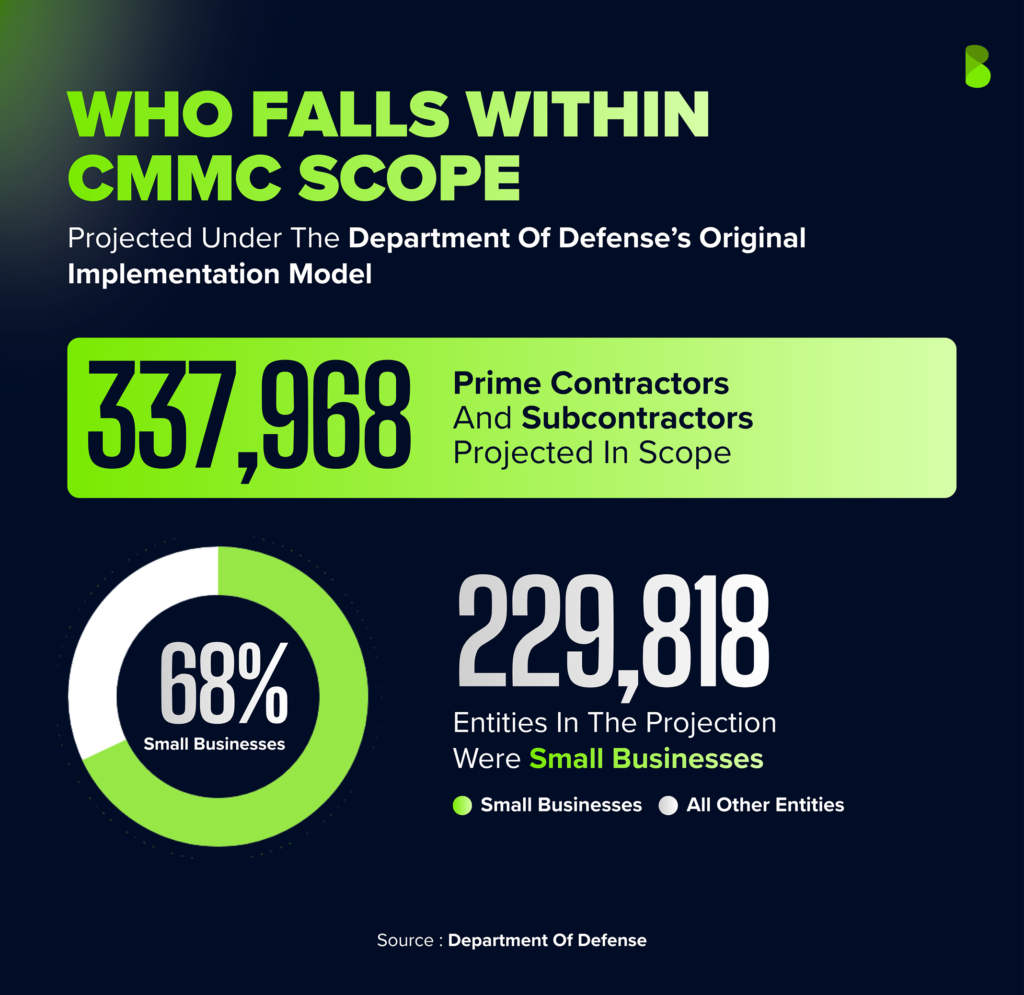
- 337,968 prime contractors and subcontractors were projected to fall within CMMC’s scope under the Department of Defense’s original implementation model. This is a planning estimate, not a count of organizations that have completed assessments. Source: Department of Defense.
- 68% of the entities in that projection were small businesses, representing 229,818 prime contractors and subcontractors. Source: Department of Defense.
- The Department’s projected assessment mix was 62% Level 1 self-assessment, 2% Level 2 self-assessment, 35%Level 2 certification, and 1% Level 3 certification. These are projected shares, not observed adoption rates. Source: Department of Defense.
- 1,866 final Level 2 certificates had been issued as of the July 2026 Cyber AB town hall. Certificates cover assessed information systems; the figure is not a count of unique certified companies. Source: Cyber AB.
- 58 Level 2 certificates held conditional status at the July 2026 town hall. They are separate from the final certificate count. Source: Cyber AB.
- 168 Level 2 assessments were in progress at the same town hall, showing certification activity beyond completed and conditional certificates. Source: Cyber AB.
- 111 authorized or accredited C3PAOs and more than 1,000 Certified CMMC Assessors were part of the assessment ecosystem at the July 2026 town hall. Source: Cyber AB.
CMMC Cost Statistics
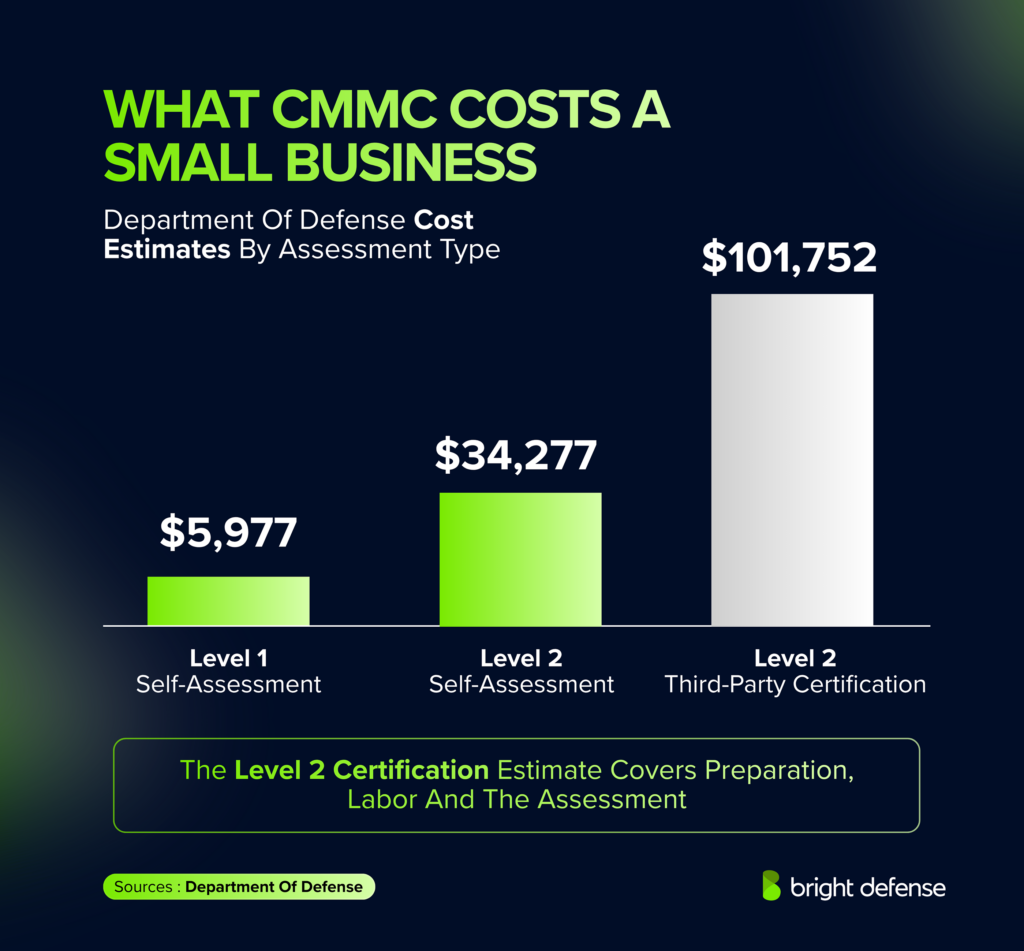
- The Department of Defense estimated $5,977 for a small business to complete a CMMC Level 1 self-assessment and initial affirmation. Source: Department of Defense.
- A small business’s Level 2 self-assessment and initial affirmation carried an estimated cost of $34,277 in the department’s model. Source: Department of Defense.
- The modeled cost for a small business to prepare for and undergo a Level 2 third-party certification assessment, including initial affirmation, was $101,752. That figure includes contractor labor and outside support; it is not solely an assessor’s fee. Source: Department of Defense.
- Within that small-business Level 2 estimate, the modeled third-party assessor engagement accounted for $31,234. It is already included in the $101,752 figure above. Source: Department of Defense.
- For a small business pursuing Level 3, the department modeled an additional $2.7 million in one-time engineering costs and $490,000 in recurring engineering costs to implement and maintain the Level 3 requirements. These are modeled costs for a much narrower group of contractors, on top of the Level 2 prerequisite. Source: Department of Defense.
- 49% of respondents to NDIA’s defense industry cybersecurity survey reported spending more than $100,000 in one-time costs to implement NIST SP 800-171 security requirements. Those costs are separate from CMMC assessment and certification. Source: National Defense Industrial Association.
- 45% of respondents to the same NDIA survey reported spending more than $100,000 annually to maintain NIST SP 800-171 requirements. Source: National Defense Industrial Association.
- In PreVeil’s survey of defense industry summit attendees, 62% of 2025 respondents budgeted under $50,000 for CMMC compliance, compared with 49% in its 2024 survey. These are planned budgets, not measured costs. Source: PreVeil.
- Among contractors surveyed by Redspin in 2025, 26% reported spending 100,000–250,000 preparing for CMMC, while 31% reported spending more than $250,000 to date. Source: Redspin.
- After the Phase II suspension, 88% of organizations in a July 2026 survey said they had neither decreased nor paused their CMMC budget. The survey covered 273 organizations already doing business with the department, so the result describes that group rather than all defense contractors. Source: Kiteworks.
Contractor Readiness Statistics
- 46% of defense industrial base organizations in a 2025 survey said they were ready to seek CMMC Level 2 certification. Source: Kiteworks and Coalfire.
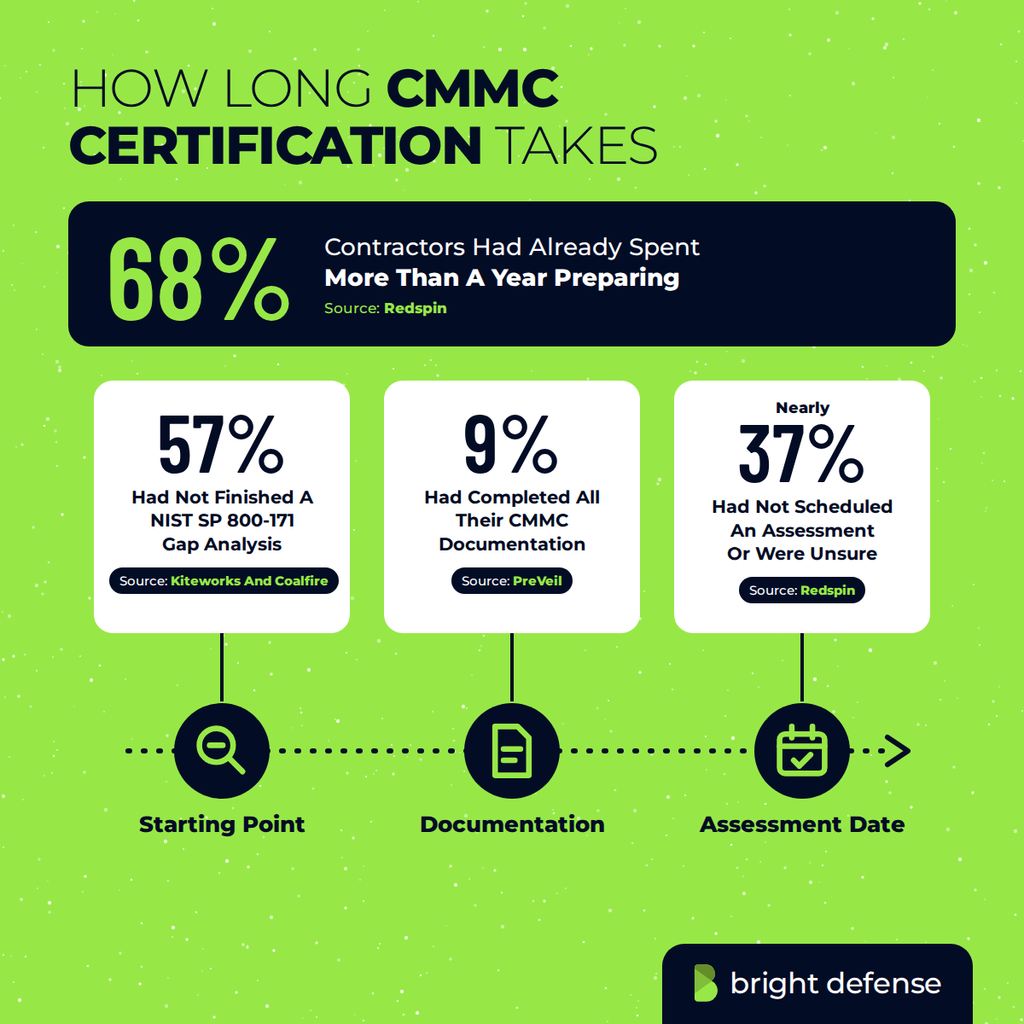
- 57% of respondents in the same survey had not completed a thorough gap analysis against NIST SP 800-171 requirements. Source: Kiteworks and Coalfire.
- 34% of respondents to a defense industry survey were still at the “just getting started” stage of CMMC preparation, up from 30% in the prior survey. Source: PreVeil.
- 9% of respondents to that survey said they had completed all their CMMC documentation. Source: PreVeil.
- 68% of contractors in a 2025 survey said they had already spent more than a year preparing for CMMC. Source: Redspin.
- Nearly 37% of respondents to the same survey had not scheduled a CMMC assessment or were unsure of their next steps. Source: Redspin.
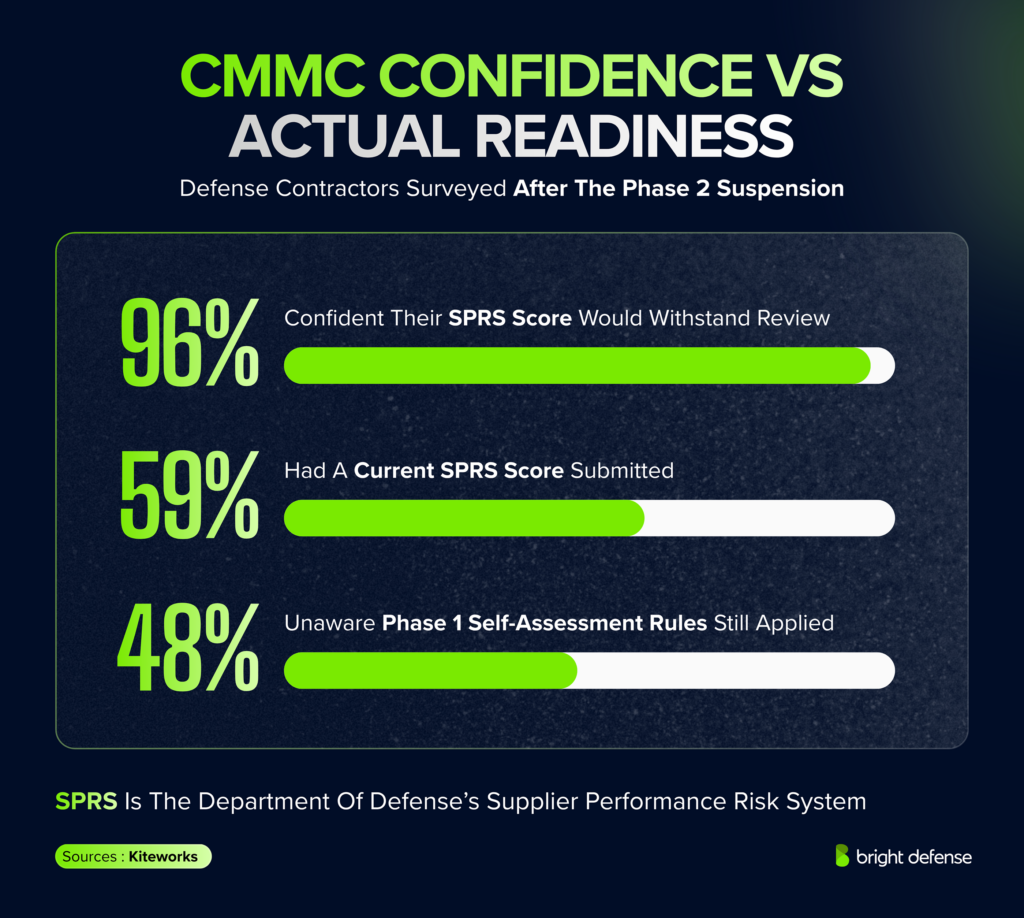
- In a July 2026 survey, 96% of respondents were confident their self-attested SPRS score would withstand review, while 59% said they had a current score submitted. Source: Kiteworks.
- 48% of respondents to that July 2026 survey did not know that Phase 1 self-assessment requirements remained in effect after the Phase 2 suspension. Source: Kiteworks.
Common CMMC Compliance Gaps
- Among organizations handling CMMC preparation internally, only 27% had a well-documented assessment scope, compared with 63% of organizations working with experienced partners. Source: Kiteworks and Coalfire.
- 32% of surveyed defense industrial base organizations had only partially documented cybersecurity policies and procedures, with updates still in progress. Source: Kiteworks and Coalfire.
- Only 33% of organizations that had not started a NIST SP 800-171 gap analysis had a detailed Plan of Action and Milestones with assigned responsibilities and timelines. That rose to 71% among organizations that had completed a gap analysis. Source: Kiteworks and Coalfire.
- Only 44% of surveyed contractors had implemented continuous monitoring for systems within their CMMC Level 2 assessment scope. Source: Kiteworks and Coalfire.
- Fewer than 53% had fully implemented required access controls across all relevant systems. Source: Kiteworks and Coalfire.
- More than 30% did not enforce multifactor authentication across every system processing or storing sensitive data. Source: Kiteworks and Coalfire.
- 25% said they encrypted some data but still had gaps in their encryption practices. Source: Kiteworks and Coalfire.
- 29% had only some controls in place to limit third-party access to Controlled Unclassified Information. Source: Kiteworks and Coalfire.
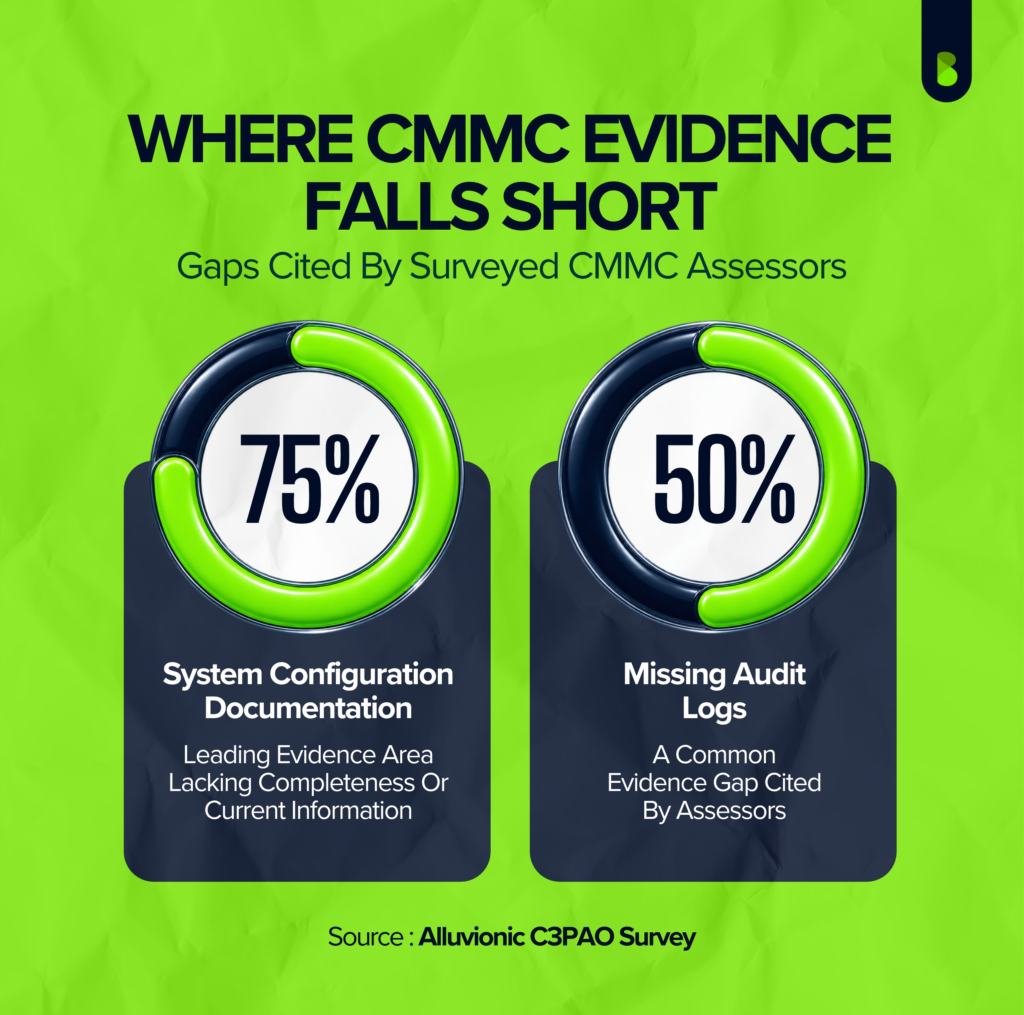
- 75% of surveyed CMMC assessors identified system configuration documentation as the leading evidence area lacking completeness or current information. Source: Alluvionic.
- 50% of surveyed CMMC assessors cited missing audit logs as a common evidence gap. Source: Alluvionic.
CMMC Compliance Staffing
- More than 31% of respondents to NDIA’s defense industry cybersecurity survey had less than 1 full-time equivalent employee managing or supporting cybersecurity. More than 21% had less than 1 full-time equivalent employee supporting IT. Source: National Defense Industrial Association.
- 23% of small organizations in a CMMC survey had both an approved compliance budget and a dedicated team, compared with 62% of large organizations. Source: Kiteworks and Coalfire.
- 55% of respondents to PreVeil’s 2025 summit survey planned to handle CMMC compliance with an internal team, up from 46% in its 2024 survey. This measures staffing plans, not completed work. Source: PreVeil.
- 21% of cybersecurity professionals surveyed by ISC2 spent at least 20 hours per week on CMMC work. Among respondents at organizations with fewer than 100 employees, 35% spent more than 20 hours per week. Source: ISC2.
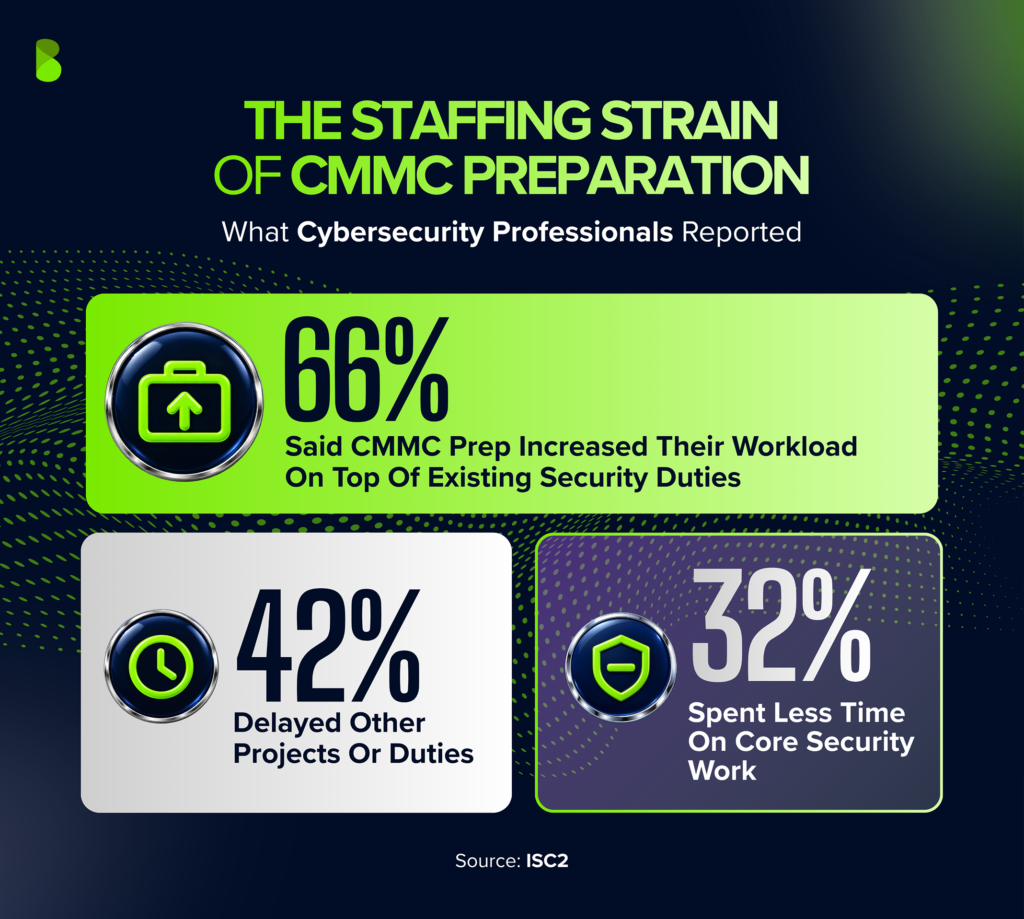
- 66% of ISC2 respondents said CMMC preparation increased their workload alongside their existing cybersecurity responsibilities. Source: ISC2.
- 32% said they spent less time on their cybersecurity responsibilities because of CMMC work. Source: ISC2.
- 42% said CMMC preparation delayed other projects or responsibilities. Source: ISC2.
- 81% of ISC2 respondents worked on CMMC documentation, while 78% participated in CMMC-related meetings. Source: ISC2.
- 55% said CMMC preparation increased their own need for additional credentials, training, or expertise. 46%said it increased those needs for other employees in their organizations. Source: ISC2.
- In a separate survey of 48 NDIA San Diego member organizations, approximately one in three cited IT or security staff burnout or turnover as an effect of CMMC implementation. Source: National Defense Industrial Association.
Cyber Threats Targeting Defense Contractors
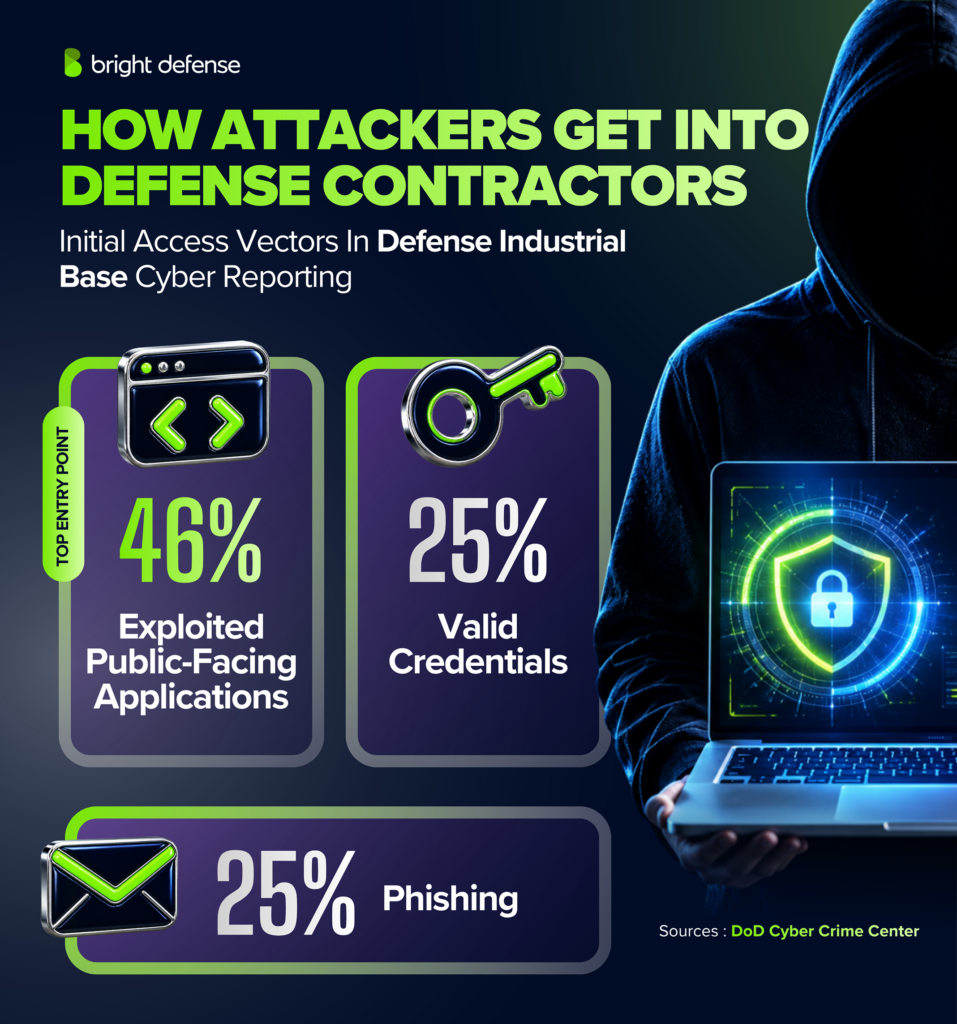
- 46% of the initial access vectors identified in defense industrial base cyber reporting for the first quarter of 2026 involved exploitation of public-facing applications. DoD Cyber Crime Center.
- 25% of identified initial access vectors in the same reporting period involved attackers using valid credentials. DoD Cyber Crime Center.
- 25% of identified initial access vectors in that period involved phishing. DoD Cyber Crime Center.
- 14% of mandatory defense industrial base cyber reports submitted in the fourth quarter of 2025 involved ransomware. DoD Cyber Crime Center.
- 47% of surveyed defense industry IT practitioners said their organizations had at least four user accounts or email addresses compromised in the preceding year. RADICL.
- 47% of respondents in the same survey reported virus or malware compromises on at least four company endpoints in the preceding year. RADICL.
- 37% of surveyed defense industry organizations estimated that cybersecurity incidents had cost them at least $100,001 in lost time, productivity, or cash. RADICL.
- Aerospace and defense organizations accounted for about 1% of victims listed on the ransomware and extortion data leak sites tracked globally in 2025. That measure covers public leak-site listings, not every intrusion against the sector. Google Threat Intelligence Group.
- A China-linked espionage group used 17 distinct malware families in operations against defense industrial base targets observed by researchers. Google Threat Intelligence Group.
For businesses serving both defense and commercial customers, SOC 2 statistics offer another perspective on compliance budgets, staffing, and audit readiness.
What Do the CMMC Statistics Mean for Your Contracts?
The CMMC statistics show how preparation gaps can affect your ability to compete for defense contracts. Incomplete evidence, unclear assessment scope, and insufficient budgets can leave your organization unprepared when a solicitation requires a specific CMMC status.
The following are five implications for your contract pipeline and compliance planning.
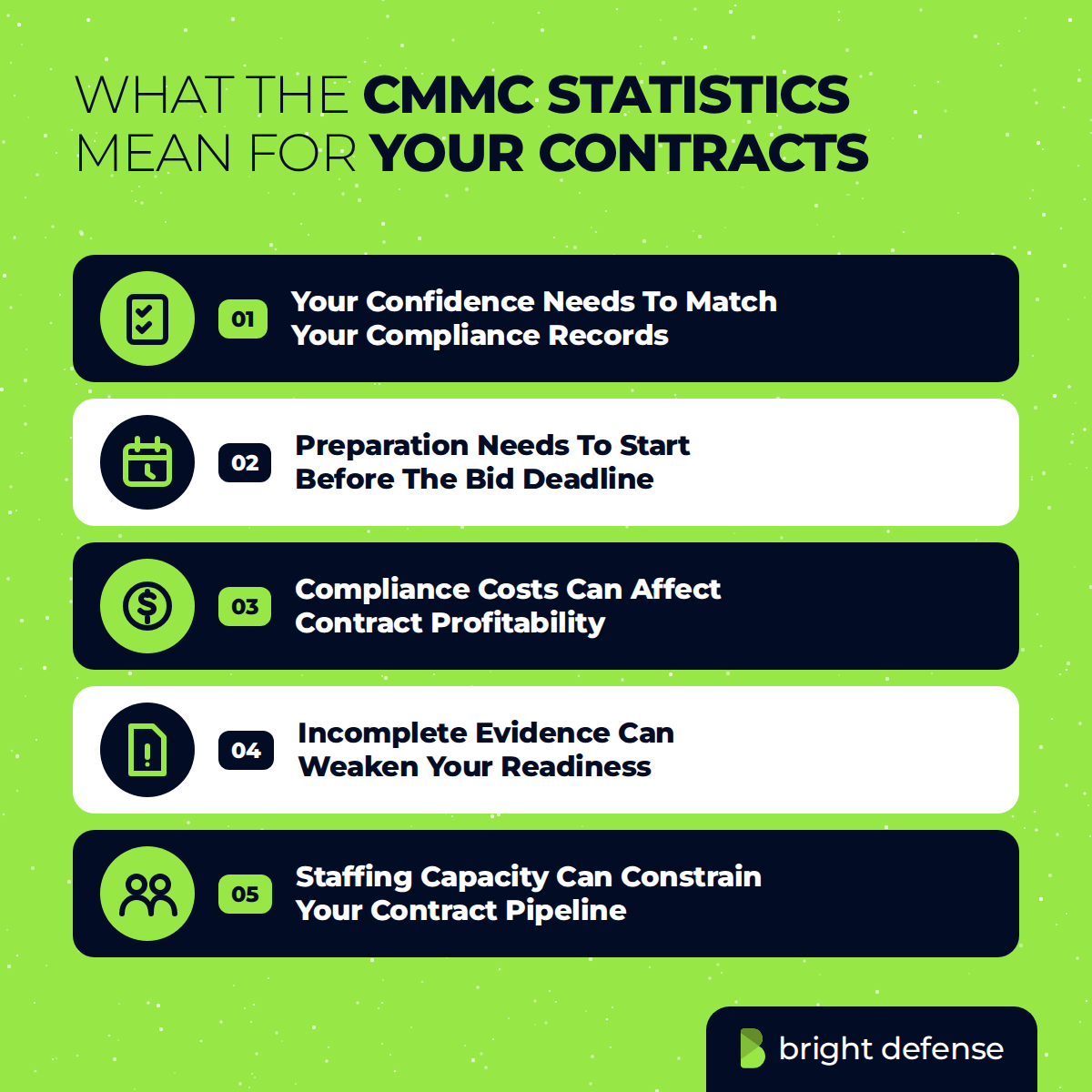
1. Your Confidence Needs to Match Your Compliance Records
In Kiteworks’ July 2026 survey, 96% of respondents believed their self-attested SPRS score would withstand review, while 59% said they had a current score submitted. That gap suggests confidence can run ahead of the records needed to support contract readiness.
Before pursuing an opportunity, compare its cybersecurity requirements with your assessment records, supporting evidence, and applicable affirmations. Sales, compliance, and IT teams should share the same understanding of which requirements your organization can currently satisfy.
2. Preparation Needs to Start Before the Bid Deadline
Redspin found that 68% of surveyed contractors had spent more than a year preparing for CMMC. Nearly 37% had not scheduled an assessment or were unsure of their next steps.
These findings make preparation time a contract planning issue. Waiting until a solicitation arrives can leave too little time to resolve technical weaknesses, complete evidence, and arrange an assessment where required.
Work backward from anticipated opportunities. Identify the required assessment level, confirm your scope, and assign deadlines for remediation and evidence review.
3. Compliance Costs Can Affect Contract Profitability
In NDIA’s survey, 49% of respondents spent more than $100,000 implementing NIST SP 800-171 requirements, and 45% spent more than that amount annually maintaining them. Those expenses are separate from CMMC assessment and certification costs.
For your business, this means contract profitability depends partly on the cost of protecting the systems and information involved in delivery. A budget focused only on the assessment can miss recurring expenses for monitoring, staffing, licensing, and evidence maintenance.
Evaluate those costs against the defense revenue your compliance program supports. Define where contract information needs to flow so that your budget reflects the systems, people, and suppliers involved.
4. Incomplete Evidence Can Weaken Your Readiness
Only 9% of respondents to PreVeil’s survey had completed all their CMMC documentation. Separately, 75% of surveyed assessors identified incomplete or outdated system configuration documentation as a leading evidence gap.
These findings indicate that installing security tools does not finish the preparation process. Your team needs evidence showing how controls operate across the assessment scope.
Assign an owner to each requirement and review the supporting policies, configurations, logs, and records before assessment. Include the environments and workflows intended to support upcoming contracts in that review.
5. Staffing Capacity Can Constrain Your Contract Pipeline
Only 23% of small organizations in the Kiteworks and Coalfire survey had both an approved compliance budget and a dedicated team, compared with 62% of large organizations. ISC2 found that CMMC preparation delayed other projects or responsibilities for 42% of respondents.
For a smaller contractor, compliance work competes with customer delivery and daily security operations. Adding defense work without accounting for that workload can stretch the people responsible for maintaining readiness.
Build compliance responsibilities into resource planning. Assign time for evidence upkeep, remediation, and supplier oversight so your organization can support the contracts it pursues.
How Much Does CMMC Certification Cost a Small Business?
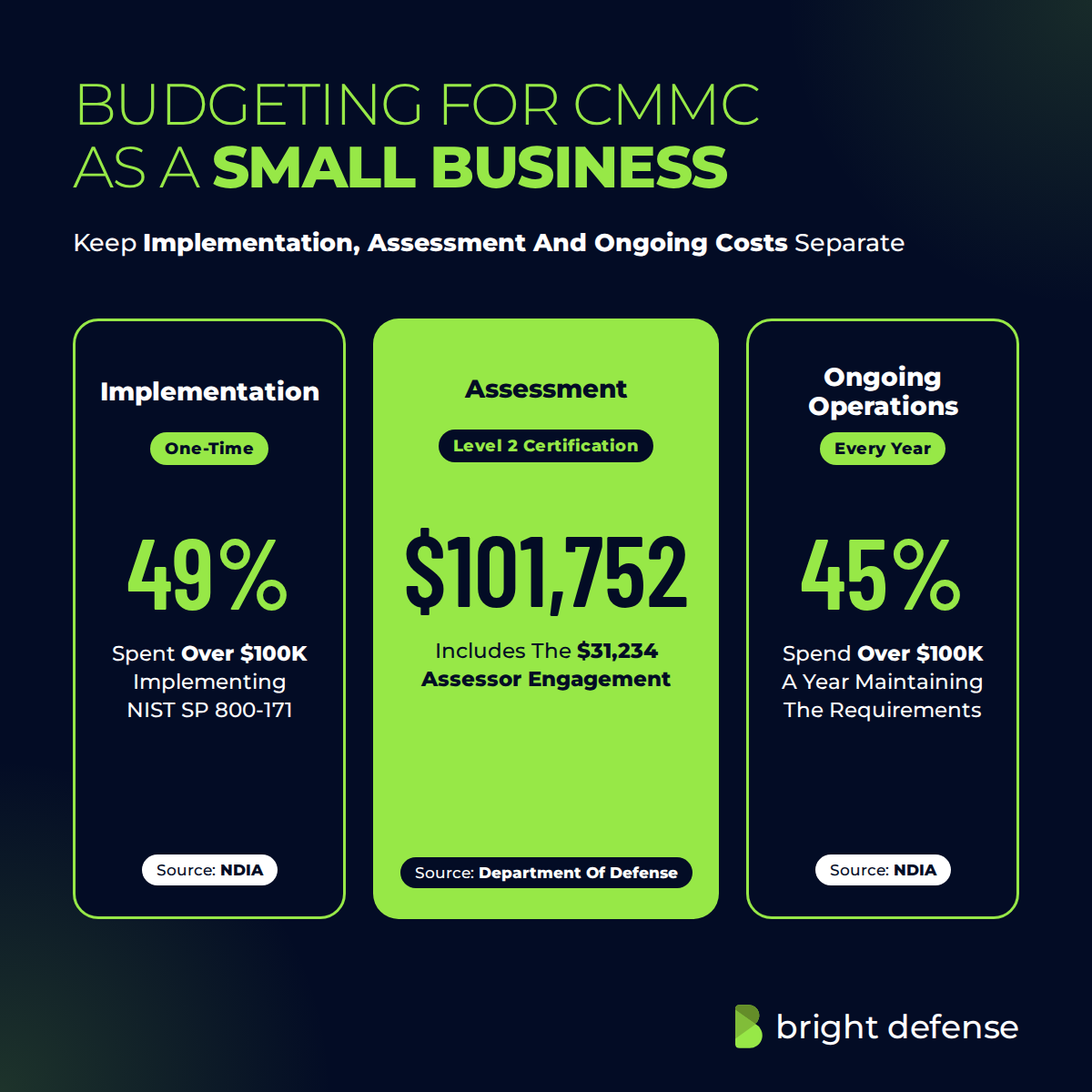
The Department of Defense’s cost model puts a small business’s CMMC Level 2 certification assessment and initial affirmation at $101,752, including assessment preparation, contractor labor, and outside support. The third-party assessor engagement accounts for $31,234 of that total.
Your total budget depends on your required CMMC level and the work needed to bring your systems into compliance. The following figures show the DoD’s modeled assessment costs for small businesses.
| Assessment Path | Modeled Cost | What It Covers |
|---|---|---|
| Level 1 Self-Assessment | $5,977 | Self-assessment and initial affirmation |
| Level 2 Self-Assessment | $34,277 | Self-assessment and initial affirmation |
| Level 2 Third-Party Certification | $101,752 | Assessment preparation, certification assessment, and initial affirmation |
The self-assessment paths do not provide third-party certification. The $31,234 assessor engagement is already included in the Level 2 certification total and should not be added again.
Implementation Adds to the Assessment Budget
The cost of implementing security requirements is separate from the assessment itself. Your business may need to improve access controls, replace unsupported systems, strengthen encryption, centralize logging, or obtain outside security support before it is ready.
In NDIA’s survey, 49% of respondents spent more than $100,000 in one-time costs implementing NIST SP 800-171 requirements. In Redspin’s survey, 26% spent $100,000–$250,000 preparing for CMMC, while 31% spent more than $250,000.
These surveys cover different contractor groups and cost categories. Their figures illustrate the potential scale of preparation costs; they should not be added directly to the DoD model.
Maintaining Compliance Creates Recurring Costs
In NDIA’s survey, 45% of respondents spent more than $100,000 annually maintaining NIST SP 800-171 requirements. Recurring expenses can include security staff, software subscriptions, monitoring, training, and evidence maintenance.
For your small business, a practical budget separates implementation, assessment, and ongoing operations. Start with a gap analysis and a clearly defined assessment scope, then obtain quotes based on the systems, users, and locations that handle contract information.
How Long Does CMMC Certification Take?
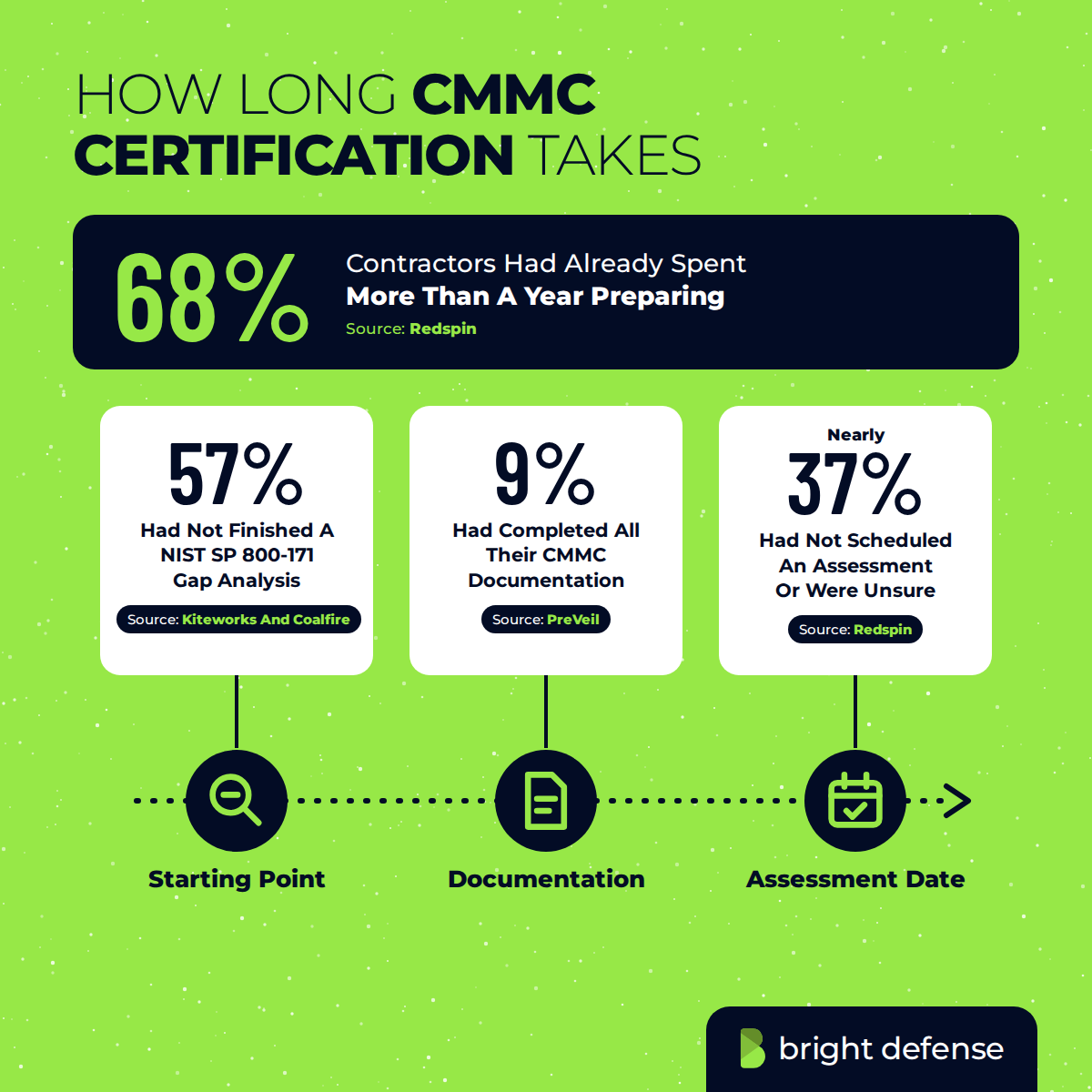
CMMC certification preparation can take more than a year, depending on your existing security controls, assessment scope, and staffing. In Redspin’s survey, 68% of contractors had already spent more than a year preparing. That figure measures preparation time and does not establish an average time to certification.
The following factors shape how quickly your business can become assessment-ready.
Your Starting Point Determines the Remediation Work
A business with established security controls and current evidence has less preparation work than one starting its compliance program. In the Kiteworks and Coalfire survey, 57% of respondents had not completed a thorough NIST SP 800-171 gap analysis.
Without that analysis, your team may overlook weaknesses that affect the schedule. Confirm your assessment scope, identify unmet requirements, and assign remediation owners before setting a target assessment date.
Documentation and Staffing Affect Your Schedule
Only 9% of respondents to PreVeil’s survey had completed all their CMMC documentation. Policies, system configurations, access records, and other evidence take time to prepare and validate.
Staff availability creates another constraint. ISC2 found that 66% of respondents handled increased workloads alongside their existing cybersecurity responsibilities, while 42% said CMMC preparation delayed other projects or responsibilities. Your timeline needs to account for the hours your team can actually dedicate to preparation.
Assessment Scheduling Adds Another Variable
Nearly 37% of contractors in Redspin’s survey had not scheduled an assessment or were unsure of their next steps. Completing internal preparation and scheduling your CMMC assessment are separate milestones.
For contracts requiring third-party certification, discuss availability with a C3PAO early and align the assessment date with your remediation plan. Build your schedule around completed controls and reviewed evidence, with time to address findings before the contract opportunity requires certification.
Which CMMC Gaps Should You Fix First?
Start by confirming where Controlled Unclassified Information (CUI) resides, then address weaknesses that expose those systems to unauthorized access. The statistics highlight common problem areas, but your remediation order should reflect your own assessment findings, exposure, and implementation dependencies.
The following are five priorities for organizing that work.
1. Define Your Assessment Scope
Only 27% of organizations handling CMMC preparation internally had a well-documented assessment scope, compared with 63% working with experienced partners, according to Kiteworks and Coalfire.
An incomplete scope can leave systems, users, and service providers outside your remediation plan. Map how CUI enters, moves through, and leaves your environment. Identify the assets and external services involved before deciding which controls need attention.
2. Close Access Control and Authentication Gaps
Fewer than 53% of surveyed contractors had fully implemented required access controls across relevant systems. More than 30% had gaps in multifactor authentication coverage.
Prioritize unnecessary privileges, inactive accounts, remote access weaknesses, and missing MFA where required. Review third-party access carefully: 29% of respondents had only some controls in place to limit external access to CUI.
3. Address Exposed Applications and Encryption Weaknesses
Exploitation of public-facing applications accounted for 46% of the initial access vectors identified in DoD Cyber Crime Center’s first-quarter 2026 defense industrial base reporting. Separately, 25% of surveyed contractors had gaps in their encryption practices.
Review internet-facing systems for exploitable vulnerabilities and unsupported software. Confirm that CUI receives the required protection during storage and transmission, including transfers through email, file-sharing platforms, and external services.
4. Strengthen Logging and Continuous Monitoring
Only 44% of surveyed contractors had implemented continuous monitoring across their Level 2 assessment scope. Missing audit logs were a common evidence gap for 50% of surveyed assessors.
Verify that relevant systems generate usable logs, retain them appropriately, and support investigation. Assign responsibility for reviewing alerts and following up on suspicious activity so that monitoring produces actionable findings.
5. Complete Evidence and Assign Remediation Owners
Incomplete or outdated system configuration documentation was a leading evidence gap for 75% of surveyed assessors. Separately, 32% of contractors had only partially completed cybersecurity policies and procedures.
Update evidence alongside technical fixes. Each remediation item needs an owner, a deadline, and a clear method for verifying completion. Keep policies, configurations, and operational records aligned with how your environment actually works.
This order provides a starting point. An actively exploited vulnerability or exposed CUI warrants immediate attention, and every applicable requirement still needs to be addressed.
How Bright Defense Can Help You
Bright Defense helps defense contractors prepare for CMMC Level 1 and Level 2 through gap analysis, remediation, policy development, and ongoing compliance support. Our CMMC Registered Practitioners work with your team to identify weaknesses and build a plan for assessment readiness.
The following services help address the preparation, staffing, and evidence gaps highlighted in these statistics:
- Gap Analysis and Remediation: Identify unmet requirements and prioritize the work needed to strengthen your security controls.
- Policy and Evidence Management: Develop policies, organize supporting evidence, and maintain records for assessment preparation.
- Compliance Automation: Track compliance status and streamline ongoing evidence collection.
- vCISO Support: Align security priorities with your budget, timeline, and business requirements.
- Continuous Compliance: Review controls and maintain readiness as your systems and operations change.
Schedule a CMMC consultation with Bright Defense to discuss your current readiness and the next steps for your business.
Frequently Asked Questions
1. How Many Defense Contractors Are CMMC Certified, and Am I Behind?
The Defense Compliance Report’s September 29, 2026 snapshot lists 2,362 final Level 2 certificates and 71 conditional certificates, citing Cyber AB town hall data. Certificates cover assessed information-system scopes, so these figures do not establish the number or percentage of unique companies certified.
Your readiness depends on the requirements and timing of your contract opportunities. The certificate count alone cannot establish whether you are behind.
2. How Much Should I Budget for CMMC Level 1 Compliance as a Small Business?
DoD’s cost model puts a small business’s Level 1 self-assessment and initial affirmation at $5,977. This includes preparation, assessment work, submission of results, and affirmation.
The figure is a planning benchmark rather than a fixed fee. Additional spending depends on the security improvements your business needs. Level 1 uses an annual self-assessment and does not require a C3PAO certification assessment.
3. How Much Will I Spend on a CMMC Level 2 Certification Assessment?
DoD models $101,752 for a small business’s Level 2 certification assessment and initial affirmation, including internal labor and outside support. The C3PAO engagement accounts for $31,234, already included in that total.
The model assumes you have implemented NIST SP 800-171 requirements. Remediation and security implementation can add costs, and your assessor’s actual quote will depend on your assessment scope.
4. How Long Should I Expect CMMC Preparation and Certification to Take?
There is no single timeline that applies to every contractor. In Redspin’s survey, 68% of respondents had spent more than a year preparing for CMMC. That measures preparation already undertaken, not an average time to completed certification.
Your schedule depends on existing controls, evidence quality, remediation work, staff availability, and assessment scheduling. A scoped gap analysis gives you a stronger basis for setting a target date.
5. How Many Defense Contractors Am I Competing With for CMMC Assessments?
DoD’s 2025 acquisition-rule model projects 337,968 prime contractors and subcontractors across all CMMC levels. Many fall under self-assessment, so that total should not be treated as the number competing for C3PAO appointments.
The projection does not measure how many assessment-ready contractors are seeking appointments now. Your scheduling competition depends on assessor availability, scope, and timing.
Start with a scoped gap analysis, then address missing access controls, required multifactor authentication, monitoring, and supporting evidence. In the Kiteworks and Coalfire survey, fewer than 53% had fully implemented access controls, more than 30% had MFA coverage gaps, and only 44% had implemented continuous monitoring across their Level 2 scope.
These findings identify common weaknesses; your own assessment determines which requirements remain unmet and which fixes need immediate attention.
The Defense Compliance Report’s September 29, 2026 snapshot lists 117 authorized or accredited C3PAOs, citing Cyber AB data. That count does not measure open appointments or establish a nationwide waiting period.
Availability can affect your schedule. Verify each firm’s current status through the Cyber AB Marketplace and request availability based on your scope, locations, and intended assessment date.
An inaccurate SPRS score can jeopardize your contract position, particularly if it conceals failure to meet applicable cybersecurity requirements. An error does not automatically mean contract termination; the consequences depend on the facts, contract terms, and government action.
Knowingly false submissions can create False Claims Act exposure. DOJ’s $875,000 settlement with Georgia Tech Research Corporation resolved cybersecurity allegations that included a false assessment score. Correct inaccuracies promptly and retain evidence supporting your score.
There is no universal staffing number. Your workload depends on assessment scope, existing controls, technical complexity, and outside support.
ISC2 found that 35% of respondents at organizations with fewer than 100 employees spent more than 20 hours per week on CMMC work. This measures individual workload, not a required staffing ratio. Assign a compliance owner and allocate sufficient technical and management time to implement controls and maintain evidence.
You may pursue opportunities, but you must satisfy the applicable award requirements before receiving a contract. Lacking third-party certification does not automatically exclude you from defense work.
During the current Phase 2 suspension, departmental instructions permit Level 1 and Level 2 self-assessment requirements and direct removal of C3PAO and DIBCAC assessment requirements through solicitation amendments and contract modifications. Self-assessment and safeguarding obligations continue. Check the written solicitation and any amendments with the contracting officer before assuming you qualify.