60 SOC 2 Compliance Statistics for 2026

Updated:
October 3, 2026
About 70% of Drata customers hold a SOC 2 attestation, according to the company’s 2026 analysis of thousands of active accounts.
Among organizations surveyed by Secureframe, 73% share third-party audit reports, such as SOC 2 reports, to demonstrate their security practices.
A SOC 2 report examines a service organization’s controls against criteria relevant to security, availability, processing integrity, confidentiality, or privacy. Demand for that assurance extends beyond the audit itself. Buyers request reports during vendor reviews, while service organizations must keep controls operating and evidence available between examinations.
The team at Bright Defense has compiled current SOC 2 statistics for 2026.
This article covers:
- SOC 2 Adoption and Multi-Framework Compliance
- Buyer Demand, Procurement Requirements, and Report Usage
- SOC 2 Report Types & Audit Scope
- SOC 2 Cost
- SOC 2 Audit Readiness and Timelines
- SOC 2 Compliance Workload, Staffing, and Automation
Let’s dive right in!
Key SOC 2 Statistics
- Approximately 70% of active customer accounts in a 2026 compliance-platform study had SOC 2 enabled. (Drata)
- 61% of respondents in a cross-framework survey needed compliance to win or renew a contract. (Secureframe)
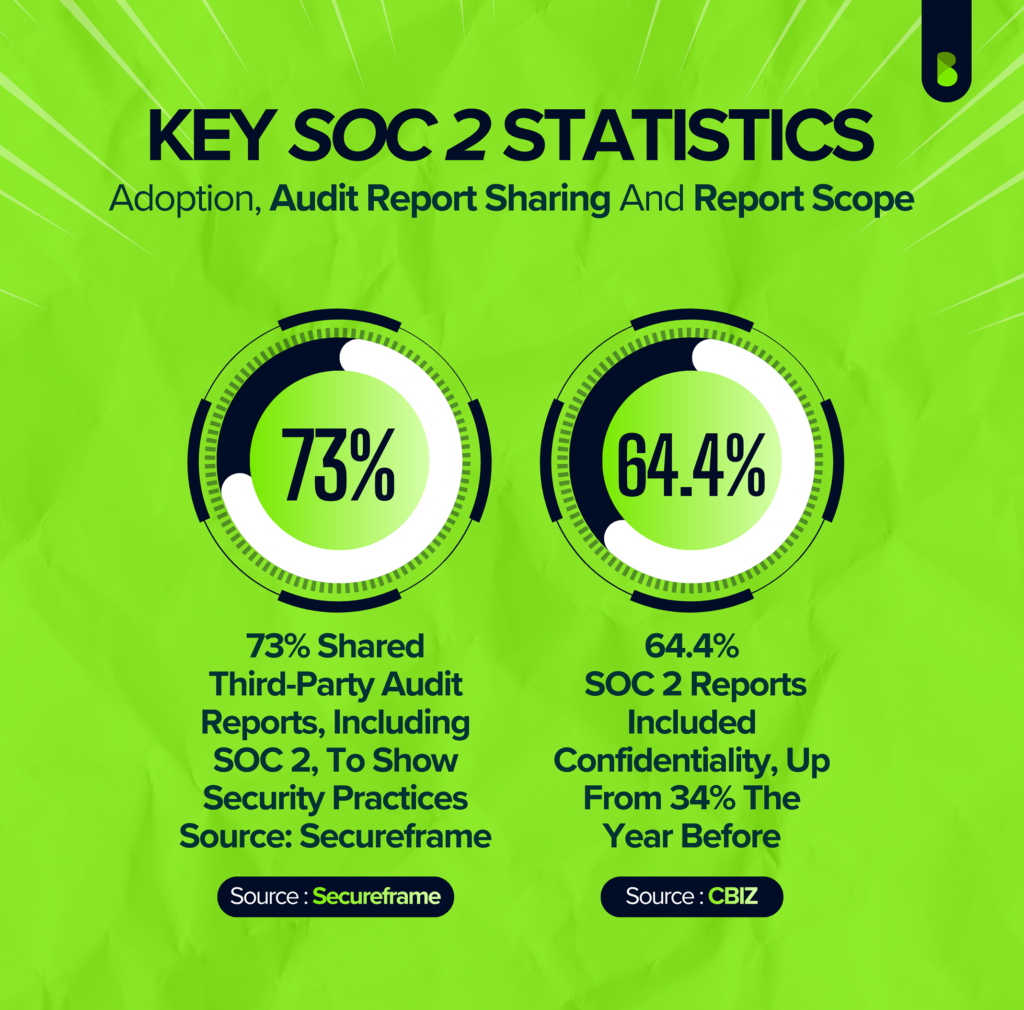
- 73% of organizations in a cross-framework survey shared third-party audit reports, including SOC 2 reports, to demonstrate their security practices. (Secureframe)
- 32% of customer accounts with SOC 2 enabled had ISO 27001 as an additional framework. (Drata)
- Confidentiality appeared in 64.4% of SOC 2 reports in a 2024 sample, up from 34% in the previous year’s sample. (CBIZ)
- Published Type 2 audit fee guidance ranges from 12,000–20,000 for small to midsize companies and 30,000–100,000+ for large organizations. (Drata)
- A SOC 2 Type 2 report typically examines controls over 3–12 months. (EY)
- 68% of organizations in a cross-framework survey had one or fewer full-time cybersecurity employees. (Secureframe)
- 95% of respondents in a cross-framework survey used technology during audits or assessments. (A-LIGN)
SOC 2 Adoption and Multi-Framework Compliance
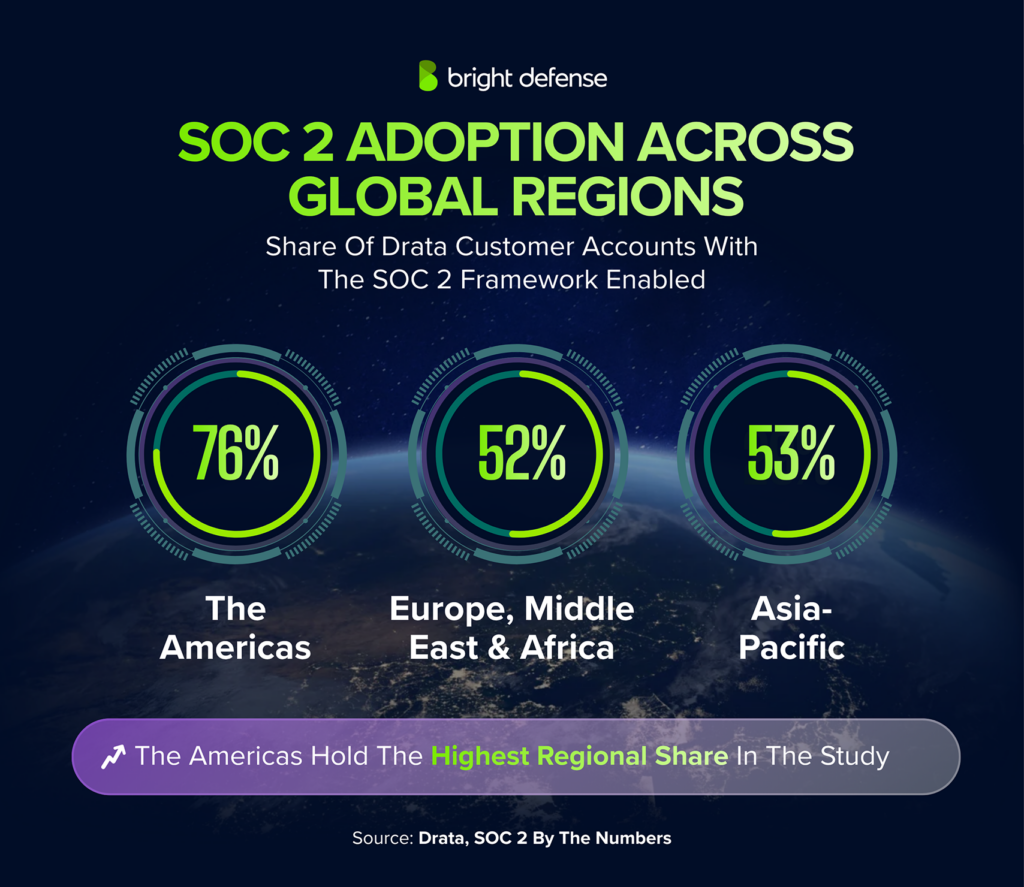
- Approximately 70% of active Drata customer accounts had the SOC 2 framework enabled in the first half of 2026. (Drata, SOC 2 By the Numbers, pp. 3, 20)
- In the Americas, 76% of Drata customer accounts had SOC 2 enabled, the highest regional share in the study. (Drata, p. 4)
- The corresponding shares were 53% in Asia-Pacific and 52% in Europe, the Middle East, and Africa. (Drata, p. 4)
- Software and services and technology hardware and equipment each had SOC 2 enabled in 76% of Drata customer accounts. (Drata, p. 4)
- Commercial and professional services followed at 73% of Drata customer accounts. (Drata, p. 4)
- SOC 2 was enabled for 70% of financial-sector accounts and 65% of healthcare accounts in Drata’s dataset. (Drata, p. 4)
- By customer segment, 74% of emerging-market accounts had SOC 2 enabled, compared with 65% of commercial accounts and 46% of enterprise accounts. (Drata, p. 5)
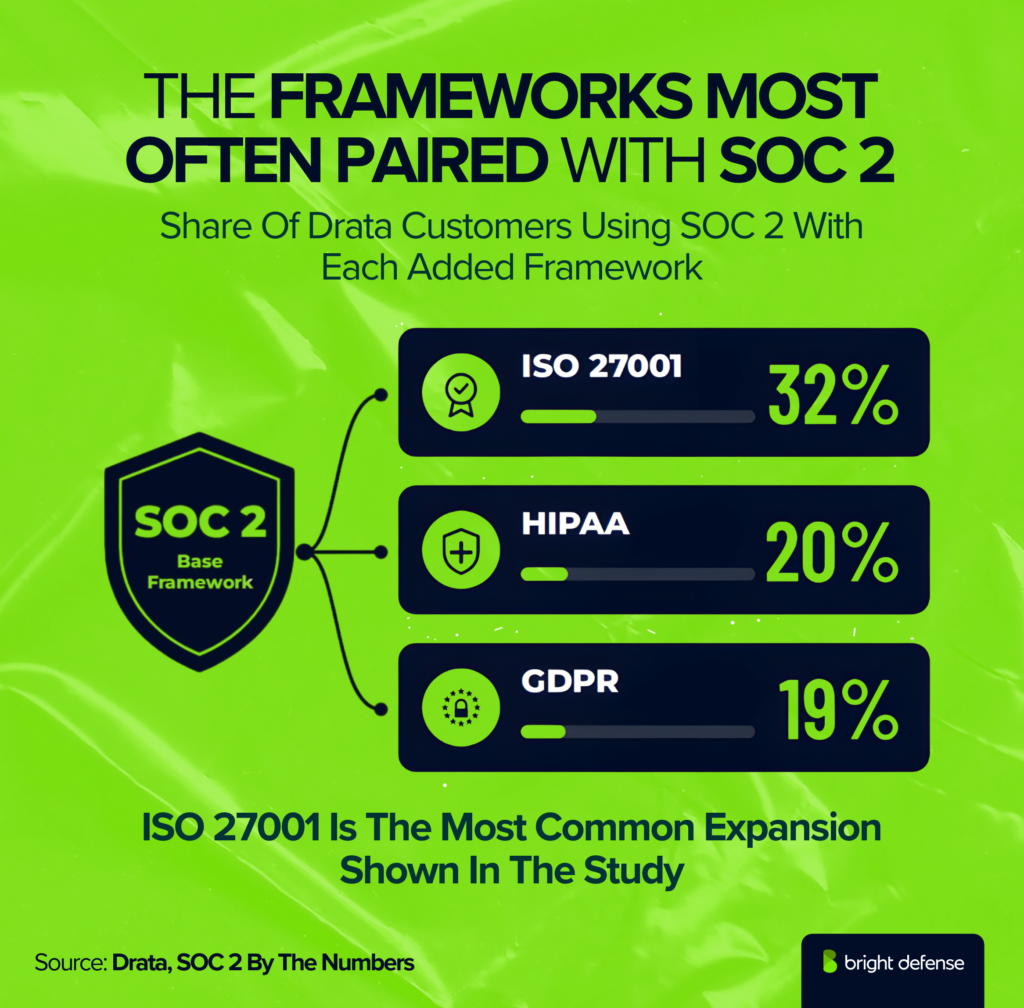
- Among Drata customers using SOC 2, 32% had ISO 27001 as an additional framework, making it the most common expansion shown in the study. (Drata, p. 15)
- HIPAA appeared alongside SOC 2 for 20% of Drata customers using SOC 2. (Drata, p. 15)
- GDPR appeared alongside SOC 2 for 19% of Drata customers using SOC 2. (Drata, p. 15)
- Across all frameworks, 52% of respondents in Secureframe’s 2026 survey said their organizations maintained compliance with more than one framework. (Secureframe, 2026 Cybersecurity and Compliance Benchmark Report)
- Organizations with more than $100 million in revenue maintained an average of 3.2 frameworks, compared with 1.6 among smaller organizations in Secureframe’s survey. (Secureframe, 2026 Cybersecurity and Compliance Benchmark Report)
Buyer Demand, Procurement Requirements, and Report Usage
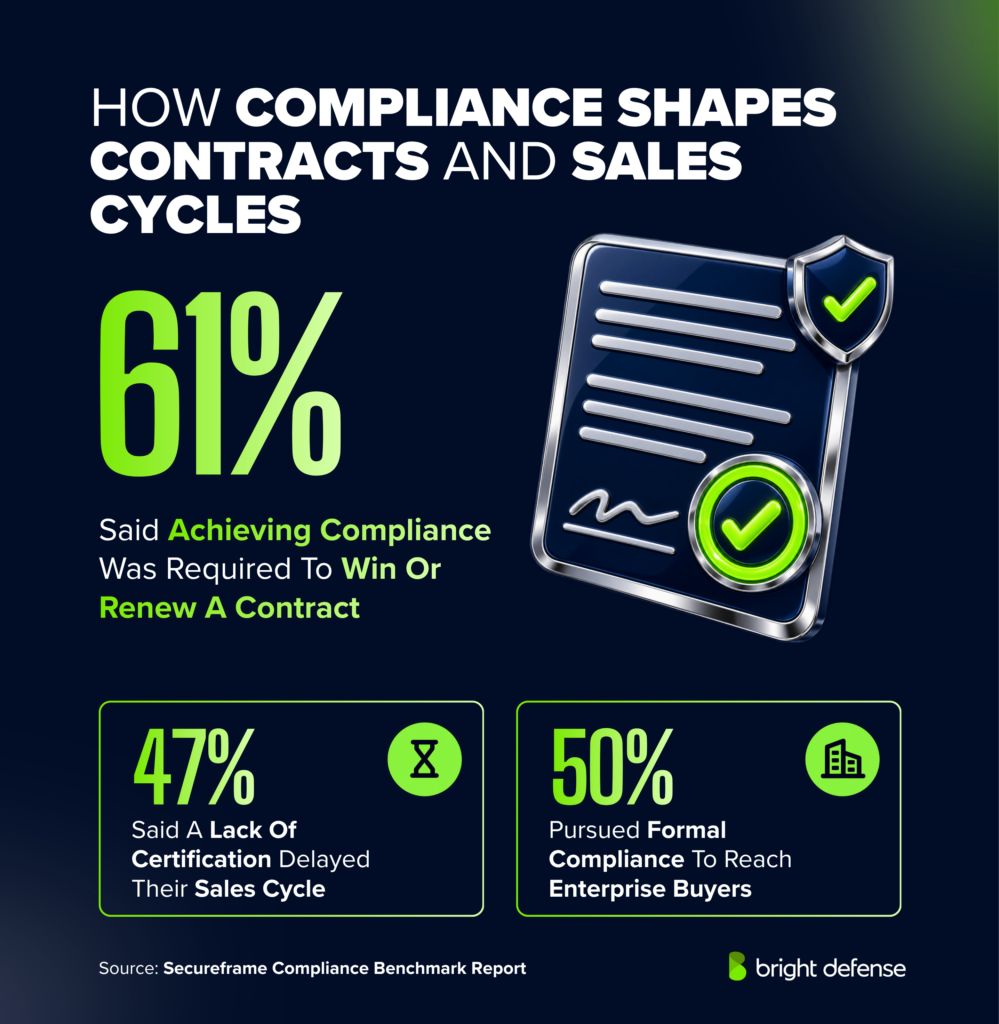
- 61% of respondents in Secureframe’s 2026 survey said achieving compliance was required to win or renew a contract. (Secureframe)
- 47% said a lack of certification had delayed their sales cycle. (Secureframe)
- 38% said they had lost revenue or a competitive bid because they lacked certification. (Secureframe)
- 40% said they pursued formal compliance to reach enterprise buyers. (Secureframe)
- 73% of organizations in Secureframe’s survey regularly needed to share a third-party audit report, such as a SOC 2 report. (Secureframe)
- 70% still relied heavily on security questionnaires and requests for proposals, even though many shared third-party audit reports. (Secureframe)
- 51% of respondents to the Association of Corporate Counsel’s 2025 survey said their organizations asked vendors for proof of certification or assurance. The survey gave SOC 2 and ISO 27001 as examples. (Association of Corporate Counsel) acc.com
- 77% of respondents to ISC2’s supply-chain survey cited compliance with standards, including SOC 2, ISO 27001, or NIST, among their vendor security requirements. The result does not measure SOC 2 requirements alone. (ISC2)
- 71% of respondents in that survey required vendors to provide security audits, attestations, or assessments. (ISC2)
- 68% of respondents in Whistic’s vendor-security study said they were likely to request additional documentation after receiving a vendor’s SOC 2 or ISO 27001 report. A report therefore did not necessarily end the buyer’s security review. (Whistic)
SOC 2 Report Types and Audit Scope
- 73% of the 75 completed SOC 2 examinations in Lazarus Alliance’s 2026 study were Type 2; 27% were Type 1. (Lazarus Alliance)
- Security appeared in 100% of the 73 SOC 2 reports reviewed in CBIZ’s 2024 benchmark. This describes the sample, rather than a requirement that every SOC 2 report include Security. (CBIZ)
- Availability appeared in 75.3% of the SOC 2 reports reviewed by CBIZ. (CBIZ)
- Confidentiality appeared in 64.4% of the reviewed reports, up from 34% in CBIZ’s previous-year sample. (CBIZ)
- Processing Integrity appeared in 13.7% of the SOC 2 reports in CBIZ’s 2024 sample. (CBIZ, 2024 SOC Benchmark Report)
- Privacy appeared in 6.8% of the reviewed SOC 2 reports, making it the least frequently included Trust Services category in the sample. (CBIZ, 2024 SOC Benchmark Report)
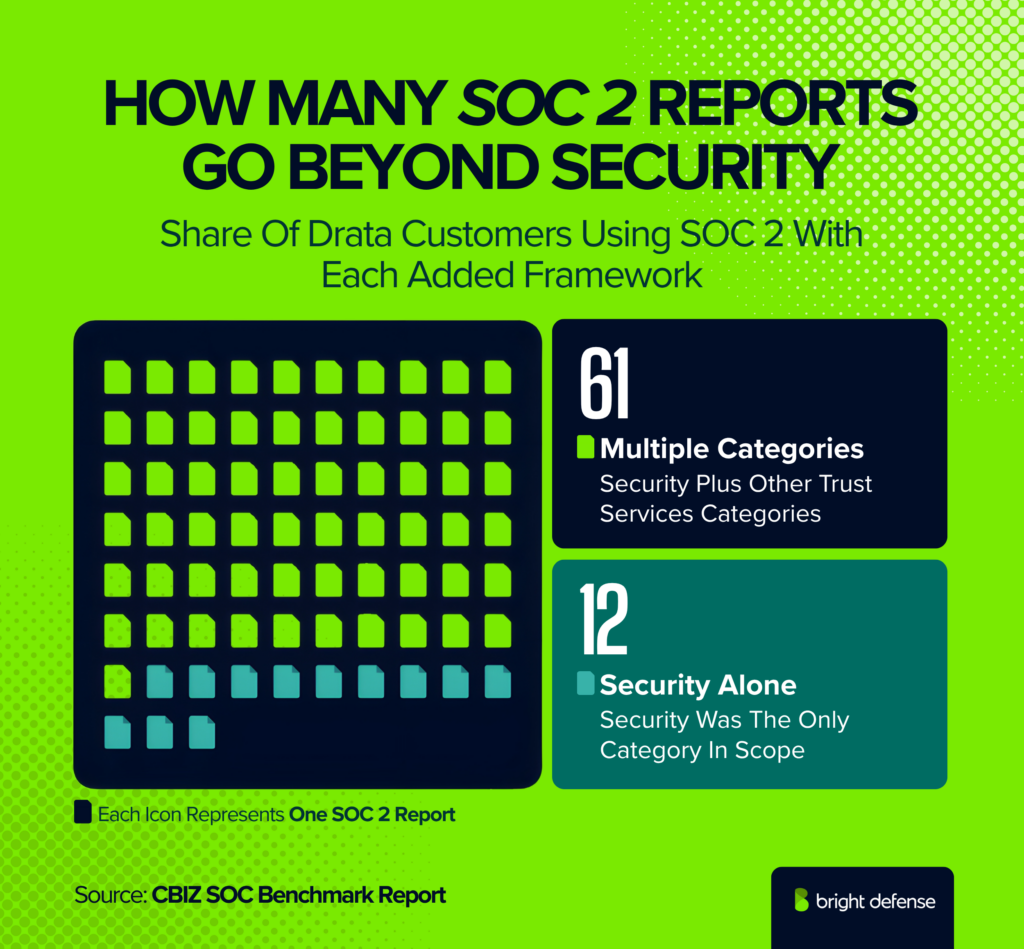
- 12 of 73 SOC 2 reports in CBIZ’s sample covered Security alone. The other 61 included multiple Trust Services categories. (CBIZ, 2024 SOC Benchmark Report)
- 9.6% of the SOC 2 reports in CBIZ’s sample were SOC 2+ reports, which incorporated criteria from another security framework into the examination. (CBIZ)
- 23% of the SOC 2 reports reviewed by CBIZ contained more than 150 Security controls, compared with 16% in its previous-year sample. (CBIZ)
- SOC 2 reports in CBIZ’s study listed an average of 8.9 complementary user entity controls. These identify controls that the service organization expects its customers to operate. (CBIZ)
- Subservice providers appeared in 89.6% of the reports in CBIZ’s broader sample, which included both SOC 1 and SOC 2. Their treatment can affect what a buyer must review separately. (CBIZ)
- The carve-out method was used in 96% of the applicable reports in CBIZ’s broader sample. Under this method, the subservice provider’s controls are excluded from the service auditor’s testing. (CBIZ)
SOC 2 Cost Statistics
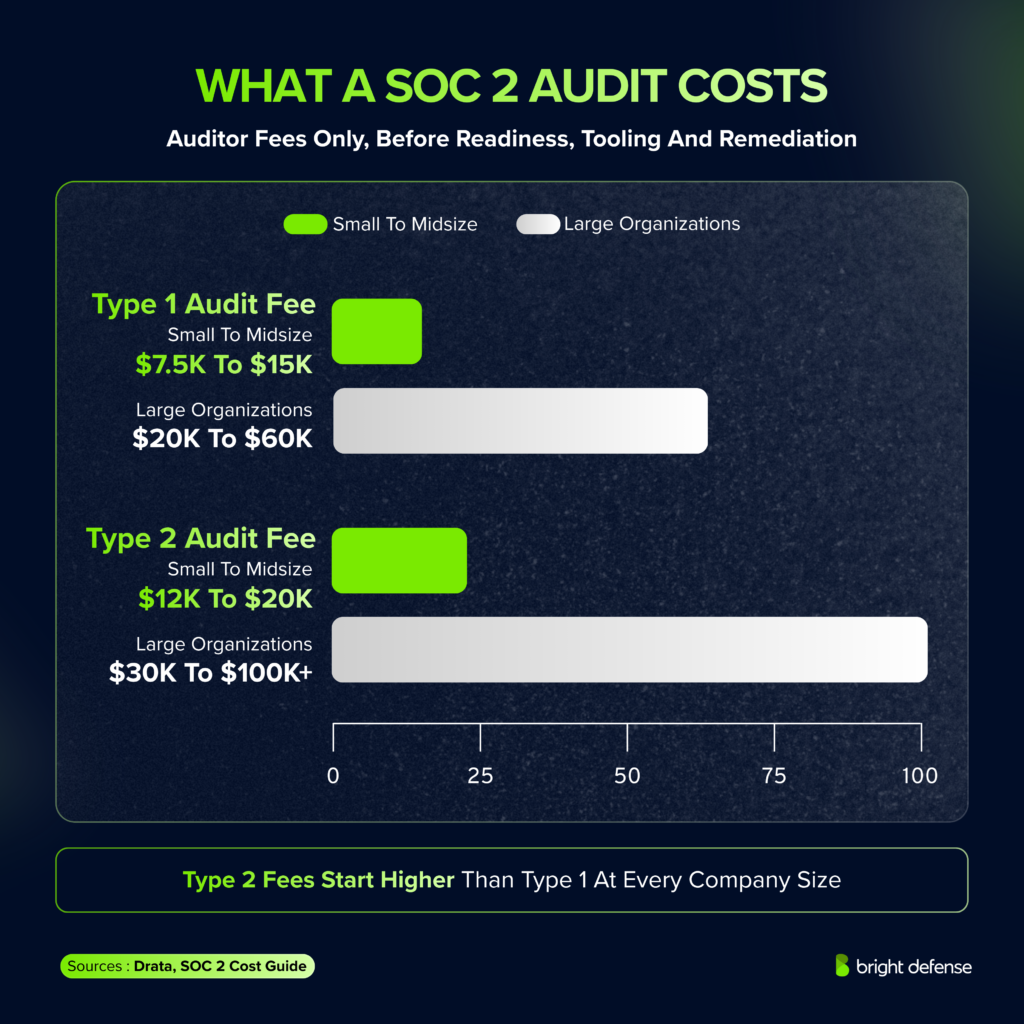
These figures combine publisher budgeting guidance and published service prices. They are not a survey of what SOC 2 customers paid. The audit fee, preparation, testing, and ongoing costs are separate parts of a budget.
- Drata places Type 1 audit fees at 7,500–15,000 for small to midsize companies and 20,000–60,000 for large organizations. These ranges cover the auditor’s fee alone. (Drata)
- Drata places Type 2 audit fees at 12,000–20,000 for small to midsize companies and 30,000–100,000+ for large organizations. (Drata)
- An external SOC 2 readiness assessment can cost 10,000–17,000, according to Vanta’s budgeting guidance. An internal self-assessment avoids that external fee. (Vanta)
- Implementing missing controls can add $30,000 or more for work such as configuring systems, enabling logging, and establishing security workflows. (Drata)
- Drata budgets 5,000–50,000+ for security tool upgrades when an organization needs new endpoint monitoring, vulnerability scanning, or identity management tools. (Drata)
- External consultant support can add 5,000–25,000+, depending on how much help the internal team needs. (Drata)
- One published managed-preparation service charges $5,000 for a company with 1–10 employees and $10,000 for a company with 51–100 employees for a full year. Its independent audit, compliance platform, and penetration testing are priced separately. These are Agency’s service prices, not market averages. (Agency)
- If a penetration test is part of the organization’s security plan, Bright Defense’s published testing packages cost $2,750, $5,250, or $9,250, depending on scope. Penetration testing is not a universal SOC 2 audit fee. (Bright Defense)
- Drata’s guidance places ongoing SOC 2 costs at 15,000–40,000 annually, including the repeat audit and continuing platform or tool subscriptions. This is a budgeting range, not an observed renewal median. (Drata)
- Vanta suggests startups budget 20,000–80,000+ for their first year of SOC 2, including auditor fees, tooling, and remediation. The amount varies with report type, scope, and readiness. (Vanta)
SOC 2 Audit Readiness and Timelines
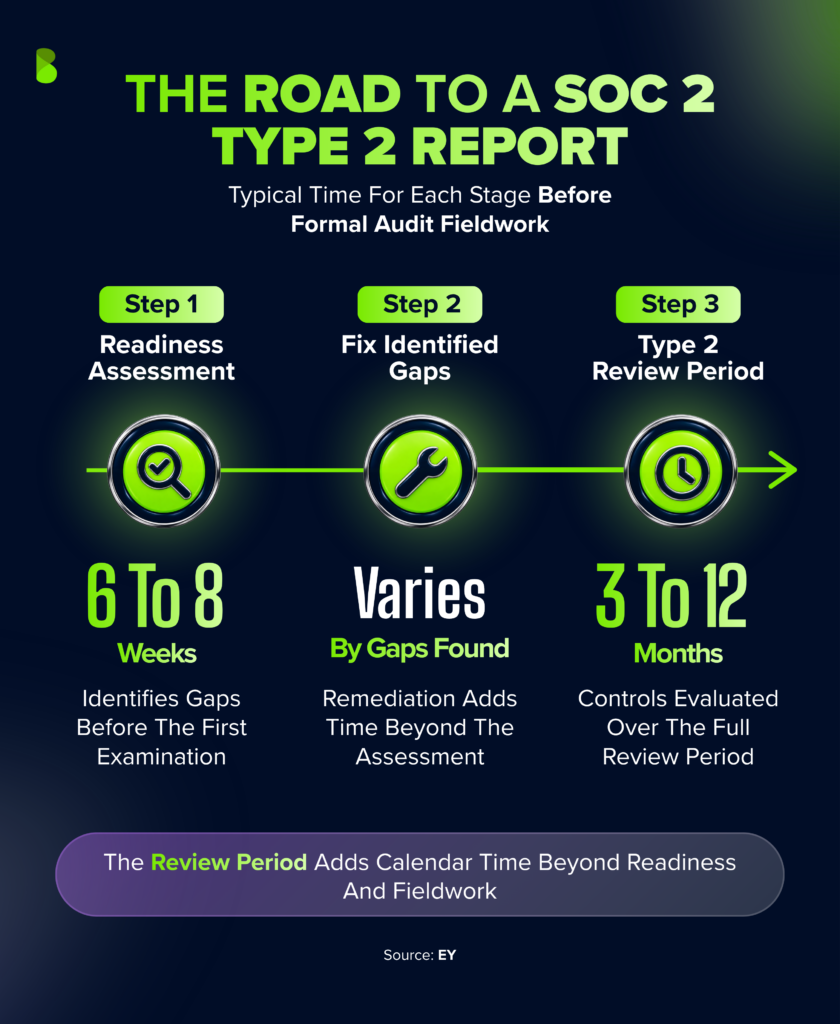
- EY says a SOC 2 readiness assessment typically takes 6–8 weeks. This assessment identifies gaps before the first examination; fixing those gaps can take additional time. (EY)
- In Drata’s customer data, accounts took an average of 602 days in its enterprise segment, 760 days in its commercial segment, and 829 days in its emerging segment to reach their highest recorded SOC 2 readiness score. These are platform score milestones, not audit preparation estimates or report delivery times. (Drata)
- 17.4% of emerging and small-business accounts in Drata’s study reached a 100% SOC 2 readiness score, compared with 5.5% of enterprise accounts. A full platform score does not mean an auditor has issued a report. (Drata)
- A SOC 2 Type 2 report evaluates controls over a period typically lasting 3–12 months, according to EY. That period adds calendar time beyond a readiness assessment and formal audit fieldwork. (EY)
- Formal SOC 2 fieldwork typically ran 6–10 weeks in Lazarus Alliance’s benchmark of 75 completed examinations. Its measure runs from audit kickoff or acceptance of the evidence package to the draft report; it excludes earlier preparation. (Lazarus Alliance)
- Median fieldwork was 6 weeks for Type 1 examinations and 8 weeks for Type 2 examinations in the same sample. The groups contained 20 and 55 examinations, respectively. (Lazarus Alliance)
- First-time SOC 2 examinations had a median of 9 weeks of fieldwork, versus 7 weeks for renewals. This compares 32 first-time examinations with 43 renewals at the same firm. (Lazarus Alliance)
- First-time examinations also averaged 2.1 evidence clarification cycles, compared with 1.3 for renewals. Teams scheduling their first audit should allow time to answer follow-up requests during fieldwork. (Lazarus Alliance)
- Lazarus Alliance estimates another 2–6 weeks for exception handling and report finalization after fieldwork. This is a planning range from the firm, rather than a measured average across its sample. (Lazarus Alliance)
- In CBIZ’s review of 193 SOC 1 and SOC 2 reports, the final report was issued an average of 69.9 days after the audit period ended. This combined figure describes the gap between period end and issuance, not the full time spent preparing for SOC 2. (CBIZ)
SOC 2 Compliance Workload, Staffing, and Automation
- Type 2 examinations required an average of approximately 1,650 evidence artifacts, compared with 900 for Type 1, in Lazarus Alliance’s review of 75 completed SOC 2 examinations. (Lazarus Alliance)
- 88% of the SOC 2 examinations in that sample required at least one round of additional evidence after the initial submission. (Lazarus Alliance)
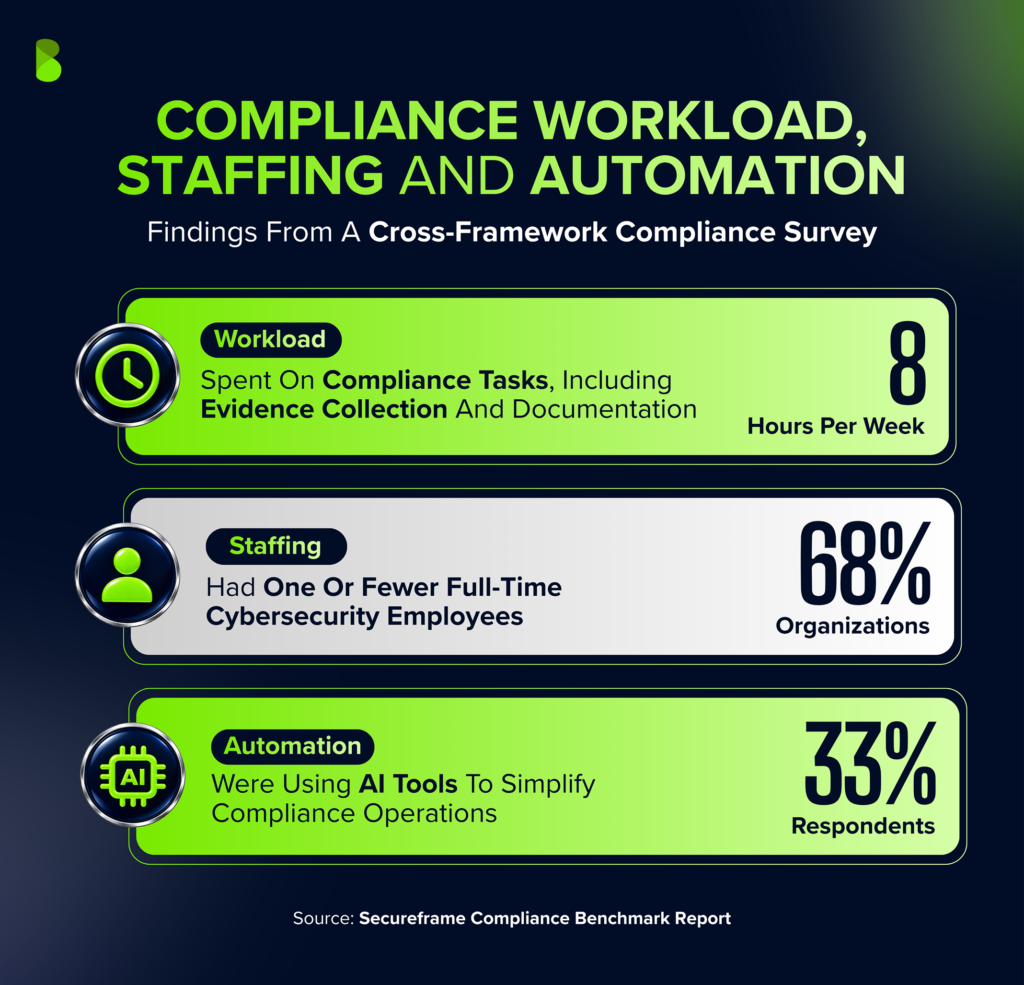
- Teams in Secureframe’s cross-framework survey spent an average of 8 hours per week on compliance tasks, including evidence collection and documentation. This is a compliance workload figure, not a SOC 2-only estimate. (Secureframe)
- 23% of Secureframe respondents named manual audit preparation as their biggest compliance challenge heading into 2026. (Secureframe)
- 68% of organizations in the Secureframe survey had one or fewer full-time cybersecurity employees. The measure covers security staffing across frameworks; it does not count staff assigned specifically to SOC 2. (Secureframe)
- 20% of respondents to A-LIGN’s cross-framework survey said limited staff dedicated to compliance was their greatest audit-process challenge. (A-LIGN)
- 25% of A-LIGN respondents identified managing multiple audits during the year as their greatest compliance challenge. (A-LIGN)
- 90% of organizations in A-LIGN’s survey worked with multiple audit partners, adding separate coordination and evidence requests to their audit cycles. (A-LIGN)
- 95% of A-LIGN respondents used technology during audits or assessments. The figure measures technology use; it does not measure how much audit work was automated. (A-LIGN)
- 33% of Secureframe respondents were using AI tools to streamline compliance operations. The survey covered multiple frameworks, including SOC 2. (Secureframe)
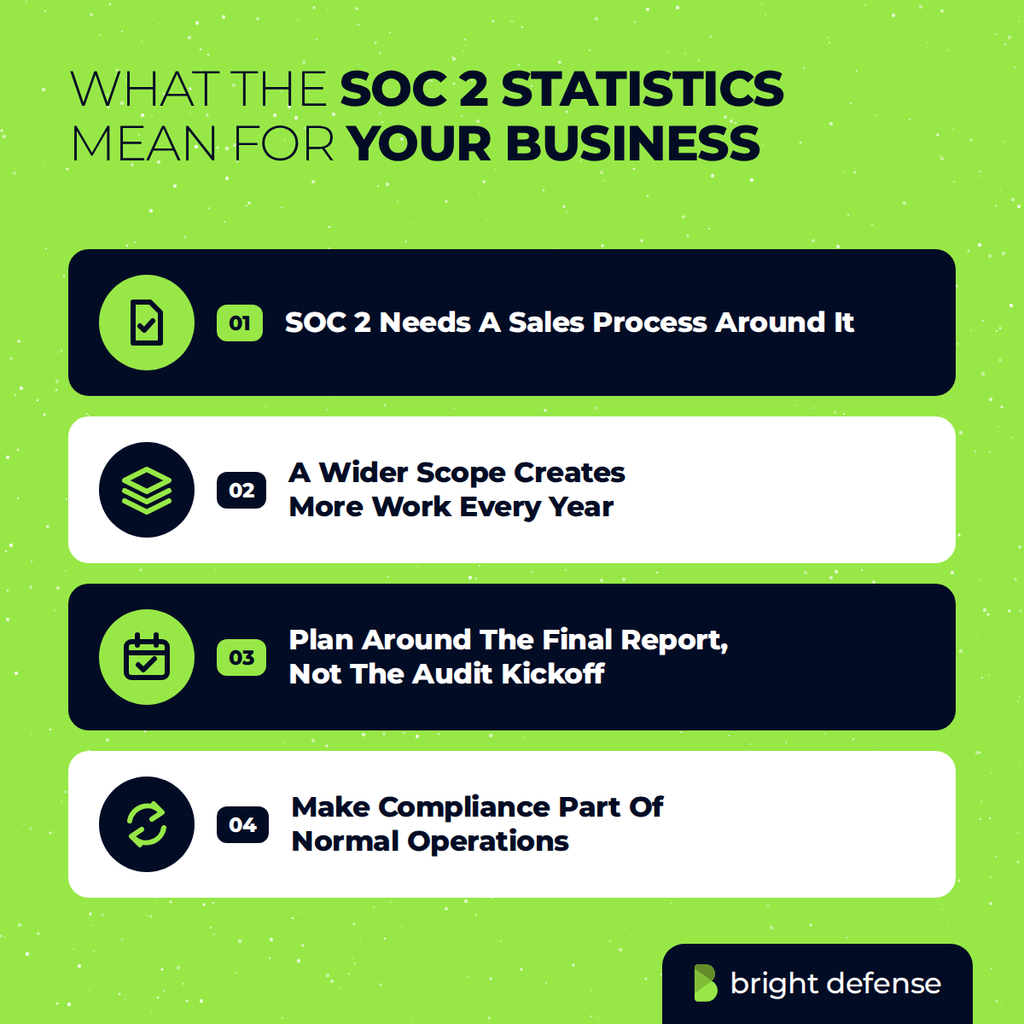
What Do the Statistics Mean for Your Business?
The SOC 2 statistics above connect buyer demand with audit scope, costs, timelines, and ongoing control work. Below are the main implications for businesses preparing a report and using it in customer reviews:
SOC 2 Needs a Sales Process Around It
Compliance was required to win or renew a contract for 61% of organizations in a broader compliance survey. 73%shared third-party audit reports, yet 70% still relied heavily on questionnaires or RFPs.
Buyers want the report, then ask whether it covers the service they intend to buy and how the company handles risks outside its scope.
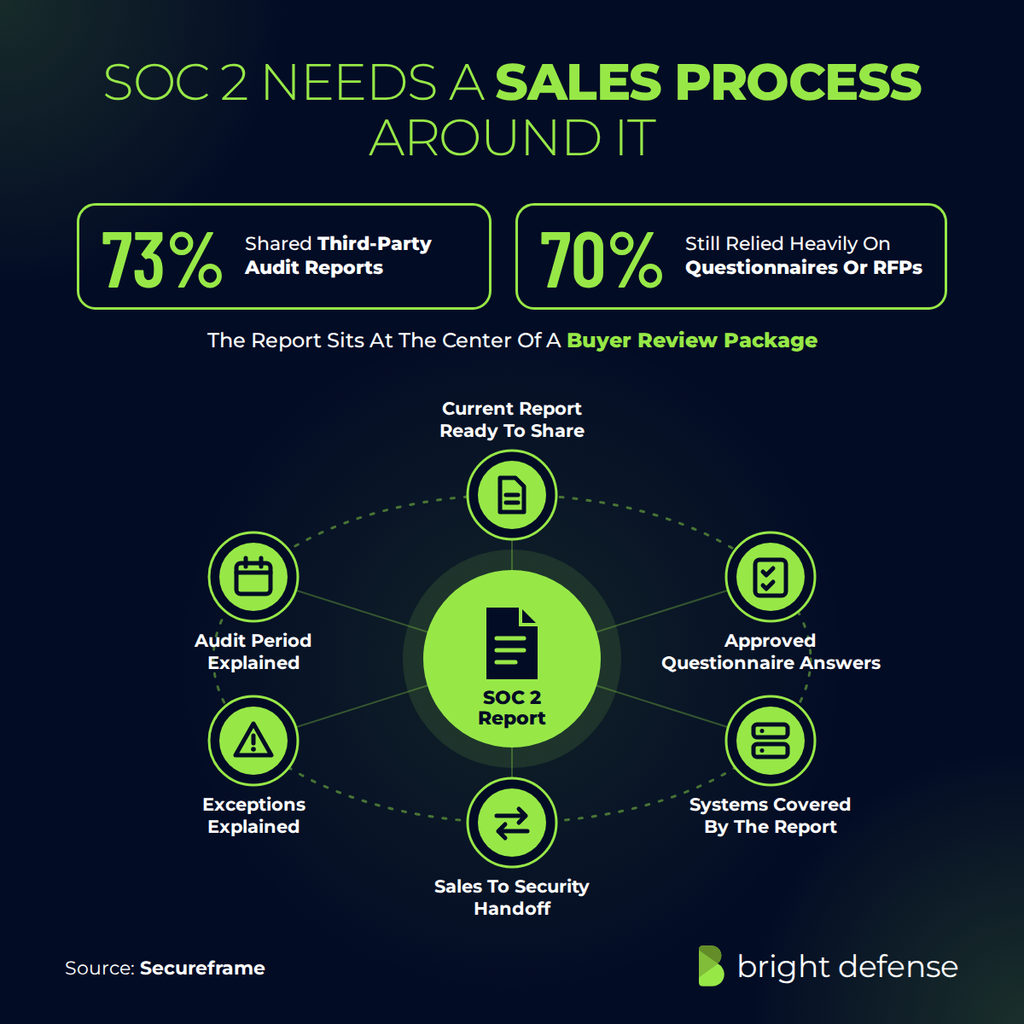
Treat the report as the center of a buyer review package. Keep a current copy ready to share, maintain approved questionnaire answers, and prepare clear explanations of the systems covered, the audit period, and any exceptions.
Give sales and security teams a defined handoff so buyer questions do not sit unanswered while a deal waits.
A Wider Scope Creates More Work Every Year
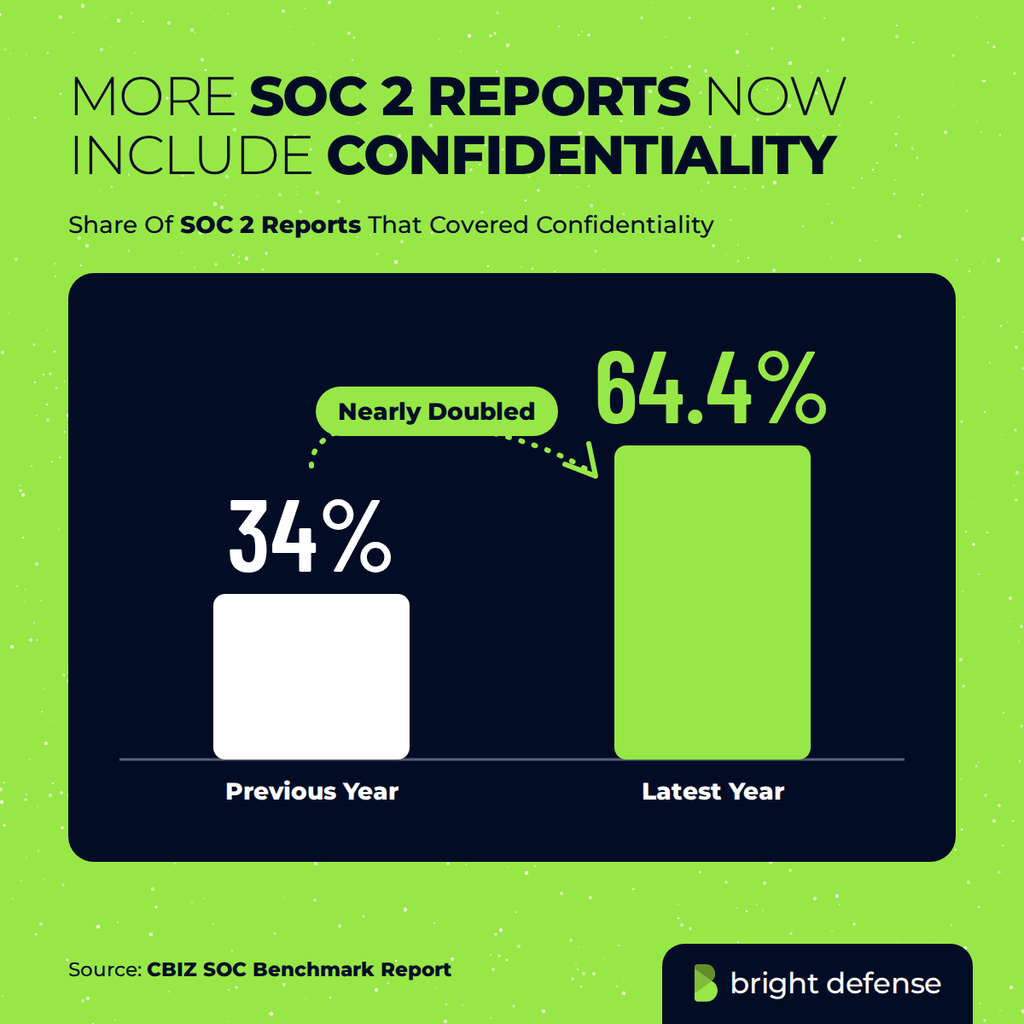
Confidentiality appeared in 64.4% of the SOC 2 reports reviewed in one benchmark, up from 34% in the previous sample.
The share of reports with more than 150 Security controls rose from 16% to 23%. Both trends increase the importance of deciding exactly what the report needs to cover.
A broader report requires controls that operate throughout the audit period, people who own them, and evidence that shows the work happened.
Add a category from the SOC 2 Trust Services Criteria when it reflects the service and its commitments to customers. Before adding controls, check whether existing controls address the requirement and whether the team can maintain the added work through future audits.
Plan Around the Final Report, Not the Audit Kickoff
Published guidance places Type 2 audit fees at 12,000–20,000 for small to midsize companies and 30,000–100,000+ for large organizations.
The fee does not cover every task needed to reach the final report. Preparation, fixing gaps, security tools, and staff time belong in the same budget.
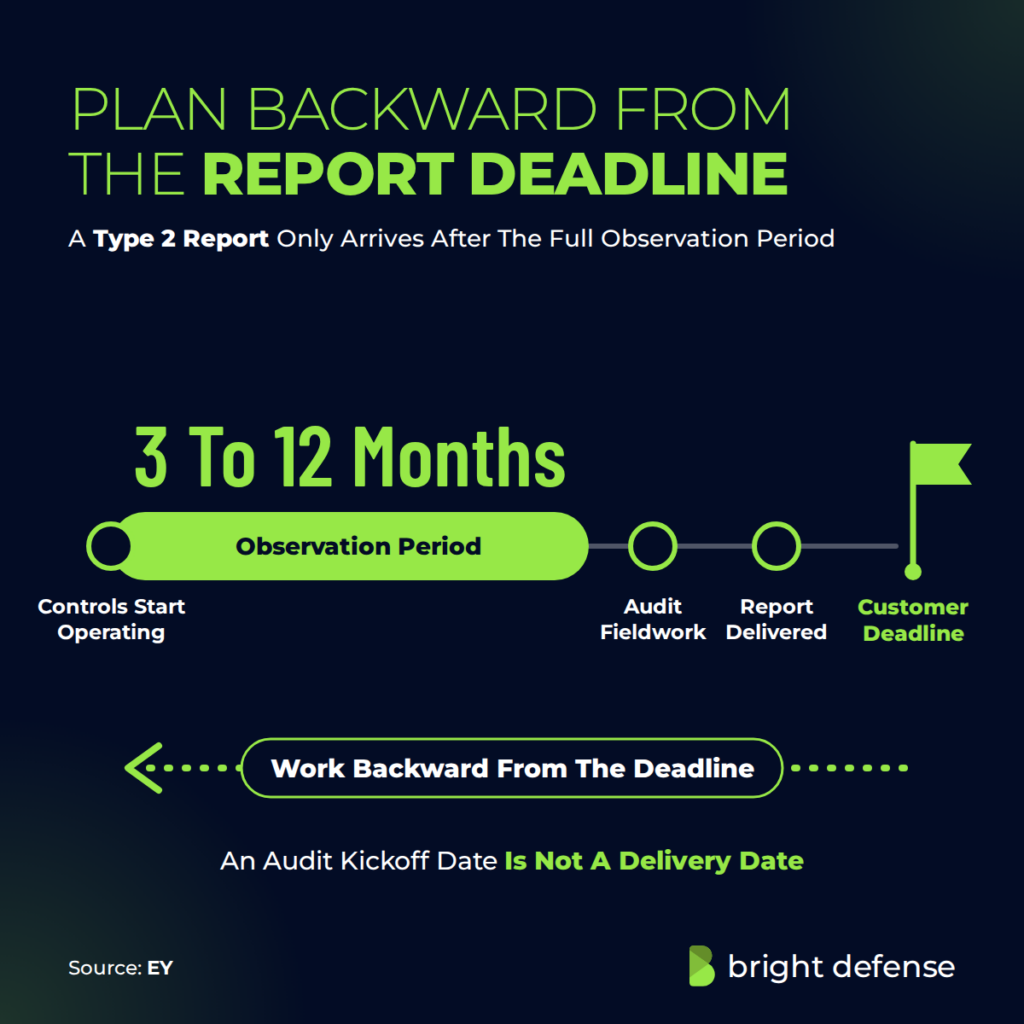
Timing needs the same treatment. A Type 2 observation period typically covers 3–12 months of control operation. Fieldwork and report delivery follow.
If a customer needs a report before signing, work backward from that deadline and identify when controls must be operating. An audit kickoff date is not a delivery date.
Make Compliance Part of Normal Operations
Teams in a broader compliance survey spent an average of 8 hours a week on compliance tasks, while 68% of organizations had one or fewer full-time cybersecurity employees. Evidence collection therefore competes with the work of IT, engineering, and business teams.
Assign each item on your SOC 2 controls list to a person, collect evidence as the work happens, and automate recurring collection.
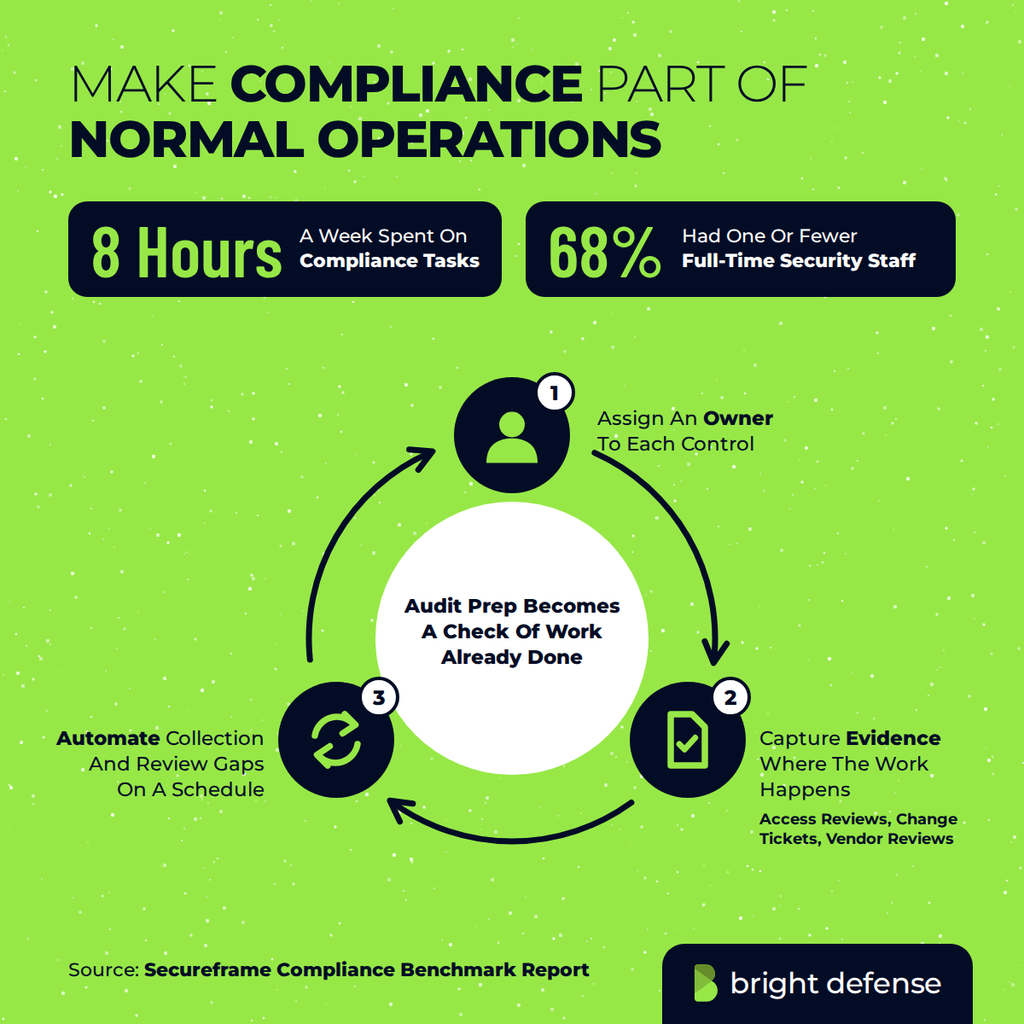
Automate recurring collection from connected systems, then review missing evidence and failed controls on a regular schedule.
That turns audit preparation into a check of work already performed instead of a search for records at the end of the period.
How Should You Budget for SOC 2?
The cost statistics above describe different parts of the same project, and SOC 2 audit costs make up only one of them. Below are the budget items to separate before setting a total and committing to a report deadline.
Price the Audit Against the Scope You Need
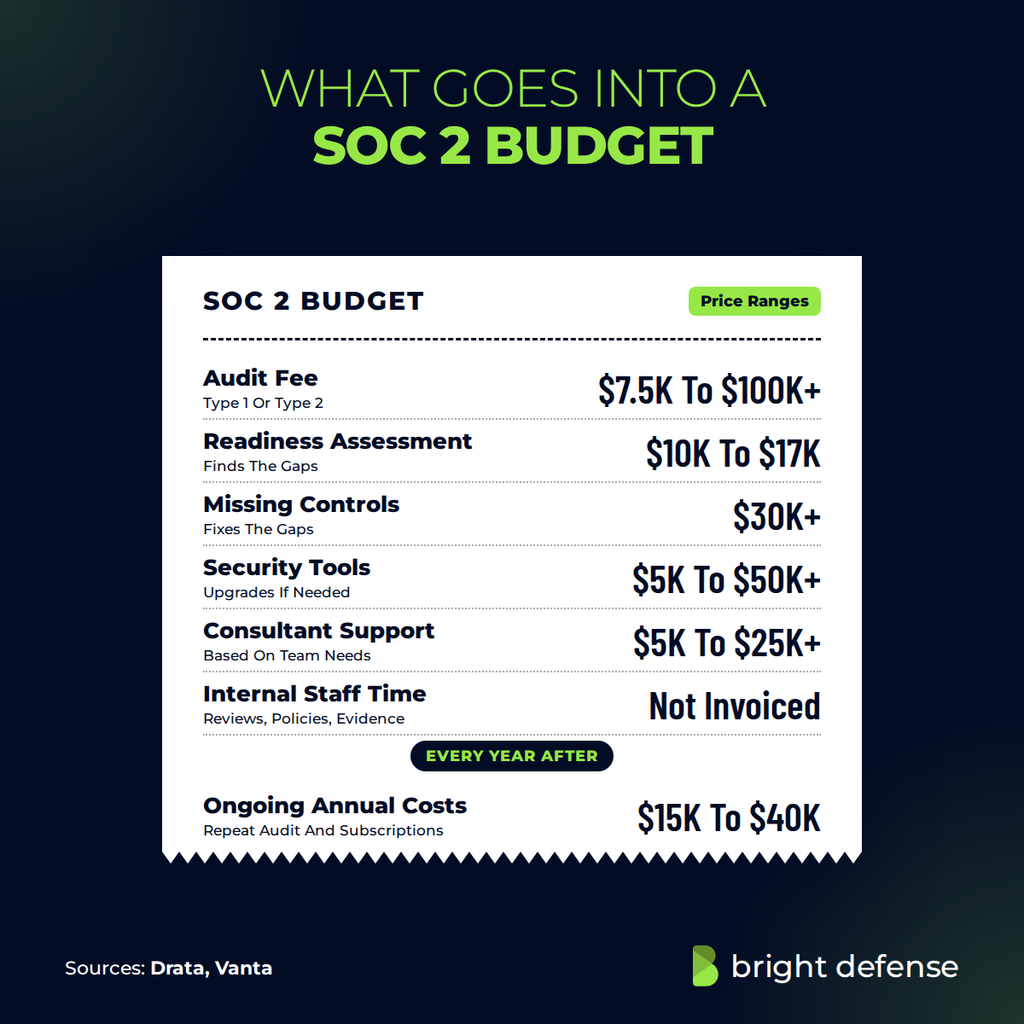
Published Type 1 audit fees range from $7,500–$15,000 for small to midsize companies and $20,000–$60,000 for large organizations. Type 2 fees range from $12,000–$20,000 and $30,000–$100,000+, respectively.
Decide which report your buyers require before comparing prices. Ask SOC 2 audit firms to quote the same service boundary, Trust Services categories, and, for Type 2, observation period.
Budget Separately for Preparation and Fixes
An external readiness assessment costs $10,000–$17,000 in the guidance cited above. That pays to identify gaps; it does not pay to fix them. Implementing missing controls may add $30,000 or more, depending on the systems and processes that need work.
Review existing controls before buying outside help. Then give remediation its own budget and deadline so the team knows what must be operating before a Type 2 observation period begins.
Include Tools and Staff Time
Security tool upgrades may cost $5,000–$50,000+, while consultant support may add $5,000–$25,000+. Internal staff time matters even when it does not appear on an invoice. Control owners must maintain policies, perform reviews, resolve gaps, and provide evidence during the audit.
List the tools already in place and the work the team will perform internally. Check consultant proposals for work already covered by a readiness assessment or platform subscription so the same task is not budgeted twice.
Separate First-Year Costs From Renewals
First-year budgeting guidance for startups runs from $20,000–$80,000+ when audit fees, tools, and remediation are considered together. Ongoing guidance places annual SOC 2 costs at $15,000–$40,000, including the repeat audit and continuing subscriptions.
Use the first-year range as a check on the complete budget, not as another expense to add to it. Keep one-time setup and remediation separate from annual testing, evidence collection, and renewals. Revisit the budget when the service boundary or report scope changes.
How Long Does SOC 2 Really Take From Start to Report in 2026?
The timeline starts with preparing controls and ends when the final report is issued. The statistics above measure different stages of that process. Below is how those stages fit together when planning a customer deadline.
Readiness Comes Before the Audit Period
A SOC 2 readiness assessment typically takes 6–8 weeks. It identifies gaps in policies, controls, systems, and evidence. The time needed to fix those gaps is separate. If access reviews or other controls are not operating yet, the team needs to establish them before relying on their performance during a Type 2 period.
The platform readiness figures elsewhere in this article measure how long accounts took to reach their highest recorded score. They do not measure the time from starting SOC 2 to receiving a report.
Report Type Determines the Main Calendar Commitment
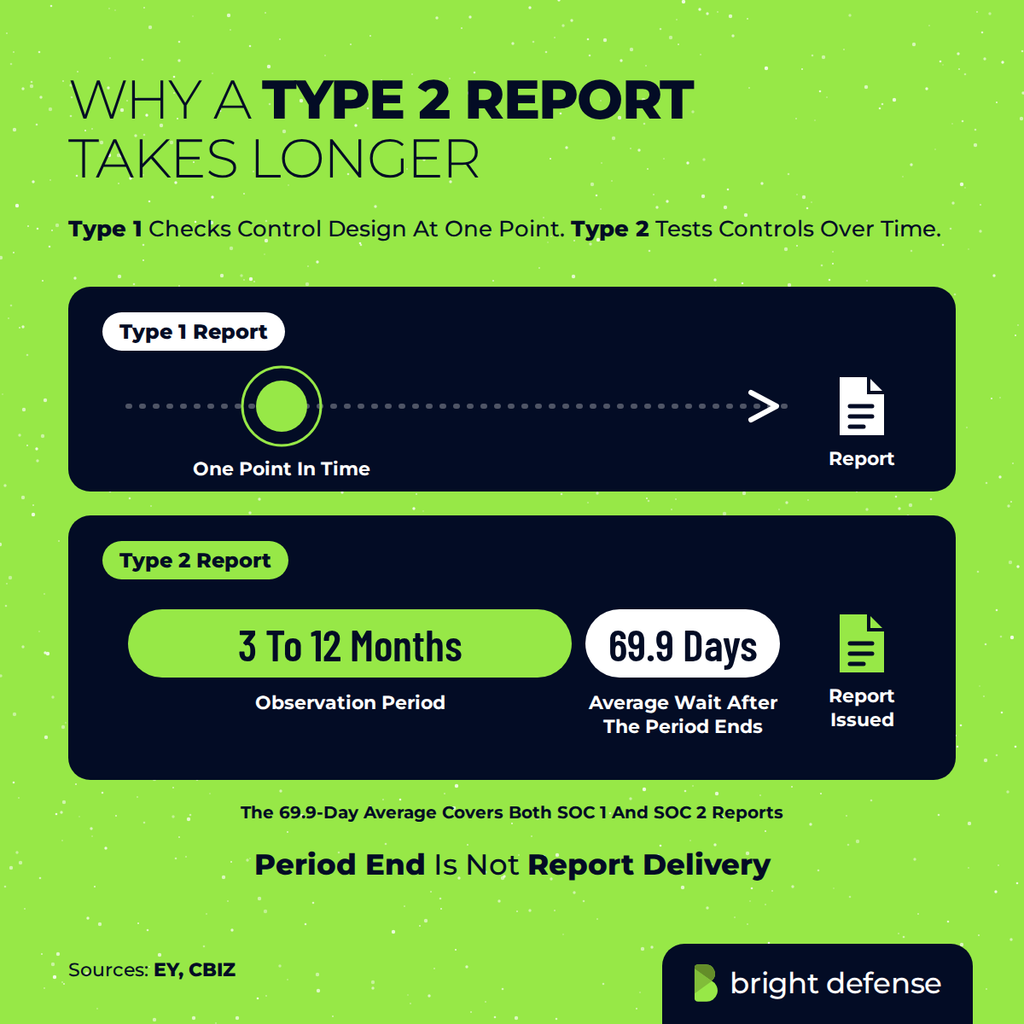
A Type 1 report examines control design at a point in time. A Type 2 report examines whether controls operated effectively across a period that typically lasts 3–12 months. That observation period is the main reason a Type 2 report takes longer.
Choose the report type against the customer’s requirement before setting a delivery date. Starting with Type 1 provides a point-in-time report, but it does not fulfill a request for Type 2 coverage.
Period End Is Not Report Delivery
After the Type 2 period ends, the auditor still needs to complete testing, resolve evidence requests, and issue the report. In a benchmark covering both SOC 1 and SOC 2 reports, final reports were issued an average of 69.9 days after the audit period ended. Build time after period end into the schedule rather than treating it as the finish line.
Work Backward From the Buyer’s Deadline
Start with the date the customer needs an issued report. Then set dates for the end of the observation period, the start of control operation, and completion of readiness work. Confirm the fieldwork and issuance schedule with the audit firm. This gives sales a report delivery plan grounded in the work still to be done.
How Bright Defense Helps With SOC 2 Readiness
Bright Defense provides SOC 2 compliance consulting and ongoing support for startups and growing companies. Our team conducts a gap analysis and risk assessment, develops policies, helps implement controls, and guides remediation before the audit. We use compliance automation to track progress and maintain visibility into your security program, while our vCISO service provides guidance through each phase of readiness.
SOC 2 Statistics FAQs
1. When I see a SOC 2 adoption rate, does it mean those companies have completed reports?
No. The adoption figure in this article counts customer accounts with the SOC 2 framework enabled in a compliance platform. It does not establish that an independent auditor has issued a report for every account.
2. Do I need a SOC 2 report to sell to enterprise customers?
You need one when a customer makes it a procurement or contract requirement. Ask prospective buyers which report type they expect, what service it must cover, and how recent it must be. The broader compliance survey in this article shows strong contract demand, but it does not mean every buyer requires SOC 2 specifically.
3. Should I pursue a Type 1 or Type 2 report first?
Choose against the buyer’s requirement. Type 1 examines control design at a point in time. Type 2 examines whether controls operated effectively over a period, typically 3–12 months. You may start with Type 1 to establish a baseline, but you can pursue Type 2 directly when your controls are operating and buyers require it.
4. Which Trust Services Categories should I include in my report?
Select categories that match the service and its customer commitments. Availability addresses promised uptime; Confidentiality addresses information you have committed to protect; Processing Integrity addresses whether processing is complete and accurate; and Privacy addresses personal information practices. You do not need to include every category simply because it exists. (AICPA)
5. Will my SOC 2 report replace customer security questionnaires?
No. The survey covered above found that organizations shared third-party audit reports while continuing to rely heavily on questionnaires and RFPs. Keep approved answers ready and use the report to support them. Buyers may still ask about systems outside the report’s scope or risks specific to their use of your service.
6. How Much Does a SOC 2 Audit Cost in 2026?
Published audit fee guidance puts Type 1 at $7,500–$15,000 for small to midsize companies and $20,000–$60,000 for large organizations. Type 2 guidance is $12,000–$20,000 and $30,000–$100,000+, respectively. Your quote depends on the report type, systems, Trust Services categories, and audit scope.
7. How much should I budget beyond the auditor’s fee?
Budget for internal staff time, readiness work, control fixes, and any security tools or consulting you need. An external readiness assessment has a separate fee; performing the review internally still uses staff time. Get quotes for the work you need and check for overlap between consultant, platform, and auditor proposals.
8. When can I start my Type 2 observation period?
Set the period with your auditor once the in-scope controls are operating and producing evidence. The auditor evaluates what happened during that period, so evidence from earlier months does not prove a control operated during the period you chose. (Schellman)
9. How often do I need a new SOC 2 report?
Plan for an annual report and consecutive coverage periods. SOC 2 reports do not have a fixed expiration date set by the AICPA; your customers decide how recent a report they will accept. (Schellman)
10. If my audit has control exceptions, will I receive a qualified opinion?
Not automatically. An exception identifies a problem found during testing. The auditor evaluates its significance when forming an opinion, and reports with exceptions may still receive an unqualified opinion. Review each exception and your response rather than judging the report by its opinion alone. (CBIZ)
11. Can I automate evidence collection and still complete an independent SOC 2 audit?
Yes. Automation collects and organizes evidence and helps teams spot missing or failing controls. An independent CPA still examines the controls, tests the evidence, and issues the SOC 2 report. (AICPA)