ISO 42001 Moves From AI Standard To Vendor Requirement
Updated:
September 21, 2026
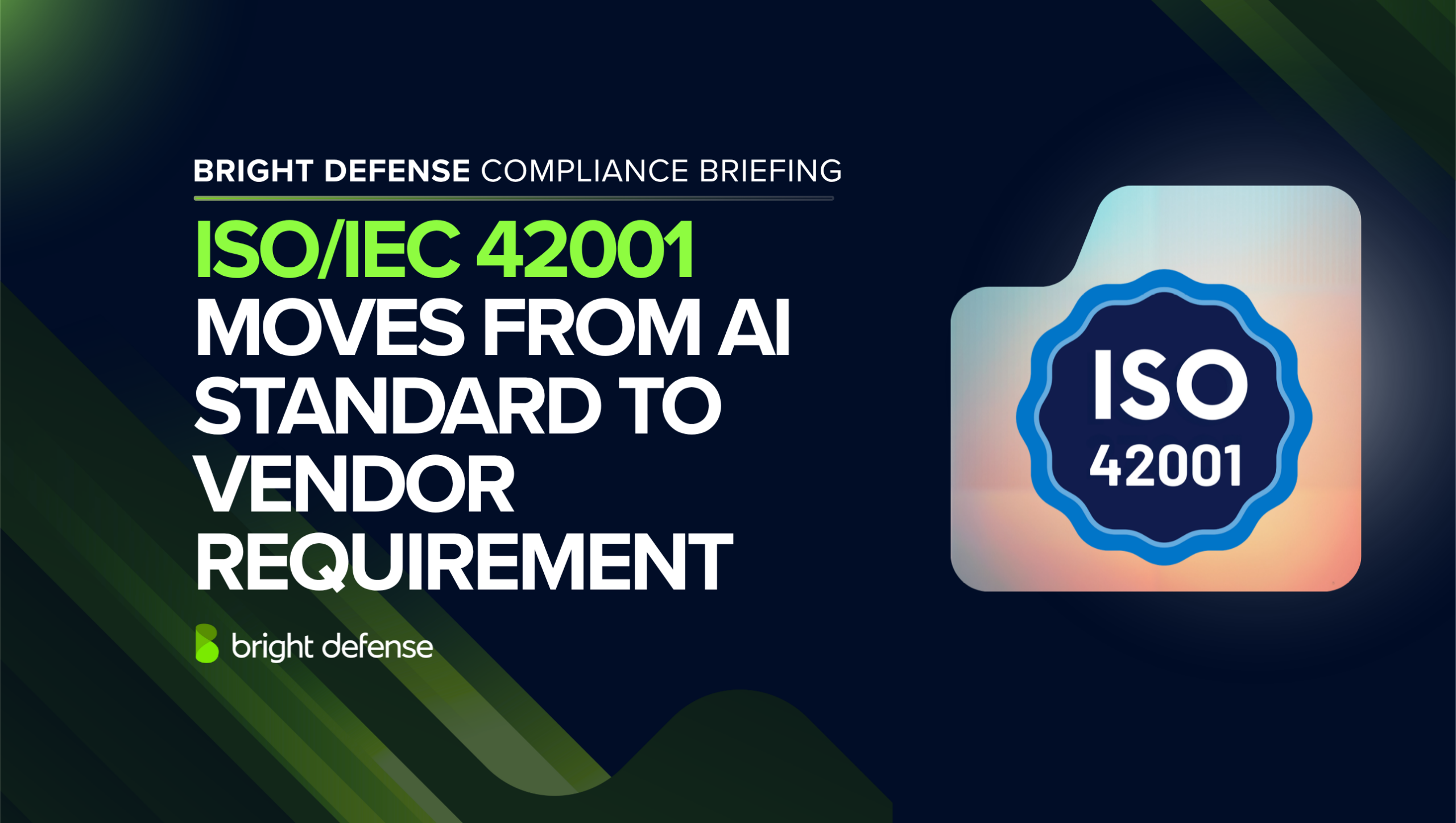
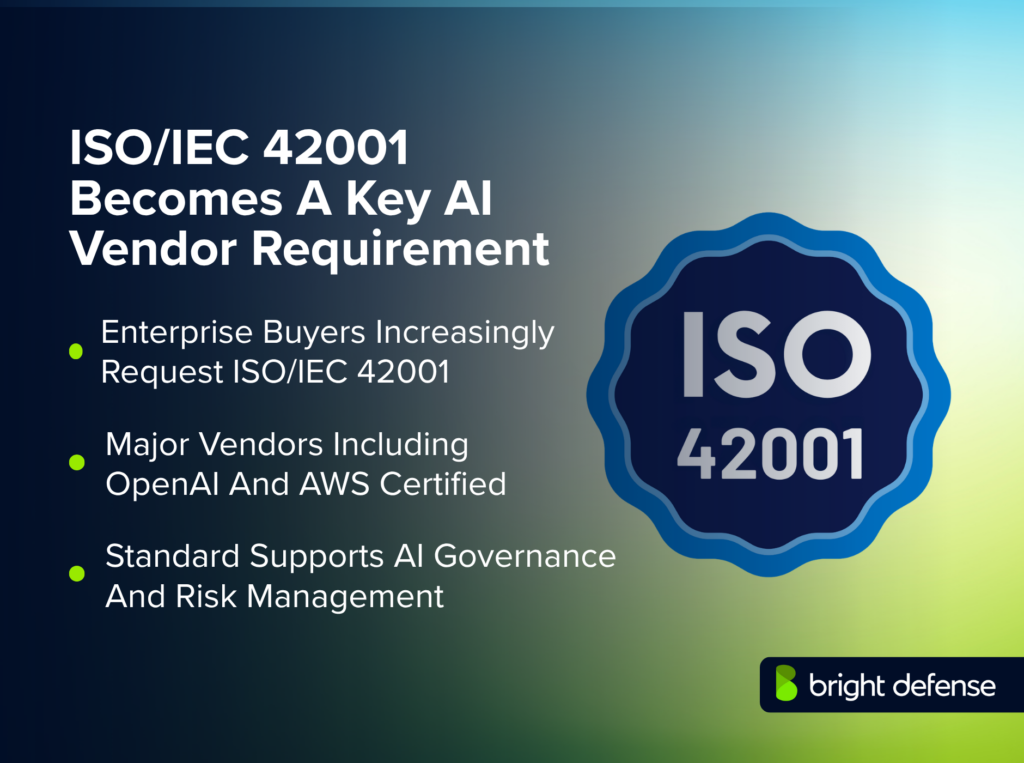
ISO/IEC 42001 is becoming a practical vendor requirement for AI companies as enterprise buyers, cloud customers and regulated clients ask for third-party proof that AI systems are governed, monitored and documented. The standard remains voluntary, but public certifications from AWS, Anthropic, OpenAI, Snowflake, Salesforce and ServiceNow show how fast it has moved into procurement, trust-center evidence and AI Act readiness.
What Is ISO/IEC 42001 And Why Are AI Vendors Being Asked For It?
ISO/IEC 42001 is an international artificial intelligence management system standard for organizations that develop, provide or use AI systems. ISO 42001 compliance helps organizations document model governance, risk review, human oversight, data controls, monitoring and accountability within an auditable management system.
ISO published ISO/IEC 42001:2023 in December 2023. The standard does not certify a model as safe. It certifies that the organization has a management system for AI risk and governance within the stated audit scope.
When Did ISO/IEC 42001 Become A Vendor Requirement For AI Companies?
ISO/IEC 42001 began as a formal standard in December 2023, then became commercially relevant after large AI and cloud vendors started publishing certifications. AWS announced accredited certification for Amazon Bedrock, Amazon Q Business, Amazon Textract and Amazon Transcribe on November 25, 2024.
Anthropic announced certification on January 13, 2025. Snowflake followed on June 12, 2025, Salesforce listed ISO/IEC 42001 documentation updated on October 1, 2025, ServiceNow announced certification on December 18, 2025, and BCG said on January 27, 2026 that it was among the first 100 organizations certified globally.
What Does ISO/IEC 42001 Require AI Companies To Document?
ISO/IEC 42001 requires an AI management system that covers policies, objectives, roles, risk treatment, monitoring, documentation, controls and continual improvement. For vendors, the practical evidence set usually includes AI inventories, risk registers, model governance records, data controls, testing records, human oversight procedures and supplier controls.
The standard is structured like other management system standards. That makes it familiar to companies already using ISO/IEC 27001, SOC 2 or other assurance programs. AI-specific work still matters because the audit scope must address AI risk, data quality, transparency, security, accountability and system lifecycle controls.
Which AI Vendors And Sectors Are Most Affected By ISO/IEC 42001 Procurement Requests?
The most affected groups are AI model providers, enterprise software vendors, cloud platforms, hiring technology firms, data platforms, healthcare software providers, professional services firms and security vendors. These companies face buyers that need AI governance evidence before deployment in regulated, high-trust or customer-facing workflows.
The pressure is strongest where AI affects employment, finance, healthcare, education, public services, legal work, identity checks, cybersecurity or infrastructure. Those buyers often cannot rely on vendor marketing claims. They need audit reports, certification scopes, system documentation and contract terms that support their own compliance files.
Maintaining continuous audit readiness can help AI vendors keep risk records, control evidence, testing results and certification documents prepared for customer review.
Companies working toward certification should also understand how to prepare for an ISO 42001 audit, including defining the AIMS scope, mapping requirements to evidence, completing internal audits, addressing findings, and preparing for the certification audit.
Can ISO/IEC 42001 Certification Reduce EU AI Act Compliance Risk?
ISO/IEC 42001 can reduce EU AI Act compliance risk, but it does not automatically satisfy the AI Act. The European Commission says harmonized standards can provide legal certainty after citation in the Official Journal, while ISO/IEC 42001 currently functions mainly as a governance and evidence framework.
The Commission’s AI Act standardization program covers risk management, data governance, record keeping, transparency, human oversight, accuracy, resilience, cybersecurity, quality management and conformity assessment. ISO/IEC 42001 helps organize many of those records, but AI Act duties may still require product-level conformity assessment, EU database registration and role-specific obligations.
What Penalties Can AI Companies Face Without ISO/IEC 42001 Controls?
ISO/IEC 42001 itself has no statutory fine structure because it is voluntary. Legal risk comes from contracts, procurement exclusions, failed audits, misleading compliance claims, negligence allegations and regulatory duties under laws such as the EU AI Act, GDPR and sector-specific rules.
AP reported that EU AI Act violations can draw fines up to €35 million or 7% of global revenue. Reuters reported that the Commission proposed delaying some high-risk AI rules to December 2027, but transparency, governance and customer evidence demands continue to affect AI vendors.
What Should AI Companies Do To Meet ISO/IEC 42001 Vendor Requirements?
AI companies should treat ISO/IEC 42001 as a customer assurance project with legal, security, product, data science and governance ownership. The starting point is a scoped AI management system that shows which products, models, services, teams and third-party dependencies fall inside the certification boundary.
1. Create an AI system inventory that covers internal, customer-facing and third-party AI.
2. Define the ISO/IEC 42001 scope and match it to customer-facing services.
3. Build AI risk registers, impact reviews, security controls and monitoring records.
4. Document data sources, data quality checks, model testing and human oversight.
5. Map ISO/IEC 42001 controls to SOC 2, ISO/IEC 27001, NIST AI RMF and EU AI Act duties.
6. Prepare supplier controls for model providers, cloud platforms and data vendors.
7. Run an internal audit before the certification audit.
How Are AI Vendors Reacting To ISO/IEC 42001 Certification Pressure?
AI vendors are reacting with public trust-center updates, accredited certifications and customer-facing assurance claims. AWS said its certification gives customers additional assurance for responsible AI use, and a Snowflake executive quoted in the AWS announcement said certified AWS services gave Snowflake confidence in supplier responsibility.
Anthropic said certification gave independent validation of its AI management system. OpenAI’s security page says it maintains ISO/IEC 42001:2023 coverage for consumer and business AI products and models. ServiceNow said certification covered ServiceNow AI, including agents, tools and utilities using internal and third-party AI models.
What Government And Standards Actions Are Driving ISO/IEC 42001 Adoption?
Government and standards activity is driving ISO/IEC 42001 adoption through AI regulation, audit infrastructure and harmonized-standard work. NIST released AI RMF 1.0 in January 2023, ISO published ISO/IEC 42001 in December 2023, and ISO published ISO/IEC 42006 in July 2025 for audit and certification bodies.
In Europe, CEN-CENELEC JTC 21 is developing AI standards to support the AI Act. The European Commission says standards can translate legal requirements into common technical language and may create a presumption of conformity after Official Journal citation.
What Costs And Business Risks Come With ISO/IEC 42001 Certification?
ISO/IEC 42001 certification can require months of work because it reaches product governance, engineering, data science, legal, security, privacy, procurement and internal audit. Costs vary based on audit scope, product count, model complexity, cloud architecture, third-party dependencies and existing compliance maturity.
The business risk of waiting is commercial. Vendors without ISO/IEC 42001 may face longer security questionnaires, more custom audit requests, delayed enterprise sales cycles and weaker responses to AI Act readiness reviews.
A continuous compliance program can keep policies, controls and supporting evidence current between formal audits. Certification does not remove customer due diligence, but it can reduce repeated evidence requests.
What Remains Unclear About ISO/IEC 42001 As A Vendor Requirement?
The main unresolved issue is how quickly ISO/IEC 42001 will become a default RFP requirement rather than a preferred assurance signal. No verified global adoption rate was found in official ISO, IEC, NIST, EU or major news sources reviewed for this report.
A second uncertainty is EU legal treatment. ISO/IEC 42001 supports governance, but EU AI Act presumption of conformity depends on harmonized standards cited in the Official Journal. Vendors should avoid claiming that ISO/IEC 42001 certification alone proves full AI Act compliance.
How Bright Defense Helps AI Vendors Prepare For ISO/IEC 42001 Requirements
Bright Defense helps AI companies turn governance requirements into practical security evidence through testing, continuous compliance, and security assessments. We review AI system inventories, model-facing APIs, access paths, cloud services, logging, vendor dependencies, incident workflows, security test results, and data flows.
This work supports ISO/IEC 42001 readiness, SOC 2 alignment, ISO/IEC 27001 integration, and AI Act preparation for enterprise buyers, auditors, and regulated customers.
Sources Cited In This ISO/IEC 42001 Vendor Requirement Report
- ISO — ISO/IEC 42001:2023 AI Management Systems (2023)
- IEC — ISO/IEC 42001:2023 Information Technology, Artificial Intelligence, Management System (2023)
- ISO — ISO/IEC 42006:2025 Requirements For AIMS Audit And Certification Bodies (July 2025)
- NIST — Artificial Intelligence Risk Management Framework AI RMF 1.0 (January 2023)
- European Commission — Standardisation Of The AI Act (2026)
- Reuters Via SRN News — EU To Delay High Risk AI Rules Until 2027 After Big Tech Pushback (November 19, 2025)
- AP — EU Unveils AI Code Of Practice To Help Businesses Comply With Bloc’s Rules (July 10, 2025)
- AWS — AWS Achieves ISO/IEC 42001:2023 Artificial Intelligence Management System Accredited Certification (November 25, 2024)
- Anthropic — Anthropic Achieves ISO 42001 Certification For Responsible AI (January 13, 2025)
- OpenAI — Security And Privacy At OpenAI (2026)
- Snowflake — Snowflake Achieves ISO/IEC 42001 Certification (June 12, 2025)
- Salesforce — ISO 42001 Compliance Site (October 1, 2025)
- ServiceNow — ServiceNow Achieves ISO Certification For Its AI Management System (December 18, 2025)
- UKAS — UKAS Grants First AIMS Accreditation For ISO/IEC 42001 (January 2026)
- Boston Consulting Group — BCG Among First 100 Organizations Globally Certified For ISO/IEC 42001 (January 27, 2026)