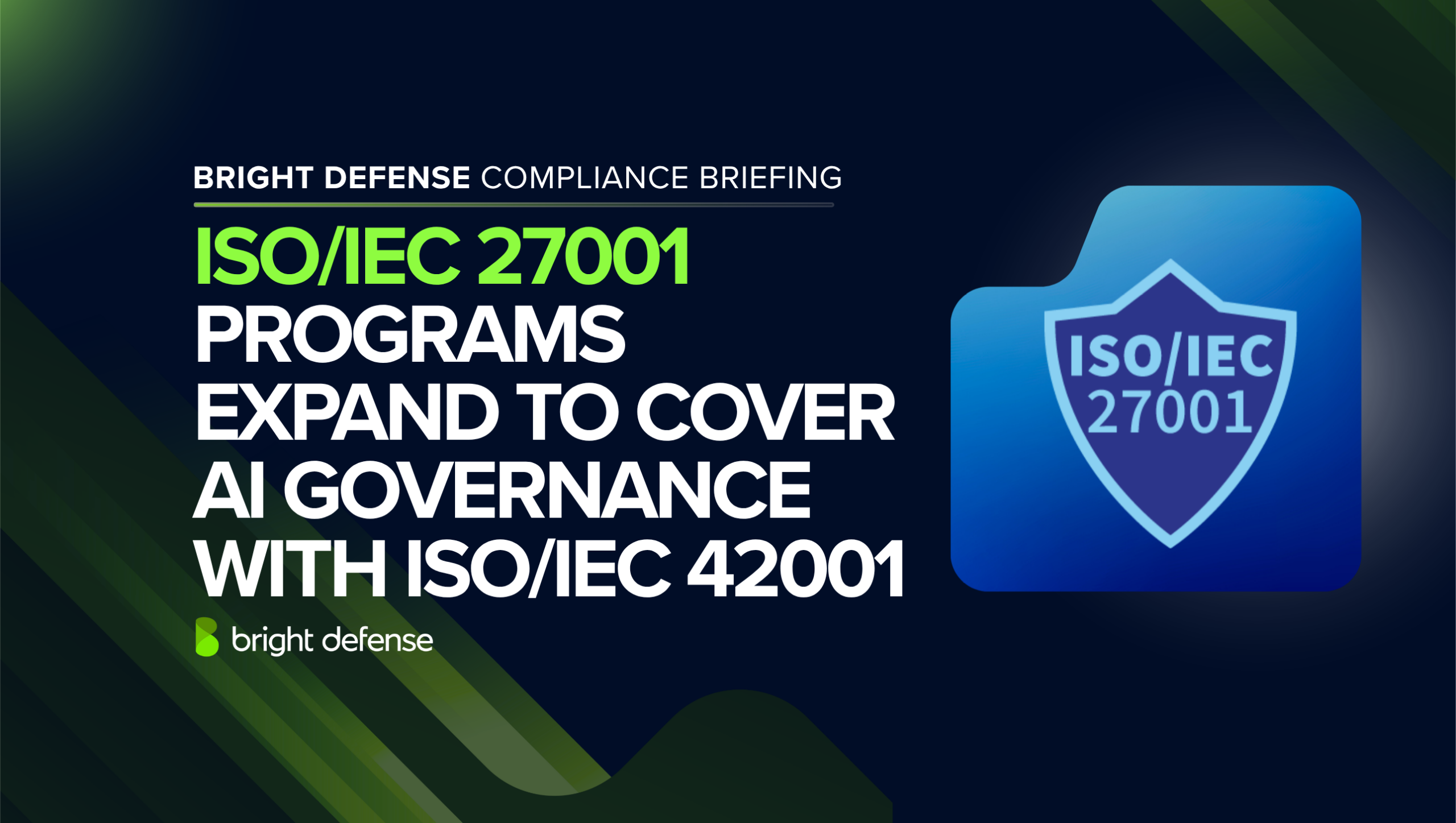
ISO/IEC 27001 Programs Expand To Cover AI Governance With ISO/IEC 42001
Updated:
September 21, 2026
Organizations are extending ISO/IEC 27001 security programs to cover AI governance through ISO/IEC 42001, as AI systems create new risks that information security controls alone do not fully address. The move gives security, legal, risk and compliance teams a familiar management-system structure for AI inventories, model oversight, supplier controls, documentation and audit evidence.
Why Are Organizations Adding ISO/IEC 42001 To ISO/IEC 27001 Programs?
Organizations are adding ISO/IEC 42001 to ISO/IEC 27001 programs because AI governance now needs controls for model behavior, data quality, human oversight, transparency, lifecycle monitoring and supplier risk. ISO/IEC 27001 protects information assets, while ISO/IEC 42001 adds an AI Management System for organizations that provide or use AI systems.
ISO/IEC 27001:2022 remains the core standard for information security management systems. It gives organizations a governance structure for confidentiality, integrity, availability, access control, risk treatment, supplier management, incident response and internal audits.
ISO/IEC 42001:2023 extends that structure into AI-specific risks. ISO 42001 compliance covers the setup, operation, maintenance and continual improvement of an Artificial Intelligence Management System. This structure allows existing ISO/IEC 27001 teams to reuse governance routines while adding AI-specific review points.
When Did ISO/IEC 27001 And ISO/IEC 42001 Become An AI Governance Stack?
The combined ISO/IEC 27001 and ISO/IEC 42001 stack took shape after ISO published ISO/IEC 27001:2022 in October 2022, NIST released AI RMF 1.0 on January 26, 2023, and ISO published ISO/IEC 42001:2023 in December 2023. The EU AI Act then raised demand for auditable AI governance.
ISO’s decision to market the two standards together as an AI and information security management package shows how the standards are being treated in practice. The package pairs ISO/IEC 42001:2023 with ISO/IEC 27001:2022 for organizations managing both AI governance and information security.
The certification market moved next. AWS announced ISO/IEC 42001 certification for selected AI services on November 25, 2024. Anthropic announced certification on January 13, 2025. Microsoft announced ISO/IEC 42001 certification for Azure AI Foundry Models and Microsoft Security Copilot on July 17, 2025.
What ISO/IEC 42001 Requirements Extend ISO/IEC 27001 Security Programs?
ISO/IEC 42001 extends ISO/IEC 27001 programs with AI governance requirements for system context, leadership, planning, support, operation, performance review and improvement. In practical terms, it adds AI inventories, impact reviews, model oversight, data governance, lifecycle controls and documentation that traditional information security programs may not track.
The overlap is structural. ISO management system standards use a common operating pattern, so organizations can connect AI governance to existing risk registers, internal audit cycles, corrective action workflows, management reviews and supplier reviews.
The gap is substantive. ISO/IEC 27001 covers information security, but AI systems create concerns around training data, model drift, fairness, explainability, autonomy, unsafe outputs, prompt misuse and human oversight.
The OWASP Top 10 for LLM applications can help security teams assess prompt injection, sensitive information disclosure and insecure model integrations. ISO/IEC 42001 gives these risks a formal place inside the control program.
Which Organizations Are Expanding ISO/IEC 27001 Programs For AI Governance?
The organizations most likely to expand ISO/IEC 27001 programs with ISO/IEC 42001 include AI vendors, cloud providers, SaaS companies, financial technology firms, healthcare technology providers, cybersecurity companies, professional services firms and enterprises using AI in regulated workflows. The pressure is strongest when AI touches personal data, security decisions, hiring, credit, healthcare or critical services.
Large vendors are setting the market signal. AWS, Anthropic and Microsoft have public ISO/IEC 42001 announcements. OpenAI’s security page lists ISO/IEC 27001:2022 and other security certifications for business services, while its trust materials state ISO/IEC 42001 AI management coverage for its AI products and models.
Enterprise buyers are pushing the same trend through procurement. Security questionnaires that once focused on ISO/IEC 27001, SOC 2 and privacy controls now ask for AI governance evidence, model documentation and incident-handling procedures. A formal vendor risk management program can document how external models, cloud platforms and AI suppliers are assessed before production use.
How Do ISO/IEC 27001 And ISO/IEC 42001 Support EU AI Act Readiness?
ISO/IEC 27001 and ISO/IEC 42001 support EU AI Act readiness because the law requires covered AI systems to show evidence of risk management, documentation, logging, cybersecurity, human oversight, monitoring and quality management. ISO/IEC 42001 can organize AI governance evidence, while ISO/IEC 27001 supports security and supplier controls.
The EU AI Act was published in the Official Journal on July 12, 2024 as Regulation (EU) 2024/1689. It applies across the EU’s 27 member states and can reach non-EU providers when AI systems or outputs are used in the EU.
The law’s Article 17 requires providers of high-risk AI systems to maintain a documented quality management system. Article 15 addresses accuracy, resilience and cybersecurity. ISO/IEC 42001 can help organize these processes, but it does not replace AI Act conformity assessment, EU database registration, CE marking or system-specific legal duties.
What Penalties And Contract Risks Make ISO/IEC 42001 Useful For ISO/IEC 27001 Teams?
ISO/IEC 42001 has no direct fine structure because it is voluntary, but it helps ISO/IEC 27001 teams answer legal, procurement and audit questions tied to AI systems. The risk comes from AI Act penalties, contract claims, customer due diligence, failed audits and inaccurate public claims about AI governance.
EU AI Act fines can reach €35 million or 7% of global annual turnover for prohibited AI practices. Other violations can reach €15 million or 3%, while incorrect or misleading information can trigger fines up to €7.5 million or 1%.
Contract risk may arrive before regulator action. Customers may require vendors to prove that AI systems have owners, risk records, monitoring, access controls, security testing and incident response plans. ISO/IEC 42001 gives ISO/IEC 27001 teams a clearer format for that evidence.
What Steps Should Organizations Take To Add ISO/IEC 42001 To ISO/IEC 27001?
Organizations should add ISO/IEC 42001 to ISO/IEC 27001 through a single governance program that reuses existing security processes and adds AI-specific controls. The practical aim is to avoid parallel audits, duplicate evidence requests and separate risk registers for the same systems.
1. Define the ISO/IEC 42001 AIMS scope and compare it with the existing ISO/IEC 27001 ISMS scope. A cybersecurity gap analysis can show which current security controls apply to AI systems and where new governance processes, documentation or evidence are required.
2. Build an AI inventory that covers internal AI, customer-facing AI, embedded AI, vendor AI and employee generative AI use.
3. Map AI risks to existing information security risks, including access control, data protection, logging, vulnerability management and incident response.
4. Add AI-specific controls for model review, data quality, human oversight, monitoring, output review and supplier documentation.
5. Update policies, risk registers, internal audit plans, management review agendas and corrective action records.
6. Test AI systems through security reviews, penetration testing, data-flow analysis and incident response exercises.
7. Prepare certification evidence after the combined program operates long enough to show repeatable control performance.
How Are Vendors And Certification Bodies Reacting To ISO/IEC 42001 Demand?
Vendors and certification bodies are reacting with new ISO/IEC 42001 certifications, trust-center materials and audit services that sit beside existing ISO/IEC 27001 programs. The pattern shows that AI governance is becoming a formal assurance category rather than a short policy addendum.
ISO published ISO/IEC 42006:2025 in July 2025 for bodies that audit and certify AI Management Systems. That matters because it gives certification bodies AI-specific audit requirements and helps customers compare ISO/IEC 42001 certificates with greater confidence.
Accreditation bodies are moving as well. UKAS said on January 15, 2026 that it granted its first AIMS accreditation for ISO/IEC 42001:2023 certification. ANAB lists ISO/IEC 42001 accreditation activity for certification bodies.
What Costs And Open Questions Remain For Combined ISO/IEC 27001 And ISO/IEC 42001 Programs?
Combined ISO/IEC 27001 and ISO/IEC 42001 programs can cut duplicate work, but they still add cost across legal, security, privacy, product, engineering, procurement, data science and internal audit teams. Costs depend on AI system count, scope, model complexity, supplier reliance, regulated data use and existing ISO maturity.
The main open question is adoption speed. No official global count of ISO/IEC 42001 certified organizations was found in the official sources reviewed for this report. Public certifications show momentum, but they do not prove that ISO/IEC 42001 is already a default requirement in every sector.
The second open question is EU legal treatment. ISO/IEC 42001 can support governance evidence, but EU AI Act presumption of conformity depends on European harmonized standards cited in the Official Journal. Organizations should not claim that ISO/IEC 42001 certification alone satisfies every AI Act duty.
How Bright Defense Helps Organizations Extend ISO/IEC 27001 Programs With ISO/IEC 42001
Bright Defense helps organizations extend ISO/IEC 27001 programs into ISO/IEC 42001 AI governance through penetration testing, continuous compliance, security assessments, vulnerability management and vCISO support. Our work covers AI systems, cloud environments, APIs, infrastructure, access controls, logging, vendor risk and incident response.
For organizations preparing a combined ISMS and AIMS program, Bright Defense helps teams review the security evidence needed for ISO/IEC 42001 readiness. This includes AI system inventories, model-facing applications, cloud exposure, supplier dependencies, security test results and remediation plans. The same evidence can support EU AI Act readiness, SOC 2, ISO/IEC 27001 and customer audit requirements.
Sources Cited In This ISO/IEC 27001 And ISO/IEC 42001 Report
- ISO — ISO/IEC 27001:2022 Information Security Management Systems (2022)
- ISO — ISO/IEC 42001:2023 AI Management Systems (2023)
- ISO — AI And Information Security Management Package (2026)
- ISO — Management System Standards (2026)
- ISO — ISO/IEC 42006:2025 Requirements For AIMS Audit And Certification Bodies (July 2025)
- NIST — Artificial Intelligence Risk Management Framework AI RMF 1.0 (January 2023)
- EUR-Lex — Regulation (EU) 2024/1689 Artificial Intelligence Act (July 12, 2024)
- European Commission — Standardisation Of The AI Act (2026)
- European Commission — The General-Purpose AI Code Of Practice (July 10, 2025)
- AP — EU Unveils AI Code Of Practice To Help Businesses Comply With Bloc’s Rules (July 10, 2025)
- Reuters Via Investing.com — EU To Delay High Risk AI Rules Until 2027 After Big Tech Pushback (November 19, 2025)
- CEN-CENELEC — Artificial Intelligence Standards Work (2026)
- AWS — AWS Achieves ISO/IEC 42001:2023 Artificial Intelligence Management System Accredited Certification (November 25, 2024)
- Anthropic — Anthropic Achieves ISO 42001 Certification For Responsible AI (January 13, 2025)
- Microsoft Azure — Azure AI Foundry Models And Microsoft Security Copilot Achieve ISO/IEC 42001:2023 Certification (July 17, 2025)
- OpenAI — Security And Privacy At OpenAI (2026)
- UKAS — UKAS Grants First Accreditation For Artificial Intelligence Management Systems (January 15, 2026)