Pentagon Personnel Breach Exposes More Than 3 Million People

Updated:
October 11, 2026
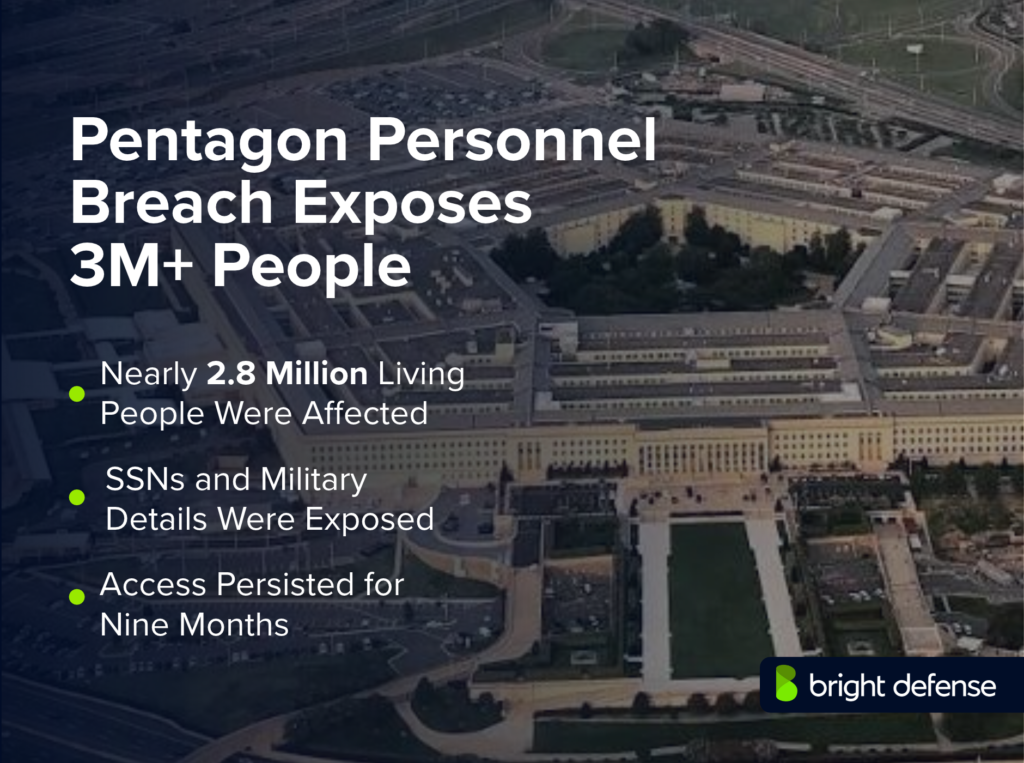
A breach of the Pentagon’s Defense Manpower Data Center (DMDC) exposed personal information belonging to approximately 3.054 million people, including 2.76 million living individuals and 294,000 deceased individuals, according to a defense official cited by ABC News.
The reported figures include people connected to the military, rather than 3 million active-duty service members.
Unauthorized access occurred between October 2025 and July 2026. The exposed information included Social Security numbers and personnel details. Officials said they had found no evidence of misuse at the time of their statements.
This article reflects reporting available as of September 30, 2026. It covers the affected system, exposed information, response, personal risks, and questions that remain unanswered.
Pentagon Breach Status As Of September 30, 2026
| Issue | Verified Information |
|---|---|
| Affected population | Officials reported 2.76 million living individuals and 294,000 deceased individuals. |
| Access period | Unauthorized access occurred between October 2025 and July 2026. |
| Discovery | DMDC identified the file-sharing vulnerability on July 16, 2026. |
| Remediation | DMDC said it patched the vulnerability after discovery. |
| Identity protection | Affected individuals are being offered 12 months of credit monitoring through IDX. |
| Attribution | The reviewed reports do not identify who accessed the files. |
What Happened In The Breach
DMDC discovered a vulnerability in a file-sharing system on July 16, 2026. A subsequent analysis found unauthorized access to files containing unencrypted personally identifiable information, or PII, dating back to October 2025.
Military Times reviewed a notification sent to an affected individual on September 18. Two defense officials confirmed its authenticity. The publication reported the incident on September 24, initially citing a possible population of approximately 4 million people.
Later official figures reported by ABC News and MeriTalk support the more specific total of approximately 3.054 million.
Timeline From Unauthorized Access To Public Reporting
| Date | Development |
|---|---|
| October 2025 | The reported period of unauthorized file access began. |
| July 16, 2026 | DMDC discovered the vulnerability and said it patched the affected system. |
| September 18, 2026 | The notification reviewed by Military Times was sent to an affected individual. |
| September 24, 2026 | Military Times published its initial report. |
| September 28, 2026 | ABC News reported the official breakdown of living and deceased individuals affected. |
| September 29, 2026 | A department spokesperson confirmed that breakdown to MeriTalk. |
The chronology separates the access period, discovery, individual notification, and public reporting.
What Data And Systems Were Affected
The reported exposure involved files on a DMDC file-sharing server.
SecurityWeek reported that the information varied by individual and included Social Security numbers, names, dates of birth, contact details, demographic information, and military occupational specialties.
The notification did not identify the file-sharing product or describe the specific vulnerability.
DMDC holds records covering service members, civilian employees, contractors, retirees, veterans, and military families. Its broader holdings exceed 60 million records.
That figure describes the agency’s overall repository and should not be presented as the number exposed in this incident.
Who Was Responsible And How Access Occurred
Public attribution remains unresolved. Federal News Network reported that a Pentagon official declined to identify the users or explain whether the access was intentional.
The reviewed sources do not establish a particular criminal group, foreign government, or insider as responsible.
The disclosed technical explanation is limited to a vulnerability that permitted unauthorized file access. SecurityWeek reported that the notification provided no product name or detailed vulnerability description.
Claims about a specific exploit, ransomware deployment, or stolen credentials would exceed the available evidence.
Impact And Risks For Affected Individuals
Exposure of Social Security numbers creates a risk of identity theft. The Federal Trade Commission advises people concerned about identity misuse to review their credit reports and consider a credit freeze. Unrecognized accounts can indicate that someone has used their information.
Military job information adds a separate concern. As an assessment of the exposed data, combining occupational details with personal identifiers could make impersonation attempts more convincing.
That possibility does not establish that espionage or targeted fraud occurred in this case. Officials told Federal News Network that they had no indication of misuse.
Pentagon Response And Identity Protection
DMDC said it initiated privacy and cybersecurity incident response procedures after identifying the vulnerability.
A department spokesperson told MeriTalk that affected individuals were being notified through postal mail by Identity Theft Guard Solutions, known as IDX.
The response includes notification, credit monitoring, and identity restoration support based on the information affected.
MeriTalk reported a 12-month monitoring offer and an enrollment deadline of August 19, 2027. Recipients should check their own notification for applicable instructions and deadlines.
Steps Affected Individuals Can Take
Affected individuals can use the notification and federal identity-theft guidance to organize their response:
- Review the notification. Identify the information exposed and retain the letter for reference.
- Follow the IDX enrollment instructions. Check the eligibility terms and deadline stated in the notification.
- Consider freezing credit with all three bureaus. Equifax, Experian, and TransUnion each require a freeze request. The FTC says placing and lifting a freeze is free.
- Review credit reports for unfamiliar accounts. Keep records of suspicious activity and dispute inaccuracies.
- Report identity theft through IdentityTheft.gov. The FTC’s service provides a recovery plan based on the reported circumstances.
What Remains Unclear
The reviewed public accounts leave several material questions unanswered: who accessed the files, the precise vulnerability involved, why sensitive information was available in unencrypted form, and how the affected population breaks down by personnel category. A public forensic report would be needed to explain the access mechanism and scope in greater detail.
The reports reviewed for this article provide no confirmed total for response costs, compensation, or financial losses.
The available facts support reporting a personnel-data exposure and an identity-protection response. They do not support assigning a settlement value or predicting individual payments.
Why This Incident Matters
The DMDC breach illustrates the sensitivity of personnel information held in file-sharing environments. Its significance comes from the combination of personal identifiers, employment details, and the extended period covered by the reported unauthorized access.
The unanswered technical questions make it important to separate the established exposure from assumptions about the attackers or their objectives.
How Bright Defense Can Help Reduce Similar Breach Risks
Bright Defense offers penetration testing, security assessments, and continuous compliance services.
Organizations handling sensitive personnel information can use these services to examine file-sharing permissions, assess access controls, and review the evidence supporting their security practices.
Testing should focus on whether users can reach information beyond their authorized roles and whether remediation addresses the weaknesses identified.
References
- Cohen, R. S. (2026, September 28). More than 3 million people affected by military data breach. Federal News Network. https://federalnewsnetwork.com/defense-main/2026/09/more-than-3-million-people-affected-by-military-data-breach/
- Federal Trade Commission. (2025, January). Freezing? Maybe freeze your credit, too. https://consumer.ftc.gov/consumer-alerts/2025/01/freezing-maybe-freeze-your-credit-too
- Federal Trade Commission. (2025, August). Credit freezes and fraud alerts. https://consumer.ftc.gov/articles/credit-freezes-and-fraud-alerts
- Kovacs, E. (2026, September 29). Pentagon personnel agency data breach impacts 3 million people. SecurityWeek. https://www.securityweek.com/pentagon-personnel-agency-data-breach-impacts-3-million-people/
- Martinez, L., & Barr, L. (2026, September 28). Pentagon breach exposed sensitive data on nearly 3 million people. ABC News. https://abcnews.com/Politics/pentagon-breach-exposed-sensitive-data-3-million-people/story?id=136832909
- Oliverio, N. (2026, September 24). Military personnel data exposed in breach, agency warns. Military Times. https://www.militarytimes.com/news/pentagon-congress/2026/09/24/military-personnel-data-exposed-in-breach-agency-warns/
- Perez, L. (2026, September 29). Pentagon database breach exposes personal information of more than 3 million. MeriTalk. https://www.meritalk.com/articles/pentagon-database-breach-exposes-personal-information-of-more-than-3-million/