10 Best Penetration Testing Companies in the USA

Updated:
August 25, 2026
Penetration testing helps organizations find exploitable vulnerabilities before attackers use them. That matters because IBM reported that the average cost of a data breach in the United States reached a staggering $10.22 million in 2025, while Verizon’s 2025 DBIR found that vulnerability exploitation was involved in 20% of breaches.
Choosing a penetration testing company is not just about finding weaknesses. Cobalt’s 2025 State of Pentesting Report found that serious pentest findings are resolved only 55% of the time, a figure that sits alongside other penetration testing statistics showing why businesses need providers that deliver clear reports, practical remediation guidance, and risk-based priorities.
This guide reviews the top 10 best penetration testing companies in the USA and explains which providers are worth considering based on testing quality, reporting, remediation support, and overall security value.
Let’s dive right in!
Note: This Is Not a Ranked List. The Placement Numbers Do Not Imply That One Company Is Better Than Another. Each Company Featured Here Is Highly Reputable, with a Track Record of Successful Penetration Testing Engagements for Numerous Clients.
1. Bright Defense
Bright Defense is a cybersecurity compliance firm that folds penetration testing into a continuous, monthly security program rather than selling it as a one-off engagement.
The team runs network and web application tests to find exploitable weaknesses, then carries those findings straight into remediation and audit evidence for frameworks like SOC 2, ISO 27001, HIPAA, and CMMC. Companies preparing for an audit can read more about how penetration testing for SOC 2 supports control evidence.
The setup fits smaller companies that need a pen test for an auditor and want the fix work tracked in the same place. Co-founders Tim Mektrakarn and John Minnix started the company in 2023 after years running VPLS, a managed service provider acquired in 2019.
Best For: Small and mid-sized businesses and SaaS companies pursuing SOC 2 or ISO 27001 that want penetration testing packaged with continuous compliance and hands-on remediation.
Bright Defense Company Overview
- Company Name: Bright Defense, LLC
- Headquarters: Culver City, California, United States
- Year Founded: 2023
- Global Presence: US-based, serving clients nationwide
- Website: brightdefense.com
- Founders: Tim Mektrakarn and John Minnix
- Certifications and Accreditations: ISO 27001:2022 certified provider; CISSP, CISA, and ISO 27001 Lead Auditor staff; Drata Gold Partner
- Number of Employees: ~50
- Delivery Model: Consultant-led, delivered inside a monthly continuous compliance engagement with compliance automation tooling
- Company Valuation: N/A
Pen Test Types Offered
- Network (internal and external) and web application penetration testing, plus recurring vulnerability scanning. Red team and physical testing are not the core focus.
Key Features
- Continuous Compliance Model: Pen tests run inside a recurring program, so findings move into remediation and audit evidence instead of sitting in a static PDF.
- Compliance Automation Tooling: The engagement runs on platforms such as Drata to track control status and evidence in one place.
- Certified Practitioners: Testing and oversight come from CISSP, CISA, and ISO 27001 Lead Auditor certified staff.
- Remediation Support: Each finding arrives with a fix plan and direct help, not just a severity label.
- vCISO Access: Clients can add virtual CISO leadership for policy and risk decisions alongside testing.
Pros and Cons
- Pros: Pen testing tied straight to audit readiness; certified compliance practitioners; fix work and evidence tracked in one monthly program.
- Cons: A newer, smaller firm (founded 2023) than enterprise pure-play testing shops; offensive depth such as red team and physical testing is limited, so teams wanting a standalone adversarial engagement may look elsewhere.
Pricing
- Pricing Public range of roughly $2,750 to $9,250 per test, with the final figure set by scope, asset count, and test type. For a fuller breakdown of what drives these figures, see our guide to penetration testing pricing. Penetration testing is usually sold within a monthly compliance plan rather than alone.
What People Say About Bright Defense
- Clear, Actionable Findings: Clients describe the reports as easy to understand and prioritized, so their teams know exactly what to fix first instead of wading through raw scanner output.
- Kept On Schedule: Pen test clients point to a steady cadence that moved testing along without disrupting day-to-day operations, with engagements scoped and delivered on time.
- Fit For Startups: Founders note that the team understands tight budgets and fast timelines, scoping tests that fit the stage they’re at rather than overselling.
- Personal And Reliable: Reviewers single out a direct, plain working relationship (Tim gets named more than once) and dependable retesting and remediation guidance once fixes are in place.
2. CrowdStrike
CrowdStrike is a global cybersecurity vendor that folds penetration testing into a broader security program built around endpoint protection, identity security, threat intelligence, and exposure management.
The team runs internal and external network, web application, mobile application, wireless, and insider threat tests to show how real attackers could exploit weaknesses, move laterally, and test detection and response controls.
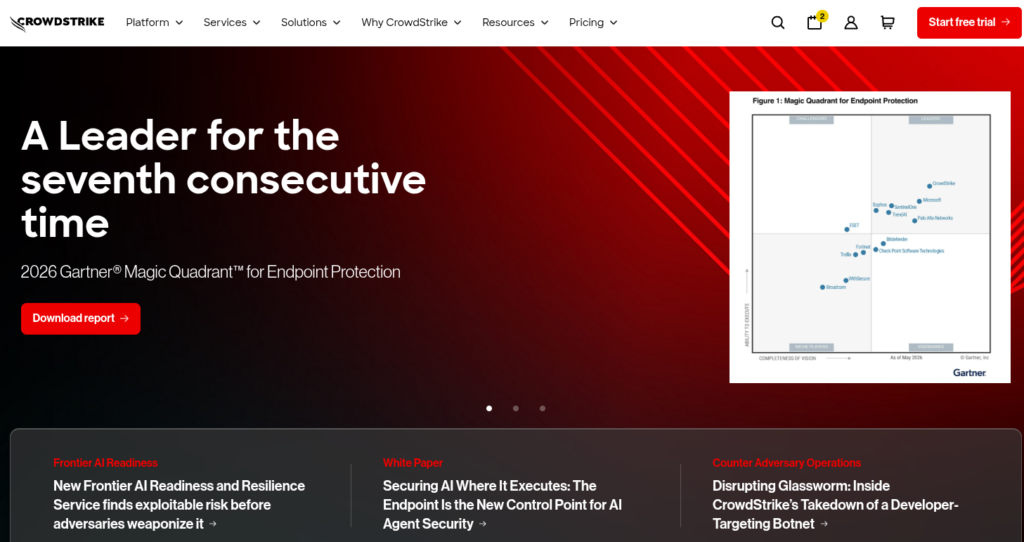
The setup fits larger organizations that already use Falcon or want penetration testing tied to threat intelligence, response validation, and exposure management rather than a basic one-off assessment.
Co-founders George Kurtz, Dmitri Alperovitch, and Gregg Marston started the company in 2011, and CrowdStrike now operates globally with Austin, Texas listed as its principal executive office.
Best For: Mid-sized and large enterprises, regulated organizations, and Falcon customers that want intelligence-led penetration testing connected to detection, response, and exposure management.
CrowdStrike Company Overview
- Company Name: CrowdStrike Holdings, Inc.
- Headquarters: Austin, Texas, United States
- Year Founded: 2011
- Global Presence: Global, with operations across North America, Europe, and Asia
- Website: crowdstrike.com
- Founders: George Kurtz, Dmitri Alperovitch, and Gregg Marston
- Certifications and Accreditations: SOC 2, ISO 27001, and security staff credentials such as CISSP and OSCP
- Number of Employees: ~10,000+
- Delivery Model: Consultant-led projects supported by Falcon platform data, threat intelligence, and exposure management workflows
- Company Valuation: ~$65B – $75B (Market Cap)
Pen Test Types Offered
Pen Test Types Offered: Internal and external network testing, web and mobile application testing, wireless testing, and insider threat testing. Physical red team testing is not the core focus.
Key Features
- Threat Intelligence Led Testing: CrowdStrike uses global threat telemetry to model attacker behavior during tests.
- Broad Technical Scope: Testing can cover networks, applications, wireless systems, mobile apps, and insider threat scenarios.
- Real Exploitation: Testers attempt exploitation, privilege escalation, and lateral movement to show practical attack paths.
- Falcon Integration: Findings can connect back to Falcon workflows for monitoring, remediation, and exposure management.
- Detection And Response Validation: Engagements test whether existing tools and teams can detect and respond to attacker behavior.
- Global Expert Team: Testing is supported by threat hunters, incident responders, and offensive security consultants.
Pros and Cons
- Pros: Strong threat intelligence; broad enterprise testing scope; useful for Falcon customers; good fit for detection and response validation.
- Cons: Likely higher cost than smaller penetration testing firms; less focused on physical testing or standalone red team work; may be too complex for smaller companies needing a one-time audit test.
Pricing
CrowdStrike does not publish penetration testing pricing. Costs depend on scope, asset count, test type, regulatory requirements, and Falcon platform involvement. Buyers should expect custom enterprise pricing rather than a fixed public package.
What People Say About CrowdStrike
- Strong Threat Context: Customers value testing that reflects real attacker tactics rather than basic vulnerability checks.
- Integrated Platform Experience: Falcon users benefit from having findings connected to existing security workflows.
- Responsive Security Expertise: Broader customer feedback often points to strong incident response and security consulting support.
- Better Fit For Larger Teams: Smaller organizations may find the service expensive or too advanced for a simple one-off penetration test.
3. Rapid7
Rapid7 is a long-standing cybersecurity vendor that folds penetration testing into a broader security program built around vulnerability management, detection and response, exposure management, and the Metasploit framework.
The team runs network, web application, mobile application, IoT, wireless, social engineering, and red team tests to find exploitable weaknesses and show how attackers could move through an environment.
The setup fits mid-sized and large organizations that want broad testing coverage, audit support, and findings connected to Rapid7’s Insight platform. Founders Alan P. Matthews, Tas Giakouminakis, and Chad Loder started the company in 2000, and Rapid7 now serves more than 11,000 customers worldwide.
Best For: Mid-sized and large organizations that need broad penetration testing across networks, applications, IoT, wireless, and social engineering, with optional integration into Rapid7’s vulnerability management and SIEM tools.
Rapid7 Company Overview
- Company Name: Rapid7, Inc.
- Headquarters: Boston, Massachusetts, United States
- Year Founded: 2000
- Global Presence: Global, with operations across North America, Europe, Asia, and Australia
- Website: rapid7.com
- Founders: Alan P. Matthews, Tas Giakouminakis, and Chad Loder
- Certifications and Accreditations: CREST member; staff credentials include OSCP, CISSP, and other security certifications; supports SOC 2, PCI DSS, and ISO 27001 audit needs
- Number of Employees: ~2,800
- Delivery Model: Consultant-led projects, sold as one-time assessments or as part of managed services and continuous red team programs
- Company Valuation: ~$2B – $3B (Market Cap)
Pen Test Types Offered
Internal and external network testing, web and mobile application testing, IoT testing, wireless testing, social engineering, and red team simulations.
Key Features
- Broad Testing Coverage: Rapid7 covers networks, applications, mobile apps, IoT, wireless systems, social engineering, and red team scenarios.
- Standards Based Methodology: Testing follows OSSTMM, PTES, and OWASP methods for consistent assessment and audit support.
- Metasploit Expertise: Rapid7 testers contribute to Metasploit and use that research experience during exploitation work.
- Compliance Support: Reports include remediation guidance that can help teams support SOC 2, PCI DSS, ISO 27001, and other audit requirements.
- Continuous Red Teaming: Vector Command gives larger teams ongoing attack simulations beyond a single point-in-time test.
- Insight Platform Integration: Findings can connect with InsightVM and InsightIDR for vulnerability tracking, detection, and response work.
Pros And Cons
- Pros: Broad test catalog; strong vulnerability management background; Metasploit expertise; useful InsightVM and InsightIDR integration; available red team and continuous testing options.
- Cons: Pricing is custom and may be high for full-scope projects; larger engagements may need advance scheduling; the service is built more for enterprises than very small businesses.
Pricing
Rapid7 does not publish penetration testing prices. Costs depend on scope, asset count, test type, environment size, and any managed service or Vector Command involvement. Buyers should expect custom pricing rather than a fixed public package.
What People Say About Rapid7
- Technical Depth: Customers value Rapid7’s testing expertise and the advantage of working with a team connected to Metasploit research.
- Detailed Reporting: Reviews often mention clear findings, practical remediation guidance, and reports that help teams prioritize fixes.
- Platform Integration: Users like the connection between testing, InsightVM, and InsightIDR because it keeps vulnerability and detection work in one workflow.
- Planning And Cost: Some customers note that large engagements require lead time and that pricing can be higher than smaller boutique testing firms.
4. HackerOne
HackerOne is a crowdsourced security and penetration testing company that folds PTaaS into a broader platform for vulnerability disclosure, bug bounty programs, and developer-connected security testing.
The team runs web application, API, mobile, desktop, cloud, network, source code, and AI/LLM tests with vetted pentesters, live reporting, and AI-supported reconnaissance and validation.
The setup fits tech-forward startups, SaaS companies, and larger organizations that want real-time findings, direct tester communication, and remediation workflows tied into developer tools.
Co-founders Michiel Prins, Jobert Abma, Alex Rice, and Merijn Terheggen started the company in 2012, and HackerOne now works with a global hacker and pentester community.
Best For: Tech-savvy startups, SaaS companies, and mid-market teams that want real-time, developer-integrated penetration testing from a vetted hacker community.
HackerOne Company Overview
- Company Name: HackerOne Inc.
- Headquarters: San Francisco, California, United States
- Year Founded: 2012
- Global Presence: Remote-first workforce with pentesters worldwide and offices in North America and Europe
- Website:hackerone.com
- Founders:Michiel Prins, Jobert Abma, and Alex Rice
- Certifications and Accreditations: Reports support SOC 2, ISO 27001, and GDPR audit needs; HackerOne is FedRAMP authorized for bug bounty programs, but not all services
- Number of Employees: ~700
- Delivery Model: Platform-based PTaaS delivered through vetted pentesters, AI-supported testing workflows, live findings, and developer tool integrations
- Company Valuation: ~$1B+ (Private/Estimated)
Pen Test Types Offered
Web application, API, mobile application, desktop application, internal and external network, cloud infrastructure, source code, and AI/LLM penetration testing. Physical and social engineering testing are not the core focus.
Key Features
- Vetted Pentester Community: HackerOne matches clients with vetted security experts from its global hacker community.
- AI-Supported Testing: AI agents support reconnaissance, exploitation, and validation while human testers review risk and confirm findings.
- Real-Time Reporting: Findings appear live in the platform so teams can begin remediation during the engagement.
- Developer Workflow Integration: HackerOne connects with Jira, GitHub, Slack, and ServiceNow to move findings into existing remediation workflows.
- Broad Application And Cloud Coverage: Testing covers web apps, APIs, cloud environments, mobile apps, desktop apps, networks, and source code.
- Retesting And Validation: HackerOne supports retesting after fixes so teams can confirm that vulnerabilities are resolved.
Pros And Cons
- Pros: Large vetted hacker community; strong developer workflow integration; real-time reporting; useful fit for SaaS and cloud-heavy teams; AI-supported testing with human oversight.
- Cons: Pricing is not public and may be high for larger programs; results can vary on highly specialized systems without tight scoping; physical and social engineering testing are limited.
Pricing
HackerOne does not publish penetration testing prices. Costs depend on scope, asset count, test complexity, tester requirements, and whether the buyer combines pentesting with bug bounty or vulnerability disclosure programs. Buyers should expect custom pricing rather than a fixed public package.
What People Say About HackerOne
- Skilled Tester Network: Customers value HackerOne’s vetted hacker community and the ability to work with security experts through the platform.
- Fast Remediation Workflow: Users like real-time communication, live findings, and integrations with Jira, GitHub, Slack, and ServiceNow.
- Broad Testing Coverage: Feedback often points to the convenience of testing web, cloud, API, mobile, network, and code assets through one platform.
- Pricing And Consistency: Some users note that pricing can be high and that specialized systems need careful scoping to get consistent depth.
5. NetSPI
NetSPI is a penetration testing and proactive security provider that folds manual testing into a continuous Penetration Testing as a Service program.
The team runs application, network, cloud, mainframe, hardware, AI/ML, social engineering, and red team tests to find exploitable weaknesses, validate real risk, and track remediation in one platform.
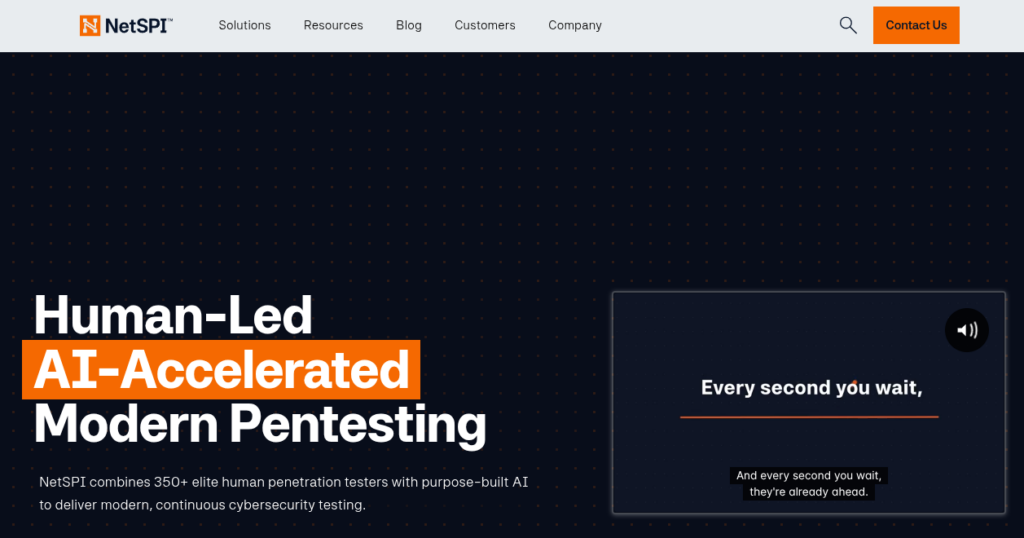
The setup fits large enterprises and regulated organizations that need ongoing visibility, human-led testing, and findings connected to development or security workflows. Co-founders Deke George and Seth Peter started the company in 2001, and NetSPI now serves clients across North America, Europe, and Asia.
Best For: Large enterprises and regulated organizations that need continuous, manual-first penetration testing with real-time reporting, remediation tracking, and workflow integration.
NetSPI Company Overview
- Company Name: NetSPI LLC
- Headquarters: Minneapolis, Minnesota, United States
- Year Founded: 2001
- Global Presence: Remote-first delivery across North America, Europe, and Asia
- Website: netspi.com
- Founders: Deke George and Seth Peter
- Certifications and Accreditations: CREST member; staff credentials include OSCP, OSCE, and other security certifications; supports PCI DSS, SOC 2, and ISO 27001 audit needs
- Number of Employees: ~600
- Delivery Model: PTaaS platform with continuous testing, human-led assessments, AI-assisted recon, dashboards, ticketing integration, and remediation tracking
- Company Valuation: ~$1B+ (Private/Estimated)
Pen Test Types Offered
Application, network, mainframe, cloud, hardware, and AI/ML penetration testing, plus red team operations, social engineering, detective controls testing, secure code review, and threat modeling.
Key Features
- PTaaS Platform: NetSPI gives teams real-time dashboards, ticketing integration, remediation tracking, and trend analysis in one testing platform.
- Manual-First Testing: Human testers validate real risk, reduce false positives, and focus findings on exploitable issues.
- AI-Assisted Recon: AI supports reconnaissance and pattern recognition while testers handle deeper analysis and prioritization.
- Broad Service Catalog: Services cover applications, networks, cloud, mainframes, hardware, AI/ML systems, red team operations, and social engineering.
- Continuous External And Cloud Testing: Ongoing asset discovery and human validation help teams monitor risk between formal assessments.
- Workflow Integration: Findings can move into ticketing systems and remediation workflows for faster tracking and accountability.
Pros And Cons
- Pros: Strong manual testing model; continuous PTaaS platform; broad testing coverage; useful remediation workflows; strong fit for regulated industries and large enterprises.
- Cons: Custom pricing can be high; scheduling may require advance planning; the enterprise focus may not fit small businesses that need a simple one-time penetration test.
Pricing
NetSPI does not publish public penetration testing pricing. Costs depend on scope, asset complexity, test type, workflow integration, and whether the buyer needs a continuous PTaaS program. Enterprises should expect custom contract pricing rather than a fixed public package.
What People Say About NetSPI
- Manual Testing Quality: Customers and industry reviews often point to NetSPI’s human-led testing depth and practical validation of risk.
- Useful PTaaS Platform: Teams value real-time dashboards, collaboration features, remediation tracking, and visibility across engagements.
- Strong Regulated Industry Fit: Finance, healthcare, and government buyers value NetSPI’s audit-aware testing approach and reporting structure.
- Enterprise-Oriented Model: Some reviewers note that NetSPI is better suited to large organizations because costs and lead times can be higher than smaller testing firms.
6. Cobalt
Cobalt is a penetration testing as a service company that connects organizations with a vetted global community of penetration testers through a SaaS platform.
The team runs web application, API, internal and external network, cloud, AI/LLM, red team, and digital risk tests to help teams find exploitable weaknesses and fix them through live workflows.
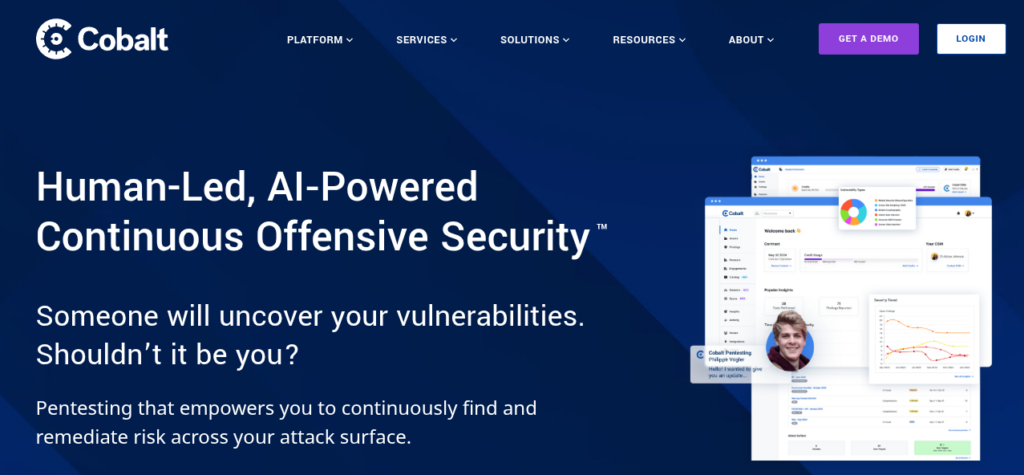
The setup fits software-driven organizations that need fast test launches, flexible scheduling, and findings connected to development tools. Co-founders Jacob Hansen, Esben Friis-Jensen, Jakob Storm, and Christian Hansen started the company in 2013, and Cobalt now serves more than 1,500 customers worldwide.
Best For: Development-centric organizations that need fast, on-demand penetration testing with live reporting, flexible credits, and integration into software development workflows.
Cobalt Company Overview
- Company Name: Cobalt Labs, Inc.
- Headquarters: San Francisco, California, United States, with offices in Boston and Berlin
- Year Founded: 2013
- Global Presence: Global, with more than 1,500 customers and distributed testers worldwide
- Website: cobalt.io
- Founders: Jacob Hansen, Esben Friis-Jensen, Jakob Storm, and Christian Hansen
- Certifications and Accreditations: CREST member; supports SOC 2, PCI DSS, and ISO 27001 compliance needs; testers hold credentials such as OSCP and OSCE
- Number of Employees: ~350
- Delivery Model: PTaaS delivered through a SaaS platform, where clients buy credits and launch tests on demand
- Company Valuation: ~$500M – $700M (Private/Estimated)
Pen Test Types Offered
Web and API penetration testing, internal and external network testing, cloud configuration reviews, AI/LLM penetration testing, red teaming, and digital risk assessments.
Key Features
- On-Demand Testing: Cobalt lets teams start penetration tests quickly through a self-service platform and a vetted tester network.
- Credit-Based Pricing: Clients buy credits that can be used across different test types, which helps with scheduling and budget planning.
- Live Dashboard: Findings appear in real time so security and development teams can review issues during the engagement.
- Developer Workflow Integration: Cobalt integrates with tools such as Jira so teams can send findings into existing remediation workflows.
- Vetted Tester Community: Cobalt uses a global pool of vetted testers, giving clients access to different skill sets across applications, cloud, and infrastructure.
- Continuous Offensive Security: Ongoing programs support repeat testing, fix validation, and strategic guidance beyond one-time assessments.
Pros And Cons
- Pros: Fast test launch; flexible credit model; strong developer workflow integration; global tester community; good fit for application and cloud testing.
- Cons: Less focused on complex on-premises infrastructure, hardware testing, or highly specialized enterprise environments; credit packages may not fit teams that only need one occasional test; marketplace delivery can require coordination across different testers.
Pricing
Cobalt uses a credit-based pricing model. Customers purchase credits that can be used for different test types, with cost based on asset count, complexity, scope, and program needs. Public documentation does not list fixed penetration testing prices.
What People Say About Cobalt
- Fast Setup: Customers value Cobalt’s ability to start tests much faster than traditional consulting-led engagements.
- Easy Developer Handoff: Users like the live dashboard and Jira integration because findings can move into remediation work quickly.
- Flexible Scheduling: Buyers appreciate the credit model because it supports testing as needs arise without restarting procurement for every engagement.
- Best For Software Teams: Some users note that Cobalt is strongest for application and cloud testing, while deeper hardware or complex infrastructure work may require another provider.
7. Synack
Synack is a crowdsourced penetration testing and offensive security provider that folds human-led testing, AI agents, and attack surface visibility into a continuous PTaaS platform.
The team runs web application, API, cloud, AI/LLM, mobile, internal and external network, social engineering, and custom red team tests to find exploitable weaknesses and validate fixes through one platform.
The setup fits enterprises, regulated organizations, and government agencies that need continuous testing, audit-ready evidence, and validated findings from a vetted researcher community. Co-founders Jay Kaplan and Mark Kuhr started the company in 2013 after working as U.S. National Security Agency analysts.
Best For: Enterprises, regulated industries, and government agencies that need continuous PTaaS with vetted researchers, AI-supported testing, attack surface visibility, and compliance-ready reporting.
Synack Company Overview
- Company Name: Synack Inc.
- Headquarters: Redwood City, California, United States
- Year Founded: 2013
- Global Presence: Global, with offices in North America, Europe, and the Middle East and a Synack Red Team across more than 80 countries
- Website: synack.com
- Founders: Jay Kaplan and Mark Kuhr
- Certifications and Accreditations: FedRAMP Moderate authorization for the Synack platform; SOC 2 and ISO 27001 compliant reporting; recognized by GigaOm and information security awards
- Number of Employees: ~600
- Delivery Model: PTaaS platform with continuous testing, AI agents, subscription contracts, and a global vetted researcher community
- Company Valuation: ~$1B+ (Private/Estimated)
Pen Test Types Offered
Web application, API, cloud, AI/LLM, mobile application, internal and external network, social engineering, vulnerability disclosure, and custom red team testing. Physical red team testing is not the core focus.
Key Features
- Vetted Researcher Community: Synack uses a global Synack Red Team of vetted researchers across more than 80 countries.
- AI-Supported Testing: Synack uses AI agents, including Sara, to support reconnaissance, validation, and testing workflows while human researchers confirm risk.
- Continuous Attack Surface Discovery: The platform finds IP, web, and FQDN assets, fingerprints open ports and misconfigurations, and groups assets by team or business unit.
- Asset Insights: Synack shows tested and newly found assets, test coverage, vulnerability history, and asset priority in one view.
- Custom Reporting: Customers can export charts, metrics, graphs, and CSV files for executive reporting and audit evidence.
- Safe Retesting And Validation: The platform validates proof-of-concept findings under guardrails and retests fixes after remediation.
Pros And Cons
- Pros: Strong fit for regulated industries; FedRAMP Moderate authorized platform; vetted global researcher community; AI-supported testing; continuous asset visibility and reporting.
- Cons: Pricing is built more for mid-market and enterprise buyers; onboarding can be complex for smaller teams; human and AI testing still needs clear scoping to get the right depth.
Pricing
Synack does not publish PTaaS pricing. Costs depend on asset count, scope, test frequency, researcher needs, integration requirements, and reporting needs. Buyers should expect custom subscription pricing rather than a fixed public package.
What People Say About Synack
- Trusted For Regulated Buyers: Security leaders value Synack’s FedRAMP authorization, government experience, and audit-ready reporting.
- Strong Researcher Quality: Customers often point to the Synack Red Team as a major strength because researchers are vetted and globally distributed.
- Useful Platform Visibility: Feedback highlights attack surface discovery, vulnerability tracking, continuous testing, and reporting in one platform.
- Enterprise-Level Fit: Some reviewers note that Synack can be expensive and complex for smaller teams that need a simple one-time penetration test.
8. BreachLock
BreachLock is a penetration testing as a service company that folds certified human testing and AI-driven automation into a continuous offensive security platform.
The team runs web, mobile, API, internal and external network, cloud, IoT, attack surface management, red team, and adversarial exposure validation work to find exploitable weaknesses and verify findings.
The setup fits small and mid-sized businesses that need fast kickoff, predictable subscription pricing, compliance-ready reports, and retesting built into the engagement. Founder Seemant Sehgal started the company in 2019, and BreachLock now serves more than 1,000 customers across over 20 countries.
Best For: Compliance-led small and mid-sized businesses that need rapid penetration testing, predictable subscription pricing, in-house certified testers, and continuous retesting.
BreachLock Company Overview
- Company Name: BreachLock Inc.
- Headquarters: New York City, New York, United States
- Year Founded: 2019
- Global Presence: Offices in New York, Amsterdam, and London, serving clients in over 20 countries
- Website: breachlock.com
- Founder: Seemant Sehgal
- Certifications and Accreditations: CREST, SOC 2, and ISO 27001 certified; testers hold credentials such as OSCP, OSCE, and CISSP
- Number of Employees: ~300
- Delivery Model: PTaaS platform with hybrid human and automation testing, in-house certified testers, and subscription pricing
- Company Valuation: N/A
Pen Test Types Offered
Web, mobile, API, internal and external network, cloud, and IoT penetration testing, plus attack surface management, Red Team as a Service, and adversarial exposure validation. Physical social engineering and hardware testing are not the core focus.
Key Features
- Rapid Kickoff: BreachLock can start penetration tests within 24 to 48 hours after scoping through a standardized intake process.
- Hybrid Testing Model: Automated tools scan for known vulnerabilities while in-house certified pentesters manually verify findings and test exploitability.
- Verified Findings: BreachLock positions its model around zero false positives because human testers confirm automated findings before reporting.
- Retesting And Continuous Scans: Each engagement includes unlimited automated retests, one manual retest, and 12 months of automated scanning.
- Compliance-Ready Reporting: Reports map findings to SOC 2, ISO 27001, PCI DSS, HIPAA, and GDPR requirements with prioritized remediation guidance.
- DevSecOps Integrations: Findings can connect with Jira, Slack, and Trello so teams can track remediation in existing workflows.
Pros And Cons
- Pros: Fast kickoff; predictable subscription pricing; in-house certified testers; verified findings; unlimited automated retesting; strong fit for compliance-driven teams.
- Cons: Less focused on deep bespoke exploitation than enterprise offensive security firms; limited physical social engineering and hardware testing; may not fit teams that need highly specialized red team work.
Pricing
BreachLock publishes subscription tiers with pricing bands based on asset count and scope. Costs vary by test type, number of assets, retest frequency, and chosen subscription tier.
What People Say About BreachLock
- Fast And Predictable: Customers value quick kickoff, standardized scoping, and pricing that is easier to plan than fully custom consulting projects.
- Verified Results: Reviewers point to human validation as a strength because it reduces noisy findings and keeps reports focused on actionable risk.
- Strong Compliance Fit: Buyers appreciate reporting mapped to SOC 2, ISO 27001, PCI DSS, HIPAA, and GDPR, along with retesting for auditor follow-up.
- Depth Tradeoff: Some feedback suggests BreachLock is strongest for scalable continuous testing, while deep custom exploitation or physical testing may require another provider.
9. Bishop Fox
Bishop Fox is an offensive security company that folds penetration testing, red teaming, attack surface management, and AI-supported testing into a broader enterprise security program.
The team runs application, network, cloud, IoT, AI/LLM, secure code review, social engineering, ransomware readiness, and red team tests to find exploitable weaknesses and prove real attack paths.

The setup fits large enterprises and regulated organizations that need deep adversarial testing, continuous external visibility, and executive-ready reporting. Co-founders Vincent “Vinnie” Liu and Francis Brown started the company in 2005, and Bishop Fox now serves major technology firms and Fortune 100 companies.
Best For: Large enterprises and regulated organizations that need AI-supported offensive security, deep red team expertise, attack surface management, and business-risk reporting.
Bishop Fox Company Overview
- Company Name: Bishop Fox Security LLC
- Headquarters: Tempe, Arizona, United States
- Year Founded: 2005
- Global Presence: North America-based team serving clients worldwide, including major technology firms and Fortune 100 companies
- Website: bishopfox.com
- Founders: Vincent “Vinnie” Liu and Francis Brown
- Certifications and Accreditations: CREST member; supports FedRAMP assessment work; recognized by GigaOm for attack surface management
- Number of Employees: ~700
- Delivery Model: Project-based penetration testing, managed red team work, and continuous attack surface management through the Cosmos platform
- Company Valuation: N/A
Pen Test Types Offered
Application, network, cloud, IoT, AI/LLM, and secure code review testing, plus red team operations, adversary emulation, social engineering, ransomware readiness, and physical security testing through custom scopes.
Key Features
- Cosmos Platform: Bishop Fox uses Cosmos for continuous asset discovery, evidence-first testing, dashboards, and risk tracking across external attack surfaces.
- AI-Supported Testing: The Cosmos AI engine supports reconnaissance, exploitation, and validation while human testers guide deeper offensive work.
- Evidence-First Scanning: Cosmos captures fingerprints, screenshots, service details, and proof of exploitability so teams can prioritize real risk.
- Attack Surface Management: Continuous discovery helps security teams track exposed assets, new services, and risk changes over time.
- Red Team Heritage: Bishop Fox has a long-running red team practice covering adversary emulation, social engineering, ransomware readiness, and physical testing.
- Executive Reporting: Dashboards and reports connect technical findings to business risk, remediation priorities, and compliance needs.
Pros And Cons
- Pros: Deep offensive security expertise; strong red team background; AI-supported Cosmos platform; continuous attack surface visibility; strong fit for large and regulated organizations.
- Cons: Pricing is built for enterprise budgets; engagements can be more complex than small teams need; public pricing is limited.
Pricing
Bishop Fox does not publish pricing for Cosmos or penetration testing services. Costs depend on scope, asset count, continuous monitoring needs, red team depth, testing type, and compliance requirements. Buyers should expect custom enterprise pricing.
What People Say About Bishop Fox
- Deep Offensive Expertise: Clients often value Bishop Fox for sophisticated testing and red team work that finds attack paths basic assessments may miss.
- Evidence-First Platform: Analysts point to Cosmos as useful for proof-driven risk validation and remediation prioritization.
- Trusted By Large Enterprises: Feedback often highlights Bishop Fox’s experience with Fortune 100 companies and major technology firms.
- Premium Enterprise Fit: Some buyers note that the service quality is strong, but pricing and scope may exceed what smaller organizations need.
10. Coalfire
Coalfire is a cybersecurity advisory and offensive security firm that folds penetration testing into a broader program built around compliance, cloud security, risk management, and continuous validation.
The team runs network, web application, mobile application, cloud, SaaS, wireless, IoT, AI/ML, social engineering, physical, red team, and adversary emulation tests to find exploitable weaknesses and support regulated security programs.

The setup fits enterprises, public-sector organizations, and cloud providers that need penetration testing tied to FedRAMP, PCI DSS, HITRUST, ISO 27001, and other audit requirements. Co-founders Kennet Westby, Rick Dakin, and Alan Ferguson started the company in 2001, and Coalfire now operates across the United States and the United Kingdom.
Best For: Enterprises, public-sector organizations, cloud providers, and regulated teams that need compliance-aligned offensive security, continuous validation, and advisory support.
Coalfire Company Overview
- Company Name: Coalfire Systems, Inc.
- Headquarters: Westminster, Colorado, United States
- Year Founded: 2001
- Global Presence: Offices across the United States and the United Kingdom
- Website: coalfire.com
- Founders: Kennet Westb and Rick Dakin,
- Certifications and Accreditations: Authorized assessor for FedRAMP, PCI DSS, HITRUST, and ISO/IEC 27001/27701; CREST member; holds certifications including SOC 2
- Number of Employees: ~1,500
- Delivery Model: Project-based penetration testing, compliance assessments, advisory services, managed security services, and continuous offensive security through Hexeon
- Company Valuation: ~$1B+ (Private/Estimated)
Pen Test Types Offered
External and internal network testing, web and mobile application testing, cloud and SaaS penetration testing, wireless and IoT testing, AI/ML testing, red team operations, adversary emulation, social engineering, and physical testing through custom scopes.
Key Features
- Hexeon Platform: Coalfire uses Hexeon to combine high-frequency penetration testing, defensive risk management, real-time dashboards, and vulnerability tracking.
- Human-First Testing: Experienced testers use automation to support reconnaissance, risk validation, and real-world attack simulation.
- Compliance Mapping: Findings can map to frameworks such as FedRAMP, PCI DSS, HITRUST, ISO 27001, and MITRE.
- Risk Dashboards: Hexeon provides risk scoring, trend data, industry benchmarking, and prioritized remediation views.
- Remediation Guidance: Reports include practical fix guidance connected to organizational risk and compliance priorities.
- Specialized AI/ML Testing: Coalfire offers AI/ML penetration testing and threat modeling for risks such as prompt injection, model poisoning, and adversarial misuse.
Pros And Cons
- Pros: Strong compliance expertise; broad assessor credentials; scalable offensive security program; useful Hexeon platform; strong fit for regulated industries and cloud providers.
- Cons: Pricing is not public; services are built more for enterprise programs than small one-time tests; larger scopes may require longer planning and scheduling.
Pricing
Coalfire does not publish pricing for penetration testing or Hexeon services. Costs depend on asset count, test type, compliance requirements, testing frequency, platform needs, and advisory support. Buyers should expect custom enterprise pricing.
What People Say About Coalfire
- Compliance Expertise: Clients value Coalfire’s knowledge of FedRAMP, PCI DSS, HITRUST, ISO 27001, and related certification processes.
- Enterprise Program Scale: Reviewers point to Coalfire’s ability to run large testing programs and support continuous validation through Hexeon.
- Human And Automation Blend: Feedback highlights the mix of expert testing, automation, analytics, dashboards, and risk scoring.
- Cost And Lead Time: Some buyers note that pricing and scheduling reflect Coalfire’s enterprise and regulated-industry focus.
How To Choose The Best Penetration Testing Company
The best penetration testing company is one that combines skilled manual testing, proven methodology, clear reporting, remediation support, secure data handling, and the ability to grow with your security program.
A good provider should not only find vulnerabilities, but explain business risk, help your team fix the issues, and verify that remediation worked.
The following factors matter most when comparing penetration testing companies.
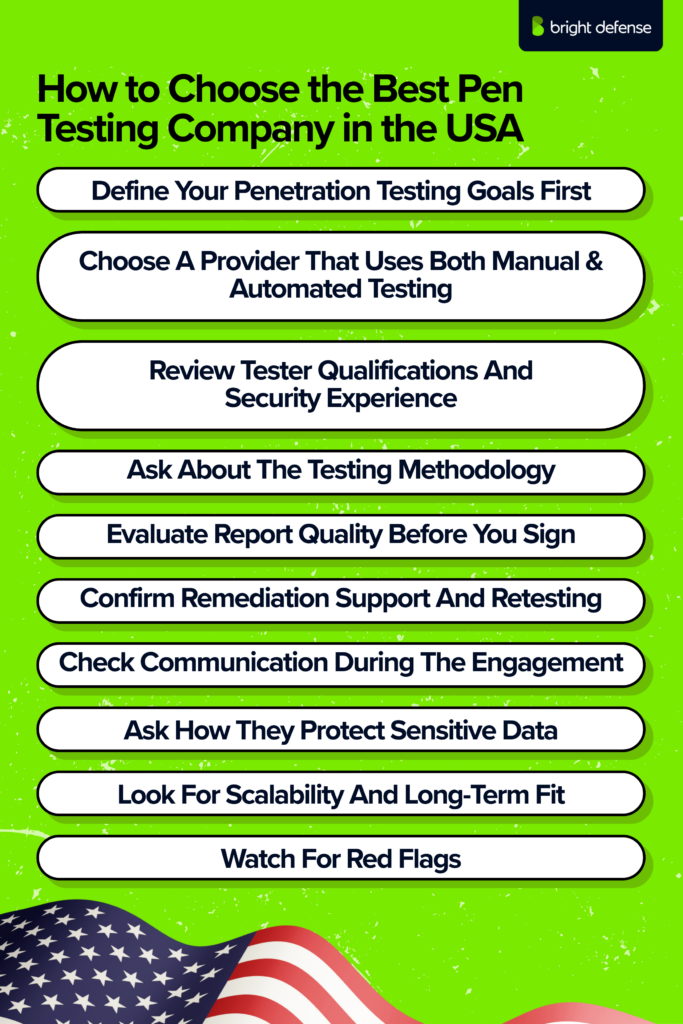
1. Define Your Penetration Testing Goals First
Start with the reason your organization needs a penetration test. Some companies need testing for compliance. Others need to assess a new application before launch, validate security controls, reduce breach risk, or test whether attackers can chain multiple weaknesses together.
In Fortra’s 2024 Penetration Testing Report:
- 82% of organizations named risk assessment and remediation as a reason for testing
- 72% pointed to external compliance
- 54% to internal mandates
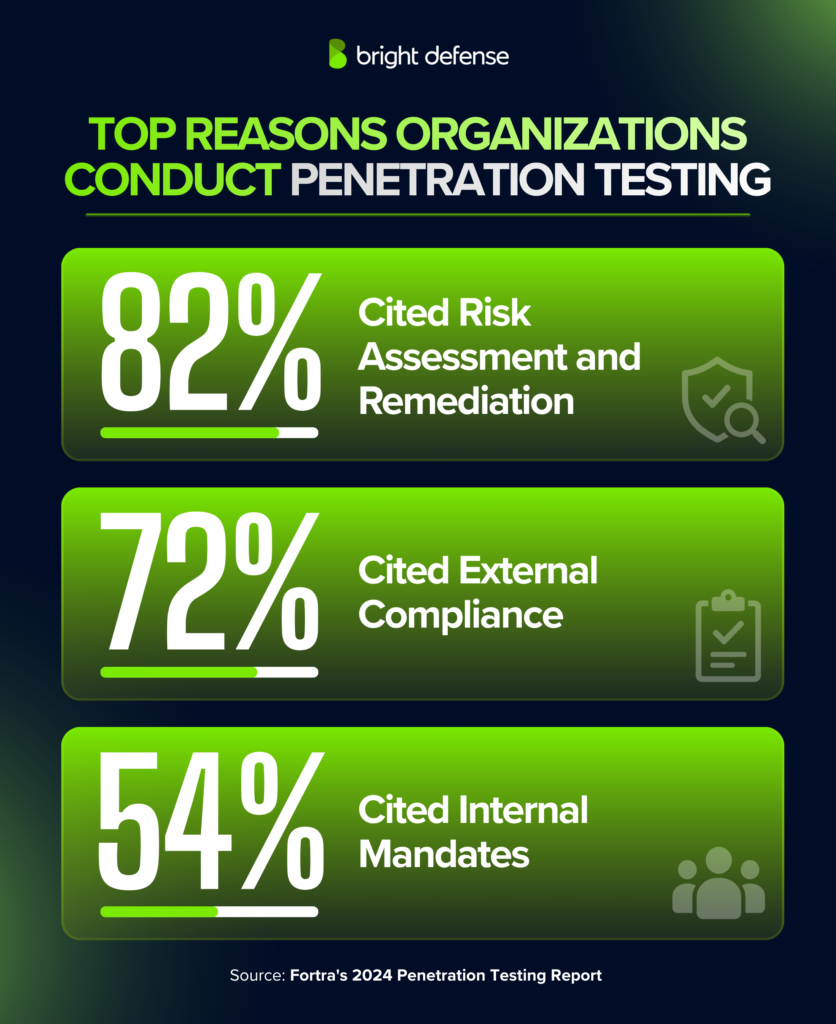
This confirms most teams run a test with more than one objective in mind. Clear goals help you choose the right testing scope, timeline, methodology, and provider.
A provider should ask about your business objectives before quoting the project.
The scope should cover the systems, applications, cloud assets, APIs, networks, user roles, and testing limits involved in the engagement, and matching scope to the right types of penetration testing keeps the work focused.
A vague scope usually leads to vague results.
2. Choose A Provider That Uses Both Manual & Automated Testing
A strong penetration testing company uses automated tools for speed and coverage, but relies on human testers for deeper analysis. Automated scanners can find common vulnerabilities quickly, while manual testers can identify business logic flaws, chained exploits, authorization issues, and workflow abuse that tools often miss.
This balance is important because business logic abuse accounted for 27% of API attacks in 2023, making it the largest single API attack category. Scanners struggle with these flaws because the attack traffic often looks like normal user behavior.
That is why manual testing is crucial: a skilled tester can understand the application’s intended workflow, spot where that workflow can be abused, and prove whether the issue creates real business risk.
The right provider should explain the balance between tool-based testing and manual effort. A company that offers only automated scans is usually closer to a vulnerability scanning vendor than a true penetration testing partner, and it helps to understand the difference between a penetration test and a vulnerability scan before you compare quotes.
3. Review Tester Qualifications And Security Experience
The quality of a penetration test depends heavily on the people assigned to the project. Ask how the company sources its testers, what certifications they hold, what industries they serve, and whether the same team works together across engagements.
Good signs include hands-on exploit experience, active security research, participation in the cybersecurity community, internal training, peer review, and experience with your technology stack. Company-level credentials matter, but the background of the actual testers matters more. In Pentera’s State of Pentesting 2025 report, 48% of CISOs named the availability of skilled penetration testers as the top reason they don’t test more often. A capable team is the scarce part of the equation, which is why the people behind the report deserve scrutiny.
For regulated industries, ask whether the testers understand the compliance frameworks that apply to your organization. These may include PCI DSS, HIPAA, NIST, CIS, or sector-specific cybersecurity rules.
Bright Defense brings certified security and compliance expertise to penetration testing engagements. The company is an ISO 27001:2022 certified provider, with CISSP, CISA, and ISO 27001 Lead Auditor staff who understand how to connect technical findings to frameworks such as SOC 2, ISO 27001, HIPAA, and CMMC.
4. Ask About The Testing Methodology
A reliable penetration testing company follows a documented and repeatable methodology. The process should include scoping, reconnaissance, vulnerability analysis, exploitation, post-exploitation analysis, reporting, and remediation support.
Recognized frameworks such as OWASP, NIST, PTES, and industry-specific standards can help create consistency across engagements. A repeatable process matters because penetration testing should not depend only on one individual tester’s habits. The provider should have checklists, playbooks, quality review, and internal oversight to produce consistent results.
The methodology should still allow room for customization. Every environment has different assets, business processes, user roles, and risk patterns. The best providers combine a standard process with testing decisions based on your actual systems.
5. Evaluate Report Quality Before You Sign
A penetration test is only useful when the report is clear, accurate, and actionable. Ask for a sanitized sample report before choosing a vendor.
A strong report should include an executive summary for leadership, technical findings for developers, proof-of-concept evidence, affected assets, risk ratings, business impact, remediation steps, and retesting guidance. The report should explain which vulnerabilities matter most and why they should be fixed first.
Risk prioritization should account for more than generic severity scores. A good provider considers asset criticality, exploit likelihood, data sensitivity, exposure level, and business impact. This helps your team focus on the vulnerabilities that create the greatest real-world risk.
6. Confirm Remediation Support And Retesting
The best penetration testing companies stay involved after the final report. Finding vulnerabilities is only the first part of the engagement. Your team still needs to understand the findings, apply fixes, and confirm that those fixes work.
In Pentera’s State of Pentesting report, 26% of CISOs named a lack of internal resources to remediate findings as a reason they do not test more often, which shows how often the work backs up after the vulnerabilities are identified.
Ask whether the provider offers post-test consultations, remediation guidance, developer support, and retesting. Retesting is especially important for high-risk and critical vulnerabilities because it verifies that the issue was fixed and that the fix did not introduce a new weakness.
A provider that hands over a report with no support leaves your team with more work and less certainty.
7. Check Communication During The Engagement
Clear communication is a major part of a successful penetration test. The provider should give you a dedicated point of contact, a testing schedule, escalation rules, and a plan for urgent findings.
Critical vulnerabilities should be reported as soon as they are confirmed. Waiting until the final report can leave exploitable issues open longer than necessary. The provider should explain how they will communicate high-risk findings, how often they will provide updates, and which channels will be used during the test.
This is especially important when testing production systems, customer-facing applications, or environments with strict uptime requirements.
8. Ask How They Protect Sensitive Data
Penetration testing can expose personal data, financial records, credentials, source code, internal system details, and other sensitive information. A trustworthy provider should have clear rules for how test data is accessed, stored, transmitted, and destroyed.
Ask whether they use encryption, access controls, secure file transfer, limited data retention, and non-disclosure agreements. The provider should be able to explain who can access your data, where it is stored, and how long it is kept after the engagement ends.
Weak data handling creates unnecessary risk during a process that is supposed to reduce risk.
9. Look For Scalability And Long-Term Fit
Your penetration testing needs will change as your company grows. A provider that works for one small application may not fit a larger environment with multiple applications, cloud systems, APIs, third-party integrations, and recurring compliance needs.
Ask how the provider supports repeat testing, multiple teams, development workflows, ticketing systems, vulnerability tracking, trend reporting, and program maturity over time. A long-term partner should help your organization track progress, reduce repeated findings, and improve remediation workflows.
The right provider should function as an extension of your security team, not just a vendor that appears once a year.
10. Watch For Red Flags
Avoid providers that offer only automated scans, refuse to share sample reports, give vague answers about methodology, lack qualified testers, provide unclear pricing, or have no plan for remediation support. Low pricing can be attractive, but it may signal shallow testing, inexperienced resources, or limited manual effort.
A strong penetration testing company should be transparent about scope, process, timeline, deliverables, data security, tester qualifications, reporting, and retesting. The final choice should be based on security value, not only cost.
Questions You Must Ask A Penetration Testing Company
The right questions help you separate a real penetration testing partner from a vendor that only runs automated scans and sends a basic report. Here are 10 typical question you should ask before signing up with any company:
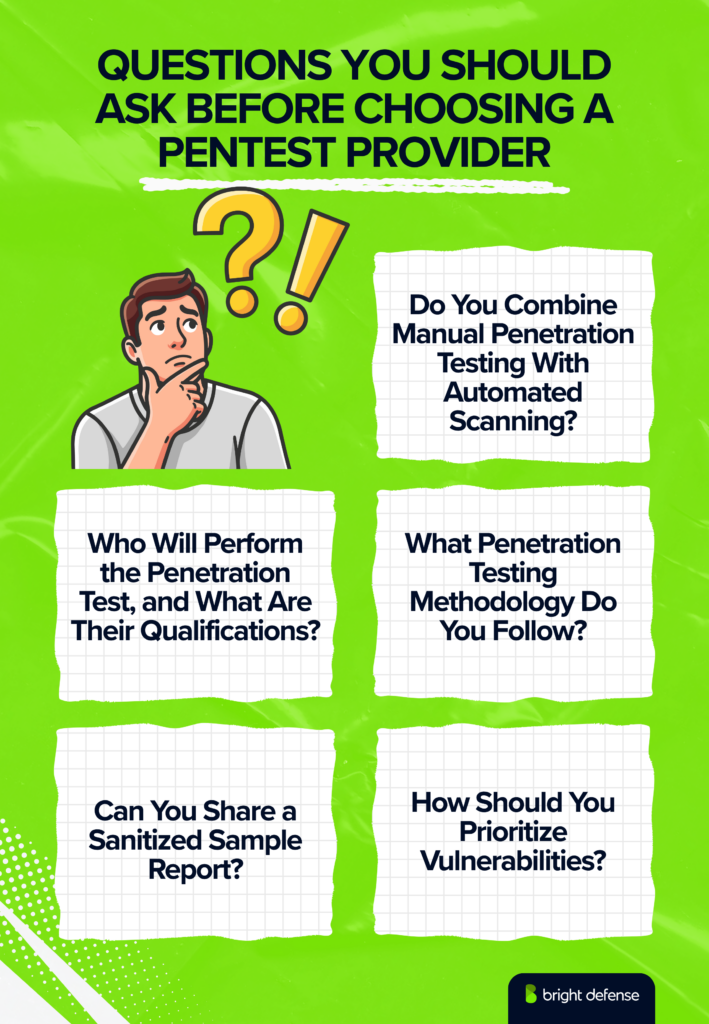
- Do you combine manual penetration testing with automated scanning?
A strong provider should use automated tools for speed and coverage, then rely on expert testers to find business logic flaws, chained vulnerabilities, authorization issues, and context-specific risks that scanners often miss.
- Who will perform the penetration test, and what are their qualifications?
Ask about the experience, certifications, training, and industry background of the actual testers assigned to your project. The value of the test depends on the people doing the work, not only the company’s brand name.
- What penetration testing methodology do you follow?
The provider should explain a repeatable process that covers scoping, reconnaissance, vulnerability analysis, exploitation, post-exploitation review, reporting, and remediation support. Look for alignment with recognized frameworks such as OWASP, NIST, or PTES.
- Can you share a sanitized sample report?
A sample report shows whether the provider can explain findings clearly for both technical teams and executives. The report should include proof of concept, affected assets, risk ratings, business impact, and practical remediation steps.
- How do you prioritize vulnerabilities?
The provider should prioritize findings based on real business risk, not only generic severity scores. Strong prioritization considers asset criticality, exploit likelihood, data sensitivity, exposure level, and potential business impact.
- Do you provide remediation guidance after the test?
A good penetration testing company should help your team understand each finding, reproduce the issue, and apply the correct fix. The provider’s role should not end when the final report is delivered.
- Do you offer retesting after vulnerabilities are fixed?
Retesting confirms that remediation worked and that the fix did not introduce a new weakness. This is especially important for critical and high-risk findings.
- How do you handle sensitive data during the engagement?
Ask how the provider stores, transmits, limits access to, and deletes sensitive information found during testing. The answer should cover encryption, access controls, data retention, secure file transfer, and non-disclosure agreements.
- How will you communicate during the test?
The provider should define a point of contact, update schedule, escalation process, and urgent-notification plan. Critical findings should be reported as soon as they are confirmed, not held until the final report.
- Can your services scale with our security program over time?
A long-term partner should support repeat testing, multiple applications, cloud assets, APIs, ticketing integrations, vulnerability tracking, and program-level reporting as your environment grows.
Final Verdict
Choose the penetration testing company that can prove its ability to find real vulnerabilities, explain business impact, guide remediation, and support your security program over time. The best provider combines automation, human expertise, repeatable methodology, clear communication, secure data handling, and practical reporting that your technical and executive teams can act on.
Looking for a provider specifically for SOC 2? Read our guide to the best penetration testing companies for SOC 2 compliance to compare suitable options.
Check similar articles:
- Top Penetration Testing Companies in Los Angeles
- Best Penetration Testing Companies Worldwide
- Best Cybersecurity Companies in Los Angles
FAQ
A strong shortlist includes NetSPI for enterprise PTaaS, Bishop Fox for advanced offensive security, Coalfire for regulated environments, GuidePoint Security for customized testing, Cobalt for agile PTaaS, TrustedSec for manual testing and red teaming, Rapid7 for broad security testing, NCC Group for global technical assurance, and Bright Defense for compliance-focused startups and growing companies.
NetSPI, GuidePoint Security, and NCC Group are strong enterprise options. NetSPI provides more than 50 test types through a human-led PTaaS model, GuidePoint offers manual, cloud, OT, purple-team, and red-team assessments, and NCC Group supports both point-in-time tests and broader attack simulations.
Bishop Fox, Cobalt, TrustedSec, and NetSPI are strong choices for modern application environments. Their published services cover web applications, APIs, cloud systems, mobile apps, AI or LLM systems, and complex application architectures that automated scanners may not test properly.
Coalfire is a strong option for federal and highly regulated work because it provides FedRAMP assessment services that include penetration testing. Bright Defense is a practical option for startups and mid-sized companies seeking tests tied to SOC 2, ISO 27001, PCI DSS, or CMMC requirements, with remediation guidance and retesting included.
Compare the exact systems covered, the amount of manual testing, tester experience, testing methodology, reporting quality, remediation support, retesting terms, and whether work is completed internally or through a crowdsourced model. A strong provider should explain how tools support human testing rather than presenting an automated scan as a complete penetration test.
A smaller SaaS company usually benefits from a provider with fixed or clearly defined scope, web and API expertise, audit-ready reporting, and included retesting. Bright Defense publishes fixed-scope plans covering 48, 96, or 176 testing hours, while Cobalt offers a platform-based model designed for repeatable application testing.
It depends on the application size, number of user roles, API endpoints, networks, cloud accounts, and testing depth. One current pricing guide places a web application penetration test at approximately $3,000 to $22,500, while complex enterprise, red-team, or continuous testing programs can cost considerably more.
It depends on provider availability and how quickly the scope and authorization are completed. Cobalt states that some PTaaS engagements can begin in as little as 24 hours, but larger tests normally require more preparation because target systems, user roles, exclusions, testing windows, and escalation contacts must be agreed upon first.
Yes. A provider can test relevant applications, APIs, networks, and cloud environments and supply documented findings, remediation guidance, and retest evidence for the audit process. The report should clearly state the scope, methodology, results, and status of corrected findings so auditors and customers can understand what was tested.
A useful report should contain an executive summary, testing scope, methodology, technical findings, supporting evidence, risk ratings, affected assets, practical fixes, and retest results. NCC Group also recommends a customer-shareable summary covering the scope, testing time, methodology, initial results, and the status of findings after retesting.