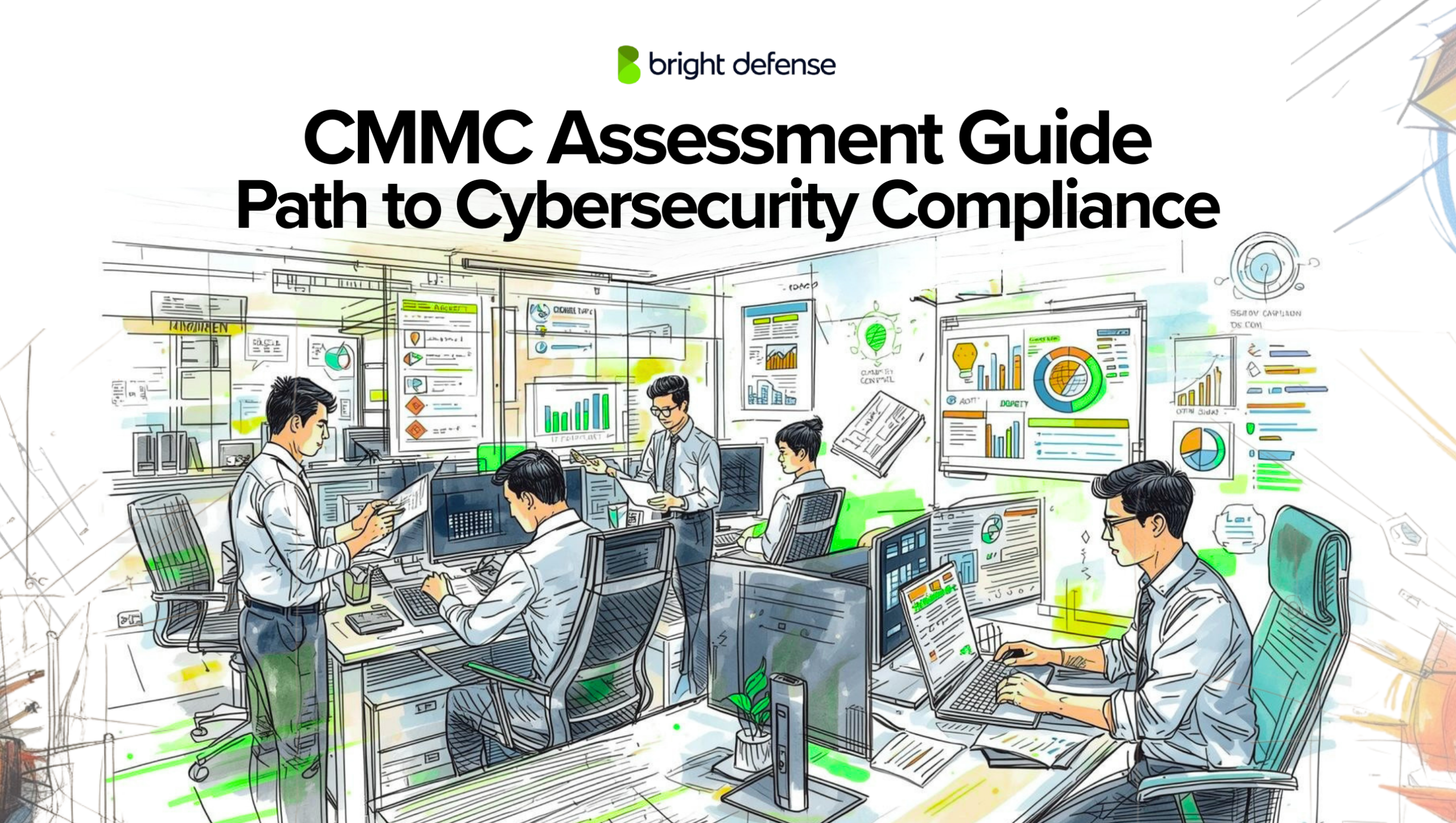
CMMC Assessment Guide: Path to Cybersecurity Compliance
Updated:
September 21, 2026
Cyberattacks are becoming increasingly sophisticated and prevalent. Safeguarding sensitive data and securing government contracts has never been more critical. The Department of Defense (DoD) introduced the Cybersecurity Maturity Model Certification (CMMC) to address these concerns. This framework has quickly become a crucial standard for businesses looking to enhance their cybersecurity posture and maintain compliance.
In this comprehensive CMMC Assessment Guide, we will explore the ins and outs of CMMC and provide valuable insights for businesses interested in achieving and maintaining CMMC compliance.
At Bright Defense, we specialize in continuous cybersecurity compliance services, making us your trusted partner on this journey. If you are interested in CMMC compliance services, contact us today!
What is CMMC?
The Cybersecurity Maturity Model Certification, or CMMC, is a unified standard designed to assess and enhance the cybersecurity posture of organizations that engage with the U.S. Department of Defense (DoD). This framework aims to standardize cybersecurity practices across the defense industrial base (DIB) and ensure that contractors and subcontractors meet the necessary cybersecurity requirements.
The original CMMC framework was announce in 2019. It featured five levels of maturity (1-5) with increasing requirements as the levels progressed. In November 2021, the Department of Defense released CMMC 2.0. This streamlined the compliance model into three tiers (Levels 1, 2 and 3).
Why is CMMC Necessary?
The need for CMMC arises from the ever-increasing cyber threats organizations face, particularly those dealing with sensitive government data and contracts. In an era of data breaches and cyberattacks, CMMC provides a robust defense mechanism to safeguard sensitive information and ensure the integrity of the defense supply chain.
Overview of CMMC Levels
CMMC 2.0 comprises three maturity levels. CMMC Level 1 is the most basic level. It comprises 17 practices from NIST 800-171. Companies that meet Level 1 compliance are required to submit an annual self assessment. Bright Defense can assist with the 17 controls and the assessment process.
CMMC 2.0. Level 2 is aligned with NIST SP800-171. It comprises 110 controls. A third-party assessments are required every three years for critical national security data. Annual self assessments will also be required.
CMMC 2.0 Level 3 is the most stringent. There are over 110 requirements based on NIST SP 800-171 and 800-172. Government-led assessments will be required every three years for Level 3 contractors.
CMMC 2.0 is currently in the rule-making process. Companies that want to do business with the defense industrial base must meet CMMC 2.0 once the rules go into effect. This is estimated to take place in 2024.
CMMC Assessment Process
Let’s look at the CMMC assessment process in detail:
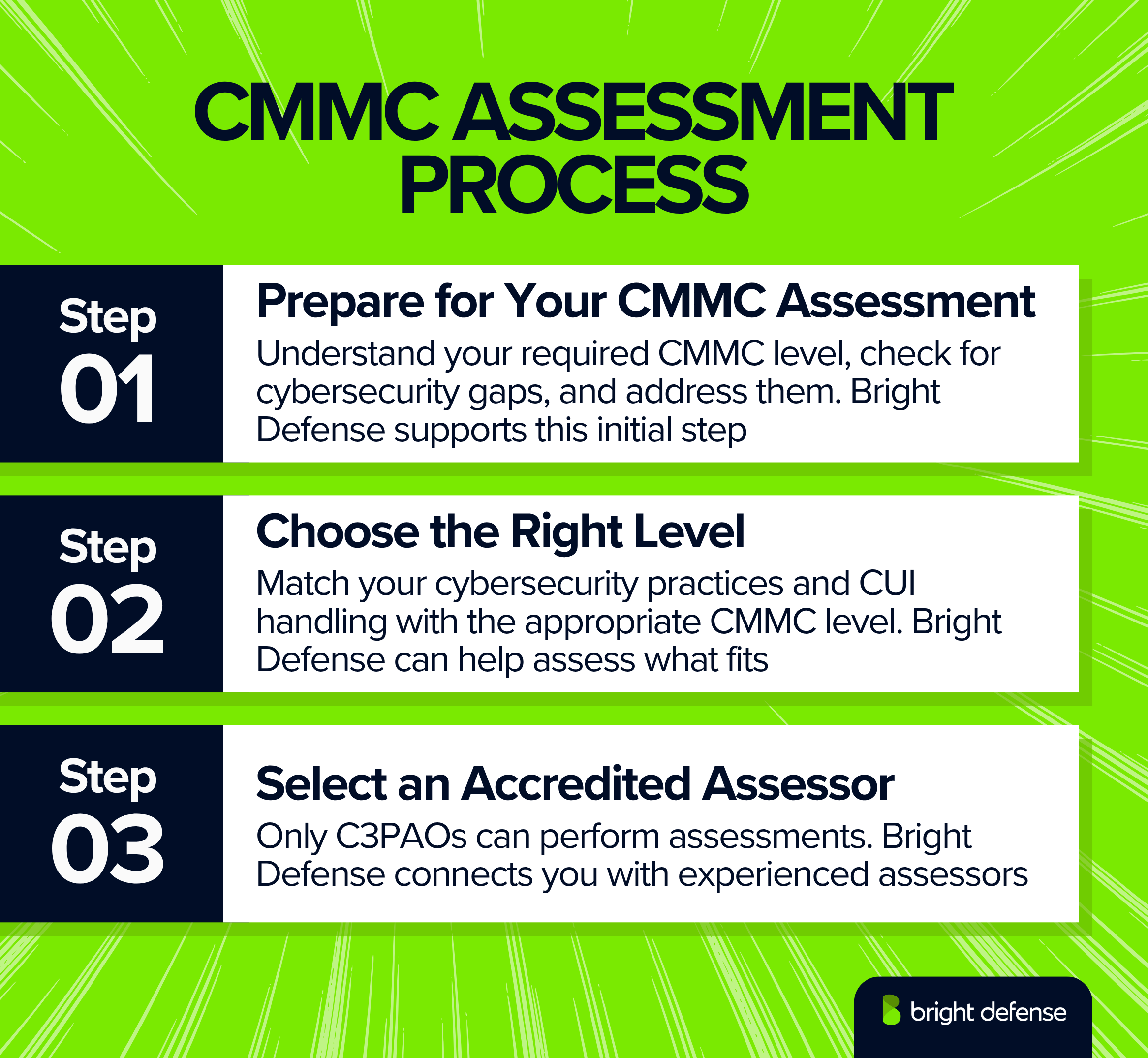
1. Preparing for a CMMC Assessment
Preparation is key to a successful CMMC assessment. It involves understanding the requirements of your chosen CMMC level, identifying potential gaps in your cybersecurity practices, and putting corrective measures in place. Bright Defense specializes in assisting organizations with this preparatory phase.
2. Choosing the Right Assessment Level
Selecting the appropriate CMMC level is crucial. Businesses should assess their current cybersecurity practices, the nature of their work with the DoD, and the level of CUI they handle to determine the most suitable level. Bright Defense can provide guidance in this decision-making process.
3. Selecting an Accredited Assessor
Certified Third-Party Assessor Organizations (C3PAOs) must conduct CMMC assessments. Choosing the right assessor is essential to ensure a fair and thorough evaluation. Bright Defense can help you connect with reputable assessors experienced in CMMC assessments.
CMMC Compliance Steps
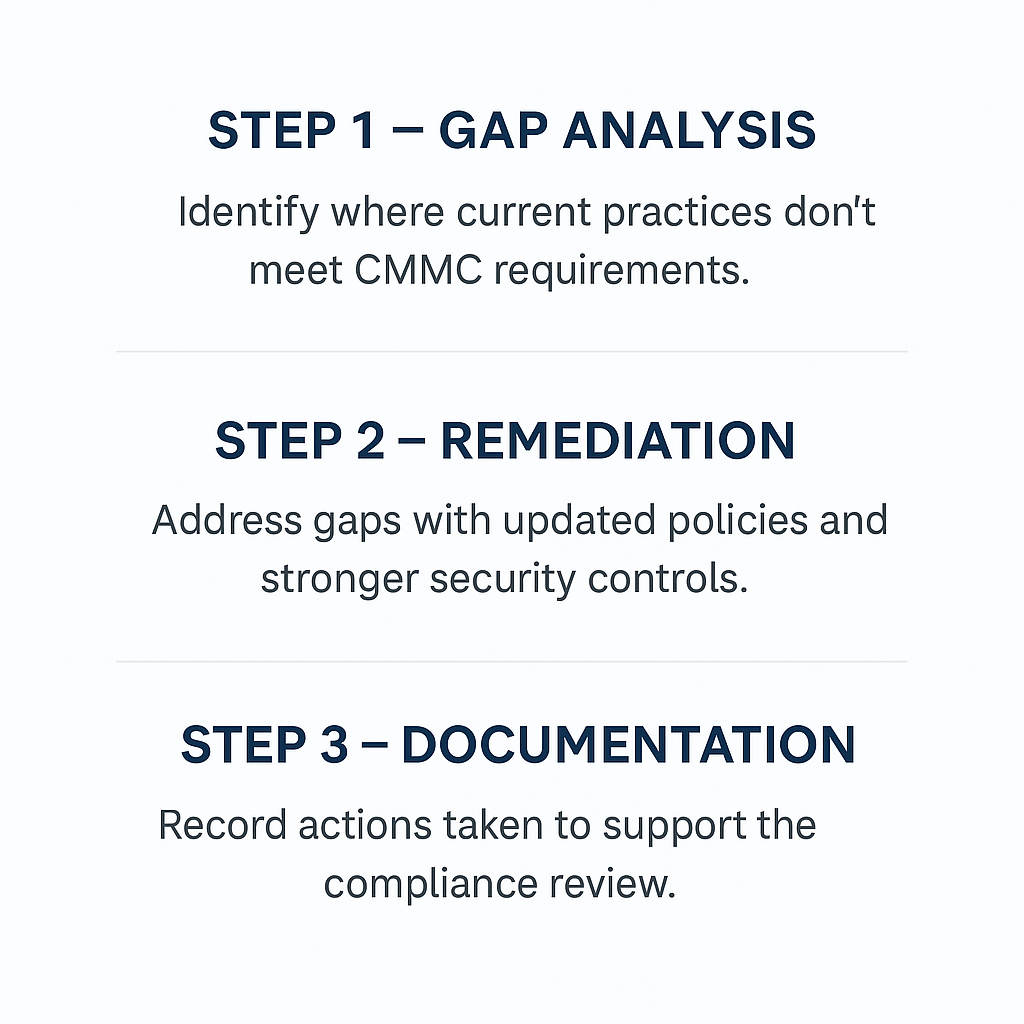
CMMC compliance requires a step-by-step approach to meet federal cybersecurity standards. The process below outlines the key phases to prepare for certification:
Step 1 – Gap Analysis
Conducting a gap analysis is the first step towards CMMC compliance. This process involves identifying areas where your organization’s current cybersecurity practices fall short of the requirements outlined in the chosen CMMC level. Bright Defense’s expertise in this phase can significantly streamline the process.
Step 2 – Remediation
Once gaps are identified, organizations must take corrective action to address vulnerabilities and shortcomings. Remediation involves implementing cybersecurity best practices, updating policies and procedures, and enhancing security controls to meet CMMC requirements.
Step 3 – Documentation
Documentation is a crucial aspect of CMMC compliance. Organizations must maintain accurate records of their cybersecurity practices and actions taken during the gap analysis and remediation phases. These records serve as evidence during the assessment process.
CMMC Assessment Prcess
Let’s check out the CMMC assessment process:
1. The Assessment Process
During a CMMC assessment, certified assessors evaluate an organization’s cybersecurity practices against the selected CMMC level. This involves reviewing documentation, conducting interviews, and assessing the effectiveness of security controls. The assessment process ensures that organizations meet the required standards.
2. Handling Assessment Findings
Assessment findings can result in various outcomes, ranging from full compliance to non-compliance with the chosen CMMC level. It is essential to address any non-compliance issues promptly, implementing corrective measures and documenting the changes made.
Maintaining CMMC Compliance
Here’s how you can maintain CMMC compliance:
1. Continuous Monitoring
CMMC compliance is not a one-time achievement; it requires continuous monitoring and improvement. Organizations should establish processes for ongoing cybersecurity maintenance and regularly update their practices to stay aligned with evolving threats and CMMC requirements. Bright Defense offers continuous cybersecurity compliance services to support this critical aspect of compliance.
2. Dealing with Changes in CMMC
The cybersecurity landscape is dynamic, and CMMC requirements may evolve over time. Organizations must stay informed about changes and updates to the CMMC framework to ensure continued compliance. This involves ongoing training, assessments, and adjustments to cybersecurity practices.
CMMC vs. NIST SP 800-171: Understanding the Key Differences
Before the introduction of the Cybersecurity Maturity Model Certification (CMMC), the National Institute of Standards and Technology (NIST) Special Publication 800-171 was the primary framework for safeguarding Controlled Unclassified Information (CUI).
While CMMC builds upon the foundation of NIST SP 800-171, it introduces several critical differences and improvements that organizations must be aware of when transitioning to this new standard.
CMMC vs. NIST SP 800-171 Comparison Table
| Aspect | NIST SP 800-171 | CMMC (Cybersecurity Maturity Model Certification) |
|---|---|---|
| Certification vs. Self-Assessment | Self-assessment model. Organizations create a System Security Plan (SSP) and a Plan of Action and Milestones (POA&M) to track compliance. | Requires third-party certification. Certified Third-Party Assessor Organizations (C3PAOs) evaluate and certify organizations at one of three levels. |
| Maturity Levels | No maturity levels. All security requirements are applied uniformly. | Three defined maturity levels, allowing organizations to align cybersecurity efforts with data sensitivity and risk. |
| Progressive Requirements | Static controls. Compliance is binary – either a control is implemented or not. | Requirements increase with each maturity level. Higher levels demand greater cybersecurity capabilities. |
| Assessment Scope | Focused on protecting Controlled Unclassified Information (CUI) only. | Broader focus including APT defense and securing the defense supply chain. Reflects wider DoD cybersecurity goals. |
| Ongoing Monitoring | Encouraged, but not clearly defined. No strict requirements for frequency or scope. | Emphasizes continuous monitoring and responsiveness to emerging threats. Ongoing security practices are expected. |
Certification vs. Self-Assessment
CMMC assessment responsibilities depend on the required level and assessment type, while NIST SP 800-171 defines security requirements without establishing a certification program.
| NIST SP 800-171 | CMMC |
|---|---|
| Revision 2 requires a System Security Plan (SSP) and plans of action to address deficiencies. Assessment obligations come from applicable contracts and regulations; they can include contractor self-assessments and government assessments. | Level 1 requires self-assessment. Level 2 requires self-assessment or certification assessment by an authorized or accredited CMMC Third-Party Assessment Organization (C3PAO), depending on the contract. Government assessors conduct Level 3 certification assessments. |
Maturity Levels
| NIST SP 800-171 | CMMC |
|---|---|
| Organizations implement applicable security requirements to protect Controlled Unclassified Information (CUI). The publication does not divide these requirements into maturity levels. | Level 1 has 15 safeguarding requirements. Level 2 uses 110 requirements from NIST SP 800-171 Revision 2. Level 3 adds 24 selected requirements from NIST SP 800-172. Contractors must meet the level specified in their contracts. |
Progressive Requirements
- NIST SP 800-171: NIST SP 800-171 provides a static set of security controls that organizations must implement. Compliance was largely binary – either a control was in place, or it was not.
- CMMC: CMMC’s maturity levels are progressive, with each level building upon the requirements of the previous one. This approach encourages organizations to improve their cybersecurity posture and adapt to evolving threats continuously. Achieving a higher CMMC level reflects greater cybersecurity maturity and capability.
Assessment Scope
- NIST SP 800-171: Organizations could focus solely on the protection of CUI when implementing NIST SP 800-171 controls.
- CMMC: CMMC considers a broader range of security practices, including protection against advanced persistent threats (APTs) and ensuring the overall security of the defense supply chain. This expanded scope addresses the evolving cyber landscape and aligns with the DoD’s commitment to enhancing cybersecurity across its contractor base.
Ongoing Monitoring
- NIST SP 800-171: While NIST SP 800-171 encouraged organizations to continuously monitor their security controls, it did not specify the frequency or extent of monitoring activities.
- CMMC: CMMC emphasizes the importance of continuous monitoring and adaptation. Organizations must maintain ongoing security practices and stay vigilant against emerging threats. This focus on continuous improvement is integral to CMMC compliance.
How CMMC Builds on NIST SP 800-171
CMMC formalizes verification of cybersecurity requirements, including NIST SP 800-171 Revision 2 at Level 2. Its three levels establish different safeguards and assessment obligations, with self-assessments, third-party assessments, or government assessments depending on contract requirements.
Organizations preparing for CMMC should confirm their required level, define their assessment scope, document implemented controls, and maintain continuing compliance. Existing obligations to protect sensitive information remain in force.
Final Thoughts
CMMC compliance supports the protection of sensitive defense information and eligibility for contracts with CMMC requirements. Organizations should confirm their required level, prepare assessment evidence, address security gaps, and maintain applicable safeguards.
Bright Defense’s CMMC compliance services help businesses prepare for assessments and manage ongoing responsibilities. Regular reviews, employee training, and compliance monitoring support continued compliance as systems, threats, and contractual requirements change.
Bright Defense Delivers CMMC Compliance Solutions!
Bright Defense helps organizations prepare for CMMC assessments and maintain ongoing compliance. Its CISSP- and CISA-certified experts support security program development, gap analysis, risk assessments, policy implementation, and remediation. These services help your organization evaluate readiness and address gaps against its required CMMC level.
Bright Defense’s CMMC compliance services include security awareness training, phishing simulations, compliance automation, and virtual Chief Information Security Officer (vCISO) support. This ongoing assistance helps your team maintain security practices and organize assessment evidence.
Meeting applicable CMMC requirements supports eligibility for covered Department of Defense contracts and helps protect sensitive defense information. Contact Bright Defense to discuss your assessment preparation and ongoing compliance needs.
Frequently Asked Questions (FAQs)
What is the difference between a CMMC self-assessment and a third-party assessment?
A CMMC self-assessment involves an organization evaluating its own implementation of applicable security requirements. A third-party assessment involves an authorized or accredited CMMC Third-Party Assessment Organization (C3PAO) evaluating Level 2 compliance. Government assessors conduct Level 3 certification assessments.
What is CMMC 2.0, and how does it impact CMMC compliance requirements?
CMMC 2.0 revises the original five-level model into three levels with defined security and assessment requirements. Level 2 uses the 110 requirements from NIST SP 800-171 Revision 2. Organizations must meet their contractual requirements for assessment type, reporting, and continuing compliance.
Can organizations still perform self-assessments under CMMC 2.0?
Organizations perform self-assessments annually for Level 1 and every three years for Level 2 contracts that specify self-assessment. Both require annual affirmations of continuing compliance. Self-assessment is a recognized route to the applicable CMMC status, subject to the contract’s requirements.
How does CMMC support national security?
CMMC supports national security through verification of safeguards for Federal Contract Information (FCI) and Controlled Unclassified Information (CUI). These safeguards help reduce unauthorized access and disclosure across defense contractors and subcontractors. Level 3 adds requirements designed to address advanced persistent threats.
What is the self-assessment process in CMMC?
A CMMC self-assessment evaluates implemented safeguards against the applicable level’s assessment objectives. Organizations define their assessment scope, examine evidence, interview personnel, test controls, and record results. They submit results and a senior official’s compliance affirmation in the Supplier Performance Risk System (SPRS).
What is included in the assessment report after a CMMC assessment?
A CMMC certification assessment report documents the scope, assessment findings, and results for applicable security requirements. Supporting records include assessor information, evidence references, and any permitted Plan of Action and Milestones (POA&M). Findings explain unmet requirements and support decisions about corrective action and assessment status.
Can an organization solely rely on CMMC self-assessments for compliance?
Self-assessment can satisfy the assessment requirement for Level 1 and contracts specifying Level 2 self-assessment. Organizations must maintain the required safeguards, submit results, and complete annual affirmations. Contracts requiring Level 2 certification or Level 3 require the corresponding third-party or government assessment.
How can organizations improve their security posture with CMMC?
Organizations can strengthen security through implementation and maintenance of applicable CMMC safeguards. Practical activities include restricting access, training personnel, correcting vulnerabilities, monitoring systems, and testing incident response procedures. Accurate documentation and periodic control reviews help organizations demonstrate that safeguards remain effective.
What is the role of information systems in CMMC compliance?
Information systems determine where applicable CMMC safeguards must operate. Assessment scope depends on the required level and the assets that handle covered information or provide security functions. Organizations must document relevant system boundaries and apply the scoping rules for their assessment level.
Where can I learn more about CMMC and its compliance requirements?
Official DoD CMMC resources, assessment guides, and applicable contract clauses explain program requirements. Bright Defense’s CMMC compliance services provide guidance on readiness, remediation, and ongoing compliance. Organizations should confirm their required level and assessment type before arranging an assessment.