Budget-Friendly SOC 2 Compliance: Practical Steps That Work
Updated:
August 25, 2026
Startups often view compliance as an afterthought, yet it is increasingly tied to revenue. This guide lays out everything a founder needs to know about SOC 2: how a security attestation accelerates sales, when mid‑market and enterprise customers will ask for it, what a lean first‑year budget looks like, and practical ways to keep costs in check.
It concludes with warnings about common missteps that increase expenses. Focusing on the controls buyers care about, using automation to minimize manual work and allocating budget where it drives the most value, founders can turn compliance from a cost center into a growth enabler.
Key Takeaways
- 83% of enterprise buyers require SOC 2 from SaaS vendors before signing
- Type 1 audits cost $5,000–$20,000. Type 2 runs $10,000–$100,000 with a minimum 3-month observation period
- Automation platforms ($10,000–$20,000/year) replace most consulting work and cut manual effort significantly
- Security is the only required SOC 2 criterion. Add others only when customers ask
- Skipping MFA, logging, or access reviews always costs more in remediation than meeting them upfront
How to Get SOC 2 Certified on a Tight Budget
A lean SOC 2 program focuses on the controls and criteria that customers actually request, automates evidence collection, and compares auditors early.
The following steps outline the most cost‑effective path to a first SOC 2 report.
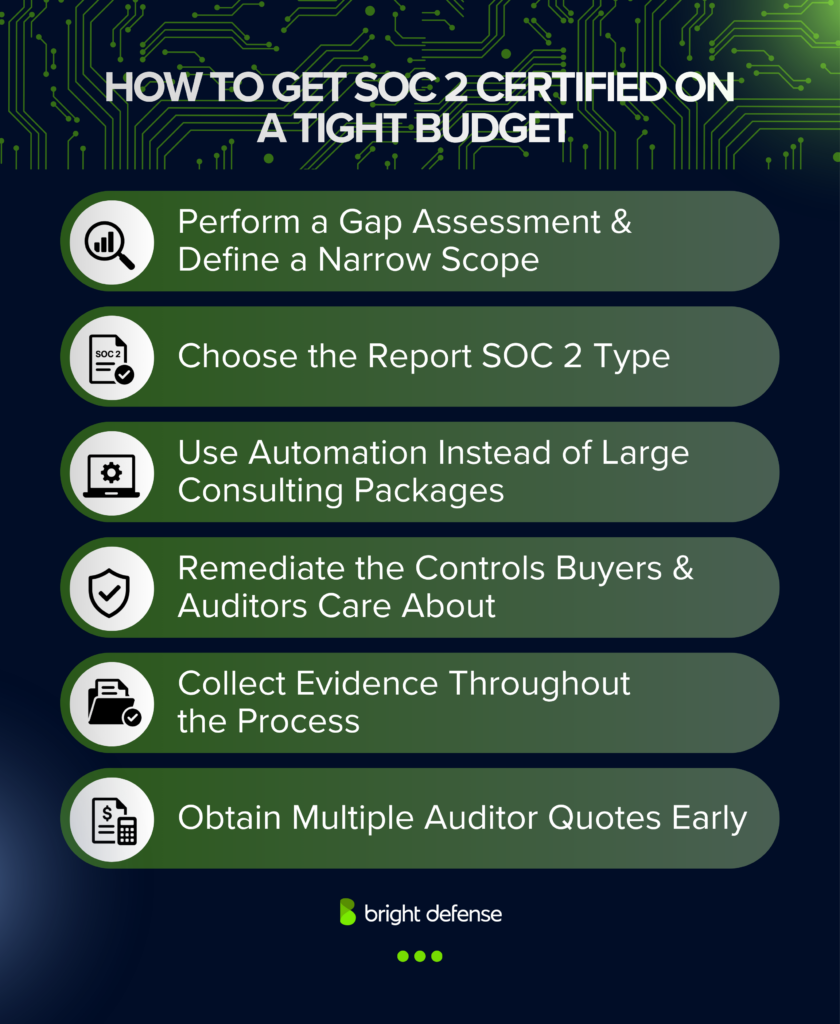
1. Perform a Gap Assessment and Define a Narrow Scope
Before purchasing tools or hiring an auditor, conduct a SOC 2 gap assessment to review your current policies, systems, vendors and personnel in scope. SOC 2 is built around the AICPA Trust Services Criteria; Security is the only criterion required for every SOC 2 audit.
Additional criteria (Availability, Confidentiality, Privacy and Processing Integrity) can be added later when customers request them. A smaller scope usually means fewer controls to document, fewer screenshots and interviews, and lower audit fees.
2. Choose the Report Type That Matches Sales Reality
Type 1 audits review control design at a point in time, while Type 2 audits test whether those controls operated effectively over a period of at least three months. Type 1 reports are faster and less expensive; small and mid‑sized companies typically pay $5,000–$20,000 for a Type 1 exam. A deeper breakdown of SOC 2 Type 1 vs Type 2 compliance helps founders pick the right first report.
Type 2 reports provide stronger assurance but cost more. SOC 2 audit costs for Type 2 engagements generally range from $10,000–$100,000 or more and require a longer observation period. Many businesses start with a short Type 1 or limited Type 2 audit and expand later when customers demand a longer window.
3. Use Automation Instead of Large Consulting Packages
Automation platforms can drastically reduce the manual work of policy management, evidence collection and control tracking. Engaging consultants for readiness assessments, risk analyses and remediation often costs $10,000–$20,000 and requires significant staff time, typically 100 hours or more.
In contrast, the best SOC 2 compliance software costs $10,000–$20,000 per year and includes policy templates, evidence collection and integrations. Automating evidence collection reduces manual effort and lowers the total cost of compliance.
4. Remediate the Controls Buyers and Auditors Care About First
Spend budget on the controls that matter most to the Security criterion and your customer risk profile.
For most startups, this means multi‑factor authentication, access control, centralized logging, backup and recovery, change management, vendor oversight, onboarding and off‑boarding, and incident response.
A narrow remediation plan prevents wasting money on controls that do not match your product, data or customer requirements.
5. Collect Evidence Throughout the Process
A SOC 2 audit becomes expensive when teams wait until the end to gather policies, screenshots, access reviews, training records, tickets and vendor documents.
Collecting evidence continuously during the preparation period reduces rework and cuts the need for outside help. Because Type 2 audits evaluate operating effectiveness over time, maintaining evidence across the observation period is essential.
6. Obtain Multiple Auditor Quotes Early
Audit pricing varies widely across SOC 2 audit firms. Large, brand‑name CPA firms charge premium rates, while smaller regional or platform‑partnered auditors often cost less.
For example, one industry guide notes that Type 1 audits generally cost $5,000–$20,000 for small and mid‑sized companies and Type 2 audits cost $10,000–$100,000 depending on company size and scope.
Collecting multiple quotes early helps you compare options, ask about bundled Type 1 and Type 2 packages, and avoid rush timelines that drive up costs.
A practical budget‑first plan limits the initial scope to Security, uses an automation tool for policy and evidence work, assigns one technical owner and one executive sponsor, and involves shopping carefully for an auditor. This approach helps startups obtain a first SOC 2 report while keeping compliance costs reasonable.
Five Strategies to Cut SOC 2 Costs
SOC 2 costs drop when businesses keep the process lean, limit manual work and avoid paying for services they do not need.
The following strategies highlight practical ways to reduce first‑year compliance spend without weakening audit readiness:
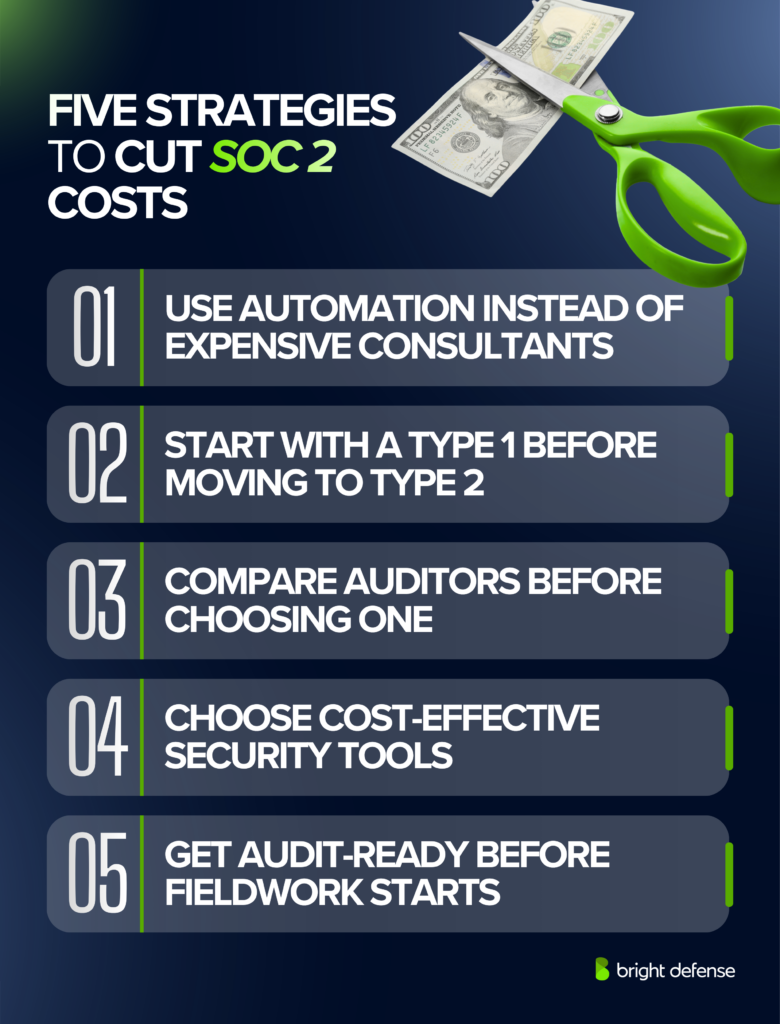
1. Use Automation Instead Of Expensive Consultants
Automation cuts SOC 2 costs because most spending comes from preparation work, not the audit. Tasks like evidence collection, policy management, and control monitoring drive costs that can reach $10,000 to $150,000+, with audits alone costing $5,000 to $150,000.
Automation tools handle these repeatable tasks inside software, which reduces consultant hours and shortens audit timelines. Companies rely on platforms for ongoing work and use consultants only for focused tasks like scoping or final checks.
2. Start With A Type 1 Before Moving To Type 2
Starting with a SOC 2 Type 1 reduces first-year compliance cost because it verifies control design at a single point in time instead of testing performance over months. Type 2 audits require longer review periods, higher evidence volume, and more audit effort, which increases fees from about $7,000 to $100,000+ compared to $5,000 to $20,000 for Type 1. This approach works when stakeholders accept a point-in-time report, while strict vendor requirements for Type 2 limit the cost advantage.
3. Compare Auditors Before Choosing One
Comparing auditors reduces SOC 2 costs because pricing varies widely across firms for the same scope. Audit fees typically range from $5,000 to $60,000, with some quotes near $12,000 for Type 1 and others exceeding $20,000 for similar work depending on criteria and complexity.
Differences come from scope assumptions, readiness level, and included advisory work. Evaluating multiple quotes against identical criteria, systems, and entities reveals unnecessary cost and prevents overpaying.
4. Choose Cost-Effective Security Tools
Choosing cost-effective tools lowers SOC 2 costs because audits evaluate control effectiveness, not product price. SOC 2 focuses on controls like access management, monitoring, and vulnerability handling, which lower-cost tools can support with clear evidence.
Pricing varies widely, from a few dollars per user for password managers to free or low-cost logging tiers, while penetration testing often ranges from $5,000 to $25,000 depending on scope. Matching tools to system size and risk level prevents unnecessary enterprise spending.
5. Get Audit-Ready Before Fieldwork Starts
Getting audit-ready before fieldwork reduces SOC 2 costs because auditors spend less time chasing missing evidence during testing. SOC 2 audits rely on complete documentation such as policies, access reviews, and logs, with programs often requiring over 200 controls.
Gaps delay fieldwork and increase billable time. Continuous evidence collection and early readiness checks keep documentation organized, shorten audit timelines, and reduce rework.
What Does a Low-Cost SOC 2 Budget Look Like?
A low-cost SOC 2 budget for a small team typically falls between $25,000 and $50,000 in the first year. The budget covers 4 core line items:
- A readiness assessment
- A compliance automation platform
- An auditor engagement
- Penetration testing
Internal staff time adds roughly 100 hours for policy writing, control configuration, and evidence collection.
SOC 2 Cost Breakdown by Line Item
| Expense | Typical Range |
| Readiness or gap assessment | $10,000–$15,000 |
| Compliance automation platform | $10,000–$20,000 per year |
| Type 1 audit (small to mid-size) | $5,000–$20,000 |
| Type 2 audit | $10,000–$100,000+ |
| Penetration testing | $5,000–$15,000 |
| Internal staff time | 100+ hours |
Small teams reduce SOC 2 costs by writing policies internally, starting with a Type 1 audit before a Type 2, and using lightweight tools for evidence collection. A lean first-year setup pairs a compliance platform at the lower end of the $10,000–$20,000 range with a Type 1 audit at $5,000–$20,000. Renewal years cost less once controls and evidence routines are established.
What Not to Cut When Reducing SOC 2 Costs
Cutting costs only works if you remove waste without weakening the controls that determine audit success. The following common mistakes often appear cheaper at first but lead to higher expenses later:
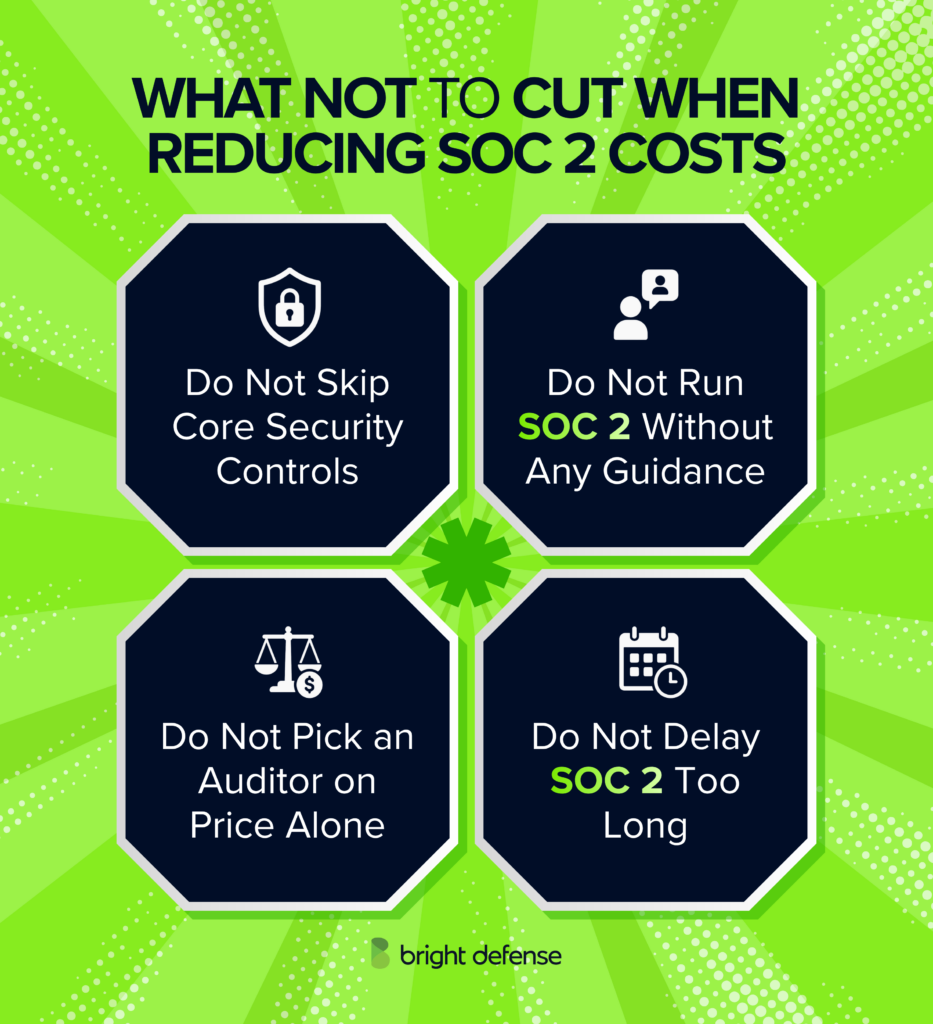
- Do not skip core security controls. Eliminating multi‑factor authentication, logging, access reviews or other required controls leads to audit issues and costly remediation. Instead, meet those requirements with lower‑cost tools or existing infrastructure.
- Do not run SOC 2 without any guidance. A fully do‑it‑yourself approach often causes mistakes in scope definition, policies and evidence, resulting in rework. A better option is to use an affordable platform or limited expert support that gives the team structure without the price of full‑service consulting.
- Do not pick an auditor on price alone. The lowest‑cost auditor may lack the experience needed for a smooth engagement. An auditor without the right background can create delays, raise avoidable issues or produce a report that buyers trust less. A startup‑friendly auditor with relevant experience is usually the better choice.
- Do not delay SOC 2 too long. Waiting to save money often costs more in lost deals, longer security reviews and slower procurement cycles. In many cases, one delayed enterprise contract costs more than a lean SOC 2 project.
Cutting bloated tools, unnecessary consulting and poor scoping reduces cost, but do not cut controls, guidance, audit quality or timing. A properly scoped SOC 2 program helps businesses unlock enterprise sales, satisfy investors and build trust while keeping compliance costs manageable.
Why SOC 2 Is a Business Investment, Not a Compliance Cost?
SOC 2 compliance functions as a sales accelerator because it provides the proof buyers need that a young company takes data protection seriously. Enterprise procurement teams frequently ask for a SOC 2 report early in the sales cycle, and failing to provide it can stall or even end negotiations.
A 2025 Vanta survey found that 83 % of enterprise buyers require SOC 2 certification from SaaS vendors before signing contracts. By demonstrating that controls are documented and operating, a SOC 2 report reduces risk concerns and supports faster procurement decisions.
When Does a Business Needs SOC 2?
A startup or a business usually pursues SOC 2 when it begins selling to mid‑market or enterprise customers, handles sensitive data, or faces formal security diligence from buyers and investors. A deeper look at who needs SOC 2 compliance walks through each trigger in detail.
The following situations are the most common triggers for SOC 2 adoption:
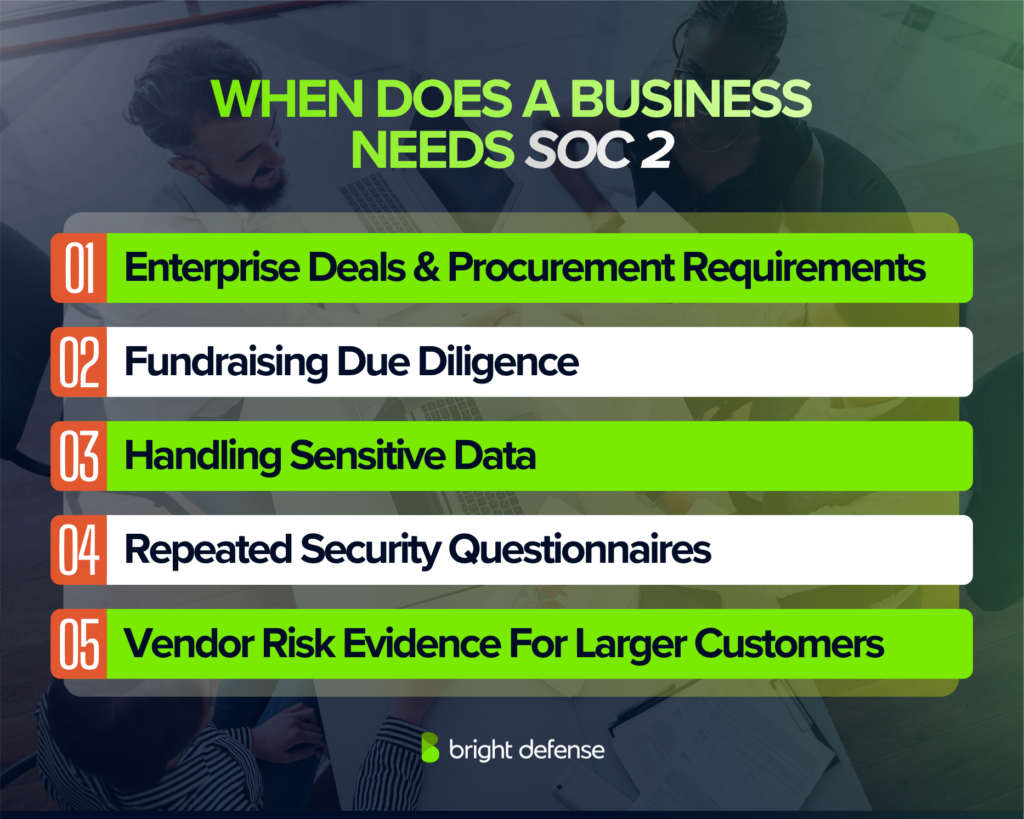
1. Enterprise Deals And Procurement Requirements
Large customers often make a SOC 2 report a formal procurement requirement. Security, legal, and procurement teams want evidence that controls are documented and functioning, and a missing report can delay or block the sale. Because Type 2 audits evaluate control effectiveness over three‑ to twelve‑month observation windows , businesses should plan ahead rather than wait until a major deal depends on compliance.
2. Fundraising Due diligence
Investors increasingly review a company’s security posture during Series A fundraising. A current SOC 2 report or a clear plan to obtain one signals that the business is preparing for larger customers and formal risk reviews.
3. Handling Sensitive Data
SOC 2 urgency rises when a product processes personally identifiable information, protected health information, payment data or other sensitive information. Customers expect stronger control evidence when the risk of exposure is higher.
4. Repeated Security Questionnaires
When security questionnaires from prospects begin to slow deals, a SOC 2 report provides standardized answers that reduce back‑and‑forth and gives sales teams a document they can share during due diligence.
5. Vendor Risk Evidence For Larger Customers
Mature companies often cannot approve a vendor without a recognized security report. SOC 2 provides a familiar format for evaluating controls and makes internal approval easier.
How Long Does It Take to Get SOC 2 Compliant?
A first‑time SOC 2 Type 2 audit usually requires at least a three‑month observation period in addition to pre‑audit preparation and report creation. A full timeline of how long it takes to get SOC 2 compliance covers each phase, from readiness through report issuance. Starting from scratch can take several months, so small and medium businesses should begin planning long before a major contract depends on compliance.
How Bright Defense Helps You Achieve Budget-Friendly SOC 2 Compliance
Bright Defense helps you get SOC 2 compliant faster with a budget-friendly, execution-focused approach built for growing teams. We handle scoping, control mapping, and gap remediation with clear direction so you avoid wasted effort and unnecessary tools. Our team prepares your policies, evidence, and audit artifacts from day one, which reduces delays and keeps costs predictable. If you want a clean path to SOC 2 without building an in-house compliance team, Bright Defense gives you the structure, support, and momentum to reach audit readiness with confidence.
FAQ
SOC 2 is a report on controls at a service organization relevant to security, availability, processing integrity, confidentiality, or privacy, and “on a budget” usually means scoping only what customers truly need and keeping the audit period and evidence work manageable.
A common low-cost path starts with a Type I to show control design, then moves to Type II when you can support an operating period, since published audit-fee ranges often place Type I around US$7,500–US$15,000 for small to midsize firms and Type II around US$12,000–US$20,000 for small to midsize firms.
Many breakdowns put the combined prep work plus audit in the US$10K–US$80K+ range, and some cost guides note additional spend beyond the audit fee can add US$20K–US$80K depending on tools, remediation work, and internal time.
A practical low-cost schedule often follows prep work of 1–3 months, a Type II observation period of 3–12 months, an audit phase of 2–5 weeks, and report drafting of 2–6 weeks, with the observation period driving most of the calendar time.
Costs drop fastest when you keep the system boundary tight, limit criteria to what your buyer contract requires, and prepare a clear system description because the audit is scoped to controls relevant to the criteria and the described system.
Send a short plan that states your target report type, scope, and timing, then share current security evidence you already have such as policies, an architecture overview, access control approach, and recent security testing artifacts, since SOC 2 is designed for users who want detailed assurance about controls.
Yes. SOC 2 is an examination of controls and evidence, so the budget driver is the work needed to run the controls and produce evidence, while tools mainly reduce manual evidence collection effort rather than replacing the audit.
Yes. Observation windows can be 3, 6, 9, or 12 months, and one audit FAQ notes many organizations start with 3 months for their first audit and later move to 12 months.
No. SOC 3 is the general-use report that can be freely distributed, while SOC 2 is positioned for users who need more detailed information and assurance.
Keep evidence collection consistent across the year, fix exceptions quickly, and treat control checks as ongoing monitoring rather than end-of-period cleanup, since steady monitoring reduces last-minute remediation and rework pressure.
A SOC 2 Type 2 audit often costs about $10,000 to $60,000 on average, although some firms quote broader market ranges and higher totals for larger or more complex environments.
SOC 2 is expensive because the audit cost rises with scope, control complexity, number of in-scope apps, employees, locations, third parties, Trust Services Criteria, remediation work, and auditor support, and Type 2 testing also reviews control operation over 3 to 12 months instead of a single point in time.
A SOC 2 report often costs about $20,000 to $150,000, with a reported median around $30,000, but the final number depends on report type, audit firm, scope, and readiness.