10 Best SOC 2 Compliance Software for 2026
Updated:
July 12, 2026
Securing customer data isn’t just smart, it’s a financial safeguard. With the average U.S. data breach now exceeding $10 million and vendor compromise ranking among the top attack vectors, a SOC 2 report has become more than a compliance checkbox. It’s a public proof of trust.
Yet reaching that attestation can be grueling. Teams spend months buried in manual evidence collection, policy updates, and control tracking. SOC 2 compliance software changes that. These platforms automate key tasks, cut audit timelines, and keep your organization audit-ready throughout the year.
In this guide, we review the 10 best SOC 2 compliance software solutions to help you find the right fit for your business, balancing cost, scalability, and simplicity while building lasting customer confidence.
Note: This is not a ranked list. The companies are presented in no particular order, and their placement does not imply superiority over others. All of them have solid reputations and should be able to deliver good results.
Key Takeaways
- Drata, Vanta, Secureframe, Scytale, and Sprinto Serve Cloud and Software Companies
- Optro, Hyperproof, Apptega, and LogicGate Support Enterprises and Multi-Framework Teams
- UnderDefense Combines Compliance Evidence With Managed Security Operations
- Audits, Penetration Tests, Remediation, and Security Tools May Cost Extra
- Test Integrations, Evidence Quality, Ownership, Auditor Access, Exports, and Support
Best SOC 2 Compliance Software for 2026
Here’s a focused list of the top 10 SOC 2 compliance software platforms, selected for their features, usability, and support for modern security programs.
For a quick comparison, we’ve also included a table below:
| SOC 2 Platform | Best For | Headquarters | Founded |
|---|---|---|---|
| 1. Drata | Automated compliance, assurance, and Trust Center workflows | San Francisco, California | 2020 |
| 2. Vanta | Large integration catalog and continuous testing | San Francisco, California | 2018 |
| 3. Secureframe | Guided readiness and auditor support | San Francisco, California | 2020 |
| 4. UnderDefense | Security-led compliance and managed support | New York, New York | 2017 |
| 5. Optro, Formerly AuditBoard | Enterprise audit, controls, and connected risk | Los Angeles, California | 2014 |
| 6. Scytale | AI GRC with dedicated specialists | New York and Tel Aviv | 2020 |
| 7. Sprinto | Fast-growing SaaS and multi-framework programs | San Francisco and Bengaluru | 2020 |
| 8. Hyperproof | Enterprise multi-framework compliance and risk | Seattle, Washington | 2018 |
| 9. Apptega | Managed service providers and multi-program operations | Atlanta, Georgia | 2018 |
| 10. LogicGate Risk Cloud | Configurable enterprise GRC workflows | Chicago, Illinois | 2015 |
1. Drata
Drata is an AI-native compliance automation and agentic trust management platform that supports SOC 2 and other security, privacy, and regulatory frameworks. It centralizes controls, evidence, risk management, audit workflows, and customer assurance within one system.
The platform uses integrations and continuous monitoring to reduce manual evidence collection and audit preparation. Drata currently supports more than 30 frameworks and provides a library of over 1,000 infrastructure tests across AWS, Microsoft Azure, and Google Cloud.
Drata reports that more than 8,500 organizations worldwide use its platform. Its products support compliance and risk programs across startups, mid-sized companies, and global enterprises.
Drata received G2 Leader recognition across several categories, including Cloud Compliance, GRC, Security Compliance, and Vendor Security and Privacy Assessment.
Teams weighing Drata against another popular SOC 2 platform can read our Drata vs Sprinto comparison for a feature-by-feature breakdown.
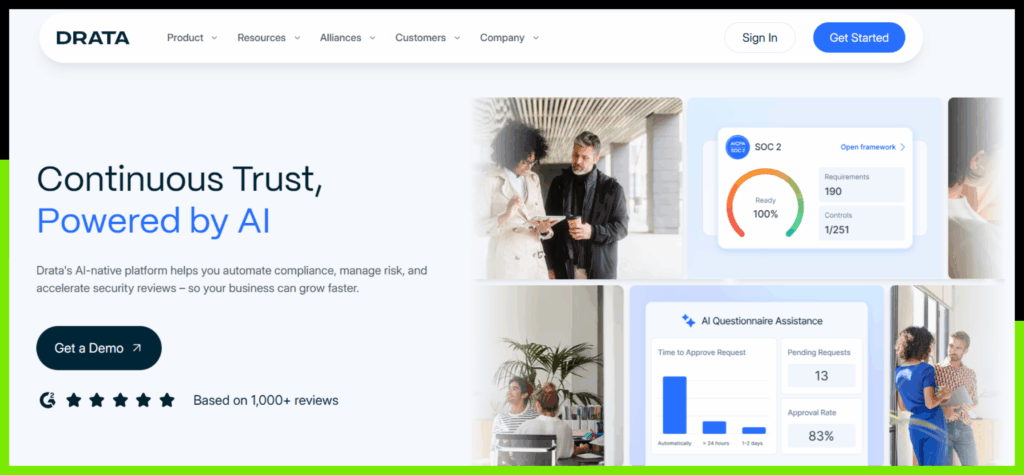
Drata Company Overview
- Company Name: Drata Inc.
- Headquarters: San Diego, California (USA)
- Year Founded: 2020
- Global Presence: Serves over 8,500 customers, including roughly one-third of the Cloud 100
- Website: https://drata.com/
- Framework Scope: 30+ standard frameworks plus custom frameworks
- Founders: Adam Markowitz (CEO), Daniel Marashlian (CTO), and Troy Markowitz
- SOC 2 Cost Range: Pricing is customized, so you’ll need to request a quote. I did some research on Reddit and found that Drata’s SOC 2 platform may usually cost about $7,000 or more per year, without audits. Including audit fees, total SOC 2 expenses can cost $12,000+ depending on scope and audit type. Here’s the Reddit thread that talking about the Drata’s SOC 2 cost so you can give it a look.
Certifications & Accreditations Held by Drata
- SOC 2 Type 2
- SOC 3
- ISO/IEC 27001:2022
- ISO/IEC 27017
- ISO/IEC 27018
- ISO/IEC 42001:2023
- HIPAA
- CCPA
- GDPR
- CISA: Secure-by-Design Pledge
- VPAT
- AWS Qualified Software
- AWS Security Software Competency Partner
(Source: Drata Trust Center)
Awards & Honors
- Ranked No. 78 among G2’s Best Software Products and No. 11 among its Best Governance, Risk & Compliance Products for 2026. (G2)
- Earned G2 Summer 2026 Leader recognition across Security Compliance and Vendor Security and Privacy Assessment categories in several global markets. (G2)
- Ranked No. 144 on Forbes’ America’s Best Startup Employers list for 2026. (Forbes)
- Selected as one of 20 growth-stage cybersecurity companies in Fortune’s 2026 Cyber 60. (fortune.com)
Key SOC 2 Features
- Automated evidence collection: Connects with cloud, identity, HR, security, and development tools to collect audit evidence.
- Continuous control monitoring: Tracks control performance and flags failed tests.
- Policy management: Supports templates, approvals, version control, renewals, and control mapping.
- Centralized audit workspace: Organizes controls, evidence requests, auditor access, and readiness tracking.
- Personnel and device monitoring: Tracks employee compliance, policy acknowledgments, and device security settings.
Other Features
- Agentic AI: Assists with questionnaires, risk analysis, policy mapping, and control summaries.
- Third-party risk management: Centralizes vendor reviews, assessments, documents, and follow-ups.
- Trust Center: Shares security reports, certifications, policies, and approved compliance information.
- Multi-framework support: Covers more than 30 frameworks, including SOC 2, ISO 27001, HIPAA, PCI DSS, CMMC, and DORA.
- Open API: Supports custom integrations, workflow automation, and data exports.
Pros
- Broad framework and integration coverage
- Automated evidence collection and control testing
- Reusable controls across multiple frameworks
- Built-in audit, policy, risk, and vendor workflows
- Controlled auditor access and security reporting
Cons
- Advanced features may require higher plans or add-ons
- Initial setup can take time
- Some users report integration and workflow limitations
2. Vanta
Vanta is an agentic trust management platform founded in 2018 that centralizes compliance, risk, security, and customer trust workflows. More than 16,000 companies across 58 countries use the platform.
It supports 35+ security and privacy frameworks, 400+ integrations, and 1,400+ automated tests for continuous SOC 2 control monitoring and evidence collection.
The platform includes policy templates, security awareness training, risk assessments, personnel tracking, audit workflows, and automated remediation notifications.
Vanta AI supports evidence checks, policy generation, risk analysis, and security questionnaire responses. Its Trust Center includes an AI-powered chatbot that answers customer questions using approved security and compliance information.
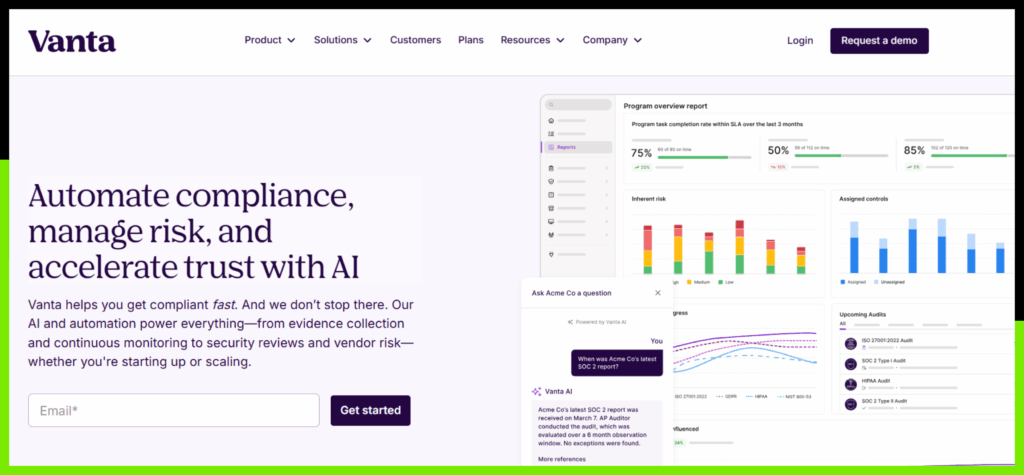
Vanta Company overview
- Company Name: Vanta Inc.
- Headquarters: San Francisco, California, USA
- Year Founded: 2018
- Global Presence: More than 16,000 customers across 58 countries, with offices in San Francisco, New York, Dublin, London, and Sydney.
- Website: https://www.vanta.com/
- Founders: Christina Cacioppo (CEO & Founder)
- SOC 2 Cost: Vanta uses personalized pricing based on the selected plan, company size, frameworks, and required features. The previously listed $10,000 to $80,000 range represents the potential total cost of achieving SOC 2, not Vanta’s annual platform fee.
Certifications & Accreditations Held by Vanta
- SOC 2 Type II
- ISO/IEC 27001:2022
- ISO/IEC 42001:2023
- ISO/IEC 27701:2019
- ISO/IEC 27017
- ISO/IEC 27018
- PCI DSS 4.0.1
- FedRAMP 20x Moderate Authorization for Vanta Government Cloud
- CSA Trusted Cloud Provider
- AWS Security Competency
- GDPR and CCPA compliance
(Source: Vanta Trust Center)
Awards & Honors
- Ranked No. 1 on G2’s Best Governance, Risk & Compliance Products list for 2026. (G2)
- Named a Leader in The Forrester Wave for GRC Platforms in Q2 2026 and the IDC MarketScape for Worldwide GRC Software in 2025. (Vanta)
- Ranked No. 63 on the 2025 Forbes Cloud 100, marking its third consecutive appearance, and joined the 2025–2026 Fortune Cyber 60. (Business Wire)
Key SOC 2 Features
- Automated evidence collection: Connects with more than 400 tools across cloud, identity, code, HR, and security systems.
- Continuous control monitoring: Runs over 1,400 automated hourly tests across more than 35 frameworks.
- Vanta AI Agent: Reviews evidence, detects gaps, maps controls, generates policies, and recommends fixes.
- Audit and policy management: Centralizes policies, evidence, audit requests, control ownership, and auditor access.
- Risk and vendor management: Supports risk assessments, vendor reviews, vulnerability tracking, and third-party monitoring.
Other Features
- AI-Enabled Trust Center: Shares approved security documents and answers customer questions with Vanta AI.
- Questionnaire Automation: Uses stored policies and evidence to complete security questionnaires.
- Personnel and Access Management: Tracks employee compliance, access reviews, onboarding, and offboarding.
Pros
- More than 400 integrations and 35 supported frameworks
- Automated evidence collection and hourly control testing
- Centralized compliance, risk, audit, and vendor workflows
- AI support for policies, evidence, questionnaires, and remediation
- Built-in Trust Center and auditor collaboration tools
Cons
- Pricing requires a custom quote
- Advanced functions may require higher plans or add-ons
- Some users report integration gaps and limited lower-tier features
- Pricing may be high for smaller companies
3. Secureframe
Secureframe is an AI-powered security, risk, and compliance automation platform founded in 2020. More than 6,000 companies use it to manage evidence collection, policy creation, employee training, risk assessments, and audit readiness.
The platform provides 300+ integrations and supports 30+ compliance frameworks, including SOC 2, ISO 27001, HIPAA, PCI DSS, CMMC, NIST, DORA, and NIS2. Continuous control monitoring and automated tests help teams detect compliance gaps and maintain readiness.
Secureframe has raised $79 million and operates six hubs across San Francisco, New York, Austin, Denver, Toronto, and London. Shrav Mehta and Natasja Nielsen co-founded the company to simplify security compliance.
Buyers choosing between Secureframe and another major automation platform can review our Secureframe vs Sprinto comparison for pricing, integrations, and audit support side by side.
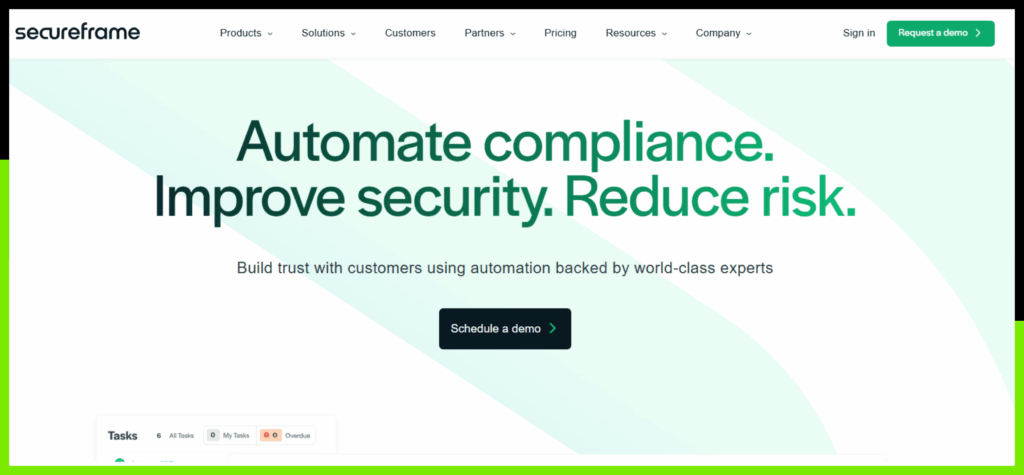
Secureframe Company Overview
- Headquarters: San Francisco, California, USA
- Year Founded: 2020
- Global Presence: Six hubs across San Francisco, New York, Austin, Denver, Toronto, and London
- Website: https://secureframe.com/
- Founders: Shrav Mehta and Natasja Nielsen
- SOC 2 Cost Range: Secureframe uses custom platform pricing. Independent SOC 2 audits generally cost $5,000–$20,000 for Type I and $7,000–$150,000 for Type II, depending on scope and company complexity. (Secureframe)
Certifications & Accreditations Held by Secureframe
- SOC 2 Type II
- ISO/IEC 27001:2022
- FedRAMP 20x Low Authorization
- CMMC Level 2 Certification
- TX-RAMP Level 1 Certification
- GDPR compliance
- CPRA compliance
Secureframe’s CMMC Level 2 and TX-RAMP certifications remain valid through 2028. Its current FedRAMP 20x Low authorization letter is valid through August 20, 2026.
(Source: Secureframe Trust Center)
Awards & Honors
- Ranked No. 4 on G2’s Best Governance, Risk & Compliance Products list for 2026. (G2)
- Named among the top 50 companies on Forbes’ America’s Best Startup Employers list for 2025. (Secureframe)
- Won the Hot Company Compliance Automation award at the 2025 Global InfoSec Awards. (Secureframe)
- Named a finalist for Best Compliance Solution at the 2025 SC Awards. (Secureframe)
Key SOC 2 Features
- Automated evidence collection: Connects with more than 300 systems to collect evidence and test controls.
- Continuous monitoring: Detects failed tests and configuration changes across connected systems.
- Policy and personnel management: Includes policy templates, security training, policy acceptance tracking, and onboarding workflows.
- Audit readiness: Centralizes controls, evidence, remediation tasks, and auditor collaboration.
- Common control mapping: Reuses controls and evidence across multiple frameworks to reduce duplicate work.ce.
Other Features
- Comply AI: Assists with policies, remediation, risk assessments, and vendor document reviews.
- Third-party risk management: Tracks vendor assessments, documents, risk scores, and recurring reviews.
- Multi-framework support: Covers more than 30 frameworks, including SOC 2, ISO 27001, HIPAA, PCI DSS, CMMC, and FedRAMP.
- Trust Center and questionnaires: Shares approved security information and supports automated questionnaire responses.
Pros
- More than 300 integrations
- Automated evidence collection and continuous testing
- Strong policy, personnel, risk, and vendor workflows
- Reusable controls across multiple frameworks
- AI-assisted remediation and risk analysis
- Access to compliance experts and audit partners
Cons
- Pricing requires a custom quote
- The entry plan includes only one compliance framework
- Advanced vendor risk, questionnaire, access review, and Trust Center features require the Complete package
- Some users request broader integrations and more alerting options
4. UnderDefense
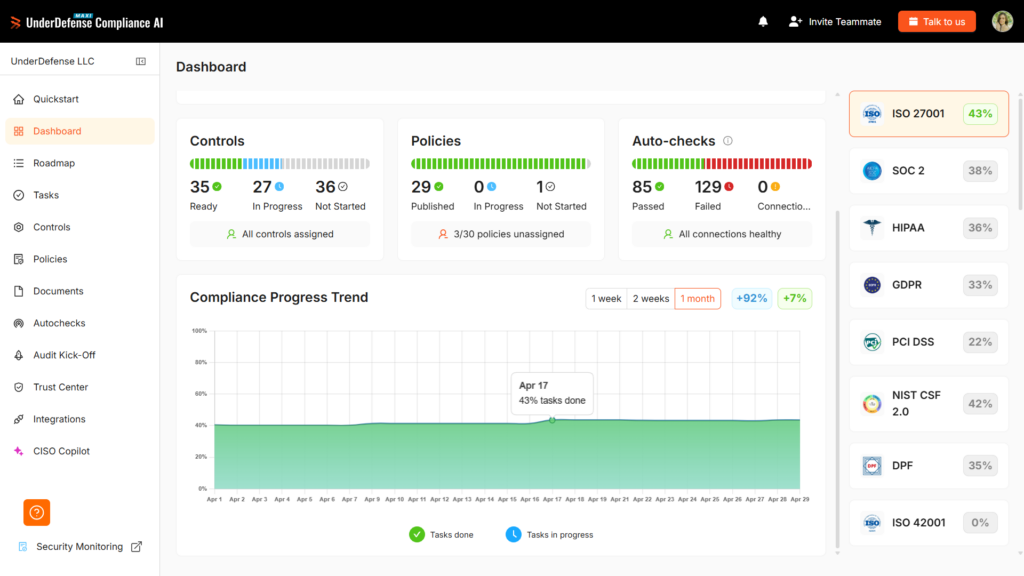
UnderDefense is an agentic AI security and compliance platform that combines compliance automation with 24/7 threat detection and response. It automates gap assessments, control mapping, policy management, evidence collection, audit collaboration, and continuous monitoring across SOC 2, ISO 27001, HIPAA, PCI DSS, GDPR, NIST, and other frameworks.
UnderDefense states that teams can reach 40% audit readiness within the first 40 minutes and complete compliance up to two times faster than traditional audit approaches.
The platform generates evidence from live security operations, including alerts, investigations, response actions, and infrastructure activity. It connects with endpoint, SIEM, network, and cloud tools while providing support from compliance specialists and vCISOs.
UnderDefense Company Overview
- Company Name: UnderDefense, LLC
- Headquarters: New York, New York (USA)
- Year Founded: 2017
- Global Presence: Serves organizations across five continents with support from more than 120 security engineers
- Website:https://underdefense.com/get-compliant/
- Founder: Nazar Tymoshyk
- SOC 2 Cost Range: A free compliance plan is available. Paid plans start at $499 per month, while Essential and Certified plans start at $1,299 and $1,899 per month. Final pricing depends on the required services, and the pricing page does not confirm that independent audit fees are included.
Certifications & Accreditations Held by UnderDefense
- SOC 2 Type I attestation, achieved in November 2024
- ISO/IEC 27001:2013 certification, received in November 2021
Awards & Honors
- Earned 12 badges in G2’s Spring 2025 reports across MDR, incident response, and system security categories.
- Won the MDR Service category at the 2025 Global InfoSec Awards.
- Named a finalist for Best MDR Service at the 2025 SC Awards.
- Recognized in Expert Insights’ Best-Of Cybersecurity Awards for Q1 2025.
Key SOC 2 Features
- Rapid onboarding: UnderDefense states that teams can reach 40% audit readiness within 40 minutes and complete compliance up to two times faster than traditional approaches.
- Automated evidence collection: Collects evidence from cloud systems and active security operations.
- Continuous monitoring: Tracks infrastructure and control performance throughout the audit period.
- AI-assisted compliance: Automates gap assessments, control mapping, documentation, and remediation guidance.
- Audit support: Centralizes evidence, readiness tasks, reporting, and communication with audit partners.
Other Features
- Multi-framework support: Covers SOC 2, ISO 27001, HIPAA, PCI DSS, GDPR, and NIST.
- Operational evidence: Converts security alerts, investigations, and response actions into audit-ready records.
- Integrations: Provides more than 45 out-of-the-box integrations and supports custom connections.
- Trust Center: Shares current compliance and security information with customers and partners.
- On-premise deployment: Supports sovereign, closed, and air-gapped environments.
Pros
- Connects compliance evidence with live security operations
- Combines automation with support from compliance and security specialists
- Reuses evidence across multiple frameworks
- Includes continuous infrastructure monitoring
- Supports cloud and on-premise environments
Cons
- Pricing may require a custom quote
- Initial integration and configuration can take time
- Some G2 users request more integrations, dashboard control, and automation
- Independent audit costs may sit outside the platform fee
5. Optro Formerly AuditBoard
Optro, formerly AuditBoard, is an AI-powered GRC platform founded as SOXHUB in 2014. The company became AuditBoard in 2017 and adopted the Optro name on March 9, 2026. More than 50% of the Fortune 500 and seven of the Fortune 10 use its platform.
The platform connects audit, risk, information security, controls, and compliance data in one system. Its products cover controls management, internal audit, multi-framework compliance, third-party risk, AI governance, and autonomous control testing.
Optro surpassed $300 million in annual recurring revenue in 2025. Hg acquired the company in 2024 through a transaction valued at more than $3 billion.
Optro Company Overview
- Company Name: Optro, Inc.
- Former Names: AuditBoard and SOXHUB
- Headquarters: Los Angeles, California, USA
- Year Founded: 2014
- Global Presence: Serves more than 2,000 customers and supports over 50% of the Fortune 500
- Website: https://auditboard.com/
- Founders: Daniel Kim and Jay Lee
- SOC 2 Cost Range: Optro reports that SOC 2 Type 1 audits cost $10,000–$60,000, while Type 2 audits range from $30,000–$100,000, depending on company size.
Certifications & Accreditations Held by AuditBoard
- ISO/IEC 27001-certified information security program
- SSAE 18 SOC 2 assessed control environment
- Cloud Security Alliance STAR alignment
- HIPAA security control alignment
- NIST SP 800-53 alignment
- Hosted on cloud infrastructure that meets FedRAMP Moderate requirements
(Source: Optro Trust Center)
Awards & Honors
- Ranked No. 5 on G2’s Best Governance, Risk & Compliance Products list for 2026. (G2)
- Named a Leader in The Forrester Wave: Governance, Risk, and Compliance Platforms, Q2 2026. (Optro)
- Won the Market Leader in Governance, Risk and Compliance title at the 2026 Global InfoSec Awards. (Optro)
- Recognized as a Leader across eight G2 categories in the Winter 2026 reports. (Optro)
Key SOC 2 Features
- Centralized compliance: Manages SOC 2, ISO 27001, NIST, PCI DSS, and other frameworks in one platform.
- Automated evidence collection: Connects with more than 200 systems to collect evidence and monitor controls.
- AI-powered gap assessments: Maps requirements, detects control gaps, and recommends remediation tasks.
- Continuous control testing: Monitors controls in real time and surfaces exceptions earlier.
- Common control mapping: Reuses controls and evidence across several frameworks to limit duplicate work
Other Features
- Agentic GRC: Uses governed AI agents to automate testing and support risk, audit, and compliance workflows.
- AI governance: Centralizes AI inventories, approvals, risks, controls, and lifecycle documentation.
- Connected risk management: Links risks, controls, issues, audits, and regulatory requirements.
- Broad product coverage: Includes internal audit, controls management, enterprise risk, IT risk, third-party risk, and regulatory compliance.
- Security questionnaires: Uses approved evidence to complete customer security questionnaires.
Pros
- More than 200 integrations
- Strong support for complex enterprise GRC programs
- Reusable controls and evidence across frameworks
- Continuous testing and real-time compliance reporting
- Connected audit, risk, compliance, and controls data
- AI support for testing, mapping, and gap analysis
Cons
- Pricing requires a custom quote
- The broad feature set may exceed the needs of small teams
- Implementation may require careful configuration and staff training
- Advanced capabilities may require additional products or services
6. Thoropass
Thoropass is an end-to-end cybersecurity audit and compliance platform. It combines compliance automation, continuous monitoring, expert guidance, AI-supported evidence review, and audit delivery in one system.
Thoropass reported more than 1,200 customers in April 2026. The company has more than 200 employees across over 12 countries and supports more than 30 compliance frameworks.
Thoropass received Leader recognition in 16 G2 Winter 2025 Grid Reports, including Audit Management and Cloud Compliance.
Thoropass Company Overview
- Company Name: Thoropass, Inc.
- Headquarters: New York City, New York, United States
- Year Founded: 2019
- Global Presence: More than 1,200 customers, over 200 employees, and operations across more than 12 countries
- Website: thoropass.com
- Founders: Sam Li, Eva Pittas, and Austin Ogilvie
- SOC 2 Cost Range: Estimated at $14,500 to $30,000+ per year for smaller platform-and-audit packages. Thoropass does not publish standard pricing. Final costs depend on company size, audit scope, frameworks, and added services.
Certifications & Accreditations Held by Scytale
- SOC 2
- ISO/IEC 27001
- ISO/IEC 27017
- ISO/IEC 27018
- ISO/IEC 27701
- ISO/IEC 42001
- ISO 9001:2015
- HITRUST i1
- PCI DSS
- GDPR, CCPA, and CPRA privacy programs
- AICPA peer-reviewed CPA firm
- PCI Qualified Security Assessor Company
- PCI Approved Scanning Vendor
- HITRUST Accredited Assessor
- CREST-accredited penetration testing provider
(Source: https://trust.scytale.ai/)
Awards & Honors
- 2025 Frost & Sullivan Global Customer Value Leadership Award
- Leader recognition across six G2 Summer 2025 categories
- Sam Li named an EY Entrepreneur of the Year 2026 New York finalist
Key SOC 2 Features
- Automated Evidence Collection: Collects compliance evidence through auditor-vetted connections with cloud, identity, HR, development, and security tools. The current integration directory displays 202 entries.
- Continuous Control Monitoring: Tracks connected controls and flags compliance gaps between audit periods.
- First Pass AI: Reviews evidence for missing, outdated, or incorrect information before submission to an auditor.
- Policy and Risk Management: Provides policy workflows, control mapping, risk registers, owners, and remediation tasks.
- Integrated Audit Workspace: Keeps controls, evidence requests, comments, status updates, and auditor communication within one platform.
Other Features
- Smart Sort AI: Reviews exports from other GRC platforms and maps uploaded files to the correct audit requests.
- MCP Server: Connects organizational AI agents with Thoropass audit data, evidence requests, and submission workflows. Thoropass launched the feature on July 9, 2026.
- Trust Center: Publishes approved compliance documents and security information through a controlled customer-facing portal.
- Multi-Framework Audits: Coordinates shared evidence across SOC 2, ISO, PCI, HITRUST, and other supported frameworks.
- Penetration Testing: Provides CREST-accredited penetration testing and continuous vulnerability scanning.
Pros
- Combines compliance software and in-house audit services.
- Supports more than 30 frameworks.
- Provides more than 100 auditor-vetted integrations.
- Includes AI tools for evidence checking, sorting, and submission.
- Supports coordinated audits across multiple frameworks and business units.
Cons
- Standard list pricing is not publicly available.
- Total cost can rise with additional frameworks, products, and security services.
- The combined platform-and-auditor model may not suit companies that prefer separate compliance and audit providers.
- Initial evidence configuration may require guidance for first-time users.
7. Sprinto
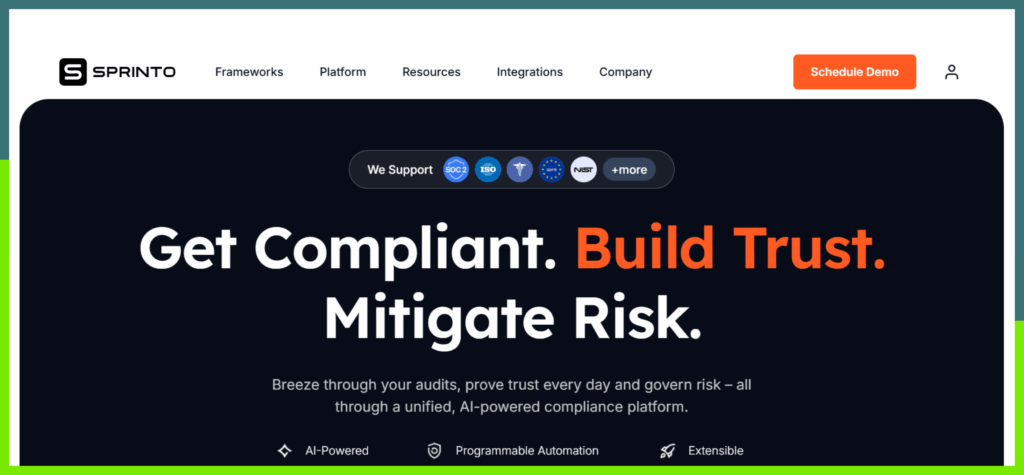
Sprinto is an AI-native GRC and compliance platform founded in 2020 by Girish Redekar and Raghuveer Kancherla. More than 3,000 companies across 75 countries use the platform to manage continuous compliance, audit readiness, risk, policies, vendors, and security questionnaires.
The platform supports 200+ compliance frameworks and connects with 200+ systems across cloud infrastructure, identity, HR, code, devices, and security tools. Sprinto AI automates evidence validation, control mapping, policy updates, vendor reviews, drift detection, and remediation guidance. Its native device-monitoring tool tracks encryption, antivirus, firewall, screen-lock, and operating-system status.
Sprinto Company Overview
- Company Name: Sprinto, Inc. in the United States and Sprinto Technology Private Limited in India.
- Headquarters: San Francisco, California, USA, with operations in Bengaluru, India.
- Year Founded: 2020, following initial development in 2019.
- Global Presence: Serves over 1,000 customers in 75 countries and has roughly 200 employees
- Website: https://sprinto.com/
- Founders: Girish Redekar and Raghuveer Kancherla
- SOC 2 Cost Range: Pricing is tailored, with separate packages for startups and enterprises
Certifications & Accreditations Held by Sprinto
- SOC 2 attestation
- ISO/IEC 27001
- ISO/IEC 42001:2023
- GDPR compliance
- HIPAA compliance
(Source: Sprinto Trust Center)
Awards & Honors
- Ranked No. 3 on G2’s Best Governance, Risk & Compliance Products list for 2026.
- Named to G2’s Fastest-Growing Products and Best GRC Software Products lists for 2025.
- Ranked No. 2 on LinkedIn’s Top Startups India list for 2024.
Key SOC 2 Features
- Continuous monitoring: Tracks systems, users, vendors, controls, and evidence in real time.
- Automated evidence collection: Connects with more than 300 systems across cloud, identity, HR, code, devices, and security tools.
- AI-powered compliance: Detects evidence gaps, maps controls, updates policies, reviews vendors, and recommends remediation.
- Audit management: Centralizes controls, evidence requests, auditor access, and readiness tracking.
- Device monitoring: Checks encryption, antivirus, firewalls, screen locks, and operating-system status.
Other Features
- Multi-framework support: Includes 25+ automated frameworks and more than 200 digitized frameworks.
- Risk and vendor management: Supports risk assessments, vendor discovery, document reviews, and recurring assessments.
- Trust management: Provides a public Trust Center and AI-powered security questionnaire automation.
- AI governance: Tracks AI systems, approvals, risks, safeguards, and monitoring.
- Guided onboarding: Includes expert-led onboarding and audit-readiness guidance.
Pros
- More than 300 integrations
- More than 200 supported frameworks
- Automated evidence collection and continuous monitoring
- AI support for policies, risks, vendors, and questionnaires
- Built-in audit management and expert guidance
Cons
- Pricing requires a custom quote
- Some frameworks and advanced functions require add-ons
- Higher-level workflows are limited to the Growth plan
- Initial configuration may require input from IT, security, and compliance teams
8. Hyperproof
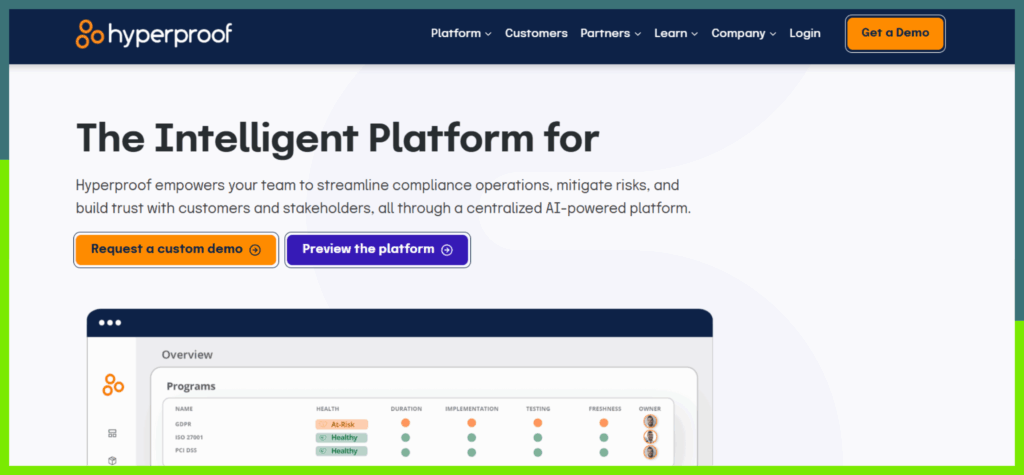
Hyperproof is an AI-powered GRC platform founded in 2018 by Craig Unger in Bellevue, Washington. It supports more than 160 pre-built frameworks and centralizes compliance, risk, controls, policies, evidence, and audit workflows.
The platform automates control mapping, recurring evidence collection, task management, risk assessments, and third-party reviews. Its AI tools help teams validate evidence, detect compliance gaps, analyze risk data, and manage security questionnaires.
Hyperproof has raised at least $66.5 million in funding. It expanded its vendor risk and trust management capabilities through the acquisition of Expent.ai in 2025 and received FedRAMP Moderate authorization in 2026.
Hyperproof Company OverviewUpdated Hyperproof Company Overview
- Company Name: Hyperproof, Inc.
- Headquarters: Seattle, Washington, USA
- Year Founded: 2018
- Global Presence: Serves more than 350 organizations and supports customers in North America and Europe through US- and EU-hosted platform environments.
- Website: Hyperproof.io
- Founder: Craig Unger, Founder and CEO.
- SOC 2 Cost Range: Hyperproof uses customized subscription pricing based on the selected products, programs, and services. The previously listed $12,000 annual starting price is not confirmed by Hyperproof and should be removed.
Certifications & Accreditations Held by Hyperproof
- SOC 2 Type II attestation
- FedRAMP Moderate authorization for Hyperproof Gov
- GDPR third-party compliance attestation, completed with no findings in January 2025
Awards & Honors
- Named a Category Leader in three 2026 Chartis RiskTech Quadrants covering enterprise GRC, third-party risk management, and IT risk.
- Earned 41 G2 badges across the Spring and Summer 2026 reports.
- Received several 2026 recognitions from Capterra and Software Advice.
Key SOC 2 Features
- Control and framework management: Maps shared controls across more than 160 pre-built frameworks to reduce duplicate work.
- Automated evidence collection: Uses more than 200 integrations to collect evidence and support continuous control testing.
- Audit management: Centralizes requests, evidence, tasks, auditor access, and audit status tracking.
- Risk and vendor management: Connects risks to controls and supports third-party assessments based on vendor evidence.
- Policy management: Stores policies, tracks versions, and manages review and approval workflows.
Other Features
- Hyperproof AI: Uses AI agents for evidence validation, testing, reporting, risk detection, and compliance guidance.
- Trust Management Center: Automates security questionnaires and publishes approved security information through branded Trust Centers.
- Custom frameworks: Lets organizations create internal frameworks and reuse existing controls and evidence.
Pros
- More than 160 frameworks and 200 integrations
- Reusable controls and evidence across programs
- Centralized compliance, audit, policy, and risk workflows
- AI-assisted evidence testing and reporting
- Dedicated auditor collaboration workspace
Cons
- Pricing requires a custom quote
- Some users report limited dashboard and reporting customization
- The interface may require training for new users
- The broad enterprise feature set may exceed the needs of smaller teams
9. Apptega
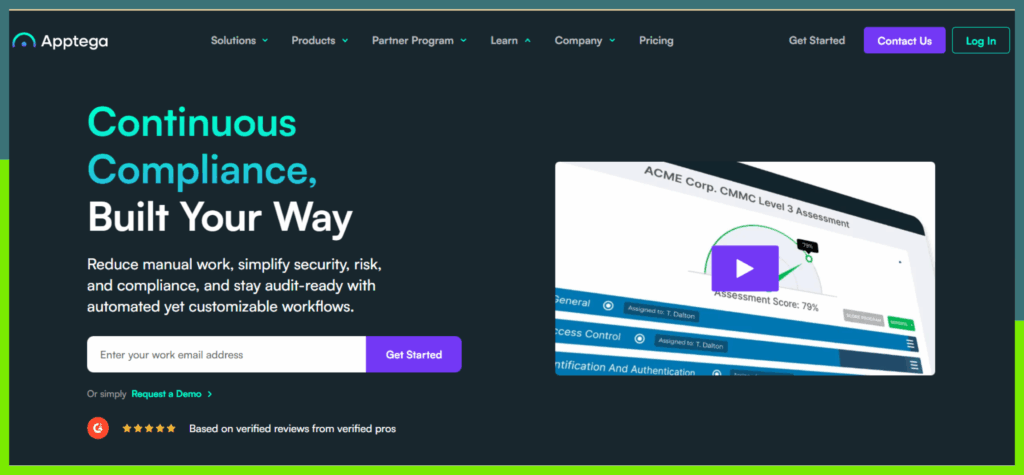
Apptega is a GRC automation platform founded in 2018 that supports more than 15,000 security and compliance programs worldwide. It centralizes framework management, risk assessments, control tracking, evidence, audits, and reporting for internal teams and managed security providers.
The platform supports more than 30 frameworks, including SOC 2, ISO 27001, HIPAA, PCI DSS, and NIST. Its Harmony crosswalking tool maps shared controls across frameworks, allowing teams to reuse completed work and track gaps through unified dashboards.
Apptega primarily serves MSPs, MSSPs, security consultants, and organizations managing several compliance programs. Its multi-tenant architecture lets service providers manage separate client environments from one platform.
Apptega Company Overview
- Company Name: Apptega, Inc.
- Headquarters: Atlanta, Georgia, USA
- Year Founded: January 2018
- Global Presence: Supports more than 15,000 compliance programs for thousands of customers and partners worldwide
- Website: apptega.com
- Founder: Armistead Whitney
- Current CEO: Dave Colesante
- SOC 2 Cost Range: Custom annual subscription based on company size, modules, and frameworks
Certifications & Accreditations Held by Apptega
- SOC 2 Type II
- PCI
- NIST Cybersecurity Framework
- NIST SP 800-171
- CMMC Level 2
Only SOC 2 Type II should be described as an attestation. PCI, NIST CSF, NIST SP 800-171, and CMMC Level 2 appear as Trust Center badges.
(Source: Apptega Trust Center)
Awards & Honors
- Earned 39 G2 badges in the Fall 2023 reports, including GRC Momentum Leader, High Performer, Best Support, Easiest to Implement, and Best Estimated ROI. (Apptega)
- Holds a 4.7 out of 5 rating from 157 G2 reviews and a 4.6 out of 5 rating from 25 Capterra reviews as of 2026. (G2)
- Ranked No. 243 on the 2022 Inc. 5000 list. The 2019 awards can be removed since newer third-party recognition is available.
Key SOC 2 Features
- Framework management: Supports more than 30 pre-built frameworks with customizable controls and assessments.
- Framework crosswalking: Harmony maps shared controls across frameworks and reuses completed evidence.
- Automated evidence collection: Integrations collect artifacts, update control status, and support continuous monitoring.
- Audit management: Centralizes evidence, requests, control validation, tasks, and auditor collaboration.
- Risk management: Scores risks, links them to controls, assigns remediation, and tracks residual risk.
Other Features
- Third-party risk management: Automates vendor questionnaires, scoring, follow-ups, and remediation tracking.
- Policy management: Supports policy creation, approvals, distribution, reviews, and framework mapping.
- AI questionnaire automation: Generates responses from existing documentation and evidence.
- Multi-tenant management: Lets MSPs, MSSPs, and consultants manage separate client programs from one platform.
- Compliance reporting: Provides scheduled reports, dashboards, control-level views, and program rollups.
Pros
- More than 30 cross-mapped frameworks
- Strong support for MSPs, MSSPs, and consultants
- Connected audit, risk, policy, and vendor workflows
- Automated evidence collection and real-time control updates
- High user ratings for usability and customer service
Cons
- Pricing requires a custom quote
- The Essentials plan supports only one framework
- Initial configuration may require expert support
- Some users report limited customization and missing advanced functions
10. LogicGate (Risk Cloud)
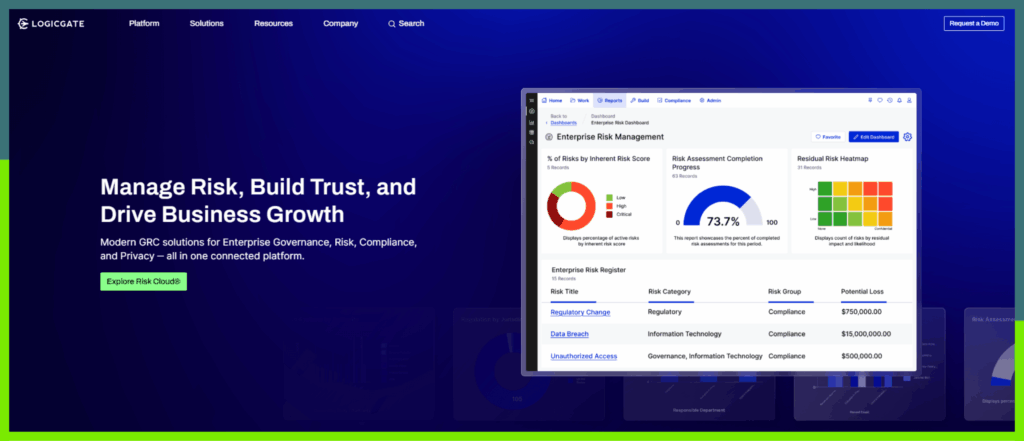
LogicGate is an AI-powered, no-code GRC platform designed for enterprise risk, compliance, audit, cybersecurity, and third-party risk programs. Risk Cloud uses a connected graph database and provides more than 30 purpose-built applications on one platform.
The platform supports configurable workflows, automated evidence testing, risk quantification, framework management, and real-time reporting. Hundreds of native and custom integration options connect risk and compliance data across existing business systems.
LogicGate’s Spark AI supports evidence reviews, record linking, form completion, and reporting insights. Its 2026 release introduced Workflow Agents that can perform governed GRC tasks within configured processes.
LogicGate Company Overview
- Company Name: LogicGate, Inc.
- Headquarters: Chicago, Illinois, USA
- Year Founded: 2015
- Global Presence: Serves enterprises worldwide and offers data hosting in the United States, United Kingdom, European Union, and Australia.
- Website: www.logicgate.com
- Founders:Matt Kunkel, Jon Siegler and Dan Campbell
- Current CEO: Diego Panama
- SOC 2 Cost Range: LogicGate provides custom pricing based on selected applications and Power User licenses. Implementation, integrations, professional services, and advanced features may add separate costs.
Certifications & Accreditation Held by LogicGate
- SOC 2 Type II attestation
- ISO/IEC 27001:2022 certification
- CSA STAR Level 1 self-assessment
- GDPR alignment
- HIPAA alignment
Awards & Honors
- Named one of four Leaders in The Forrester Wave: Governance, Risk, and Compliance Platforms, Q2 2026.
- Named a Leader in The Forrester Wave: Third-Party Risk Management Platforms, Q1 2026.
- Named a Leader in the 2025 Gartner Magic Quadrant for GRC Tools, Assurance Leaders.
- Earned G2 Leader status for the 28th consecutive quarter, with recognition across ten categories.
- Won the Market Innovator in Governance, Risk, and Compliance award at the 2025 Global InfoSec Awards.
Key SOC 2 Features
- No-code workflow builder: Configures controls, tasks, approvals, issues, and evidence workflows without custom coding.
- Controls and compliance management: Maps requirements across SOC 2 and other frameworks while tracking control ownership, testing, and remediation.
- Automated evidence testing: Uses AI to review evidence, flag gaps, and support recurring control assessments.
- Audit management: Centralizes audit plans, requests, evidence, findings, and auditor collaboration.
- Risk management: Connects risks, controls, assets, issues, and compliance requirements within one system.
Other Features
- Workflow Agents: Perform governed GRC tasks within configurable and auditable workflows.
- Third-party risk management: Supports vendor assessments, questionnaires, monitoring, and remediation.
- Risk quantification: Converts cyber and enterprise risks into financial values for executive reporting.
- Purpose-built applications: Provides more than 30 applications for audit, compliance, enterprise risk, policy, and third-party risk programs.
- Integration options: Connects Risk Cloud with existing enterprise systems through native and custom integrations.
Pros
- Highly configurable workflows and data models
- Strong enterprise risk and third-party risk functions
- No-code application and workflow configuration
- Connected view of risks, controls, audits, and compliance
- Strong customer support and training resources
Cons
- Initial setup can require substantial configuration
- New administrators may face a learning curve
- Advanced reporting may require extra customization
- Pricing requires a custom quote
- Implementation services and advanced features may add costs
Honorable Mention: Bright Defense
We built Bright Defense for the part of SOC 2 that software cannot do for you. Every platform on this list automates evidence and monitoring. None of them read your results, fix your gaps, or sit across from your auditor. We do.
Our CISSP and CISA certified team runs your compliance program between review cycles, so your controls stay audit-ready instead of drifting the moment setup ends.
We close the gaps your platform surfaces, run the security assessments and remediation that keep evidence real, and reinforce your policies with managed security awareness training.
Need leadership for scope and audit decisions? Our vCISO support gives you that without a full-time hire.
We are a Drata Elite Partner, and we work alongside every major SOC 2 platform, so you keep the tool you already trust and add the expert layer that moves you to done. If you want SOC 2 readiness that actually finishes, talk with Bright Defense.
SOC 2 Compliance Market Size in 2026
SOC 2 market size in 2026 is usually described as part of the much larger governance, risk, and compliance software market because most research does not report SOC 2 as its own separate category. In 2026, that broader market is commonly estimated at about USD 56.7 billion for enterprise GRC platforms.
Inside it, several SOC 2 related slices suggest where spending concentrates: SOC reporting services are roughly USD 6.8 billion in 2026, SOC 2 compliance automation tools are about USD 1.3 billion in 2026, and two SOC 2 heavy verticals are each in the low single digit billions in 2026, with financial services around USD 2.5 billion and colocation around USD 2.6 billion.
Within this wider market, SOC 2‑specific segments show strong growth:
- SOC reporting services (SOC 1, SOC 2, SOC 3 audits): USD 5.39 billion (2024) projected to USD 10.47 billion (2030) at 12.3% CAGR, implying about USD 6.8 billion (2026).
- SOC 2 compliance for financial services: USD 1.92 billion (2024) projected to USD 6.47 billion (2033) at about 14.2% CAGR, implying about USD 2.5 billion (2026).
- SOC 2 compliance for colocation: USD 1.98 billion (2024) projected to USD 5.16 billion (2033) at 15.2% CAGR, implying about USD 2.6 billion (2026).
- SOC 2 compliance automation: Compliance automation market USD 2.8 billion (2025) with USD 850 million attributed to SOC 2 tools, forecast at USD 1.3 billion (2026), USD 1.9 billion (2027), and USD 2.7 billion (2028).
All figures are global, in USD. Several 2026 values are calculated from a stated base year plus CAGR.
| Market proxy | 2026 size | What it represents |
|---|---|---|
| SOC reporting services | ~6.80B | Audit and reporting services tied to SOC reports (includes SOC 2) |
| SOC 2 compliance automation | ~1.30B | Tools and services focused on automating SOC 2 readiness and evidence collection |
| Compliance software | ~40.82B | Broad compliance software category that can include SOC 2 workflows |
| eGRC software and services | ~56.73B | Broad GRC market that includes audit, risk, and compliance programs like SOC 2 |
| Cloud compliance solutions | ~49.50B | Cloud-focused compliance tools and services that can support SOC 2 controls |
| SOC 2 in financial services (two vendor estimates) | ~1.51B to ~2.50B | A vertical slice; vendor estimates differ on definitions and scope |
| SOC 2 in colocation | ~2.63B | A vertical slice focused on data centers and colocation providers |
Best HRIS Compliance Software for GDPR and SOC 2
Modern HRIS platforms are now part of the compliance surface area. Auditors expect them to support GDPR data rights and fit cleanly into SOC 2 access, logging, and retention controls.
- Humaans is a strong fit for SaaS and tech startups. It is SOC 2 Type II compliant and designed with GDPR-first controls such as role-based access, audit logs, and structured offboarding. It integrates well with identity and compliance tools, which simplifies audit evidence.
- BambooHR is widely accepted by auditors and works well for SMBs. It maintains SOC 2 reports and supports GDPR obligations like data access requests and retention rules. It is less technical than newer tools but easy to justify in audits.
- Rippling combines HR, IT, and device management. It holds SOC 2 Type II certification and supports GDPR-aligned processing. Centralized user access and device control make it especially useful for SOC 2 access control evidence.
- Gusto is suitable for early-stage companies. It maintains SOC 2 compliance and GDPR data protections through its security program and data processing terms. It is payroll-focused but commonly accepted for first SOC 2 audits.
- Workday supports GDPR globally and publishes SOC reports covering its services. It fits large or regulated organizations but comes with higher cost and longer setup.
Free and Open-Source SOC 2 Compliance Tools
Free and open-source tools can support SOC 2 control mapping, risk tracking, policy management, evidence organization, and audit preparation. They usually require self-hosting, internal configuration, security maintenance, backups, and more manual evidence work than commercial compliance platforms.
- CISO Assistant is one of the most relevant open-source options for SOC 2 readiness. Its community edition includes compliance assessments, risk registers, evidence records, remediation tracking, reporting, and automatic control mapping across more than 150 frameworks. The platform uses an AGPLv3 licence, but internal teams remain responsible for deployment, updates, security, and configuration.
- SimpleRisk Core provides a broader governance, risk, and compliance foundation. The self-hosted edition supports unlimited users, risk registers, framework management, compliance testing, asset records, dashboards, and reports. Registered installations can access the Secure Controls Framework, which covers more than 250 frameworks and 1,000 common controls. Advanced add-ons and managed hosting require paid plans.
- Eramba Community supports compliance management, risk assessments, policy reviews, account reviews, incident tracking, and audit documentation. The free edition can help smaller teams organize their SOC 2 program, but automated upgrades, vendor support, managed backups, and some advanced functions remain part of the paid edition.
- OpenGRC Community includes controls, risks, vendors, incidents, projects, audits, and framework imports. It can serve as a central record for compliance work, but evidence collection may require manual uploads or custom API connections when native connections are unavailable.
Free tools do not issue a SOC 2 report or replace an independent CPA firm. They are most practical for organizations with technical staff, a limited audit scope, and enough internal time to maintain the platform. Commercial software is generally more suitable for teams that need automatic evidence collection, managed integrations, vendor support, and faster implementation.
SOC 2 Compliance Software vs Manual Compliance
SOC 2 compliance software centralizes evidence, controls, policies, risks, and audit tasks. Manual compliance relies on spreadsheets, shared folders, screenshots, email threads, and staff follow-up. RegScale’s 2026 State of Continuous Controls Monitoring Report, based on responses from more than 250 information security leaders, found that 83% of organizations experience moderate or major regulatory delays from manual compliance work.
| Area | SOC 2 Compliance Software | Manual Compliance |
|---|---|---|
| Evidence Collection | Pulls evidence from connected systems using integrations | Requires screenshots, exports, and manual document collection |
| Control Monitoring | Tracks control status continuously and flags failed checks | Depends on scheduled reviews and staff follow-up |
| Policy Management | Stores policies, approvals, versions, and acknowledgments in one platform | Uses separate documents, folders, and email records |
| Task Tracking | Assigns owners, deadlines, reminders, and status updates | Relies on spreadsheets, calendars, and project tools |
| Audit Preparation | Organizes controls and evidence for auditor review | Requires teams to build and maintain audit folders manually |
| Multi-Framework Use | Reuses controls across SOC 2, ISO 27001, HIPAA, and other frameworks | Requires separate control mappings and trackers |
| Reporting | Provides dashboards for readiness, overdue tasks, and failed controls | Requires manual reports and spreadsheet updates |
| Cost Structure | Predictable subscription and setup costs | Low tool costs but high recurring staff hours |
| Best Fit | Growing companies, recurring audits, and complex environments | Small organizations with a narrow scope and experienced staff |
SOC 2 compliance software automates evidence collection, runs continuous checks, sends reminders, and centralizes reporting. These functions cut repetitive work and give compliance teams a clearer view of control status throughout the audit period.
Manual compliance can work for smaller organizations with few systems, limited vendors, and a simple audit scope. The workload increases as the company adds employees, cloud accounts, frameworks, and control owners.
Software does not replace human oversight or the independent CPA examination. Teams remain responsible for defining scope, approving policies, reviewing risks, correcting control failures, and providing accurate evidence. A hybrid model can combine automated monitoring with human review, remediation, and audit coordination.
Top Akitra Competitors for Fast SOC 2 Readiness
Akitra focuses on fast SOC 2 readiness through automation. Several competitors offer similar or broader coverage.
- Drata
Strong automation and integrations
Entry pricing around the high four figures, scaling quickly with scope - Secureframe
Large integration library
Software and audit fees are separate - Vanta
Fast onboarding and strong policy management
Costs rise with headcount and add-ons - Thoropass
Software plus bundled audit services
Fewer vendors to manage, higher upfront cost
Trusted Database Software for Security and Compliance
Databases are a core audit focus for SOC 2 and GDPR. These platforms are commonly accepted in regulated environments.
- Snowflake
SOC 2 Type II, strong encryption, detailed access logging - MongoDB Atlas
SOC 2 Type II, GDPR support, modern access controls - Amazon RDS
Inherits AWS SOC and GDPR programs, highly auditor-friendly - Couchbase Capella
SOC 2 Type II, encryption and regional hosting options - Databricks
SOC 2 Type II, commonly used for regulated analytics workloads
Secureframe Pricing vs Other SOC 2 Tools
Secureframe pricing is custom and typically starts in the low five-figure range per year. Costs scale with employee count, frameworks, and optional modules. Audit fees are paid separately.
Drata often starts around USD 7,000 to 7,500 annually. Mid-tier plans reach roughly USD 15,000, while larger deployments can exceed USD 40,000 per year.
Thoropass costs more upfront because audits are bundled, but some startups prefer the predictable total spend. For startups balancing tight budgets against customer pressure, our guide to budget-friendly SOC 2 compliance lays out practical ways to keep total first-year spend predictable.
How to Choose Quality SOC 2 Software
This guide provides practical advice for security and compliance teams choosing SOC 2 software. It is written from a practitioner’s view and supported by AI to organize and verify details.
1. Define Scope and Constraints
Start with the essentials. Decide whether you need a SOC 2 Type I or Type II report and set a realistic timeline. Clarify which Trust Services Categories apply, security alone or with others like Availability, Confidentiality, or Privacy. Document the systems in scope, the regions involved, and the internal team’s available time. Establish a budget that includes both the software and expected SOC 2 audit process costs.
2. Key Product Capabilities
A SOC 2 platform should automate and simplify evidence collection. Look for:
- Control mapping to SOC 2 criteria, with the ability to cross-reference other frameworks.
- Continuous monitoring that tracks control changes and sends alerts for drift.
- Policy management with versioning, acknowledgment tracking, and ownership assignments.
- Risk and vendor management features for unified oversight.
- Audit readiness tools such as an auditor portal and immutable evidence exports.
- Platform security controls including encryption, role-based access, and logged sessions.
These should function reliably without constant manual input.
3. Additional Useful Features
Extra features can save time and improve visibility. Support for custom frameworks, redaction of production data in evidence, and multi-entity management are valuable. AI-driven policy drafting or evidence suggestions can help but should never replace human review within your security and compliance program.
4. Integration Requirements
Confirm native integrations with the systems already in use:
- Identity: Okta, Entra ID, Google Workspace
- Cloud: AWS, Azure, or GCP
- Code and build: GitHub, GitLab, or Bitbucket
- Device and endpoint: Intune, Jamf, or Kandji
- IT service: Jira or ServiceNow
- HR systems: Workday, BambooHR, or Rippling
Ask the vendor to demonstrate automated evidence collection pulled live from these systems.
5. Auditor Compatibility
The best platforms already work with your audit firm. Ask if your auditor uses the vendor’s portal, request a sample evidence pack, and check customer references from similar SOC 2 Type II projects. This prevents friction at audit time.
6. Platform Security and Privacy
Request assurance documents such as a SOC 2 report, pen test summary, and subprocessor list. Review how the vendor handles encryption, incident response, and data privacy. Data location and retention should be transparent.
7. Usability and Change Management
A practical tool should make task tracking easy. It needs clear ownership fields, due dates, and bulk evidence handling. Built-in help or walkthroughs reduce onboarding time. Ask for a sandbox to verify usability with your real environment.
8. Pricing and Total Cost
Request detailed pricing with no hidden add-ons. Compare costs for the base license, integrations, and extra users. Review renewal terms, data export options, and any fees for auditor access. Pricing packages should be transparent and predictable.
9. Proof-of-Concept Evaluation
Run a short proof-of-concept to validate audit readiness. Connect one cloud account, one repository, and one HR system. Measure success through these results:
- At least 70% of controls auto-checked.
- Two or more policies published with user acknowledgments.
- A vendor review completed in the system.
- Auditor access tested with real evidence and access control logs.
Document results, time spent, and remaining manual steps.
10. Scoring and Comparison
Use a weighted scorecard for fair evaluation. Give higher weight to control automation, integration depth, platform security, and the current compliance posture. Use gap analysis findings to highlight areas that need work. Include smaller weights for usability, support, and total cost. This structured scoring model supports defensible decisions.
11. Red Flags
Avoid tools that rely on screenshots as evidence or manual uploads when APIs exist. Lack of clear pricing, no deletion policy, or forced upgrades to unrelated frameworks are warning signs. Missing policy history, unverified data integrity, or no validation for processing integrity also signal risk.
12. Auditor Handoff
Once a tool is selected, prepare for audit handoff. Share control mappings, sample evidence, and access instructions. Confirm the auditor accepts the platform’s export format. Agree on exception handling and remediation tracking within the system.
Vendor Questionnaire
Ask each vendor:
- Which Trust Services Categories are supported?
- What integrations are available, and how often does data sync?
- How is evidence stored and validated?
- Can you share your SOC 2 report and pen test results?
- What is your incident response process?
- How are exports formatted for evidence and controls?
- What is your average implementation timeline?
- What are your contract terms and renewal policies?
- Can you provide references from recent SOC 2 Type II customers?
- How are access reviews performed and recorded?
Bright Defense Support for SOC 2 Compliance Software
Bright Defense delivers continuous cybersecurity compliance services that pair well with SOC 2 compliance software so your controls stay audit ready. Our CISSP and CISA certified team runs security assessments, supports remediation, and applies compliance automation so your tool data reflects real control performance.
Managed security awareness training helps reinforce the policies and processes your platform tracks, and vCISO support adds leadership for risk decisions and audit preparation. If you want your SOC 2 compliance software to drive faster, clearer progress toward readiness, talk with Bright Defense today.
FAQs
SOC 2 compliance software helps teams prepare for a SOC 2 audit with functions such as evidence collection, control tracking, monitoring, policy workflows, and audit preparation support, while SOC 2 itself remains an AICPA attestation report about controls at a service organization.
The best tool is the one that matches your size, technical stack, audit timeline, and internal team skills, especially around integrations, evidence collection, ongoing monitoring, policy management, and how well it works with your auditor. Vendor product pages also show that offerings differ across startup, mid market, and enterprise use cases.
Common shortlists often include Vanta, Drata, Secureframe, Thoropass, and Hyperproof because each has a public SOC 2 product or framework page and positions its platform for SOC 2 preparation or automation.
No. The final SOC 2 audit report must come from an independent CPA firm, not from the software platform itself. Shortlisting the right auditor matters because the firm’s experience shapes both timeline and cost, so our guide to the 13 best SOC 2 audit firms covers vetted CPA options for SOC 2 work.
No. Some products focus mainly on automation and continuous monitoring, some add stronger guided implementation support, and some combine software with in house audit or assessor services, so the buying decision should include service model and not only feature lists.
Start with a tool that has clear onboarding, policy templates, evidence collection, continuous checks, and hands on guidance so your team can finish core setup without a large internal compliance team. Sprinto, Secureframe, and Thoropass, for example, publicly emphasize guided support alongside platform features, while Vanta and Drata also emphasize automation and ongoing monitoring.
It depends. If your team is new to SOC 2 and timing is tight, a provider with more guided audit preparation or a combined service model can reduce coordination work, but you still need an independent CPA firm for the final report.
Ask which integrations are available for your stack, what evidence is collected automatically versus manually, how controls map to SOC 2 criteria, what continuous monitoring checks run, how auditor collaboration works, what support is included, and what happens after the first audit when you need to maintain the program.
No. A SOC 2 report is an independent examination, so software can help organize controls and evidence, while the CPA firm still performs the examination work and issues the report.
Key features usually include evidence collection integrations, control mapping and testing workflows, policy management, access for auditors, vendor risk workflows, and a clear way to track exceptions and remediation tasks.
11. I am a startup doing SOC 2 for the first time. What should I set up first in the tool?
Connect identity, cloud, and ticketing sources you already rely on, then define your system boundary and owners for each control so evidence collection matches real operations and does not become a one-person scramble.
12. How long does SOC 2 Type II usually take if I use compliance software?
A common breakdown includes pre-audit preparation of 1 to 3 months, an observation period of 3 to 12 months, an audit phase of 2 to 5 weeks, and report creation of 2 to 6 weeks, with the observation period driving most of the calendar time.
13. Can I switch SOC 2 compliance tools mid-audit, or reuse evidence from a prior tool?
Yes, usually. Evidence artifacts and control descriptions can carry over, but the work still includes re-mapping controls, re-connecting integrations, and confirming your auditor’s expectations for evidence format and completeness before fieldwork.
14. Is ISO 27001 better than SOC 2?
Neither is inherently better. ISO/IEC 27001 is the best-known standard for an information security management system, while SOC 2 is an attestation report on a service organization’s controls against the Trust Services Criteria. The better fit depends on what your customers, market, or contracts ask for.
Sources
- SOC reporting services market – Mark & Spark Solutions
https://marksparksolutions.com/reports/soc-reporting-services-market - Compliance software market – Mordor Intelligence
https://www.mordorintelligence.com/industry-reports/compliance-software-market - Enterprise governance, risk, and compliance (eGRC) market – Grand View Research
https://www.grandviewresearch.com/industry-analysis/enterprise-governance-risk-compliance-egrc-market - Cloud compliance market – Grand View Research
https://www.grandviewresearch.com/industry-analysis/cloud-compliance-market-report - Compliance statistics and trends for 2026 – Secureframe
https://secureframe.com/blog/compliance-statistics - eGRC market worth $60.7B by 2026 – MarketsandMarkets via PR Newswire
https://www.prnewswire.com/news-releases/egrc-market-worth-60-7-billion-by-2026–exclusive-report-by-marketsandmarkets-301384649.html - SOC 2 compliance automation market size and 2026 projection – SOC2Certification
https://soc2certification.com/blog/soc2-automation-market-size-2025.html - SOC 2 compliance automation market – DataIntelo
https://dataintelo.com/report/soc-2-compliance-automation-market/amp - SOC 2 compliance for financial services market – DataIntelo
https://dataintelo.com/report/soc-2-compliance-for-financial-services-market - SOC 2 compliance for colocation market – DataIntelo
https://dataintelo.com/report/soc-2-compliance-for-colocation-market - SOC 2 compliance for financial services market – MarketIntelo
https://marketintelo.com/report/soc-2-compliance-for-financial-services-market