Multi-Framework Compliance: Managing Shared Controls and Evidence
Updated:
October 26, 2026
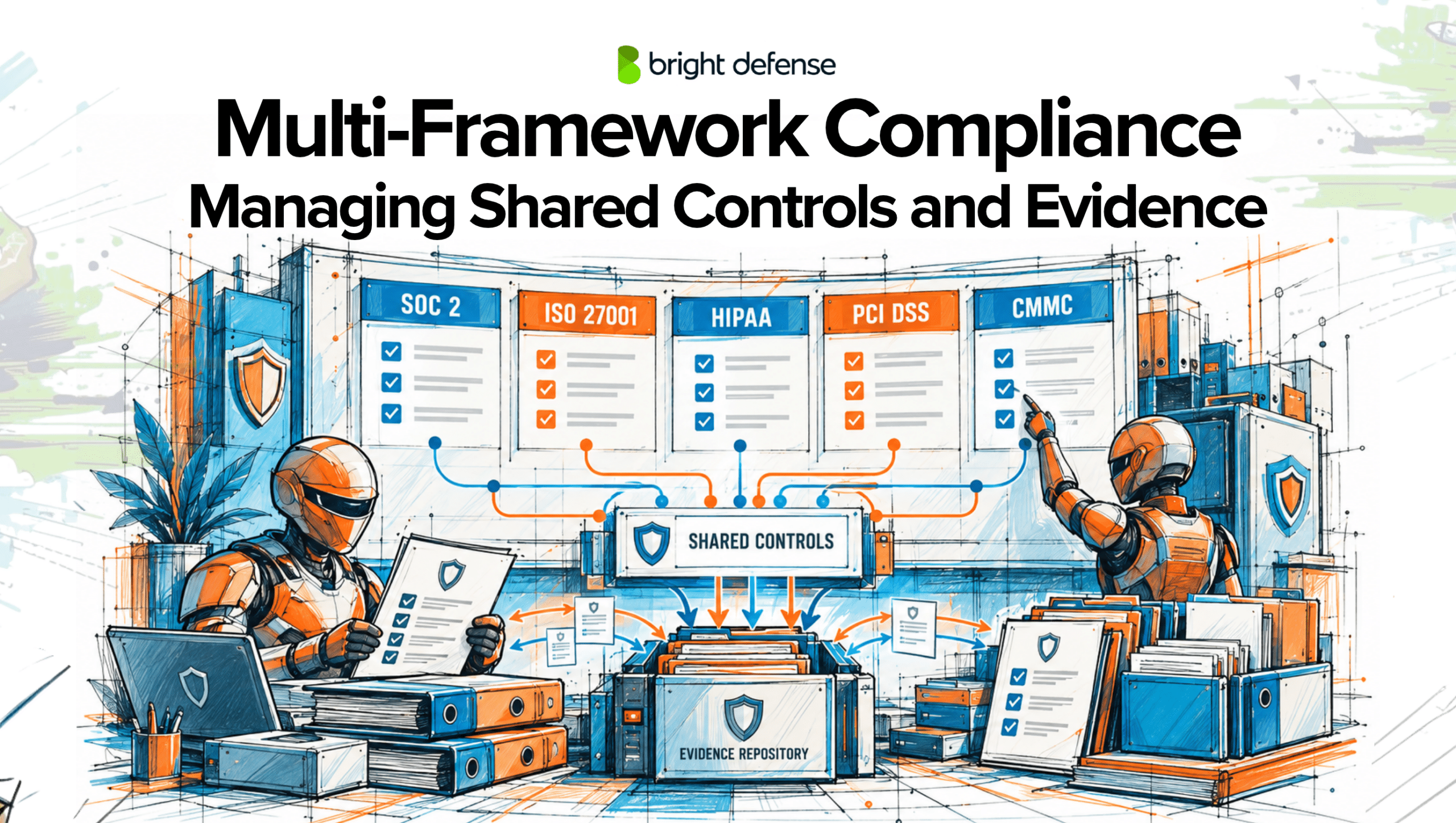
Multiframework compliance brings the requirements of multiple standards and regulations into one coordinated security program. It helps teams reuse controls and evidence while addressing the requirements unique to each framework.
Nearly 70% of respondents in Coalfire’s compliance study managed at least six frameworks. Running a separate program for each can mean asking the same employees for access records repeatedly or maintaining conflicting versions of the same policy.
A coordinated approach connects that work. For example, an employee access review can support both SOC 2 and ISO 27001 when it covers the systems and requirements of each assessment. Teams can collect evidence once and check where it applies, while tracking any additional work separately.
This guide explains how to map overlapping requirements, reuse evidence, and build a multiframework compliance program your team can maintain.
Key Takeaways
- Multi-framework compliance coordinates multiple standards and regulations through one security program
- Shared controls and evidence reduce repeated preparation across assessments
- Reused evidence must match each assessment’s scope and required period
- Each framework retains specific requirements that need separate attention
- Clear ownership, updated mappings, and human review keep shared compliance work accurate
What Is Multi-Framework Compliance?
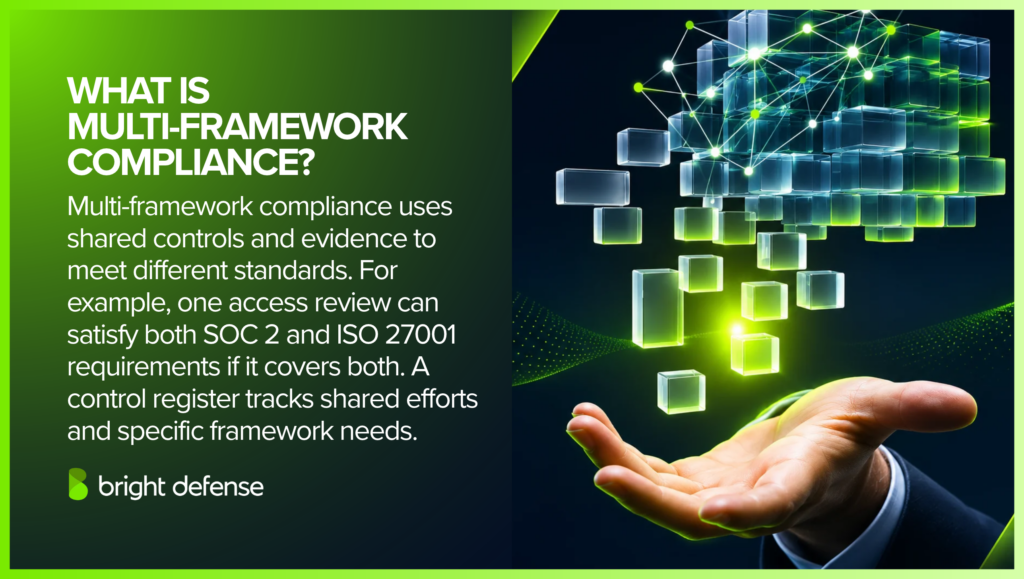
Multi-framework compliance is the practice of managing requirements from multiple standards and regulations through one coordinated program. Teams map overlapping requirements to shared controls and reuse evidence where it meets each assessment’s needs.
For example, a company pursuing SOC 2 and ISO 27001 can use one employee access review process to support both. The review must cover the systems in each assessment’s scope, and its records must provide the evidence each assessor needs.
Common areas of overlap include:
- Risk assessment and treatment
- User access management
- Security awareness training
- Incident response
- Vendor risk management
A shared control register connects these activities to the requirements they support. It records who owns each control and where its evidence is stored, helping teams avoid collecting the same records repeatedly.
Each framework retains its own requirements. An ISO 27001 internal audit evaluates the information security management system, while a SOC 2 Type 2 examination tests control operation over a specified period.
Track these differences alongside shared work so that a completed task in one program does not hide a gap in another.
Why Organizations Need Multi-Framework Compliance?
A new customer can require SOC 2 compliance while another requires ISO 27001 certification.
Expansion into a regulated market can bring further obligations. Managing these requirements together helps teams handle growing workloads without building a separate compliance program for every framework.
97% of surveyed organizations conduct at least two audits annually, and 74% of large enterprises conduct four or more, in A-LIGN’s 2026 Compliance Benchmark Report.
The benefits extend from reducing repeated work to giving leadership a clearer view of unfinished tasks.
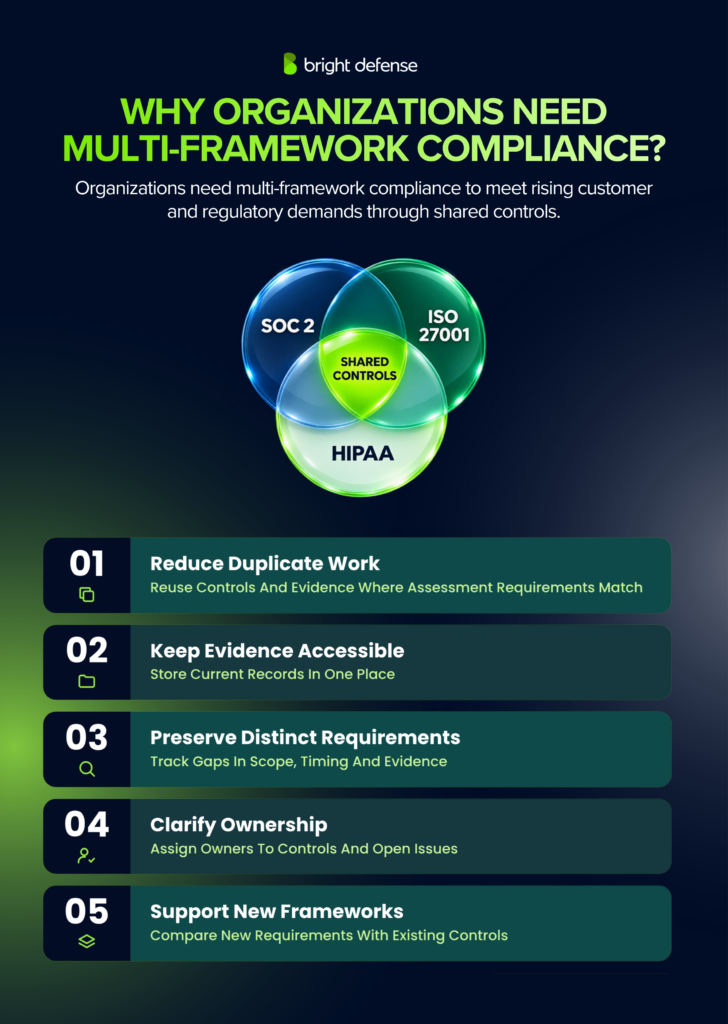
1. Reduce Duplicate Work
Separate programs can leave employees answering the same questions for different assessments. Security teams may export the same access records twice or maintain competing versions of a policy. Nearly 90% of practitioners in a July 2026 compliance cycles survey manually remap or re-document evidence across frameworks, and only 6.5% have largely automated that mapping.
The distance between those two figures shows how few teams have moved past copying the same records into each framework’s tracker.
Multi-framework compliance connects shared activities to the requirements they support. Teams can reuse evidence after checking that its scope and timing meet each assessment’s needs.
For example, a SaaS company can maintain one security training program for employees. Its completion records can support multiple assessments when the training covers the required topics.
2. Keep Evidence Consistent And Accessible
Evidence scattered across inboxes and spreadsheets is difficult to maintain. An assessor may receive an outdated policy while the current version sits in another team’s folder.
A central evidence repository gives control owners a consistent place to keep records. Each item needs a clear connection to the control it supports, along with its collection date.
This makes missing or outdated evidence easier to spot before an assessment begins.
3. Preserve Requirements That Do Not Overlap
Similar requirements can call for different evidence. They may cover different systems or require a control to operate over a different period.
A shared program makes those differences visible. Teams can record where a control meets a requirement fully and where additional work remains.
For example, an access review covering the customer-facing application may support one assessment. A broader assessment may require the review to include internal systems as well.
4. Clarify Responsibility For Controls And Gaps
Shared controls need clear ownership. Without it, two teams may assume the other is reviewing access or resolving an overdue issue.
Give each control an owner responsible for its operation and evidence. Track exceptions with an approver and a review date so temporary arrangements do not become permanent gaps.
Leadership can then see which issues remain open and who is responsible for resolving them.
5. Make Additional Frameworks Easier To Manage
A growing business may need another framework to meet a customer requirement. An existing control inventory gives the team a starting point for that work.
Compare the new requirements against current controls, then assess what is missing. This helps the organization budget for additional work while continuing to maintain its existing commitments.
The result is a compliance program that can grow with the business while keeping each framework’s requirements visible.
Which Standards And Frameworks Can You Manage Together?
A multi-framework compliance program can combine customer assurance requirements with legal obligations. The right combination depends on the services your organization provides and the data it handles.
Each framework serves a different purpose. The table below explains where shared work is possible and what needs separate attention.
| Framework Or Regulation | Main Purpose | Role In A Shared Compliance Program |
| SOC 2 | Provides independent assurance about controls within a defined service system. | Access reviews and security monitoring can support other assessments. The SOC 2 examination retains its own scope and evidence requirements. |
| ISO 27001 | Sets requirements for an information security management system, or ISMS. | Provides a structure for managing security risks and reviewing controls. Certification requires assessment of the ISMS within its defined scope. |
| NIST CSF 2.0 | Organizes cybersecurity outcomes into six functions, including Govern. | Helps teams assess their current practices and prioritize improvements. It provides guidance without prescribing specific technical controls. |
| CIS Controls | Provides prioritized safeguards against common cyber threats. | Gives teams practical security activities to map to broader requirements, such as maintaining asset inventories and managing vulnerabilities. |
| HIPAA | Protects health information handled by covered entities and business associates. | Security controls may overlap with other frameworks. Privacy duties and breach notification procedures need their own review. |
| CMMC | Assesses protection of federal contract information and controlled unclassified information in applicable defense contracts. | Existing security practices can support preparation. The contract’s required level and assessment scope determine the work needed. |
| SOX | Addresses corporate accountability and internal control over financial reporting. | Access restrictions and change approvals may support shared controls. Testing must address the systems and processes affecting financial reporting. |
| ISO 42001 | Sets requirements for an AI management system. | Can share management processes with ISO 27001. AI-specific risks and impact assessments require additional attention. |
| DORA | Sets digital operational resilience requirements for covered EU financial entities. | Connects technology risk management with resilience testing. Its incident reporting and third-party obligations need specific tracking. |
| NIS2 | Sets cybersecurity obligations through national laws implementing the EU directive. | Shared risk management controls can support implementation. Applicable national requirements determine the organization’s obligations. |
NIST CSF 2.0 includes Govern alongside Identify, Protect, Detect, Respond, and Recover. ISO 42001 is an AI management system standard, while HIPAA, SOX, DORA, and NIS2 involve legal obligations with defined applicability. NIST
How Shared Controls Work Across Frameworks
Map controls at the requirement level. A SOC 2 controls list provides examples of control activities and supporting evidence to compare against other frameworks. Broad labels such as “access control” can hide differences in which systems need coverage.
For example, an organization can use one employee offboarding process across its compliance program. Each assessment still needs evidence that the process removes access to the systems within its scope.
Keep the expected outcome separate for each engagement. SOC 2 produces an attestation report, while ISO 27001 supports ISMS certification. Neither outcome automatically proves that the organization meets another framework or law.
How Does Multi-Framework Compliance Work Across Different Frameworks?
Multi-framework compliance connects shared requirements to the same operational controls. Teams reuse suitable evidence and track additional requirements separately. These combinations show how that works in practice.
1. SOC 2 And ISO 27001
SOC 2 and ISO 27001 share security practices such as access reviews and incident response. An organization can operate these controls through one security program.
The team maps each control to the requirements it supports. Before reusing evidence, it checks that the records cover the systems and assessment periods involved.
ISO 27001 requires work specific to its management system, including internal audits and management reviews. A SOC 2 Type 2 examination evaluates whether controls operate effectively throughout its examination period.
For example, a SaaS company can use the same employee offboarding records for both assessments. It still completes the ISMS reviews required for ISO 27001.
2. HIPAA And SOC 2
A healthcare technology company may need to meet HIPAA obligations while providing customers with a SOC 2 report. Access restrictions and security monitoring can support both programs.
The organization can maintain shared technical controls for systems handling electronic protected health information. Its HIPAA work must address applicable privacy and breach notification duties separately.
For example, a medical billing platform can reuse access approval records across both programs. Its business associate agreements remain a distinct HIPAA responsibility.
The Breach Notification Rule requires notice to affected individuals without unreasonable delay and no later than 60 calendar days after discovery, a deadline with no SOC 2 counterpart.
3. NIST CSF And CIS Controls
NIST CSF describes cybersecurity outcomes, while CIS Controls provides prioritized safeguards that help achieve them. Together, they connect security planning with practical implementation.
A team can use NIST CSF to assess weaknesses in its current program. It can then select CIS safeguards to address those weaknesses and track progress.
For example, a business finds that it lacks a reliable inventory of employee devices. It uses CIS asset inventory safeguards to improve visibility and support its NIST CSF objectives.
4. ISO 27001 And ISO 42001
Organizations managing information security and AI risks can coordinate their management systems. Policy reviews and internal audit planning can share an administrative process.
Each system still needs coverage of its specific risks. An information security assessment does not fully address AI concerns such as harmful outputs or inappropriate use.
For example, a software company can coordinate reviews of its security and AI policies. It performs separate assessments of how its AI product could affect users.
5. ISO 27001 And DORA
A financial organization can use its ISO 27001 program to support parts of its DORA work. Existing risk assessments and supplier reviews provide a starting point.
The team compares those activities against its applicable DORA obligations. It then adds any missing requirements for resilience testing or incident reporting.
Supplier reviews deserve early attention, since third parties were involved in 48% of confirmed breaches in the 2026 Verizon DBIR, up from 30% a year earlier. A review that stops at contract terms misses the technology dependencies behind that jump.
For example, a bank can extend its existing supplier review process to assess technology dependencies. It separately checks whether supplier contracts meet DORA requirements.
6. ISO 27001 And NIS2
ISO 27001 can provide a management structure for organizations addressing NIS2-related obligations. Shared work may include incident handling and supply chain risk reviews.
The organization must compare its controls with the national law implementing NIS2 that applies to it. Certification alone does not confirm that those legal duties are met.
For example, a manufacturer can reuse its incident response procedures. It updates notification steps to reflect the deadlines and authorities specified by applicable law.
7. SOC 2 And SOX
An organization pursuing SOC 2 and subject to SOX may share controls over user access and system changes. The key difference is which systems each program covers.
SOC 2 focuses on the defined service system. SOX-related testing focuses on controls affecting financial reporting.
For example, a company can use one change approval process for its customer platform and financial applications. It keeps evidence showing that changes to each system received the required review.
Why Is Managing Multiple Frameworks Manually So Difficult?
Manual compliance becomes harder as each framework adds evidence requests and review deadlines. Spreadsheets can organize the work, but keeping them accurate requires regular coordination. Three problems tend to grow with that workload.
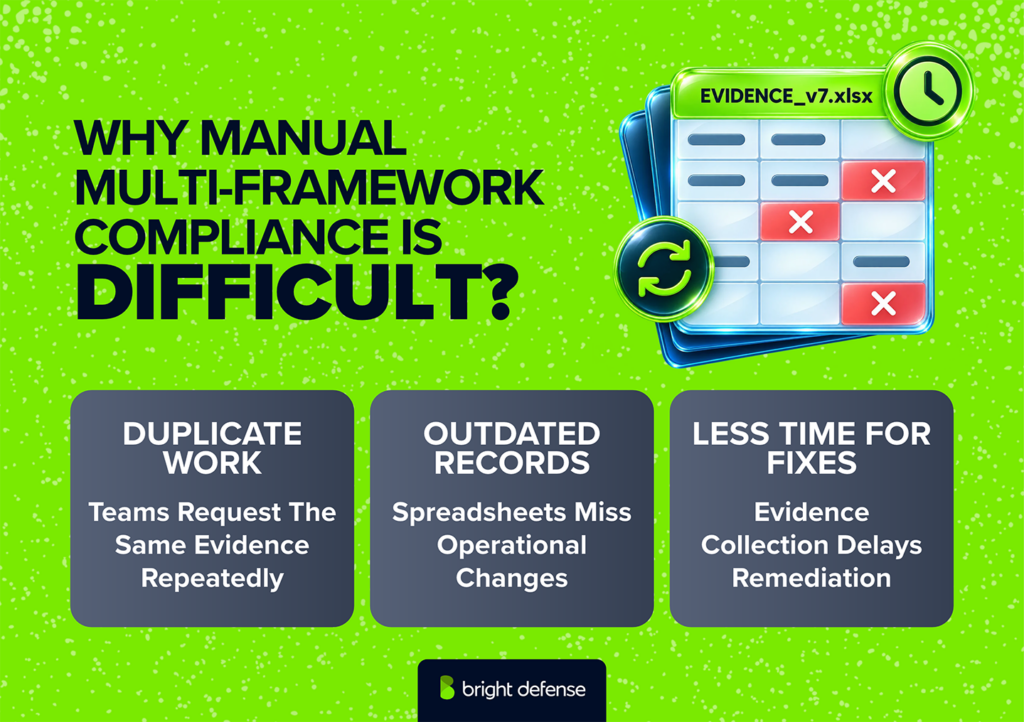
1. Overlapping Controls Create Duplicate Tasks
Separate framework trackers can assign the same activity to different people. Teams may request access records twice or repeat a policy review that another assessment already covers.
Similar requirements still need individual evaluation. Without clear mappings, staff must repeatedly decide which work can be reused and where additional testing is necessary.
For example, IT receives separate requests for employee termination records from the SOC 2 and ISO 27001 teams. Both requests cover the same systems and period.
2. Evidence Falls Behind Operational Changes
A spreadsheet records what someone entered at a particular time. It does not automatically reflect a new application or a change in control ownership.
That creates gaps between the compliance tracker and actual operations. Evidence may cover an old configuration while the current system remains unchecked.
Missing evidence can delay an assessment or require further testing. The effect on the final result depends on the requirement and the significance of the gap.
3. Coordination Takes Time Away From Fixing Problems
Control owners spend time locating records and answering repeated requests. Compliance staff then follow up on missing items and reconcile conflicting versions.
In RegScale’s 2026 State of Continuous Controls Monitoring Report, 83% of organizations faced moderate or major delays from manual compliance work, and 53% dedicate the equivalent of a full-time employee to evidence collection alone.
That headcount goes to gathering records, which leaves less of it for repairing the controls those records describe.
Back-to-back assessments intensify that workload. Teams have less time to investigate recurring failures or improve weak controls.
A shared request schedule helps reduce repeated follow-ups. Each request needs a clear owner and a description of acceptable evidence.
Security Risks Of Poorly Managed Multi-Framework Compliance
A shared compliance program needs accurate mappings and clear ownership. Errors in either can leave gaps hidden behind a dashboard that shows work as complete. The main risks involve control coverage, evidence quality, and unresolved exceptions.
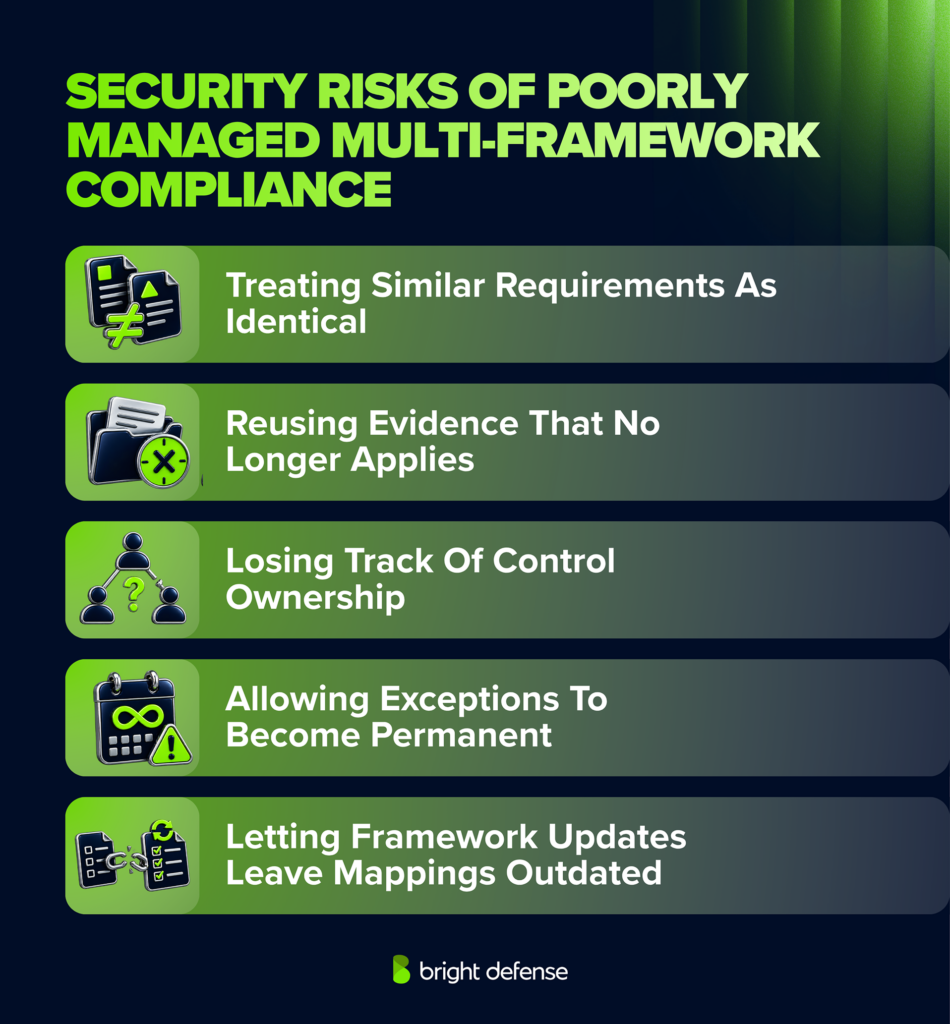
1. Treating Similar Requirements As Identical
Two frameworks may address access control without covering the same systems. A completed review for one assessment can leave accounts outside that scope unchecked.
Check each requirement before marking a shared control as sufficient. Record any additional systems or testing that need coverage.
For example, a review of cloud administrator accounts does not prove that access to the customer support platform has been reviewed.
2. Reusing Evidence That No Longer Applies
Evidence can become unsuitable after a system change or fall outside an assessment period. A screenshot showing MFA enabled months ago may not demonstrate that newly added accounts have the same protection.
Keep collection dates with each evidence item. Confirm that the record covers the systems and period required before reusing it.
3. Losing Track Of Control Ownership
A central register cannot keep controls working without accountable owners. Staff departures and role changes can leave recurring tasks unattended.
Give each shared control a primary owner. Review that assignment when responsibilities change, and make overdue tasks visible to the person responsible for resolving them.
4. Allowing Exceptions To Become Permanent
Temporary exceptions can persist long after their original purpose ends. An application approved for use without SSO, for example, may remain outside normal access controls indefinitely.
Record the reason for each exception and its approval. Include an expiration date and any safeguards required while it remains open.
For example, a legacy application awaiting replacement might require restricted access and more frequent account reviews until migration is complete.
5. Letting Framework Updates Leave Mappings Outdated
A mapping reflects the requirements reviewed when it was created. Changes to a framework can introduce additional work that an existing control does not cover.
Track the version used for each mapping. When requirements change, review the affected controls and update the tasks assigned to their owners.
How Does Multi-Framework Compliance Software Work?
Multi-framework compliance software connects requirements to shared controls and evidence. It helps teams coordinate assessment work while keeping each framework’s scope visible. Four core functions support this process.
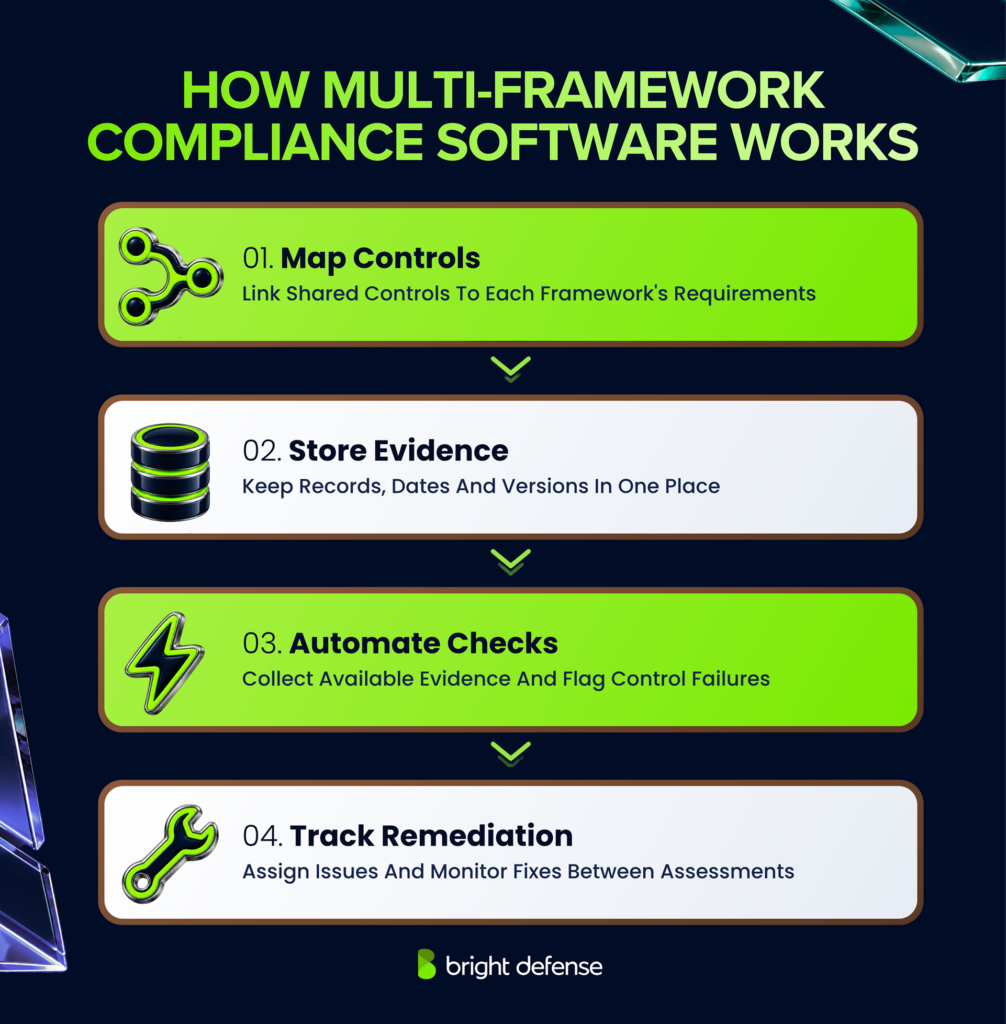
1. Map Controls Across Frameworks
The platform links internal controls to the requirements they support. Teams can see where one activity serves multiple assessments and where additional work remains.
Mappings need review before use. Similar wording does not guarantee that requirements cover the same systems or demand the same evidence.
For example, one employee access review can support two assessments when it covers both scopes. Any excluded systems need a separate review.
2. Centralize Compliance Evidence
A shared repository keeps records connected to their controls. Collection dates and version history help reviewers determine whether evidence remains suitable.
Teams can link one record to multiple requirements without maintaining separate copies. Permissions control who can view sensitive evidence or share it with assessors.
3. Automate Evidence Collection And Control Checks
Integrations collect records from connected business systems. Automated checks can flag specific failures, such as an administrator account without MFA.
80.6% of respondents collected compliance evidence throughout the year in a July 2026 survey of 201 security and compliance practitioners. Within the full sample, 38.3% primarily used automated security tools, and 42.3% relied on significant manual consolidation.
Some platforms use AI to suggest mappings or assess evidence completeness. People still need to review those suggestions and evaluate activities that software cannot observe directly.
For example, an integration can retrieve backup job results. A person still needs to assess whether a restore test demonstrated successful recovery.
4. Monitor Changes And Track Remediation
Recurring compliance monitoring helps teams detect control failures between assessments. The platform can route issues to their owners and track corrective work.
Monitoring frequency varies by integration. Manual controls still require scheduled reviews and evidence from the people performing them.
Continuous monitoring supports assessment readiness. External assessments retain their own testing requirements and schedules.
How Can Bright Defense Help You Manage Multi-Framework Compliance?
Bright Defense helps organizations coordinate compliance work across frameworks such as SOC 2 and ISO 27001. We assess your existing controls and build a plan for the requirements that still need attention.
Our continuous compliance services combine expert guidance with managed automation. We help your team:
- Map shared controls to the requirements they support
- Adapt policies to your systems and daily operations
- Organize evidence for each assessment’s scope
- Track control failures and support remediation
- Prepare for assessor requests and ongoing reviews
For organizations pursuing SOC 2 and ISO 27001 together, we coordinate shared preparation while tracking each engagement’s requirements separately. Your team gets clear ownership of open tasks and guidance on what to address next.
Talk to Bright Defense about building a compliance program that supports your next assessment and the frameworks your customers require.
Frequently Asked Questions
1. How Do I Know Whether My Business Needs Multiple Frameworks?
Check your customer contracts and the obligations that apply to your business. A second framework becomes useful when it meets a specific requirement or business goal. A customer requesting ISO 27001 certification, for example, may create additional work for a company that already has a SOC 2 report.
2. Which Framework Do I Start With?
Prioritize applicable legal and contractual obligations. Then consider customer deadlines and the controls already in place. Choose the sequence that meets those commitments while allowing enough time to implement and test missing controls.
3. Can I Add Another Framework To My Existing Compliance Program?
Yes. Compare the new framework’s requirements against your current controls. Mark each requirement as fully covered, partly covered, or missing, then assign the additional work. Check whether the new assessment includes systems outside your existing scope.
4. Does Meeting One Framework Automatically Satisfy Another?
No. Overlapping controls can reduce preparation work, but each framework retains its own requirements. A shared access review may support two assessments while separate management reviews or reporting duties still need attention.
5. Can I Use The Same Evidence For Multiple Audits?
Yes, when the evidence meets each assessment’s needs. Check its scope and collection period before reusing it. Assessors may request additional samples or perform their own testing, even when they review the same underlying records.
Yes. Coordinating schedules can reduce repeated evidence requests and meetings. Confirm the scope and timing with each assessor early. Each engagement still produces its own assessment results or deliverables.
No. A small program can use a control spreadsheet and a well-organized evidence repository. Software becomes useful when manual updates and follow-ups consume too much time. Clear ownership remains necessary with either approach.
It can reduce repeated preparation work and evidence collection. Initial control mapping takes time, and separate assessment fees may remain. Compare the total cost of coordination with the staff time your current approach consumes.
Give each control one accountable owner, even when several teams contribute. That owner coordinates the activity and maintains its evidence. The compliance lead checks which requirements the control supports and tracks any remaining gaps.
Review the changed requirements against your existing mappings. Determine which controls need adjustment and assign the work before any applicable transition deadline. Keep the previous mapping version so reviewers can understand what changed and why.