Apple Outage Disrupts iCloud and Store Checkouts

Updated:
November 18, 2026
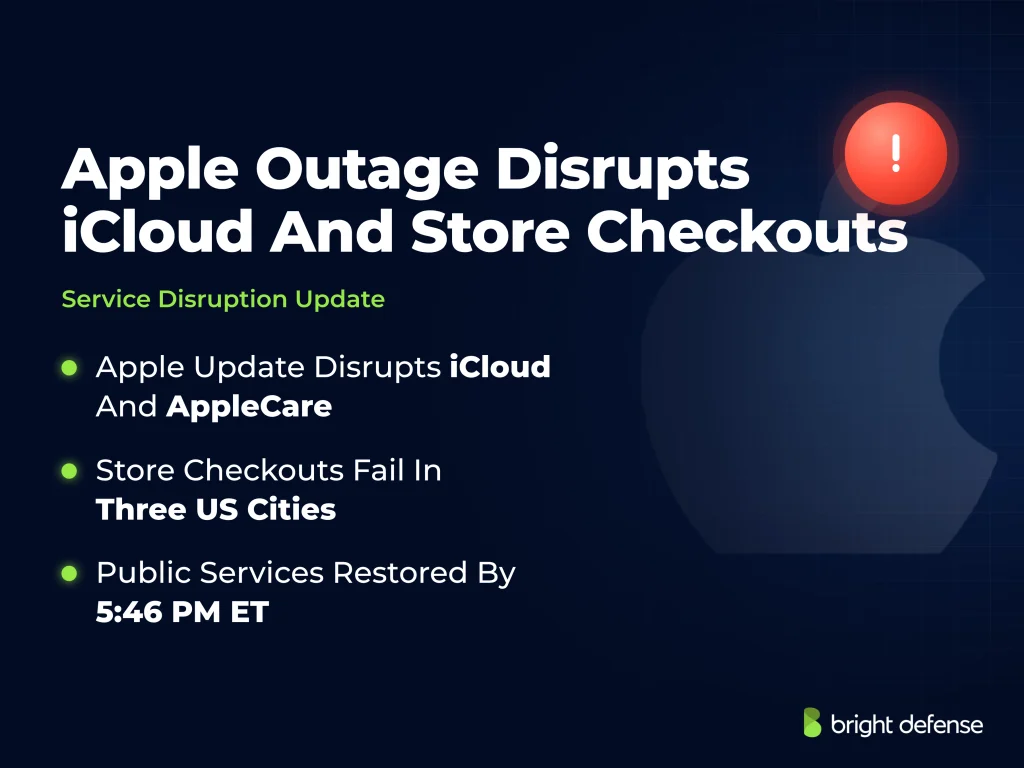
Apple’s public System Status page showed normal service by about 5:46 p.m. Eastern on November 17, 2026, after an outage disrupted iCloud and store checkouts. AppleCare on Device began experiencing problems at 11:15 a.m., followed by iCloud sign-in failures around 11:45 a.m.
Apple traced the outage to an internal update and ruled out a cyberattack. The company has not disclosed what the update changed or why it affected services ranging from email to retail sales.
U.S. users submitted about 1,800 iCloud problem reports at the peak of the disruption, Reuters reported from Downdetector figures. That count measures complaints submitted to the tracker and leaves the total number of affected customers unknown.
What Happened During the Apple Outage?
Employees at Apple stores in New York and Chicago told NBC News that their internal software stopped working. Staff could neither complete purchases nor book appointments.
A customer who visited the Philadelphia store at 18th and Walnut streets around 12:30 p.m. encountered the same problem at the register. An employee told the customer that the store could not process a sale and that self-checkout in the Apple Store app was down, too.
Apple Outage Timeline
Apple tracked each affected service separately on November 17. The afternoon entries below record what the dashboards showed at the time. A status check can confirm that a service has recovered without pinpointing the minute it came back.
| Time (ET) | Development |
|---|---|
| 11:15 a.m. | AppleCare on Device disruption begins. |
| About 11:45 a.m. | Users report iCloud sign-in failures. |
| About 12:30 p.m. | A Philadelphia customer learns that both the register and app self-checkout are unavailable. |
| About 2 p.m. | Apple’s status page lists issues with iCloud Mail, iCloud web apps and AppleCare. |
| 2:27 p.m. | A status update lists an App Store outage. Apple marks it resolved by 3 p.m. |
| By 4:45 p.m. | iCloud sign-in and AppleCare on Device have recovered. Apple Business and Apple School Manager still show problems. |
| About 5:46 p.m. | Apple confirms to CBS News that its public System Status page shows normal service across the board. |
| 10:25 p.m. | AppleInsider’s update still lists two App Store Connect outages on Apple’s separate developer dashboard. |
What Caused the Apple Outage?
An internal Apple update triggered the disruption. Apple ruled out a cyberattack in its statement to CBS News. The company did not name the component it changed, explain how the failure spread or say whether engineers reversed the update to restore service.
Which Apple Services Were Affected?
- Consumers. Apple listed iCloud Mail and iCloud web app problems around 2 p.m., after users had trouble signing in. Apple Music experienced an outage, and an App Store issue listed at 2:27 p.m. was marked resolved by 3 p.m.
- Support. AppleCare on Device was affected, and customers temporarily could not purchase AppleCare coverage.
- Retail. Employees reported checkout failures in New York and Chicago. The Philadelphia store lost access to register sales and app self-checkout.
- Business and education. Apple listed Apple Business, Apple School Manager and Schoolwork as slow or unavailable for affected users.
- Developers. Apple’s developer dashboard carried separate notices for tools including App Store Connect and Xcode Cloud.
Downdetector recorded about 2,300 U.S. Apple Pay complaints around 12:20 p.m. Eastern, and the number of failed payments remains unknown.
How Did the Outage Affect Apple Stores and Businesses?
Apple’s status notices describe which services were unavailable. Store interviews provide a closer view of the work that stopped. The evidence covers three groups.
1. Apple Retail Stores
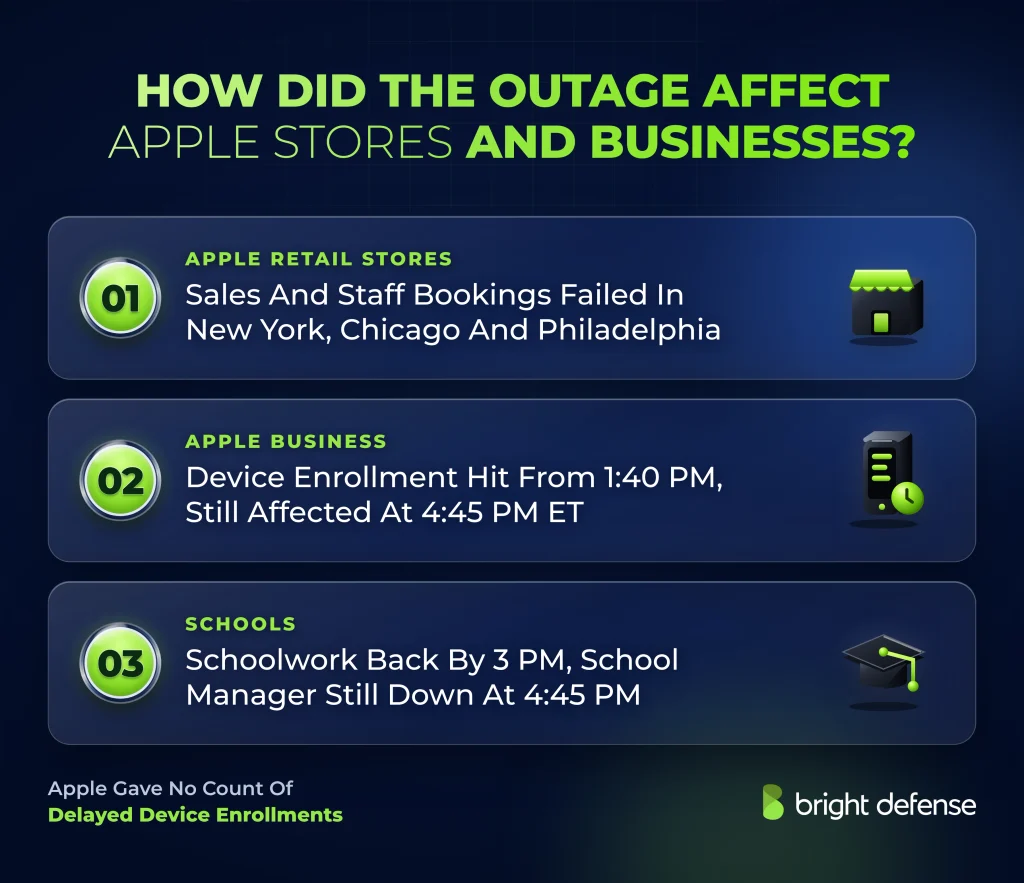
In New York and Chicago, the failure interrupted two jobs normally handled by store staff. A customer ready to buy could not complete the purchase, and a customer seeking an appointment could not book one through the employee. In Philadelphia, switching from the register to a personal phone still left the customer without a way to finish the sale in the store.
2. Organizations Managing Devices Through Apple Business
Apple Business became slow or unavailable for affected users around 1:40 p.m. Eastern and still showed problems at 4:45 p.m. Organizations use the service to register devices for automated enrollment. Apple did not give a count of delayed enrollments.
3. Schools Using Apple School Manager and Schoolwork
Apple listed problems with both services around 1:40 p.m. Schoolwork recovered by 3 p.m., while Apple School Manager still showed problems at 4:45 p.m. A school checking whether it could resume device administration needed to check School Manager’s own status.
Was Customer Data Stolen or Exposed?
Apple ruled out a cyberattack. Neither the company’s public statements nor the reviewed incident coverage described stolen credentials, exposed messages or unauthorized access to customer data.
What Does the Apple Outage Mean for Business Continuity and Compliance?
Bright Defense’s Microsoft Outage Sparks Global Chaos covered how a provider disruption interrupted work even when employees still had access to their devices. Apple’s outage raises a related question for retailers and IT teams. Four decisions belong in the continuity plan before a vendor changes a system that employees depend on.
1. Production Updates Need Staged Rollouts and a Rollback Plan
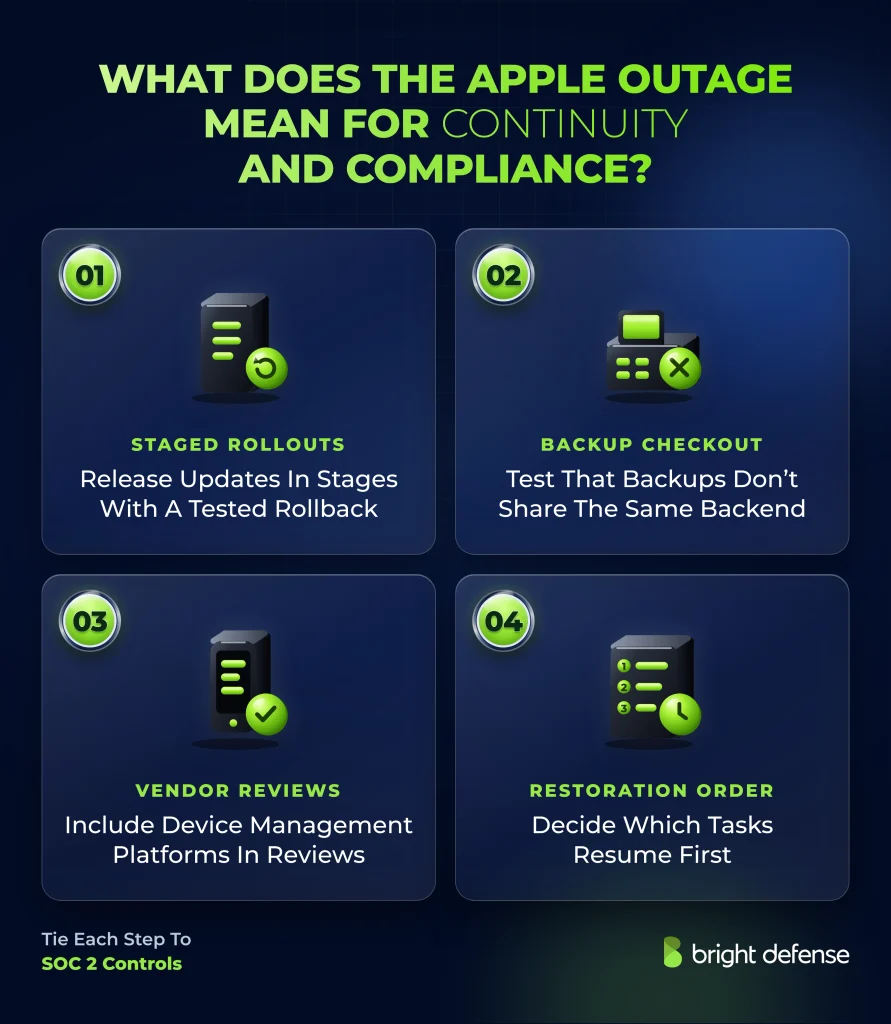
Apple linked one update to disruptions across retail, support and business services. For an engineering team releasing its own changes, a staged rollout gives the release owner time to catch a failed checkout or sign-in before expanding the release. The plan needs a person authorized to stop the rollout, a condition that triggers that decision and a tested way to restore the previous version.
Change management under the SOC 2 Trust Services Criteria covers how teams authorize, test, approve and implement changes to system components. Connecting SOC 2 Policies and Procedures to the release process gives engineers one approval path and preserves a record of who authorized the change.
2. A Backup Checkout Fails When It Shares the Primary System’s Backend
The Philadelphia store lost both checkout options. Apple has not disclosed whether they shared the same backend. A retailer can test that risk directly by having IT take the primary checkout service offline in a controlled exercise and asking a store employee to complete a test sale through the backup.
The test ends when the employee can produce a receipt and finance can reconcile the transaction. That gives the retailer evidence for the continuity and recovery work described in the SOC 2 Requirements Checklist.
3. Vendor Reviews Need to Cover Device Management Platforms
Apple Business and Apple School Manager support automated device enrollment. An IT team that relies on either portal can record which setup steps require it, who can contact vendor support and what staff can do for a new employee or student while enrollment is unavailable. This connects the vendor review to an actual interruption covered by the SOC 2 risk mitigation criteria.
4. Recovery Plans Need a Restoration Order
By 4:45 p.m., iCloud sign-in had recovered while Apple Business and Apple School Manager still showed problems. A customer organization cannot set Apple’s restoration order, but its incident lead can decide which internal tasks resume first and which require another check. For example, a successful sign-in can clear an account access ticket while a device enrollment ticket stays open until an administrator completes setup.
The availability controls in the SOC 2 Controls List cover disaster recovery and recovery testing. A practical test assigns an owner to each critical task and records the transaction that owner must complete before declaring recovery.
How Bright Defense Helps Your Business Prepare for Vendor Update Outages
Bright Defense helps teams connect change approvals with risk assessments and business continuity planning through its continuous cybersecurity compliance service. We work with the people who own each service to document vendor dependencies, decide who can authorize a fallback and define how staff will verify recovery.
Frequently Asked Questions
The following answers cover service recovery, payment complaints and the email issues users reported that day.
1. Are Apple Services Working Again?
Apple confirmed that its public status page showed normal service by about 5:46 p.m. Eastern on November 17. At 10:25 p.m., AppleInsider still listed two App Store Connect outages on the developer dashboard. The exact recovery time for those two incidents remains unverified.
2. Was the Apple Outage a Cyberattack?
Apple ruled out a cyberattack and traced the disruption to an internal update. It has not published a technical explanation of the change that failed.
3. Did Apple Pay Stop Working During the Outage?
U.S. users filed about 2,300 Apple Pay complaints around 12:20 p.m. Eastern. A complaint total cannot show how many transactions failed or whether merchants outside Apple stores experienced the same checkout problem.
4. Was the Gmail Disruption Connected to the Apple Outage?
Neither company confirmed a connection. Downdetector logged more than 2,800 Gmail problem reports by noon Eastern, mostly about receiving mail, while Google said it saw no evidence of a broad disruption. The Google Workspace Status Dashboard listed no Gmail incident for November 17 in its 10:39 a.m. UTC update on November 18.
Downdetector counts user reports against the usual volume for that time of day. The total cannot show how many messages were delayed or where delivery stalled.
5. What Should a Business Do When Email Seems Delayed?
Support staff can record when the sender sent a specific message and check the delivery time in its full header once it arrives. If a customer request or approval is urgent, a phone call lets the recipient confirm receipt while the team investigates.
Sources
- Apple: System Status, accessed November 18, 2026.
- Apple Developer: System Status, accessed November 18, 2026.
- Google: Google Workspace Status Dashboard, accessed November 18, 2026.
- Downdetector: Downdetector Methodology, accessed November 18, 2026.
- Google: Trace an Email With Its Full Header, accessed November 18, 2026.
- Apple Support: Automated Device Enrollment and Device Management, accessed November 18, 2026.
- CBS News: Apple Restores Services After Internal Update Caused Outages, November 17, 2026.
- NBC News and the Associated Press, via NBC New York: Apple Outages Appear to Be Resolved After Internal Update Takes Popular Services Offline, November 17, 2026.
- NBC10 Philadelphia: Apple Reports Outages for Multiple Services, November 17, 2026.
- Associated Press: Apple Joins a Parade of Technology Hiccups in Recent Days, November 17, 2026.
- Reuters: Apple Works to Restore Services After Outage Caused by Internal Update, November 17, 2026.
- AppleInsider: ‘Not a Cyber Attack,’ Apple Says About Outage That Hit iCloud and Internal Services, November 17, 2026.
- The Guardian: Apple Outage: iPhone Apps Suffer Disruption Days After Major Microsoft Issues, November 17, 2026.
- AOL: Gmail Users Report Trouble Receiving Emails Tuesday as Marriott’s App Also Struggles, November 17, 2026.