FedRAMP vs CMMC Compliance: Understanding Federal Cybersecurity Requirements
Updated:
September 28, 2026
Introduction to FedRAMP and CMMC
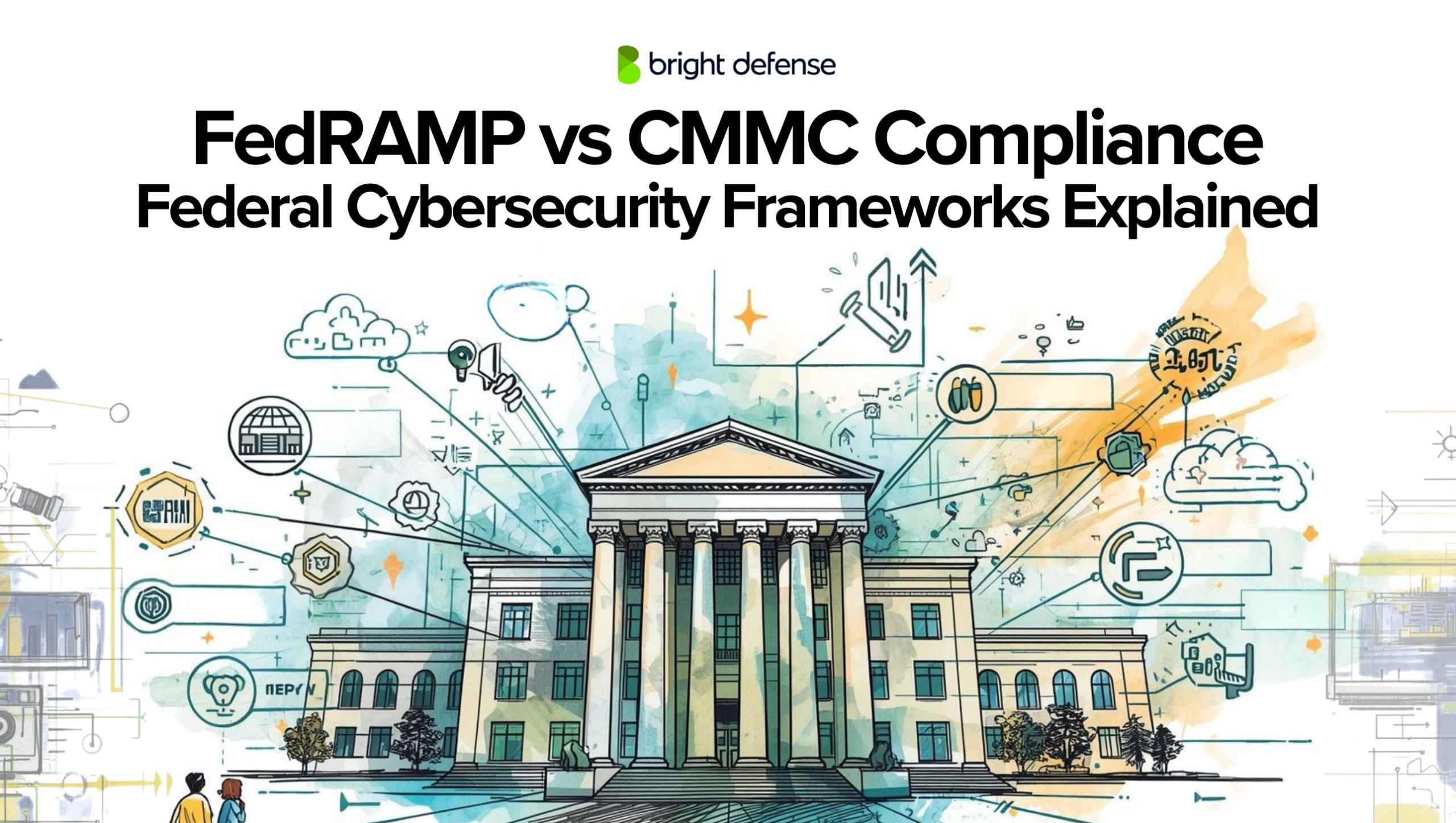
The Federal Risk and Authorization Management Program (FedRAMP) and the Cybersecurity Maturity Model Certification (CMMC) support federal cybersecurity through different requirements and assessment processes.
FedRAMP focuses on cloud services used by federal agencies, providing a standardized approach to security assessment, authorization, and continuous monitoring.
CMMC evaluates safeguards within defense contractor and subcontractor systems that handle Federal Contract Information (FCI) or Controlled Unclassified Information (CUI) under applicable contracts.
Understanding these differences helps businesses identify their obligations and prepare for the appropriate assessment. This guide compares FedRAMP and CMMC requirements, assessment methods, and business applicability.
FedRAMP vs CMMC Comparison Table
FedRAMP evaluates cloud service offerings for federal use, while CMMC assesses safeguards in defense contractor systems handling Federal Contract Information (FCI) or Controlled Unclassified Information (CUI). The following table compares their requirements and reflects program updates through September 2026.
| Category | FedRAMP | CMMC |
|---|---|---|
| Purpose | Standardizes cloud security assessment, certification, and ongoing monitoring for federal use. | Verifies implementation of safeguards required under applicable defense contracts. |
| Primary Audience | Cloud service providers offering products to federal agencies. | Defense contractors and subcontractors handling FCI or CUI. |
| Security Framework Basis | Rev5 uses NIST SP 800-53 Revision 5 baselines. The 20x approach uses Key Security Indicators and automated evidence. | Level 1 uses FAR 52.204-21. Level 2 uses NIST SP 800-171 Revision 2. Level 3 adds selected NIST SP 800-172 requirements. |
| Levels and Classifications | The 2026 model introduces Classes A–D. Class A is the entry tier; Classes B, C, and D replace Low, Moderate, and High terminology. Availability varies by certification route. | The model has three levels: Foundational, Advanced, and Expert. |
| Assessment Scope | The assessment covers a defined cloud service offering and its supporting environment. | The assessment covers defined systems, assets, personnel, and service dependencies under level-specific scoping rules. |
| Assessment Routes | Rev5 and 20x have different evidence and review requirements. FedRAMP certification supports separate agency authorization decisions. | The program provides Level 1 self-assessments, Level 2 self-assessments or C3PAO assessments, and government-led Level 3 DIBCAC assessments. |
| Ongoing Obligations | Providers must maintain security, monitor vulnerabilities, and meet applicable reporting and reassessment requirements. | Contractors must maintain safeguards and submit annual affirmations. Level 1 assessments are annual; Level 2 and Level 3 assessments follow three-year cycles. |
| Current Implementation | FedRAMP is introducing 20x certification routes alongside existing Rev5 routes under its Consolidated Rules for 2026. | The July 2026 Phase 2 suspension leaves Phase 1 self-assessment requirements in effect. |
| Preparation Time and Cost | Effort depends on the service boundary, certification route, class, existing safeguards, and remediation needs. | Effort depends on the required level, assessment scope, security gaps, and assessment route. |
| Typical Use Case | A software provider offers a cloud application to federal agencies. | A manufacturing subcontractor protects defense technical information within its assessed environment. |
| Program Oversight | GSA administers FedRAMP, while federal agencies retain responsibility for their authorization decisions. | The defense department establishes CMMC requirements and implements them through applicable contracts. |
CMMC and FedRAMP: Background Information
FedRAMP and CMMC address different federal cybersecurity needs: cloud service security and the protection of defense information within contractor systems. Their origins and purposes explain these distinct responsibilities:
FedRAMP: History and Purpose
The Office of Management and Budget established the Federal Risk and Authorization Management Program (FedRAMP) in December 2011. Its purpose is to standardize security assessment, authorization, and continuous monitoring for cloud services used by federal agencies. Reusable assessment evidence reduces duplicate reviews across agencies and supports informed decisions about cloud security risks.
CMMC: History and Purpose
The Department of Defense developed the Cybersecurity Maturity Model Certification program to verify that defense contractors and subcontractors implement required safeguards for Federal Contract Information (FCI) and Controlled Unclassified Information (CUI).
The department announced CMMC 2.0 in November 2021, replacing the original five-level model with three levels. The CMMC assessment process evaluates safeguards within a defined contractor environment against the requirements of the applicable level.
Key Components and Requirements of CMMC and FedRAMP
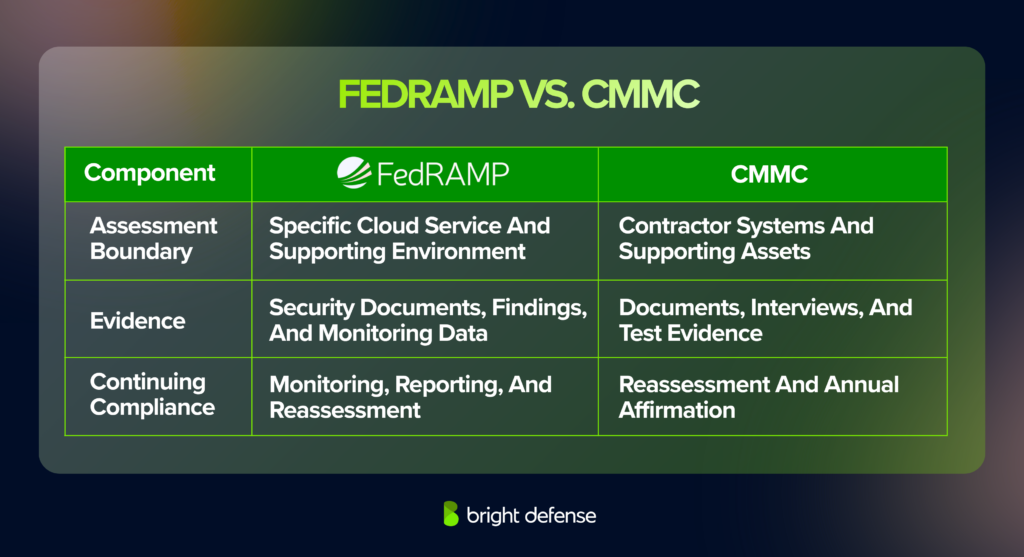
FedRAMP sets security requirements for cloud service offerings, while CMMC verifies safeguards within defined defense contractor environments. Their components differ in three areas: security requirements, assessment evidence, and continuing compliance.
FedRAMP Components
FedRAMP combines security requirements, assessment evidence, certification, and ongoing monitoring. Its Rev5 approach uses NIST SP 800-53 Revision 5 control baselines. FedRAMP 20x uses Key Security Indicators and evidence of security outcomes.
The 2026 classification system introduces Classes A through D, with Classes B, C, and D replacing Low, Moderate, and High terminology. Requirements depend on the certification route and class.
CMMC Components
CMMC has three levels that specify safeguards for Federal Contract Information (FCI) and Controlled Unclassified Information (CUI). Understanding the differences between CMMC Levels 1 and 2 helps contractors identify their preparation needs.
Comparison of Components
Target Audience and Scope
FedRAMP applies to qualifying federal uses of cloud services, while CMMC applies to contractor systems handling defense information under applicable contracts. The following sections explain their audiences, security classifications, and assessment boundaries:
FedRAMP’s Target Audience and Scope
FedRAMP serves cloud service providers offering software, platforms, or infrastructure to federal agencies. Its scope centers on a specific Cloud Service Offering (CSO) and the agency’s intended use. A provider’s certification covers the assessed offering and boundary, rather than every product the company sells.
Understanding FedRAMP Classes and FIPS 199 Impact Levels
FedRAMP’s 2026 certification model introduces Classes A through D. Class A provides an entry tier, while Classes B, C, and D replace the previous Low, Moderate, and High designations.
Federal agencies continue to categorize their information systems under Federal Information Processing Standards (FIPS) 199 according to the potential consequences of losing confidentiality, integrity, or availability.
| FIPS 199 Impact Level | Potential Consequences | Related FedRAMP Designation |
|---|---|---|
| Low | A security incident could cause limited harm to agency operations, assets, or individuals. | Class B replaces the former Low designation. |
| Moderate | A security incident could cause serious harm, including significant operational disruption or financial loss. | Class C replaces the former Moderate designation. |
| High | A security incident could cause severe or catastrophic harm, including loss of critical functions or threats to human life. | Class D replaces the former High designation. |
FedRAMP High addresses sensitive unclassified information. It does not authorize a cloud service to handle classified information, which requires separate approvals and safeguards.
Selecting an Appropriate Cloud Service
Agencies must evaluate whether an offering’s assessed capabilities satisfy the security requirements for their government data. This review includes the certification package, service configuration, customer responsibilities, and intended workload.
FedRAMP certification provides reusable evidence for risk management decisions, while the agency remains responsible for authorizing its use of the service.
CMMC’s Target Audience and Scope
CMMC applies to defense contractors and subcontractors that process, store, or transmit Federal Contract Information (FCI) or Controlled Unclassified Information (CUI) under applicable contracts. Requirements depend on the information handled and contractual obligations, regardless of business size.
The assessment boundary includes relevant contractor systems and supporting assets under level-specific scoping rules. It can cover on-premises, cloud, and hybrid environments without automatically extending to the entire organization.

Compliance and Certification Process
FedRAMP evaluates cloud service security through defined certification routes, while CMMC verifies contractor safeguards through self-assessments, independent assessments, or government assessments. Their processes differ in assessment responsibility, approval decisions, and ongoing obligations:
FedRAMP Compliance Process
Cloud providers define the service boundary, implement applicable safeguards, gather evidence, and complete the reviews required for their certification route and class. Rev5 and FedRAMP 20x have different documentation and independent assessment requirements.
FedRAMP certification and an agency’s Authorization to Operate (ATO) are separate decisions. Certification provides reusable security evidence about the cloud offering.
The agency authorizing official evaluates and accepts the risks associated with its use within an agency information system. Providers must maintain applicable monitoring, reporting, and reassessment activities.
CMMC Assessment and Certification Process
Contractors define their assessment scope, implement the required safeguards, and collect evidence demonstrating that assessment objectives are met.
The CMMC program provides three assessment arrangements: Level 1 uses annual self-assessments; Level 2 uses self-assessments or CMMC Third-Party Assessment Organization (C3PAO) assessments every three years; Level 3 uses government-led Defense Industrial Base Cybersecurity Assessment Center (DIBCAC) assessments every three years.
Annual compliance affirmations apply at every level.The Phase 2 transition remains suspended following the July 13, 2026 announcement. Phase 1 self-assessment requirements remain in effect. Contractors should confirm the assessment obligations specified in their applicable solicitations and contracts.
Comparison of Processes
Preparation time depends on scope, existing safeguards, remediation needs, evidence readiness, and reviewer availability. These factors provide a more useful basis for scheduling than assuming one program always takes longer.
| Process Element | FedRAMP | CMMC |
|---|---|---|
| Assessment Responsibility | Independent assessment and review requirements depend on the certification route and class. | Assessment responsibility depends on the required level and assessment type. |
| Assessment Outcome | Certification provides evidence supporting separate agency authorization decisions. | Assessment results establish the applicable CMMC status for the assessed environment. |
| Continuing Obligations | Providers maintain security and meet applicable monitoring, reporting, and reassessment requirements. | Contractors maintain safeguards, complete periodic assessments, and submit annual affirmations. |
FedRAMP and CMMC: Rooted in NIST Standards
FedRAMP’s Rev5 requirements draw from NIST SP 800-53, while CMMC Level 2 uses NIST SP 800-171 Revision 2. These National Institute of Standards and Technology publications provide different security requirements for federal cloud services and contractor systems. The following sections explain their application:
FedRAMP’s Use of NIST SP 800-53
NIST SP 800-53 Revision 5, titled Security and Privacy Controls for Information Systems and Organizations, provides a catalog of security and privacy controls.
FedRAMP’s Rev5 approach selects applicable controls and adds program-specific requirements, guidance, and parameter values. Providers implement the requirements for their assessed cloud service offering.
These cover areas such as access control, incident response, contingency planning, logging, and communications protection.
FedRAMP 20x and Security Outcomes
FedRAMP 20x uses Key Security Indicators (KSIs) to describe security outcomes that cloud providers must demonstrate. These indicators reference related NIST SP 800-53 controls and emphasize evidence of operating safeguards.
Examples include secure account management, configuration management, and centralized logging. Providers must follow the requirements and evidence expectations of their selected certification route.
CMMC’s Use of NIST SP 800-171 and SP 800-172
CMMC Level 2 incorporates the 110 requirements in NIST SP 800-171 Revision 2, titled Protecting Controlled Unclassified Information in Nonfederal Systems and Organizations.
These requirements address the confidentiality of Controlled Unclassified Information (CUI) within contractor environments. Implementing NIST SP 800-171 requirements involves technical safeguards, operating procedures, documentation, and evidence supporting assessment objectives.
| CMMC Level | Source of Requirements |
|---|---|
| Level 1: Foundational | FAR 52.204-21 supplies 15 basic safeguarding requirements for Federal Contract Information (FCI). |
| Level 2: Advanced | NIST SP 800-171 Revision 2 supplies 110 security requirements across 14 families for protecting CUI. |
| Level 3: Expert | The program adds 24 selected requirements from NIST SP 800-172 to the Level 2 foundation. |
CMMC Level 2 continues to use Revision 2 despite NIST’s publication of Revision 3. Organizations adopting newer NIST guidance must still satisfy the requirements incorporated into the applicable CMMC rules.
The Interplay of FedRAMP, CMMC, and NIST Standards
FedRAMP and CMMC use related NIST security requirements while retaining separate scopes, assessment methods, and compliance obligations. Shared controls support coordinated implementation, but compliance with one program does not automatically establish compliance with the other. Businesses should consider three areas of overlap:
Implications for Businesses
Cloud providers serving federal agencies must determine whether their offerings and intended uses fall within FedRAMP’s scope. Small defense contractors must identify their contractual requirements and prepare for the applicable CMMC level.
Organizations operating in both markets should map overlapping safeguards, document assessment boundaries, and identify evidence that satisfies each program’s requirements.
Cloud Services Used by Defense Contractors
Defense contractors using external cloud services to handle covered defense information face overlapping obligations. DFARS 252.204-7012 requires those providers to meet security requirements equivalent to the FedRAMP Moderate baseline and applicable incident-reporting, evidence-preservation, and forensic-access obligations.
Contractors remain responsible for their own CMMC requirements, including customer-managed configurations and safeguards within the assessed environment.
Resource Planning and Evidence Management
Coordinating FedRAMP requirements with NIST SP 800-171 implementation can reduce duplicate work where safeguards and assessment objectives overlap.
Organizations should assign control owners, document shared responsibilities, and verify that reused evidence covers the relevant systems and requirements. Budgets must account for remediation, assessments, staff training, and ongoing monitoring. A control mapping identifies relationships between requirements; it does not establish automatic equivalence.
Final Thoughts on CMMC vs FedRAMP
FedRAMP evaluates cloud service offerings for federal use, while CMMC verifies safeguards in contractor systems handling defense information under applicable contracts. Businesses should identify their contractual obligations, define assessment boundaries, and implement the required protections.
Understanding the CMMC security requirements for small businesses supports this preparation. Organizations subject to both programs can coordinate overlapping safeguards while maintaining the evidence and assessment requirements specific to each.
Bright Defense’s NIST and CMMC Compliance Support
Bright Defense helps organizations implement applicable NIST SP 800-53 and NIST SP 800-171 requirements through gap assessments, remediation planning, and control implementation support.
Its monthly engagement model includes ongoing compliance reviews, documentation support, and evidence collection to track progress and prepare for assessments.
These activities help organizations identify deficiencies, assign corrective actions, and maintain safeguards as systems and business needs change.
FAQ:
1. What Is FedRAMP?
FedRAMP, the Federal Risk and Authorization Management Program, standardizes security assessment, certification, and ongoing monitoring for cloud services used by federal agencies. Certification provides reusable security evidence, while each agency remains responsible for authorizing its use of the service.
2. What Is CMMC?
CMMC, the Cybersecurity Maturity Model Certification program, verifies safeguards in defense contractor systems handling Federal Contract Information (FCI) or Controlled Unclassified Information (CUI). CMMC Level 1 protects FCI, while Levels 2 and 3 address CUI with progressively greater requirements.
3. How Do FedRAMP and CMMC Differ in Their Purpose?
FedRAMP evaluates cloud service offerings for federal use. CMMC evaluates contractor safeguards required under applicable defense contracts. Their assessment boundaries differ: FedRAMP focuses on a cloud offering, while CMMC covers a defined contractor environment and its supporting assets.
4. Are FedRAMP and CMMC Based on the Same NIST Standards?
The programs use different NIST publications. FedRAMP Rev5 draws from NIST SP 800-53, while FedRAMP 20x uses related Key Security Indicators. CMMC Level 2 uses NIST SP 800-171 Revision 2. Level 1 uses FAR safeguards, and Level 3 adds selected NIST SP 800-172 requirements.
5. Who Needs to Comply With FedRAMP?
Cloud providers and federal agencies must follow FedRAMP requirements when the agency’s intended cloud use falls within the program’s scope. Agencies evaluate the specific offering, configuration, and responsibilities as part of their authorization and vendor risk management activities.
6. Who Needs to Comply With CMMC?
Defense contractors and subcontractors must meet CMMC requirements specified in applicable contracts involving FCI or CUI. Business size alone does not determine applicability. The required level, assessment scope, and contractual obligations guide CMMC implementation.
7. What Does the Assessment Process Involve?
FedRAMP requires evidence and reviews appropriate to the certification route and class. CMMC provides Level 1 self-assessments, Level 2 self-assessments or CMMC Third-Party Assessment Organization (C3PAO) assessments, and government-led Level 3 assessments. The July 2026 Phase 2 suspension leaves Phase 1 self-assessment requirements in effect.
8. Can a Company Hold Both FedRAMP and CMMC Certifications?
An organization can maintain a FedRAMP-certified cloud offering and CMMC certification for an applicable contractor environment. Each status covers a defined scope. Shared safeguards can support both programs, but one certification does not automatically establish compliance with the other.
9. How Often Are Assessments and Compliance Updates Required?
FedRAMP requires ongoing compliance monitoring and route-specific reassessments, including annual independent assessments where required. CMMC Level 1 requires annual self-assessments. Levels 2 and 3 follow three-year assessment cycles. CMMC requires compliance affirmations after assessments and annually thereafter.
10. Are There Different Levels Within FedRAMP and CMMC?
FedRAMP’s 2026 model introduces Classes A through D. Class A is an entry tier; Classes B, C, and D replace the former Low, Moderate, and High designations. CMMC has three levels: Foundational, Advanced, and Expert. FedRAMP classes and CMMC levels are not equivalent ratings.
11. How Do Businesses Benefit From These Programs?
Meeting applicable requirements supports eligibility for federal work, provides evidence of implemented safeguards, and improves security accountability. A properly scoped CMMC enclave can concentrate CUI protection within a defined environment. Compliance does not guarantee a contract award or prevent every security incident.
12. Where Can Businesses Find Authoritative FedRAMP and CMMC Guidance?
The official FedRAMP website provides program rules, provider guidance, and Marketplace listings. The defense department’s CMMC website provides assessment guides, scoping guidance, FAQs, and implementation updates. Current solicitations and contracts establish the requirements applicable to a particular engagement.