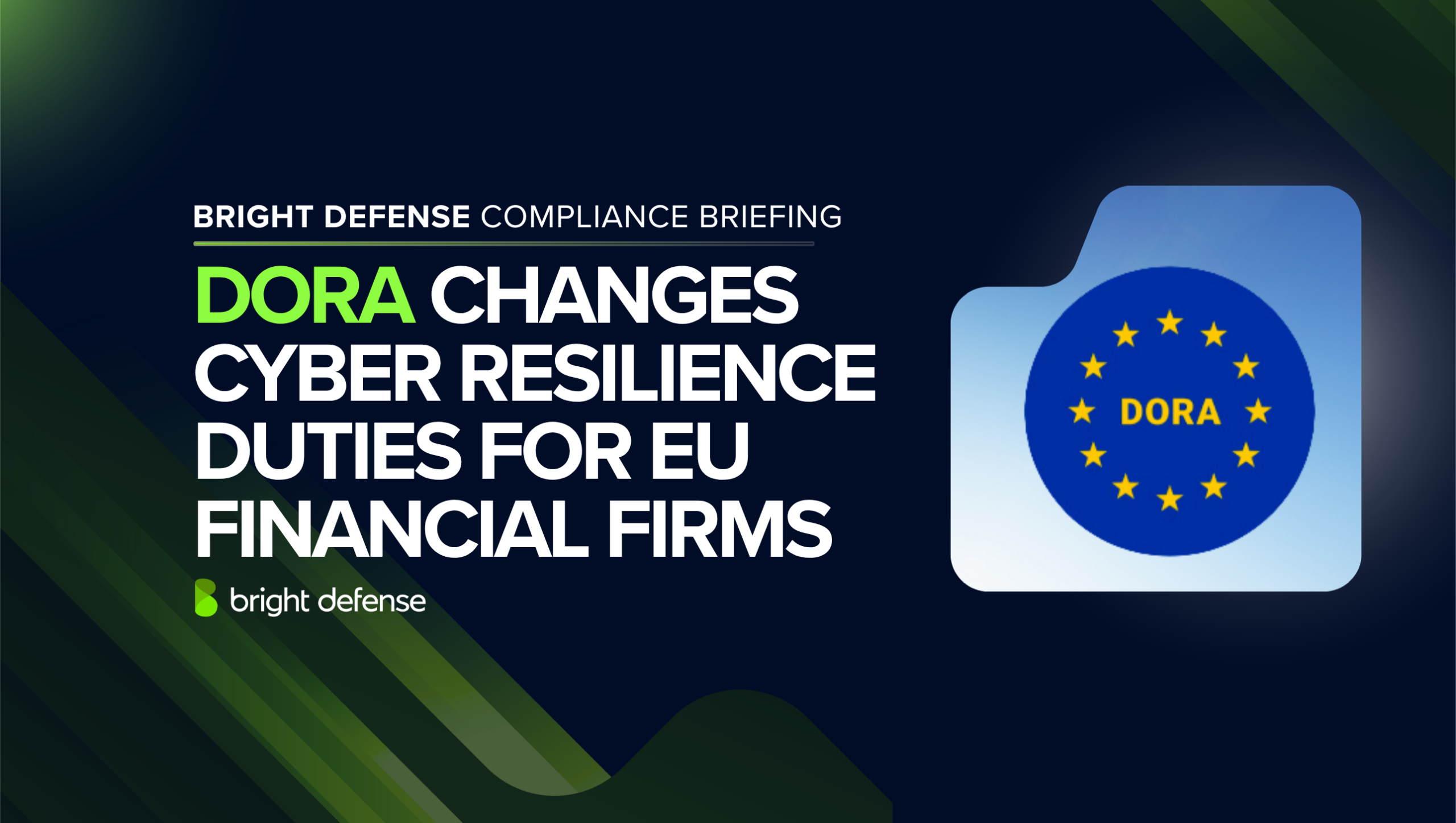
DORA Reshapes Cyber Duties For EU Financial Firms
Updated:
September 21, 2026
DORA has changed cybersecurity and technology-risk duties for EU financial firms from fragmented national obligations into a binding EU-wide operational resilience regime, with banks, insurers, payment firms, investment firms, and major ICT suppliers now facing stricter governance, incident reporting, testing, and third-party risk rules. The latest confirmed update came on June 3, 2026, when the European Supervisory Authorities published their first DORA incident overview.
What Is DORA And Why Does It Matter For EU Financial Firms Now?
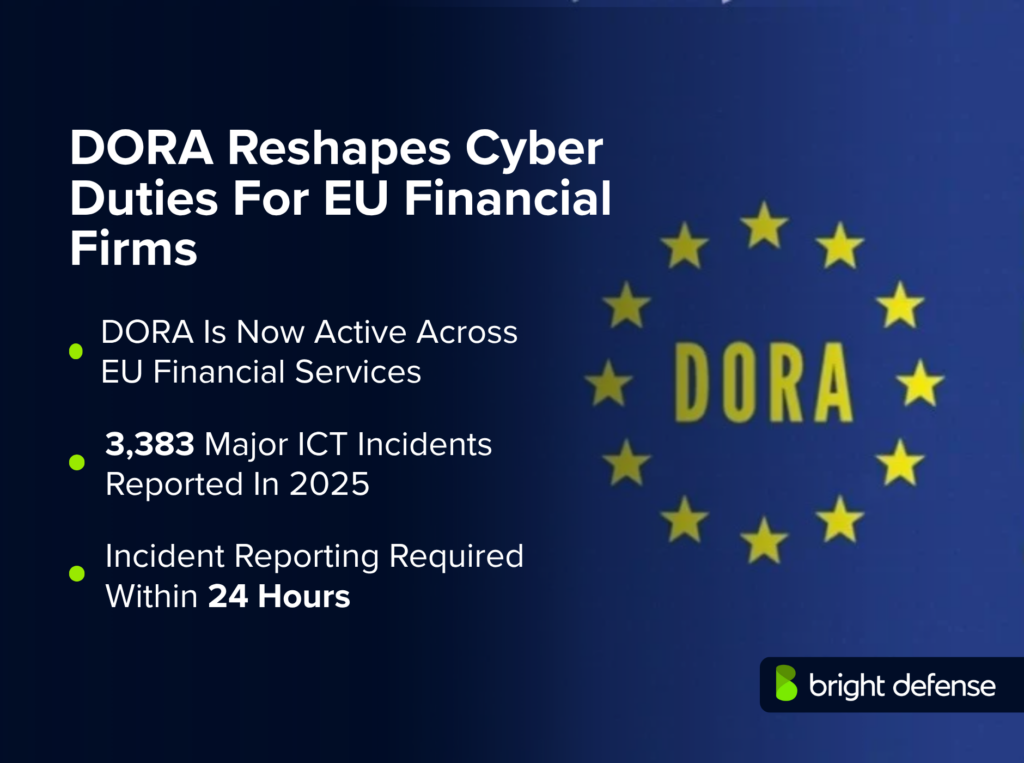
DORA is the EU Digital Operational Resilience Act, formally Regulation (EU) 2022/2554, and it applies to financial entities and ICT third-party service providers across the EU. It matters now because the law has been active since January 17, 2025, and regulators are already collecting incident, outsourcing, and third-party data.
DORA was created to address a gap in financial regulation: digital systems had become central to payments, trading, lending, insurance, clearing, settlement, and customer service, but cyber and technology-risk rules were uneven across EU member states.
The law does not treat cyber risk as a back-office IT issue. It makes management bodies responsible for ICT risk oversight, requires firms to track critical services and vendors, and gives supervisors common powers to test whether firms can withstand and recover from severe disruption.
What Is The DORA Timeline From The 2020 Proposal To The 2026 Incident Report?
DORA began in the European Commission’s Digital Finance Package on September 24, 2020, was adopted by the Council on November 28, 2022, was signed on December 14, 2022, entered into force on January 16, 2023, and became applicable on January 17, 2025.
The rulemaking then moved into technical standards. Commission Delegated Regulation (EU) 2024/1772 set major incident classification criteria. Commission Delegated Regulation (EU) 2025/301 set reporting content and timing. Commission Implementing Regulation (EU) 2025/302 set reporting forms, templates, and procedures.
The next phase focused on live supervision. The ESAs designated critical ICT third-party providers on November 18, 2025. On June 3, 2026, the ESAs published the first annual overview of major ICT-related incidents under Article 22(2) of DORA, covering incidents reported for 2025.
What Does DORA Require From Banks, Insurers, And Payment Firms?
DORA requires financial entities to run an ICT risk management framework, report major ICT-related incidents, test operational resilience, manage ICT third-party risk, maintain registers of ICT contracts, and support voluntary cyber threat information sharing. The rules are built around operational continuity, not just data security.
The main compliance pillars cover governance, risk management, detection, protection, response, recovery, backup, post-incident learning, communication, resilience testing, and outsourcing oversight. Firms must keep a register of contractual arrangements with ICT third-party service providers at entity, sub-consolidated, and consolidated levels.
DORA incident reporting has fixed timing. A major ICT-related incident requires an initial notification within 4 hours after classification as major and no later than 24 hours after awareness. A documented cyber threat intelligence and incident response process can help teams classify incidents, preserve evidence and escalate regulatory notifications within these deadlines.
The intermediate report is due within 72 hours after the initial notification, and the final report is due no later than 1 month after the intermediate report.
Which Financial Firms And ICT Providers Are Covered By DORA?
DORA applies across roughly 20 regulated financial-entity categories and ICT third-party service providers. EIOPA describes the scope as 20 types of financial entities plus ICT providers, while ESMA describes DORA as covering 21 types of financial entities, including 12 in ESMA’s remit.
Covered firms include credit institutions, payment institutions, electronic money institutions, investment firms, crypto-asset service providers, central securities depositories, central counterparties, trading venues, trade repositories, alternative investment fund managers, insurance and reinsurance undertakings, insurance intermediaries, pension institutions, credit rating agencies, crowdfunding service providers, and administrators of critical benchmarks.
The law also reaches designated critical ICT third-party providers. On November 18, 2025, the ESAs listed 19 critical providers, including Accenture plc, Amazon Web Services EMEA Sarl, Bloomberg L.P., Capgemini SE, Google Cloud EMEA Limited, IBM Corporation, Microsoft Ireland Operations Limited, Oracle Nederland B.V., SAP SE, and Tata Consultancy Services Limited.
What Penalties And Enforcement Tools Apply Under DORA?
DORA gives national competent authorities supervisory, investigatory, and sanctioning powers, while member states set detailed penalty regimes for financial entities. For critical ICT third-party providers, DORA allows Lead Overseers to impose periodic penalty payments of up to 1% of average daily worldwide turnover for up to 6 months.
Supervisors can request documents, inspect premises, require explanations, order remediation, publish penalties, and use national sanctioning rules. DORA also allows member states to adopt criminal penalties for serious breaches where national law provides that route.
The enforcement model is split. National regulators supervise financial entities. The ESAs coordinate direct oversight of designated critical ICT third-party providers through Lead Overseers, joint examination teams, information requests, general investigations, inspections, and follow-up measures.
What Should EU Financial Firms Do Now To Comply With DORA?
EU financial firms should treat DORA as an operating model for technology resilience, not a one-time compliance project. Practical work includes board accountability, ICT risk mapping, incident reporting procedures, vendor registers, contract reviews, resilience testing, backup validation, threat-led penetration testing where applicable, and evidence retention.
Firms should map important and critical functions, connect those functions to ICT assets and vendors, and document concentration risk. Security teams should test detection, response, recovery, backup restoration, vulnerability management, access control, logging, and incident escalation.
Legal and procurement teams should update ICT contracts to cover audit rights, access rights, service levels, incident support, subcontracting, exit rights, data location, and termination support. Risk teams should keep the register of information current because regulators use those registers to supervise third-party risk and designate critical providers.
How Has The Financial Industry Responded To DORA Compliance Costs?
Industry response has focused on implementation cost, third-party contract work, reporting complexity, and pressure on security leaders. Rubrik Zero Labs, with Wakefield Research, surveyed 350 CISOs and found 47% of UK financial and banking organizations spent more than €1 million on regulations such as DORA and PRA over 2 years.
The same survey found 28% spent between €501,000 and €1,000,000, 58% of UK CISOs reported increased pressure, and 79% reported mental-health impact tied to compliance and cyber risk pressures. The findings are vendor-sponsored, so they should be treated as industry sentiment evidence rather than official cost estimates.
Specialist legal and risk advisers said many firms entered 2025 with continuing work on delegated rules, technical standards, reporting formats, and third-party contract remediation. That pushed DORA from a deadline exercise into a sustained governance and operations program.
What Have EU Regulators Done Under DORA Since January 17, 2025?
EU regulators have moved from rulemaking into data collection, reporting analysis, and third-party oversight since DORA became applicable on January 17, 2025. The ESAs collected registers of information, designated critical ICT third-party providers, and published the first Article 22(2) annual report on major ICT incidents.
The June 3, 2026 ESA report counted 3,383 major ICT-related incidents in 2025, equal to an average of 0.18 major incidents per financial entity subject to DORA. Around 1 third had cross-border impact, and about 10% were classified as cybersecurity-related.
The ESAs said system failures and external events were the main drivers. Almost 1 third of major incidents originated from third parties, including ICT providers, other financial entities and infrastructure providers. Penetration testing in third-party risk management can help financial firms examine vendor-connected applications, APIs and infrastructure before those dependencies contribute to an operational disruption.
What Are The Business And Legal Risks From Missing DORA Requirements?
Missing DORA requirements can create regulatory, contractual, operational, and customer-trust risk for financial firms and their ICT suppliers. The biggest exposure areas are poor incident reporting, weak recovery evidence, incomplete vendor registers, deficient ICT contracts, untested backup processes, and unmanaged concentration risk.
A DORA failure can become a business problem before it becomes a fine. A bank, insurer or payment firm that cannot show resilience evidence may face supervisory findings, remediation orders, delayed product launches, vendor restrictions, board scrutiny and higher audit workloads.
Maintaining continuous audit readiness helps firms keep policies, test results, incident records and remediation evidence available for regulatory review.
ICT suppliers face a different risk profile. Designated critical ICT third-party providers enter direct ESA oversight, and non-designated providers still face more demanding customer due diligence, contract terms, incident support duties, and exit-planning expectations.
What Questions Remain About DORA In 2026?
The main open DORA questions in 2026 concern supervisory consistency, national penalty differences, incident-reporting data quality, third-party concentration risk, cloud-provider oversight, and how firms will handle AI-driven cyber threats. The ESAs said reporting practices still diverge across sectors and jurisdictions.
Another open question is whether the current reporting structure will move toward greater centralization. The ESAs published a January 17, 2025 study on centralizing major ICT incident reporting, but DORA reporting still runs through competent authorities.
No major EU court ruling was found in the public record that directly changes DORA’s core obligations. The main legal uncertainty sits in national enforcement practice, cross-border supervision, and how regulators will judge proportionality for smaller firms.
Why Does DORA Matter For Financial Cyber Resilience In Europe?
DORA matters because financial services depend on digital infrastructure, cloud services, data providers, payment systems, trading platforms, outsourced operations, and shared technology suppliers. A major ICT failure can spread across borders, firms, and markets faster than traditional operational incidents.
The ESA incident report shows the practical reason for the law. Major incidents in 2025 were frequent enough to create supervisory visibility, but client and transaction impact was generally limited in many cases, which suggests response and containment work can reduce harm.
The broader significance is that DORA makes resilience measurable. EU financial firms must prove they can detect, absorb, recover from, and learn from disruption, while supervisors now have common tools to inspect ICT risk across the sector.
How Bright Defense Helps Financial Firms Meet DORA Cyber Resilience Duties
Bright Defense helps banks, fintechs, insurers, payment firms, asset managers, and ICT service providers prepare for DORA through Penetration Testing, Continuous Compliance, and Security Assessments. These services support ICT risk evidence, resilience testing, vulnerability validation, incident readiness, third-party assurance, and remediation tracking.
For DORA programs, Bright Defense can test applications, APIs, cloud environments, identity controls, exposed infrastructure, backup and recovery paths, vendor access points, and incident response workflows. That work helps financial firms move from policy documents to operating proof that supports regulatory reviews, customer assurance, and board-level accountability.
Sources Cited In This DORA Report
- European Commission — Digital Finance Package (September 24, 2020)
- Council Of The European Union — Digital Finance: Council Adopts Digital Operational Resilience Act (November 28, 2022)
- EUR-Lex — Regulation (EU) 2022/2554 On Digital Operational Resilience For The Financial Sector (December 14, 2022)
- EUR-Lex — Directive (EU) 2022/2556 As Regards Digital Operational Resilience For The Financial Sector (December 14, 2022)
- EIOPA — Digital Operational Resilience Act (DORA) (Accessed June 18, 2026)
- ESMA — Digital Operational Resilience Act (DORA) (Accessed June 18, 2026)
- European Commission — Implementing And Delegated Acts, DORA (Accessed June 18, 2026)
- EUR-Lex — Commission Delegated Regulation (EU) 2025/301 On Major ICT-Related Incident Reporting (February 20, 2025)
- EUR-Lex — Commission Implementing Regulation (EU) 2025/302 On Major ICT Incident Reporting Templates (February 20, 2025)
- EUR-Lex — Commission Delegated Regulation (EU) 2024/1772 On ICT Incident Classification (June 25, 2024)
- EBA — Preparations For Reporting Of DORA Registers Of Information (Accessed June 18, 2026)
- EBA — European Supervisory Authorities Designate Critical ICT Third-Party Providers Under DORA (November 18, 2025)
- EBA, EIOPA And ESMA — List Of Designated Critical ICT Third-Party Service Providers (November 18, 2025)
- ESMA — ESAs Publish The First Report On DORA Major ICT-Related Incidents (June 3, 2026)
- EBA, EIOPA And ESMA — 2025 Report On Major ICT-Related Incidents (June 3, 2026)
- European Central Bank — Operational Resilience In The Digital Age (January 17, 2025)
- ENISA — EU Financial Entities Cybersecurity Upgrade: DORA Is Now Alive And Kicking (January 17, 2025)
- Rubrik — Cyber Security Regulations Are Breaking The Bank For UK Financial Service Organizations (January 16, 2025)