5 Best SOC 2 Consultants for Startups in 2026
Updated:
August 25, 2026
77% of business and IT leaders say stakeholders now demand verified proof of security and compliance, up from 65% a year earlier. At the same time, security teams spend about 12 working weeks per year on compliance, creating a significant workload for startups with limited security and GRC resources.
SOC 2 consultants help startups scope controls, prepare policies and evidence, close readiness gaps, and coordinate with the independent CPA firm conducting the examination. Below, we compare the 5 Best SOC 2 Consultants for Startups in 2026 based on startup fit, readiness depth, delivery model, platform support, and audit coordination.
Note: This Is Not a Ranked List. The Numbering and Placement of the Companies Do Not Indicate Superiority or Preference. All Firms Included Have the Capabilities and Experience to Provide Penetration Testing Services for SOC 2 Compliance.
What a SOC 2 Consultant Does and Cannot Do
A SOC 2 consultant helps a company design, implement, document, and maintain the control environment that the CPA auditor examines.
Depending on the engagement, the consultant may handle scoping, policy development, compliance platform configuration, evidence collection, remediation, staff training, and audit coordination.
The independent CPA firm performs the SOC 2 examination and issues the report.
Report issuance belongs to a licensed CPA firm that examines management’s controls under AICPA attestation standards.
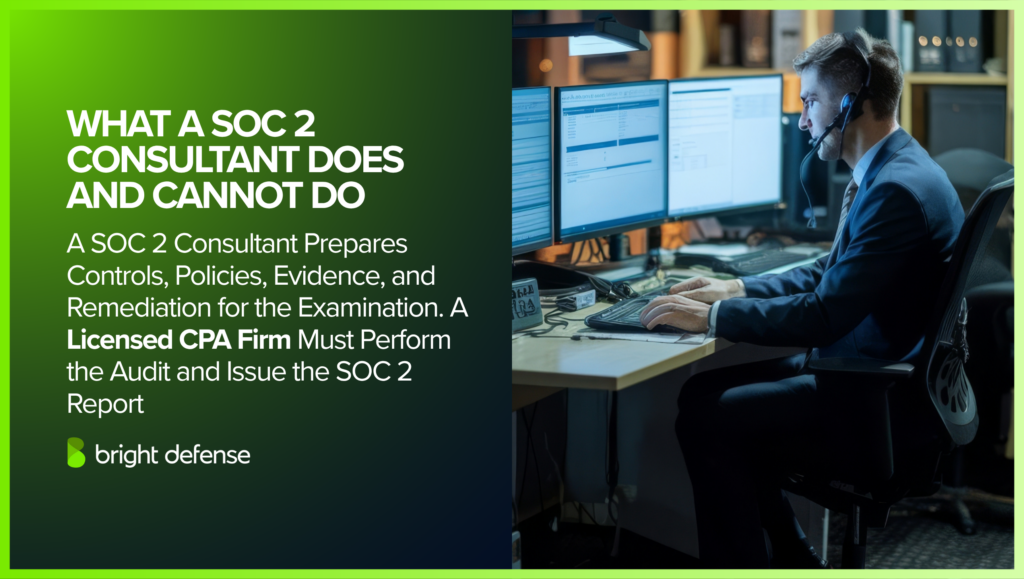
Auditor independence separates readiness work from the SOC 2 examination. Some provider groups maintain relationships with separate CPA firms or attest entities, but the structure alone does not resolve every independence concern.
The signing CPA firm must retain independence, professional judgment, and responsibility for its examination procedures. Startups should confirm which licensed CPA firm will issue the report and how relationships between the consultant, software provider, and auditor are managed.
Buyers should confirm the legal entity that will sign the report before contracting.
Startups ready to choose an auditor can compare the best SOC 2 audit firms for startups to review leading CPA firms and select the right provider for their SOC 2 examination.
SOC 2 Consultant Comparison for Startups
None of the five firms below can issue a SOC 2 report. Each one prepares the control environment and coordinates with the CPA firm that does.
| Consultant | Best For | Delivery Model | Website |
|---|---|---|---|
| 1. Bright Defense | Startups with no dedicated security or compliance staff | Monthly managed compliance with vCISO access | brightdefense.com |
| 2. Workstreet | Venture-backed technology and AI companies that use Vanta | Fully remote managed security and compliance team | workstreet.com |
| 3. Rhymetec | SaaS and cloud startups seeking readiness, vCISO, and technical security support | Managed compliance and vCISO services | rhymetec.com |
| 4. Latacora | Early-stage engineering teams that want an embedded security practice rather than a first security hire | Month-to-month retained security team | latacora.com |
| 5. Tevora | Post-Series A companies with complex security or multi-framework requirements | Project-based consulting with technical security specialists | tevora.com |
Best SOC 2 Consultants for Startups
Readiness consultants prepare a company for the SOC 2 examination without signing the report. The five firms below handle scoping, policy development, control implementation, evidence collection, remediation, and auditor coordination. Each engagement runs as a monthly managed service or a scoped project, and each requires a separate CPA firm for the examination itself.
1. Bright Defense
Bright Defense ranks first for startups that need an outsourced security and compliance function rather than advice alone. Founded in 2023 by Tim Mektrakarn and John Minnix in Culver City, California, the firm delivers SOC 2 readiness through a monthly managed service that combines compliance operations, vCISO guidance, training, technical testing, and auditor coordination.
The service covers system scoping, gap analysis, risk assessment, policy development, control ownership, evidence collection, remediation planning, awareness training, phishing simulations, vulnerability management, and penetration testing. Drata sits at the center of the current managed compliance model, with platform configuration, integration setup, and evidence automation handled inside the same engagement. The independent CPA examination remains a separate purchase.
| Attribute | Details |
|---|---|
| Headquarters | Culver City, California |
| Founded | 2023 |
| Founder or CEO | Tim Mektrakarn and John Minnix, Co-Founders |
| Best For | Startups, SaaS companies, AI companies, MSPs, and small teams without dedicated security staff |
| SOC 2 Services | Type I and Type II readiness, risk assessment, policies, control implementation, evidence management, testing, and auditor coordination |
| Can Issue Report | No |
| Delivery Model | Monthly managed compliance with vCISO access |
| Compliance Platforms | Drata-centered delivery; client platform requirements can be scoped during onboarding |
| Additional Frameworks | ISO 27001, ISO 42001, HIPAA, PCI DSS, NIST, and CMMC |
| Pricing | Custom monthly pricing |
| Website | https://www.brightdefense.com/soc-2/ |
Bright Defense SOC 2 Timeline: A startup using a compliance platform can commonly reach Type I readiness and complete the examination in about two to four months. A Type II project includes readiness work, a three to twelve month observation period, and roughly four to six weeks for final testing and report issuance after the period closes. Scope, control maturity, evidence quality, and remediation work can extend either schedule.
Bright Defense Pros:
- The monthly service combines virtual CISO leadership, compliance operations, employee training, and technical security testing under one readiness engagement.
- The founders bring prior operating experience from managed services, cloud infrastructure, and data center businesses.
- Drata configuration and evidence management are handled as part of the service rather than left entirely with the startup.
- Ongoing control maintenance supports the period between the first report and annual renewal.
Bright Defense Limitations:
- Bright Defense cannot sign or issue the SOC 2 report.
- The independent CPA examination fee is separate unless the proposal expressly bundles third-party audit costs.
- A monthly managed model may exceed the needs of a company with an experienced internal GRC team.
Startups weighing whether to run readiness in-house can work through the SOC 2 for startups guide before requesting a scoped consultation.
2. Workstreet
Workstreet is a managed cybersecurity provider founded in 2023 for fast-growing technology companies that want an embedded security team. The firm serves more than 2,000 companies and operates the largest Vanta managed service practice, staffed by more than 150 Vanta-certified professionals.
The service combines SOC 2 readiness, Vanta implementation, vCISO support, risk management, policies, penetration testing, privacy work, audit coordination, and security-questionnaire operations. Workstreet helps the client select and work with an independent auditor. The firm does not sign the SOC 2 report.
| Attribute | Details |
|---|---|
| Headquarters | San Francisco, California |
| Founded | 2023 |
| Founder or CEO | Romeen Sheth, CEO and Co-Founder; Travis Good and Ryan Rich, Co-Founders |
| Best For | Venture-backed SaaS, AI, and technology companies with small internal teams |
| SOC 2 Services | Readiness, policies, risk management, Vanta implementation, evidence operations, auditor coordination, and ongoing maintenance |
| Can Issue Report | No |
| Delivery Model | Fully remote managed security and compliance team |
| Compliance Platforms | Vanta and custom integrations |
| Additional Frameworks | ISO 27001, ISO 42001, HIPAA, HITRUST, PCI DSS, CMMC, FedRAMP, GDPR, and others |
| Pricing | Custom quote |
| Website | workstreet.com |
Workstreet Pros:
- Workstreet operates the largest Vanta managed service practice, with more than 150 Vanta-certified professionals.
- The service model is built around venture-backed startup operations, sales security reviews, and limited engineering capacity.
- Security-questionnaire support extends the engagement beyond audit preparation into revenue operations.
- vCISO, penetration testing, privacy, and GRC work can remain with one managed team.
Workstreet Limitations:
- Workstreet cannot issue the SOC 2 report.
- The strongest public platform specialization is Vanta, which matters to a startup committed to another GRC product.
- Custom pricing prevents a direct package comparison before the sales conversation begins.
3. Rhymetec
Rhymetec is a managed cybersecurity and compliance firm founded in New York City in 2015 by Justin Rende. The company has supported more than 1,000 SOC 2 audits since 2015 across SaaS and cloud-native organizations.
Rhymetec covers scoping, readiness assessments, risk assessments, policies, technical control implementation, evidence preparation, GRC configuration, vCISO support, penetration testing, and coordination with the selected CPA firm. The firm manages third-party compliance platforms rather than forcing clients into a proprietary audit system.
| Attribute | Details |
|---|---|
| Headquarters | New York, New York |
| Founded | 2015 |
| Founder or CEO | Justin Rende, Founder and CEO |
| Best For | Early-stage SaaS and cloud-native companies seeking an outsourced security and compliance team |
| SOC 2 Services | Type I and Type II readiness, control implementation, evidence preparation, vCISO support, testing, and auditor coordination |
| Can Issue Report | No |
| Delivery Model | Managed compliance and vCISO services |
| Compliance Platforms | Drata, Vanta, and other client-selected GRC platforms |
| Additional Frameworks | ISO 27001, PCI DSS, HIPAA, CMMC, GDPR, and related privacy requirements |
| Pricing | Custom SOC 2 pricing; published vCISO retainers run $5,000 to $20,000 per month |
| Website | rhymetec.com |
Rhymetec publishes vCISO retainers between $5,000 and $20,000 per month. The amount depends on service depth and executive involvement.
Rhymetec Pros:
- Rhymetec has supported more than 1,000 SOC 2 audits since 2015, a readiness volume distinct from the newer managed-service firms in this ranking.
- Clients can combine compliance implementation, vCISO leadership, penetration testing, and phishing assessments.
- The firm can operate a client’s chosen GRC platform instead of requiring proprietary software.
- Its New York startup roots and long SaaS focus fit companies preparing for enterprise procurement.
Rhymetec Limitations:
- Rhymetec cannot sign the report, so the CPA examination remains a separate engagement.
- vCISO retainers start at $5,000 per month, which sits above the entry point for a pre-revenue team.
- Total cost varies with the GRC product, technical remediation, and vCISO scope.
4. Latacora
Latacora is a Chicago-based retained security team founded in 2016 by Laurens Van Houtven and Jeremy Rauch. The firm supports startups with SOC 2 readiness, auditor preparation, Vanta implementation, penetration testing, vCISO services, application security, and detection and response. All services are delivered in-house.
| Attribute | Details |
|---|---|
| Headquarters | Chicago, Illinois |
| Founded | 2016 |
| Founder or CEO | Laurens Van Houtven and Jeremy Rauch, Co-Founders |
| Best For | Early-stage engineering teams that want a complete security practice built and run before a first security hire |
| SOC 2 Services | Readiness gauging, timeline assessment, control definition, policy and procedure buildout, evidence generation, auditor selection support, and audit coaching |
| Can Issue Report | No |
| Delivery Model | Month-to-month retained security team with a median engagement of two to three years |
| Compliance Platforms | Vanta managed service provider partner with discounted pricing and monthly billing |
| Additional Frameworks | ISO 27001, HIPAA, GDPR, and CCPA |
| Pricing | Custom month-to-month retainer |
| Website | latacora.com |
Latacora Pros:
- Engagements run month-to-month, and Latacora has started with companies as small as three people and scaled with clients through hundreds of employees.
- Substantially all clients hold a SOC 2 report or are in the process of getting one, which makes readiness a core practice rather than a side service.
- The Vanta managed service partnership carries discounted platform pricing and a monthly payment schedule instead of an annual commitment.
- Application security, cryptography, detection and response, and IT security sit inside the same engagement, delivered in-house rather than resold.
Latacora Limitations:
- Latacora cannot sign or issue the SOC 2 report.
- The published platform partnership covers Vanta, which matters to a startup standing on Drata or another GRC product.
- Latacora publishes no pricing, so budget comparison requires a scoping conversation.
- The engagement covers a full security practice, which exceeds the requirement for a team that needs policy and evidence work alone.
5. Tevora
Tevora is a cybersecurity and compliance consultancy founded in 2003 by Ray Zadjmool and headquartered in Irvine, California. It ranks fifth because its security depth suits growth-stage startups with complex environments, regulated customers, or several frameworks in scope.
Its SOC 2 work includes readiness assessments, system-boundary definition, control design, policy review, remediation guidance, evidence preparation, penetration testing, and SOC 2+ projects that map one control set to several requirements. A licensed independent CPA firm must perform the examination and sign the report.
| Attribute | Details |
|---|---|
| Headquarters | Irvine, California |
| Founded | 2003 |
| Founder or CEO | Ray Zadjmool, Founder and CEO |
| Best For | Growth-stage SaaS, FinTech, cloud, and regulated companies with complex security work |
| SOC 2 Services | Readiness, scoping, remediation, evidence preparation, SOC 2+, and audit support |
| Can Issue Report | No |
| Delivery Model | Project-based consulting with technical security specialists |
| Compliance Platforms | Client-selected GRC and evidence systems; no proprietary compliance platform advertised |
| Additional Frameworks | PCI DSS, ISO 27001, HIPAA, HITRUST, FedRAMP, NIST, and others |
| Pricing | Custom project proposal |
| Website | tevora.com |
Tevora Pros:
- Tevora brings more than two decades of cybersecurity consulting experience to readiness and remediation work.
- SOC 2 preparation can be connected directly to penetration testing, cloud security, and wider risk projects.
- SOC 2+ engagements can reuse common controls across several contractual or regulatory requirements.
- The service fits companies whose security work extends beyond policy templates and evidence collection.
Tevora Limitations:
- Tevora fits post-Series A companies, and a seed-stage team with one product will find the engagement larger than the requirement.
- The firm does not advertise a proprietary compliance automation platform.
- The independent CPA examination must be scoped separately.
How to Choose a SOC 2 Consultant for a Startup
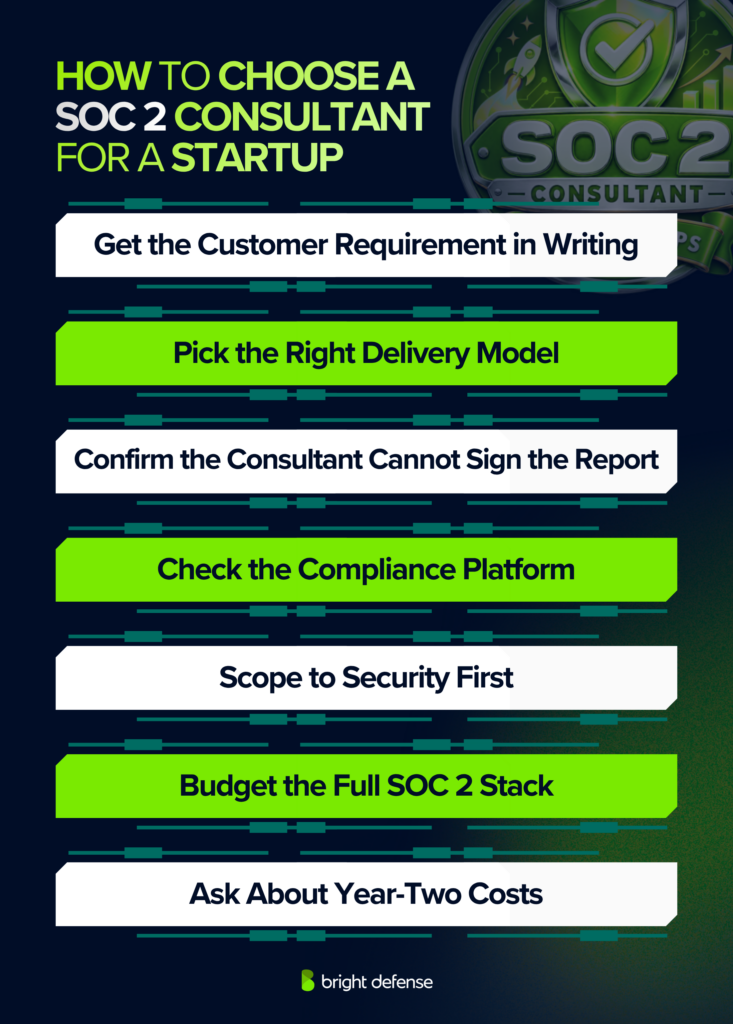
Choosing a SOC 2 consultant begins with the customer requirement that triggered the project. The report type, the Trust Services Criteria, and the deadline should come from the prospect in writing before any vendor conversation starts. First-year cost runs from about $15,000 for a self-managed path to $65,000 for a fully managed engagement, and the examination fee, compliance platform, readiness work, and penetration test account for nearly all of it.
Four delivery models serve the startup market. Internal engineering hours separate them as much as price does. The sections below cover each decision in the order a startup faces it.
1. Get the Customer Requirement in Writing Before Buying Anything
Three specifics belong in the requirement: Type I or Type II, which Trust Services Criteria categories apply, and the date the report must be in hand. Enterprise security questionnaires frequently name SOC 2 with no further detail, and the two report types differ by months of calendar time and thousands of dollars.
The distinction between SOC 2 Type 1 vs Type 2 compliance determines the entire project schedule. Type I fits a company whose controls went live recently and whose deal closes before a Type II observation window can finish. Type II fits every buyer that will accept nothing less, which is now the common position in enterprise procurement.
Choosing Type II when a customer would have accepted Type I adds an observation period before the report can be completed. Type II observation windows commonly run 3, 6, 9, or 12 months, with many organizations starting with a three-month period for their first Type II examination.
Bright Defense scopes readiness against the customer requirement and the date attached to it.
2. Pick the Delivery Model Before Picking a Vendor
Four models serve the startup market, separated primarily by how many internal hours each consumes.
| Model | First-Year Cost | Internal Engineering Hours | Fits |
|---|---|---|---|
| Platform self-serve | $15,000 to $30,000 | 150 to 250 | Technical founders with slack in the schedule |
| Platform plus auditor from its partner network | $20,000 to $40,000 | 100 to 200 | Teams with an internal owner for the project |
| Managed consultant plus platform | $30,000 to $65,000 | 40 to 80 | Teams whose engineers cannot lose a quarter |
| Retained security team or full outsource | $60,000 and up | 20 to 40 | Companies facing several frameworks at once |
Note: These Figures Are Illustrative Estimates for Comparison Purposes and Should Not Be Treated as Fixed Benchmarks or Universal Outcomes.
Internal workload can be substantial even when compliance software is in place. RegScale’s 2026 survey of more than 250 information security leaders found that 53% of organizations dedicate the equivalent of one full-time employee to evidence collection, while 83% experience moderate or major delays from manual compliance work.
Self-serve carries the lowest cash cost. It consumes the most internal hours of the four models. Senior engineers spend 40 to 80 hours on evidence collection under a managed model and 150 to 250 hours without help, which moves a feature ship date back three to six weeks. That slipped date carries a revenue number, and the number commonly exceeds the fee difference between the models.
Bright Defense operates the third model, combining readiness work with compliance automation inside a monthly engagement.
3. Confirm the Consultant Cannot Sign the Report
Only a licensed CPA firm enrolled in the AICPA peer review program can issue a SOC 2 report. That firm must be independent of whoever built the controls, which makes the consultant and the auditor two separate companies. Learning about this requirement after signing a readiness contract costs weeks of schedule.
Peer review enrollment can be verified on the AICPA website before any audit engagement letter is signed. Three questions belong in every consultant conversation: which CPA firms the provider works with regularly, whether the provider handles auditor communication during fieldwork, and who fields evidence requests when the auditor returns with questions.
Any proposal that offers both control implementation and report issuance from a single legal entity conflicts with AICPA independence requirements.
Bright Defense handles readiness and evidence work, then coordinates directly with independent CPA firms that issue the report.
4. Check Which Compliance Platform the Consultant Operates
The platform a consultant operates sets the annual software bill and the switching cost of changing providers later. Evidence, policies, integration history, and audit trails accumulate inside that tool, and they stay there after the consulting engagement ends.
Two positions exist among the five firms in this ranking. Bright Defense delivers on Drata. Workstreet and Latacora build on Vanta, with Latacora holding managed service provider status that carries discounted pricing and monthly billing. Rhymetec and Tevora operate the platform the client selects, which preserves an existing subscription.
Three questions settle the decision. Whose name holds the platform contract, whether the consultant passes through partner pricing, and what happens to the evidence library when the engagement ends. A startup already paying for a platform should weigh a client-agnostic firm against the cost of migrating to the consultant’s preferred product.
5. Scope to Security Only Until a Customer Requires More
Security is the one category of the five SOC 2 Trust Services Criteria that every report includes. Availability, Confidentiality, Processing Integrity, and Privacy are optional, and each addition brings more controls, more evidence, and a permanently higher annual bill. A category belongs in scope once a specific customer requires it in writing.
Proposals covering four or five categories with no customer requirement behind them deserve scrutiny. Scope decided at this stage compounds every year, since those controls stay in operation for as long as the company holds the report.
Bright Defense scopes first-time reports to Security unless a named customer requirement calls for more.
6. Budget the Whole Stack Rather Than the Examination Fee
The examination fee is the largest single line item in a first-year budget and still accounts for less than half of total spend. A gap assessment maps existing controls against the criteria before remediation begins, which sets the scope for every other line item below.
| Line Item | Startup Range |
|---|---|
| Type I examination fee | $7,500 to $15,000 |
| Type II examination fee | $12,000 to $20,000 |
| Compliance platform, annual | $4,000 to $25,000 |
| Readiness or gap assessment | $5,000 to $25,000 |
| Penetration test | $5,000 to $15,000 |
| Remediation tooling | Varies with the existing stack |
| Internal engineering time | 40 to 250 hours |
Specialist CPA firms running high SaaS volume quote toward the low end of the Type II range for a single Trust Services Criteria category, fewer than 50 employees, and one product. Regional firms sit above that range, and Big Four engagements start around $50,000 for the assessment alone.
Platform pricing carries the widest spread on that list. The major platforms tier by headcount, publish no rates, require annual contracts, and commonly raise the price at first renewal. Lower-cost options start near $300 per month.
The year-two rate belongs in the first negotiation, since negotiating power disappears once evidence lives inside the tool.For a closer look at examination fees, readiness work, platform costs, and other budget drivers, review the SOC 2 audit cost breakdown before setting your first-year compliance budget.
7. Ask What Year Two Costs
SOC 2 creates recurring annual costs after the first report. Drata’s 2026 benchmark places ongoing SOC 2 spending at roughly $15,000–$40,000 per year, including the re-audit and continuing platform or security-tool costs.
Actual spending depends on scope, organization size, remediation requirements, and the amount of outside support retained.
Three questions cover year two: what the renewal examination costs, what the platform renews at, and how many internal hours the second cycle consumes.
Internal hours drop substantially with automation in place, which is where the managed models return their premium. Every proposal should carry a year-two figure alongside the first-year number.
Bright Defense runs on a monthly engagement covering continuous monitoring and evidence maintenance, which converts the year-two increase into a predictable line item.
How We Evaluated These SOC 2 Consultants
Six criteria determine each position. Vendor statistics come from each firm’s own published material, and figures without a current published source were left out.
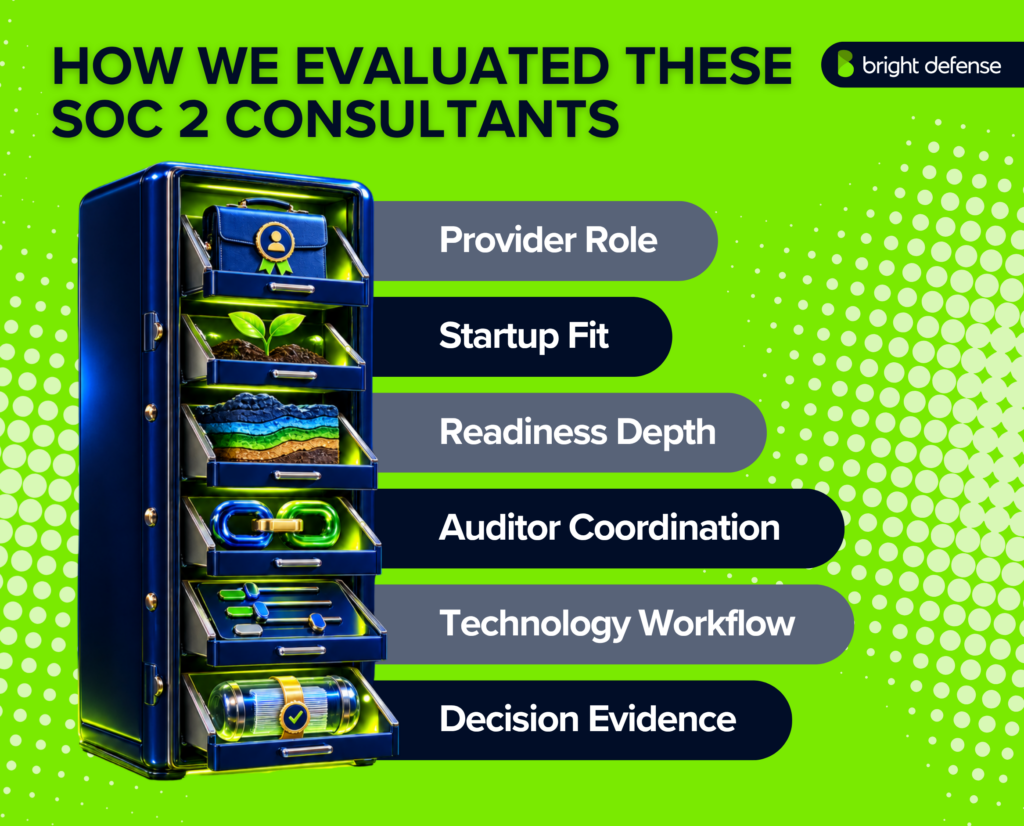
- Provider role. Each company was confirmed as a readiness consultant rather than a licensed CPA examination firm. Any firm that signs SOC 2 reports was excluded from this ranking.
- Startup operating fit. Higher positions went to providers that reduce work for founders, engineers, and small operations teams.
- Readiness depth. The review considered scoping, policy work, risk assessments, control implementation, evidence management, remediation, and audit coordination.
- Auditor coordination. Credit went to firms that support auditor selection, handle fieldwork communication, and answer evidence requests during the examination.
- Technology workflow. The review examined support for Drata, Vanta, other GRC platforms, integrations, and evidence reuse across frameworks.
- Decision evidence. Pricing, client counts, and engagement volumes appear only where the firm publishes them on its own website. Figures carried by third-party directories without a matching primary source were left out.
Compliance Platforms, Consultants, and CPA Firms Compared
Three categories of vendor sell into a SOC 2 project, and each covers a different part of the work. Compliance platforms automate evidence collection. Readiness consultants operate the control environment. Licensed CPA firms examine the result and sign the report.
A startup may use one, two, or all three categories. Every SOC 2 examination requires an independent CPA practitioner or firm, while compliance software and readiness consulting are support options that depend on the startup’s internal capabilities.
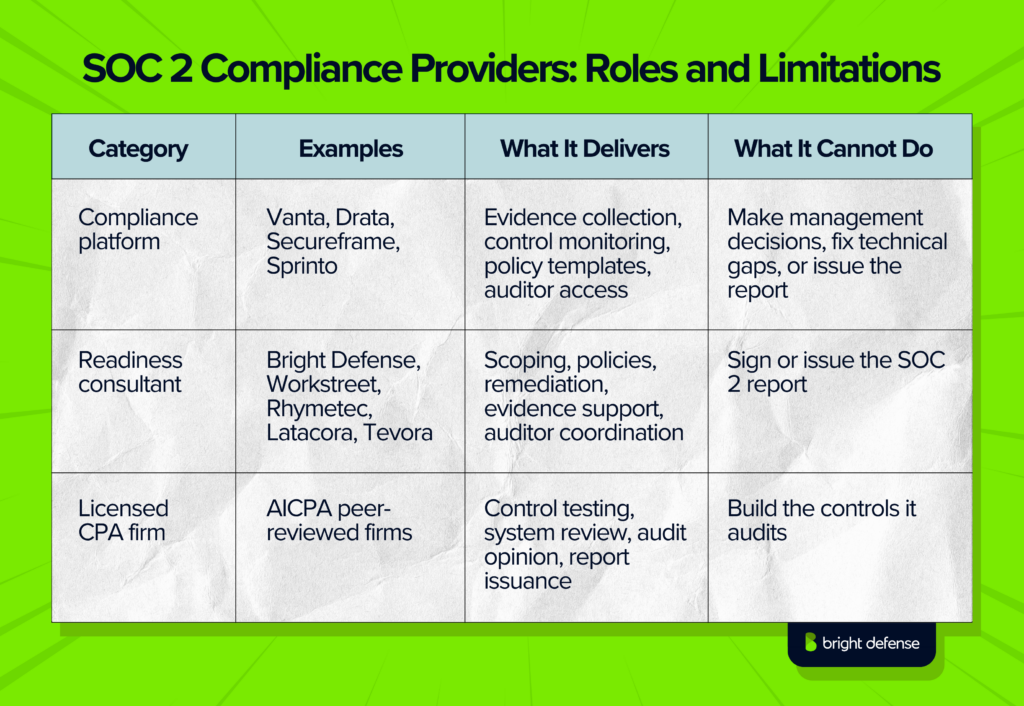
Platform-only SOC 2 projects can work for startups with an experienced internal owner, but software does not remove the labor involved in remediation, control ownership, evidence review, and auditor coordination.
In RegScale’s 2026 research, 83% of organizations reported moderate or major delays caused by manual compliance work, while 53% devoted the equivalent of a full-time employee to evidence collection alone.
Someone still has to write the access review procedure, run the vendor risk assessment, remediate the failing controls, and answer the auditor’s questions during fieldwork.
Those tasks belong to a person. The case for adding human delivery to the software appears in more detail in the guide to the benefits of a SOC 2 consultant.
Frequently Asked Questions About SOC 2 Consultants
What Does a SOC 2 Consultant Do?
A SOC 2 consultant prepares a company for the examination and operates the control environment that the auditor tests. The work covers system scoping, risk assessment, policy development, control implementation, compliance platform configuration, evidence collection, remediation, staff training, and coordination with the CPA firm during fieldwork.
What Is the Difference Between a SOC 2 Consultant and a SOC 2 Auditor?
A SOC 2 consultant delivers a control environment ready for examination, and a SOC 2 auditor delivers the report. The consultant is accountable for policies, control implementation, evidence collection, and remediation. The auditor is accountable for testing the system description, control design, and operating effectiveness under AICPA attestation standards. Management remains responsible for the control decisions in both cases.
Can One Firm Handle SOC 2 Readiness and the Audit?
One brand can provide both through separate teams or legal entities when auditor independence is preserved. Firms operating an alternative practice structure keep non-attest consulting in one legal entity and attest work in a licensed CPA entity that signs the report. None of the five consultants in this ranking issues reports. Buyers should confirm the contracting entity for each service and retain responsibility for control decisions.
How Much Does a SOC 2 Consultant Cost for a Startup?
Managed SOC 2 readiness commonly runs $30,000 to $65,000 across the first year, and total first-year spend reaches $15,000 to $65,000 depending on the delivery model. The wider figure covers the compliance platform, readiness or gap assessment work, penetration testing, remediation tooling, and the independent examination fee. Published retainers in this ranking start at $5,000 per month for vCISO-led scopes.
How Long Does SOC 2 Take for a Startup?
A platform-supported Type I project commonly takes about two to four months from initial readiness work through report issuance. Type II adds a three to twelve month observation period, followed by final testing and report preparation that commonly requires another four to six weeks. Control gaps and slow evidence responses extend the schedule, as covered in the breakdown of how long it takes to get SOC 2 compliance.
What Is the Difference Between SOC 2 Type I and Type II?
Type I evaluates control design at a specified date, and Type II evaluates design and operating effectiveness across an observation period. Type I supports an urgent customer request and provides an initial attestation milestone. Type II carries stronger evidence that the controls operated consistently and is the common requirement in mature enterprise procurement.
Is a Compliance Platform Enough for SOC 2?
A compliance platform is not enough on its own because software does not own management decisions, operate every control, remediate every gap, or sign the report. The platform can automate evidence collection, monitor integrations, store policies, and track tasks. People must implement the control environment, and an independent CPA firm must complete the examination.
Related Bright Defense SOC 2 Resources
- Budget-Friendly SOC 2 Compliance
- Bright Defense: Your Drata Partner
- How to Become SOC 2 Compliant
- Virtual Chief Information Security Officer (vCISO)
Start SOC 2 With the Right Consultant
A startup normally needs two accountable parties: a readiness owner who gets the controls operating and an independent CPA firm that examines the result. Bright Defense provides the managed readiness, security, evidence, and coordination layer for companies without dedicated compliance staff. Review SOC 2 compliance services to request a scoped plan.