Illinois AI Hiring Law Takes Effect Without Final Employer Rules
Updated:
September 21, 2026
Illinois HB 3773 has been enforceable since January 1, 2026, yet employers still have no final regulations telling them how to deliver the notices the law demands. Signed as Public Act 103-0804 on August 9, 2024, the amendment to the Illinois Human Rights Act bars artificial intelligence that has the effect of discriminating on protected characteristics and bars ZIP codes used as a proxy for them, and the Illinois Department of Human Rights withdrew its implementing rules on June 2, 2026 without publishing a new timeline.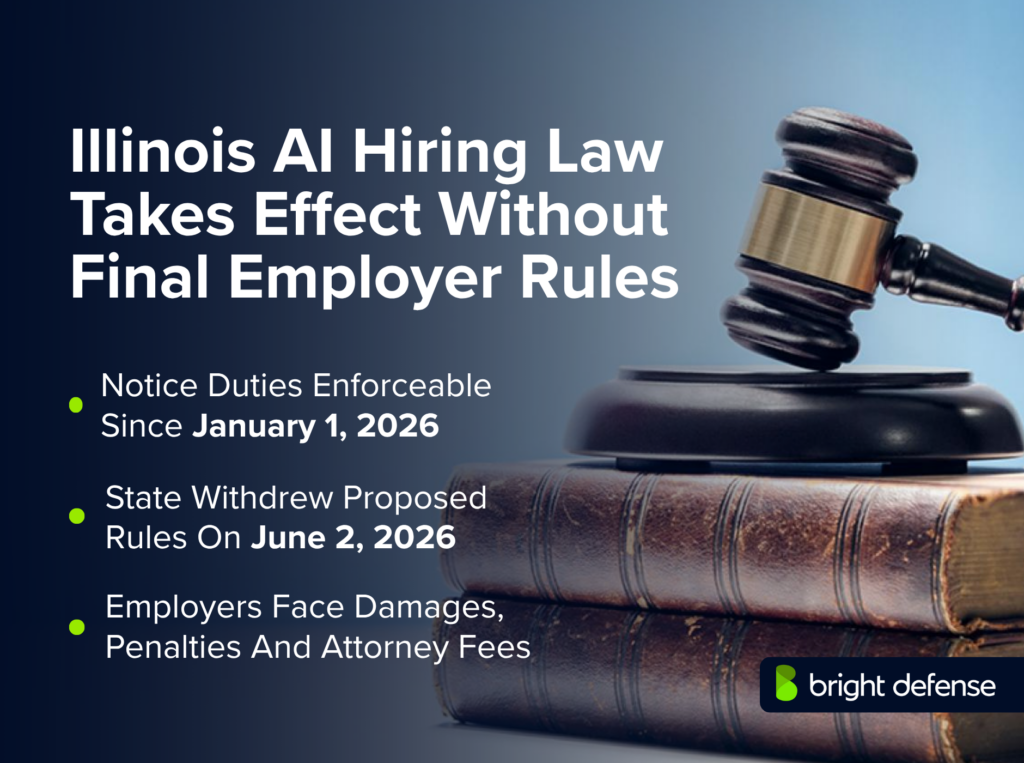
What Does Illinois HB 3773 Require Employers To Do?
Illinois HB 3773 imposes two prohibitions and one affirmative duty, and all three are live now regardless of the missing rules.
The first makes it a civil rights violation to use artificial intelligence, including generative AI, that has the effect of subjecting employees to discrimination on a protected characteristic. Seyfarth Shaw noted this largely restates duties that already existed under the Illinois Human Rights Act, and that intent is irrelevant because the statute reaches effects.
The second bars using ZIP codes as a proxy for protected classes. General use of ZIP code data is not banned, only its use as a stand-in for a protected characteristic.
The affirmative duty is notice. Employers must tell employees and applicants when AI is used to influence or facilitate a covered employment decision, and Ogletree Deakins noted that duty applies whether or not the AI use has any discriminatory purpose or effect.
Illinois AI Hiring Law Takes Effect Without Final Employer Rules
When Did Illinois HB 3773 Take Effect?
Illinois HB 3773 took effect on January 1, 2026, roughly seventeen months after it was signed as Public Act 103-0804 on August 9, 2024. That runway was meant to let the Illinois Department of Human Rights write implementing rules and let employers prepare against them.
It did not run in that order. The statutory duties attached on January 1, 2026, and the Department did not publish proposed rules until May 15, 2026, more than four months after employers were already obliged to comply.
Which Employers And Decisions Fall Under Illinois HB 3773?
Illinois HB 3773 applies to employers covered by the Illinois Human Rights Act, and Ogletree Deakins noted the withdrawn rules extended the same duties to their agents, including recruiters and third parties acting on an employer’s behalf.
The covered decisions are broad, spanning recruitment, hiring, promotion, renewal, selection for training or apprenticeship, discharge, discipline, tenure and the terms, privileges or conditions of employment. Performance review and termination sit inside that list.
The statute defines artificial intelligence as a machine-based system that infers from its inputs how to generate outputs such as predictions, recommendations or decisions, and it names generative AI explicitly. Kilpatrick Townsend noted the withdrawn rules would have treated targeted recruitment advertising and resume screening as triggering notice, while excluding the use of AI to draft a job posting or produce promotional content.
Why Are There No Final Rules Under Illinois HB 3773?
The Illinois Department of Human Rights withdrew its own proposed rules three weeks after publishing them, and has not said when they will return.
The Department published proposed amendments to Title 44, Part 2520 of the Illinois Administrative Code on May 15, 2026, under a new Subpart J on artificial intelligence in employment. Publication in the Illinois Register opened a 45-day comment period due to close on June 29, 2026, with a hearing set for June 10.
On June 2, 2026 the Department postponed the rulemaking and cancelled that hearing. Seyfarth Shaw reported the stated reason was that the pause was necessary to allow for continued collaboration with other state agencies, with no specific objections identified. Burke Warren MacKay & Serritella characterised the move as a pause in the rulemaking process rather than a rollback of the law, and no revised timeline has been published.
What Did The Withdrawn Illinois HB 3773 Rules Require?
The withdrawn rules are the clearest available signal of what compliance will eventually look like, which is why they still matter to employers.
Notice would have had to identify the AI developer, vendor and product name, the employment decisions the system influences, the system’s purpose, the categories of personal data it collects, the job positions where it is used, a contact for questions and the employee’s right to request a reasonable accommodation with instructions for doing so. Because much of that detail sits with the supplier rather than the employer, the obligation turns vendor documentation into a compliance dependency, in the same way ISO/IEC 42001 has become a vendor requirement in enterprise procurement.
Notice would go to current employees annually and within 30 days of adopting a new or substantially updated system, and to applicants through job postings, distributed via handbooks, workplace postings, intranets and external websites. Epstein Becker Green noted notices would have to be in plain language, available in the languages commonly spoken in the workforce and accessible to employees with disabilities.
What Enforcement And Remedies Come With Illinois HB 3773?
Illinois HB 3773 is enforced through the existing Illinois Human Rights Act machinery, which means a charge filed with the Illinois Department of Human Rights rather than a new standalone penalty scheme.
Hinshaw & Culbertson reported that violations carry actual damages, civil penalties, attorneys’ fees, compliance reporting obligations and relief restoring the complainant’s position. Because the claim runs through the Human Rights Act, a notice failure can travel alongside a conventional discrimination claim from the same hiring decision.
The absence of final rules is not a safe harbour. The notice duty exists independently of the regulations, which were only ever going to specify circumstances, timing and means. An employer giving no notice at all is exposed now.
What Should Employers Do To Comply With Illinois HB 3773?
The operational priority is knowing which tools touch Illinois employment decisions and being able to show what applicants and employees were told.
- Inventory every AI or algorithmic tool used in recruitment, screening, promotion, discipline or termination.
- Identify which tools are supplied by vendors and request the developer, product and data-category details a notice will need.
- Map each tool to the covered employment decisions it influences, and record who owns it.
- Issue interim notices now rather than waiting for final rules, covering the disclosure elements the withdrawn version listed.
- Add AI notice language to job postings, handbooks, intranet pages and workplace postings.
- Confirm notices are in plain language, translated for the workforce and accessible to employees with disabilities.
- Test whether ZIP code or location data functions as a proxy for a protected class in any scoring tool.
- Retain notices, postings, disclosures and records of AI use, and preserve them until any related charge is resolved.
How Does Illinois HB 3773 Compare To Other State AI Hiring Rules?
Illinois HB 3773 sits at the anti-discrimination end of a widening spread of state approaches, and the differences are structural rather than cosmetic.
Illinois folded AI into an existing civil rights statute, so the remedy is a discrimination charge and the standard is discriminatory effect. Colorado replaced its risk-based AI Act in May 2026 with a transparency regime enforced by the Attorney General, and obligations such as California’s CCPA cybersecurity audit requirements attach on different terms again.
One hiring stack can therefore face several unlike obligations at once, none of which satisfies another. That is a different problem from the EU AI Act’s staged compliance deadlines, where the sequencing is at least published in advance.
What Costs And Business Risks Follow From Illinois HB 3773?
The main cost is not the notice itself but the visibility required to produce it, because most employers cannot currently name every algorithmic tool touching a hiring decision.
Applicant tracking systems, sourcing platforms, video interview tools, assessment vendors and background screening services may each apply scoring without the employer treating it as AI. Each is a potential notice trigger and a potential source of disparate effect, and a cybersecurity gap analysis can surface where such tools sit, what data they process and which contracts fail to require the disclosures a notice depends on.
The sharper risk is regulatory whiplash. Employers who build to the withdrawn rules may find the final version differs, while employers who wait accrue exposure in the meantime. Holding the evidence in a governance structure such as AI governance under ISO/IEC 42001 keeps AI inventories, notice records and supplier documentation reusable when the requirements settle.
What Remains Unclear About Illinois HB 3773?
The largest open question is when final rules arrive and how far they move. The Department cited collaboration with other state agencies without naming them or the issues, so employers cannot predict whether the disclosure elements survive intact.
A second uncertainty is the record retention period. Reporting on the withdrawn rules conflicts: Ogletree Deakins and Hinshaw & Culbertson described a four-year retention duty, while Kilpatrick Townsend described three years, up from one. Until the rules are refiled the operative period is unsettled, which is why preserving records until any related charge is resolved is the safer reading.
A third issue is how “effect” will be proved. The statute reaches discriminatory effect without requiring intent, but neither the statute nor the withdrawn rules set out what evidence establishes it, and no published Illinois decision applying the amendment surfaced in this review.
How Bright Defense Helps Employers Prepare For Illinois HB 3773
Bright Defense helps employers prepare for obligations like these through Continuous Compliance. We keep control evidence current and monitor for drift, so AI tool inventories, notice records and vendor documentation stay provable while the rules are still moving.
Sources Cited In This Illinois HB 3773 Report
- Illinois General Assembly — Public Act 103-0804, House Bill 3773 (August 9, 2024)
- Seyfarth Shaw — Legal Update: New Illinois AI Law Requires Employee Notice, Affirms Existing Employer Nondiscrimination Duties (2024)
- Seyfarth Shaw — Illinois Department Of Human Rights Temporarily Withdraws Proposed Rules On Use Of Artificial Intelligence In Employment (June 2026)
- Ogletree Deakins — Illinois Unveils Draft Notice Rules On AI Use In Employment Ahead Of Discrimination Ban (May 2026)
- Ogletree Deakins — Illinois Postpones Proposed Regulations On AI In Employment (June 2026)
- Kilpatrick Townsend — Illinois Department Of Human Rights Issues Proposed Rules On AI Notice Requirements In Employment Decisions (June 2026)
- Epstein Becker Green — Illinois’ Proposed Notice Rules For Complying With Workplace AI Anti-Discrimination Law (May 2026)
- Burke Warren MacKay & Serritella — Illinois Department Of Human Rights Withdraws Proposed AI In Employment Rules (June 2026)
- Hinshaw & Culbertson — Illinois Adopts New AI-In-Employment Regulations: What Employers Need To Know For 2026 (2026)
- Golan Christie Taglia — Artificial Intelligence And Your Company: Being Aware Of New Amendments (2026)